
East London Enviros on Borrowed Time
Back in London, I spend a day in the Romford and Ilford areas to track down and ride some of the remaining “classic” Enviro400s in TfL service, of which a cluster of routes in this area still feature the type, either as a main allocation or as occasional visitors.
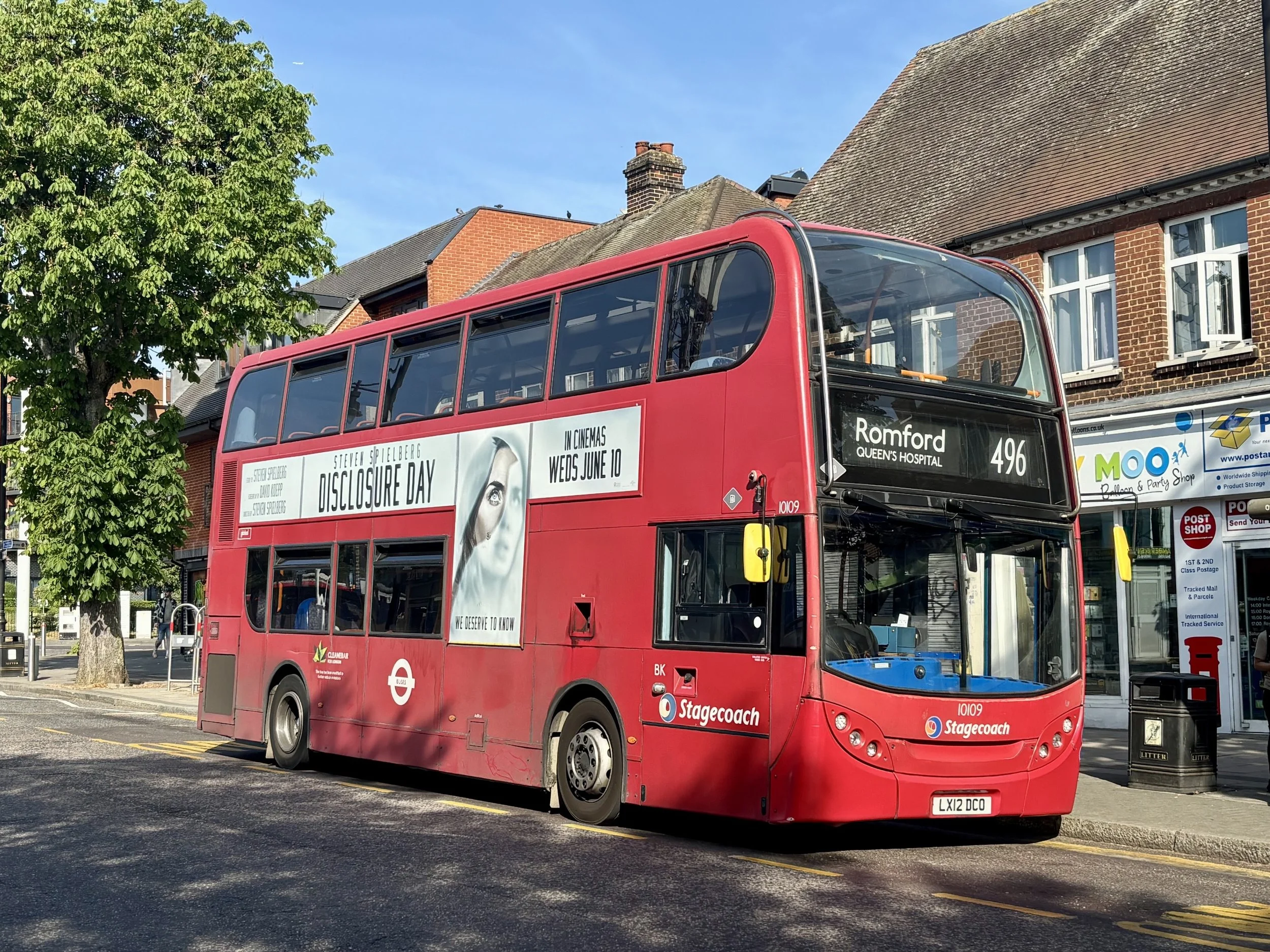
Stagecoach London Enviro400 10109 of Rainham (RM) Garage is seen at Harold Wood Station in the 496 before my ride on it to Romford Queen’s Hospital.
The contract for the 496 was renewed with Stagecoach in October 2025 on the basis of new Wright StreetDeck Electroliners in due course, so the days of sights like this are numbered.
Route 496: Gidea Park - Romford Queen’s Hospital
The “classic” diesel Enviro400 has been a familiar sight on London’s streets for the last 20 years or so, although most earlier examples have been withdrawn with many of these now enjoying a new life in the provinces, such as the ones I recently rode in Cornwall and the subject of my previous article. Rapid inroads are being made into the ranks of those still in London, with many of those remaining due for replacement either directly by new electrics or indirectly by the transfer of hybrids from other routes.
Stagecoach still have a significant pocket of diesel operation in East London, particularly on services around Romford out of North Street (NS) and Rainham (RM) Garages, although a substantial number of new Wright StreetDeck Electroliners are in course of delivery to replace the veterans. I began my day at Harold Wood Station, start point of Route 496, which was retained by Stagecoach on retender in late 2025 and is one of those due for electrification.
Meanwhile, diesels continue and Enviro400 no 10109 of RM Garage arrived on stand as I arrived. After a short layover of less than 10 minutes, the driver opened the doors and half a dozen of us boarded. Soon we were away eastwards along Church Road through typical East London suburbia, running parallel to the railway and the River Ingrebourne. Then a left turn up to the main A12 dual carriageway, which we crossed to enter the large Harold Hill estate. This was built after World War II to alleviate housing shortages in Inner London. Completed in 1958, it was located on the site of Dagnam Park House and grounds, with significant areas of parkland still remaining. These are home to herds of Fallow Deer, which often roam the streets, forage in gardens or rest on local green spaces. Indeed, as we made our way around the loop from Dagnam Park Road into Leamington Road, we encountered someone feeding a couple of deer on the grass between the houses!
We gradually picked up more passengers as we progressed, most travelling into Romford. Crossing Gooshays Drive, we had completed three sides of a square since we started and were now westbound. Entering the southern portion of Straight Road, we reached Gallows Corner, now partially reopened following recent roadworks, but still with some restrictions in place. No delays though and we continued along Upper Brentwood Road to Gidea Park Station, where some left us to transfer to the Elizabeth Line.
Then down to “The Drill” Roundabout, where six roads come together, taking the fifth exit along Heath Park Road into Romford, where most alighted either at the station, the shopping centre or the market. Only a few stayed on for the final section to Queen’s Hospital, where we terminated after a 40 min run.
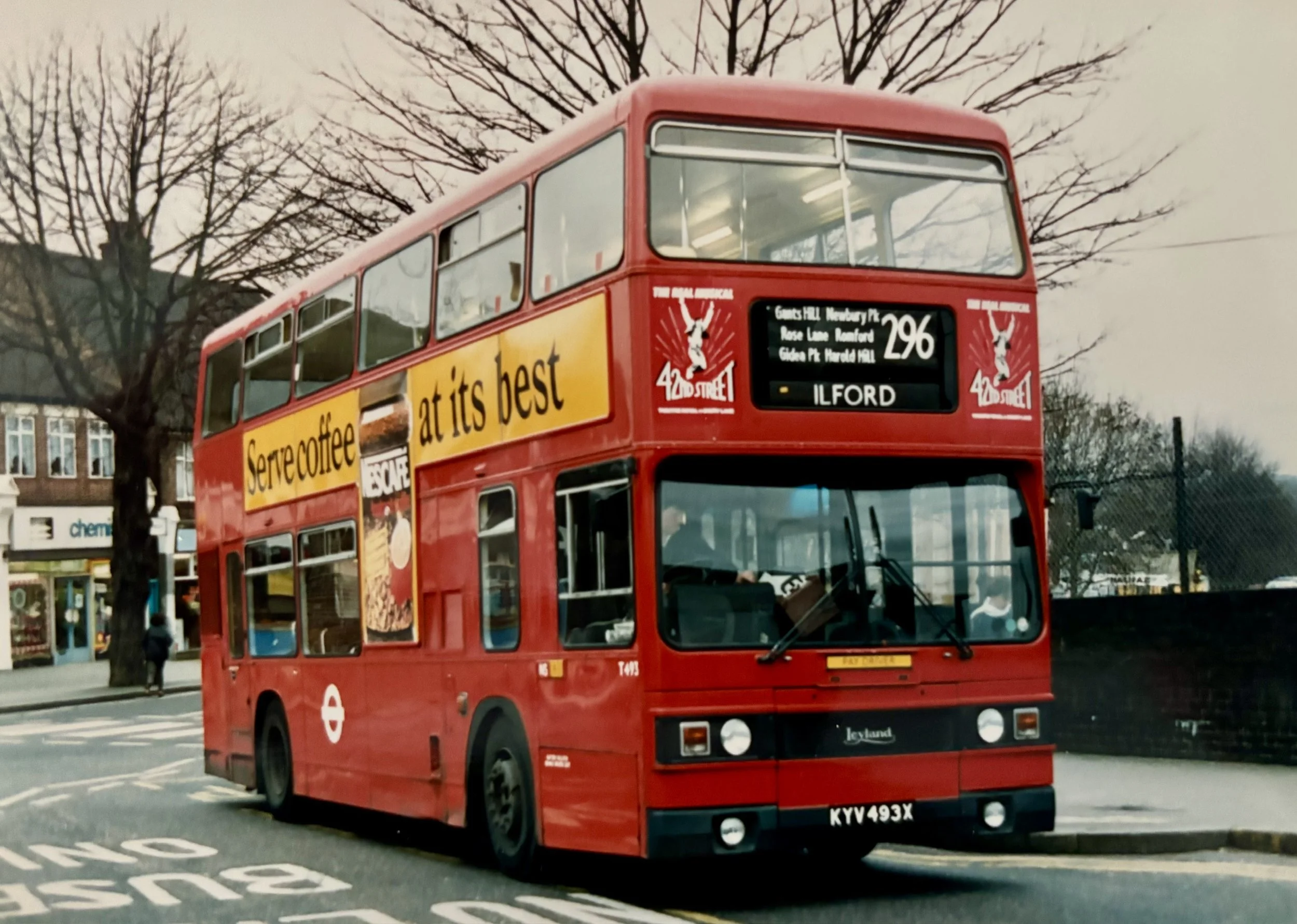
The Harold Wood - Romford Market section of the 496 was once covered by the 66, until this was cut back to operate Romford - Leytonstone in 1982. In replacement, a new localised route numbered 296 took over the abandoned section, although this was extended to Ilford via Newbury Park and Gants Hill in 1987. Clearly, this longer route was not satisfactory in operation, as the 296 was split into two in 2000, the eastern part between Harold Wood and Romford Market passing to a new variant numbered 496. The route received a short extension to Romford The Brewery in 2003 and then to Queen’s Hospital in 2006.
Always operated by Stagecoach / East London out of either NS or RM Garages, the route began with Titan (T) and Olympian (VN) operation. Converted to low floor in 2003 with Trident Alexander ALX400s, these were replaced with Enviro400s in the mid 2010s.
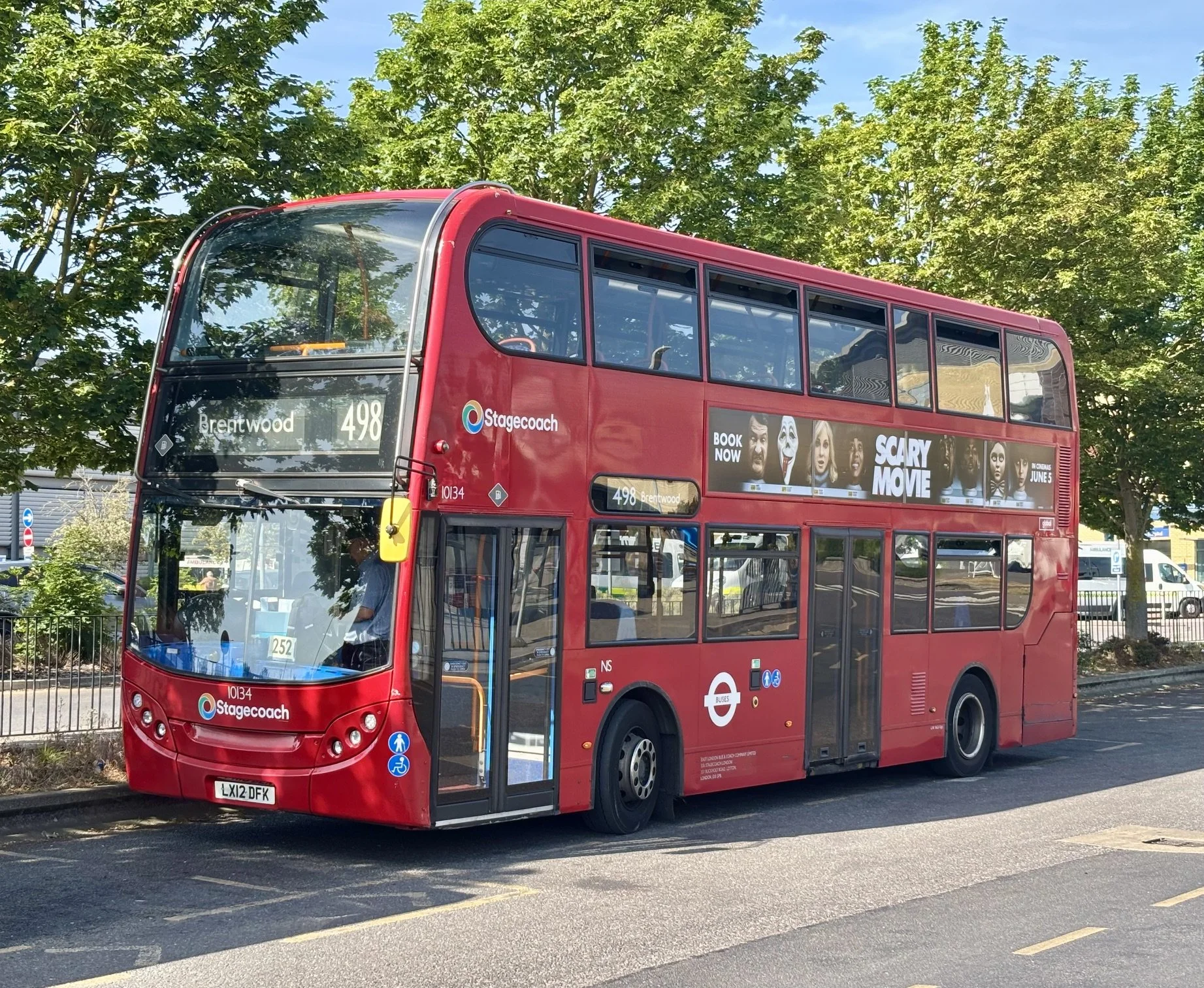
Another Stagecoach London Enviro400, no 10134 of Romford North Street (NS) Garage, takes the shade under the trees at Romford Queen’s Hospital before my trip on it to Brentwood and back.
The 498 is actually scheduled for Enviro400 MMC double deckers, but the odd “classic” version often appears. On this day, 2 of the 5 buses out were of this type.
Route 498: Romford Queen’s Hospital - Brentwood - Romford Station
At Queen’s Hospital, I switched to my second route of the day, the 498 to Brentwood. This is nominally operated by MMC versions of the Enviro400, although the odd “classic” example often appears. On this day, there were two of the latter out to play and 10134 of Stagecoach’s NS Garage appeared soon after I arrived to form the second departure.
Only a couple of us boarded and we were soon rumbling back over the hospital approach road, then back to Romford Town Centre direct via the station, where we picked up a reasonable number. From Mercury Gardens, we swung right past the Town Hall and along Main Road, with a brief stretch of green between Raphael Park and Lodge Farm Park. Slow-moving traffic up to the lights at Balgores Lane, after which we sped up through Gidea Park and out to Gallows Corner once again.
Continuing straight on along the A12 Colchester Road, we dropped a few at the Retail Park and picked up a few at stops in the Harold Hill area bound for Brentwood. After Petersfield Avenue, there is a long fast country section with no stops and we roared along to the M25 roundabout, passing out of London into Essex, the next stop being at the Holiday Inn. We picked up a few more shortriders into Brentwood at the stops along London Road, before arriving into the High Street, where most alighted. The town centre has been made famous by the TV semi-reality series “TOWIE” (The Only Way is Essex), but none of the stars of the show were seen on this trip! Turning left into Ongar Road, we arrived at the terminus adjacent to Sainsbury’s. A 45 min run.
After a 15 min break, I reboarded the same bus and returned to Romford via the reverse of the outward route, a busier journey with a large number joining in Brentwood High St. I alighted at Romford Station 40 mins later.
The 498 came in 2005 as a TfL route to replace commercial services operated by First (formerly Eastern National) over the Romford - Brentwood main road corridor, although red London buses are not new over this section, as the 87 and later the 287 ran with RT operation here until 1970. The 498 initially ran to/from Romford Station, with the extension to Queen’s Hospital added in 2013.
Initially operated by Arriva with low floor Darts, the 498 was briefly upgraded to double deck with DLA in 2006, although later that year single deckers returned in the form of Cadets apart from double deck school journeys. The route passed to First in 2008 with Enviro200s plus a few double deck workings, although these were soon replaced by a frequency increase instead. When First pulled out of London in 2013, the route passed to Go Ahead Blue Triangle, with double deck types such as EN & WVL becoming more common amongst the single deck Enviros. Current operator Stagecoach took over in 2020 using mainly Enviro400 MMCs.
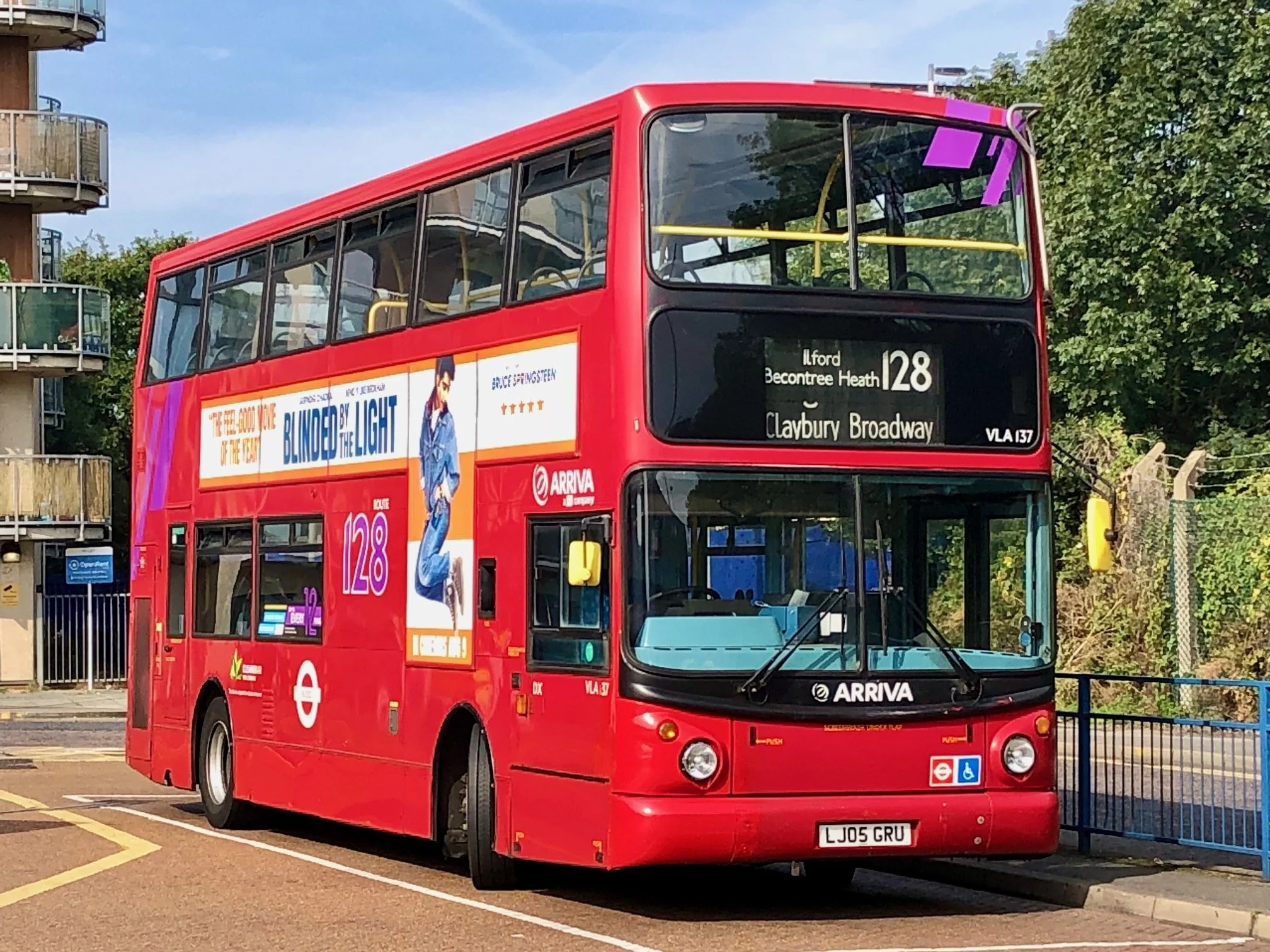
Route 128 Retro…
Back in 2019, before the contract for the route passed from Arriva to Stagecoach, we see Volvo Alexander ALX400 VLA137 of Barking (DX) Garage at Romford Station.
The bus bears the minimalist branding which was introduced experimentally for routes passing through Barkingside with different colours for each service. The 128 had purple swirls on the nearside upper deck windows and rear offside with route number amidships. The exercise was not repeated!
Route 128: Romford - Claybury Broadway
Having completed a couple of routes to the east of Romford, it was time to tackle another pair but this time to the west. I began with the 128 to Claybury Broadway via Ilford. This is another Stagecoach route with a principal allocation of Enviro400s, although once again, new electrics beckon as replacements with the forthcoming contract renewal in October 2026. On the day I travelled, there were at least a couple of MMC versions helping out on the route, which could explain why a duo of standard Enviros were on the 498 instead!
However, I stuck to the standard type and was lucky that 10127 of NS Garage was just coming off the stand as I arrived at the first stop next to Romford Station. A few boarded and we gained others as we proceeded once more around the town centre. Back past The Brewery and Queen’s Hospital, before continuing down to Roneo Corner, named after the large office equipment company which once had a factory here. Turning into Rush Green Road, we made our way past Central Park to Becontree Heath, once the site of a major Bus Station which is long gone, although a terminus and bus stand still exists here.
Crossing into Green Lane, we entered the section which runs in parallel with the 150 through to Ilford and Barkingside. The rows of suburban housing in this part of East London largely came with the development of the Ford Motor Company factory in nearby Dagenham to provide homes for the workers. A busy part of the route, with plenty on and off as we continued through Becontree, Goodmayes and Seven Kings, before encountering a slow moving traffic queue into Ilford. Many alighted at the town centre stops and we gained another large number at Ilford Station.
We then ran beside Valentines Park to the Gants Hill Roundabout, which we crossed into the continuation of Cranbrook Road up to Barkingside High Street. Parting company with the 150, we swung a left into the lengthy, hilly but straight Clayhall Avenue, through more suburbia to the terminus at Claybury Broadway, catching up with the late-running bus in front of us at the end. Traffic delays meant we were about 5 mins late ourselves, taking 1h20m from Romford.
This route is the third use of the 128 number I can recall. The first was for the local route between Chase Farm Hospital and Lower Edmonton via Enfield Town, which dated from 1941 with ST, STL and LT types in the early years, before RTL then RT conversion in the early 1950s. It was renumbered W8 when converted to Flat Fare OPO in 1969. The second version came in 1977 as the Hillingdon Local Service, with its main section between Ruislip Station & Harefield Hospital, although it had spurs to Harefield West and Rickmansworth, together with garage journeys to/from Uxbridge from both ends. It utilised the last three BL class Bristol LHs to be delivered to London Transport, but received LS (Leyland National) and then LX (Leyland Lynx) types before being replaced by Routes R1 and U1 in 1991.
Today’s 128 commenced in 1993 between Romford & Ilford, replacing the 129 section between Romford & Becontree Heath. It was projected to Claybury Broadway in 2004 when the remainder of the 129 was withdrawn. Beginning with Stagecoach Titans, the route passed to the ill-fated Harris Bus as “Ilford Link” with Olympians in 1997. When Harris Bus failed in 2000, the route passed to the “in house” East Thames Buses operation using the same vehicles. Arriva took over in 2005 using VLAs, although T class Enviro400s also appeared later in their tenure. Stagecoach won the contract in 2019 with the current vehicles.
On a personal note, I well remember riding RTs to Claybury Broadway in the mid 70s, when the Ilford - Claybury via Barkingside route was in the hands of the 129. As this was a short route, it was one of those which employed “lazy blinds”, which had no ultimate destination but displayed “ILFORD STATION AND CLAYBURY BROADWAY” in the via box. This was designed to avoid excessive blind winding on short routes, although the system was abandoned when the 129 was converted to OPO with DMS in 1977 when normal three-piece blinds were reinstated, despite no changes to the routeing!
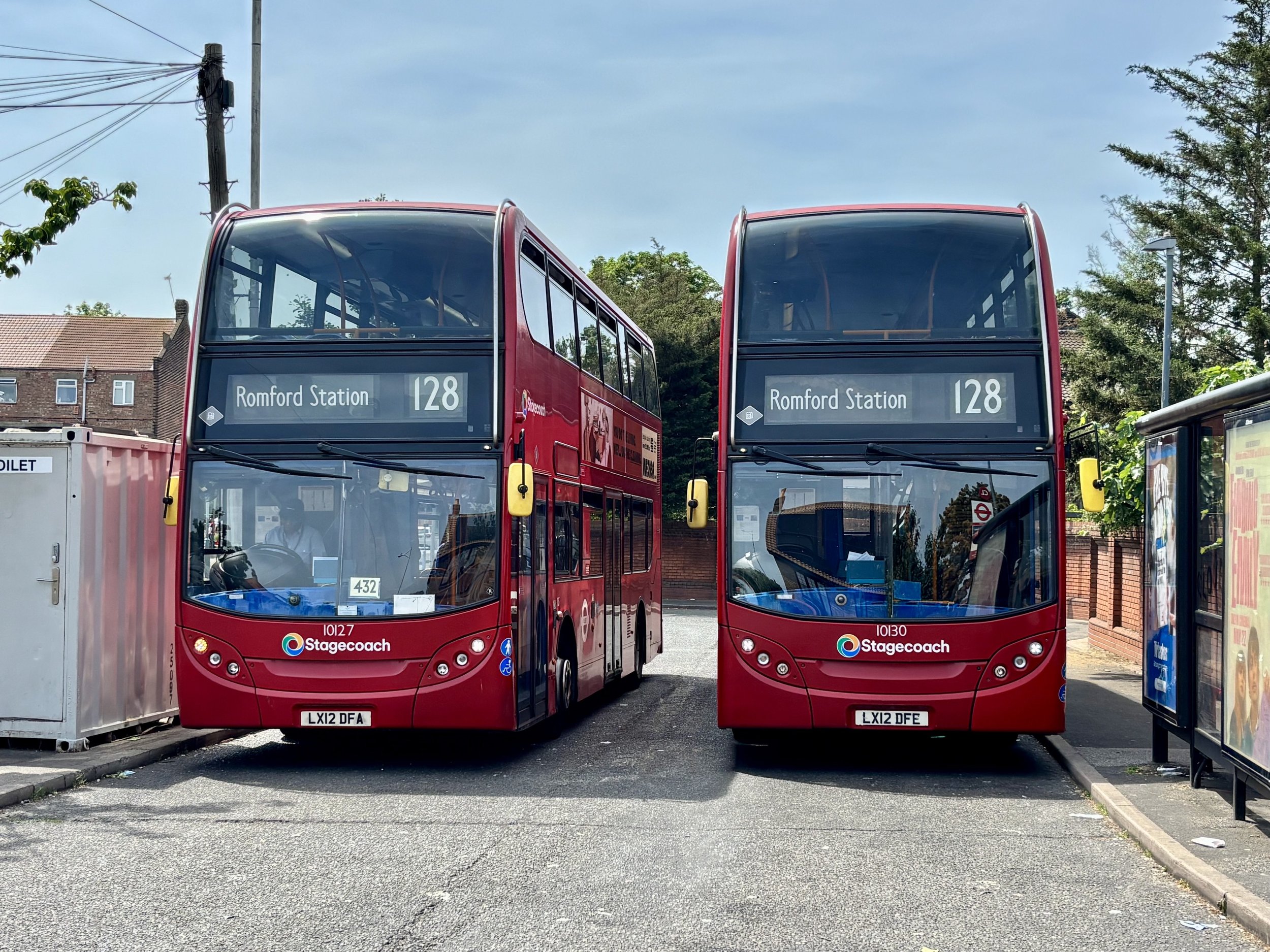
Route 128 Current…
A pair of Enviro400s, 10127 and 10130, both of NS Garage share the stand at the other end of the route, Claybury Broadway. I had just arrived on the bus on the left which also departed first.
Another sight soon to disappear into history, as the contract renewal with Stagecoach from October 2026 requires new electrics.
Part Route 128: Claybury Broadway - Barkingside
With two buses on the stand at Claybury Broadway, I had expected that the second late-running bus might leave first, but no, it was 10127 that drew forward at its allotted departure time and picked up the handful of passengers including me. The extended gap in service meant that there were a large number waiting at the stops along Clayhall Avenue and, a couple of stops in, the other bus roared past us and we played “cat and mouse” through to Barkingside High Street, where I alighted 10 mins later.
Part Route 150: Barkingside - Chigwell Row
Next, I switched to the 150, first tackling the short section up to Chigwell Row. This route was reawarded to Arriva in 2024 on the basis of cascaded hybrids from elsewhere, but these took a while to be released due to the late entry into service of electrics and only began appearing in 2025 to replace the T class Enviros formerly on this service. However, a few diesels remain at Barking (DX) Garage and, on the day I visited, three Ts and one DW were propping up the allocation. For some reason, there had been a delay further down the route and DW469 turned up at Barkingside High St together with HV183 after a 25 min gap on this scheduled 12 min frequency service.
I boarded the DW and we set off together although soon overtook the other bus. However, not entirely unexpectedly, after a few stops, the driver received the instruction to terminate at Hainault The Lowe, although for some unknown reason, he played the “This bus terminates here” announcement two stops short at Hainault Fire Station. Passengers for stops to Chigwell Row were directed to HV183 which drew up behind.
However, after consulting LVF, I saw that another now rare bus, Enviro400 T180 was 8 mins away, so awaited that instead, boarding it for the few remaining stops to the rural Chigwell Row terminus, which I reached less than 10 mins later.
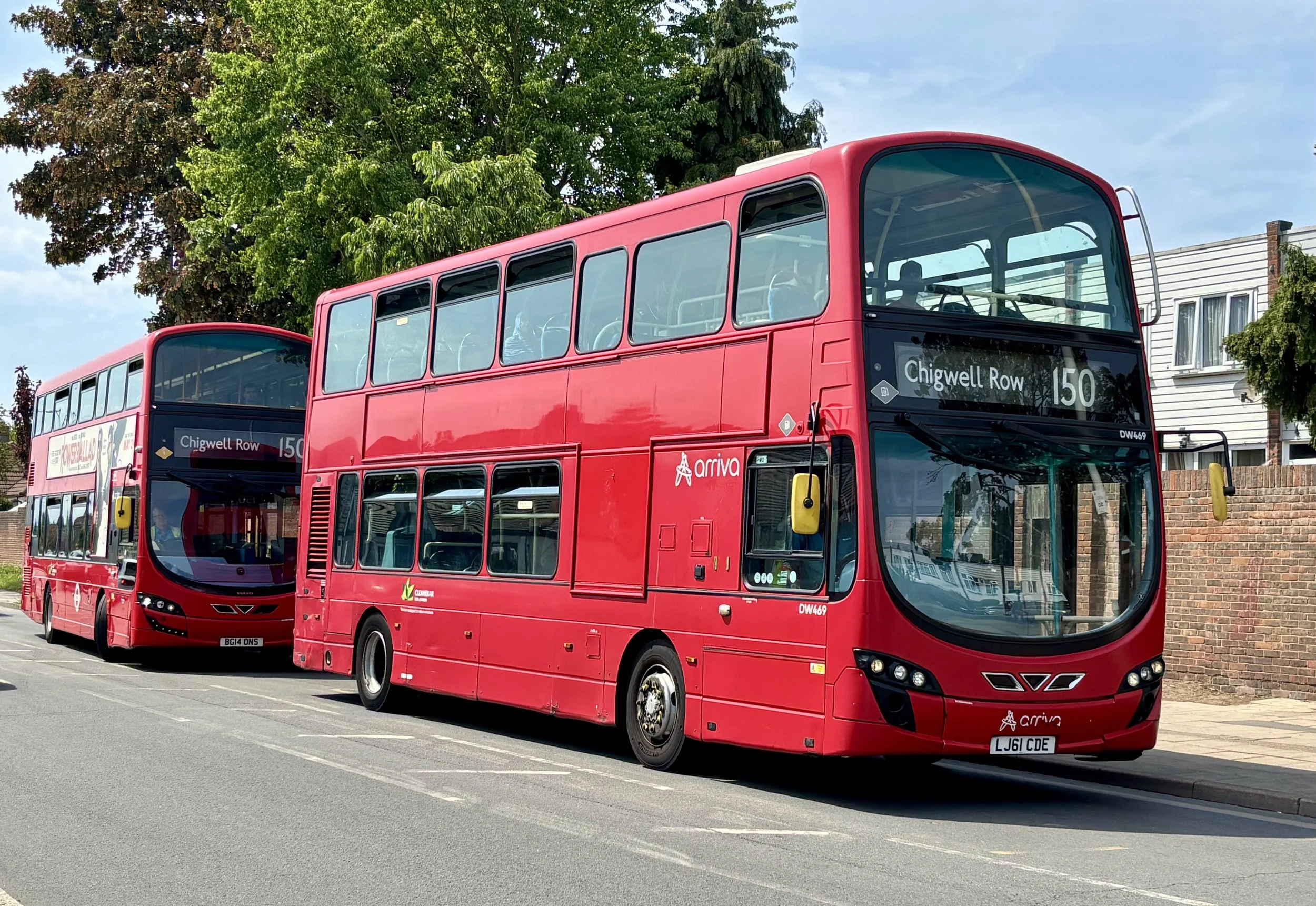
Late-running Arriva London DB300 Wright Gemini DW469 of DX Garage is seen on the 150 after turning short at Hainault Fire Station, despite announcements saying it was going to The Lowe, which is a couple of stops further on. The next bus behind, Volvo B5LH Wright Gemini HV183, has caught up and is taking passengers for stops to Chigwell Row.
The route was converted to hybrid operation with HVs in 2025 but a few diesels remain to help out. DW469 is a transferee from Tottenham (AR) Garage.
Route 150: Chigwell Row - Becontree Heath
Sadly, the former Maypole Inn which the 150 used to terminate beside closed in 2015 and buses now stand in Romford Road near All Saints Church opposite the Recreation Ground. I reboarded T180 after its 10 min break with half a dozen others. After the all-too-brief rural stretch we turned into Manford Way along the estate road to The Lowe, before gaining New North Road towards Hainault Station, beside which stands the large Central Line Depot. Then back down to Fulwell Cross and into Barkingside High St once again, with some passengers dropped here and at the nearby Tesco.
A reasonably busy run back through Gants Hill, bustling Ilford Town Centre and out onto Green Lane again through Seven Kings, Goodmayes and Becontree to Becontree Heath, the reverse of the route I had travelled earlier on the parallel 128. A 65 min spin. Interestingly, the old pubs at this end of the 150 have also been gone awhile - the well known Merry Fiddlers was replaced by a Morrisons store and petrol station in the 1990s and more recently the nearby Ship & Anchor closed its doors, although The Three Travellers in Wood Lane is still there!
The 150 route number is interesting in that it disappeared, was re-used and then came back again for its original service! It began in 1947 as a short route between Barkingside & Hainault, soon extended to Chigwell Row, with T and LT single deckers, although was converted to RT double deck in 1948 when the route was extended to Ilford. RTL and RTW types also had periods on the route during the 1950s. A Sunday extension to East Ham covering the 147 on that day was added in 1955, although when the M-S service was extended to Becontree Heath in 1963, the Sunday version to East Ham was renumbered 150A. The late 60s saw short-lived M-F peaks extensions beyond Becontree Heath to Romford North St and Hornchurch Garages. In 1971, the Sunday service on the 150 was reintroduced when the 147 became daily on the Ilford - East Ham section. RMs came to the route at weekends only from 1976, when they were spare from the 86 allocation, although this didn’t last long as the 150 was converted to OPO with DMS in 1977. Titans replaced DMSs in 1980, until 1986 when the route was withdrawn entirely and replaced by a bifurcation of the 247.
At the Chigwell Row end, there was an extension to Lambourne End which began on Summer Sundays in 1955, becoming Daily in 1958, although there only ever a limited number of journeys. In 1973, the weekend service to Lambourne End was withdrawn, with a handful of M-F trips continuing until OPO conversion in 1977. I managed a ride to Lambourne End on the 150 only once and remember that I was the sole passenger between Chigwell Row & Lambourne End, where the bus reversed in a pub car park. This was later recreated in 2022 during a Route 101 Running Day, which also once had journeys to this point and where I once again reached Lambourne End by RT after 45 years!
Back to the 150, which number was re-used in 1987 for a Summer Sunday tourist route between Aldgate & Victoria using RMLs from the 15 allocation. This was unsuccessful and ran for only one season.
However, the 247 bifurcation was evidently not a success either, as our old friend the 150 returned to its old stamping ground between Ilford & Chigwell Row in 1988, using Titans once again as if nothing had happened. After a short period with DA single deck operation in the early 90s, the route was another to pass to Harris Bus in 1997 with Olympians, also being reassigned to East Thames Buses in 2000 like the 128. The route was re-extended to Becontree Heath in 2004. First took over the 150 for one 5 year contract term in 2005 using VNW types, until Arriva became the operator in 2010 with T class Enviro400s, although DLA and DW types have also appeared at different times.
On a final note, the 150 became part of the branding exercise for TfL routes in Barkingside during 2017, with vehicles receiving light blue flashes at the front and rear sides, together with large route numbers and list of places served between decks. Route diagrams showing all stops were pasted on the interior cove panels and were still present inside T180 which I travelled on. An example of a branded bus is shown elsewhere in this article, on the 128, which used a purple scheme, each route having a different distinguishing colour. The whole exercise seemed a bit half-hearted in my view and unsurprisingly didn’t last long or catch on in other areas of London.
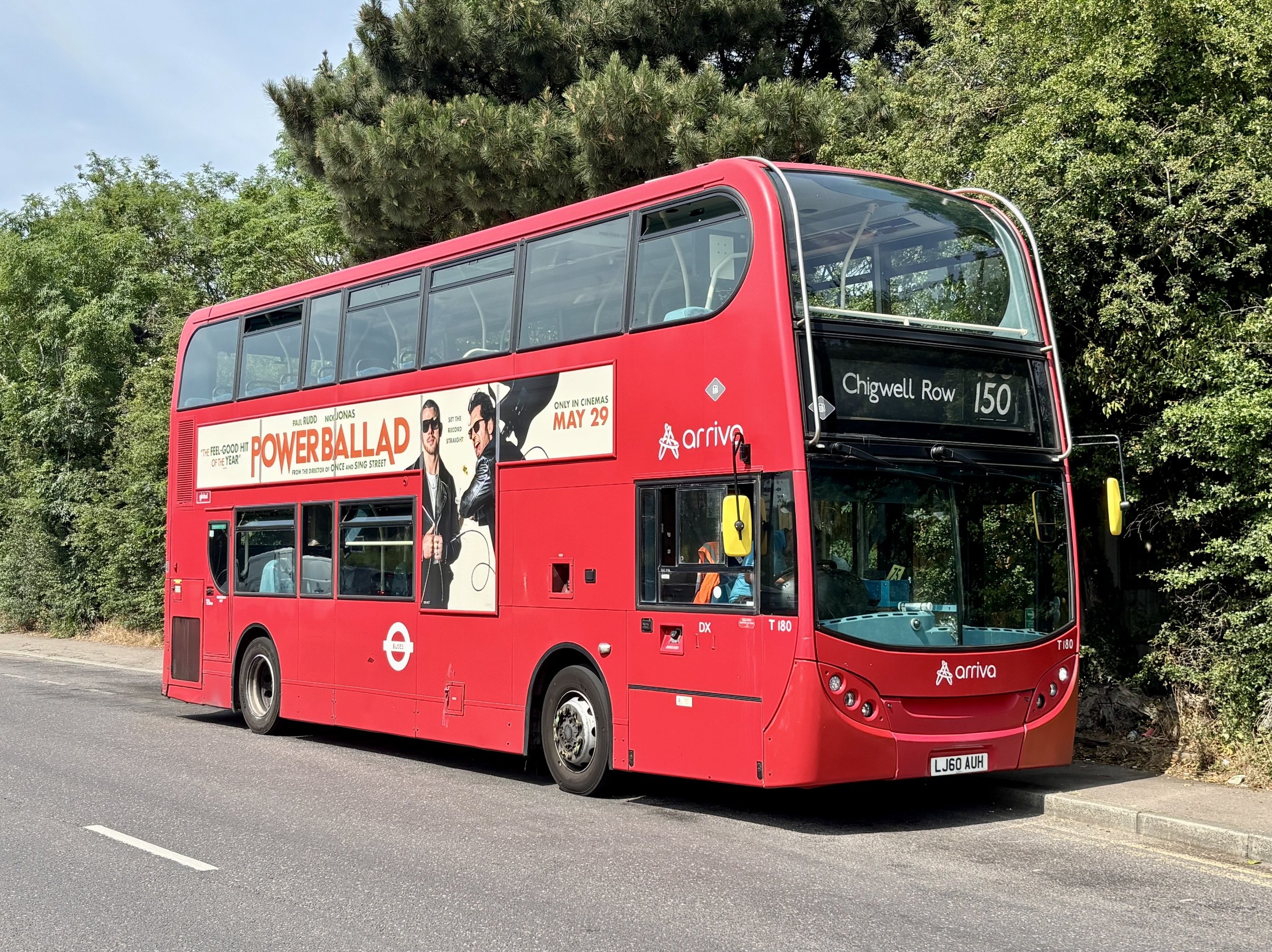
The 150 was operated mainly with T class Enviro400s prior to its recent hybrid conversion. A handful remain at DX Garage, including T180, which is seen at the countrified Chigwell Row terminus before I rode it back to Becontree Heath.
On the day I visited, there were 3 Ts and 1 DW out in support of the majority HVs.
Part Route 128: Becontree Heath - Romford Queen’s Hospital
At Becontree Heath, I had just a 5 min wait for the next eastbound 128, formed of Enviro400 10132 (NS), which I rode the short distance back to Queen’s Hospital, where I disembarked 10 mins later.
Route 496: Romford Queen’s Hospital - Harold Wood
To finish, a return run on the 496 on which I had begun, this time courtesy of Enviro400 19738 (RM). A straight 45 min run back to Harold Wood Station, where my rides were over for the day.
Watton
“And Finally”…
The Romford - Harold Wood section of the 66 passed to the 296 in 1982, with an extension to Ilford added in 1987, soon after which Leyland Titan T493 of Romford (NS) Garage is seen at a gloomy and wintry Harold Wood Station.
In 2000, the 296 was withdrawn between Romford & Harold Wood and replaced by the current 496.
