
Go Cornwall Young Man!
Adapting the old American adage “Go West Young Man!”, in Part 2 of my Cornish adventure, I take a look at bus operations in the western half of the Duchy, which saw the departure of long-established operator First Bus in February 2026 and its replacement with a new network operated by Go Ahead.
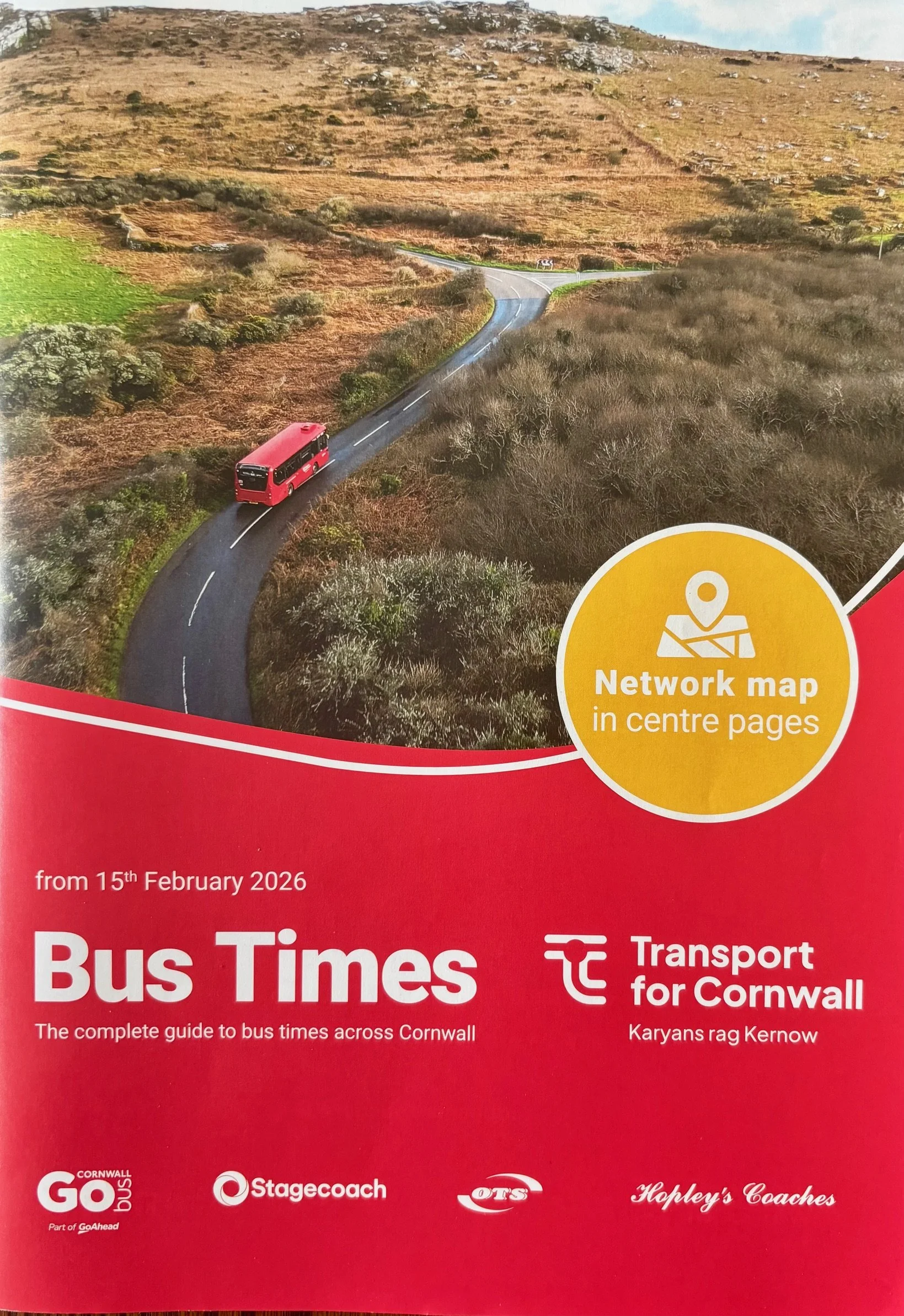
Cover of the “Bus Times” booklet valid from February 2026 when extensive changes were made to services following First Bus closing their Cornwall operation and Go Ahead taking over with a revised network.
The A4 size booklet issued by Transport for Cornwall has full timetables for all bus routes in the county with two network maps in the centre four pages. However, there are no town maps which would assist users in determining routeings in urban areas.
Buses in Cornwall
Transport for Cornwall is a partnership between Cornwall Council and various operators which together provide the bus network in the county, with local government funding provided under a franchise arrangement. This went live in 2020, when Go Cornwall Bus was awarded an 8 year contract to operate services under the scheme. As a result, the established major operator in the area, First, which was the successor to Western National, reduced their network and announced their decision to close down remaining operations in Cornwall in February 2026. This led to Go Cornwall taking on many of the former First routes, but with some rationalisation of the network and changes to route numbers involved.
In terms of fares, Transport for Cornwall operates an “Any Ticket, Any Bus” system, where participating companies accept each other’s tickets in the county, with some exceptions. There is also a multi-operator contactless capped payment system “Tap & Cap”, where passengers tap a reader when entering and leaving the bus.
Transport for Cornwall has developed a logo which is increasingly seen on vehicles, bus stops and publicity, whilst a red livery has been introduced as standard on buses. Publicity is generally good, with maps and timetables displayed at Bus Stations and major stops, with some having electronic next departure screens. Bus Stations also have a list of routes with a QR code next to each number which users are invited to scan to download the latest timetable.
There is also a “Bus Times” booklet, an A4 magazine style tome, with full timetables for all routes in the county and two maps covering the western and eastern sides of the county in the centre pages. This was not available everywhere when I visited as initial stocks had run out, but I did discover a new batch in Truro Bus Station on the last day of my visit! Whilst most timetables were still current, it was odd that this booklet was dated February 2026 and did not include certain additional services added for the summer effective from May. There was also a separate “Travel Guide & Map”, with just the two maps as per the booklet (one on each side when opened out), plus a list of routes. Where the booklets were not available, at least it was good that enterprising information office staff had printed out individual route timetables for services in their local area and put them in the leaflet racks.
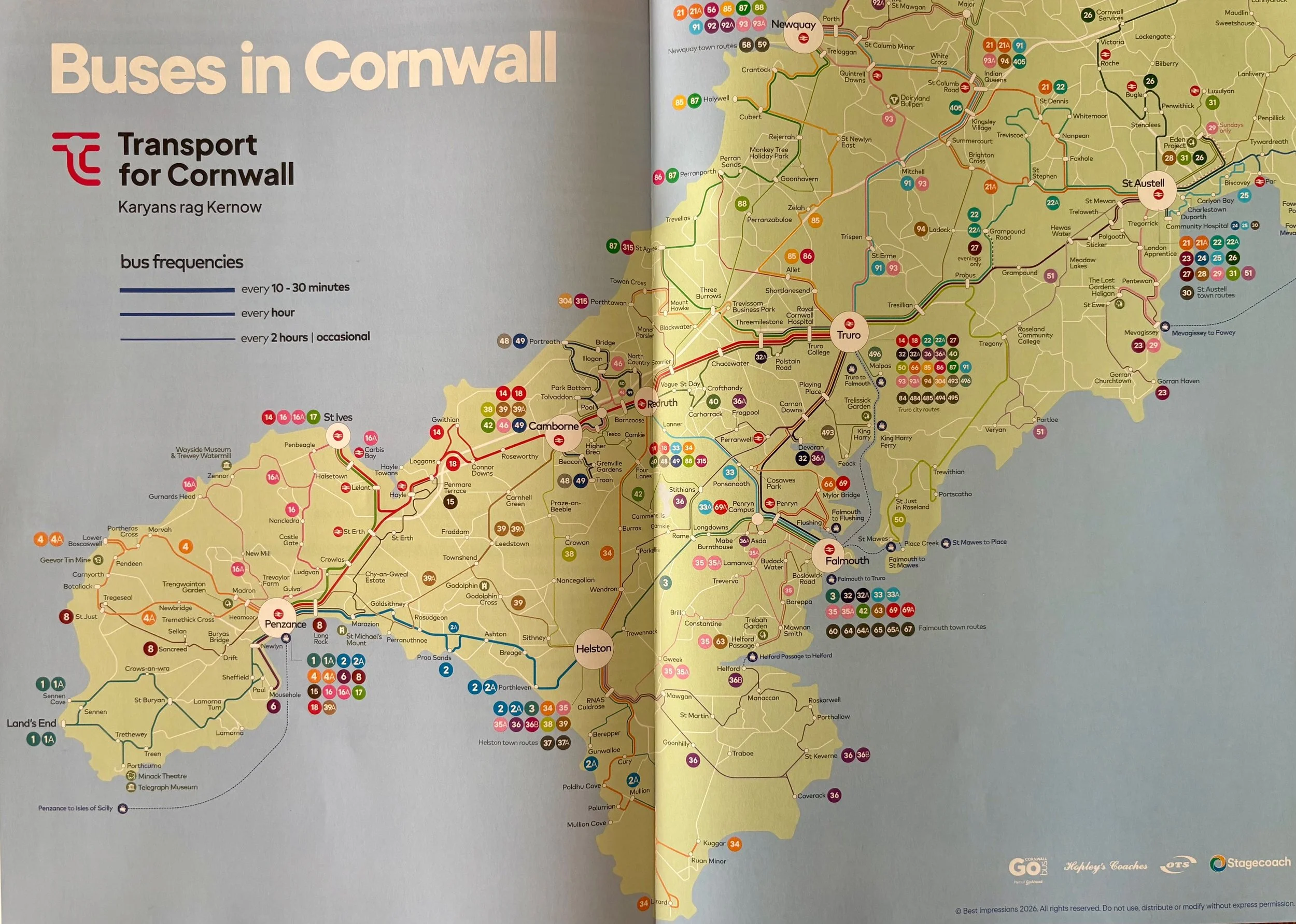
Map in the centre of the “Bus Times” booklet showing the bus network in the western part of Cornwall. A similar map on the following two pages covers the eastern part and across the Devon border to Plymouth. The routes I rode are all shown here.
Bus Rides in Cornwall
My personal association with buses in Cornwall dates back to family holidays in Looe and Newquay during the early 1970s, when I had fun riding green Bristol Lodekkas with Western National. In the late 80s and through the 90s, I revisited the area and covered much of the network, chasing and riding the then ubiquitous Bristol VRs, with this being one of their final strongholds in the early 2000s. Scroll forward to the 2010s and I paid a further visit to ride some of the last Olympians in normal service, some of which had originated in London. Secondhand London buses have been no strangers to Cornwall over the years, with early low floor types being cascaded within First to the area over the last decade and a half.
Now, that tradition continues, with Go Ahead transferring Enviro400s and Enviro200s from London to Go South West, appearing both with the Plymouth Citybus and Go Cornwall operations in recent months. Therefore, I was hoping to track down some of these old friends from the capital on this latest visit! I will talk about the Go Cornwall bus fleet in more detail as we go through the rides.
DAY 1
Route 2: Penzance - Helston
After a full Cornish Breakfast, I arrived at Penzance Bus Station, which was slightly overcast due to the sea mist coming off of Mount’s Bay. Although I had a rough itinerary, this was subject to change as I amended my journeys depending on which routes interesting ex-London buses were on. It was clear from bustimes.org that there is a great deal of interworking between Go Cornwall routes, so that a bus arriving on one service may not necessarily leave on the same service on its next trip.
However, Enviro400 no 5004, in Transport for Cornwall livery, arrived on Route 2 and departed on the same route after its layover. The use of the number 2 for the main Penzance - Helston service restores the original service number, which was latterly covered by First U4. A basic Hourly service operates M-S daytimes, 2 Hourly eves & Suns, with extra shorts Penzance - Goldsithney providing a 30 min frequency over that section M-S daytimes. Most journeys are double deck, with a mix of types observed.
This was my first ex-London bus of the trip, formerly fleet no 10201 with Stagecoach London, neatly single doored but still with Stagecoach moquette on the seats. Go Ahead have obtained a few buses of this type from this source, which is a surprise given that I would have thought they had plenty of their own of the type that could be released from TfL work. Nevertheless, a vehicle in fine fettle as we departed past Penzance Station and followed the sweep of Mounts Bay beside the railway, before deviating off to serve the retail park on the edge of town. Surprisingly busy on this stretch, although many of our passengers alighted either in Long Rock or in Marazion, where we negotiated the very narrow streets with care. As we climbed out of the small town, we had a good view of the tidal island and medieval castle of St Michael’s Mount to our right, which can be accessed via a causeway at low tide but was cut off by the sea at this time.
As is common in Cornwall, even main bus routes divert off the main roads to serve particular villages, which we did by bowling along a narrow lane through Goldsithney, before regaining the “A” road at Rosudgeon. However, we were then treated to a one way loop over further narrow roads to serve Praa Sands, a small cove on the coast. Back where we started on the main road, we continued through the villages of Ashton and Breage, before arriving at the scenic little harbour at Porthleven, a typical little Cornish port with yachts and other small boats in abundance. Around 20 passengers joined us here for the short trip into the town of Helston, which is at the northern end of the Lizard peninsula and the most southerly town in Britain. It is famous for its annual “Furry Dance”, held in early May to celebrate the arrival of spring.
After disgorging a large number in Coinagehall Street, we continued on, serving first the large Tesco Store and then the equally large Sainsbury’s, with much new housing on the edge of town since I was last here. There is a Go Cornwall outstation at Sainsbury’s, where we arrived after a trip of 1h10m and had both a change of number and of driver.
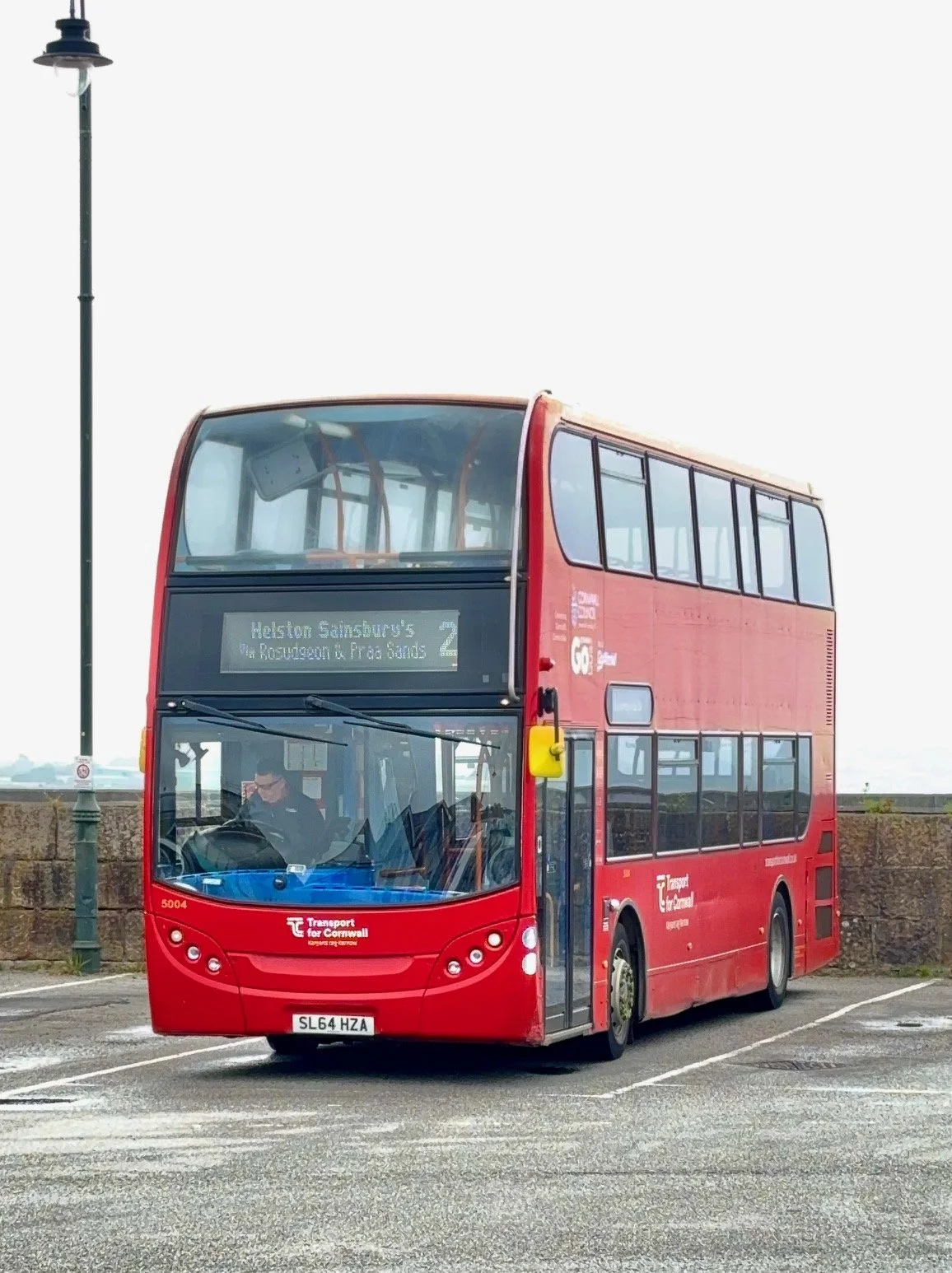
My first bus ride on this trip was aboard Go Cornwall Enviro400 no 5004, formerly Stagecoach London 10201. The vehicle is seen by the sea wall in Penzance Bus Station, where the driver is preparing to depart on Route 2 to Helston.
Go South West have obtained at least 7 of these former Stagecoach Enviros (so far) for Plymouth Citybus and Go Cornwall operations, which operate alongside their own former E class Enviros from GAL.
Route 3: Helston - Falmouth
Most Route 2 buses arriving at Helston change to a Route 3 at Sainsbury’s and operate through to Falmouth, with the reverse occurring in the other direction. As the bus was effectively now on a new trip, through passengers were required to pay again or re-tap their passes, which confused several on board, as the previous service with First Bus had operated as a single through route from Penzance to Falmouth. Like the 2, the 3 operates Hourly M-S daytimes and 2 Hourly eves & Suns.
I stayed on board for the next part of the trip, with the interior info screen now showing “Next Stop”, “Upcoming Stop” and number of stops to “Ultimate Destination” for Route 3, although oddly it had not shown this previously on Route 2, instead scrolling through various Transport for Cornwall notices and adverts. After leaving Helston, we were treated to a rip-roaring run at high speed through the rolling Cornish countryside, through the villages of Rame and Long Down. On the outskirts of Falmouth, we called at the Penryn Campus of the University, dropping a few students and pausing for a couple of minutes to await correct time. Then onwards down to Penryn Village via some more narrow streets, before gaining the main road into Falmouth itself. We arrived at the Falmouth Moor terminus a few minutes early after a decent 45 min thrash. Good to see an ex London bus being given the chance to show a clean pair of heels!
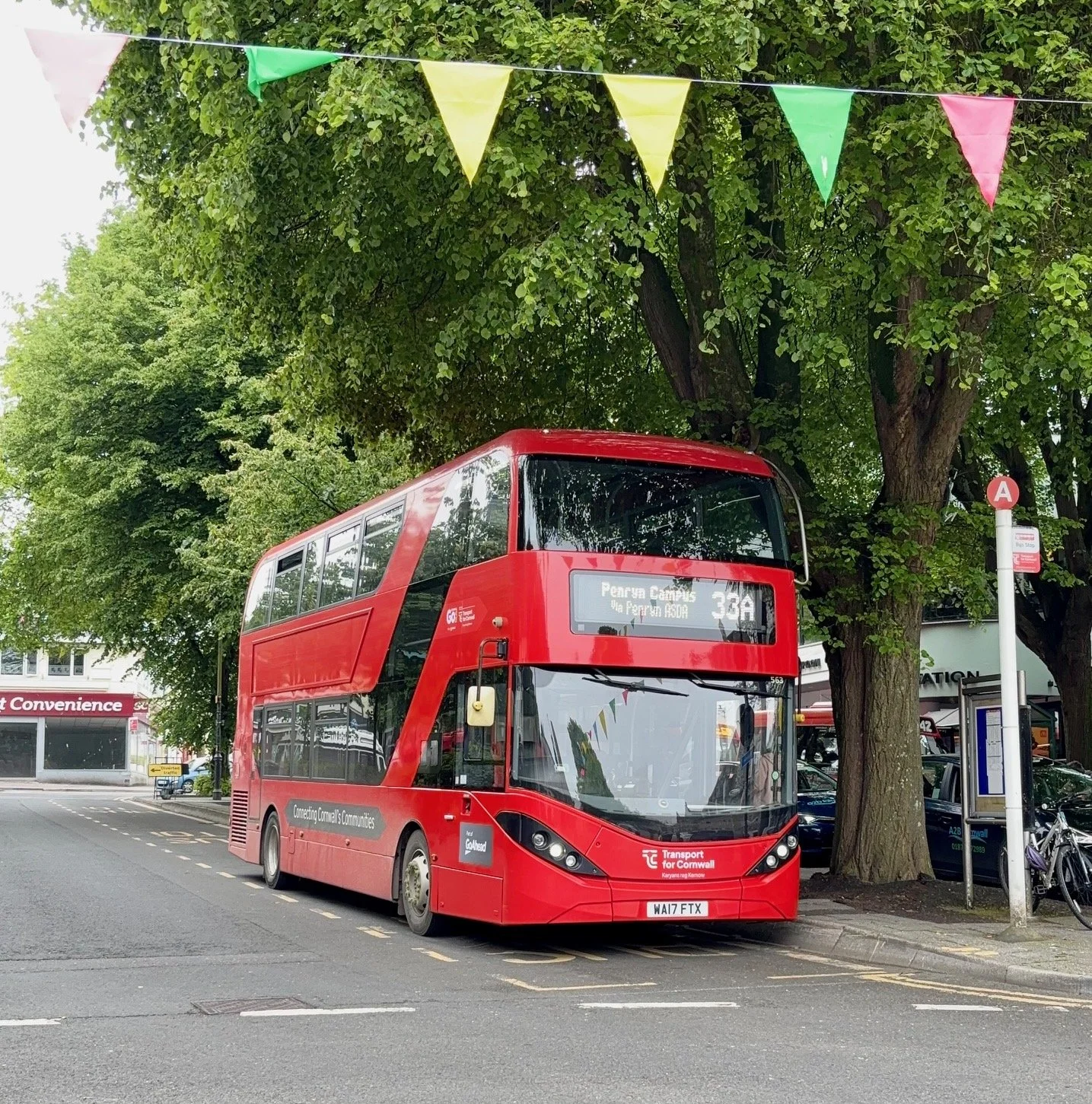
The flags are out at Falmouth Moor for Go South West Enviro400 City no 563, which was formerly in “Spark” livery for Plymouth Citybus, but is now in Transport for Cornwall colours. Later in the trip I rode similar vehicle no 550 on Route 18 Penzance - Truro still in the old livery.
The bus is on the 33A to the university campus at Penryn, which operates in tandem with the 33 to Redruth. Not routes I travelled on during this visit, although I had covered this corridor on a previous occasion.
Route 32: Falmouth - Truro
At Falmouth, I had time for a quick wander around the town, with its deep natural harbour on the Fal Estuary being home to the docks which include a cargo port, cruise ship terminal and ship-repairing facilities. The National Maritime Museum of Cornwall is situated here, with the town now a popular tourist resort with five main sandy beaches to be enjoyed.
In terms of transport, Falmouth has two stations on the branch line from Truro and a number of local bus routes. Whilst the main services are operated by Go Cornwall, there are a number of rural and town routes run by OTS, a small private operator, which uses a fleet of Mercedes Sprinter minibuses, although I didn’t have time to ride any of these on this occasion.
Instead, my next ride was on Route 32, which together with the 32A, provide the main link between Falmouth and Truro. The 32 operates direct, whereas the “A” variant deviates to serve Penryn Campus and Carnon Downs village. Each route operates Hourly M-S daytimes, with the 32A continuing on from Truro Bus Station to serve Royal Cornwall Hospital and Threemilestone M-S daytimes. An Hourly service operates Falmouth - Truro only on the 32A M-S eves and 2 Hourly on Suns.
The next 32 was not showing on bustimes.org so I wondered whether it would show but, bang on time, Enviro400 City no 567 arrived at the Falmouth Moor pick-up stop and I boarded with a handful of others. This bus was a transferee from Plymouth City Bus and had signwriting extolling the virtues of Free WiFi, USB Charging and Contactless Payment available on board. Settling into my comfortable high backed seat, we set off out of town, back to Penryn via a different intermediate route from the one I had arrrived on earlier. At Penryn, we were on a diversion due to roadworks, so made our way up towards Penryn Campus, although not calling there but continuing along the by-pass at speed, back to line of route north of Penryn.
A winding route through the trees, making a short double-run to serve the village of Devoran. Then back to the main drag, before circling a roundabout to call at a stop on the edge of Playing Place, another village, whose unusual name derives from a Cornish phrase for an open-air performance area used historically for entertainment. Then a short run downhill through the woods into Truro itself, arriving via Lemon Street and through the now traffic-restricted city centre to the Bus Station. A shortish 40 min run.
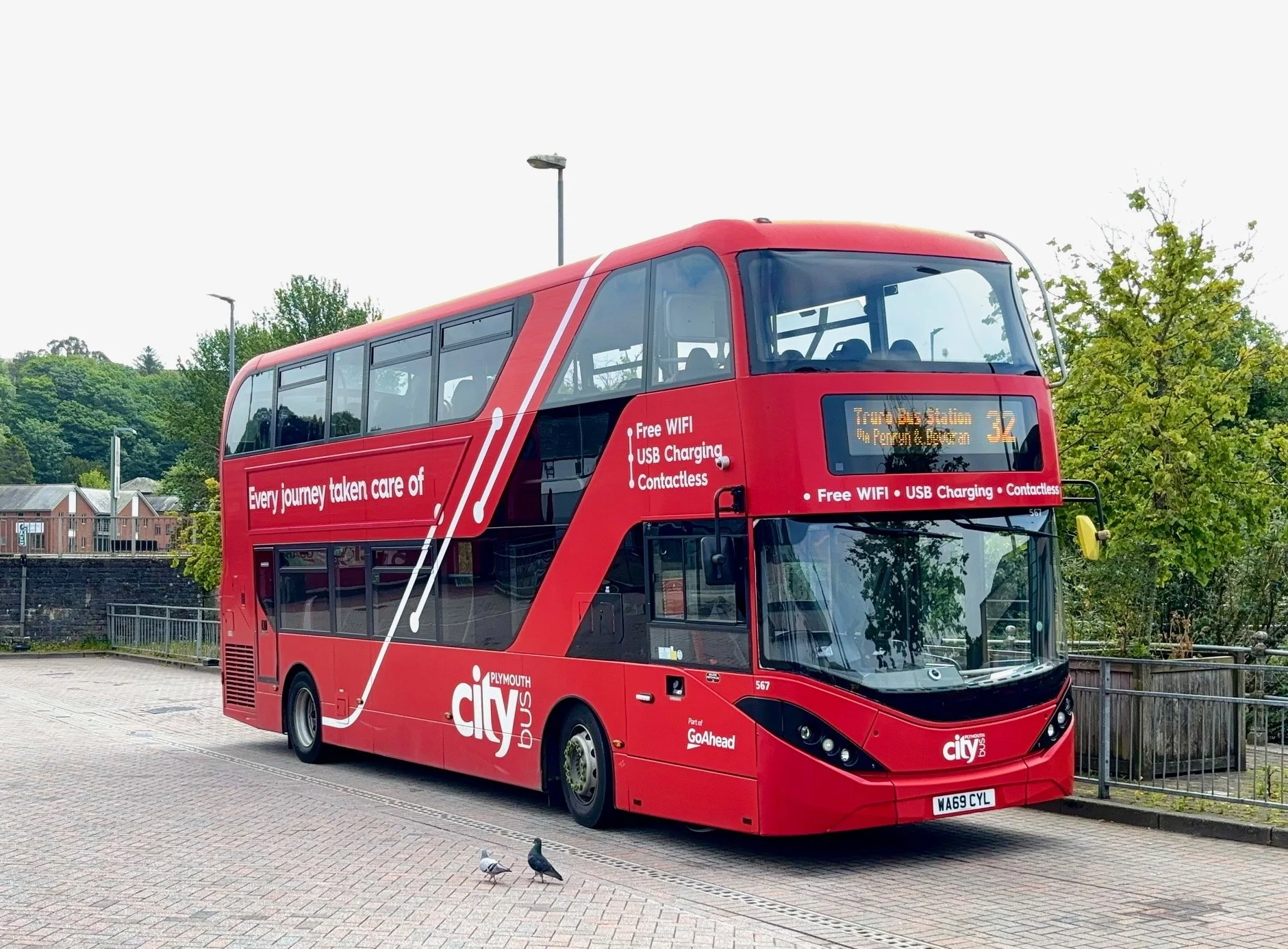
Another Go South West Enviro400 City, no 567, pictured at Truro Bus Station after riding it on the 32 from Falmouth.
Although operating in Cornwall, this one still has Plymouth Citybus fleetnames. The WiFi, USB charging and Contactless payment facilities available are well advertised.
Route 36: Truro - St Keverne - Helston
Truro is the county town and only city in Cornwall, a centre for administration, leisure and shopping. Its most famous large building is the impressive Cathedral, built between 1880 and 1910 in a Gothic Revival design on the site of the former Parish Church of St Mary and well worth a visit. The Bus Station at Lemon Quay is centrally placed and offers services to all parts of Cornwall, but is not particularly large given the importance of the location and the number of routes using it!
My next route was not one originally on my radar to do, but as mentioned earlier, I was prepared to adapt according to where any ex-London buses were going. Walking around the stands, I found a former GAL Enviro400 on the Route 36 bay, the former E19 which was once a Peckham Garage inmate and a performer on TfL Route 37. This was one that had been transferred earlier to Plymouth Citybus, whose fleetnames it still bore. Whilst smartly presented, the electronic blind display was extremely faint, so I had to consult the timetable to verify its destination! It was also an unusual vehicle for the 36 route, which is mostly single deck operated, although it seems that one double decker is allocated to cover the morning and afternoon school journeys, working shopping trips in between.
The 36 is a largely rural service, operating between Truro & Helston and then onto the eastern side of The Lizard peninsula to St Keverne. It operates about every 1 ½ to 2 hours during M-S daytimes, with additional short trips on the 36A variant which divert to Penryn ASDA after serving Perranwell providing roughly hourly departures from Truro. Not a route I had covered on previous trips, so new territory for me.
A surprising number boarded at Truro Bus Station, well into double figures and we set off out of town, back via Playing Place on the road towards Falmouth. However, at Carnon Downs, we came off the main road and began a long meander around increasingly narrow lanes, with lots of steep up and downhill stretches through the countryside to test our 20 year old bus, which performed with aplomb. Many alighted in the picturesque surroundings of Perranwell Village, before more country lanes through farming country. The main intermediate village is Stithians, famous for hosting one of the largest agricultural shows in the UK each July, which we circumnavigated via various housing estate roads, passing an Enviro200 single decker heading in the opposite direction.
Beyond this, more of the diet of countryside and villages, passing through Carnkie, Porkellis and Wendron. This is former tin and copper mining country, with abandoned stone structures visible from the bus. We called at the Poldark Mine, a tourist attraction named after the novels and BBC TV programme, the only former 18th Century tin mine in the UK to offer public tours, although the site (including the museum attached) is currently closed. En route, we had dropped around 10 mins on the schedule due to meeting vehicles coming the other way on narrow stretches, which is an occupational hazard of bus travel in rural Cornwall. However, a fast run from Wendron into Helston without stopping and a scheduled 8 min pause at Sainsbury’s for a driver change meant that we were able to regain correct time.
The first part of the next section onto The Lizard peninsula I had travelled before on main route 34, which runs down to the southern extremity via Mullion to The Lizard point. The 34 & 36 run in tandem past Culdrose RNAS (Royal Naval Air Service) Station and I observed one of the search & rescue helicopters coming in to land as we passed the large site. Then we turned off along the southern perimeter of the airfield, before observing a short double run to serve the small village of Mawgan with thatched and stone cottages. After this, we continued our run through the centre of the peninsula, passing through a moonscape of open moorland, only relieved by the huge white dishes of Goonhilly Earth Station to our right, a major space communications complex that supports NASA’s lunar missions and commercial space enterprises.
Eventually, we reached the village of St Keverne, near the east coast of the Lizard Peninsula, where we reversed and turned at the small market square with church and pub adjacent. Our last couple of passengers left us here and two more joined for the return trip to Helston, which followed the reverse of the outward route, except for a diversion to serve another small coastal village called Coverack, an idyllic setting above a rocky cove, where we picked up a mum and three kids. Then it was back up the hill via yet another winding narrow lane and back the way we had come to Helston, where I alighted in the Town Centre at Coinagehall Street. An epic run through some wonderful scenery in an old London bus, taking some 2 hours from Truro to St Keverne and then 45 mins back to Helston.
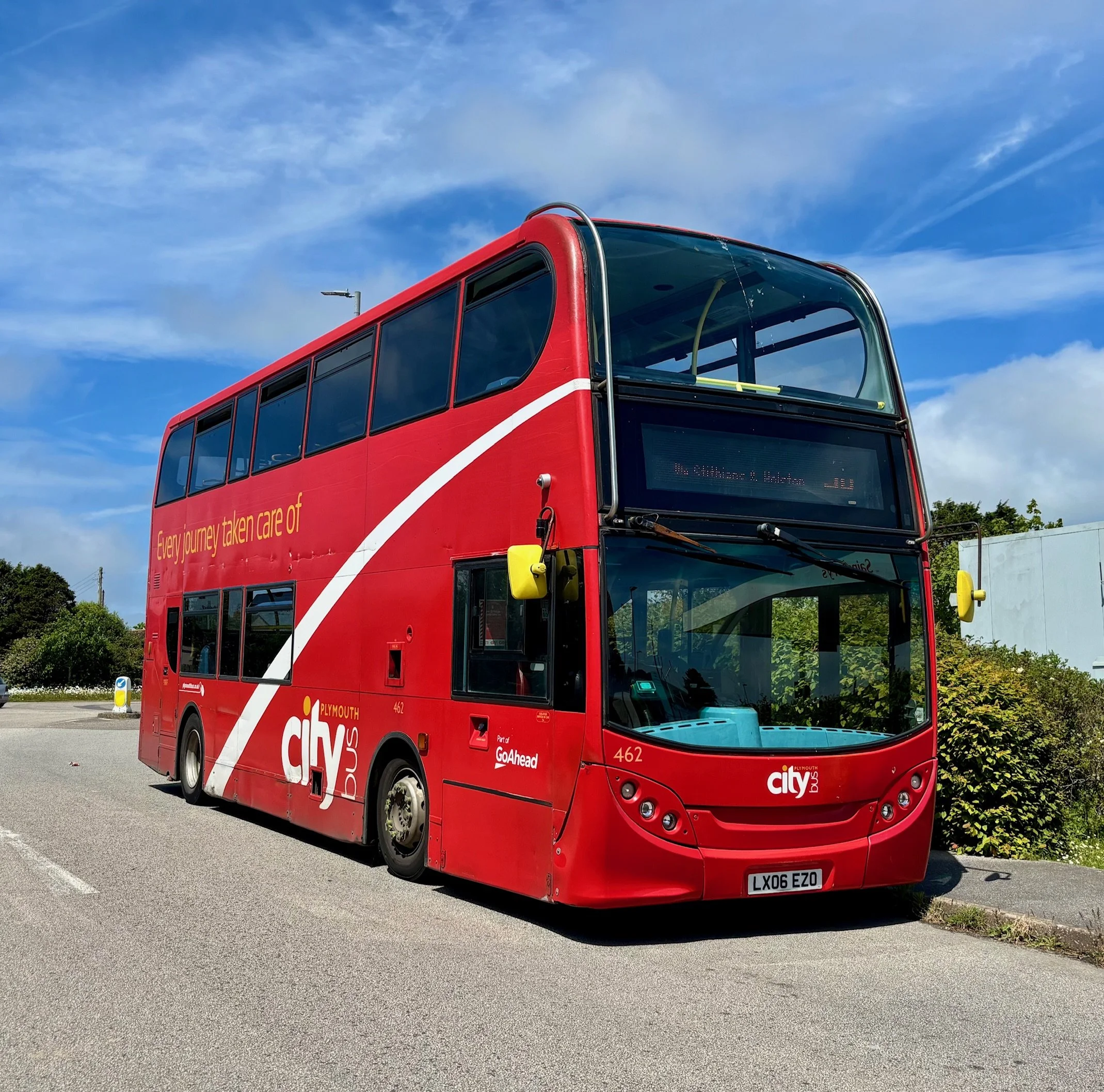
Go South West Enviro400 no 462 on Route 36 at Helston Sainsburys after my epic run aboard from Truro to St Keverne on The Lizard peninsula and back to this point. This bus may be better known to some of us as E19, its fleet number with Go Ahead London in its previous life.
Go South West have around 30 former London E types in service, most now working in Cornwall although this one still has Plymouth Citybus fleetnames. Although looking smart, the destination display was extremely faint and could hardly be read from any angle!
Part Route 2: Helston - Penzance
So far, all the buses I had caught had been on time or made up time if late. However, this was not the case on my next run! In Helston, I transferred back to Route 2 to return to Penzance. On this trip, I boarded a very full Enviro400 City, no 567, which arrived 10 mins late, having begun its journey a few minutes earlier at Helston Community College and was packed with students.
Whilst most of our load alighted a few minutes later at Porthleven, we had a rookie driver who was learning the route under the supervision of a driver mentor and was perhaps naturally a bit over-cautious on her first trip. We seemed to lose more and more time as we went along, partly due to more traffic coming the other way out of Penzance at that time of day and partly due to the inexperience of the driver. Finally, we crawled into Penzance Bus Station after an overlong 1h15m and a massive 25 mins late on the schedule. Whilst I understand the need for drivers to route learn, wouldn’t this be better to carry out off-peak with less traffic and fewer passengers or even out of service?
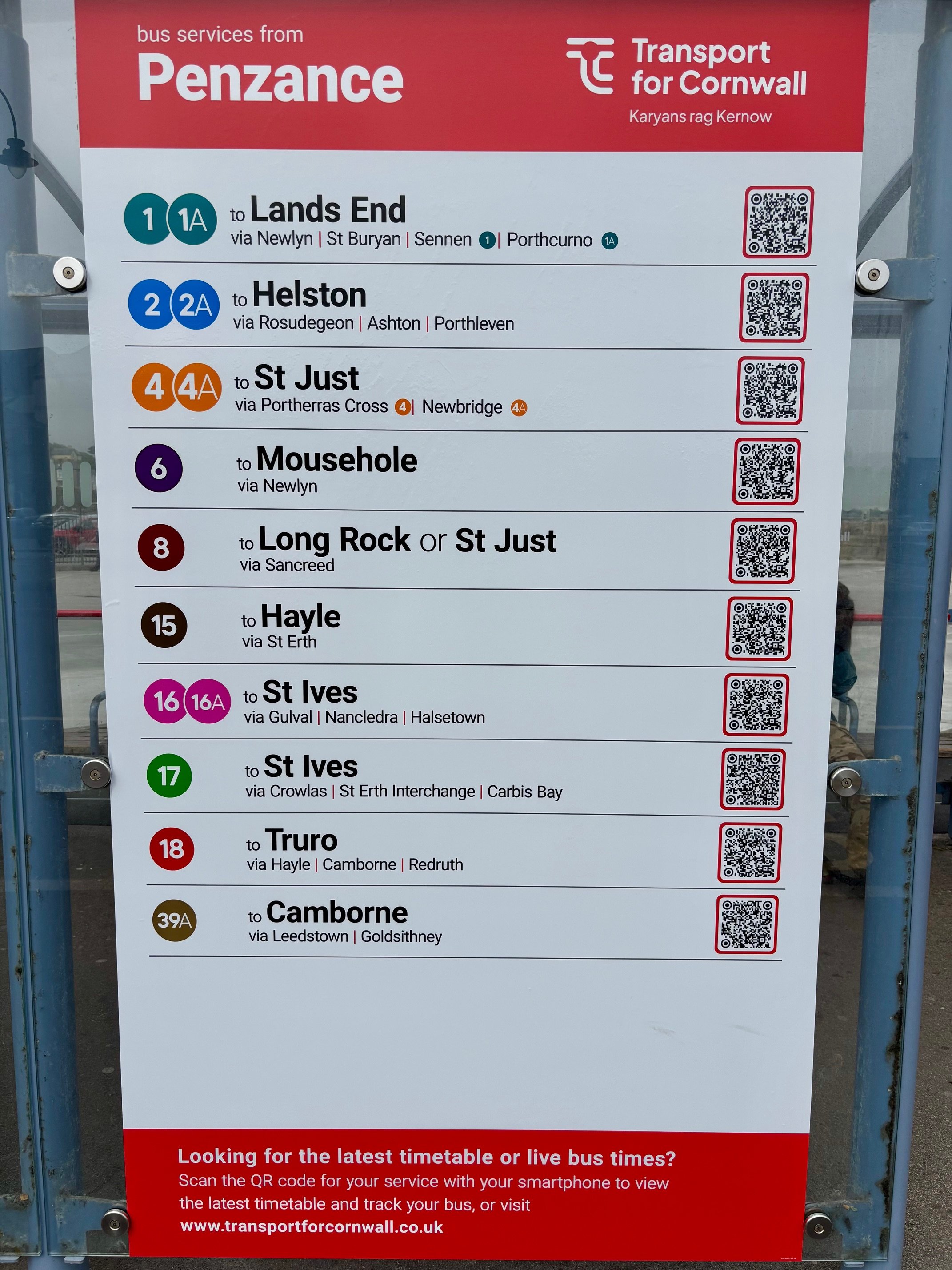
Bus Stations in Cornwall have these posters showing a list of services operating. Users are encouraged to scan the QR code to download the latest timetable.
Whilst other Bus Stations I visited in the county also had printed departure times at the stops, Penzance did not when I was there although there was an electronic display showing next departure times on each route.
Route 6: Penzance - Mousehole (& Back)
After a series of longer rides, there was just time to fit in a short local trip on Route 6 to Mousehole and back. This route was traditionally operated by small buses in Western National and First Bus days, with Bristol LH and short Dennis Darts featuring at different times. I recall riding an ex London Mercedes Alexander (MA) minibus on the service on one visit back in the day. Before First pulled out earlier in 2026, they operated Mercedes Sprinter minibuses, little vehicles always being required due to a couple of 90 degree turns between buildings on the narrow road approaching the terminus at Mousehole Harbour.
When Go Ahead took over, there was a local outcry when they cut the route back at Mousehole one stop to The Parade, near the Old Coastguard Hotel, although this is only a few hundred yards from the previous terminus. This was to enable the use of larger buses, which turn by reversing into a side road, and a reduction in the basic M-S daytime frequency from 20 to 30 mins, eves & Suns going from 30 to 60 mins. Enviro200 MMCs are now used, both longer and shorter versions being seen, of which Go Cornwall operates a large fleet. One school journey (designated 6S) from Mousehole in the morning and back there in the afternoon, uses a double decker.
Next departure when I travelled was Enviro200 MMC no 2453, a longer version. A number boarded at Penzance Bus Station, with more joining us at the stops in the now traffic-calmed Market Jew Street, the main shopping street of the town, which despite the name has no historic links to the Jewish community, but is an adaptation of the Cornish phrase “Margas Yow”, meaning “Thursday Market”. Continuing along Alverton Road towards the edge of town, we suddenly swung almost 180 degrees to serve the housing area of the Alverton Estate. Emerging onto the road beside the coast, which is a continuation of The Promenade, we turned right into Newlyn, a small fishing port which is effectively an extension of Penzance. After traversing the narrow streets, we made our way south beside the coast through a brief stretch of open country before arriving at the outskirts of Mousehole, terminating at The Parade. Just a 15 min trip but a nice ride over the final stretch from Newlyn Bridge. Interestingly, whilst the “Next Stop” and “Final Destination” screens were working on the bus, the verbal announcements kept referring incorrectly to “Mouse Hole” - presumably nobody told Go Ahead that the place is pronounced “Mouzzel”!
After a 10 min break, I reboarded the same bus for the return run, with a few others who had walked around the corner from the harbour to the new terminus. We pulled forward then backed into a fairly steep side road on our right, before turning left and back via the reverse of our outbound route. A bit quieter on this trip, which again took a mere 15 mins back to the Bus Station.
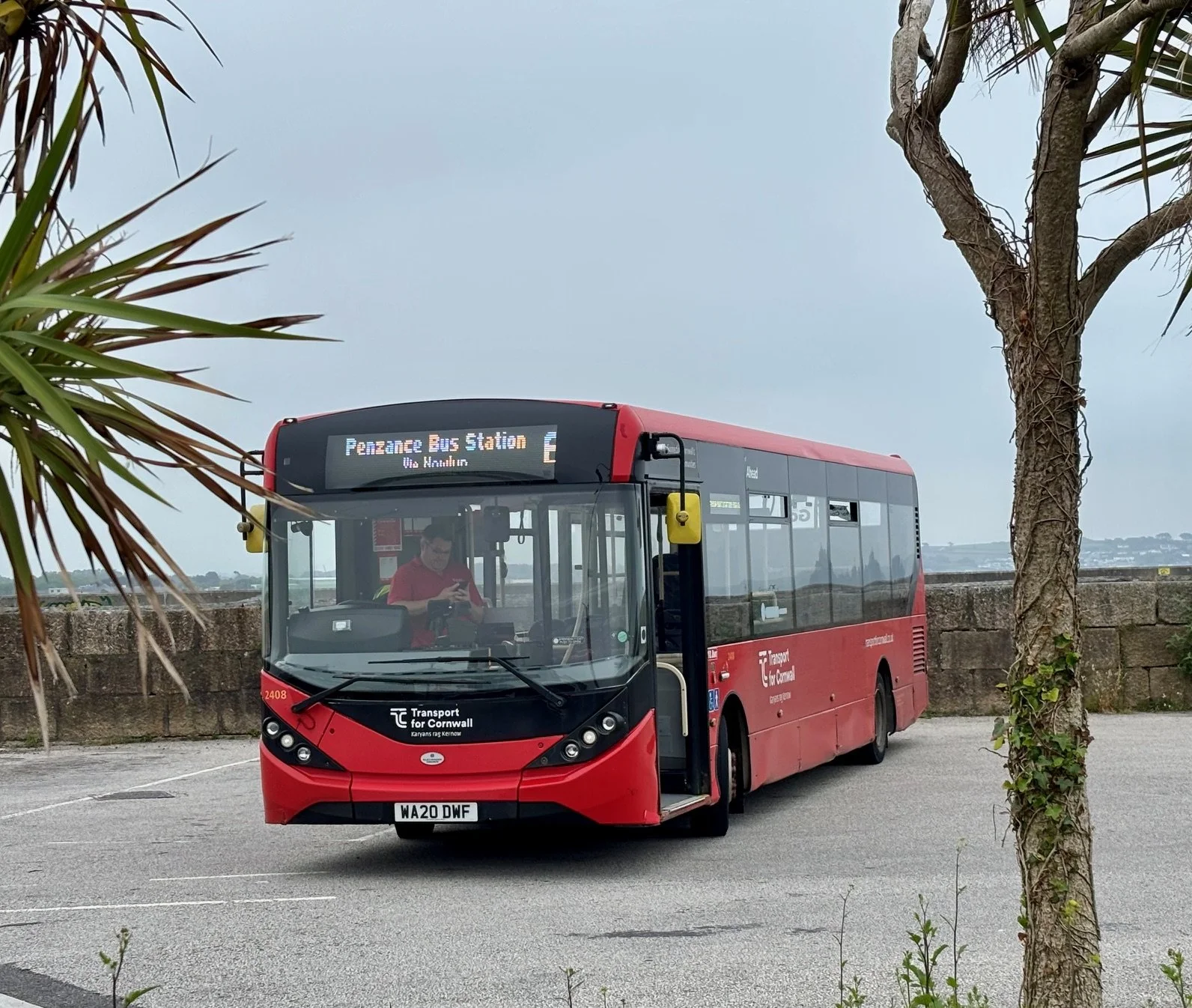
Go Cornwall operate a large fleet of Enviro200 MMCs on local services. Fleet no 2408 sits among the palms in Penzance Bus Station between trips on the short Route 6 to Mousehole. I rode similar vehicle 2453 on this service.
Many of this type were obtained with sponsorship from Transport for Cornwall.
DAY 2
Route 4A: Penzance - St Just
I was back at Penzance Bus Station shortly after 9AM the next day, to explore some of the more local routes in the area. First on the list was the 4/4A to St Just, with the 4A operating direct via Heamoor & Newbridge and the 4 taking a longer route via Madron, Pendeen and Lower Boscaswell. In practice, most buses operating outbound via one route change number at St Just Bus Station and return via the other route in a circular operation. The basic M-S daytime frequency is every 30 mins alternately as 4 and 4A, with just the 4A operating eves & Suns every 2 hours.
My observations showed a mixed double and single deck operation, but I was fortunate that Enviro400 no 4001 was on the next running, better known to me as the former E58 from its London days. This one was in Transport for Cornwall colours and fleetnames, neatly single doored, but still with blue London moquette on the seats. We departed with a number on board as we traversed the first section out to Heamoor, which is essentially a town service. Then, we left the built up area behind to speed up over open country through the village of Newbridge towards the opposite coast. The section approaching St Just was more barren and we arrived into the little town, which was once a centre for tin and copper mining. It sits on the winding and scenic coast road from St Ives to Lands End, along which First used to run Open Toppers during the summer, a route which Go Cornwall are reintroducing with a few journeys this season, but not with open top vehicles!
We arrived at the small St Just Bus Station after a short 30 min run with very few still on board by this stage, where we changed to a plain 4 and took a few minutes stand time.
Route 4: St Just - Penzance
More takers on the return run, leaving St Just on time, although mostly shortriders along the coast northwards via Botallack to Pendeen, site of a famous lighthouse which is still an important aid to navigation. Nearby is the Geevor Tin Mine, closed in 1990 and now a museum and heritage centre as a living history of a working tin mine. At the next village, Lower Boscaswell, we deviated over a short double run to serve a housing estate, dropping and picking up a few customers.
Then back inland towards Penzance through generally bleak moorland, where we surprisingly picked up a hiker in the middle of nowhere! Eventually we reached civilisation at the village of Madron, before proceeding through Heamoor back into town. A longer trip this way at 50 mins, although an interesting one.
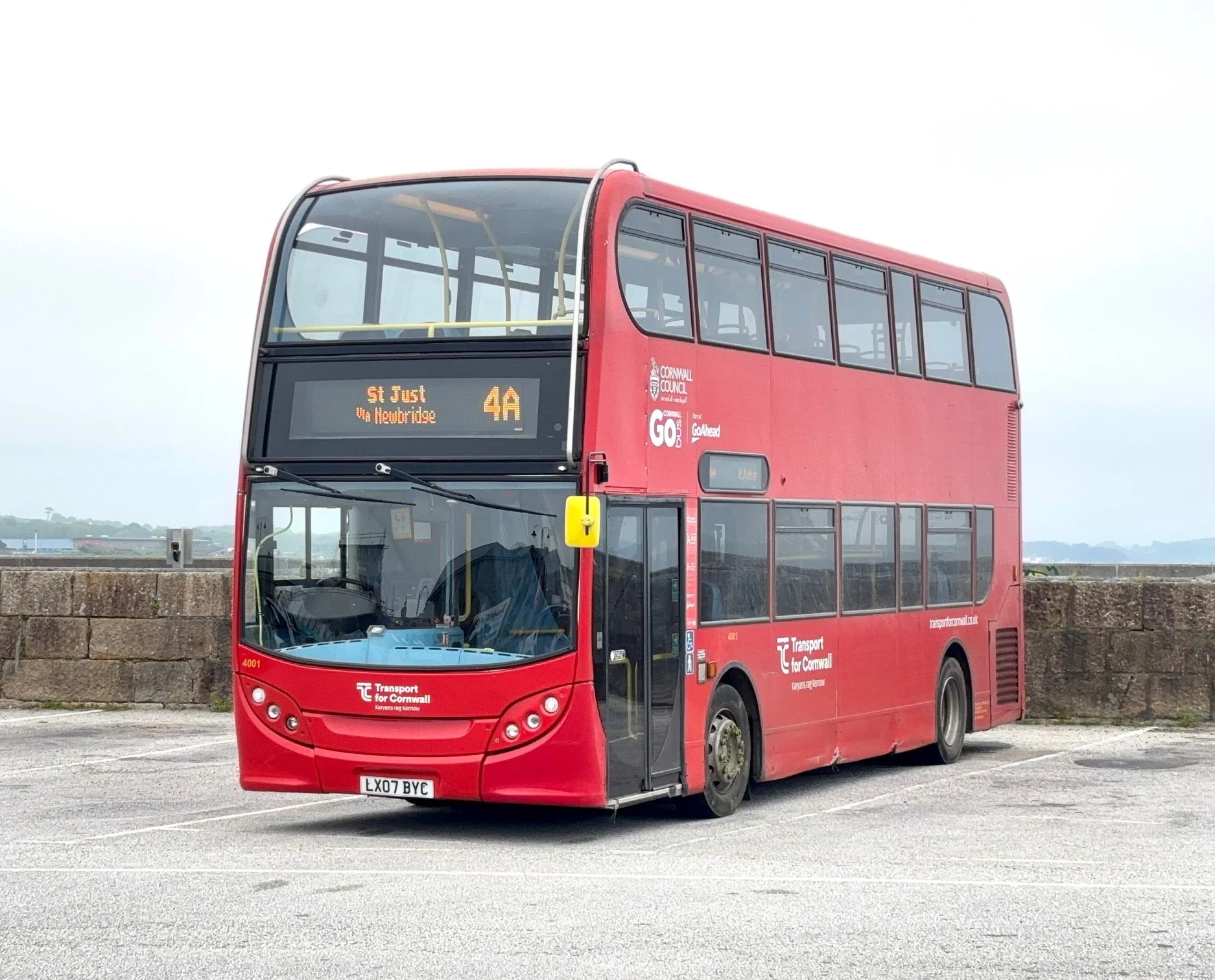
Another former Londoner with Go Cornwall is Enviro400 no 4001, once known as E58 when in the capital. Seen here in Penzance Bus Station in Transport for Cornwall livery before departing on Route 4A to St Just with me on board.
The 4 & 4A link Penzance & St Just via different intermediate routes, with most buses changing number at St Just Bus Station and operating as a circular.
Route 17: Penzance - St Ives - Penzance
Second order of business on Day 2 was a return trip from Penzance to St Ives on Route 17. This is the main service linking the two towns and operates at an Hourly frequency M-S daytimes, 2 Hourly eves & Suns. Whilst this may be sufficient during the winter, the service can become very busy in summer and could possibly do with an increase to every 30 mins for much of the day M-S and maybe Hourly on Sun daytimes. When I was there, double deckers seemed operate most journeys with the odd single deck working. There are alternative Routes 16/16A between Penzance and St Ives, which operate an Hourly M-S daytime service only, via a more inland route through Nancledra or Zennor, although these take longer for through passengers at 50-55 mins compared with around 40 mins on the 17.
Next departure on the 17 was in the hands of yet another former London Enviro400 - E76, still with its old fleet number in the driver’s cab, now known as 4011 with Go South West. This bus still retained Plymouth Citybus fleetnames and red front but with branding covering both sides for Plymouth City College, the offside on a pink background and the nearside on a light green background. Inside, still with London blue moquette on the seats.
This was a busy journey and we made our way out of Penzance over the same route as the 2 I had followed the day before, via the Retail Park and Long Rock, although turning off before reaching Marazion through the countryside towards the village of Crowlas, deviating off the main road around the Chy-an-Gweal Estate. Returning to the main road, we soon reached St Erth, where we pulled into the interchange adjoining the railway station. From here, we continued towards St Ives, essentially following the route of the branch line but a little further inland. After a short country section, the landscape became more built up as we progressed through Lelant Village, then Carbis Bay, by which time we had picked up a large number of riders into St Ives.
The terminus in St Ives is at The Malakoff, a viewing point and gardens with panoramic views over the Harbour and Porthminster Beach. The name “Malakoff” comes from the Battle of Malakoff during the Crimean War in the 19th Century, won by Anglo-French troops, and has been used for lots of towers and lookouts across Western Europe. The Bus Station occupies a small triangular area with very little space and, due to adjacent road-works, we simply used it to execute a three-point turn, before standing at the first stop outside, a little further up the hill. A 40 min run.
The 15 min layover enabled time to appreciate the sea views, before reboarding for the return run. Not quite as busy in terms of passengers, but still a reasonable number, with a mix of locals and tourists. A slight delay on approach to Penzance in negotiating the temporary lights at Long Rock and busy traffic through the Retail Park meant that we took 45 mins in this direction, but overall not a bad run.
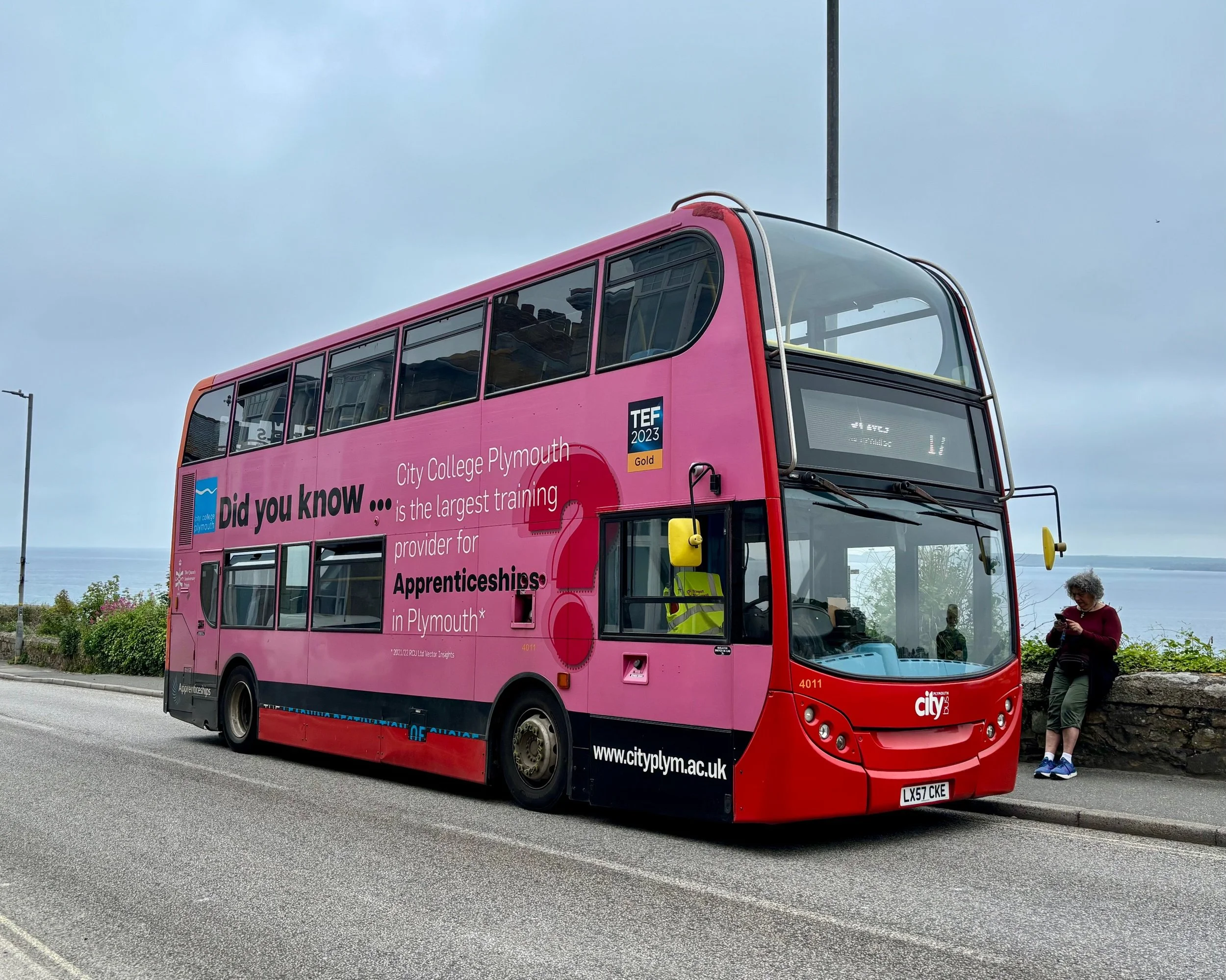
My third ex London E of the trip was E76, now no 4011 with Go South West, seen at St Ives Malakoff between journeys on Route 17 (Penzance - St Ives via St Erth).
The vehicle is an all-over advert livery for Plymouth City College and still bears Plymouth Citybus fleetnames.
Route 1: Penzance - Lands End
After lunch, it was time to tackle the famous Route 1, which together with the 1A links Penzance with Lands End. The 1 is slightly more direct, operating via Sennen Cove, whilst the 1A runs via Porthcurno. As with the 4 & 4A, most journeys interwork from one variant to the other, changing from 1 to 1A and vice versa at Lands End. A basic Hourly frequency operates alternately on the two routes during M-S daytimes and 2 Hourly on Sun daytimes. There are a couple of M-S eve journeys at 2 Hourly intervals between Penzance & Newlyn only.
Again, this is a mainly double deck service, although when I travelled one of the three buses out was a single decker. So far, I had ridden a number of ex London buses, but Go South West also has a number of former Oxford Bus Enviro400 hybrids, a few of which I had observed during my travels. One of these, no 5039, was on the next departure to Lands End and I boarded it with a good number of others, this being a popular service for visitors. Longer than the former London Enviros and with comfy high-backed seating, this example was another still bearing Plymouth Citybus fleetnames.
We departed through the town, before taking the main road route to Newlyn Bridge, after which we climbed the narrow road uphill out of the town with parked cars making progress difficult. Once again, this out of town route performs a second function as a local service, with a double run to serve a small estate at the top of the hill out of Newlyn. Then on to the village of Sheffield, before a one way loop around a very narrow lane to serve another small village, Paul, which is slightly inland from Mousehole. After negotiating some tight turns between hedges, walls and buildings, we picked up some walkers in the village square, before continuing along the lane back to the main road, where we passed through Sheffield for the second time!
Continuing westwards through wooded countryside, we reached Lamorna Turn, where one passenger alighted for Lamorna Cove, half a mile or so down another narrow lane, where there is a famous secluded beach excellent for swimming. After this, we turned off along another lane through open farming land, arriving into the large village of St Buryan, pausing briefly at the large Grade 1 listed church. The area has evidence of Neolithic activity, with stone circles and Celtic crosses to be seen. After this, another winding lane before rejoining the main A30 at Crows-an-Wra (meaning “Witch’s Cross”), a hamlet which developed with the growth of local tin mining.
We were now able to get up a bit of speed over the rolling country to Sennen, where we diverted for another double run down a steep winding road to Sennen Cove, a very scenic location with a long beach and breaking waves which were being taken advantage of by a number of surfers, for whom this is a popular location. Back up the hill to Sennen, this time turning right for the final mile or so to Lands End, which we reached after a run of 1h15m. In former times, the main bus route was more direct along the A30 and hence was quicker to/from Penzance, but in the interests of economic operation, the longer routeing has been adopted to serve other villages previously covered by a separate service.
Lands End (or is it Land’s End with an apostrophe - both spellings appear in the Bus Times booklet!) is the most westerly point in mainland England, but not in Britain, as Corrachadh Mor in Scotland is 23 miles further west. Lands End is at the end of the A30 road and is a headland, tourist and holiday complex, featuring the “First & Last House” and the “First & Last Inn”. It is also the traditional start or finish point for challenges such as walking or cycling the entire length of Great Britain to John o’Groats in Scotland, which is 874 miles by road direct. Buses terminate in a corner of the Car Park, where there is a designated bay and stop.
Route 1A: Lands End - Penzance
Having “done the touristy bits” on a previous visit, this time I took the air during the driver’s break and resumed my seat on board for the next trip, which was now over the 1A variant back to Penzance. Leaving Lands End, we proceeded in a different direction, with yet another double run down to the coast at Porthcurno, turning beside the main Car Park. In addition to another award-winning beach, Porthcurno has two main attractions - the Telegraph Museum and the Minack Theatre. Porthcurno became famous from the late 19th Century onwards as the location for submarine telegraph cables under the ocean, with a telecommunications college being built nearby, which after closure in 1993 became a museum devoted to the history of the site. The Minack Theatre is an open-air theatre adjoining the bay which stages plays during the summer ranging from Shakespeare to the more contemporary.
Back to the 1A and, after leaving Porthcurno, we continued our circuitous path around the narrow lanes. Suddenly, rounding a blind bend on an uphill stretch, we came face to face with a tractor coming full pelt towards us downhill. After both vehicles braked at the last moment, the obliging tractor driver began reversing uphill, with us slowly following, only to meet the next 1A coming round the corner at the top of the hill in the opposite direction to us. Luckily, the tractor found a wider section of road to pull over to let us pass, but a white car behind the other bus (which had stopped behind the tractor) didn’t see us and attempted to overtake, prompting the other bus driver to slew across the road to block it. The white car then reversed, as did the other bus and we gingerly crept pass all three vehicles to continue our journey, with much intake of breath amongst our passengers. Such are the perils of bus travel in rural Cornwall!
After this, it was a calmer journey, rejoining our outward route at St Buryan, then continuing back via Lamorna, Sheffield, Paul and Newlyn to Penzance. Arrival at the Bus Station was after a memorable 1h20m run. It was then time for some food and to sample the local ale at the end of a busy day’s bus travel.
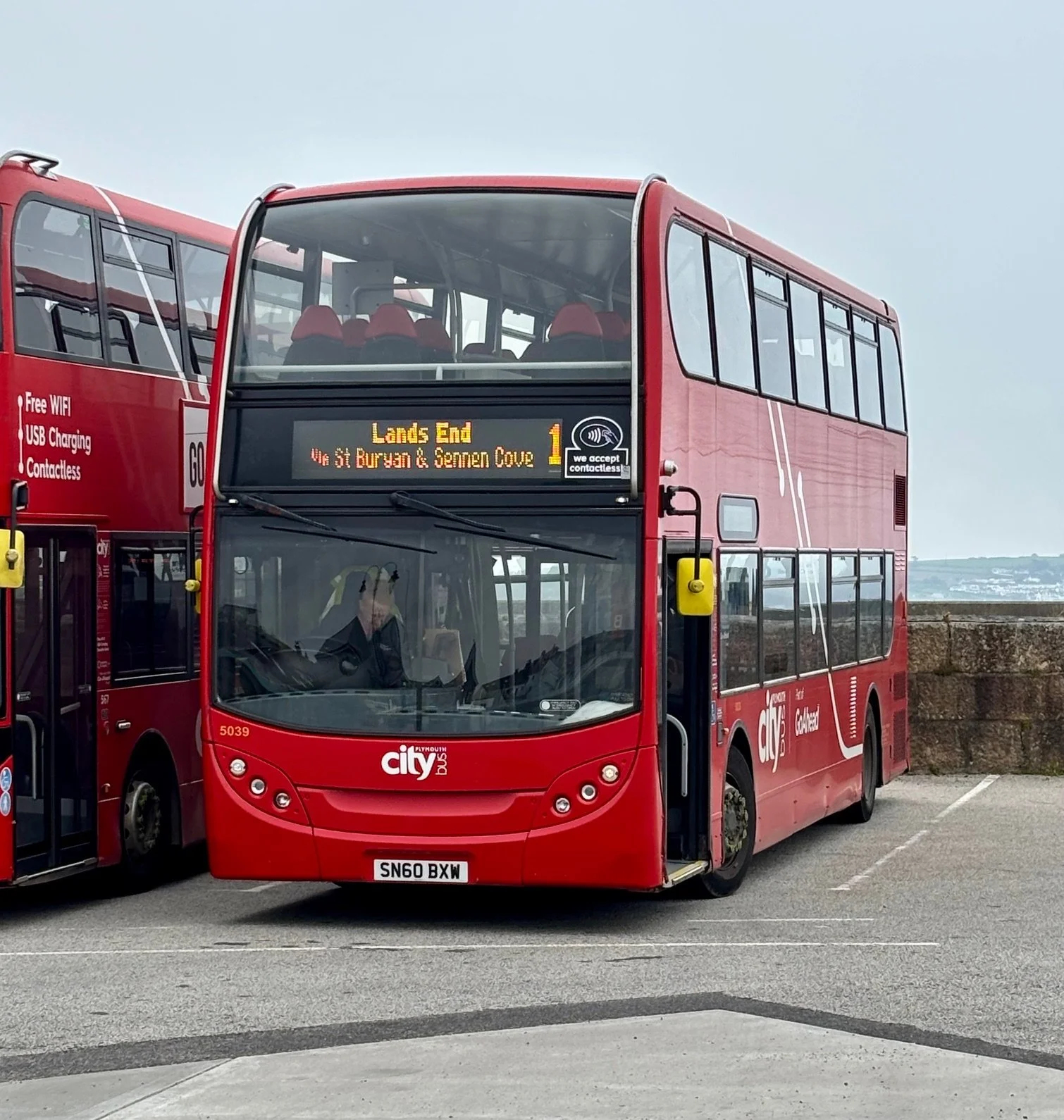
Go South West have 14 former Oxford Bus Enviro400 hybrids. No 5039 is seen at Penzance Bus Station before I joined it for a trip on Route 1 to Lands End.
This vehicle spent periods with both Oxford City Bus and the Thames Travel operation before heading west. Note the high backed seating with headrests.
DAY 3
Route 18: Penzance - Truro
Next morning was my last in Cornwall, but rather than catch the train from Penzance, I opted to start my journey by travelling part way up the main line by using parallel bus services. The 18 is the resurrected former number for the main Penzance - Truro bus service under Go Cornwall. Buses run over the full route Hourly during daytimes daily, with a 2 Hourly M-S evening service. Route 14 from St Ives - Truro joins the 18 at Hayle and provides a joint 30 min service from this point to Truro, Hourly M-S eves. Additional shorts run on the 18 over the busiest section from Camborne to Truro via Redruth, giving a 15 min frequency on this stretch M-S daytimes, 30 min Sun daytimes and Hourly M-S eves. Strangely, there is no evening service on Suns.
The 18 is a mainly double deck route, although one or two single deckers were seen. Although newer Enviro400 City types seem to be the favoured choice, older Enviro400s provide back-up, particularly on the short workings. I had Enviro400 City no 550, an example in red and silver “Spark” livery, a brand name used in Plymouth, the bus being a “17” reg vehicle. I settled in for the long ride in the front near-side seat upstairs and we were soon leaving Penzance eastbound through Long Rock. We followed the same route as the 17 to St Ives the day before, except for running direct along the main road at Crowlas, rather than deviating around the estate roads. After calling at St Erth interchange, we parted company with the 17 and crossed the causeway to Hayle, meeting up with the 14 route. After skirting around the mouth of the River Hayle estuary, we left the coastal area and continued inland for the rest of the trip.
After passing through rolling countryside and the village of Connor Downs, we entered the outskirts of Camborne, where the scenery becomes less interesting and more urban. From here to Redruth is the former industrial heartland of Cornwall, with evidence of former tin and copper mines aplenty. In Camborne Town Centre, we made our way to the Bus Station, which oddly sits somewhat inconveniently in a side road amongst houses. A short pause with a driver change, then on through the busy suburban area via Pool to Redruth. High above us, atop Carn Brea hill, the sight of Carn Brea Monument, a 90 foot granite obelisk erected in 1836 to honour Francis Basset (Lord de Dunstanville), a prominent local philanthropist and defender of the Cornish mining community.
Busy local usage on the Camborne - Redruth section but, after passing through the latter town, it was back to the pleasant country scenery and the villages of Scorrier and Chacewater. Both of these are situated on the Cornish Main Line and once had stations which have long since closed. The greenery and trees continued until reaching Threemilestone, the name reflecting the distance of the village from Truro. These days, it is virtually a suburb of the county town and the section from here to the city centre is mostly dual carriageway and largely built up. Eventually, we reached Truro Railway Station, dropping a few who were interchanging with the train and then making our way down to the Bus Station at Lemon Quay. A very long route, taking 2h5m end to end, but at least we were bang on time.
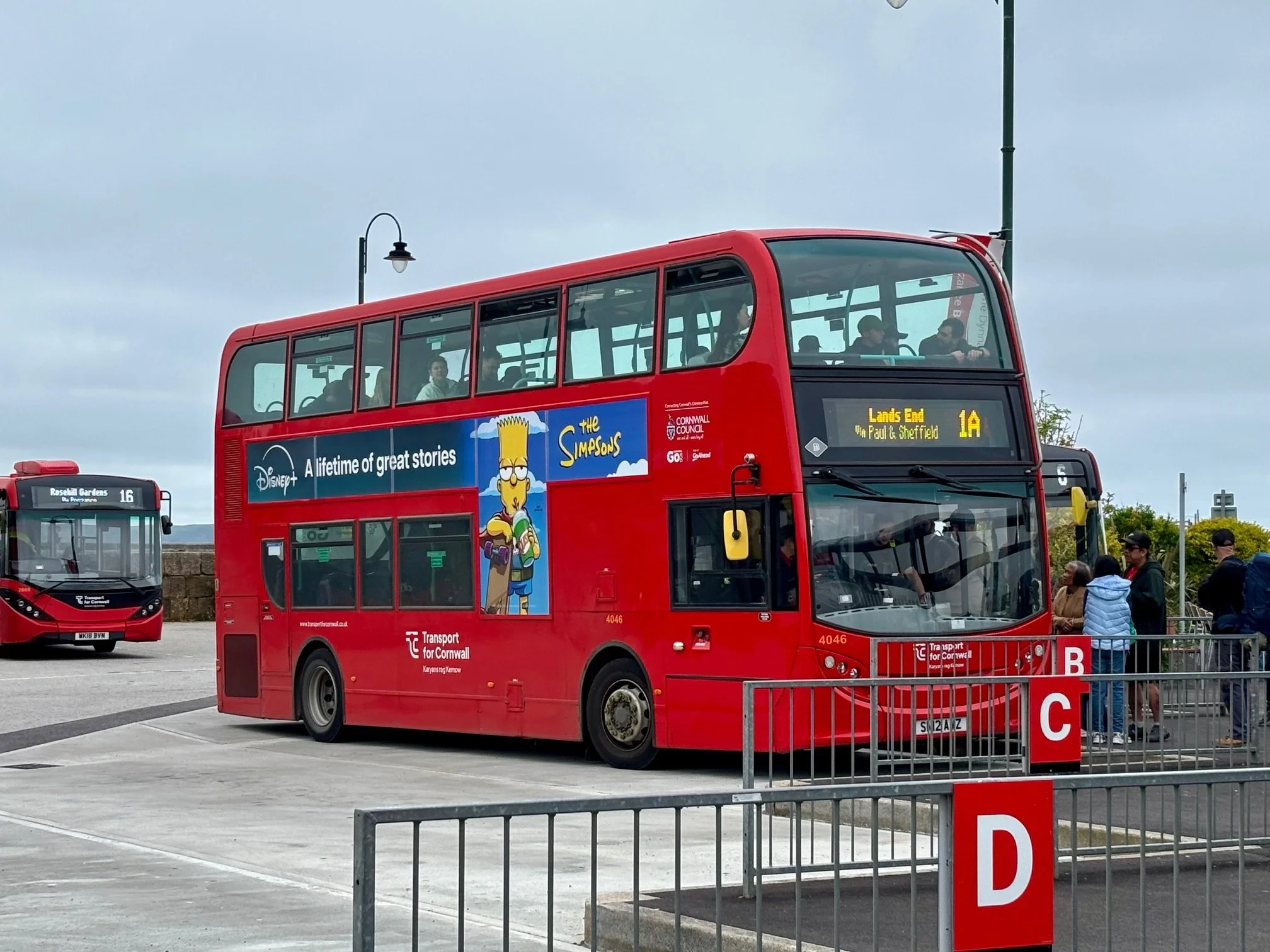
Whilst awaiting my Route 18 to Truro at Penzance Bus Station, I came across another ex London Bus, this time a former London United vehicle, now fleet no 4046 but previously ADE40481. A good crowd boards for the trip on the 1A to Lands End via Porthcurno.
Go South West had at least 3 former London United Enviro400s in service at this time. Sneaking in to the left is Enviro200 MMC no 2005 on local service 16.
Route 22: Truro - St Austell
A perusal of the timetable showed that I could squeeze in one more bus ride and connect with the London train at St Austell, the next station up the main line from Truro. There are two main routes over this corridor, the 27, which operates direct via Probus, Grampound and Sticker, running Hourly M-S daytimes, 2 Hourly eves & Suns, together with the 22/22A which take a longer route via St Stephen and St Dennis, running Hourly alternately on each variant M-S daytimes and 2 Hourly on the 22 only Sun daytimes, with no evening service.
Having “done” the main road route more than once on previous visits, I opted for the longer 22 service on this occasion. This is a single deck operation, required due to passing under a low rail bridge. The next departure from Truro Bus Station was a “classic” Enviro200 in Transport for Cornwall livery, fleet no 153. Only a handful of passengers joined me for this trip, leaving on time and making our way out of town, although most of the others alighted on the outskirts at the Park & Ride by the Retail Park. Then a pleasant run through rolling green countryside to Tresillian and Probus, after which we parted company with the main 27 route to proceed via narrower roads and looping around various villages including Grampound Road, St Stephen and Treviscoe. At St Dennis, we met up with the 21 route which links Newquay and St Austell and is the centre of the china clay mining area of Cornwall. Evidence of this around us, with the white hillsides showing where mining had previously taken place or was still ongoing. China Clay is still very much alive in the area and has many uses, including paper production (making it white and shiny), manufacture of fine porcelain and china, pigment in paint and as an ingredient in cosmetics and skincare products.
Continuing on, we picked up more custom in Whitemoor, Nanpean and Foxhole villages, before finally arriving into the town of St Austell, terminating at the small Bus Station in front of the Railway Station. Interchange is available here with local bus services to places like Bodmin, Fowey, Mevagissey and Par, in addition to the main routes to Truro and Newquay. 1h20m from Truro and a pleasant end to my rides.
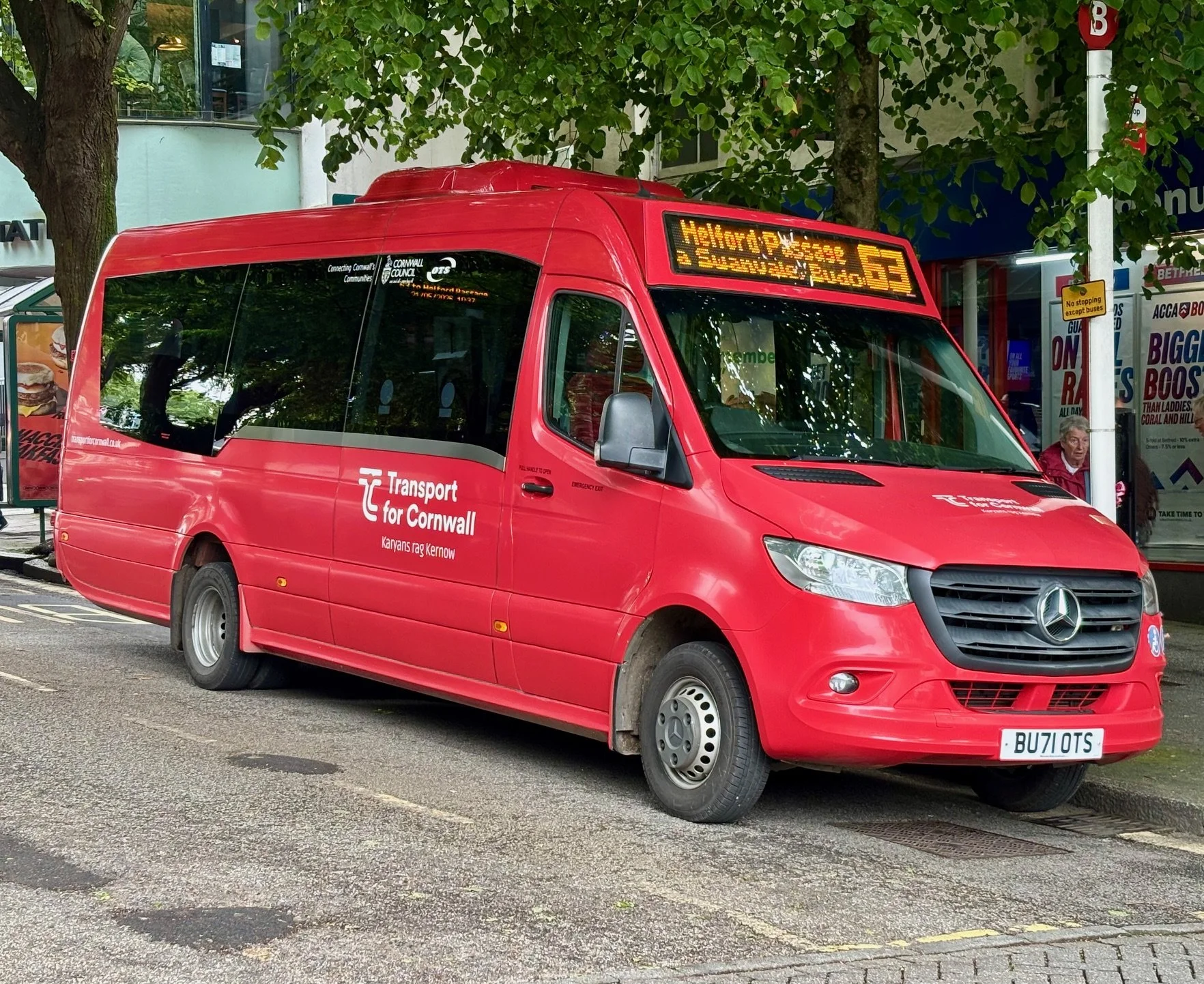
OTS of Falmouth is one of the smaller operators in Cornwall, running a number of rural and local services in the area using Mercedes Benz Sprinter minibuses.
BU71OTS is seen at Falmouth Moor prior to taking up service on the 63 to Helford Passage, which together with Route 35 provide an hourly M-S daytime service to that destination via different intermediate routes.
Journey’s End
At St Austell, I crossed from the Bus Station to the adjacent Railway Station, my Cornish bus rides over and ready for the train back from Kernow to England and home!
My overall impressions of the Transport for Cornwall network and Go Cornwall Bus were of a generally decent operation, with most buses at least in a standard red livery, even if some vehicles still had Plymouth Citybus fleetnames. The second hand buses including those from London were well presented and clean, even if not new and seemed in good mechanical condition.
Whilst most timetables appeared adequate and covered the majority of links withdrawn when First Bus pulled out, I wonder whether more enhancement will be needed during the summer on certain corridors. For example, some of the 2 Hourly Sunday services on main routes might be acceptable in winter but could do with an Hourly frequency in summer. Similarly, some Hourly M-S daytime frequencies, as on the 17 Penzance - St Ives, might need an increase to Half Hourly as operated in past years during the peak tourist season. Hopefully, any lessons learned this year will be carried forward with further improvements in 2027 as the new network beds in.
Watton
And Finally….
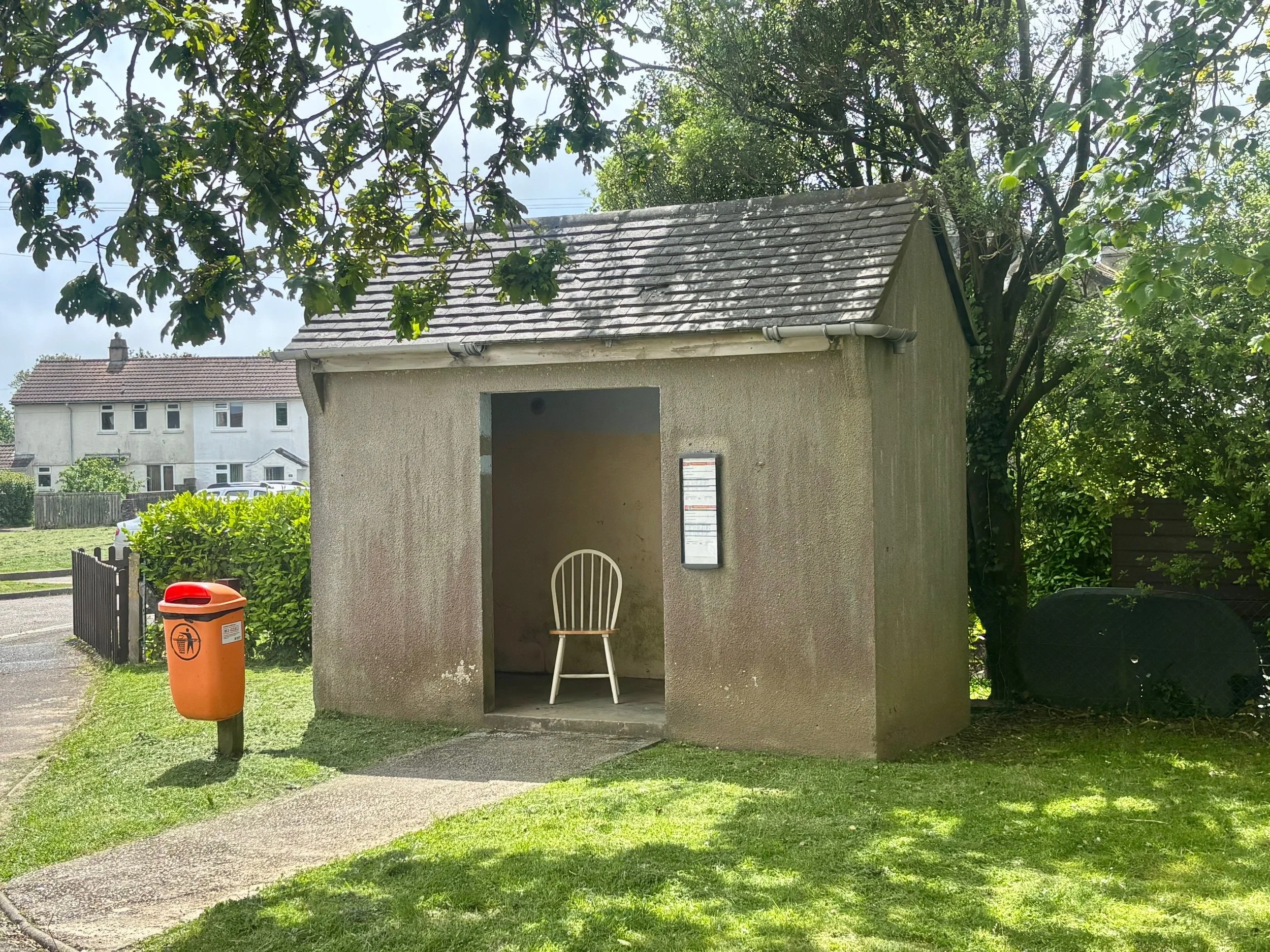
Bus Shelter Cornish style!
This example, in the village of Mawgan on the Lizard peninsula, is typical of the sturdy construction found in Cornwall. Complete with pitched tiled roof, timetable case and litter bin, together with a thoughtfully placed kitchen chair, so you can sit outside if the weather is good!
