
Cornish Branches: The Long & The Short of it
On this journey, I ride from London to Penzance over the GWR Main Line, stopping off along the way to ride the longest and the shortest branch lines in Cornwall.
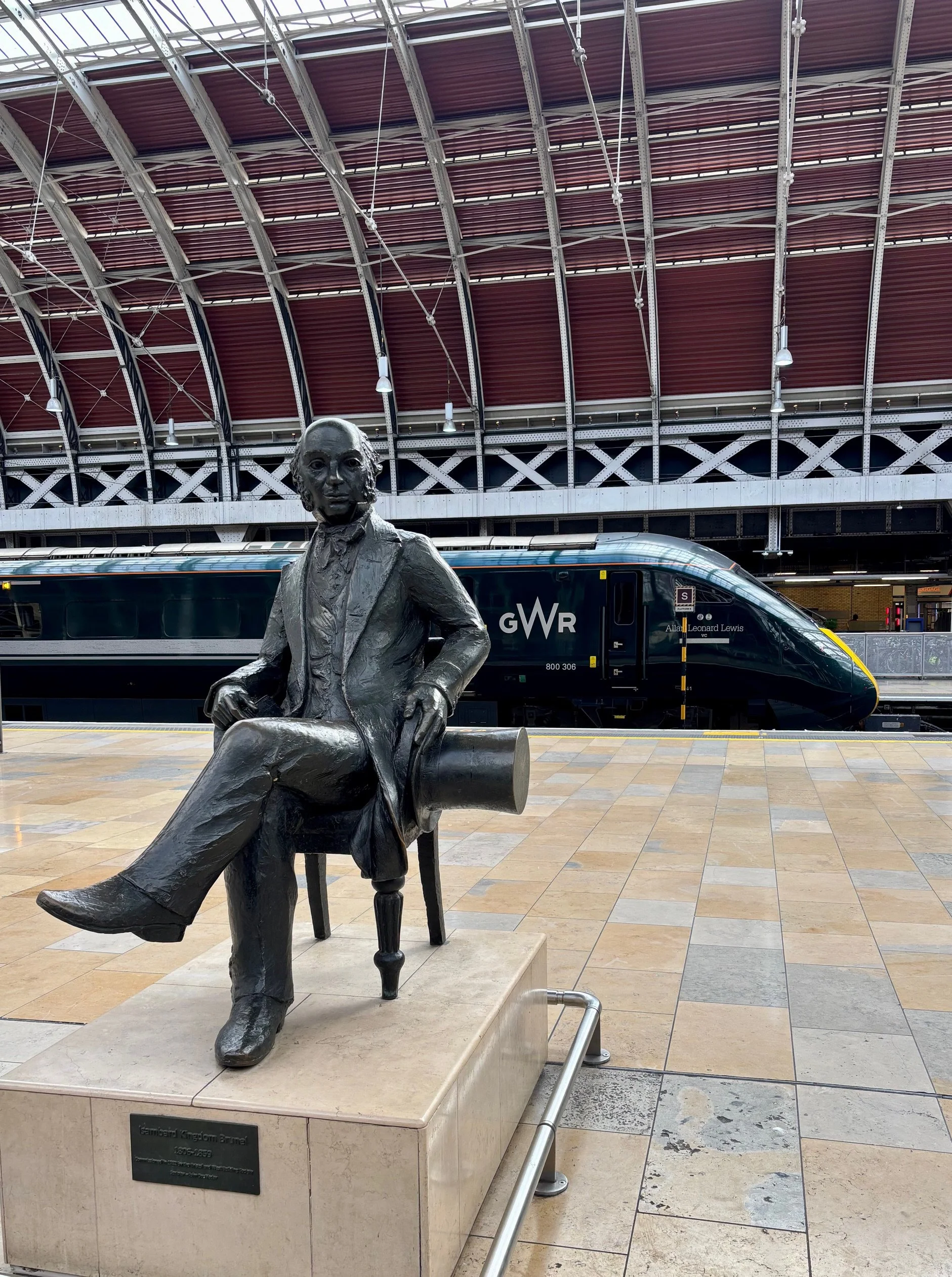
My journey began at London Paddington, where there was just time to pay my respects to Isambard Kingdom Brunel (1806-1859), the famous civil and mechanical engineer who built the original GWR in the 1830s/40s and the present Paddington Station, which opened in 1854.
In the background, under the barrel shaped roof, is the present GWR’s Inter-City Express Train (IET) Class 800 306, which I then travelled on down to Cornwall.
Great Western Railway: Paddington to Par
Paddington Station early in the morning was already busy with inbound commuters as I arrived in plenty of time for my GWR train to Penzance. After stocking up with supplies, I had time for a quick meet with two characters closely associated with the station - Paddington Bear under the clock on Platform 1, then Isambard Kingdom Brunel between Platforms 8 & 9, both depicted in bronze statues. The latter was of course famous as the builder of the original GWR and of Paddington Station in the Victorian era.
My train was formed of the expected bi-mode Class 800 unit, known as the Inter-City Express Train (IET) with GWR, but called Azuma with LNER. I had set no 800 306, which entered service in November 2018 as the WW1 Armistice Centenary Commemoration train and has the names of various military-medal-winning personnel inscribed on the carriage sides together with poppy symbols. Taking a seat in one of the centre carriages, we slid away bang on time at 08.03 precisely.
After an uneventful and punctual journey calling at Reading, Taunton, Exeter St David’s, Newton Abbot, Totnes and Plymouth, I knew that I was finally reaching my destination of Cornwall when we arrived in style across the Royal Albert Bridge over the River Tamar. This bridge, completed in 1859, was also designed by Brunel (who died in that year) and bears his name above the portals at each end as a memorial. However many times I cross this bridge, the spectacular views from it never fail to impress and remind me that I am either arriving in or departing from the Duchy with due ceremony.
The first station in Cornwall on the main line is Saltash, but we continued on without stopping at this or the subsequent small stations of St Germans and Menheniot. On approach to our next stop at Liskeard, we passed over the Looe Valley Branch Line, which crosses the main line at right angles under the viaduct far below. At Liskeard Station, Looe trains depart from Platform 3, which unusually is at right angles to the two main line platforms. A ride on the branch would have been fun, but I was concentrating on a couple of other lines this trip and had travelled to Looe by train on previous occasions.
Continuing along the main line, the next stop was Bodmin Road, where there is interchange with buses to Bodmin, Wadebridge & Bude, plus a connection with the Bodmin Railway, a heritage line to Bodmin General and Boscarne Junction stations, which I had also sampled on a previous visit.
I alighted at the next station, Par, one of seven on the British rail network with short 3 letter names, still on time at 12.05.
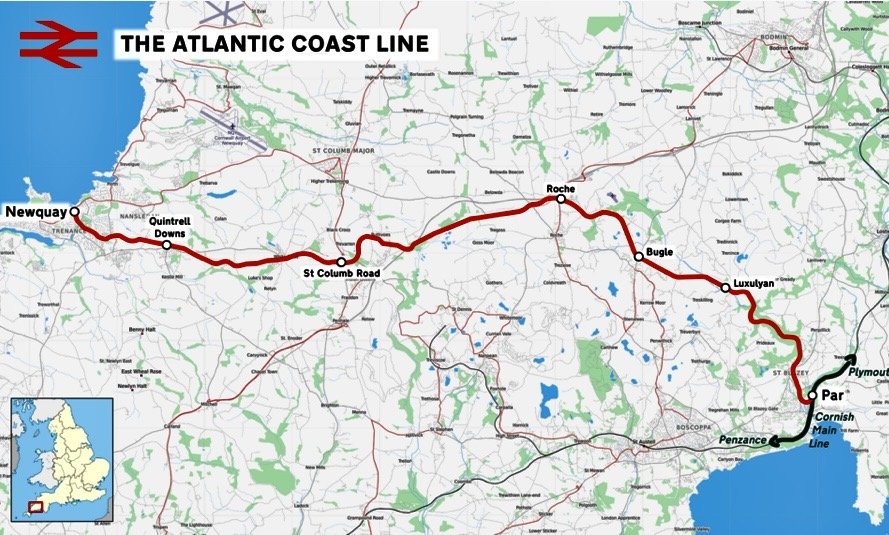
Map of the Newquay Branch Line, which connects with the Cornish Main Line at Par, running just over 20 miles from the north to the south coast of the county.
Apart from Quintrell Downs, the other intermediate stations are treated as request stops.
Atlantic Coast Line: Par to Newquay
Next on the agenda, the first of two branch lines on this trip, Par to Newquay, at just over 20 miles the longest branch in Cornwall. This has been in the news recently, as a second platform has been reinstated at Newquay and a second passing loop installed at Goss Moor in addition to the existing one at Goonbarrow, thereby allowing an hourly service to operate with effect from May 2026 timetable change.
Previously, the basic service was formed of one DMU operating to a 2 hourly frequency, but now two units are required for the new timetable, which operates approximately hourly between about 0700 and 2200 on M-S and slightly less often between about 1000 and 2200 on Suns. On the day I visited, a Class 150 Sprinter and a Class 175 Coradia unit were in charge. In addition to the local trains on the branch, there used to be through trains from London Paddington and other destinations on Summer Saturdays only formed of Class 800 or 802 IETs, but this has now been improved to 2 trains per day 7 days a week, although the workings are a bit unbalanced, as there are 2 up trains to London on M-F but only 1 down with the second down train starting from Exeter. At weekends, there is 1 through train to/from London, with the second working to/from either Plymouth or Exeter.
I joined two car Sprinter 150207 in the bay platform at Par for the 1229 departure to Newquay. A reasonable number of passengers on board, although 2 carriages were sufficient for this service. We left on time, with the conductor/guard announcing that we would be calling at Quintrell Downs and Newquay, but that anyone requiring the “request” stops of Luxulyan, Bugle and Roche should let her know. For some reason, St Columb Road was not being served on this journey, but I wonder whether the train would stop if anyone was actually waiting there!
We pulled away from Par on time and screeched around the sharp curve out of the station towards St Blazey, where there used to be a halt but now only a signal box and a goods yard. Then it was onto the branch proper, with the initial section being single track through the lush green woodland of the Luxulyan Valley, following the River Par. We continued through Luxulyan Halt without stopping, soon reaching the signalbox and first passing loop at Goonbarrow Junction. Our guard announced that we had a scheduled 5 min stand here whilst we waited for an up service to clear the single track section ahead and pass us. Meantime, I was able to view the adjacent sidings, which often host china clay trains but were empty on this occasion.
After a couple of minutes, a Class 175 passed by on the up service and then we were away again towards Newquay. Roaring through Bugle Halt without stopping, we were now into china clay country, the white hillsides around us resulting from the mining that characterise this area. We actually stopped at Roche Halt to let one passenger off, then continuing through open country which became steadily more agricultural as we left the china clay region behind. Running through the new passing loop at Goss Moor without stopping, we continued past St Columb Road Halt to Quintrell Downs, our final intermediate stop, where we picked up a couple of takers.
It was then only a few minutes more into Newquay, sweeping around the southern outskirts of the town, where new housing was in course of construction. The approach to the terminus was over the high Trenance Viaduct, with views of Trenance Gardens far below. We took the right hand fork at the new junction outside the station to arrive into the reinstated second platform after a 50 min run, a couple of minutes ahead of schedule.
Passenger services began over the Newquay branch in 1876, although originally ran to Fowey until the connection with Par Station was built in 1892 when the broad-gauge main line was narrowed to standard gauge by the GWR. There was a proposal in the 1980s to divert passenger services to/from Newquay at St Dennis Junction (between Roche & St Columb Road) over existing freight lines and a short stretch of new track into St Austell, which was reckoned to be a better traffic objective than Par, but nothing came of this.
However, the latest “Mid Cornwall Metro” scheme, financed with around £50m of Government money, includes the Newquay branch. The improved hourly service introduced in 2026 following the building of the second platform at Newquay and the second passing loop at Goss Moor is only the first phase of this, with trains on the branch intended to be extended over the main line from Par to Truro and then over the Falmouth branch in 2027. It remains to be seen whether this will encourage ridership, as journey times between Newquay & St Austell by train are likely to be similar or not much quicker than the existing bus routes, whilst the Newquay - Truro direct bus will probably still be faster than going by rail!
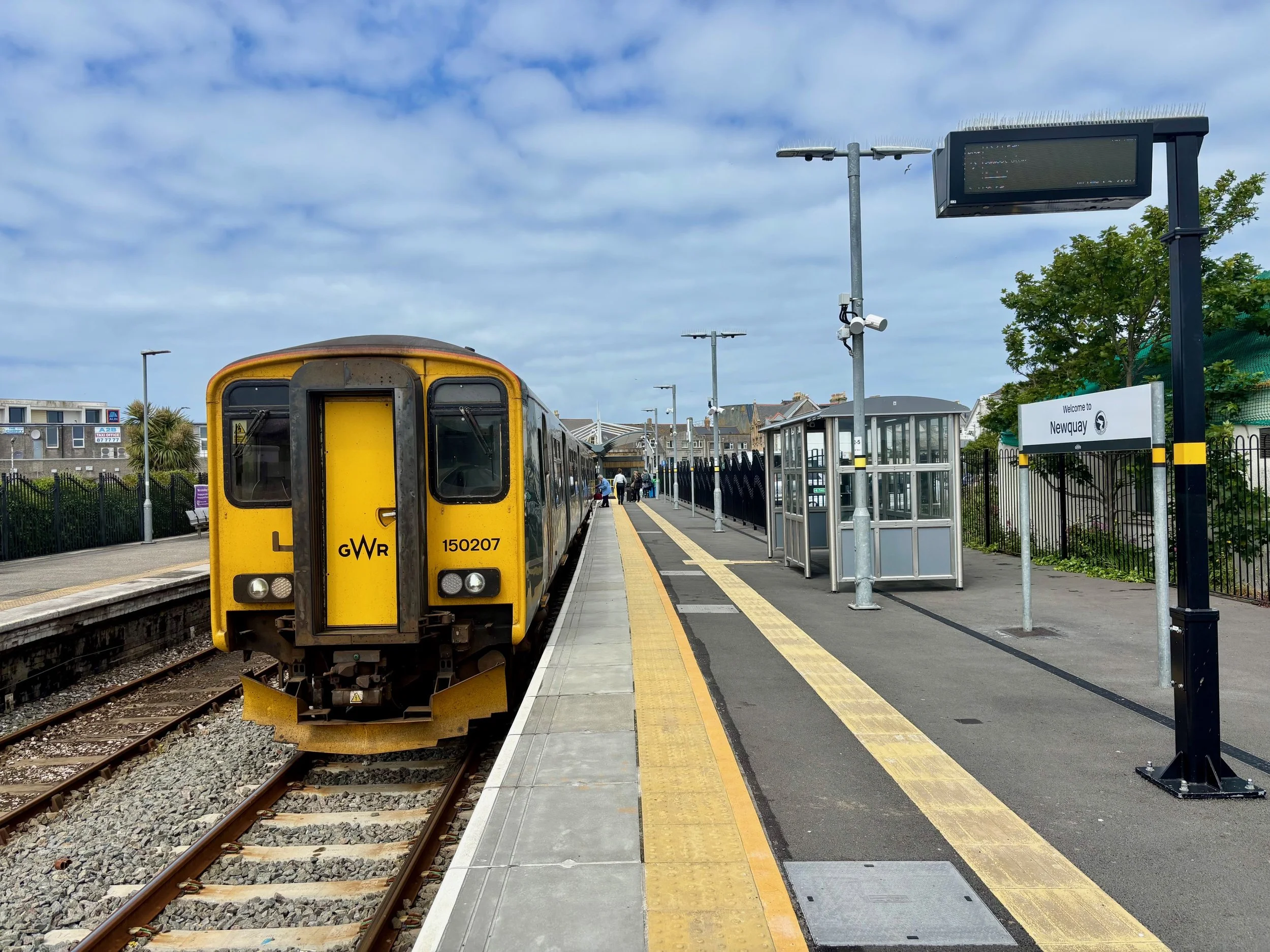
Two car “Sprinter” Class 150 207 stands in the recently reinstated second platform at Newquay Station after my journey aboard from Par. Built in the mid 1980s, these venerable units are refurbished and still giving good service.
The restored platform here plus the addition of a second passing loop on the branch have allowed an hourly service to be introduced with the 2026 Summer Timetable.
Atlantic Coast Line: Newquay to Par
At Newquay, the short 7 min turnaround time enabled me to appreciate the improvements to the station, which has now regained some of its former status with two platforms and other improved facilities.
We departed with another reasonable number of passengers on time at 1325, back along the branch. A few more users at the intermediate stations on this trip, with one on at Quintrell Downs (a GWR staff member!), one on and one off at Roche and one on and one off at Luxulyan. We passed other trains at both loops, a Class 175 on a local at Goss Moor and a Class 800 on the through train from London at Goonbarrow, running through without stopping, the practice being for up services to be timed to run non-stop and down services to have a few minutes pathing allowance built in to the schedule. As a result, we only took 45 mins for the trip in this direction, arriving back at Par a minute or two early.
The Newquay branch is perhaps not the most scenic in Cornwall but is not unattractive either, with some pleasant vistas to be had. There is a basic 50mph speed limit over most of it, although there are a number of slower restrictions over various level crossings across minor roads with either half or no barriers. An interesting route and well worth a visit.
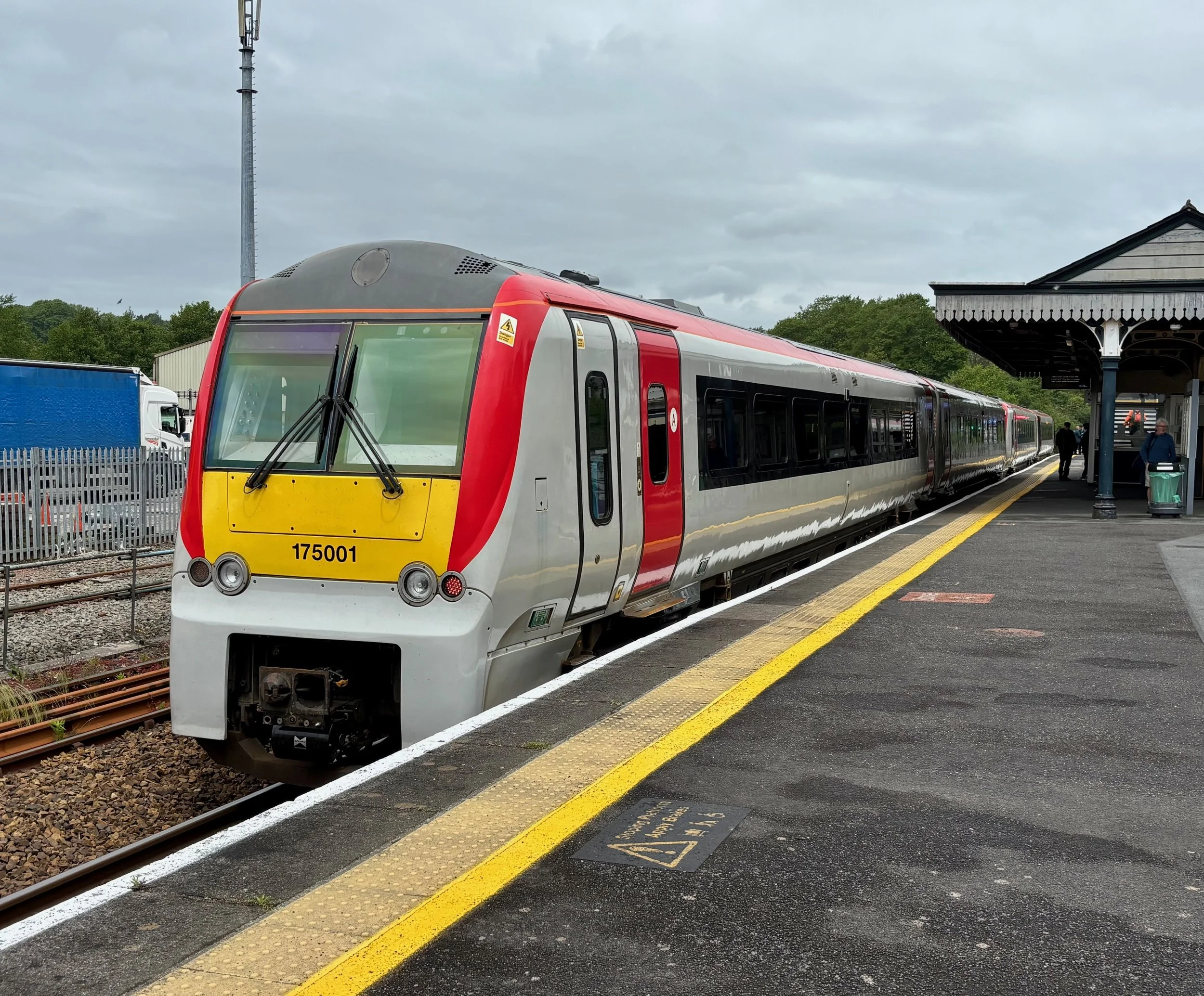
The Class 175 “Coradia 1000” DHMUs dating from 2000 have recently transferred from Transport for Wales to GWR to replace the shortened Inter-City 125 (HST) sets and to provide strengthening on branches. 175 001 stands with another set in the bay platform at Par.
Although these sets then ran empty to the depot, another Class 175 was the second train running on the Newquay branch that day, in addition to the Class 150 I travelled on.
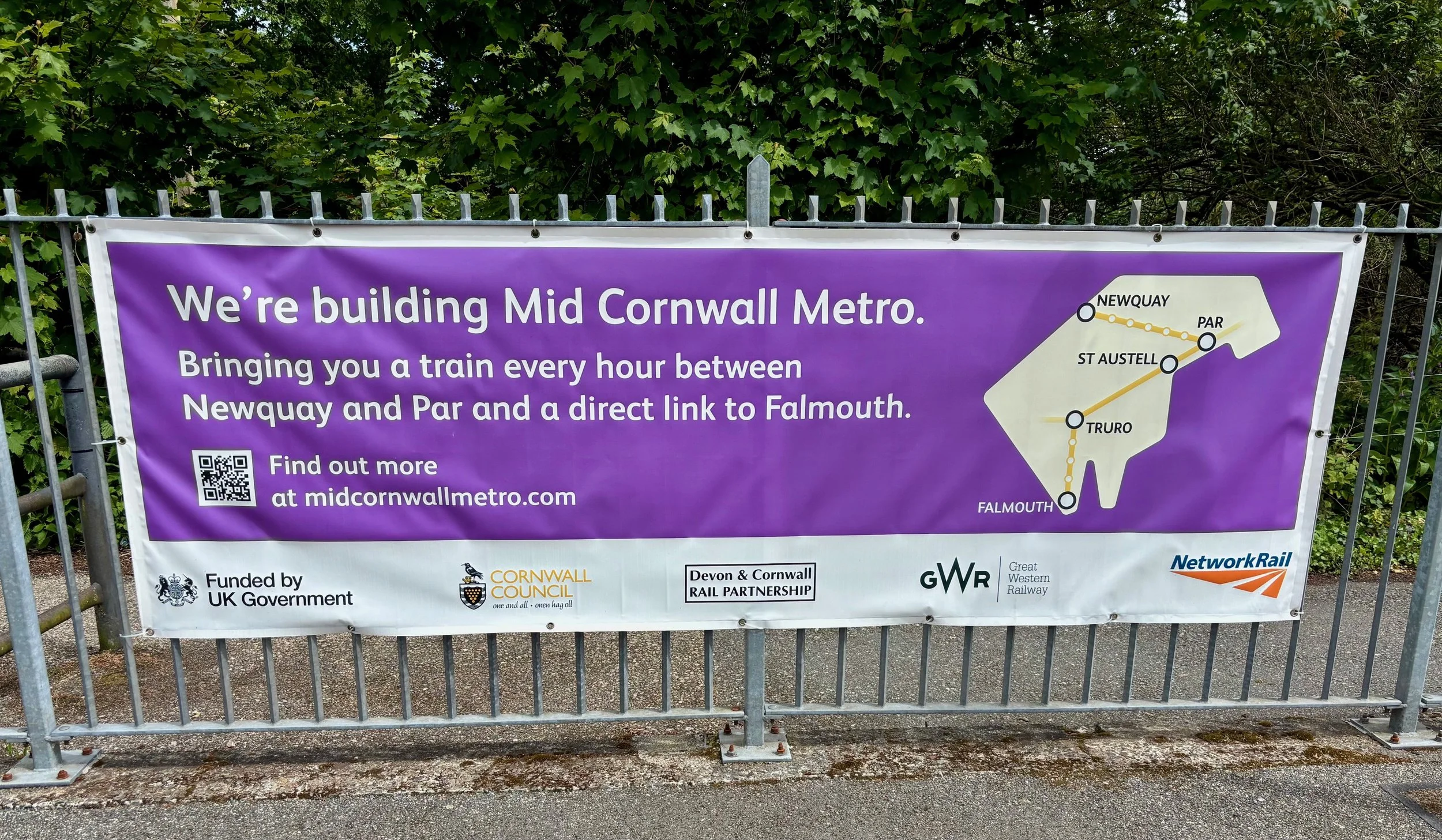
The introduction of an hourly frequency on the Newquay branch in May 2026 is the first stage of the “Mid Cornwall Metro” project, which will see the service extended from Par to Truro along the Cornish Main Line and then over the Falmouth branch in 2027. The various partners involved are shown on this poster.
Cornish Main Line: Par to St Erth
Back at Par, I resumed my journey westwards along the main line, boarding the 1338 Plymouth to Penzance service, formed of Class 175 011. A busy journey, which could have benefited from a second unit attached to the train, although I managed to find a window seat with no problem.
We called at St Austell, Truro, Redruth, Camborne, Hayle, then St Erth, where I alighted after a trip of around 50 mins for my second branch line visit of the day.
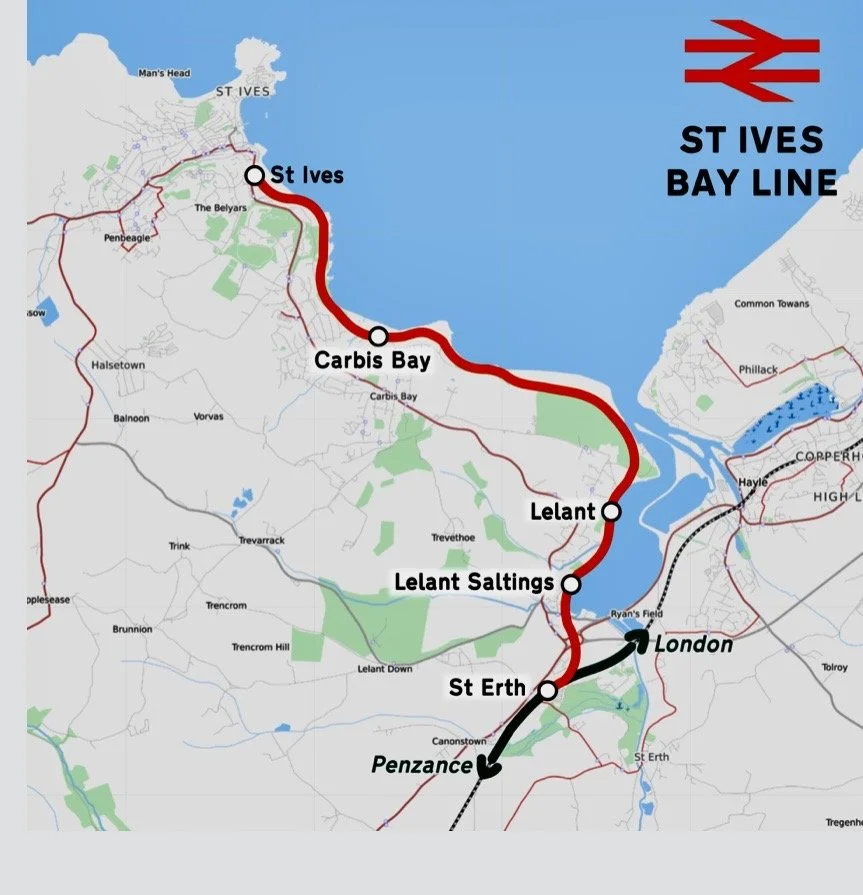
Map of the St Ives Bay Line, showing the proximity of the line to the coast, which makes for some spectacular views over this short 4 mile route.
All services call at Carbis Bay and St Ives, with Lelant a request stop on certain journeys. Lelant Saltings was built to serve a Park & Ride Car Park (now closed) and only one train a day now calls there.
St Ives Bay Line: St Erth to St Ives
Crossing the footbridge from the down platform on the main line at St Erth, I entered the station building and made my way to the bay platform, departure point for trains on the branch to St Ives. Having been on the longest Cornish branch line to Newquay earlier, now it was time to ride the shortest one, which is just over 4 miles long. Single track throughout, just one train is allowed on the branch at a time and with a journey time each way of just 11 or 12 mins, a half hourly frequency is maintained for most of the day between about 0700 and 2230 M-S and 0900 and 2000 Suns, although there are a couple of 1 hour gaps. The units are stabled at Penzance, so the first train of the day starts there and the last one at the end of service returns there.
Good use is made of the line by visitors during the summer, with a 4 coach train in use when I travelled, formed of Sprinter units 150 232 and 150 266. The timetable demands tight turnarounds of no more than 4 mins at each end for much of the day, so crew changeovers have to be fairly nifty. An almost full train disgorged its load at St Erth, with a smaller number joining the next down working, departing on schedule at 1548. Moving swiftly out of St Erth Station, we peeled away to the left through a short cutting and began to follow the route beside the Hayle estuary, with plenty of sea birds in evidence on the sands.
The first stop at Lelant Saltings was added in 1978 to provide a park and ride facility for St Ives, however the car park closed in 2019 and was replaced with a larger one at St Erth, so now only one train a day stops here and we went straight through. A short distance further on, we also passed through the original Lelant Station without stopping, which serves the nearby village of that name and where about half the trains call on request.
The next section is probably the most scenic on the route, as the line hugs the cliff above Porth Kidney Sands with spectacular sea views. After passing Hawkes Point, about 30 metres above sea level, the line comes around a headland into Carbis Bay, the main intermediate station on the line. After crossing Carbis Viaduct, the route continues along the cliff edge and drops down over St Ives Viaduct to reach St Ives Station, situated above Portminster Beach. We took just 11 mins to traverse the branch, but well worth it for the vistas!
The St Ives branch opened in 1877 and was the last new broad gauge (7 ft) passenger railway to be built in the country. Converted to standard gauge in 1892, it was slated for closure as part of the infamous Beeching Report in 1963, but survived and continues to operate today. In 1971, St Ives Station was relocated to a new site a few hundreds yard short of the original terminus to allow a larger car park to be built over the former location. There is a basic 30 mph speed limit on the line.
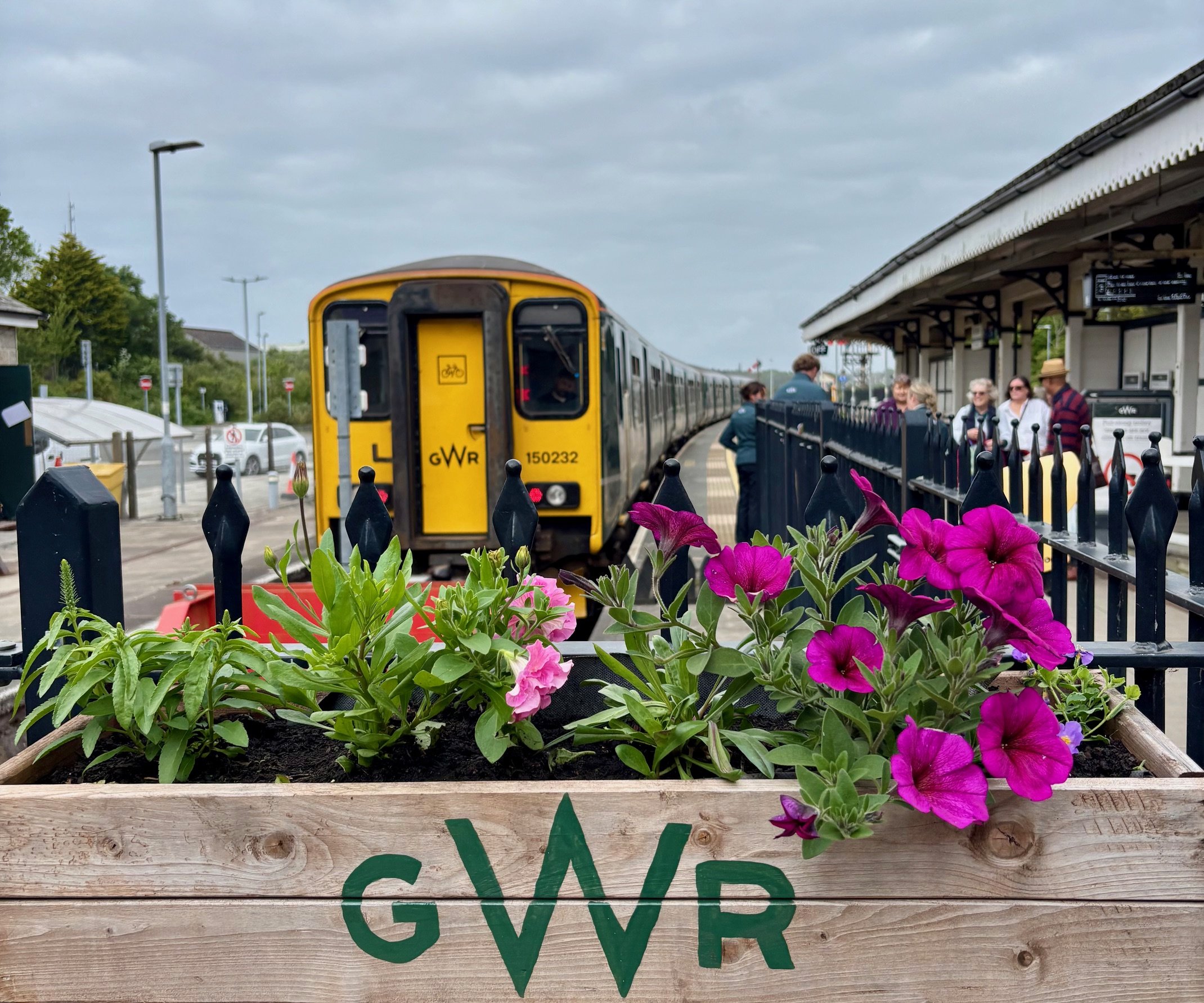
Framed by the GWR flower bed, “Sprinter” 150232 coupled to 150266 form the next St Ives departure from the bay platform at St Erth.
The first train of the day runs through from Penzance, whilst the last train of the day returns there. In between, a generally half hourly service is provided by one train over the branch.
St Ives Bay Line: St Ives to St Erth
On arrival at St Ives, the platform was jam-packed with returning day-trippers awaiting the 1603 departure, so I took the opportunity for a brief stroll to take in the picturesque views of St Ives Harbour far below and admire the “Zennor Mermaid” statue on the station platform - see following picture.
By the time the train returned to form the 1633 back to St Erth, the platform had filled up again and our 4 carriages were certainly needed. Another brief but impressive 11 min ride over this unique branch line.
Many passengers seemed to be travelling through to Penzance, so it is a pity that the service does not routinely extend to/from there, rather than enforcing a change at St Erth. However, with one train, only an hourly service could be maintained if this was the case and a half hourly frequency is certainly needed at busy times of the day (and the year)! Nevertheless, it was good to see a once threatened branch line doing such good business.
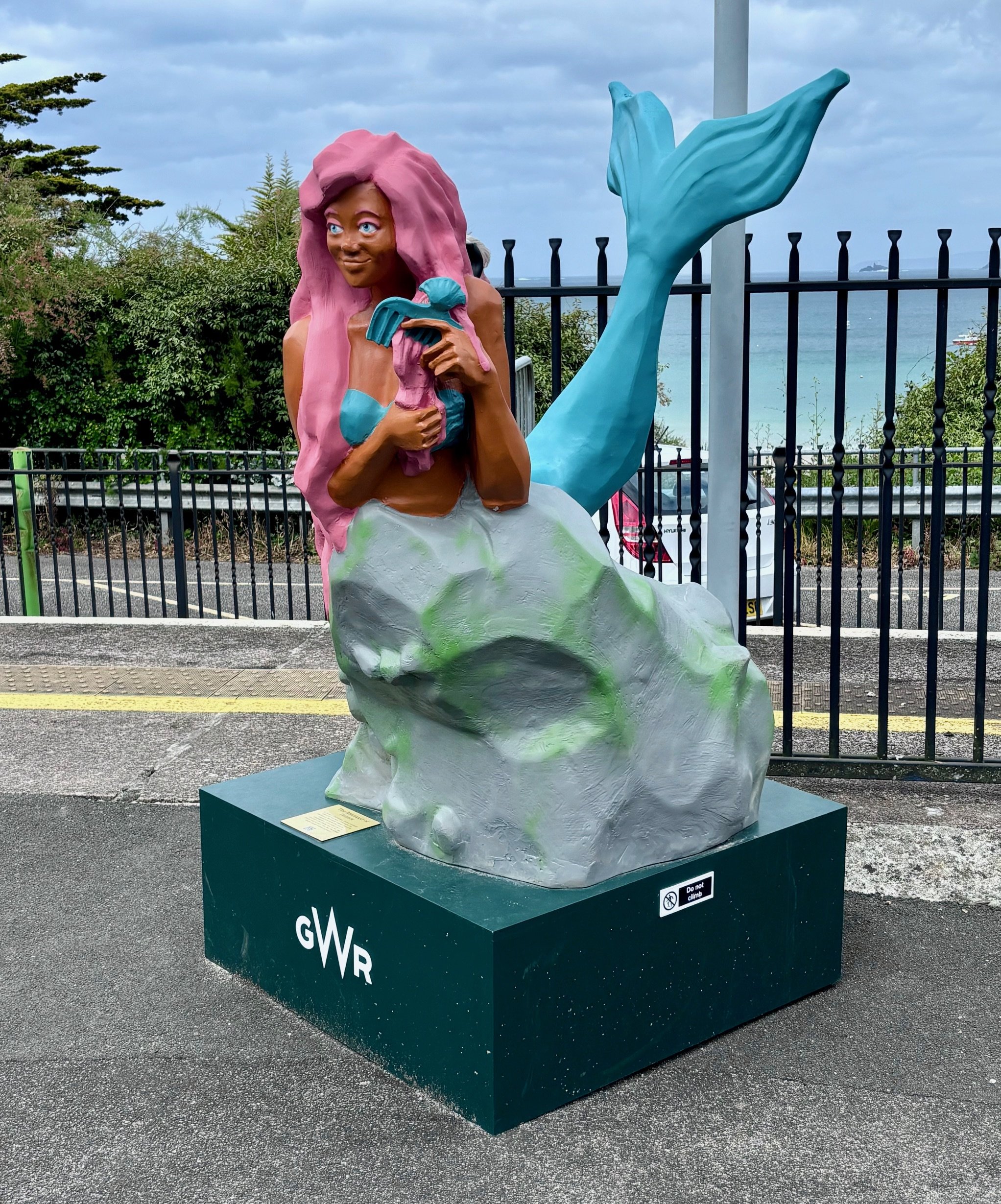
“The Mermaid of Zennor” statue at St Ives Station.
The plaque explains the story: “In Zennor, a fisherman grows troubled when his son falls in love with the mysterious Morveren, whose unearthly singing enchants the church congregation. Convinced she is a mermaid who draws men to the sea, Jowan tries to warn him, but the young lovers vanish without a trace…”
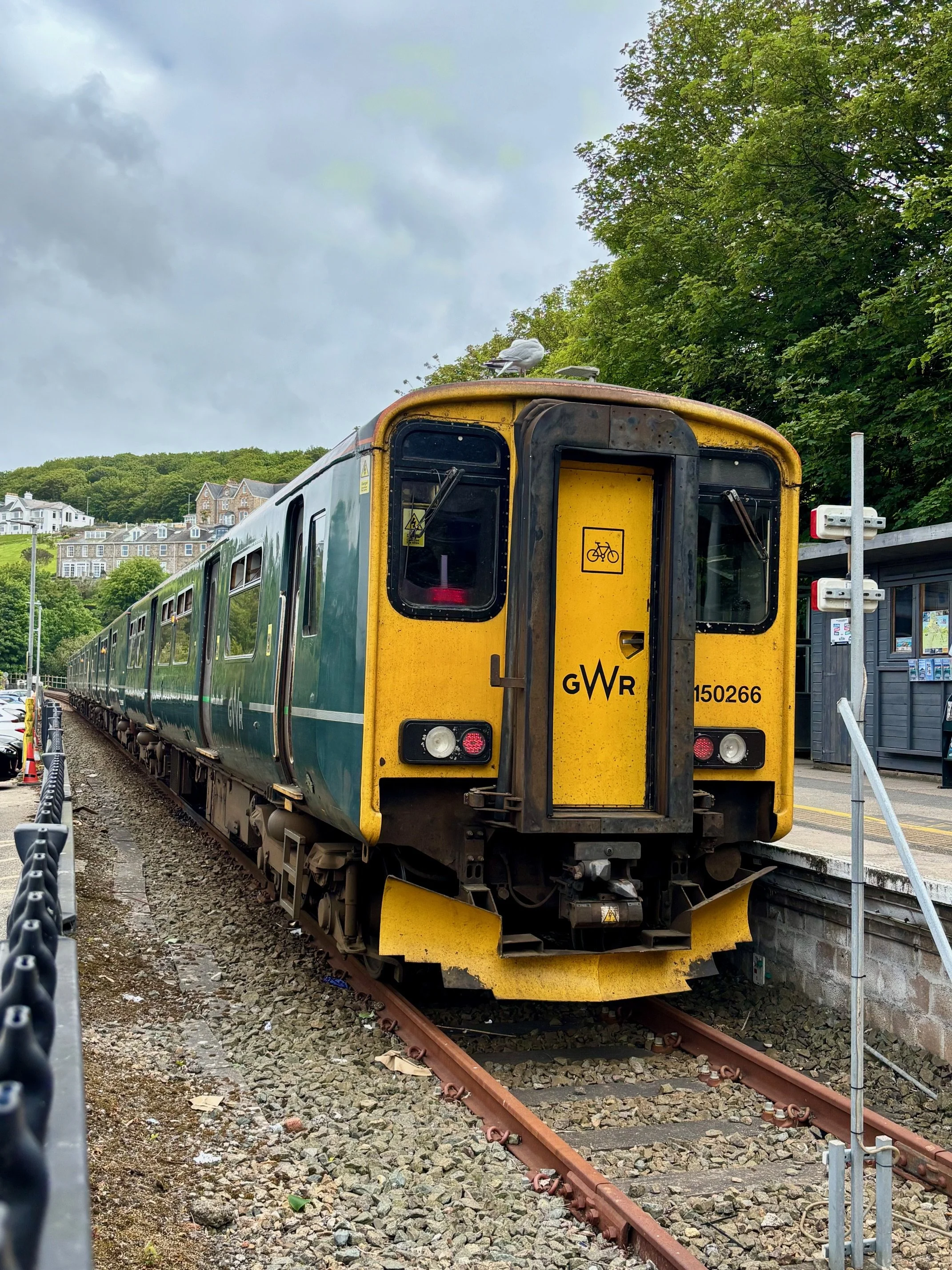
Sprinter Unit 150 266 with 150 232 make up the 4 car train at the single platform St Ives branch terminus.
The original station here was a few hundred yards further on but the line was cut back some years ago to allow the building of a larger car park.
Cornish Main Line: St Erth - Penzance
At St Erth, I recrossed the footbridge to the down main platform to await my final train of the day, just one more stop to the end of the line at Penzance. The 1650 departure which I intended to catch was running about 10 mins late, but as this was a through train from Paddington, a short delay of this nature was not unexpected. I boarded the front coach of IET set 800 302 for the brief 10 min run to the most westerly and southerly station in England.
En route, we passed the site of the closed station at Marazion, at which point the line skirts the coast along Mounts Bay, with views of St Michael’s Mount (reached by a causeway at low tide, but covered by the sea at this time). The double track main line goes into single track past Long Rock Depot, where trains are stabled and maintained. Finally, we came into Penzance Station, terminating under the overall roof in one of the four platforms.
Next door, Penzance Bus Station, which will feature in Part 2 of my Cornish Adventure, when I sample the local Go Cornwall bus network in the area. However, for now, I retired to my hotel for some rest and relaxation until the morning.
Watton
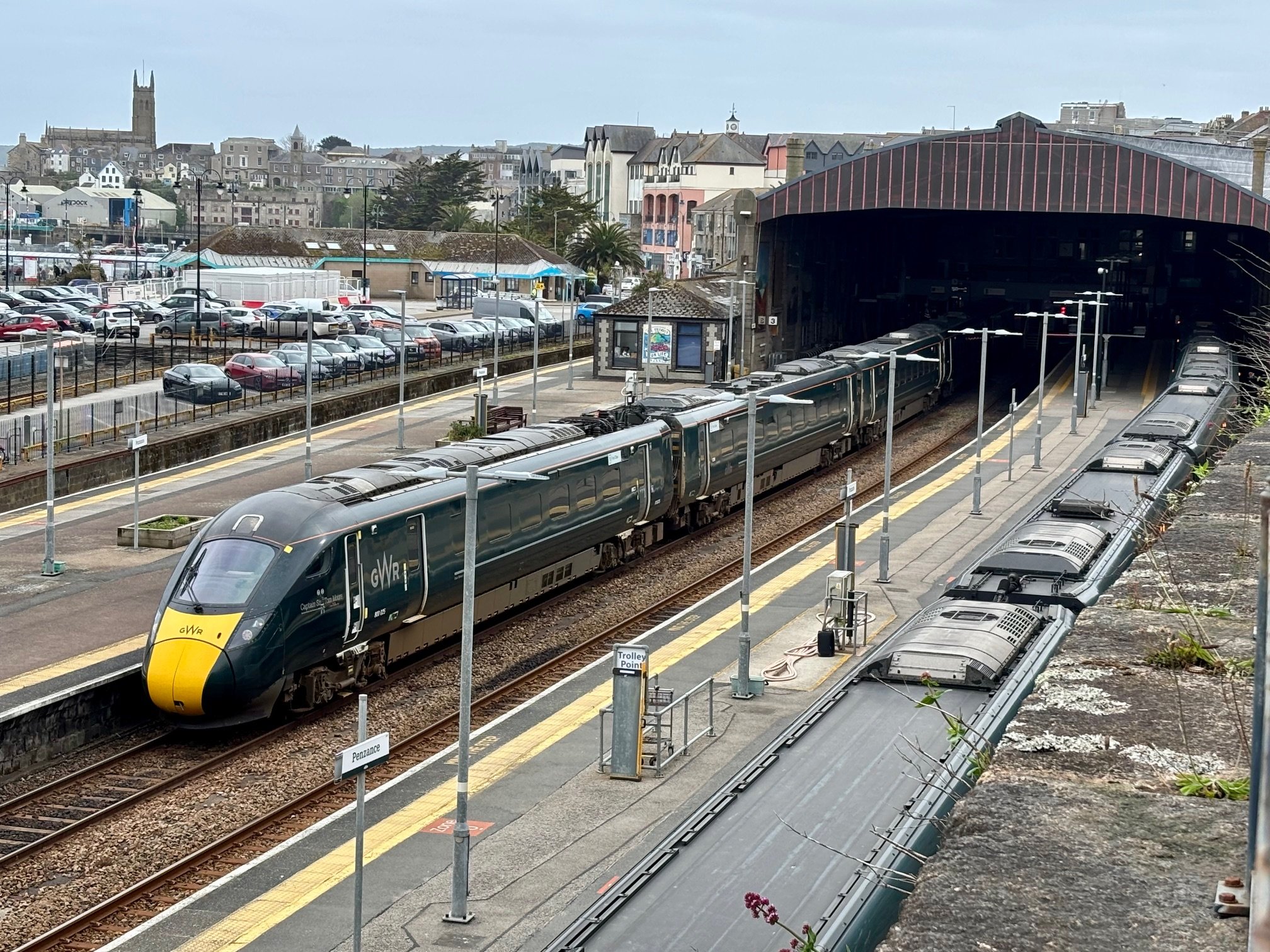
This really is the end of the line! View of Penzance Station after I arrived on IET no 800 302, the roof of which can be seen on the right. In an adjacent platform to the left, a better view of set no 800 025 named “Sir Tom Moore”, after the famous World War II veteran and fundraiser, waits to depart with a service to Plymouth.
Penzance Station is the furthest west station in England and the furthest south in Great Britain. It is 326 miles from Paddington per the mileposts (measured via Bristol) or 253 miles direct.
