
Heritage Buses: Zeroing In On Essex
On this adventure, I focus on a couple of Heritage Bus operations in Essex, riding the 339 between Epping & Shenfield and then visiting the recently opened Zero2 Bus Museum at Great Yeldham.
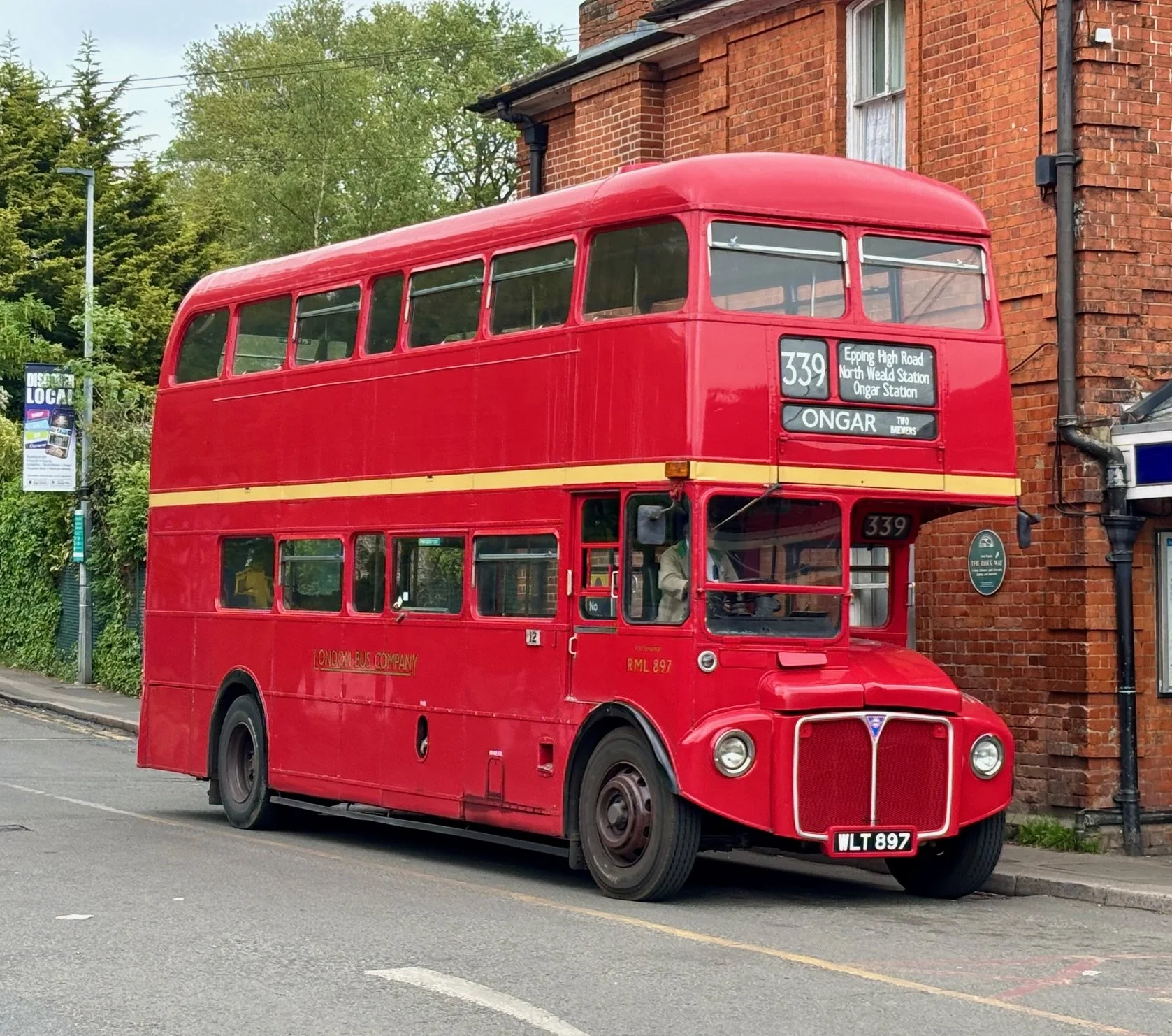
My journey began at Epping Station, where the London Bus Company’s Routemaster RML897 is seen on a 339 working to Ongar Two Brewers. I awaited the next departure through to Shenfield Station.
This was one of the first batch of longer Routemasters, which entered service on the 104 at Finchley Garage in 1961. It ended TfL service on the 38 at Clapton Garage in 2005 and was later bought by the London Bus Company, owned by Roger Wright.
Personal History of the 339
I first became acquainted with the 339 in London Country days during the early 1970s, when it was operated by Harlow (HA) Garage between Harlow, Epping, Ongar, Brentwood and Warley Fords. I well recall various visits to Harlow to ride Green RTs on the 339, together with the 397 (Harlow - Bishop’s Stortford) and the M-F Peak Hour 396 (Epping - Bishop’s Stortford). All this came to an end in 1976, when the Harlow RTs were replaced at short notice with Southend Transport Leyland PDs, which were “on hire” to London Country and were replaced in due course by RMLs. However, I managed a final RT ride on the 339 in March 1976, just before the end.
The 339 eventually disappeared, the original route being covered these days by Central Connect 20 between Harlow, Epping & Ongar and NIBS Travel 21 between Ongar & Brentwood. However, I was able to recreate parts of the 339 with RT operation in subsequent years on running days in connection with the Epping Ongar Railway and, more recently, on the regular reinstated 339 between Epping, Ongar & Shenfield, which runs during the spring, summer & autumn when the railway is open as a feeder to North Weald and Ongar Stations.
Today’s Heritage 339 generally uses RT and RM family vehicles from the London Bus Company, headed by Roger Wright. I have ridden the route a few times in recent years, my personal favourite being a “rounder” on Green RT1700, which evoked memories of past London Country days. If someone had told me in 1976 that I would still be enjoying RTs on this service 50 years later, I would never have believed them!
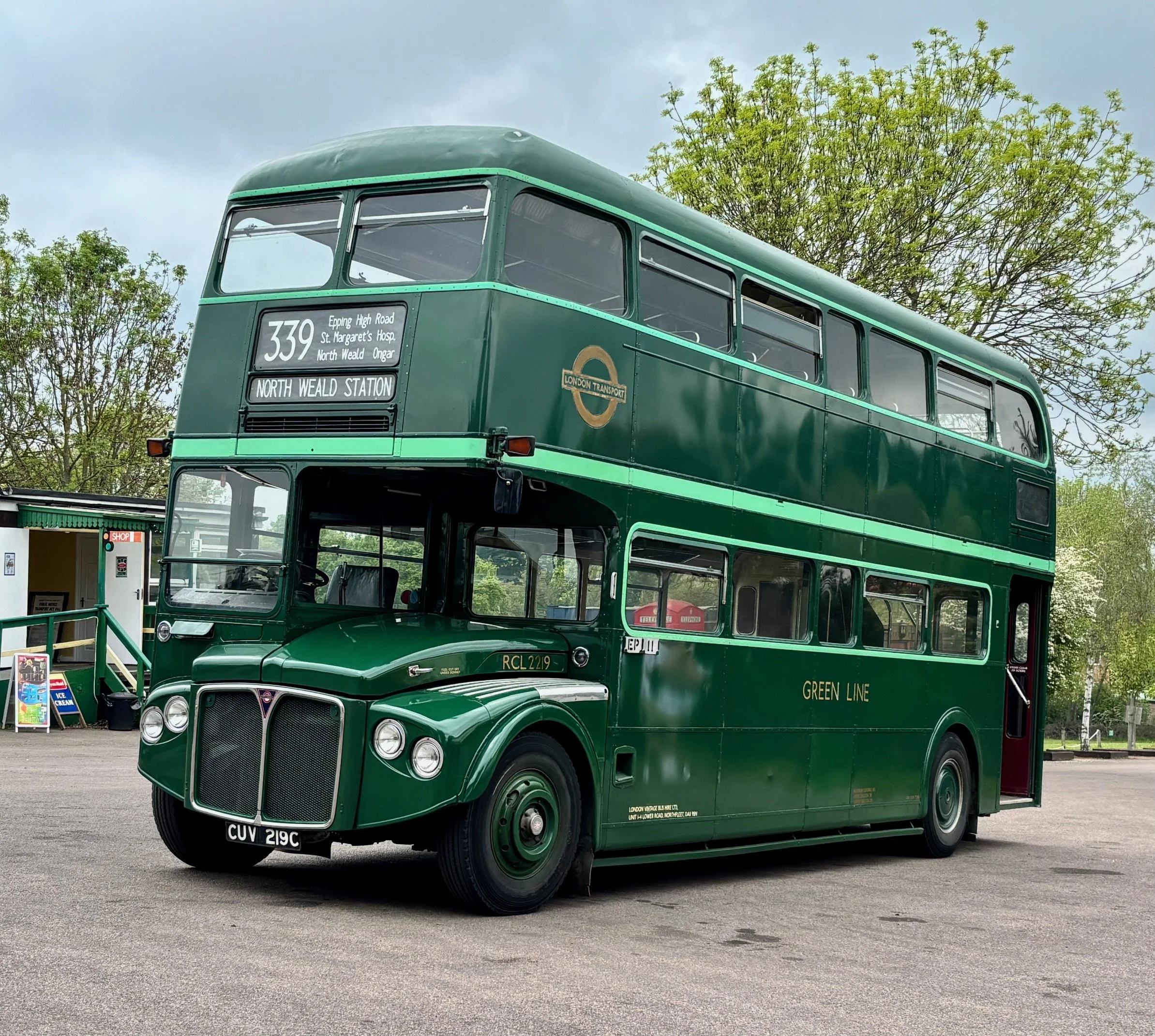
Also out on the 339 when I travelled was RCL2219, restored by the London Bus Company to “Green Line” condition. Seen parked up between duties at North Weald Station.
This bus was new in 1965 and ran on routes 721, 722 & 726 from Romford London Road Garage. It was one of those re-purchased by LT from LCBS in 1980 and repainted red for use on the 149 from Edmonton Garage. Withdrawn in 1985, it passed through various owners before ending up with the London Bus Company.
Route 339: Epping - Shenfield
Arriving at Epping Station around lunchtime on a Sunday, the first departure on the 339 was in the hands of RML897, which was working a short journey to Ongar. However, I awaited the next working, operated by RT2799, one of two preserved in “Blue Triangle” red and cream livery, these vehicles having received this scheme for use on the Summer Sunday 622 between Harlow and Great Yeldham, operated under contract to Essex County Council and which I had ridden back in 1988/9. It was a treat to rediscover this bus so many years after last having been on it.
Today’s 339 is operated by the London Bus Company mainly as a feeder to the Epping Ongar Railway at North Weald Station, but although the railway was running, there were only a handful of passengers joining at the start of this trip. Two bells from the conductor marked our departure and we made our way up the hill to Epping Town, where we picked up a few more local riders to North Weald, who were using us instead of the “normal” bus on Central Connect Route 20.
A brisk run through Epping Forest and past North Weald Airfield to North Weald Station, where there was a scheduled pause of 7 mins and a crew change. Then we continued through the village and onto the winding country stretch via Blake Hall to Ongar, where there was a passenger exchange at the station. Onwards past the “Two Brewers” terminus and then onto the pleasant rural section via Kelvedon Hatch and Pilgrims Hatch, picking up a couple of passengers, one of whom was obviously a regular known to the conductor and the other on their way to work in Brentwood who was making use of the Sunday service now provided only by this route.
On arrival in Brentwood, we dropped some of our customers, before the short run along the main road to Shenfield, turning off down to the terminus outside Shenfield Station. This involves a 180 degree turn just past the railway bridge, which our RT accomplished in one go, but which the longer Routemasters often have more difficulty with according to the conductor! Our total journey time was around 55 mins from Epping, a great run.
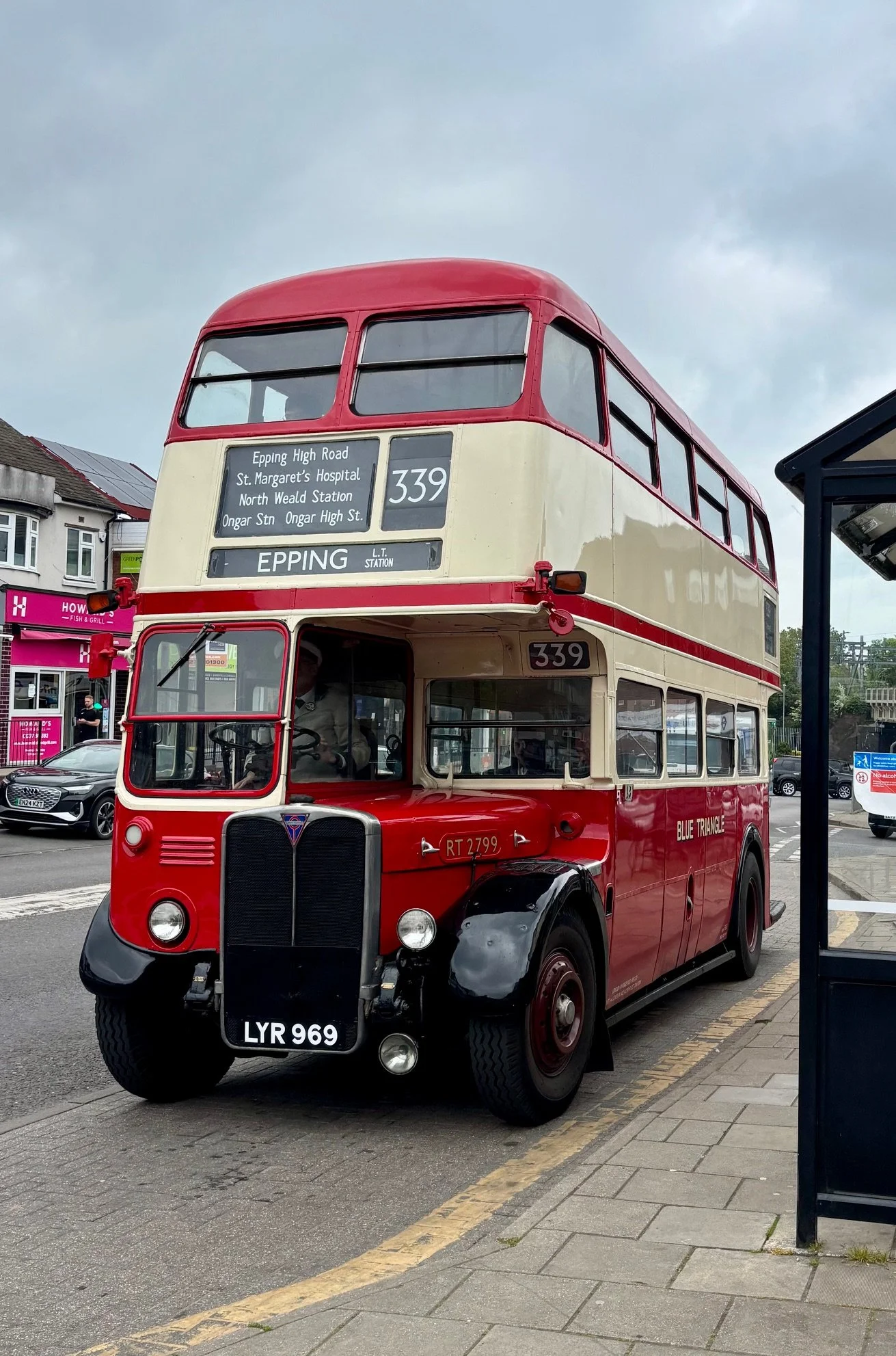
AEC Regent III RT2799 in “Blue Triangle” livery at Shenfield Station after my ride aboard from Epping. This was one of the buses used on the Summer Sunday 622 (Harlow - Great Yeldham) in the late 1980s.
New in 1952, it operated at various garages, until ending its LT days at Barking in 1978. It was bought by Roger Wright and, after use on the 622, was preserved in store before being restored more recently.
Route 339: Shenfield - Epping
After a short 5 min break, we began the return trip with a small number of takers, including one to Ongar. Back through Brentwood, with a couple of short riders picked up for Pilgrims Hatch, then on over the country roads passing the Top Secret Nuclear Bunker at Kelvedon Hatch, now a museum open to the public, with lots of signage contrary to its name!
All too soon we were back in Ongar, with a few passengers on and off, before a fast run to North Weald once again. Another pause at the station, before resuming the ride to Epping. Arrival at Epping Station was around an hour after leaving Shenfield, after an interesting round trip on a historic bus which evoked memories of former times.
Whilst the original 339 was RT operated on M-S back in London Country days, on Sundays it was one man operated with RFs by that time, RTs having been replaced on that day somewhat earlier, so our run was a reminder of a previous era.
For those wishing to ride the 339 or visit the Epping Ongar Railway, the 2026 timetable with dates of operation is shown below.
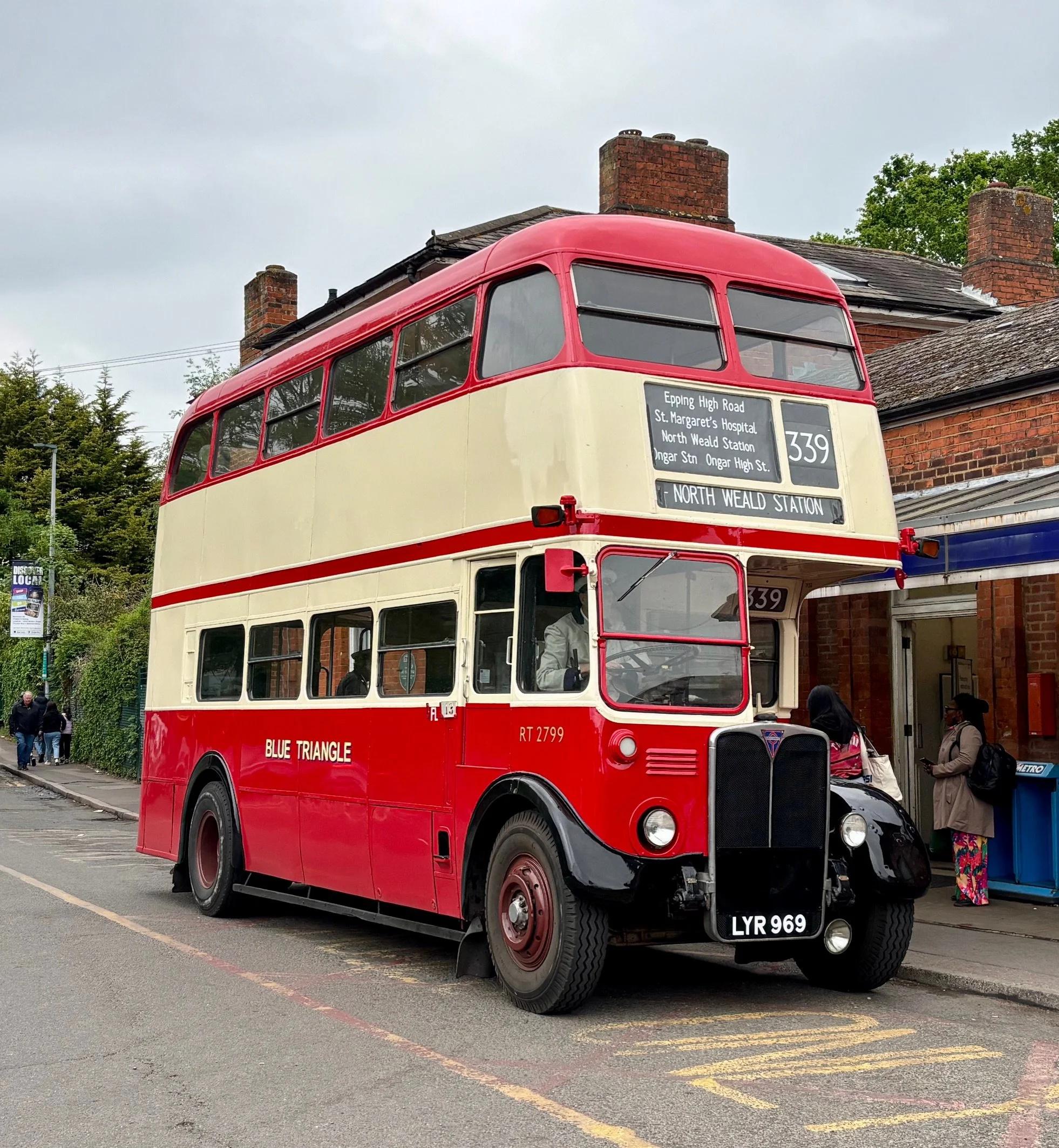
Offside view of RT2799 at the other end of the 339 at Epping Station at the conclusion of my rides for the day, before returning on a shortworking to North Weald.
Sister RT2150 is also preserved in this livery.
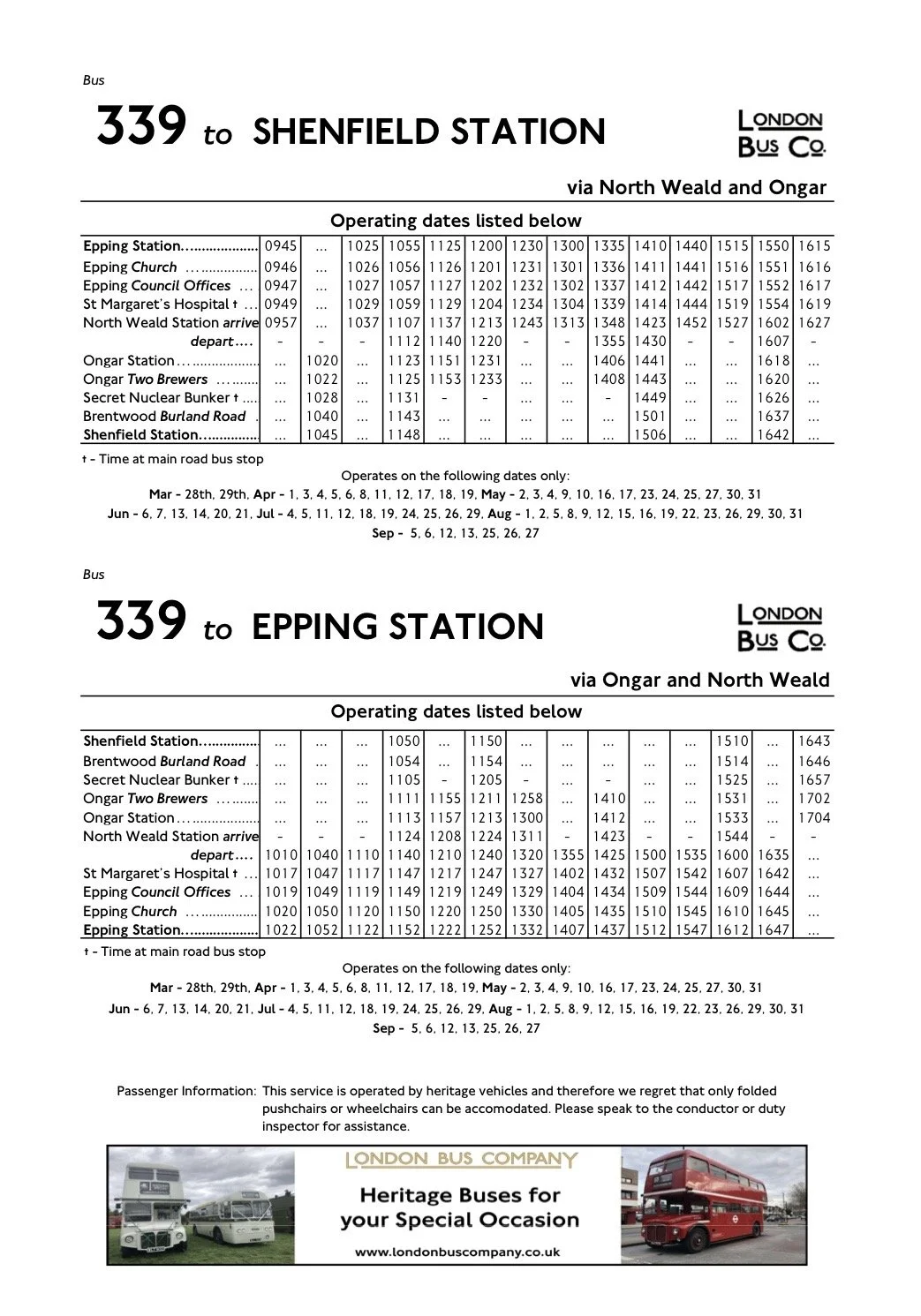
London Bus Company Timetable for the 339 in traditional LT style, showing dates of operation for 2026.
Zero2 Bus Museum
The heritage bus collection owned by the Newman family is well known to most bus enthusiasts and began in 1979, when ex London Transport RT3232 was acquired. The family owned the Ensign Bus Company, based in Purfleet, Essex, with the fleet growing over the years to around 60 vehicles. These were used for Private Hire in connection with Weddings or Corporate Events, for example, Film Work and Emergency Coverage. There were also Running Days, the most well known of which was the popular annual event based on Lakeside Shopping Centre Bus Station, with routes extending out to Upminster, Brentwood, Grays, Tilbury, Bluewater and Gravesend, amongst other places, using a variety of vehicles from the fleet.
In addition, there was an Ensignbus operation on regular local routes in the Grays area using modern buses, which was sold to First Bus in 2023, but the vintage collection was not included and the family decided to build a museum to house this. A site was found at Poole Farm near Great Yeldham in Essex, with the museum first opening to the public on Good Friday 2026.
The museum comprises two main buildings, one housing the restored buses, which range from a Jersey (JMT) Leyland of 1932 through to an Ensignbus MCW Metrobus Mark II of 1988. The London vehicles include various examples of the RT and RM family, together with representatives of the DM, M, MD and T classes. Apart from those mentioned previously, buses from other operators feature types such as the Bristol Lodekka and Bristol VR. Single deckers in the collection include examples of former London RF and T types, plus a Bristol MW and a Bedford WTB Duple, amongst others. Along the sides of the main hall housing the collection is a series of glass cases containing well over 10,000 model buses, coaches, trams and trolleybuses from around the world.
The second building includes the repair & maintenance shop, where vehicles undergoing restoration can be seen in various states of undress. There is also a display of ticketing equipment, ranging from old Bell Punch machines, through the Gibson and Setright era, to the modern electronic equipment. Another section covers destination information, going from the wooden sign boards placed on early buses, through linen blinds to the latest electronic displays.
Food & Drink is available outside from a converted First London Trident Alexander ALX400 and an Arriva Optare Versa, with adjacent wooden tables and chairs, an ex First York Mercedes Citaro bendibus providing seating under cover if required.
A connecting accessible bus service 721 operates between Zero2 and Braintree Station on weekends and Bank Holidays when the museum is open, whilst short local bus tours are run using heritage buses from the collection - see the following sections for more details.
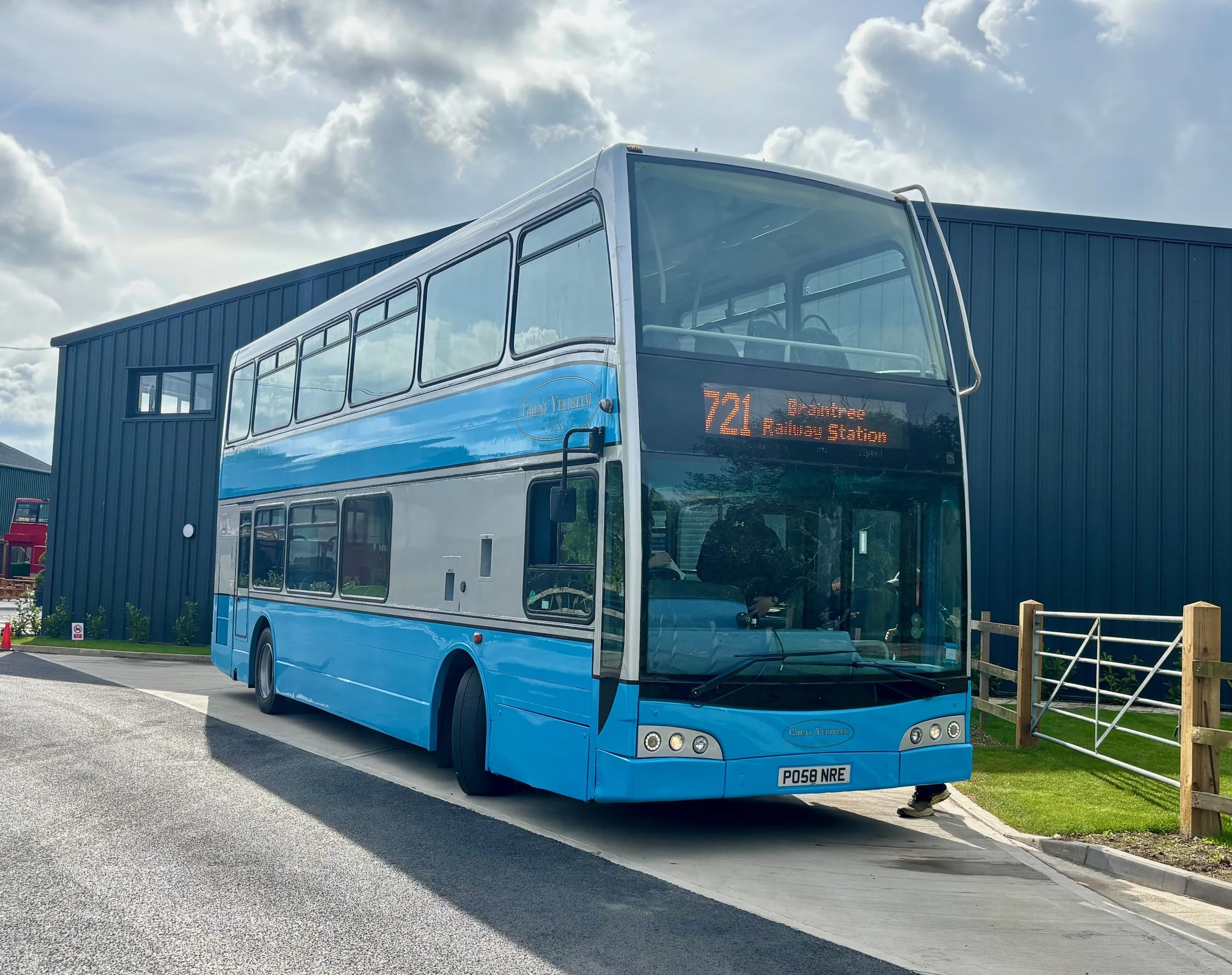
The 721 runs between the Zero2 Bus Museum at Great Yeldham and Braintree Station on days when the museum is open. Volvo B9TL Optare Olympus no 120 is preserved in Ensignbus livery but with Great Yeldham Buses fleet names.
The vehicle is seen outside the main hall of the museum before I rode it to Braintree and back.
Route 721: Zero2 Bus Museum - Braintree
Another Sunday in May and I arrived bright and early at the Zero2 Bus Museum, which is just south of Great Yeldham village, around an hour before it opened. However, this enabled me to have a coffee from the refreshment bus in the grounds and fill in the time by sampling the connecting bus service to and from Braintree Station.
This is numbered 721 and is an accessible service with low floor buses, which on the day I visited were a former Stagecoach London Enviro200 single decker in white livery and an ex Ensignbus Volvo B9TL Optare Olympus double decker in light blue and grey livery with “Great Yeldham Buses” fleet names. I rode the latter bus with just three of us on the trip from the museum at this time of day and we departed over the narrow bridge at the entrance before turning left onto the main road.
Then along the winding road through the countryside, soon passing the preserved Colne Valley Railway without stopping as it was not yet open for the day. Through Sible Hedingham and on to the next village of Gosfield, where we paused for a few minutes to await our correct departure time. More pleasant country views before arriving into Bocking, with its Grade 1 listed windmill and its main street with half timbered buildings. The final section into Braintree Town Centre is more built up and we made our way through the streets to connect with the train at the station. Just over half an hour for the run.
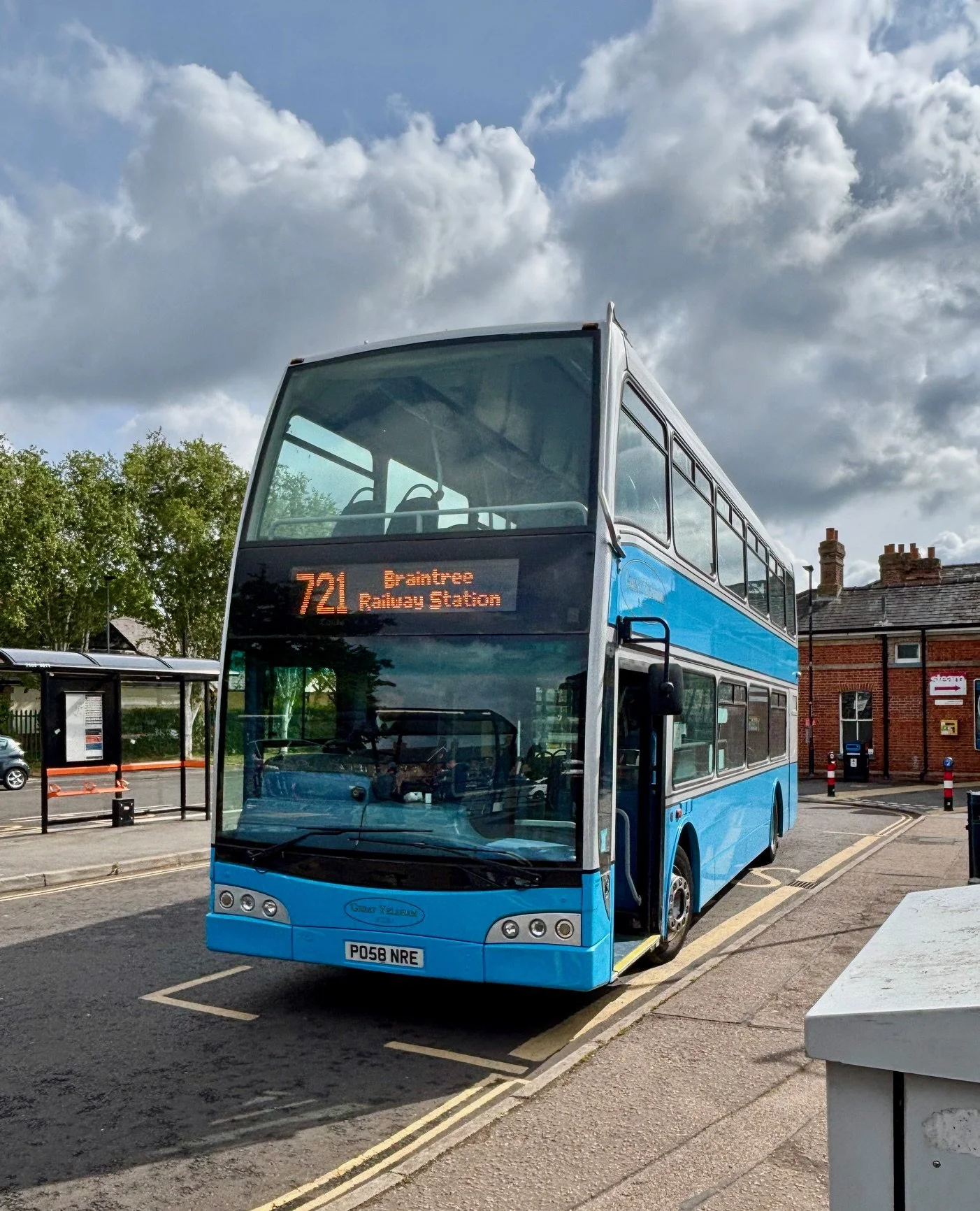
Nearside view of no 120 outside Braintree Railway Station between trips.
The second bus in service on the route when I visited was a white Enviro200 single decker formerly with Stagecoach London.
Route 721: Braintree - Zero2 Bus Museum
A 15 min break and we departed from Braintree Station with just me and the driver on board, although this is early days for the museum and hopefully more visitors will make use of this connection over time as people become aware of it.
A few more joined en route and we made our way back through Bocking, Gosfield and Sible Hedingham, this time turning in to the Colne Valley Railway station, which was now open. Then on to the Bus Museum, which was now open and where I alighted after another trip of a touch over 30 mins.
The 721 operates 3 return trips in the morning and 3 in the afternoon, with a gap at midday. The full timetable is shown at the end of this article.
I then entered the museum, which comprises two main buildings as described above. These are illustrated below.
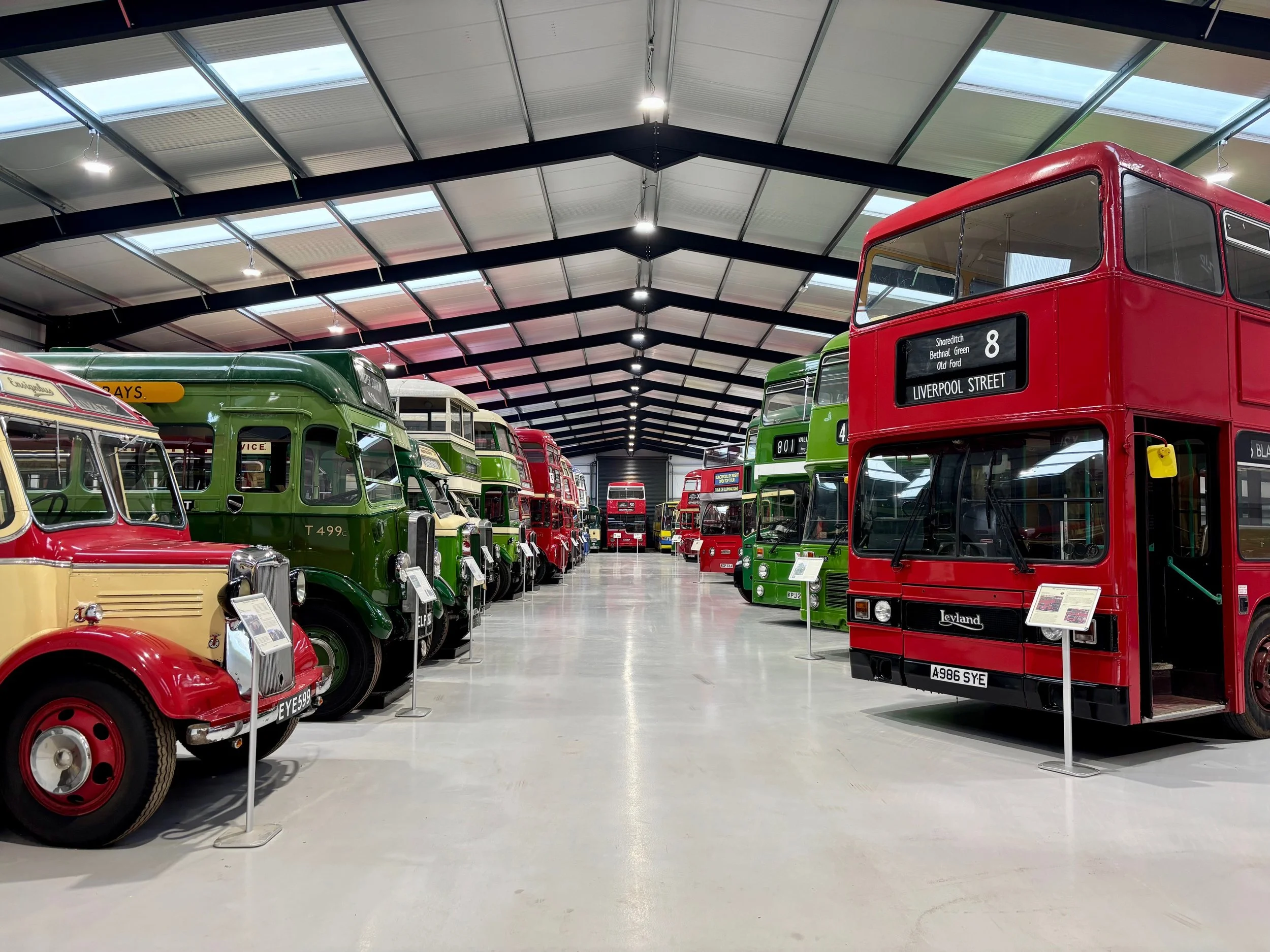
General view of the main hall at the Zero2 Bus Museum showing the extensive collection of vehicles, which includes ex London Transport, London Country and other operators’ buses.
At the far end, MCW Metropolitan MD60 can be seen in the centre, which was sporting special blinds to celebrate 50 years of the class which entered service in 1976.
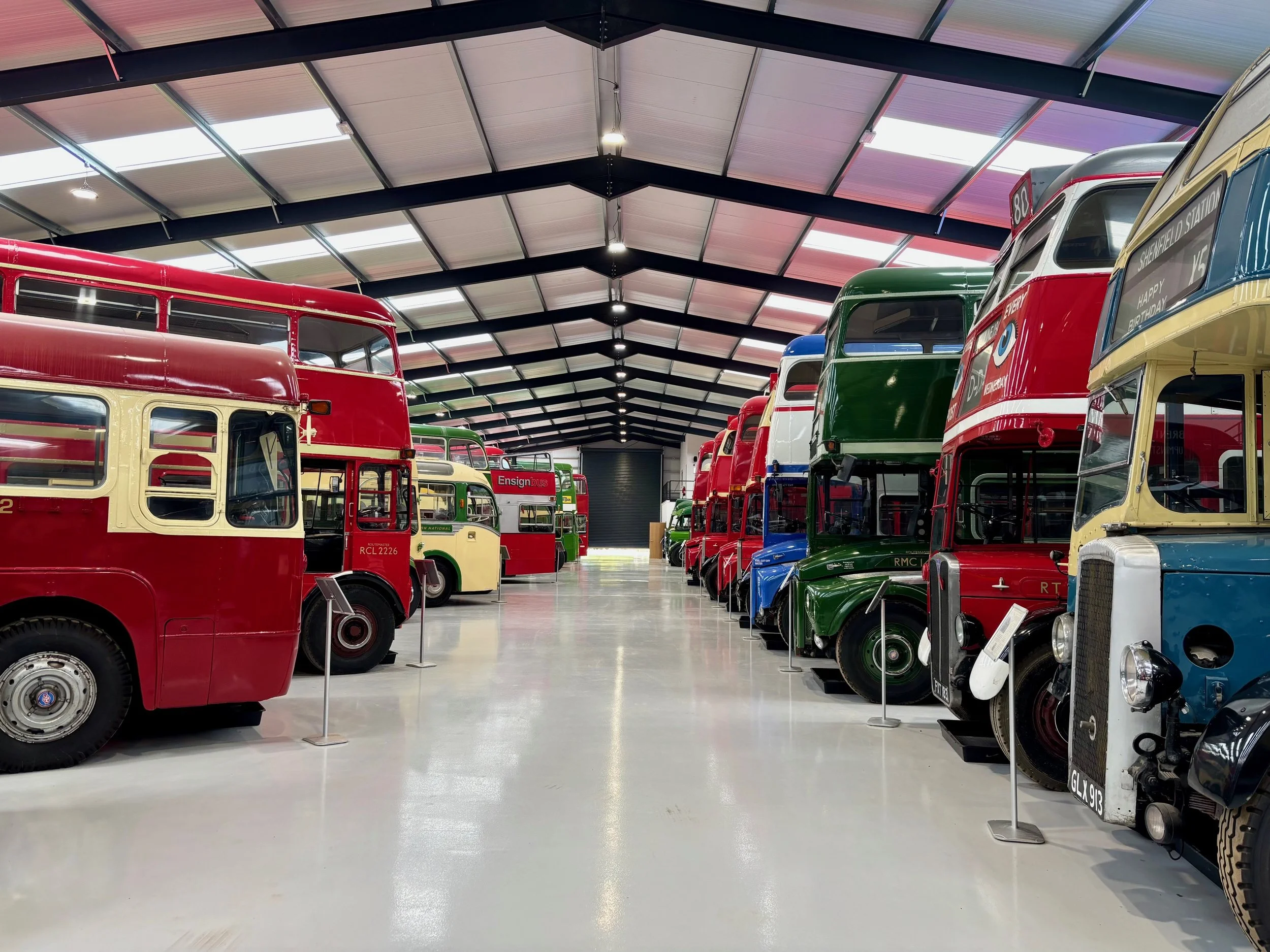
Another view of the large collection of preserved buses at the museum, seen from the opposite end of the main hall.
The collection comprises around 60 vehicles in total, dating from 1932 to 1988.
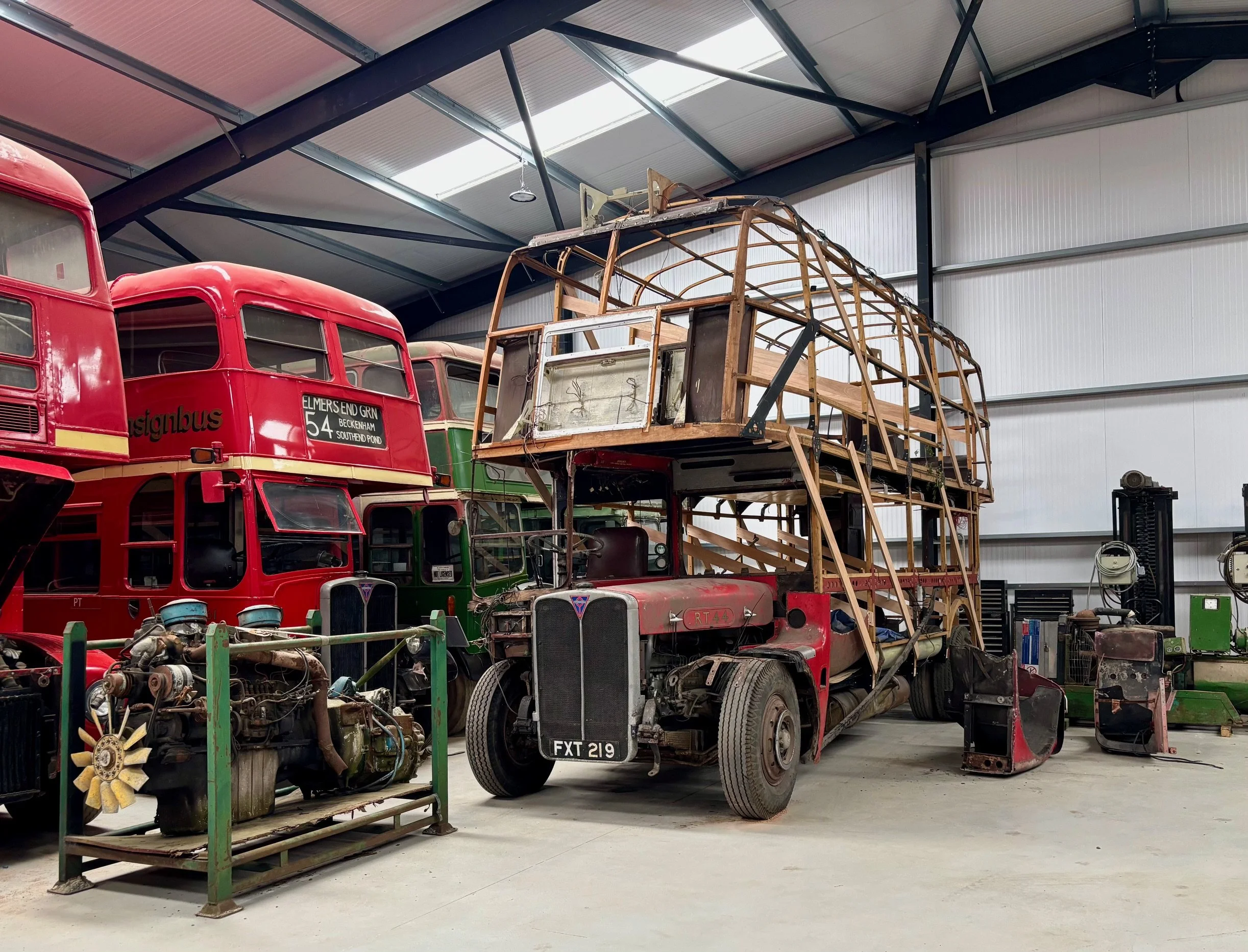
Over in the repair shop, Pre War RT44 is at early stage of reconstruction.
The extensive amount of work required is clear from this view!.
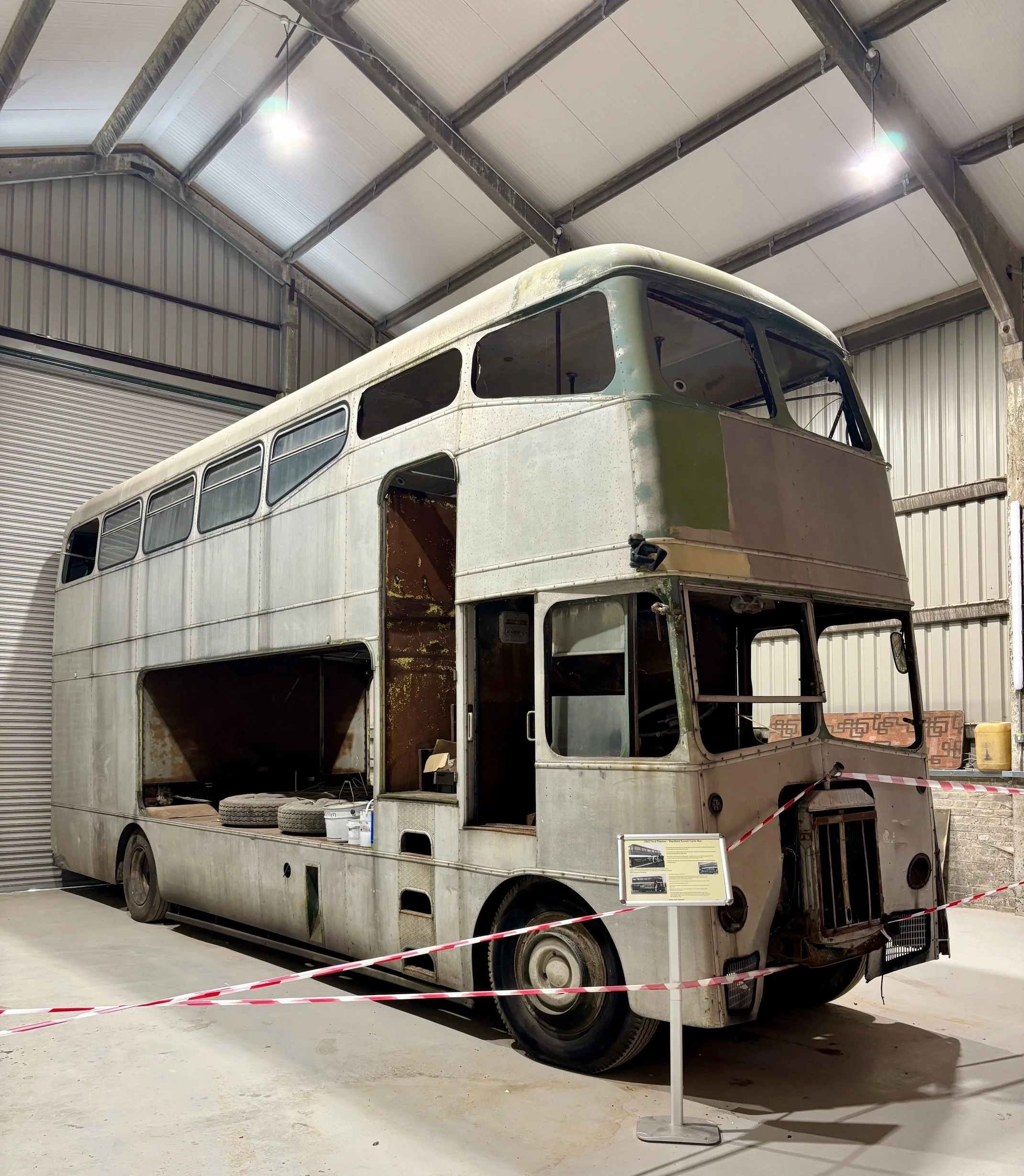
Also undergoing rebuilding in the repair shop is this rare and unusual Thames Trader double decker with Strachans bodywork. LT operated five of these odd vehicles through the Dartford Tunnel from 1963-65 for cyclists.
The bicycles were stored in racks on the lower deck behind the staircase leading to the seats on the upper deck. Although loading and unloading was from a platform, the steep steps presumably reflected LT’s belief that cyclists were incredibly fit individuals!
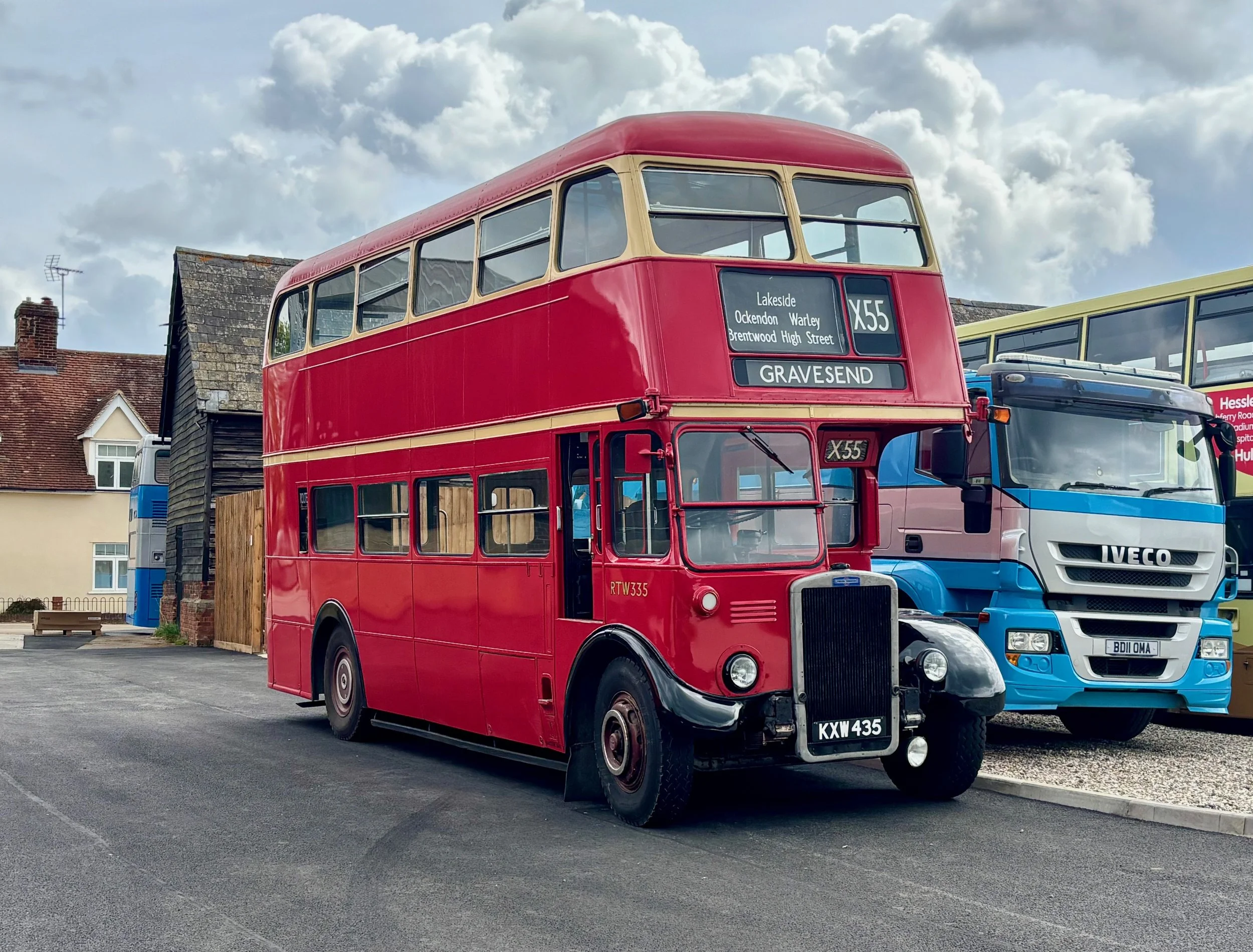
Free rides are provided from the museum to the Roughacre Brewery at Clare, over the border from Essex in Suffolk. RTW335 stands ready to perform the first trip of the day which I rode.
New in 1950 and withdrawn from normal service in 1965, it passed through various owners until purchased by Ensignbus in 2009. The bus is nicely preserved in the early livery with cream upper deck window surrounds, which was sadly discontinued later on.
RTW Ride: Zero2 Bus Museum - Clare Microbrewery & Back
In addition to the museum itself, visitors can take a ride on a preserved bus to the nearby Roughacre Microbrewery at Clare. Buses pick up from a stop just outside the main building, the vehicles used varying from day to day, with RTW335 and DM2646 being on duty when I visited. Departures are dependent on the number of visitors and are announced in advance over the tannoy system.
I took the midday trip which was in the hands of RTW335 in the early red and cream livery which the class carried in its early days until sadly discontinued later. By this time, more visitors had arrived and we carried a reasonable number on the trip, which proceeded out of the museum, this time turning right and progressing through Great Yeldham village, which has several listed buildings.
Shortly after this, we crossed the border from Essex into Suffolk, continuing along the country lanes to Stoke-by-Clare, with its pleasant village green and thatched cottages. Then through more rural idyll into Clare itself, passing through its narrow streets and negotiating a number of badly parked cars. This small market town is named after the de Clare family, who were the principal local landowners in Norman times.
Just beyond the town, we reached the Roughacre Brewery after a run of just under half an hour, where our bus reversed onto its parking spot in the car park. There is a visitor centre where locally brewed ales can be purchased for immediate consumption or take away, so I duly acquired a couple of bottles.
After around 25 mins, we all reboarded the bus and returned to Zero2 via the reverse of our outward route. An interesting run and new territory for me in an old London bus!
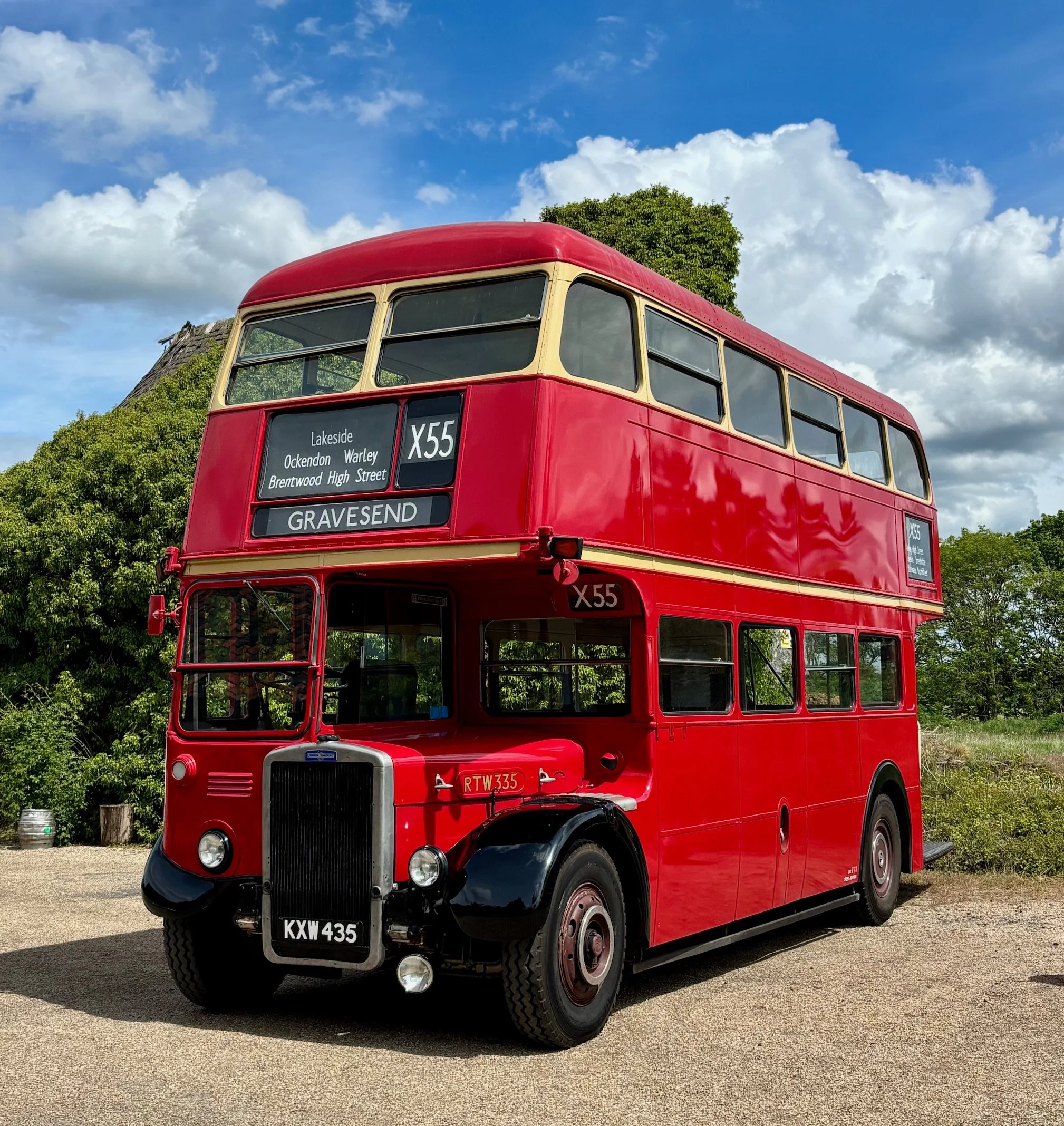
Nearside shot of RTW335 at Clare Roughacre Brewery. The X55 blinds are from one of the routes which used to operate on the annual Ensignbus Running Day in past years.
Presumably all the passengers are inside the brewery sampling the many different ales available!
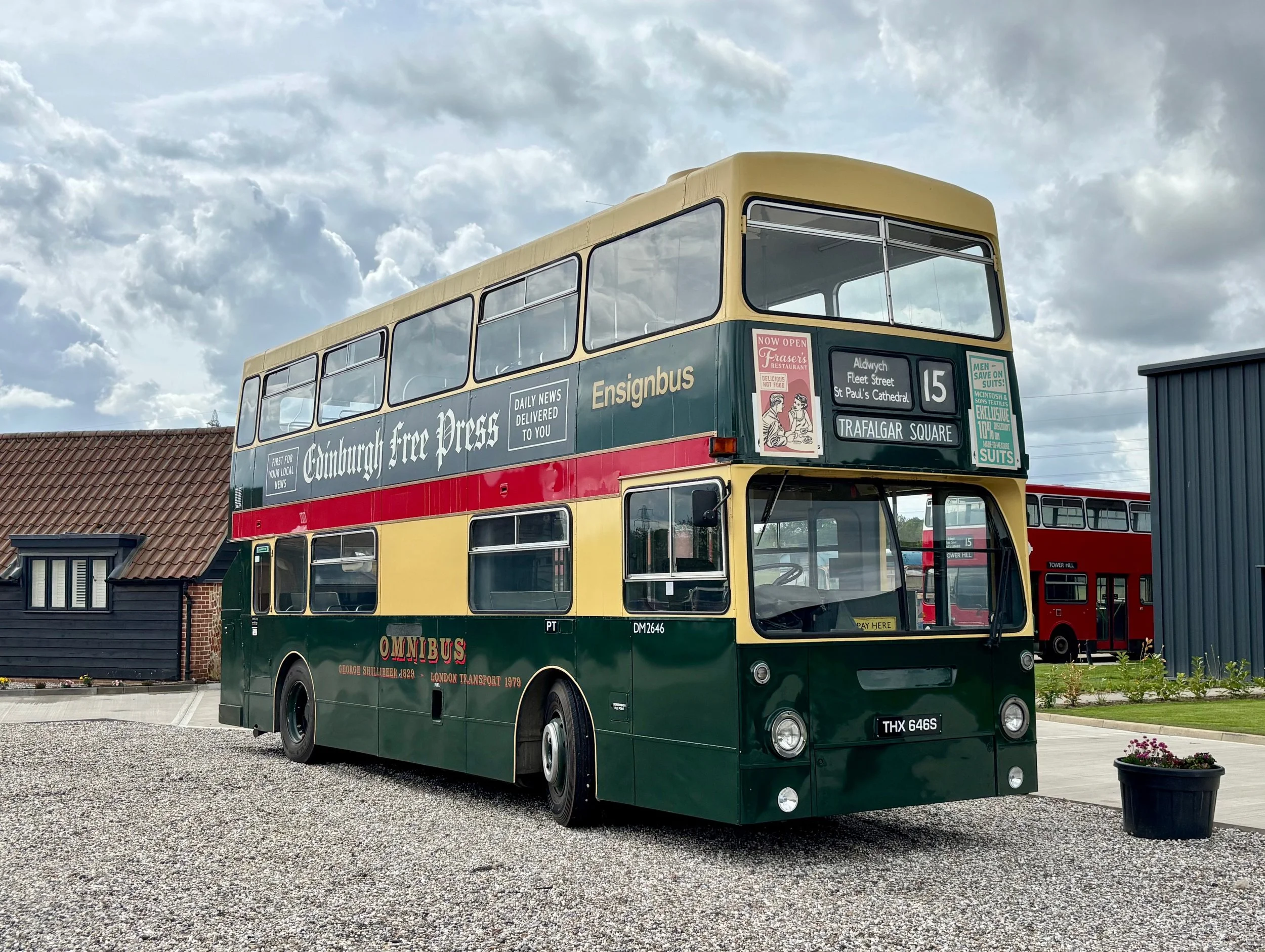
Daimler Fleetline DM2646 was the final one of the class with LT, entering service in 1978. It was restored by Ensignbus into the “Shillibeer” livery it wore when new to celebrate 150 Years of the London Omnibus in 1979 and is pictured outside the museum.
This was a Leyland B20 Fleetline, which was later fitted with an Iveco engine and ended normal service at Sutton Garage in 1992. It passed through several owners in preservation and was refitted with a Leyland engine before ending up with Ensignbus in 2004.
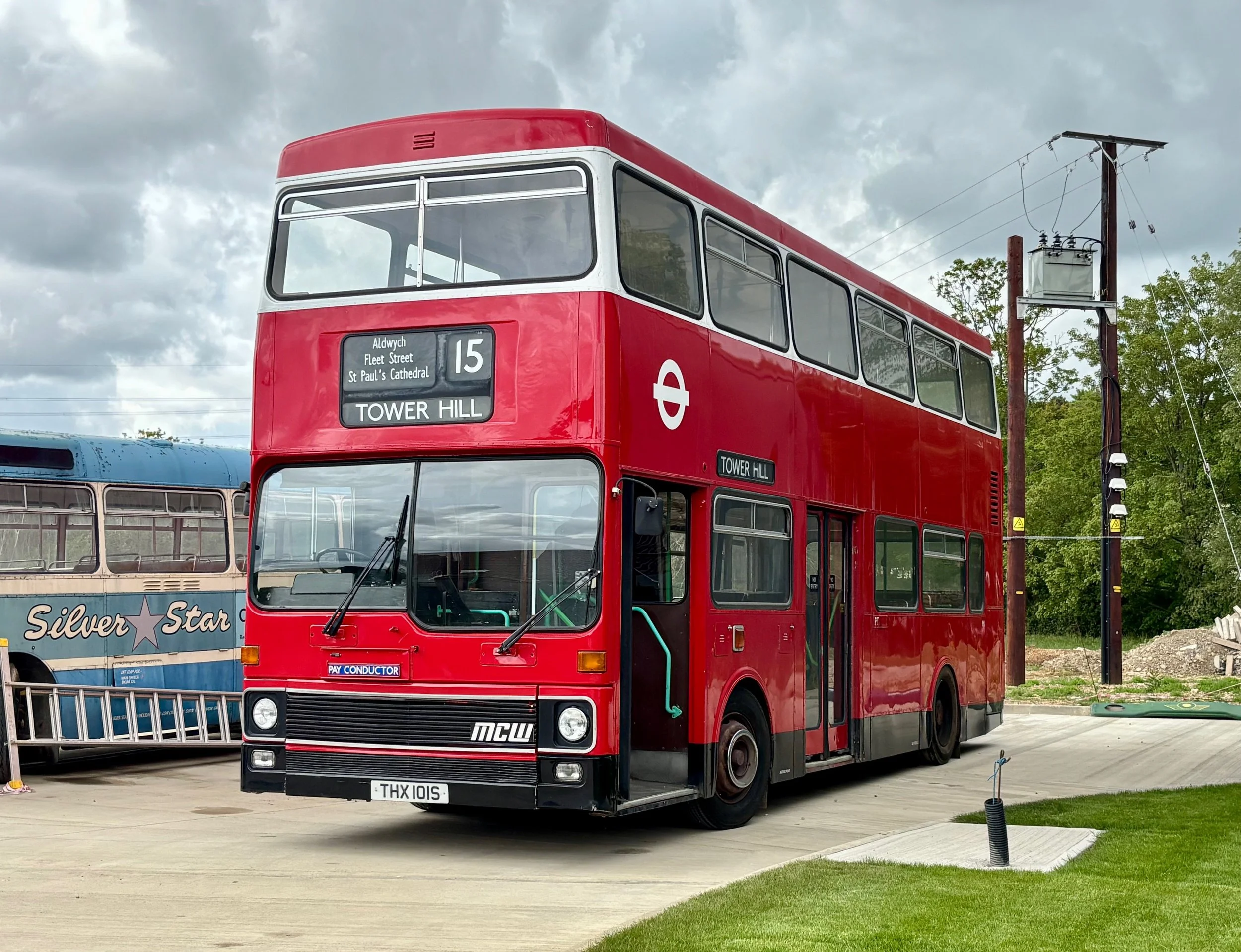
Also outside the museum, MCW Metrobus M1 was one of the five pre-production examples of the class delivered to LT in 1978, entering service initially on the 16/A at Cricklewood Garage. Becoming a trainer in 1997 and then a special events vehicle with Metroline, it was bought by Ensignbus in 2008.
The first five Ms had the three piece destination screen at the front which was replaced by a two piece version on the production models. The white upper deck window surrounds were discontinued as a cost saving measure after only a small number had been so treated.
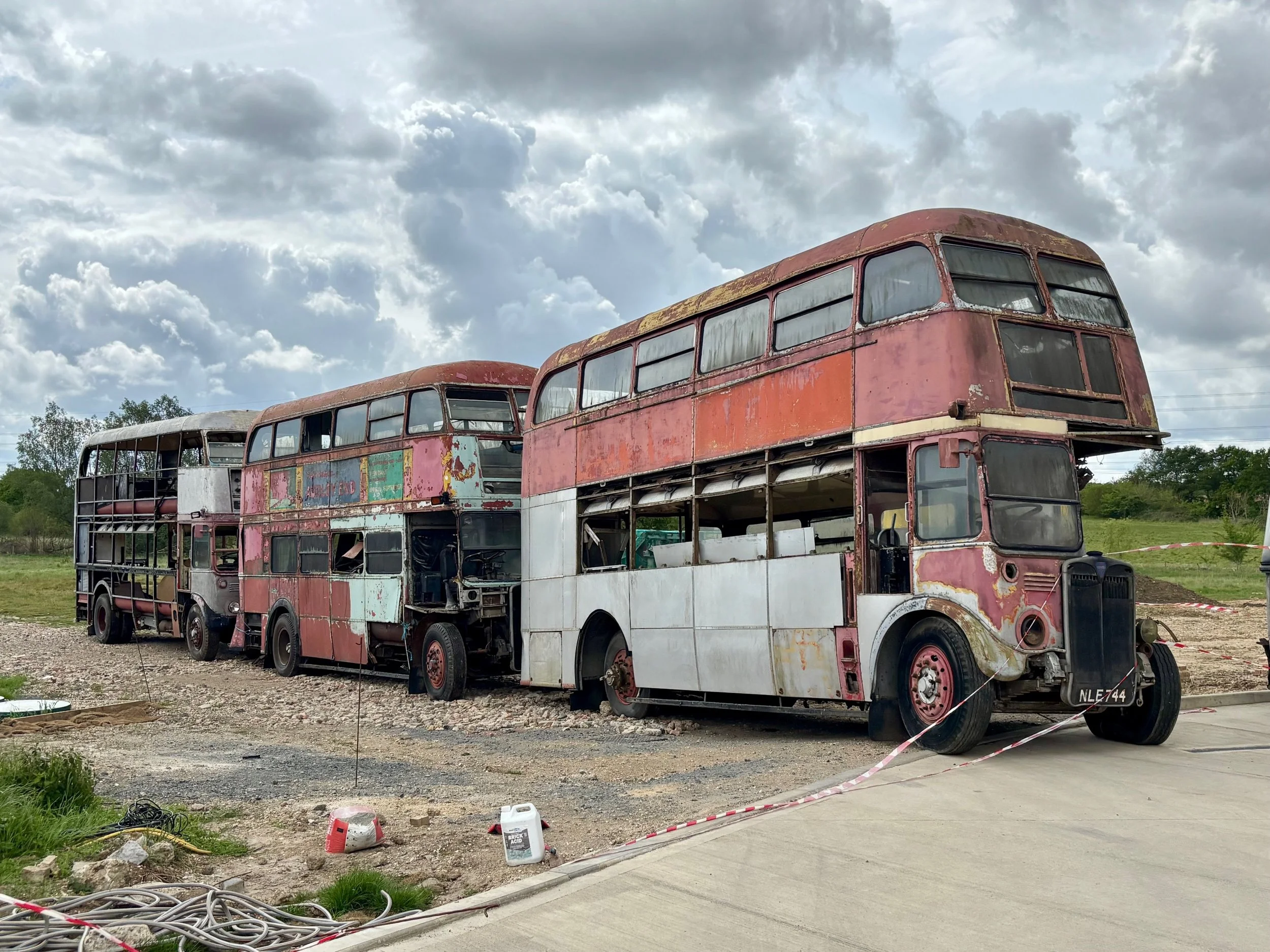
RT2976 leads a line-up of three of the class which are being stripped for spares at the back of the museum.
A sad sight but necessary to keep other examples in operational condition, given that parts are otherwise difficult to come by for such elderly vehicles.
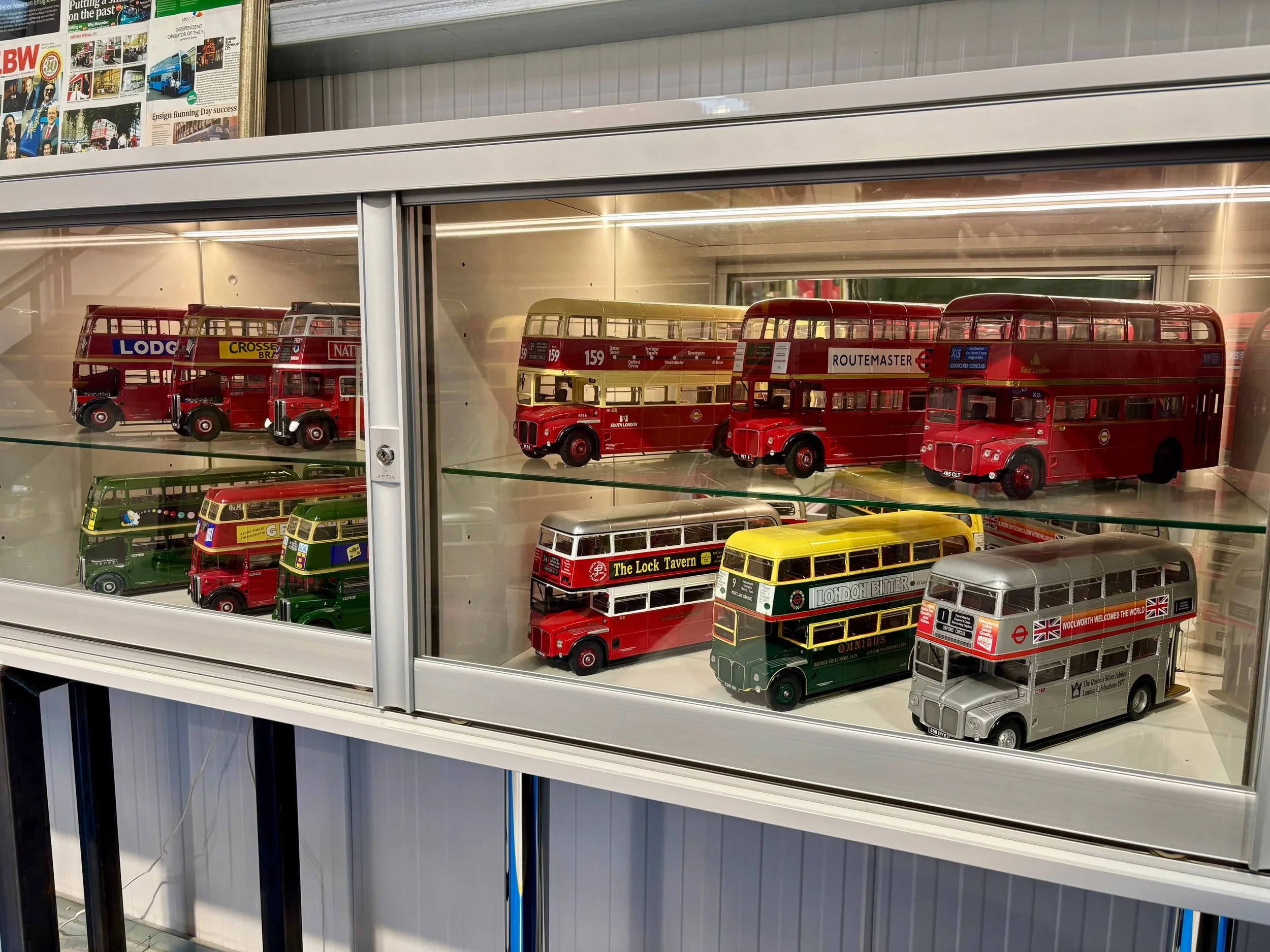
Along the sides of the main hall is a series of glass cases displaying over 10,000 models from bus fleets in the UK and around the world. Seen here are some of the larger London RT & RM class models in various liveries.
The museum also has collections of ticket machines and bus blinds adjoining the repair shop.
Future Developments
The Zero2 Bus Museum is an interesting development for the bus enthusiast and the wider public which deserves to succeed. It was a pleasure to see the collection of preserved buses all together, which evoked many pleasant memories of past running days when I had ridden several of the vehicles.
During my visit, I was privileged to meet up with owner Peter Newman and have a chat over a coffee in the outside seating area. I asked whether it was possible to operate preserved buses on the connecting 721, to which it was explained that, as a registered service, it had to comply with current accessibility requirements, especially as there is no other parallel “normal” service bus. In addition, the wish was to make the museum site itself fully accessible for visitors. I also enquired about whether there would be future running days from the museum, in the style of the former Ensignbus events based on Lakeside. This is under consideration, but if it did go ahead, would likely be fairly limited due to the narrow entrance to the museum restricting the number of departures and arrivals that would be possible, plus the lack of suitable turning points in the local area. A case of wait and see I think!
For more information on the museum including dates/times of opening and prices, see the 721 timetable below and visit the website on
https://www.zero2busmuseum.com
Watton
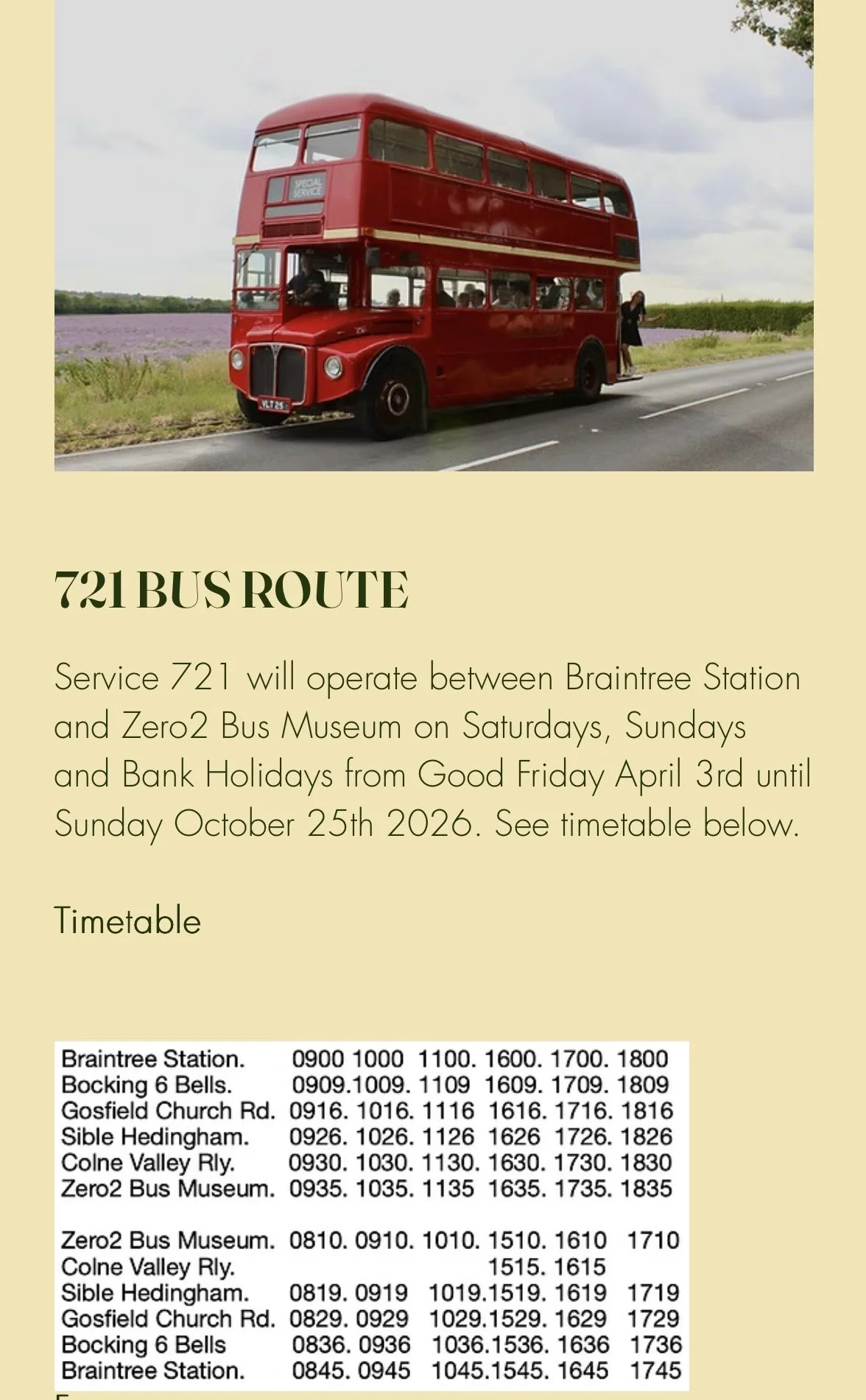
Timetable for the 721 showing operating days for 2026. This provides a useful connection for those arriving by rail, although car parking is available at the museum if required.
Despite the picture of RM25, low floor vehicles are normally used on the route.
