
Heritage Bus Running Day - Route 213
The second Saturday in June saw another in the series of popular Heritage Bus Running Days organised by the London Bus Museum. This time, the main focus was on Route 213 between Sutton Garage and Kingston, with a smaller operation on part of Route 293 between North Cheam and Epsom.
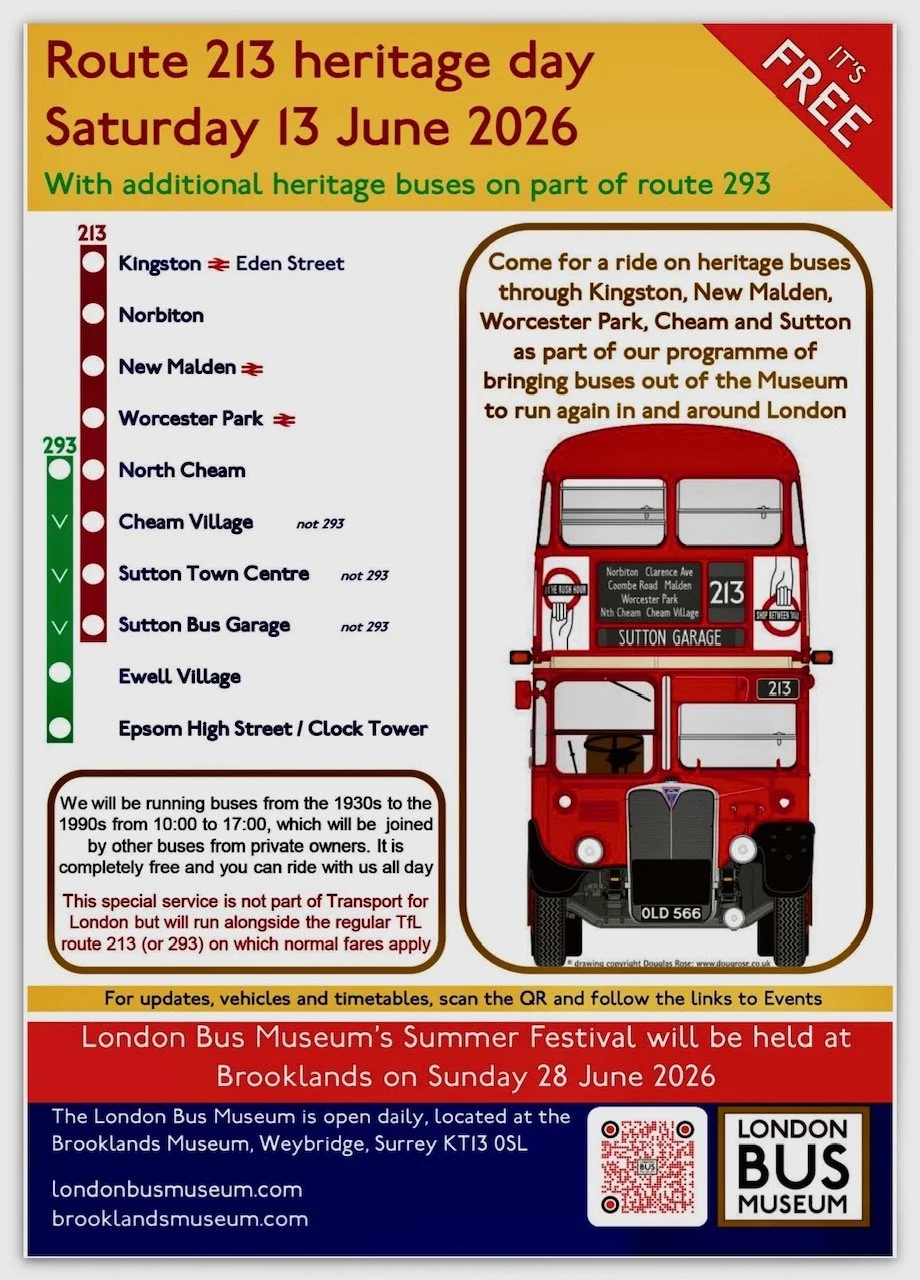
The London Bus Museum flyer showing the details of the Running Day on TfL Route 213, plus the subsidiary operation over part of the 293.
The London Bus Museum website link for the event also included a full timetable and an allocation list.
Routes & Timetable
The main Running Day route was over the current TfL 213 between Sutton Garage and Kingston Fairfield Bus Station. Heritage Buses of various eras from the 1940s to the early 2000s ran at least every 10 mins over the whole route between about 0930 & 1800, with some additional “short” journeys from each end, plus a few early evening trips.
The subsidiary operation was over the North Cheam to Epsom Clock Tower section of TfL293 at broadly 20 min intervals and featured more modern “low floor” preserved vehicles. Many of these journeys changed at North Cheam to/from 213s to/from New Malden or Sutton.
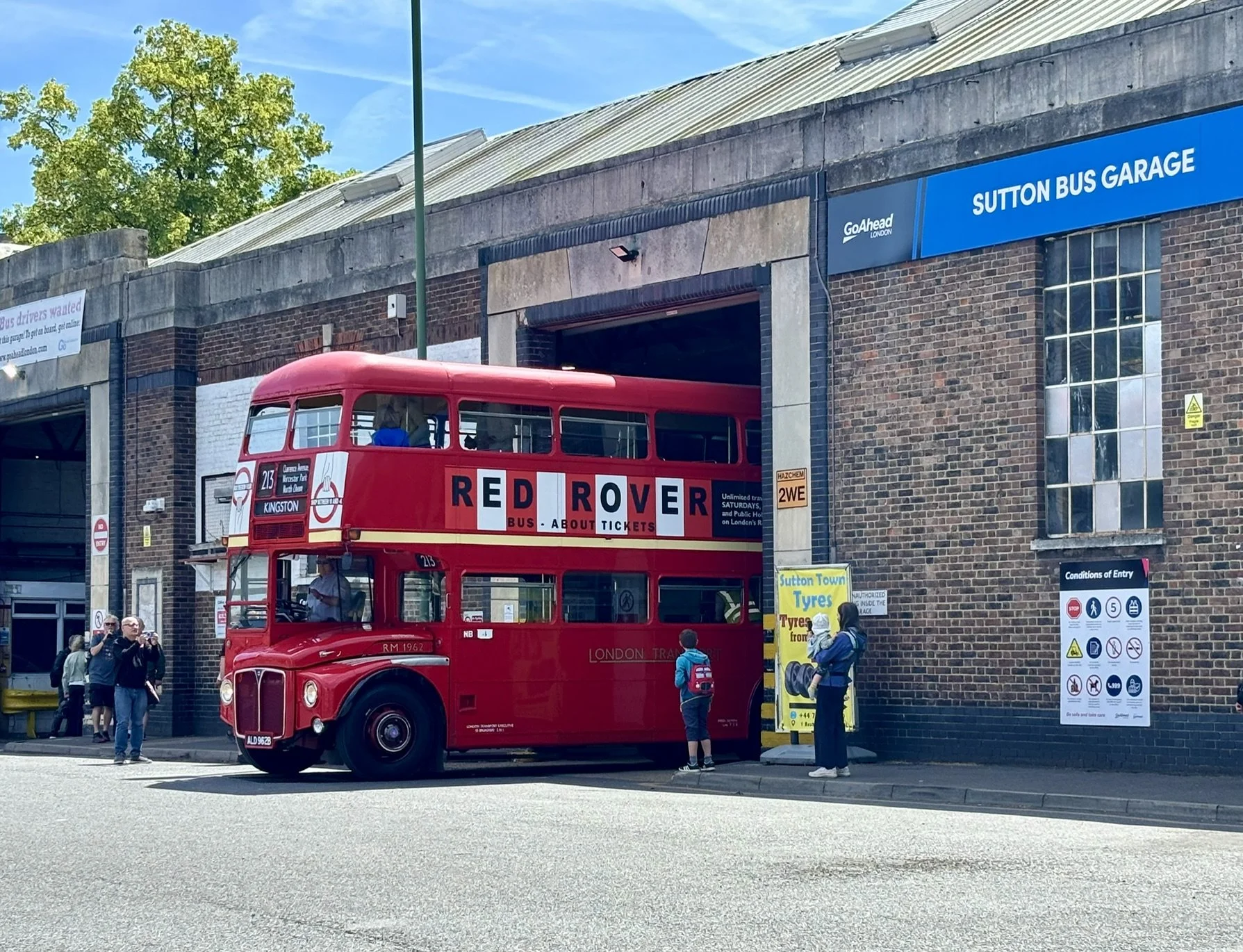
AEC Routemaster RM1962 with running number NB4 emerges from Sutton Garage during the Running Day to commence a journey on the 213 to Kingston.
Norbiton (NB) Garage had a small RM allocation on the 213 on Sundays only for a short time in the 1960s, the main Sutton (A) Garage share being RT.
The Vehicles
A total of 36 buses were scheduled for the Running Day, mostly ex London, although there were one or two “no shows”, presumably due to mechanical issues.
Double deckers included several RMs but only one (of the scheduled two) RTs, which was a disappointment to some, as the 213 was more associated with the latter than the former for much of the 60s and early 70s. No DMSs were seen, although a couple of Metrobuses were in service (a type which appeared on the route in the 80s and 90s) and one Titan (a type not associated with the route). The unique Front-Entrance Routemaster, FRM1, was also out to play. Examples of more modern “low floor” classes included PVL104, WVL38, TA324 and Stagecoach Scania OmniCity 15001.
Single deckers featured a number of RFs, both red and green, plus a few Leyland Nationals. Older museum vehicles T448 and T792 appeared, whilst at the other end of the scale, there were a few low floor Darts:- London General LDP20, First DML41424 and Stagecoach 34359.
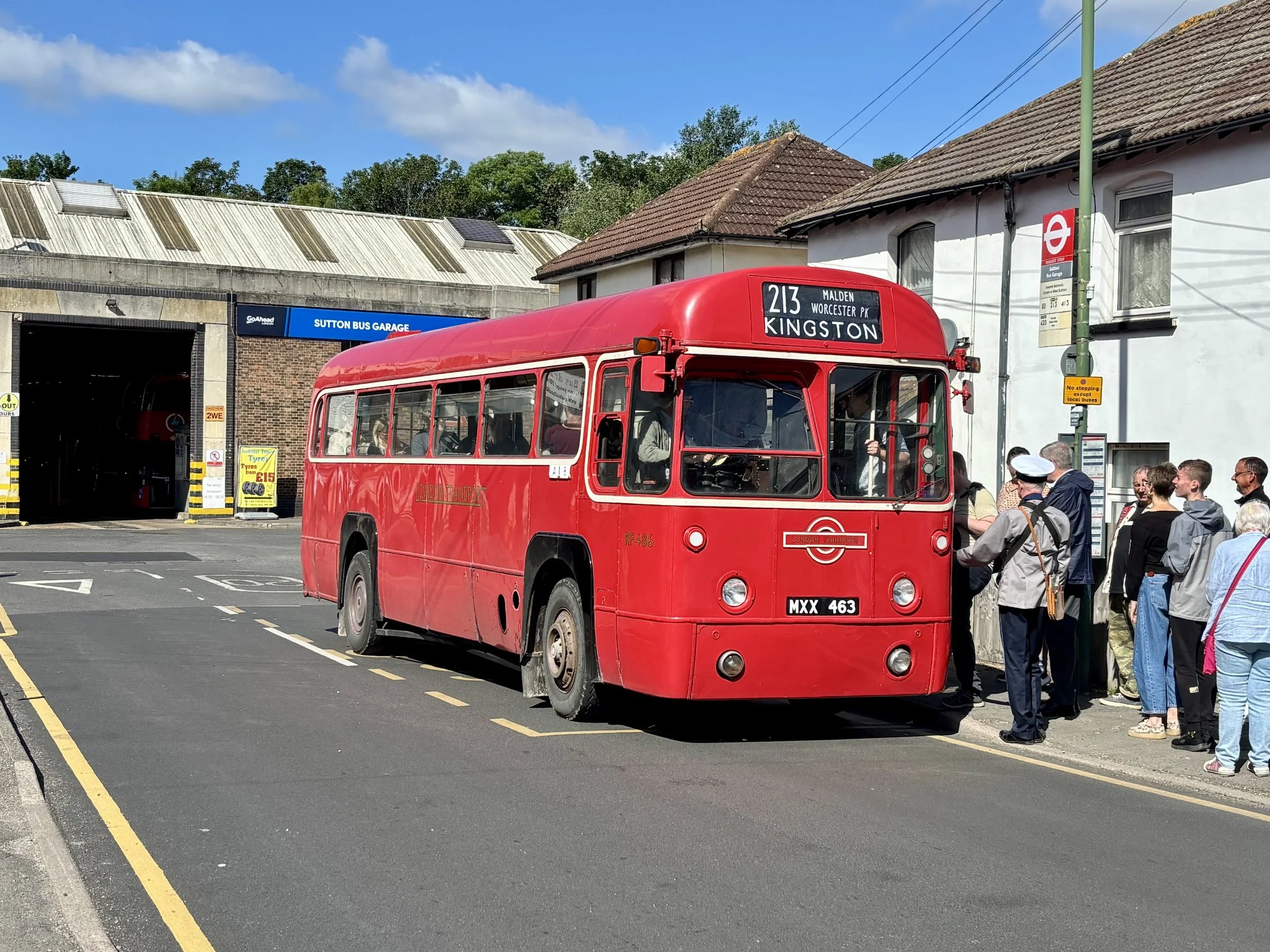
AEC Regal IV RF486 with suitable running number A8 copes with the crowd outside Sutton Garage before setting off for Kingston. The 213 was operated by this type from 1953 to 1963.
Note the driver and conductor wearing traditional LT Central Bus summer uniform. This RF was in service from 1953, ending its LT days as a staff bus then a driver trainer, before entering preservation in 1979.
Sutton Garage
The London General Omnibus Company opened Sutton Garage in 1924, with the adjacent Wimbledon & Sutton railway line opening in 1930. Built to hold around 100 buses, the allocation was initially much smaller, but grew after the Morden extension of the City & South London Railway (now the Northern Line) opened in 1926, with new “feeder” bus routes required as the population of the area expanded. A peak was reached with a run-out of 130 buses in the early 1950s, followed by a period of managed decline.
Following the establishment of London Regional Transport in 1984, route tendering was progressively introduced, with the London General operating division of London Buses creating the “SuttonBus” operation at Sutton Garage to successfully win the route contracts there in 1988. London General was acquired from London Buses by its management in 1994 and was sold to Go Ahead in 1996, the garage following suit. In 2023, the garage was converted to electric bus operation, using power taken from the railway behind the building.
Several of those present were commenting that it was a shame that the opportunity was not taken by Go Ahead to stage an Open Day at Sutton Garage to coincide with the Running Day, although it may be that, as an all-electric shed, access is required to recharging points throughout the day which may preclude such an event in the traditional fashion. However, as part of the garage was being used to park the heritage buses during their breaks, it may have been possible to organise something on a smaller scale in part of the premises.
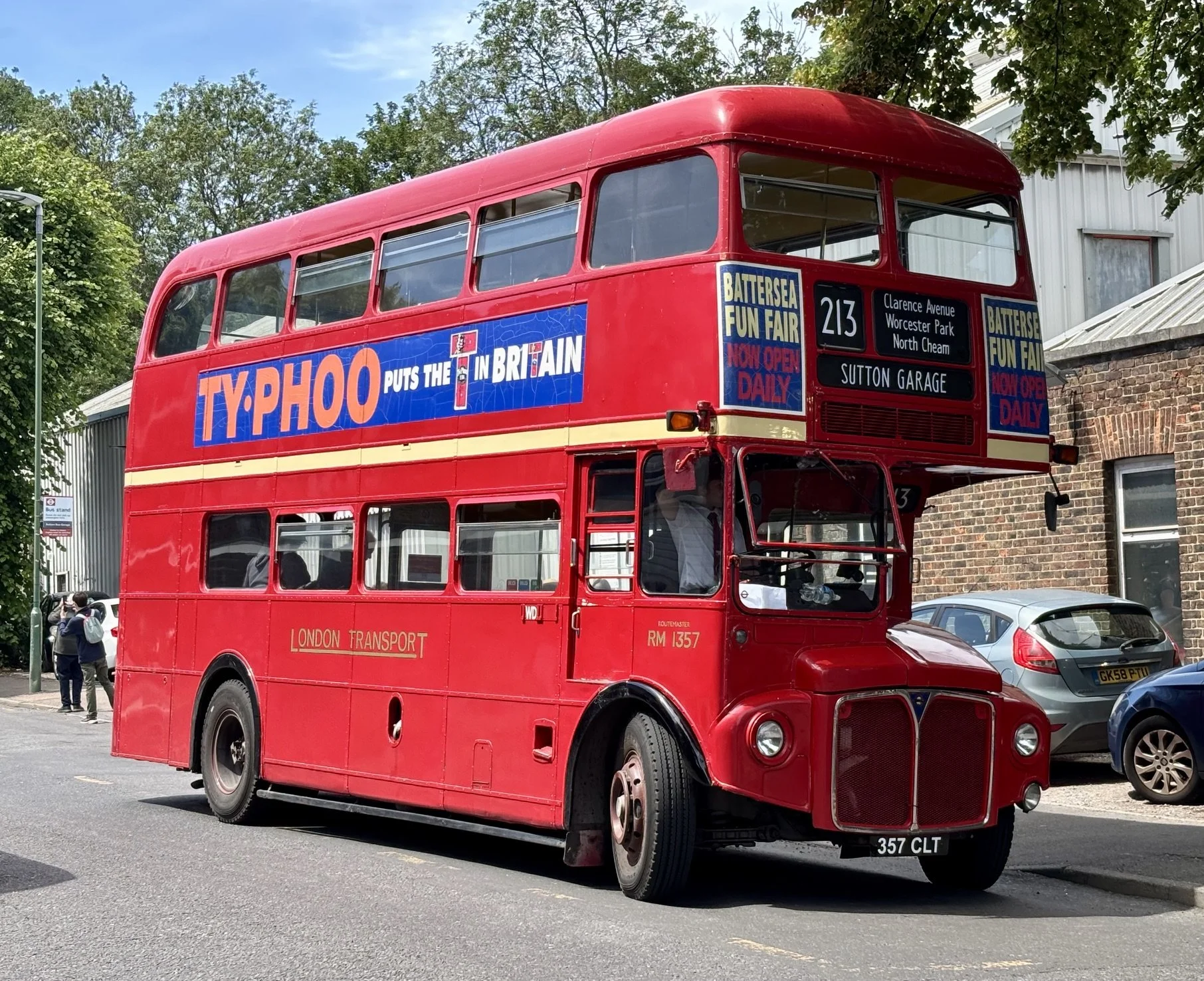
RM1357 with suitable 1960s adverts stands outside Sutton Garage after arriving from Kingston on the 213. I rode this bus on its previous journey from Sutton to Kingston.
Built in 1962, this RM worked at various garages including Norbiton (NB), so could have appeared on the 213 during the period that NB had a Sunday allocation in the 60s. After withdrawal from London service in 1988, it had spells with Blackpool Transport and Reading Mainline, before being used as a Sea Scout training unit. It was sold for preservation in 2009 and restored to London condition.
Morning Rides
I arrived just after 9AM at Sutton Garage at the start of the day’s proceedings, my intention being to commence with a ride by RT on the 213 to Kingston, a type which I had missed on the route, it having been converted to DMS by the time I first rode it in the 1970s. However, the expected RT1798 failed to appear for reasons unknown, so it was over to “Plan B” and a trip by Routemaster instead aboard RM1357. The 213 had a small Norbiton (NB) Garage share on Sundays only in the late 60s alongside the principal Sutton (A) Garage RT allocation, so this was an authentic recreation!
We departed from the Bushey Road stop close to Sutton Garage with a reasonably full load and made our way to Sutton Green, before swinging a right into the High Street and along the Throwley Way side of the town centre one-way system up towards Sutton Station. Normal passengers began to join the enthusiasts already on board, with many favourable comments and much excitement at seeing a traditional open-platform bus in operation. Along Cheam Road to Cheam High Street, where we turned right into Malden Road, through an area associated in the 1960s with the late comedians Tony Hancock and Sid James in the BBC Radio & TV sitcom “Hancock’s Half Hour”, who supposedly lived at Railway Cuttings, East Cheam.
Temporary traffic lights on this stretch didn’t delay us for long at this early hour and we continued across the London Road junction at North Cheam, where several made interchange with the secondary heritage operation on the 293 to Epsom. I continued on the 213 up through Worcester Park, with the first congestion of the day being encountered on approach to the A3 Kingston-By-Pass due to roadworks and road closures elsewhere. However, despite a massive queue on the A3 itself, we were largely unaffected and continued via New Malden High Street and Coombe Road, before hanging a left along suburban Clarence Avenue and Kenley Road to Kingston Hospital. After this, we turned left down Kingston Hill through Norbiton and into Kingston, where more roadworks dictated a single lane westbound only into the town centre, We arrived at Fairfield Bus Station after a decent run of around 1 hour.
For the return trip, I returned to my intended itinerary, with a ride aboard red RF406, a type that was synonymous with the 213 from the early 50s to the early 60s. Single deckers had always been required up to this point due to a low bridge at Worcester Park Station, under which the route passed, but when the road was lowered here in 1963 no time was wasted in converting this busy service to RT, as the RFs had struggled with the loads at times. We circumnavigated Kingston Town Centre with all seats taken, before taking the diversionary route to Norbiton via Birkenhead Avenue, emerging into London Road close to the site of the long-closed Norbiton Garage which had once participated in the 213.
Up Kingston Hill, before turning right past the hospital and then the suburban section along Clarence Avenue back to New Malden. Unfortunately, the High St there was very busy with traffic and we took an age to crawl along it. After speeding up briefly, more congestion at the A3 Roundabout and another slow moving queue for most of the way up to Worcester Park. Better progress was made onwards to North Cheam, with another exchange of passengers to/from the 293, then the final section via Cheam back to Sutton, where most alighted at the stops in St Michael’s Way on the western arm of the one-way system. Then it was “around the back” to the garage via Crown Road and Collingwood Road. We terminated in Bushey Road beside Sutton Garage after an extended trip of 1h20m. Interesting to ride a type on the route that I had missed due to my extreme youth at the time that it would have been an every day occurrence!
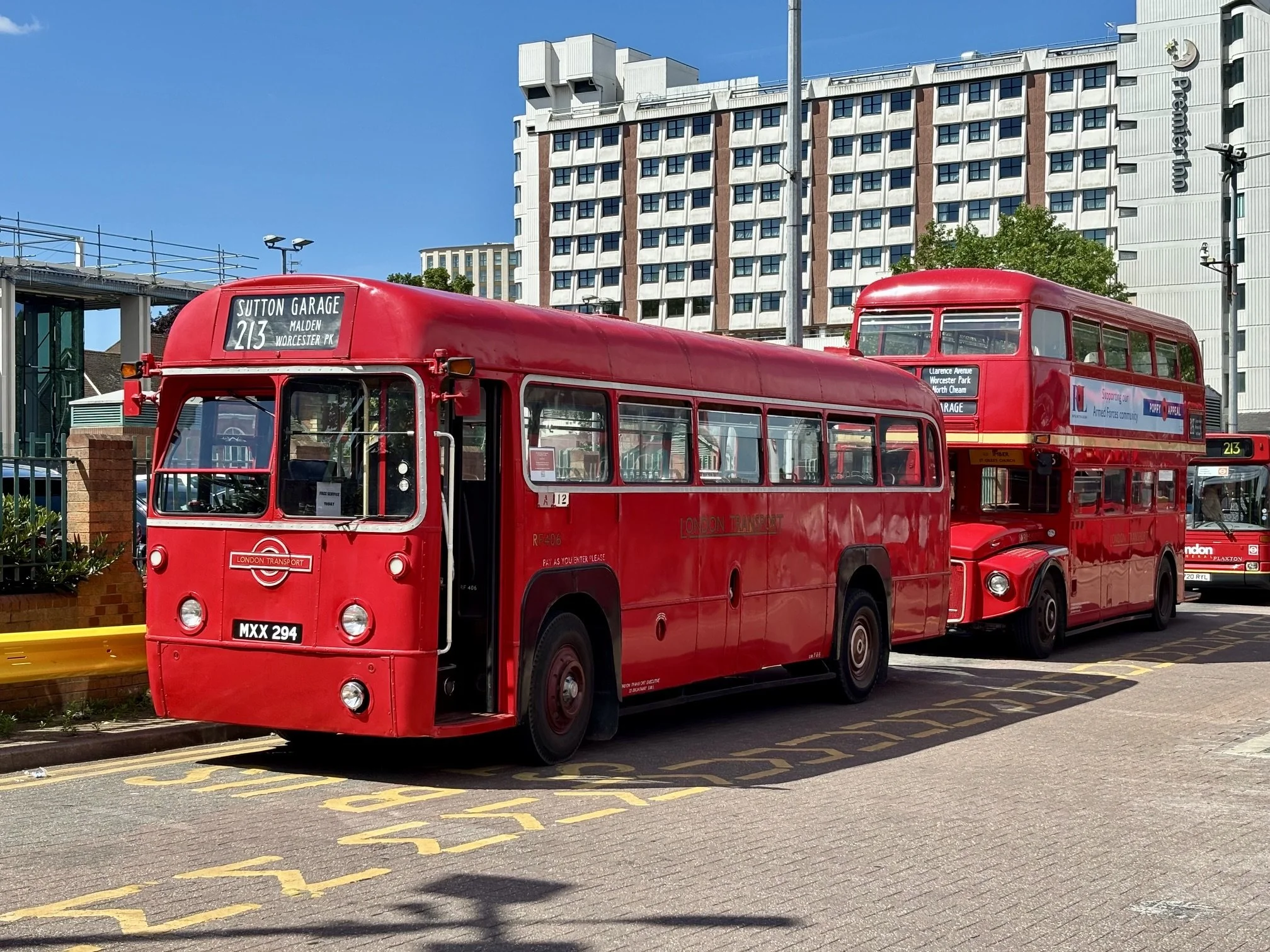
RF406 at Kingston Fairfield Bus Station before I joined it for the return trip to Sutton. This bus was actually new into service on the 213 in 1953 and served at various garages before withdrawal in 1976, since when it has passed through various owners and been preserved.
To the rear, behind the RM, the front of LDP20 can just be seen, a Plaxton Pointer Dart that was a former Sutton Garage inmate and is now preserved.
Afternoon Rides
After a short lunch break, which included watching comings and goings at Sutton Garage, I resumed my rides with a second return trip on the 213 to Kingston and back, moving along through the ages and beginning with MCW Metrobus M6. This is a type that operated on the 213A from 1979 and later on the 213 during the 1980s and 1990s, an era I remember well, so good to recreate it once again. After the prototype Metrobus batch M1-5 entered service at Cricklewood Garage in 1978, the first production examples from M6 onwards went to Fulwell Garage in 1979, soon followed by Norbiton, so would have been seen in the Kingston area for many years afterwards.
The bus seemed popular with a younger crowd despite it now being the best part of 50 years old! Good to experience the familiar whistle of the Metrobus engine and the smooth if slightly bouncy ride that was associated with this reliable workhorse, which was a familiar part of the London bus scene in much of London for almost a quarter of a century. Traffic was still an issue in the early afternoon, particularly through Worcester Park and New Malden, so we took 1h15m through to Kingston on this trip.
For my second return run from Kingston, I came even more up to date, with a ride on a low floor vehicle, Plaxton President VolvoB7TL PVL104. The 213 was host to the type in the late 2000s and 2010s together with other classes of the same era, although the Sutton examples were generally the later ones with front staircases, rather than the earlier centre staircase versions like PVL104. This bus had passed to Bluestar in Southampton following London service and ended as a driver trainer with them, only recently coming into preservation and still in dark blue livery from its time on the south coast. Likely a repaint into London red will follow at some point.
We set off with another mainly youngish enthusiast crowd mingling in with the normal punters, although it was clear that many of the latter would be hard pushed to see much difference between this particular vehicle and other modern buses! By now it was getting on in the afternoon and traffic conditions had eased considerably since the Saturday “Midday Peak”, so we had a quicker run, taking just on an hour from Kingston back to Sutton Garage. A decent thrash in a more modern bus with which to end the day.
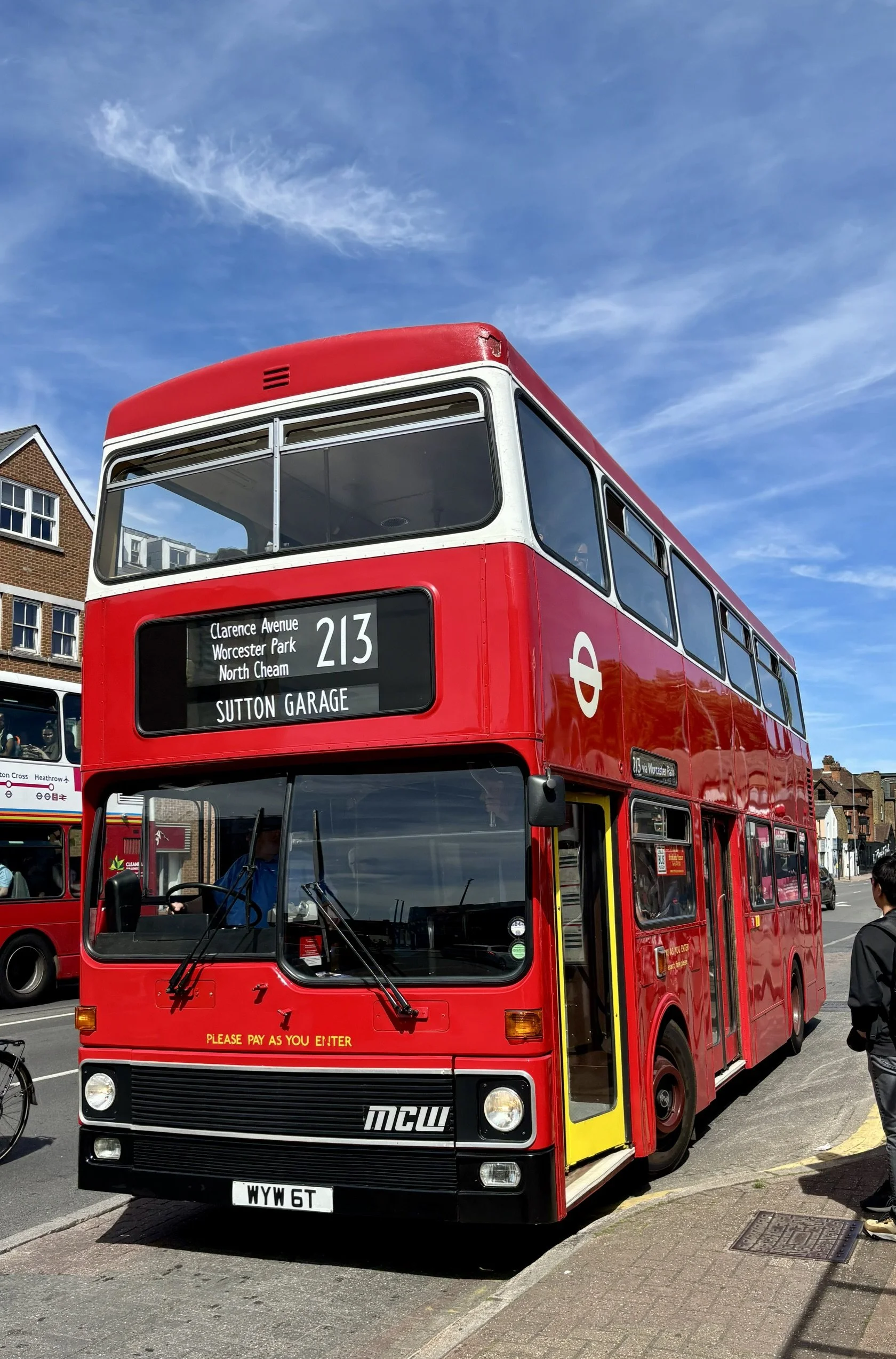
MCW Metrobus M6 was the first production example of the class in 1979 and is seen at Kingston Fairfield Bus Station after my ride aboard it from Sutton.
This vehicle has been superbly restored to original condition with black lower front panel and white upper deck window surrounds. It resides at the London Bus Museum.
Route 213 History: Crew Operation
The London General Omnibus Company first began a route numbered 113 between Kingston and Sutton in 1921, although it continued on to Belmont and Lower Kingswood (later amended to Banstead). The Belmont - Banstead section then transferred to the 164, with the remaining Kingston - Belmont portion renumbered into the new single-deck sequence as 213, this being part of the massive renumbering scheme implemented in October 1934 by the London Passenger Transport Board and the origin of today’s route number.
The 213 began with single deck LTL “Scooters” out of Sutton (A) and Kingston (K) Garages, which became joint operational sheds for many years, together with Norbiton (NB) which later joined in with a part allocation. An early route change in 1935 saw the route diverted via Carshalton Beeches instead of direct via Brighton Road between Sutton & Belmont. Certain journeys operated in service slightly off the main route to/from Sutton Garage. By the 1950s, Kingston’s minority share included Ts or Qs, with Norbiton putting out Ts when that garage opened in 1952.
In 1953, the route was converted to higher-capacity RFs, still with conductors as the previous vehicles had been. Single deck operation had been necessary due to low bridges at Norbiton and Worcester Park, although a rerouteing to serve Kingston Hospital in 1962 meant that the former was no longer passed under. At the same time, the Sutton - Belmont section of route was transferred to the 151 except on Sundays when it continued to be served by the 213.
The lowering of the road under the railway bridge at Worcester Park Station finally enabled conversion of the 213 to double deck with RT types in 1963. With this change came the introduction of the 213A variant, which served Clarence Avenue rather than Coombe Lane between Norbiton & New Malden and assumed the Sunday extension to Belmont. In January 1964, the 213A was extended to Wimbledon via Morden on M-S replacing the 286, resulting in the Sun service to Belmont being renumbered 213B. However, this situation was short-lived, as in November 1964, the 213B was withdrawn, replaced by the 213 to Belmont on Suns, whilst the 213A received a Sun extension from Sutton to Morden!
In 1966, Norbiton introduced a minority RM share to the 213 for the first time, although only on Suns, which lasted until 1969 when this element transferred to the 213A, but only until 1970, at which point both the 213 and 213A reverted to full RT operation.
Further changes in 1969 saw the 213A withdrawn between Wimbledon on M-S / Morden on Suns and Sutton Garage, this section being replaced by revisions to the 80. Meanwhile, the Sun service to Belmont switched back from the 213 to the 213A, with the 213 coming off entirely on Suns. Then, in 1970, the Sun service between Sutton & Belmont was withdrawn completely, although this section was added to the 213 in M-F Peaks in lieu of the 151.
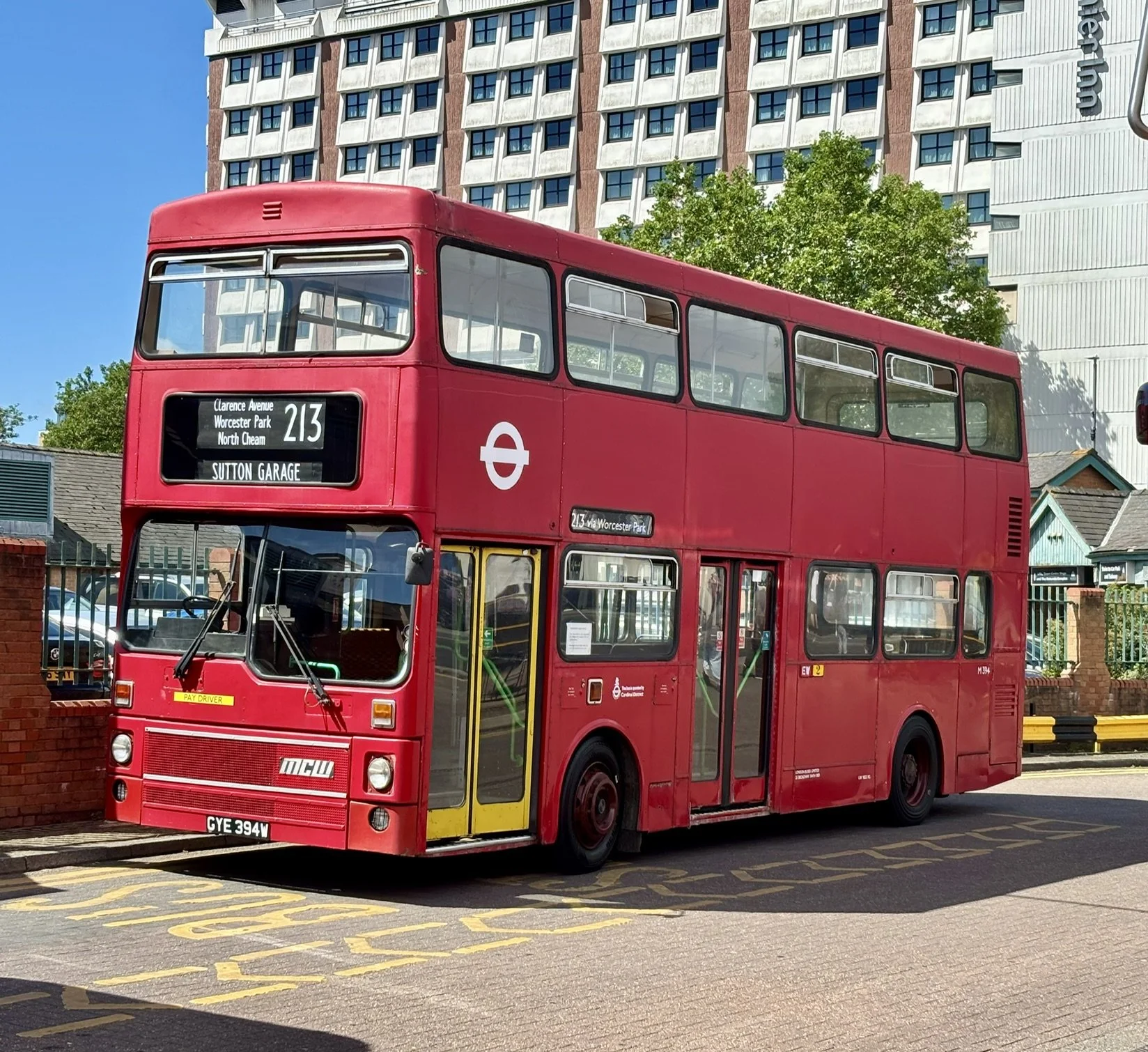
M394 is more representative of later Metrobuses in the blander all red livery and was captured between trips on the 213 in Kingston. New in 1980, this bus worked for London Buses then Metroline, before passing through various private owners from 2004 onwards.
Metros first appeared on the 213A in 1979 and formed a partial or complete allocation on the 213 for most of the time between 1984 and 1997.
Route 213 History: OPO Days
One man operation, as it was then called, came to the 213 and 213A in 1972, using DMS Daimler Fleetlines from Sutton & Norbiton Garages. The routes now ran as 213 Kingston - Sutton Garage (M-S) and 213A Kingston - Sutton Garage (Daily) with a M-F peaks extension to Belmont.
As part of the “Busplan” changes in April 1978, the plain 213 was withdrawn apart from the retention of a handful of M-S shopping hours journeys between Kingston & New Malden, although these were taken off in October that year, leaving the northern part of Traps Lane unserved. The 213A via Clarence Avenue then became the main service until 1984, when it was renumbered 213 now that the suffix was no longer necessary. A part M class (MCW Metrobus) allocation had been introduced on the 213A in 1979 from Norbiton, although the Sutton share remained DMS for the time being. This split carried over into the renumbered 213.
The “new” 213 in 1984 had various legs. Running from Kingston to Sutton, it had branches to Sutton Garage (M-S eves), St Helier (M-S daytimes), Belmont (M-F Peaks) and West Croydon via Rose Hill, Carshalton and Roundshaw (Suns). This ran counter to the intention of Busplan 1978/9, which aimed to standardise routeings as much as possible and avoid variations on different days and at different times!
Tendering came to the route in 1987, when “Kingston Bus”, a new low-cost unit under London Buses and based at Norbiton Garage, won the contract for the 213. This used mainly refurbished training bus DMSs. However, further change came with the introduction of “SuttonBus” contracts in 1988, with the 151 now covering the St Helier leg of the 213 and a rerouteing of the Sunday service to Croydon via the 154. SuttonBus won the next tender for the 213 from 1990, with the route switching from Norbiton to Sutton Garage using Ms. At this point, the legs to Belmont & Croydon were withdrawn, replaced by new Route 413 and the Sunday introduction of the 154, leaving the 213 as the basic Kingston - Sutton Garage route we have today.
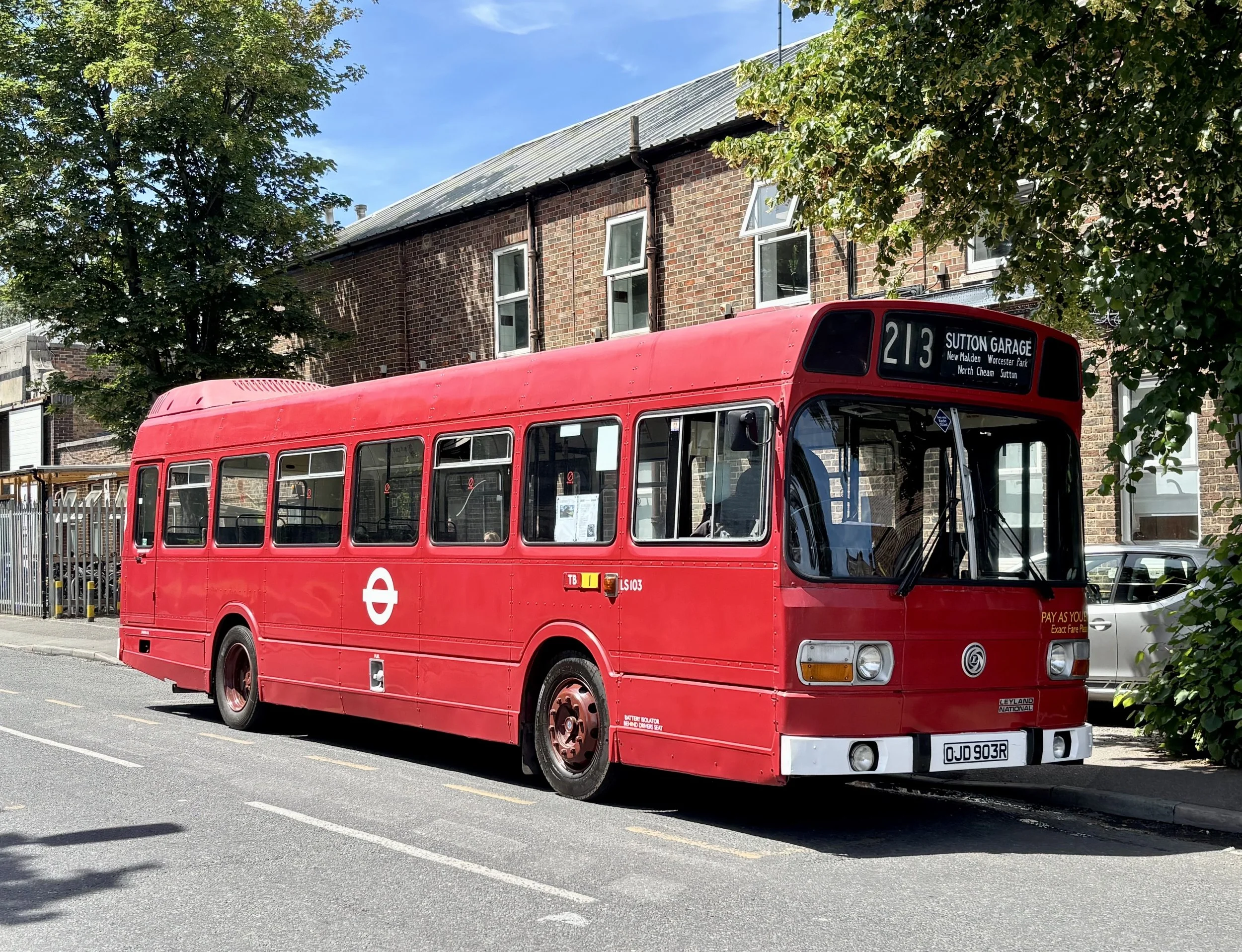
Leyland National LS103 arrives at Sutton Garage on a 213 journey from Kingston. New in 1977, it operated from Bromley, Elmers End & Croydon Garages until sold in 1990 to the Port of Ramsgate as a courtesy bus. It has been in preservation since 1999 and restored to London condition.
Whilst this type were familiar on routes from nearby Merton (AL) Garage in the 1980s, Sutton never operated the class in London bus service, although Norbiton did put out the odd LS on the 213 when it had a share.
Route 213 History: Into the Low Floor Era
The mid 1990s saw the acquisition of London General by its management and then its sale to the Go Ahead Group, who have won each succeeding tender on the 213. The Metros were ousted by NV class Olympians in 1997, which in turn were replaced by low-floor EVL class VolvoB7s in 2002. Subsequent years saw more of a mix of different types, including PVL, WVL, E, DOE and WHV classes. Standardisation returned in 2023 when the route was electrified using Ee class E400 City types.
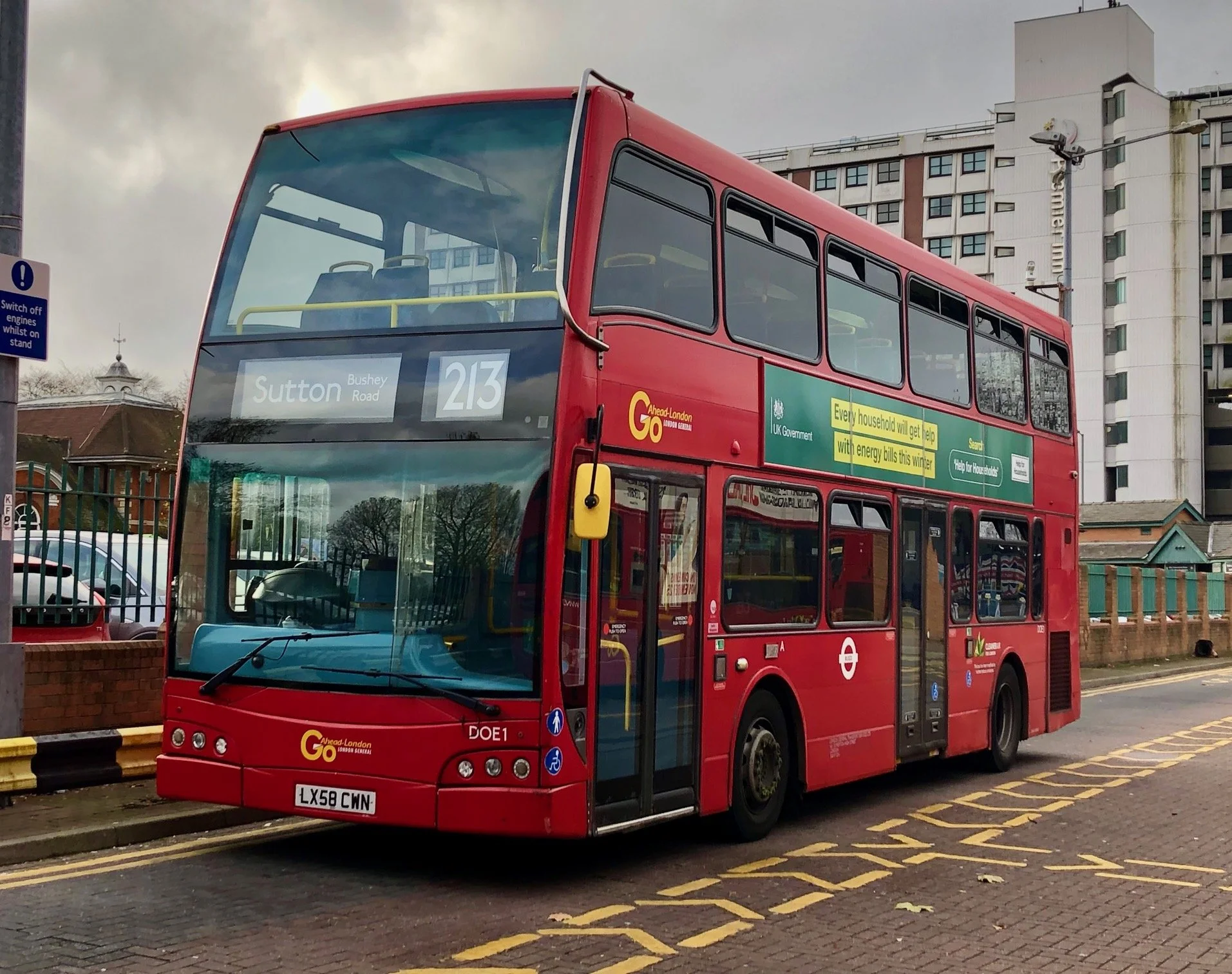
Representing the low floor era on the 213, we have this study of Dennis Trident Optare Olympus DOE1 of Sutton Garage, caught at Kingston Fairfield Bus Station on a grey November day back in 2022.
Whilst all of this class has now been withdrawn from TfL service by Go Ahead London, several remain in use in other parts of the country, with this one being preserved.
Conclusion
As usual with these events, a good day out. I like the concept of picking a route and flooding it with old buses for a day, as it gives a better impression of what bus travel used to be like than when just one or two such vehicles are out. A good selection of buses from various eras to enjoy, although personally I would have liked to see a few more RTs, which are not only my favourite type, but were the main allocation on the 213 for several years and one I missed in actual service thereon.
It was good to see everyone (mostly) enjoying themselves, both enthusiasts and wider public alike, and despite some reports on social media and transport groups of bad behaviour amongst a minority of the younger element, I personally didn’t see much more than a bit of over-excitement.
Finally, thanks as always to the vehicle owners and volunteer crews, together with the organisers at the London Bus Museum, all of whom made the event possible.
Watton
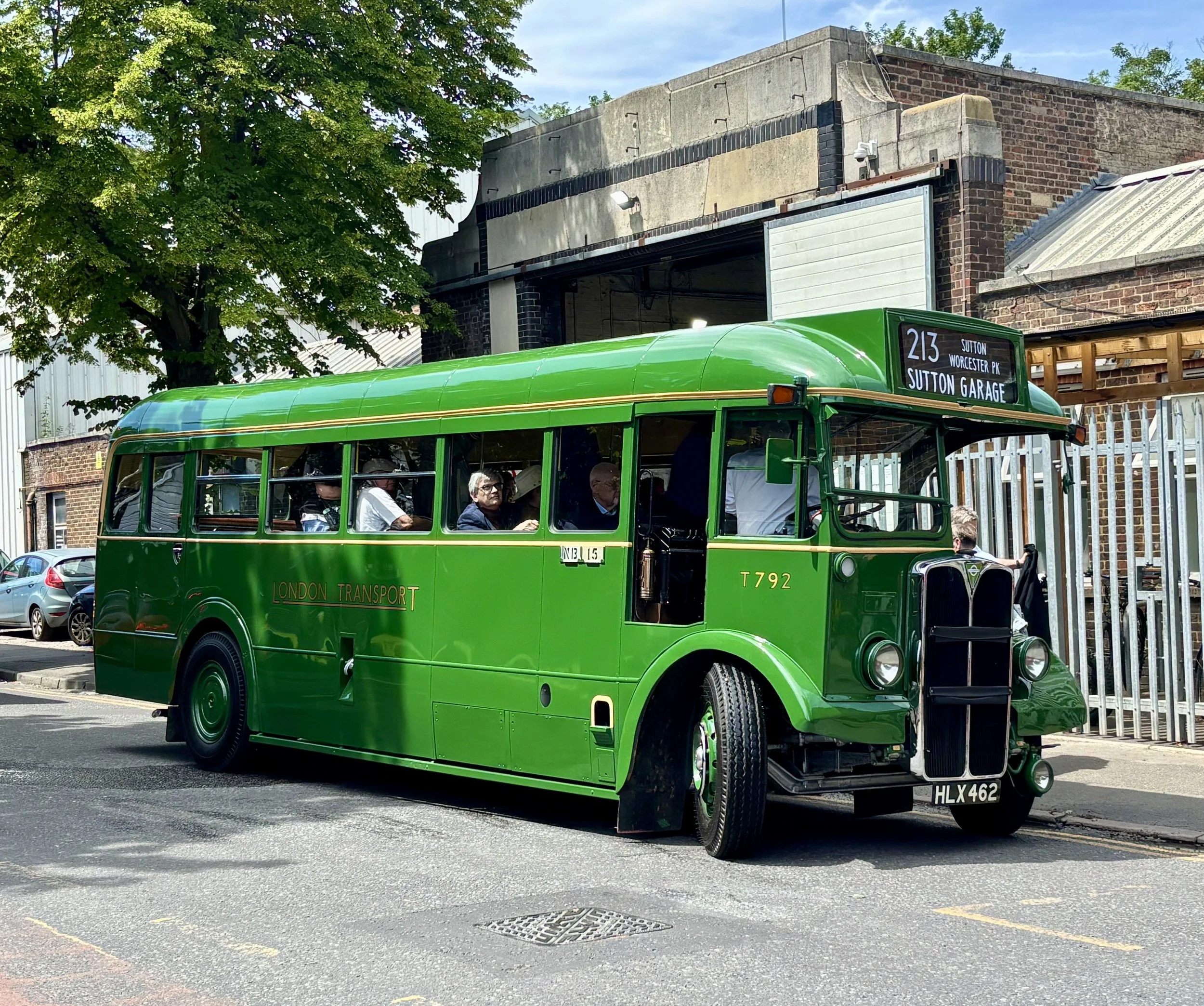
London Transport (Country Buses) T792 is a preserved AEC Regal III with Mann Egerton bodywork dating from 1948. Seen on the Runnning Day outside the side entrance to Sutton Garage.
Red examples of the T class would have been seen on the 213 prior to RF conversion in 1953.
