
South East London Enviros on Borrowed Time
Following on from my recent article tracking down remaining Enviro400s in East London, I move over to South East London and visit some of the routes there that still use the type, including a couple of services due to change operator during July.
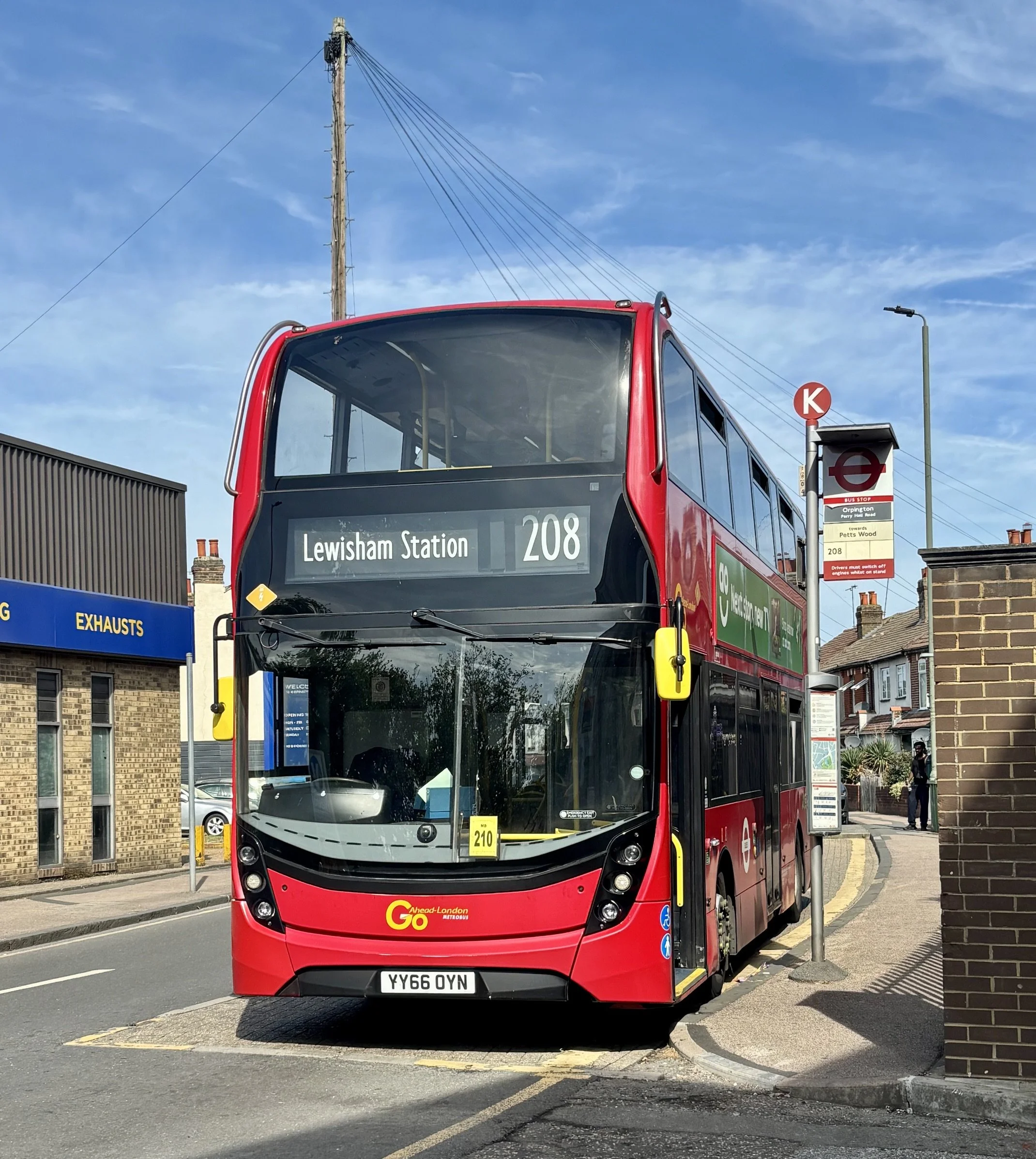
Enviro400H MMC EH84 of Orpington (MB) Garage is seen at the Perry Hall Road stand on the 208 after my ride on it from Lewisham.
GAL is due to lose the route back to its original operator, Stagecoach, from 25th July 2026. Most of the EHs made spare are expected to move to Morden Wharf (MG) to enable the double decking of the 286 in place of its existing Wright Streetlites.
Route 208: Lewisham - Orpington
The Southeastern train took me from London Bridge to Lewisham, where I arrived early on a warm Saturday morning. Recent hot weather of 30C and over could have made bus rides uncomfortable, but by starting early I hoped to avoid the worst of the late afternoon heat and by sticking to downstairs on double deckers with the windows open I intended to keep my cool!
I began with the 208, which was due to pass from Go Ahead to Stagecoach on contract change towards the end of July. This will see the route restored to its traditional operator, after a 7 year term with GAL. I had less than 5 mins to wait at Lewisham Station before one of the usual Enviro400H MMCs, EH84, drew up to the first stop. The main batch of these vehicles are higher numbered ones in the 3** series, but Orpington (MB) Garage have a few lower numbered examples too. Once the route is lost, the intention is for most of the displaced vehicles to move to Morden Wharf (MG) in order to upgrade the 286 to double deck operation.
After boarding with a few others, we made a quick getaway out of Lewisham, along unusually quiet roads. Down through Ladywell to Catford, whose name originates from an ancient crossing over the River Ravensbourne, first recorded as “Catteford”, which could either reference the wild cats that once roamed the riverbanks, or could be a simple contraction of “cattle ford”, where local farmers drove their livestock across the river. Onwards past Catford Bus Garage, where the 208 will soon return home after the forthcoming operator change. Through Downham towards Bromley, we ran in tandem with a 320, sharing the load between us at the various stops.
A general exodus ensued in Bromley Town Centre, but we soon began picking up again by Bromley South. Then a staright run down to Bromley Common, where the main road towards Bromley Garage was closed due to roadworks, but didn’t affect us as we turned into Crown Lane towards Southborough. It was then a gentle suburban run, not stopping at many stops, through to Petts Wood Station, before continuing on towards our objective of Orpington. I had memories of riding the last RTs in South East London on the former 94 over this section back in 1978! Arriving into Orpington, we called at the station, followed by the War Memorial and other stops in the High Street, before terminating at Perry Hall Road, after a reasonable 65 min run at this time of day.
The current 208 is the third incarnation of this route number in London. The first version related a route in East London between Clapton & Bromley-by-Bow, which operated between 1934 and 1970. This was single deck due to low bridges and saw first LTL, then Q then RF classes, before being replaced by the S2. The second version emerged in 1971 in West London as a route between Hanwell and Hayes replacing the “round the corner” link previously provided by the 207A. It was SM then SMS operated and lasted until 1979 when it was replaced by an extended 204.
Today’s 208 began in 1982 and replaced part of the southern section of the 47 and the Bromley - Orpington section of the 94. This, in combination with new route 261, which replaced the other part of the 94, enabled the 208 and 261 to pass their operational garages at Catford and Bromley, whereas the previous 94 had not passed either, therefore eliminating unnecessary off-route garage journeys. To start with, the 208 had a a Saturday Shopping Hours extension to Surrey Docks, but this came off in 1987 and the route settled down to the one we know today between Lewisham and Orpington.
Initially crew operated with RM, Titans replaced these in 1984, also crew operated until converted to OPO in 1986. For a period in the 90s, there was a partial Dennis Lance single deck allocation with LA and then LV class vehicles, but this was unsuccessful and only lasted a few years. Both Catford & Bromley Garages had a hand in the 208, the proportions varying over the years, but by the late 90s included VA type Olympians from TB. Low floor conversion came in 2001 with Trident Alexander 400 ALXs, later replaced with Enviro400s. Go Ahead took the contract in 2019 with the current EHs, but as we have seen, that is about to change once again!
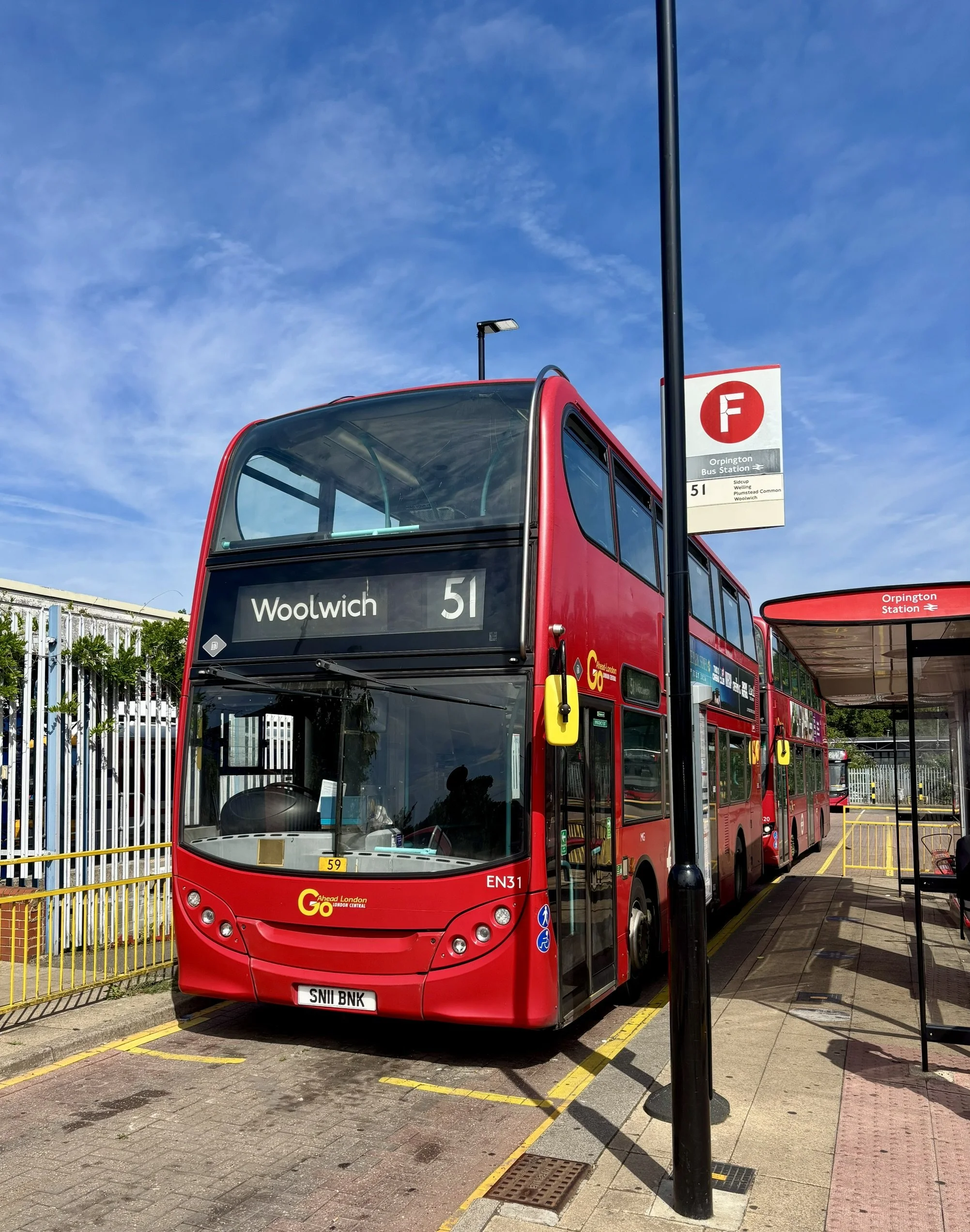
New electrics are due to convert the 51 in due course under its contract renewal terms. Meanwhile, existing diesels continue, including EN31 of Morden Wharf (MG) Garage, seen at Orpington Station before my ride aboard to Woolwich.
This is one of the batch inherited by GAL from First London, whose interior scheme it still carries. One of the WVLs which share the allocation can just be glimpsed behind.
Part Route 51: Orpington Perry Hall Road - Orpington Station
At Orpington, my second route of the day was to be the 51. This is one that I last rode in the other direction around 18 months ago, aboard a WVL when the service was still operated out of Bexleyheath (BX) Garage. However, in early 2025, it transferred to Morden Wharf (MG) to make room at BX for the uptake of the 99, 269 & 401 by GAL. Whilst electrics are intended for the route eventually, in the meantime existing diesels continue, usually EN class Enviro400s together with the aforementioned WVLs.
At Perry Hall Road, I boarded EN40 for the short trip up to Orpington Station, but after a couple of stops the driver announced that she would be turning short at the War Memorial due to late running. Luckily, EN31 was only a couple of minutes behind, so I was able to transfer together with the other remaining passengers. Within 10 mins from the start, I was alighting at the station.
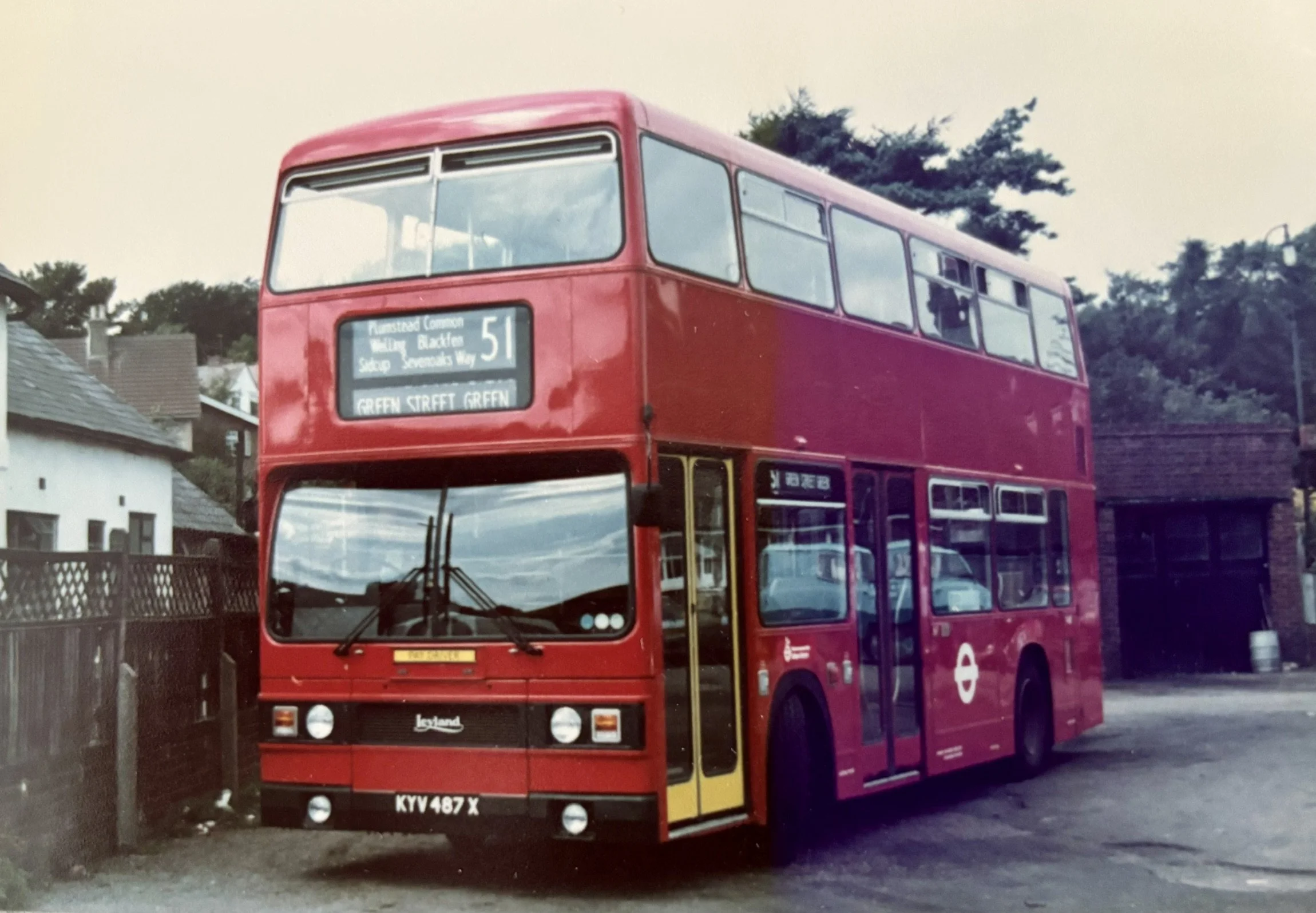
An archive shot now from 1982, which sees then new Leyland Titan T487 of Sidcup (SP) Garage on the 51 at Green Street Green.
This was shortly before the route was withdrawn between this point and Orpington Station in September of that year, this section being replaced by a revised 229.
Route 51: Orpington Station - Woolwich
After the break, I reboarded EN31, noting its purple and grey based interior from its former life with First London before passing to GAL. By now, traffic was becoming busier in the town centre and we crawled down to the War Memorial in a traffic queue. However, after loading at the various stops in Orpington High Street, progress became quicker as we turned into Cray Avenue and along Sevenoaks Way, serving the various retail parks that line this stretch through St Mary Cray. Across Crittalls Corner Roundabout up to Foots Cray, where we passed near to the site of the long closed Sidcup (SP) Garage.
More traffic as we climbed Sidcup Hill, but at least it was moving. Then into Station Road and under the bridge at Sidcup Station, before the queues seemed to melt away as we entered the suburban area towards Blackfen, making faster progress for the rest of the trip. Welling High St is sometimes congested, but we had an easy run through on this occasion, turning off near the station and continuing up to East Wickham.
Through the housing to Plumstead Common, the scene of riots in the 19th Century when locals protesting that they had the right to graze their livestock there clashed with politicians who wanted to sell off the land to build houses for the growing workforce of the nearby Royal Arsenal. The Plumstead Common Act of 1878 ensured that 100 acres of land remained as public open space in perpetuity.
Then downhill on the final section into Woolwich Town Centre, terminating at Woolwich Market and opposite the Royal Arsenal site, now repurposed with new residential and commercial developments, adjacent to the relatively new Woolwich Station on the Elizabeth Line. A decent 65 min trip end to end.
I covered most of the history of the 51 in my article of 4th Jan 2025 “Old & New in South East London” to which you are referred if you wish to read the full story. However, the 51 has also had a number of interesting variants over the years, so this time I will cover these.
Firstly, there was a 51A on three separate occasions:
Sidcup Station to Green St Green (1942-1968), Extended to/from Eltham Well Hall Station from 1958 onwards. M-S only. Began with STL/LT, converted in 1949 to RTL then RT. This differed from the parent 51 which went to Farnborough at the southern end and to Sidcup, Welling or Woolwich at the northern end.
Woolwich to Green St Green (1968-1977), Extended to/from Charlton Station in M-F Peaks. M-S only. RT operated until 1977, then RM for the final few months. This was when the parent 51 was running Woolwich to Farnborough daily.
Woolwich to Swanley (1987-92). This was during the period when Kentish Bus ran the main 51 and garage journeys were extended to/from Swanley (SJ) in service from Foots Cray on Sundays only. When SJ Garage closed and the allocation moved to Dartford (DT) or Dunton Green (DG) these trips continued to Swanley Beechenlea Lane.
Secondly, there was a 51B, Sidcup Station to Orpington Station (1943-1951). Irregular journeys, Daily at first, then M-S from 1948. Deviated from the 51/51A at Orpington War Memorial up to the station. Joint allocation with 51A using LT at first, later RTL. After being taken off briefly, the route was reinstated in 1952 with RTL and converted to RT in 1955. In line with the 51A, it was extended to/from Eltham Well Hall in 1958, but in 1964 was completely reconfigured to run between Woolwich and Sidcup Garage on M-F only, by now only deviating from the 51/51A over the extremely short section between Foots Cray & Sidcup Garage! Further changes in 1968 saw it cut back to run Blackfen - Sidcup Garage in M-F Peaks only. Complete withdrawal came in 1969.
Thirdly, there was a 51C, Welling Station to Green St Green (1958-68), Extended to/from Woolwich from 1963, with a peaks extension to/from Charlton. Sats only, RT operated. During this period, the 51A provided the main M-F and part of the Sat service to Green St Green, but operated at the northern end to Eltham, hence the need for a separate suffix for the Welling/Woolwich service.
Finally, back to the 51 itself, which had a couple of projections beyond its normal southern terminus at Farnborough back in the late 60s/early 70s to Hayes Station (M-S eves & Sun afternoons) plus a couple of Sun afternoon journeys to Bromley Garage. These were basically trips to serve Farnborough Hospital at visiting times, which were then much more limited than today. They were withdrawn with OPO conversion of the route in 1977.
All very complex and no doubt confusing to the punters, but fun for the enthusiasts!
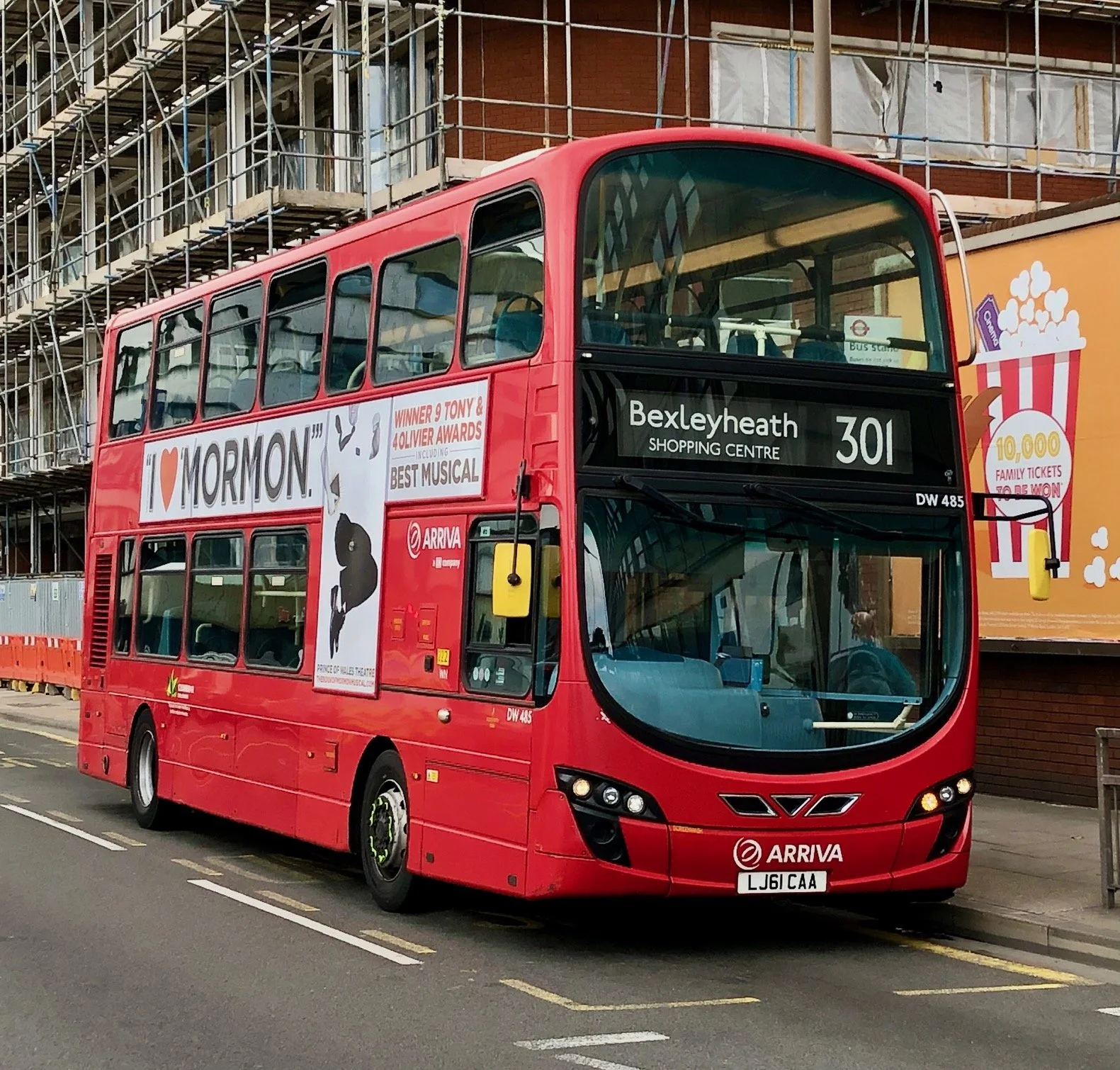
The 301 was a new route in 2019 as part of the route changes to link in with the opening of the Elizabeth Line. Arriva London DB300 Wright DW485 of Dartford (DT) Garage is seen in Woolwich in August of that year.
At the time, this was the usual type on the route, although the allocation by the first half of 2026 was a mix of DW, T and HV classes.
Route 301: Woolwich - Bexleyheath
Next up, a ride on the 301. This relatively new route began only in 2019 between Woolwich & Bexleyheath via Abbey Wood, designed to provide connections with the Elizabeth Line which was due to open shortly at that time. I rode the route soon after it started, but after 7 years with Arriva out of Dartford (DT) Garage, it is to pass to Stagecoach from Plumstead (PD) when the initial contract expires in July. New Wright StreetDeck Electroliners are anticipated, although the revised contract will likely start with hybrids.
My original trip had been by DW, which was the standard type at the beginning, but since then the allocation has changed to a mix of HV, DW and T classes. On the day I travelled, only 6 (of the scheduled 8) buses were showing on LVF, comprising 3xHV, 2xDW and 1xT. I was unsure whether the missing two buses were actual cuts or simply not showing on LVF, but I wanted to ride a T this time as I had been on DWs before. After I arrived at Woolwich Elizabeth Line Station, the first 301 was an HV, the next departure 12 mins later not appearing so confirmed as a cancelled working. Departure 3 was another HV, followed by another missing bus according to LVF. However, out of the corner of my eye, I suddenly saw T327 come into view behind a couple of other buses, so dashed down to jump aboard this vehicle, which was in service but not showing on LVF for some reason!
A good number joined, the 301 having found a more useful purpose between Woolwich & Thamesmead, now that the “all stops” 472 has been withdrawn and replaced by the express “Superloop” SL11. Making our way to Plumstead Garage, we proceeded along the industrial Nathan Way, now a freehold section for the route. Then via Central Way to Thamesmead Town Centre and around Bentham Road to the Boiler House, with many alighting in the housing area. Quieter down to Abbey Wood Station, before proceeding up New Road through the woods to Woolwich Road. Then the final suburban stretch via Long Lane and down to Bexleyheath Town Centre. The route is relatively unusual for a double deck route in having a couple of short “Hail & Ride” sections, which produced some custom.
Arrival at Bexleyheath Town Centre was after a quick 40 min run, virtually on schedule, with a driver change taking place at the terminus for this route, situated a little further away from the main bus stands which are nearer to the Market Place.
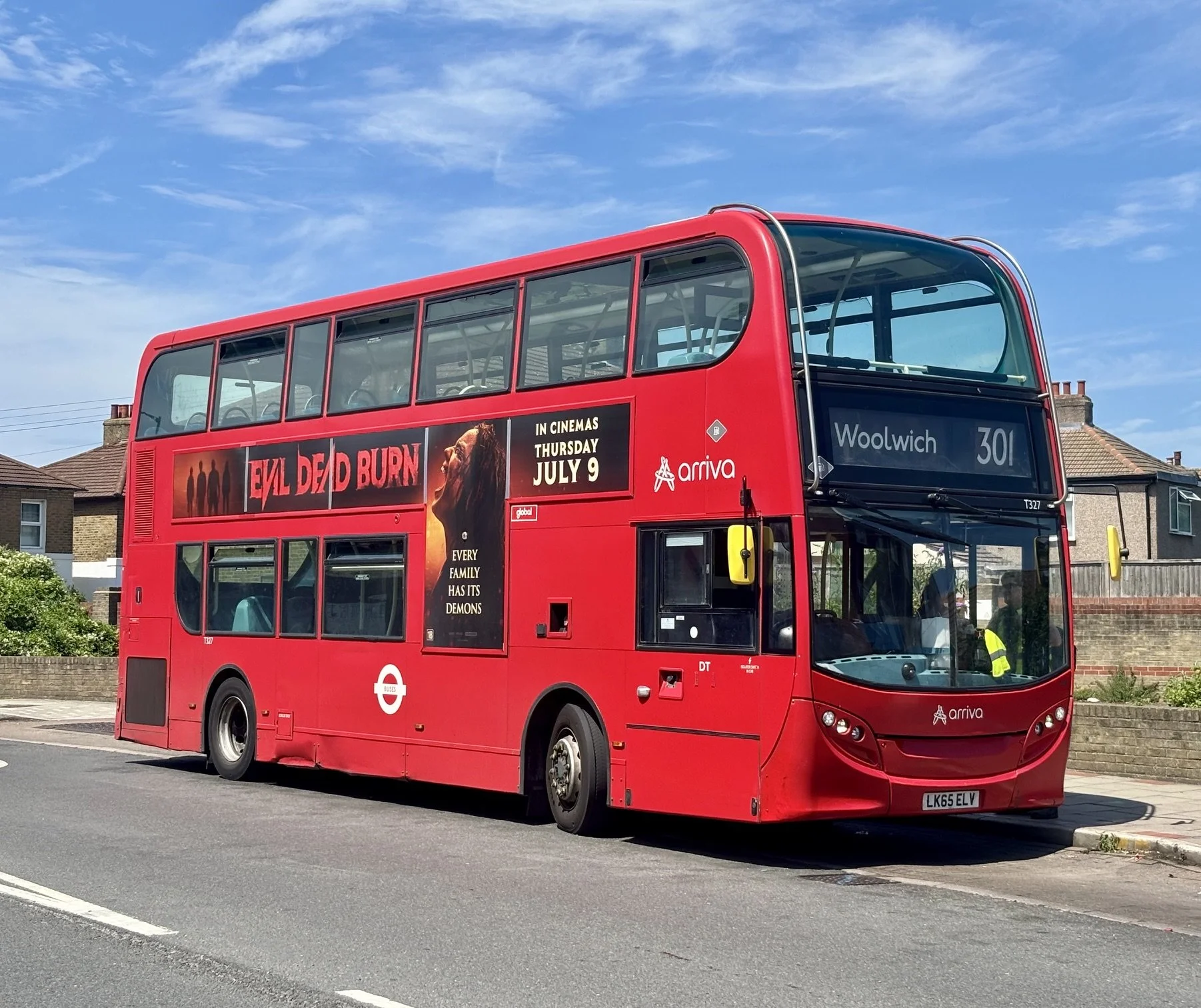
Scroll forward to June 2026 and Enviro400 T327, also of DT Garage, sits at the other end of the 301 in Bexleyheath Town Centre after I had made the journey here on it from Woolwich.
Scenes like this will disappear from 11th July 2026, when the 301 passes to Stagecoach on retender after one 7 year contract term.
Route 422: Bexleyheath - North Greenwich
By now early afternoon and with temperatures on the up, there was time to fit in one more ride before conditions became too uncomforatble. Having sampled Enviro400s with Go Ahead and Arriva, I switched to the other main operator in South East London, Stagecoach, who still have a significant number in service at Plumstead (PD) Garage. One of their main haunts is currently the 422, where classic diesel versions share the route with later hybrid MMC versions.
After letting one of the newer buses go, the second departure from Bexleyheath Clock Tower was formed by older Enviro400 no 10194, so I clambered aboard with the throng. We plodded our way out of the town centre towards Bexleyheath Station through slow but moving traffic, but then sped up a bit as we entered the inter-war suburban housing that typifies the hinterland between Bexleyheath and Plumstead. A fairly gentle run with one or two “holds” due to early running on the padded timetable. Soon, we were passing the site of the old Plumstead (AM) Garage, now a Wickes builder’s merchants, which closed in 1981 together with nearby Abbey Wood (AW), when the new and much larger Plumstead (PD) site opened to replace both former depots and to serve the expanding Thamesmead area. There must have been a gap in the parallel 96 which we were now running in parallel with, as we picked up a fair number at most stops on this section.
Turning into Plumstead High St, we continued past the station and didn’t even pause at the bus garage for a driver change on this occasion. Soon we were at Woolwich Market, with a mass exodus of our by now full and standing load. With peace and quiet restored, we continued past Woolwich Arsenal Station and up the hill out of town in hot pursuit of a 53. A clear run into Charlton Village, passing the imposing sight of Charlton House, the only remaining complete Jacobean Mansion in the London area. Built in the early 1600s, it retains many original interior features and today operates as a community hub, events venue and cafe.
We rumbled on, reaching Blackheath Royal Standard, before turning off down the hill to Westcombe Park and East Greenwich. After a largely clear run, it was disappointing to hit a crawling traffic wall over the short section to Blackwall Lane, but as we had just been a few minutes ahead of time, this neatly brought us back on schedule. After dropping a few and picking up a handful at the next few stops, we arrived at North Greenwich Bus Station after a journey of 1h15m, where many were enjoying the delights of the attractions around the O2 Arena.
The 422 was born of the “Bexleybus” scheme in 1988, taking over the eastern part of the 122 and replacing much of the 122A between Bexleyheath & Woolwich. It was operated initially with LS single deckers in the dark blue and cream Bexleybus livery out of BX Garage. However, due to driver shortages, it was reassigned to Boroline Maidstone after less than a year of operation, using mainly Olympian double deckers. Following the failure of Boroline, Kentish Bus took over in 1992 using mostly the same vehicles, with Arriva in turn soon taking control of Kentish Bus.
In 1999, London Central, by now the operator at BX Garage and later part of the Go Ahead Group, took over the 422, returning the route to its original home. After just months, the route was projected from Woolwich to North Greenwich as part of service changes at the time to provide public transport to the Millennium Dome. Titans provided the initial rolling stock, with NV class Olympians also appearing. However, low floor conversion came in 2000, using early centre-staircase PVLs, although the later forward-staircase versions eventually joined in, as did WVLs and Es. The baton passed to Stagecoach in 2018, since when the route has run out of Plumstead (PD) with the Enviro mix referred to earlier.
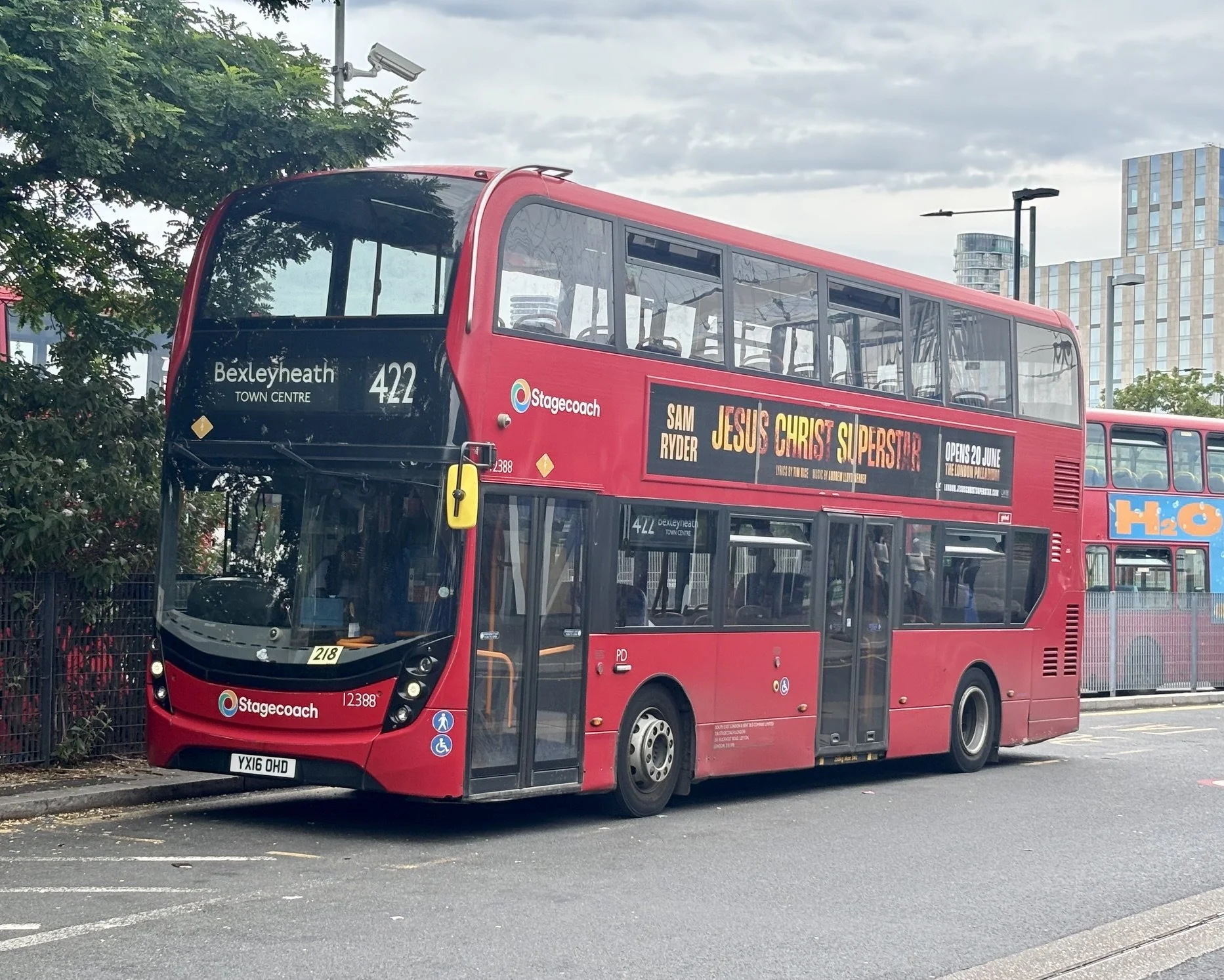
The 422 was retained by Stagecoach from early 2025 for 3 years with existing vehicles. Enviro400H no 12388 of Plumstead (PD) Garage seeks some shade under the trees at North Greenwich Station.
When I travelled, the route was about 50:50 hybrid Enviro400 MMCs and “classic” diesel Enviro400s.
At North Greenwich, my bus rides were concluded for the day, the mid-afternoon heat having curtailed the thought of fitting in any more routes, so I made my way down to the Jubilee Line for the journey home.
Watton
“And Finally”…
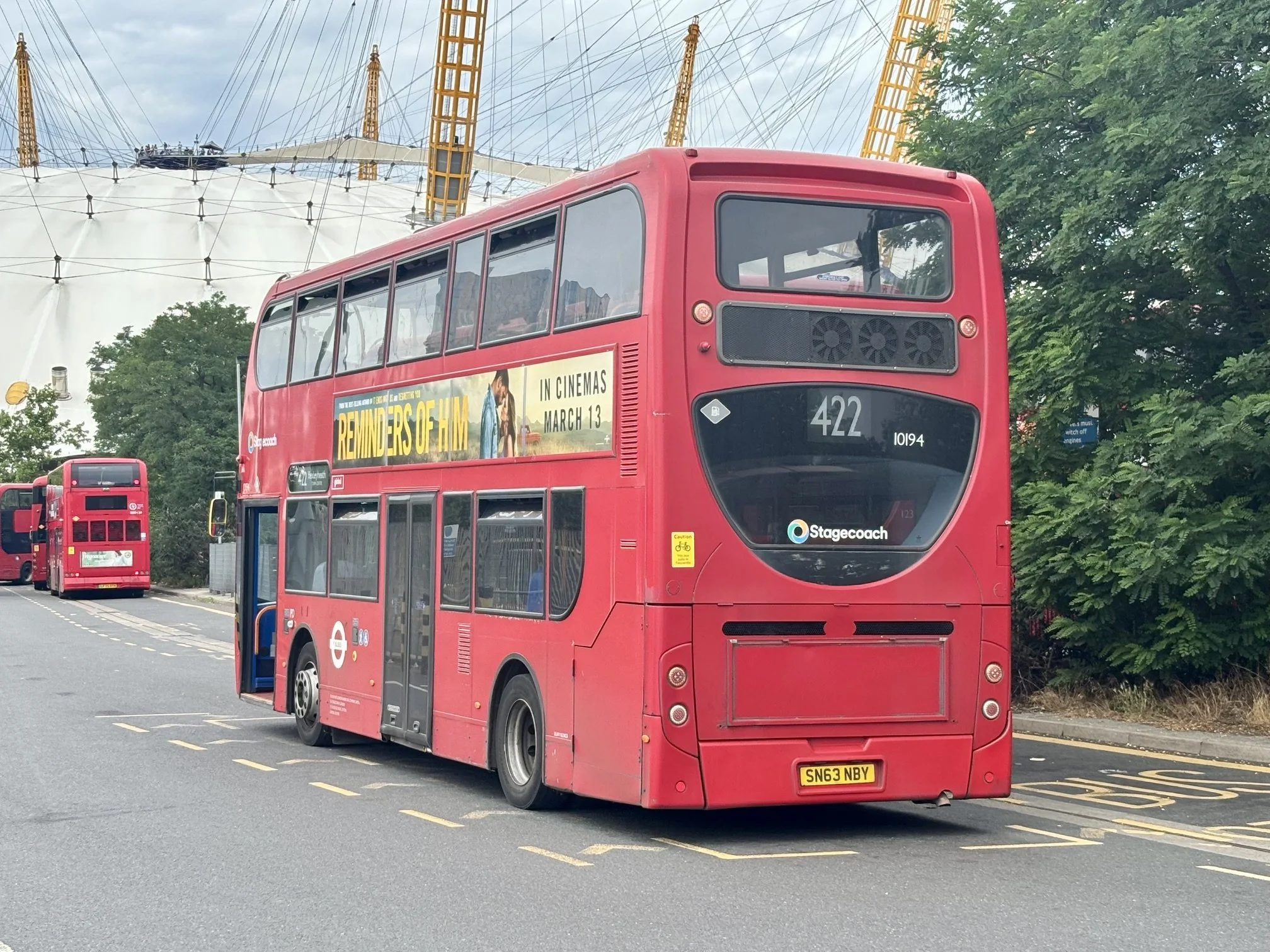
Looking like the back of a bus, a rear view of Stagecoach Enviro400 no 10194 of PD Garage, parked up at North Greenwich following my trip on it from Bexleyheath.
In the background, the O2 Arena, formerly the Millennium Dome.
