
Northern Heights & Haringey Heartlands
This time, I take a trip across the top of North London from Barnet to Chingford, then back to Wood Green to try out the new bus services to Haringey Heartlands, before taking in Cockfosters and Muswell Hill on the return journey.
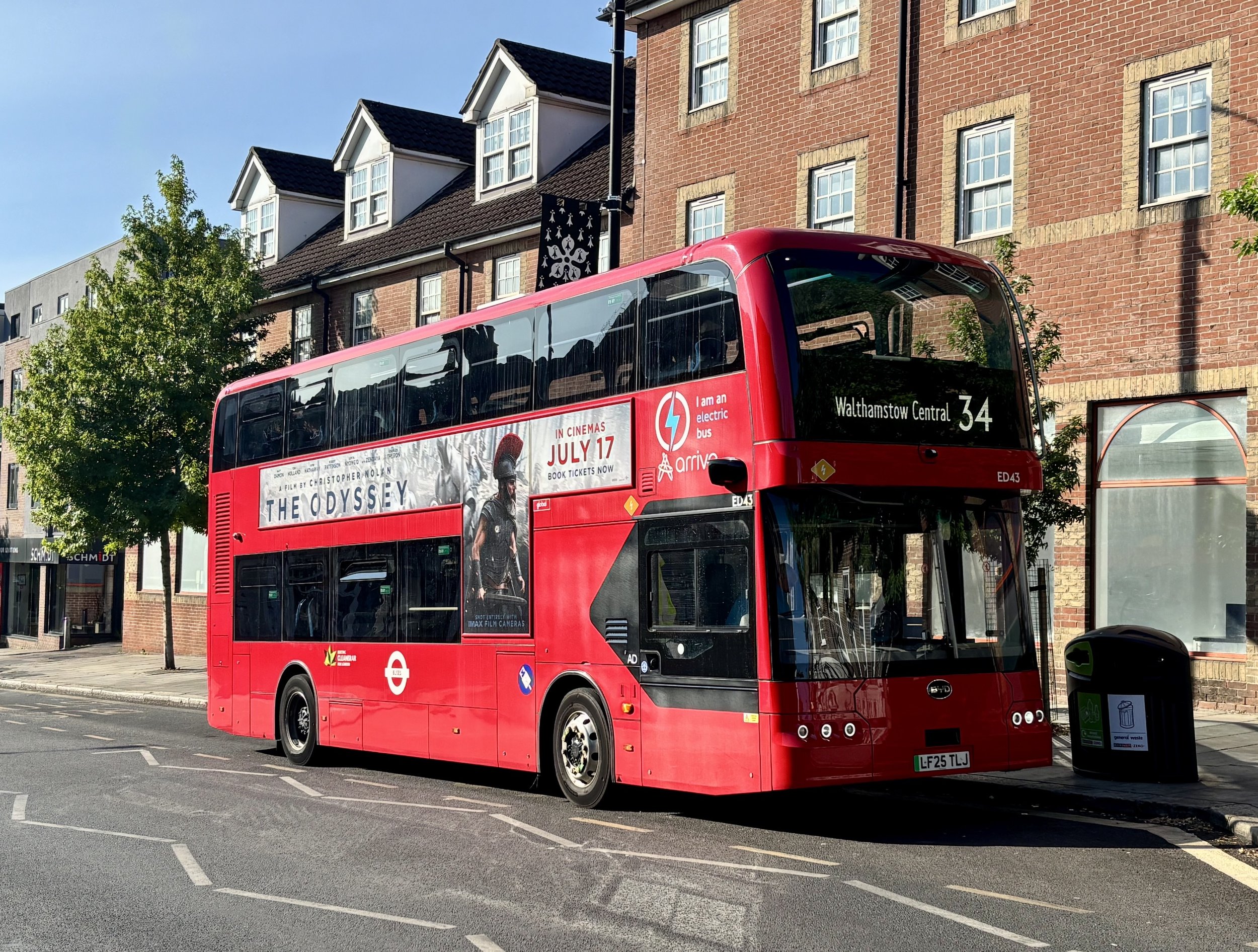
Arriva has introduced new BYD B11 electrics at Palmers Green (AD) Garage for the 34 and 141, although only a couple so far for Superloop SL1 pending installation of additional charging facilities. ED43 takes stand time at Barnet Church before my journey aboard to Walthamstow.
Deliveries of the type have so far also entered service at Croydon (TC) and Tottenham (AR) Garages.
Route 34: Barnet - Walthamstow
The first Saturday morning in August saw me arrive bright and early in Barnet, where I made my way to the start of Tfl Route 34 just south of St John The Baptist Church, known for decades in transport lore as “Barnet Church”. This location was originally a Tram terminus, then a Trolleybus terminus and finally a Bus terminus, with buses terminating from the south standing in a lay-by and then sweeping around through 180 degrees across the road junction below the church. These days, only the 34 regularly performs this turn, other routes in the town usually continuing to The Spires, Barnet Hospital or Chesterfield Road to terminate.
Quite a while since I had been on the 34, which received new BYD B11 electric double deckers in 2025 as part of its contract renewal conditions with Arriva, designated the ED class by the company, although the odd HV hybrid still turns out in support. I had only been on the type once before, a “Superloop” liveried example on the SL5 from Croydon (TC), so my first time on a standard red one. These vehicles have a somewhat squat appearance and whilst the interior is pleasant enough, they have a slightly claustrophobic feel in my opinion. However, the ride is smooth and the acceleration good, as I found after boarding ED43 at the first stop.
Not many passengers about at this time of day, so we had a fairly rapid run down Barnet Hill and past the Everyman Cinema along the main road to Whetstone. Turning left at the lights into Oakleigh Road North, we picked up a small crowd at the first stop before an easy run through suburbia to New Southgate. At the site of the former Standard Telephone Company works just across the bridge over the East Coast Main Line, I was reminded of how in RT days various short-workings used to terminate and start from this point at shift changeover times. Then it was on to Arnos Grove Station, where the stand was overflowing due to the Piccadilly Line being closed for planned engineering work and a replacement bus service was in operation, with terminating 251s and 298s competing for space with the rail replacement vehicles, whilst allowing free access for 34s and the other routes passing through!
After a bit of bus juggling, we were away and continuing down to join the North Circular, which enables a fast run when flowing well as at this hour at the weekend. At the stop before Palmers Green Garage, a swift driver change, before crossing the lights at the Green Lanes junction and continuing at speed to Edmonton “Cambridge” Roundabout. Briefly coming off the A406, we entered the narrow section of Silver Street, slowing us a little, until we rejoined the main drag at the end of Victoria Road beside Pymmes Park. This area was where the late TV personality Bruce Forsyth grew up, his parents owning and running a car repair garage in Victoria Road, now long gone.
A large passenger exchange at Angel Corner, where a man boarded carrying a large suitcase and an aluminium sink unit - I’ve heard of taking the kitchen sink on holiday, but this is the first time I’d actually seen it - and on a bus! He alighted after a few stops at the Eley Trading Estate. More rapid progress along the North Circ to the Crooked Billet Roundabout, making this a really fast journey and putting me in mind of trips I used to take on the route back in RT days, when I often experienced an exhilarating run - outside of peaks, the 34 was then mainly a fast road, perhaps less so these days but nice to rekindle old memories for once.
After Crooked Billet, we slowed down a bit for the final stretch into Walthamstow Town Centre, picking up short-riders at various stops including opposite the former Walthamstow (WW) Garage, which used to have a part share of the 34. No trace now remains, apart from the name “Omnibus Way” for the new road on the site and the former LCC Tramway Offices beside the entrance which have been converted to alternative use. After depositing most of our crowd at Walthamstow Market, we continued to Walthamstow Central Bus Station, terminating after a fantastic run of 50 mins. This had been a “proper” bus ride, how they used to be!
The 34 has provided a link between North & East London across the Lea Valley for many decades, although its destinations at each end have evolved over the years. Back in the 1950s, it ran between Barnet Chesterfield Road / New Barnet and Walthamstow Crooked Billet, although in 1956 part of the route was replaced on Sundays only by an extension of the 84, which 2 years later absorbed the whole of the 34 on that day of the week. In 1960, as part of the Trolleybus Replacement Programme, the route was extended to Leyton Green / Leyton Downsell Road at different times of day. Then, in 1964, the Barnet Chesterfield Rd - New Barnet section came off, transferred to new route 261. However, as part of the Reshaping Plan in 1969, the route was rerouted at the northern end to Barnet Church as part of further changes involving the 84 and 261. At the other end, further changes in 1973 saw the terminus becoming Leytonstone Harrow Green (M-F), Whipps Cross (Sat) and Walthamstow Central (Sun), which is how I first remember the route. By this time, it was RT on M-S and RM on Sun, although I never rode the latter.
OPO came to the 34 in 1977 with DMS types, featuring some of the later “B20” version with their distinctive rear cooling chimneys. However, in late 1981, these were replaced by Ms at AD Garage and Ts at WW Garage, due to each being in a different engineering area, so the route became one of the few to be simultaneously operated by both types. In 1984, the eastern terminus was standardised at Whipps Cross daily, although in 1988 it was cut back to Walthamstow Central, thus becoming the Barnet - Walthamstow route we know today, the route becoming all M from AD at that point. However, there was a short-lived 34A which operated for just a year from November 1988 between Walthamstow Central & Edmonton Park Road, which maintained a T allocation from WW for a while.
Tendering reached the 34 in 1997, when County Bus (T/A “Lea Valley”) won the route with Dart SLF single deckers, although a couple of Ms appeared at school times. Initially green and cream, the vehicles were repainted red and cream when the company was transferred to Arriva the following year. However, double deckers were really needed on the route and they returned in 2003 with conversion to low floor DLA & DLP types. In 2014, the route passed to Metroline for a single 5 year contract term, mainly using VWH Volvo Hybrids, supported by TE type Enviro400s. However, Arriva came back in 2019, the service returning to its old home at AD Garage, this time with HV hybrids, which continued until the current electrics recently replaced them.
I already mentioned the 34A, but there was another curious beast that was the 34B. This operated between Walthamstow Crooked Billet and Brimsdown Power Station, diverging from the 34 at Edmonton Angel via the Hertford Road and Ponders End. Limited to a few journeys in M-F peaks, it used buses off the 76 from Tottenham (AR) Garage rather than having much to do with the 34. In the 50s & early 60s it was RTW operated, until converted to RML in 1965, briefly featuring XA type Atlanteans when these ran on the 76 in the late 60s. The route was withdrawn in 1970.
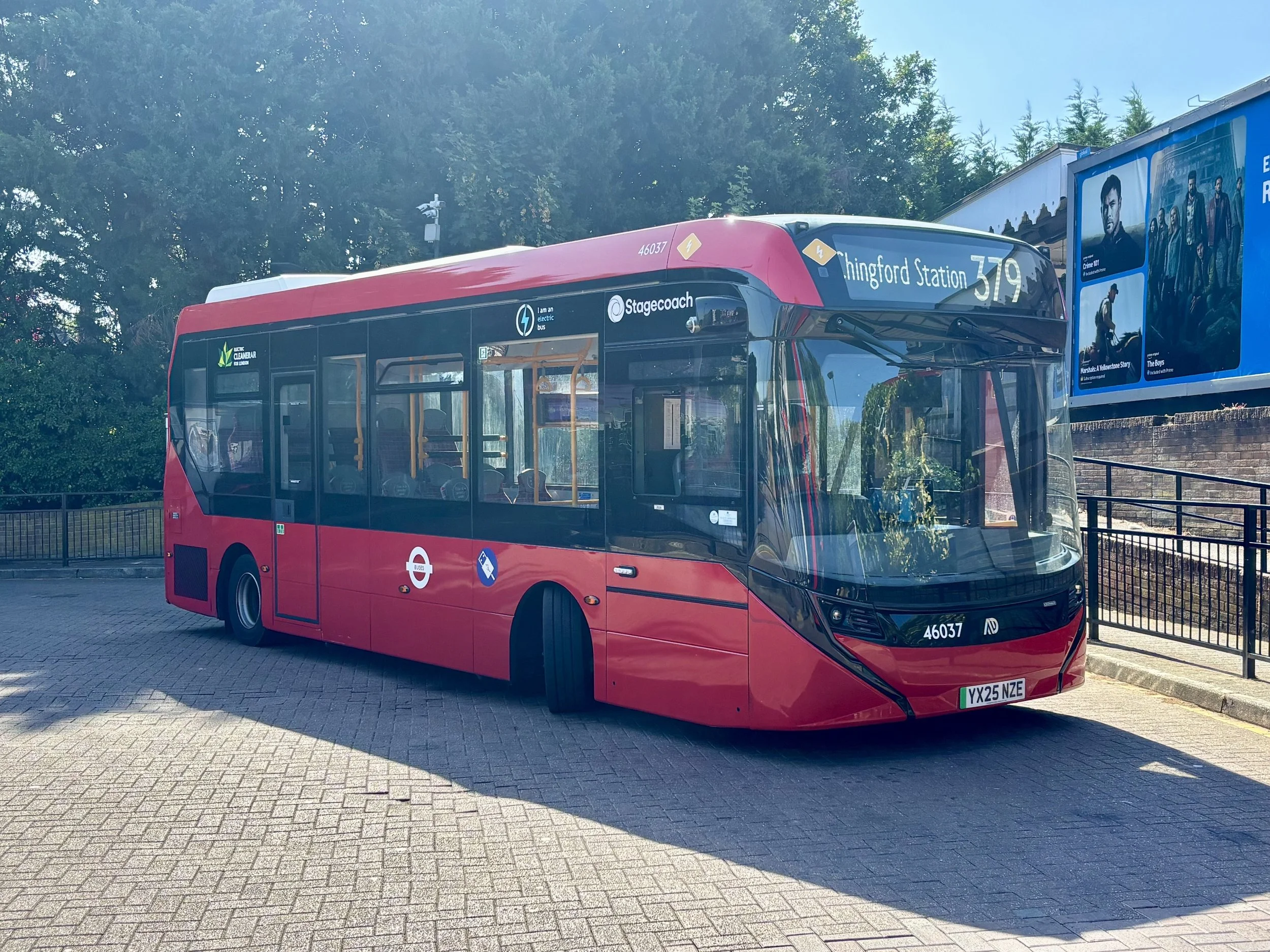
Stagecoach operate the short local 379 between Chingford Station & Yardley Lane Estate. Enviro100 EV 46037 from Walthamstow Avenue (WA) Garage is the bus I travelled on and is seen casting a shadow at Chingford Bus Station. The second bus out was one of the Switch Metrocity EVs from the W5 allocation.
There are calls for the route to be extended to Waltham Abbey (perhaps together with the 215) to restore a link between the two towns, although this would no doubt entail funding by Essex County Council.
Route 379: Chingford - Yardley Lane - Chingford
From Walthamstow Central, I took the Weaver Line train just three stops to its terminus at Chingford, taking just under 15 mins.
Walking to the adjacent Bus Station, I was just in time to catch the next departure on local route 379 to Yardley Lane Estate. When Stagecoach took over the contract in 2024, the intended electrics were not ready, so a temporary allocation was set up at Walthamstow Avenue (WA) using Enviro200s from Catford (TL) Garage off the 124 allocation, which I had sampled back in March of that year. Eventually, the intended Enviro100 EVs were delivered and I boarded fleet no 46037 for its next round trip.
We departed the station on time with just me and the driver on board. A second passenger joined us at Station Road / The Green, who travelled just a few stops down KIngs Head Hill before alighting - and that was it for the trip! Only me on the remainder of the rounder. Out via Drysdale Avenue and Hawkwood Crescent to Sewardstone Road, before looping around to serve the Yardley Lane Estate stand, just before the border with Essex. The next section of the loop via Antlers Hill and Yardley Lane itself back to Sewardstone Road is extremely narrow, with parked cars each side, which we negotiated very gingerly. At times, inconsiderate parking on this section means that buses have to be diverted without serving it.
Back in Sewardstone Road, we continued via the reverse of our outward route to Chingford Station, with not a passenger to be seen. Just a 25 min round trip. Interestingly, when I commented to the driver about how quiet the journey had been, he explained that the driver on the second bus on the route had taken over late and had been running up to 15 mins late on the last 2 trips - this on a scheduled 20 min frequency - so had been just a few minutes ahead of us and was pinching all the passengers!
The 379 has been in the news recently amid calls for it (and/or the 215) to be extended the short distance from Yardley Lane to Waltham Abbey, where residents have been calling for a reinstatement of a regular link between the town and Chingford (once provided by the 242 many years ago), plus improved bus services generally, particularly in the light of a lack of decent evening and Sunday services. Another demand is the reinstatement of the 317 from Waltham Cross to Upshire. Local councillors and other interested parties have organised an on-line petition and are lobbying both TfL and Essex County Council to make these changes. My 379 driver told me that he had a regular passenger who arrived at Chingford Station by train and took the bus to Yardley Lane, where the passenger had to arrange for a family member to meet him by car to take him to his destination of Waltham Abbey due to the lack of a through service. Also, 215 drivers often report passengers travelling to Lea Valley Campsite and then walking north along Sewardstone Road to reach their destinations. An extension of the 379 to Waltham Abbey would take only around 10 mins extra running time each way and a 20 min frequency could be provided with 3 buses, so over to TfL and ECC on that one!
The 379 was originally numbered 179A, which replaced the Chingford Station - Yardley Lane section of the 242, when that route was withdrawn between Waltham Abbey and Chingford in 1986. Originally operated with LS Leyland Nationals by London Buses, it passed to Grey Green on retendering in 1987 and was renumbered 379 using Leyland Lynxes. In 1989, it was converted to Mercedes midibus operation with Eastern National and rerouted away from the main road to the estate roads around the Yardley Lane area, although the contract passed in turn to Thamesway and then First Capital as succesors to Eastern National.
Low floor conversion in 2004 saw DMS Dart Marshalls introduced, still with First, but Arriva took the contract in 2007 with PDL Darts, replaced in turn by ENS Enviro200s in 2013. Go Ahead were next in line to operate the route, from 2017, generally using WS Wright StreetLites, although other types appeared. Present operator Stagecoach took over in 2024 as explained at the start of this section.
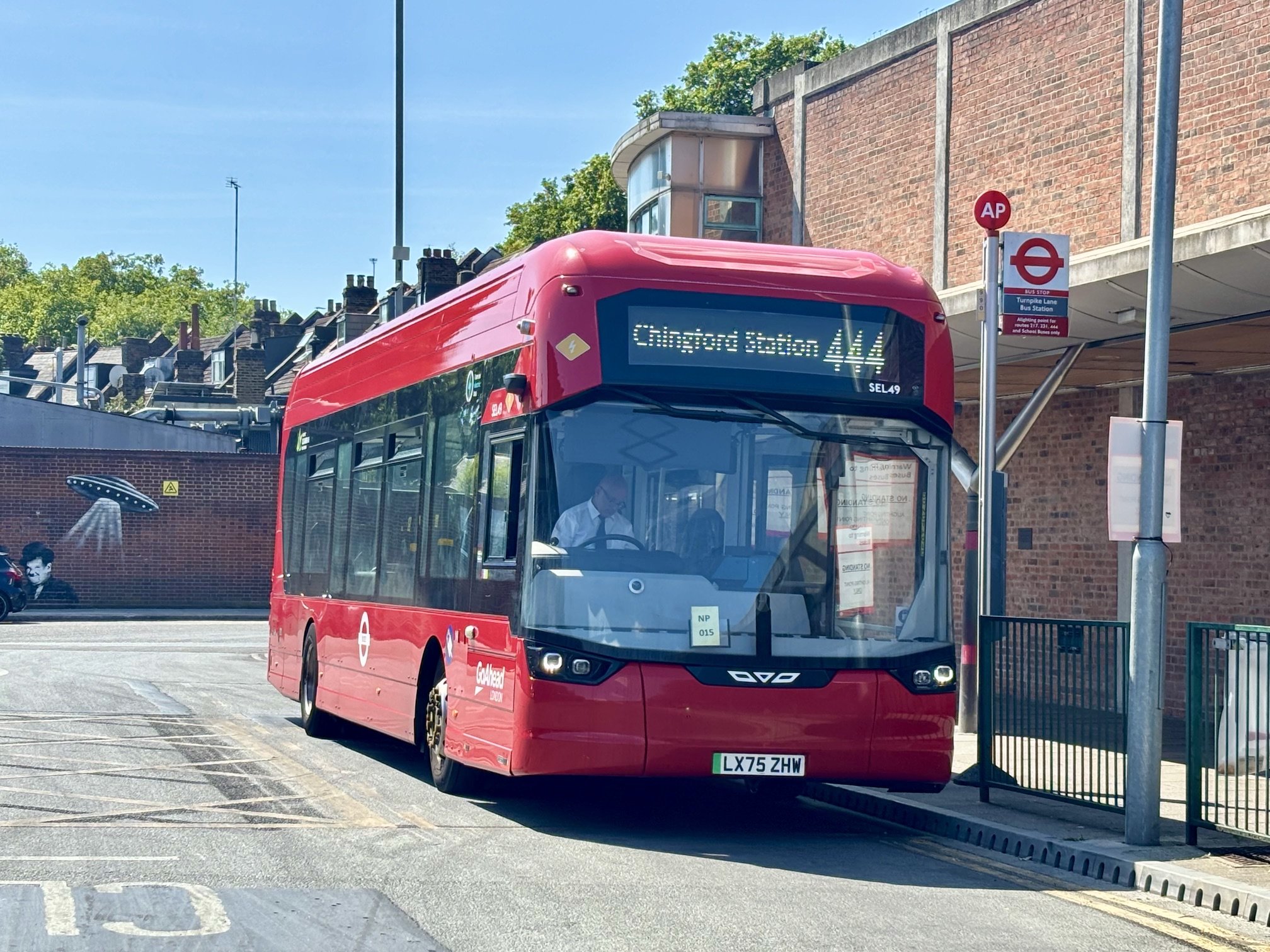
The 444 between Chingford & Turnpike Lane is operated by GAL from Northumberland Park (NP) Garage and is already onto its second generation of electrics, with Wright Kite Electroliners replacing the former SEe class Enviro200 EVs. SEL49 has just arrived at Turnpike Lane after my trip on board.
Note the wall mural behind showing Oliver Hardy and a flying saucer, which is part of a larger design commemorating the Ritz cinema which stood on this site from 1935 and was demolished in 1999 to accomodate the extension of the Bus Station.
Route 444: Chingford - Turnpike Lane
Back at Chingford Station, it was time to make my way over to Wood Green to ride the new sections of route associated with the Haringey Heartlands development. To get there, the simplest way was to take a 444 to Turnpike Lane, a route already onto its second generation of electric single deckers which I wanted to try out. The former SEe class Enviro200 EV have now been superseded by SEL type Wright Kite Elcetroliners on its latest contract retention with Go Ahead London. Already on stand at Chingford Bus Station was SEL49 of Northumberland Park (NP) Garage, which I boarded after a few minutes wait.
In contrast with the previous bus on the 379, which I had virtually had to myself, this was to prove a busy trip, with plenty on and off throughout. This is a route which in my view could do with double deckers - there is no physical restriction anywhere and the old 144 which the 444 replaced between Chingford & Edmonton was double deck. We filled up as we made our way out of Chingford via Larkshall Road to Chingford Hatch, before turning into New Road towards Chingford Mount. Another exchange of passengers, then onwards via Hall Lane to Walthamstow Avenue beside the North Circ for a short distance, before passing under it and up the slip road to join it at Angel Road. A rapid run, pausing to let a few on and off at the Ravenside Retail Park. Although we continued direct, plans are afoot to reroute the 444 via new roads through the Meridian Water development here and back to the A406 - watch this space, as they say.
Soon, we were back at Angel Corner, Edmonton, continuing under the railway bridge at Silver Street Station, before turning off along the back roads next to North Middlesex Hospital, of which the 444 is one of several routes to serve. Then on via Wilbury Way to the A10 Great Cambridge Road, joining the 217 & 231 routes from just south of the Cambridge Roundabout, crossing White Hart Lane and passing along The Roundway to Lordship Lane. Into the final section along Westbury Avenue where temporary lights and single carriageway working only delayed us for a minute or two. After crossing the course of the former Seven Sisters - Palace Gates railway line, which closed to passengers in 1963 and freight a year later, we arrived at Turnpike Lane Bus Station. Although a busy run, we only took 50 mins, with a smooth ride on the modern electric.
The 444 dates from 1991, when it replaced most of the former 144, which in turn had replaced the 102 over the Chingford - Edmonton section in 1988. Initially running via Silver Street between Edmonton Angel and Edmonton Cambridge, it was rerouted via North Middx Hospital in 2002. Initial operator was County Bus t/a Lea Valley with high floor Darts, as used on the 34 mentioned earlier, although in 1998 the company became part of Arriva. Low floor conversion came in 2000 with ADL Darts, although these were later replaced with DWL Cadets. 2015 saw the route reassigned to Tower Transit with WV StreetLites for a 5 year term, before GAL took over in 2020. SE class diesels were used temporarily until the SEe electrics were ready, which continued until the recent conversion to SEL types.
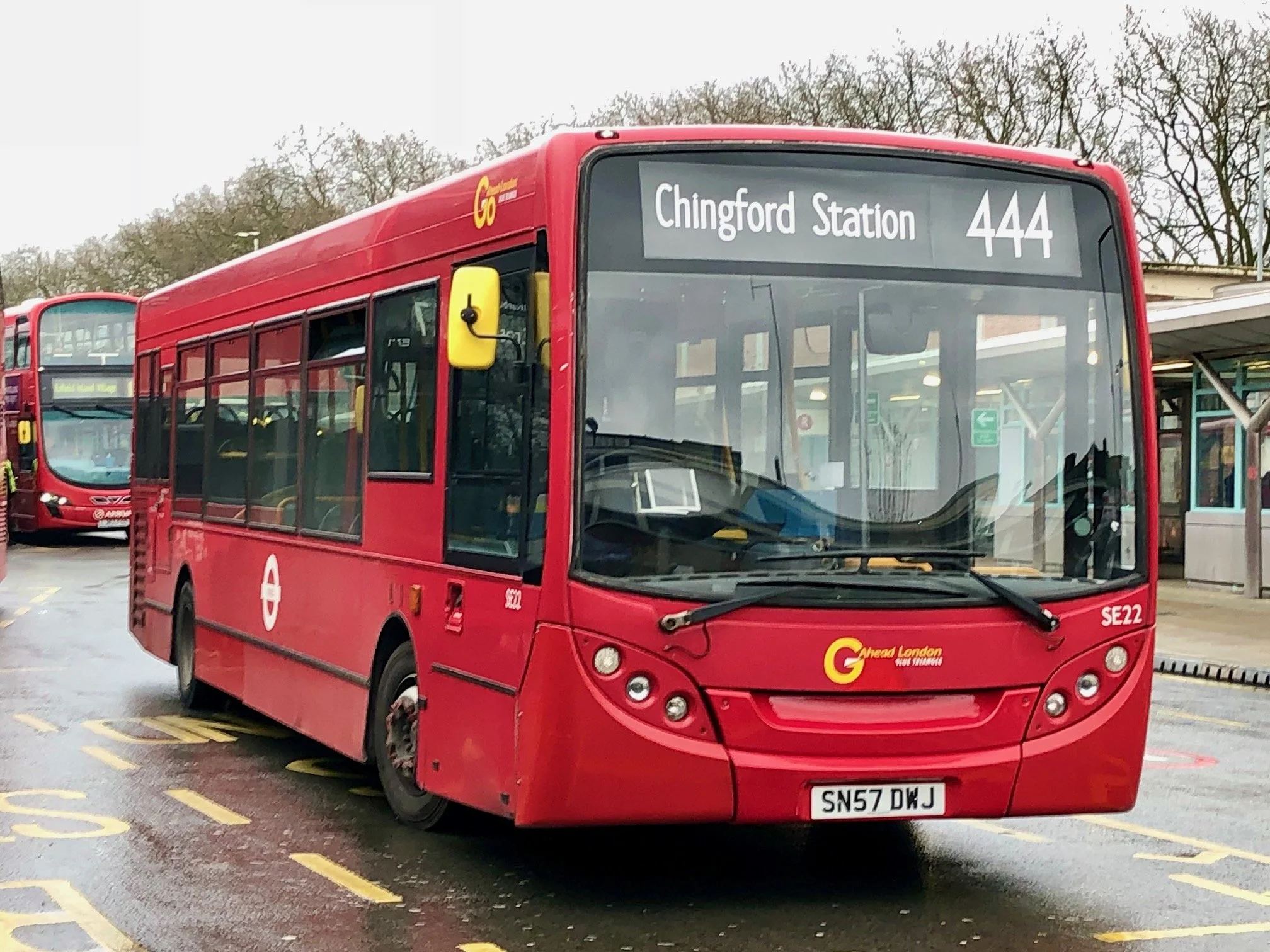
When GAL took over the 444 contract in 2020, the SEe electrics were not ready in time, so existing diesels were used as a stopgap for a few weeks. Enviro200 SE22 (NP) is seen in a wet Turnpike Lane Bus Station in early 2020 shortly before the Covid lockdown.
This vehicle has since been withdrawn from service.
Turnpike Lane - Wood Green
At Turnpike Lane Bus Station, I fancied a quick stretch of the legs, so took a short stroll along the High Road to Wood Green Station, passing on the way the Shopping City, which took less than 10 minutes - not much slower than the bus!
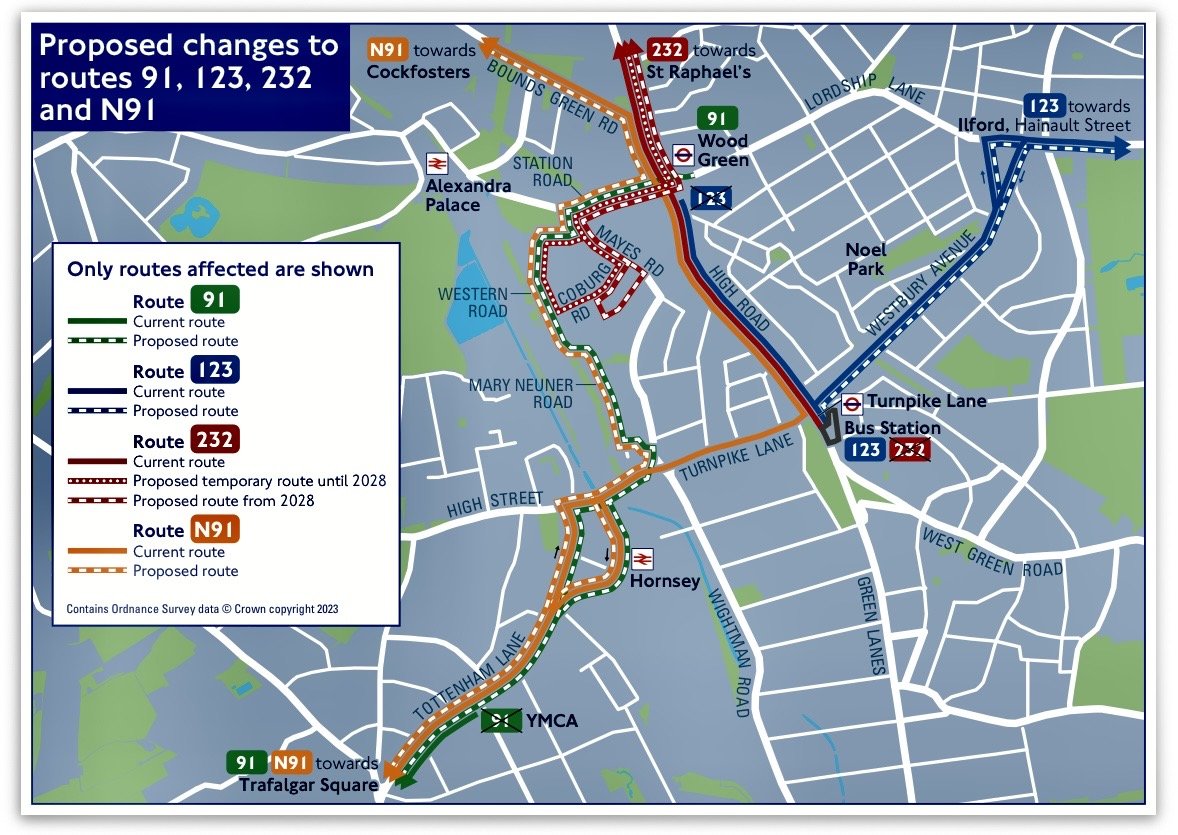
Map issued by TfL in 2024 showing the changes to routes in Wood Green to serve the new Haringey Heartlands development.
These changes were finally introduced at short notice on 1st August 2026.
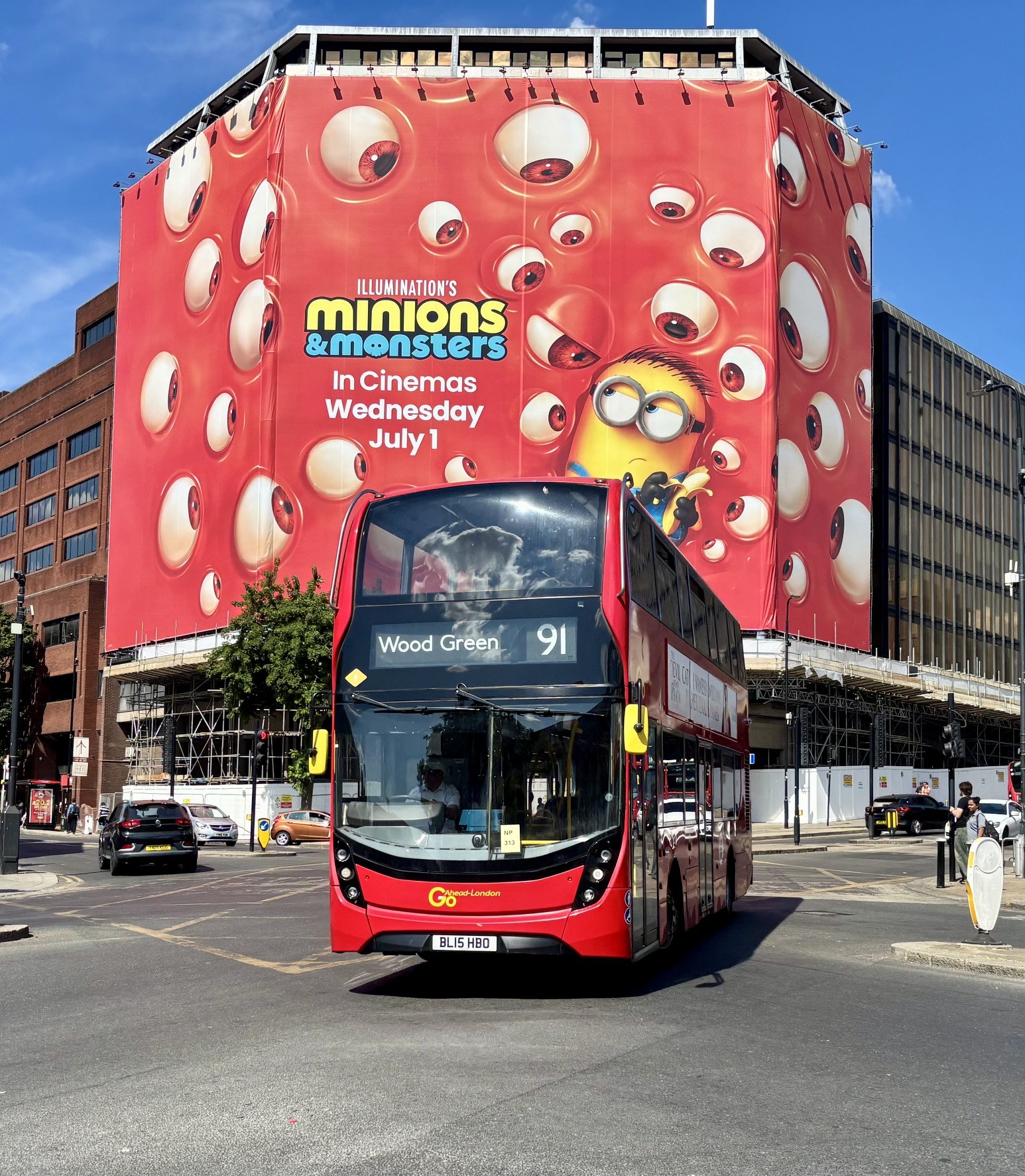
GAL Volvo Enviro400 MMC hybrid EHV7 of NP Garage makes the turn from Station Road into High Road Wood Green on the first day of the extension of the 91 from Crouch End to Wood Green Station on its way to the Redvers Road stand.
The 91 is a hybrid salad of EH, EHV, MHV and WHV types. I travelled on a couple of MHVs over the new section.
New Part of 91: Wood Green - Crouch End - Wood Green
At Wood Green, I was able to observe comings and goings on the routes which had been changed from that day to serve the new Haringey Heartlands development, which basically occupies the area beside the East Coast Main Line between Alexandra Palace and Hornsey Stations.
First on the list, the extended 91, which has been projected from its former Crouch End terminus via Hornsey and the new development to Wood Green, the terminus being at the Underground station and the stand being in Redvers Road, where the 123 has been moved out and cut back to Turnpike Lane to accomodate it. The 91 is operated by GAL from NP Garage with a mix of hybrid types, but I joined MHV66 on its next southbound trip at the first pick-up stop in Lordship Lane, joined by half a dozen others, including a couple of younger enthusiasts who were busy videoing the ride. Crossing into Station Road, we received a query from people waiting as to where we were going, but no takers. We then entered the new section of route by turning left into Mayes Road, then sharp right into Western Road, where the scene changes from Victorian terraces to modern apartment blocks. Two stops on the new bit - at Western Road and in Mary Neuner Road (named after a former Mayor of Haringey in the 1990s), picking up one person at each .
All too soon, we were at the junction of Hornsey Park Road with Turnpike Lane, where we turned right to join Route 41 for the rest of the trip, under the ECML railway bridge, then left into Tottenham Lane past Hornsey Station and down to Crouch End, where I alighted at the stop before the Broadway at the end of the new section. A 12 min trip.
Crossing the road, I caught MHV95 for the return run, which arrived after a 5 min wait. Interestingly, a number of passengers already on board were making use of the new link and rode beyond the former terminus at Crouch End. On the new section, we dropped one person at each of the two new stops, where I noted 6 and 3 people respectively waiting on the opposite side of the road for southbound buses. About 8 of us alighted at Wood Green Station after another run of around 12 mins. It certainly seemed that locals were aware of the newly extended route and were taking advantage of it, although the numbers were swelled by first day enthusiasts.
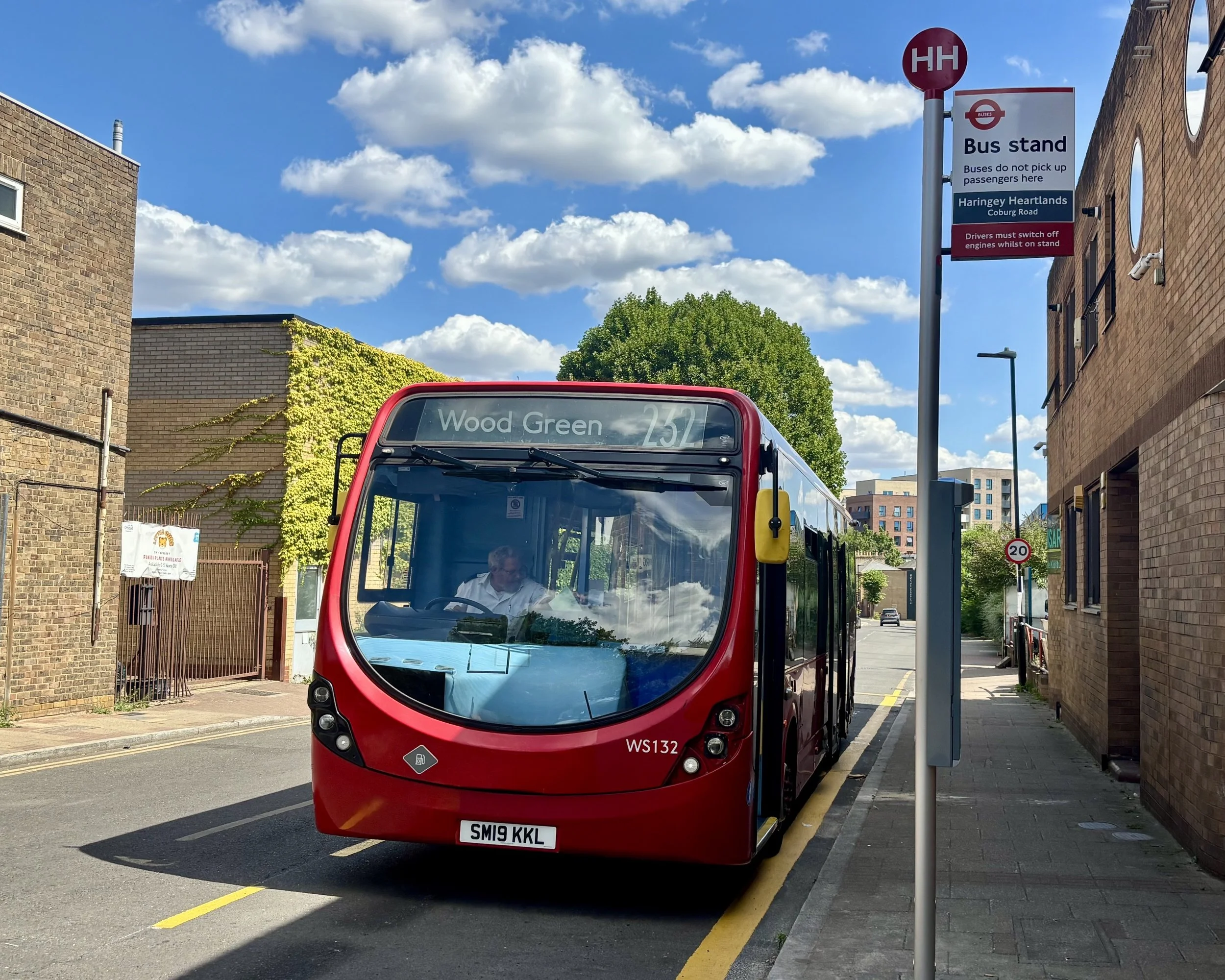
The 232 has been diverted after Wood Green Station to a new stand at Coburg Road in Haringey Heartlands, where GAL Wright StreetLite WS132 (NP) is seen on the first day.
The former Turnpike Lane stand of the 232 has been taken over by the 123, which was cut back to this point from Wood Green with the changes, the 91 taking over the former 123 stand in Redvers Road.
New Part of 232: Wood Green - Haringey Heartlands - North Circular / Brownlow Road
Next, I switched my attention to the 232, which has been diverted southbound away from its former Turnpike Lane destination to a new stand within Haringey Heartlands. Whilst there is an undoubted value to the 91 extension, I suspect there is limited demand for a link to/from Palmers Green and the North Circular. It appears that the 232 has only been rerouted here to free up the former stand at Turnpike Lane for the newly cut back 123.
Also, whilst destination blinds and i-bus screens/announcements were correct for the 91 extension when I travelled, the same was not true of the 232. I boarded southbound GAL StreetLite WS132 opposite Wood Green Garage, which was simply showing “Wood Green” on the blind and, confusingly, “Turnpike Lane” on the interior screen plus announcements. As a result, the driver was informing all passengers that he wasn’t going to Turnpike Lane, so they all alighted. At least he asked me where I was going as I boarded, which I did with two other enthusiasts.
Then we were off, right turn into Station Road, with more questions as to our destination by a couple of people at the next stop but no resulting custom. Left into Mayes Road, this time continuing further along it, past a dolly stop, then right into Coburg Road and down to the far end at the junction with Western Road, where we finished at the new stand. Just a 4 min journey.
Asking the driver where he picked up on the return, he directed me around the corner to the northbound stop in Western Road, which I noted had the appropriate route number tiles and timetables for all the routes serving it (91, N91 & 232), as did the other stops on the new section of road. Only me and one of the two other enthusiasts took WS132 on the return trip, soon arriving back at Wood Green Station, where we had a driver change and more joined us. I stayed on the bus for a short distance further, up to Palmers Green Garage and then left at the North Circ, where I alighted at the junction with Brownlow Road after a 15 min ride.
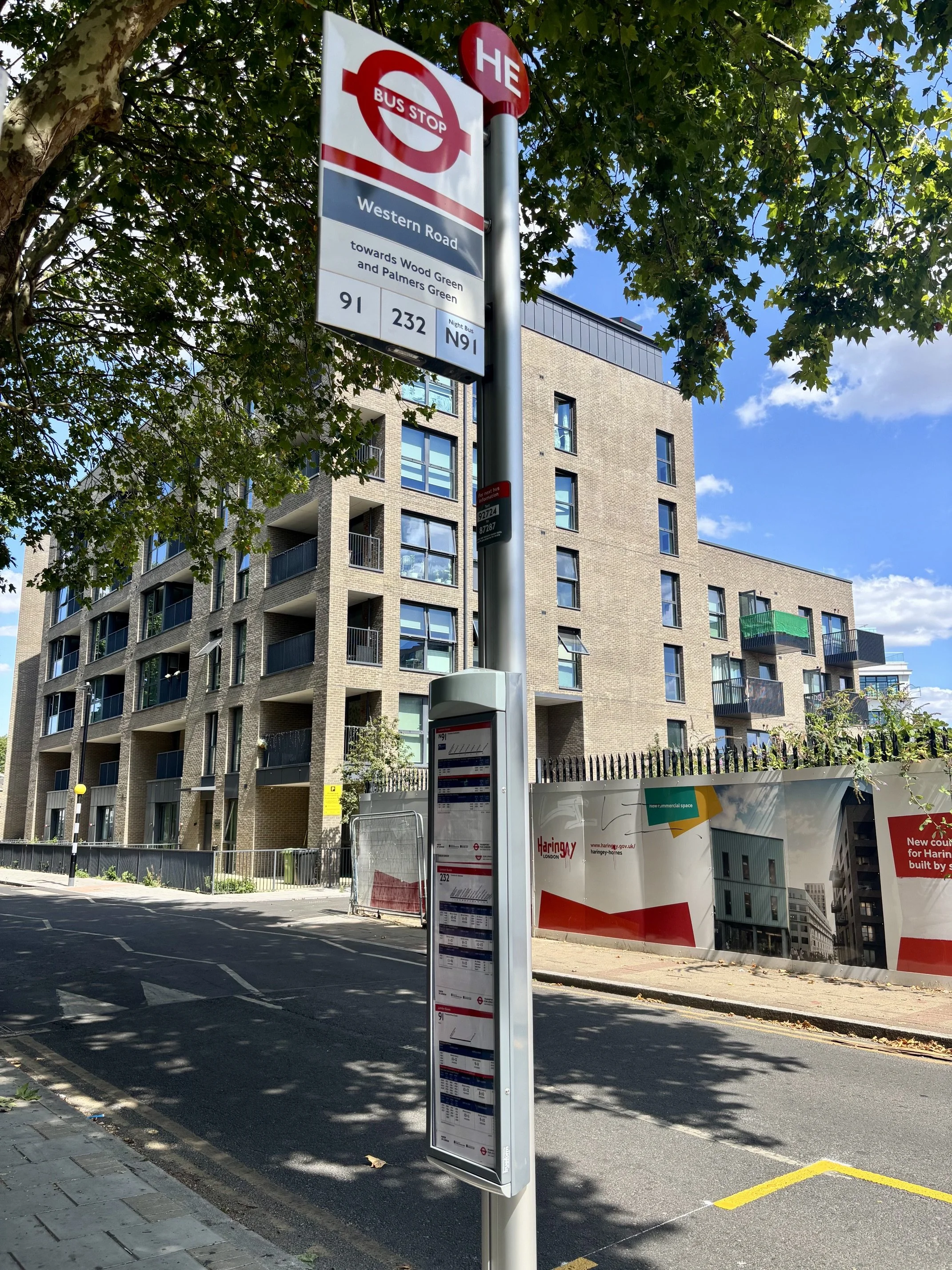
The first pick-up stop for the 232 in Haringey Heartlands is in Western Road, which it shares with the extended 91 and diverted N91. New route number plates and timetables were in place for the first day.
This is just around the corner from the Coburg Road stand. Evidence of ongoing development in the area can be seen across the road.
Part Route 299: Brownlow Road - Cockfosters
Next item on the agenda, a rounder on the 299, which since I last rode it has passed from Sullivans Buses to GAL and been largely converted from diesel to electric, using the first Volvo BZL single deckers with GAL, ordered for both Orpington (MB) and Northumberland Park (NP) Garages. Classified as the SVM class, those at NP have been the first to enter service, on the 299, 389 & 399 routes in recent weeks.
Walking around the corner from the North Circ to the first northbound stop in Brownlow Road, new SVM17 arrived after a few minutes wait, bound for Cockfosters. There was a small number already on board, as we crossed into Powys Lane and skirted Broomfield Park, which includes the remains of Broomfield House, a historic mansion destroyed by several fires, but where heritage lottery funding is being sought for its restoration. Then, we hit temporary lights due to roadworks at the junction with Aldermans Hill, luckily not so bad in our direction but with a big queue coming the other way from Old Southgate. Once through, we were ok until Meadway, after which there was a slow-moving queue past Southgate College up to the station, which was closed due to the Piccadilly Line suspension.
The bus in front must have been delayed even more than us, as it was only a couple of minutes ahead on a 15 min frequency and I kept catching glimpses of it. We followed at a discrete distance past Southgate ASDA and then via the back roads of Avenue Road and Resorvoir Road, before turning into Bramley Road. At Bramley Sports Ground, we took a right at the roundabout for the crawl along Cockfosters Road to the station, where we surprisingly arrived virtually on schedule, unlike the late-running previous bus, after a 25 min journey.
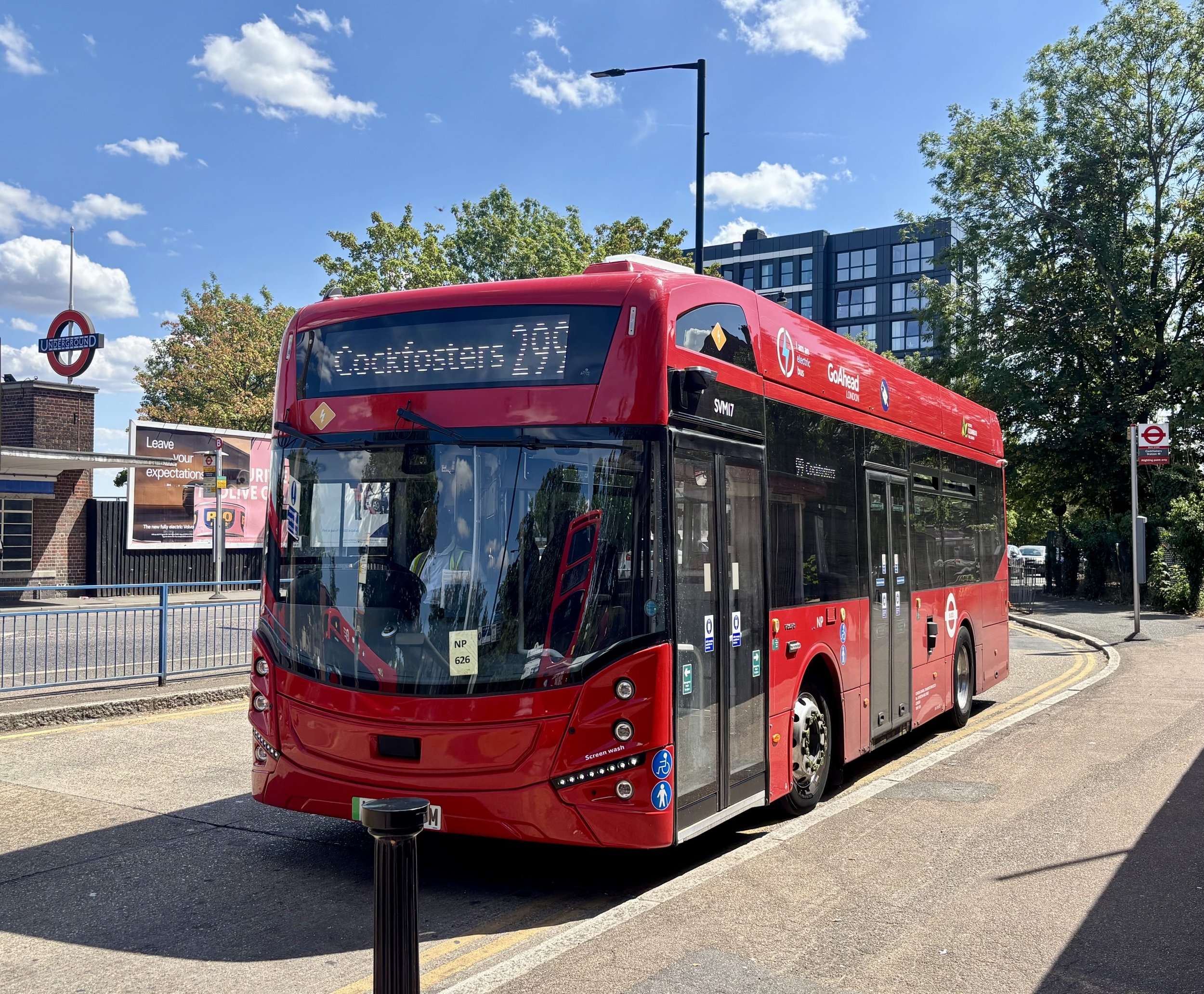
GAL have taken delivery of a batch of 25 Volvo BZL electric single deckers for Orpington (MB) and Northumberland Park (NP) Garages. Those at the latter have entered service first, on the 299 plus the derivative allocation on the 389 & 399. SVM17 is seen at Cockfosters Station after my first ride on the class.
The subway out of sight to the right of this picture provides easy access to the Piccadilly Line Station across the road, except it was closed on this day for planned engineering work with a Replacement Bus Service in operation.
Route 299: Cockfosters - Muswell Hill
I had noted during my ride on it that, in addition to the new SVMs, there were a couple of older SEs out on the 299. A quick check on LVF showed that one was a couple of buses behind the one I arrived at Cockfosters on and was due to leave from there on its next trip in just over half an hour. This just gave me nice time to grab a sandwich and a drink and sit somewhere shady whilst I awaited it, whilst observing comings and goings on the Piccadilly Line Rail Replacement Service. This appeared to be operated by Arriva, mainly with superannuated Ts and DWs, but with the odd HV and LT also seen. A couple of TfL staff in pink hi-vis were directing confused Tube passengers at Cockfosters, the replacement buses proceeding via Southgate and Arnos Grove to link up with the Northern Line at Finchley Central. A second service was running from Arnos Grove via Bounds Green, Wood Green and stations south to connect with the Victoria Line at Finsbury Park.
Eventually, the expected Enviro200 arrived, SE167, which I boarded after it pulled up outside the station a couple of minutes before scheduled departure time. A good positive run ensued, our driver negotiating the parked cars around the back streets towards Southgate with aplomb. A brief Mexican standoff when a car coming towards us tried to sneak through a gap before us and failed, so after a short pause was forced to reverse to let us through.
Back at Southgate, the earlier traffic snarl-up seemed to have vanished and we called at the station before continuing without any hold-ups. At the temporary lights by Aldermans Hill, the southbound queue had gone and we only had to wait one sequence of the lights changing before we were through. In Powys Lane, a passenger pressed the bell just as the driver was passing the stop and was quite angry when the driver went straight past, although he did pull in at a safe place a bit further on in response to the passenger’s frantic shouts! Not the driver’s fault though.
Then on across the North Circ, calling at Bounds Green Station, before continuing along Albert Road and Alexandra Park Road up to Muswell Hill. There must have been a gap in the parallel 102s, as we picked up quite a few on this section. Arrival at Muswell Hill was after a decent run of 35 mins.
The current 299 is the fourth use of the number of London. It’s first incarnation was as a route between Southgate and South Mimms, with journeys to Cranbourne Road Industrial Estate, Clare Hall Hospital and Borehamwood. This began in 1970 in replacement of part of the 298 with crew RT operation. OPO came the following year with SMS single deck, then re-conversion to double deck using DMS in 1977. It ended in 1980 upon reintroduction of the 298.
The 299 number resurfaced briefly in 1984, when the Sunday services on the 228 & 229 were combined into one long route between Eltham & Green St Green using Titans. This was obviously not a success, as the former status quo was reinstated after less than a year. Then, in 1985, the 299 came back as a short local service between Stratford & Eastway Sports Centre using Titans, although this was later amended to LS Leyland Nationals. This version was withdrawn in 1990.
We come now to the current 299, restored to its orginal area of London as a route between Cockfosters & Muswell Hill, serving new roads and replacing the Southgate - Muswell Hill section of the W9 in 1992. Originally operated by First Capital with midibuses, it went over to low floor operation with DM Dart Marshalls in the early noughties. Go Ahead assumed the contract in 2012 with SEN class Enviro200s, although Sullivan Buses took over in 2018 using mostly Wright StreetLites. Following months of chaos in 2024, when the service descended into an unreliable mess with lots of cancelled trips, Go Ahead came to the rescue using SEs until the current electrics began to arrive.
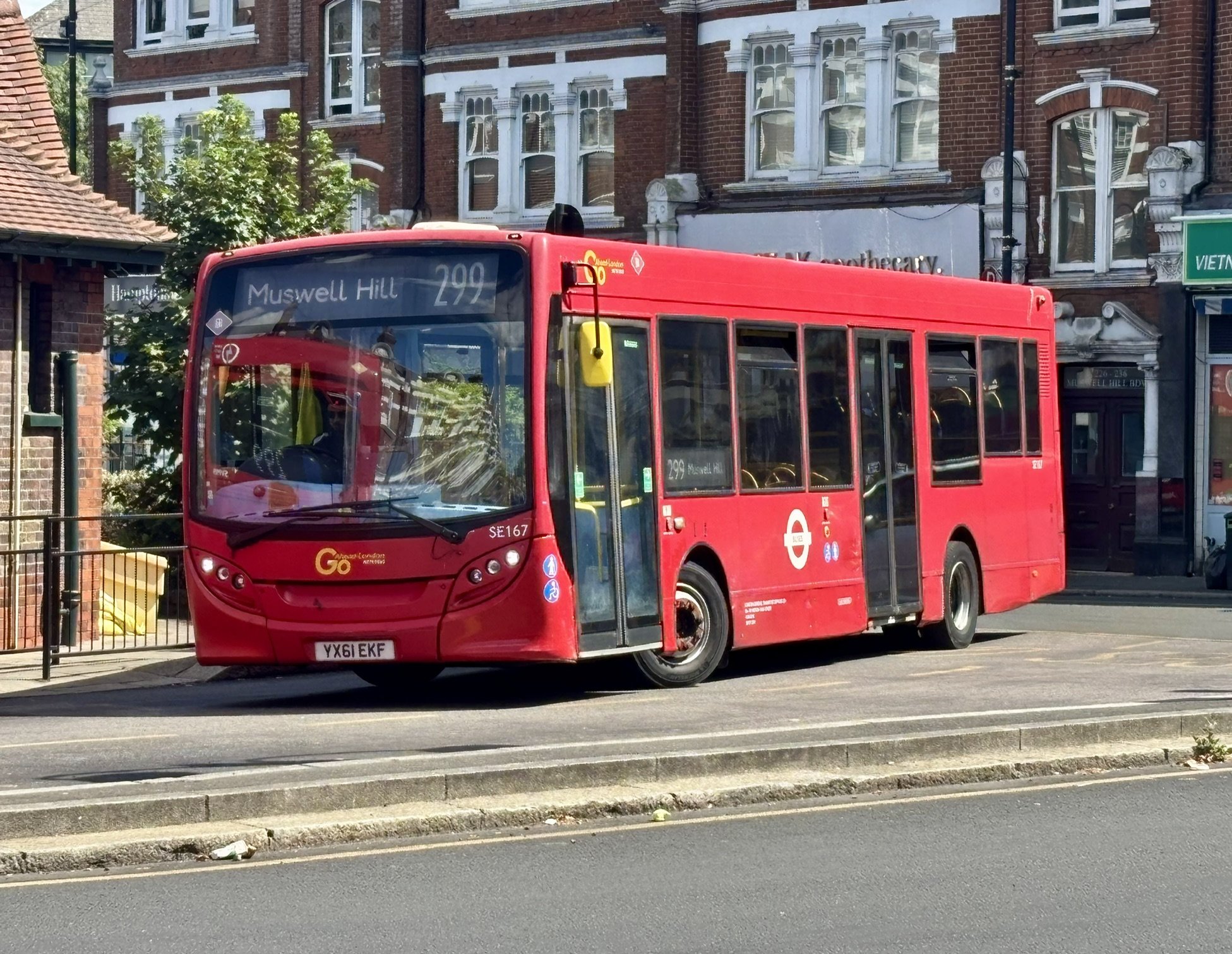
Pending delivery of the SVMs, older Enviro200s have provided the service on the 299, with a couple still helping out on the day I rode it. SE167 (NP) is at the other end of the route at Muswell Hill.
This particular bus was previously at Merton (AL) Garage before being transferred north.
Part Route 299: Muswell Hill - Brownlow Road
To complete my round trip on the 299, I was able to step up a working and board SVM19, which was ahead on the stand at Muswell Hill when I arrived. Unlike the previous one I had been on, the interior screen wasn’t correct, as it was showing “36 to New Cross Gate” (!), an unfortunate bit of mis-programming, although strangely the verbal announcements were working properly.
After a short 10 min run, I arrived back at my start point just short of the North Circ in Brownlow Road.
Part Route 34: North Circular / Brownlow Road - Barnet
To complete my day, I returned to my start point at Barnet Church, catching the next westbound 34 around the corner on the North Circular. Another fast run aboard Arriva ED6 of AD Garage, which was a nice way to finish.
Watton
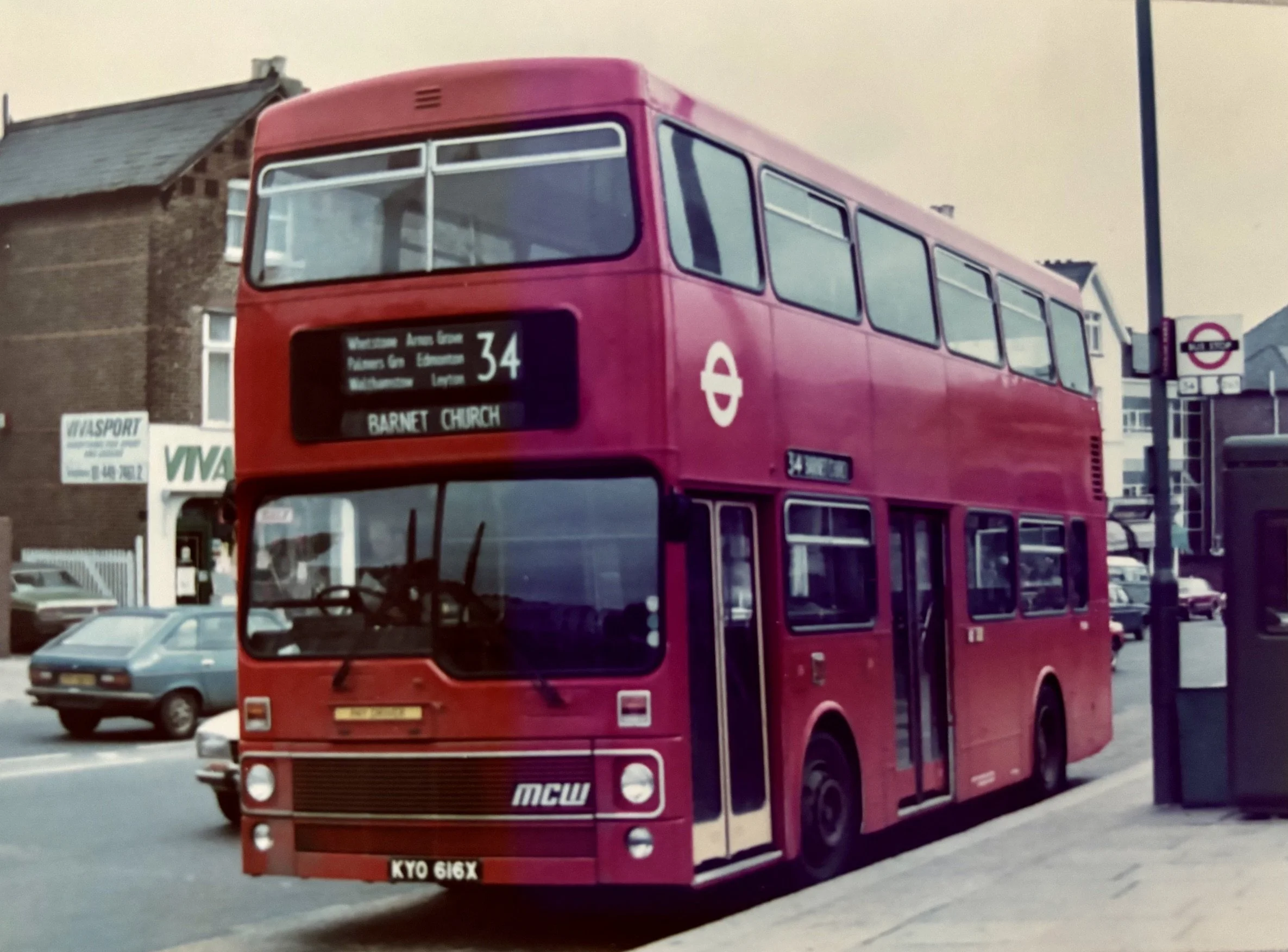
Back where we started at Barnet Church, with one from my archives taken at the end of 1981, when the Palmers Green share of the 34 was converted from DMS Daimler Fleetlines to MCW Metrobus. M616 illustrates the change.
At the same time, the Walthamstow Garage share of the 34 was converted to T class Titans, making this one of the elite group of routes to feature both types simultaneously.
