
King of the Road in Kingston
This time, I head off to the South West corner of the London Bus Map, riding First Bus services in the Kingston area. On my travels, I rode a new electric, an older diesel and a few hybrids, with a final ride on a route due to pass to another operator very soon.
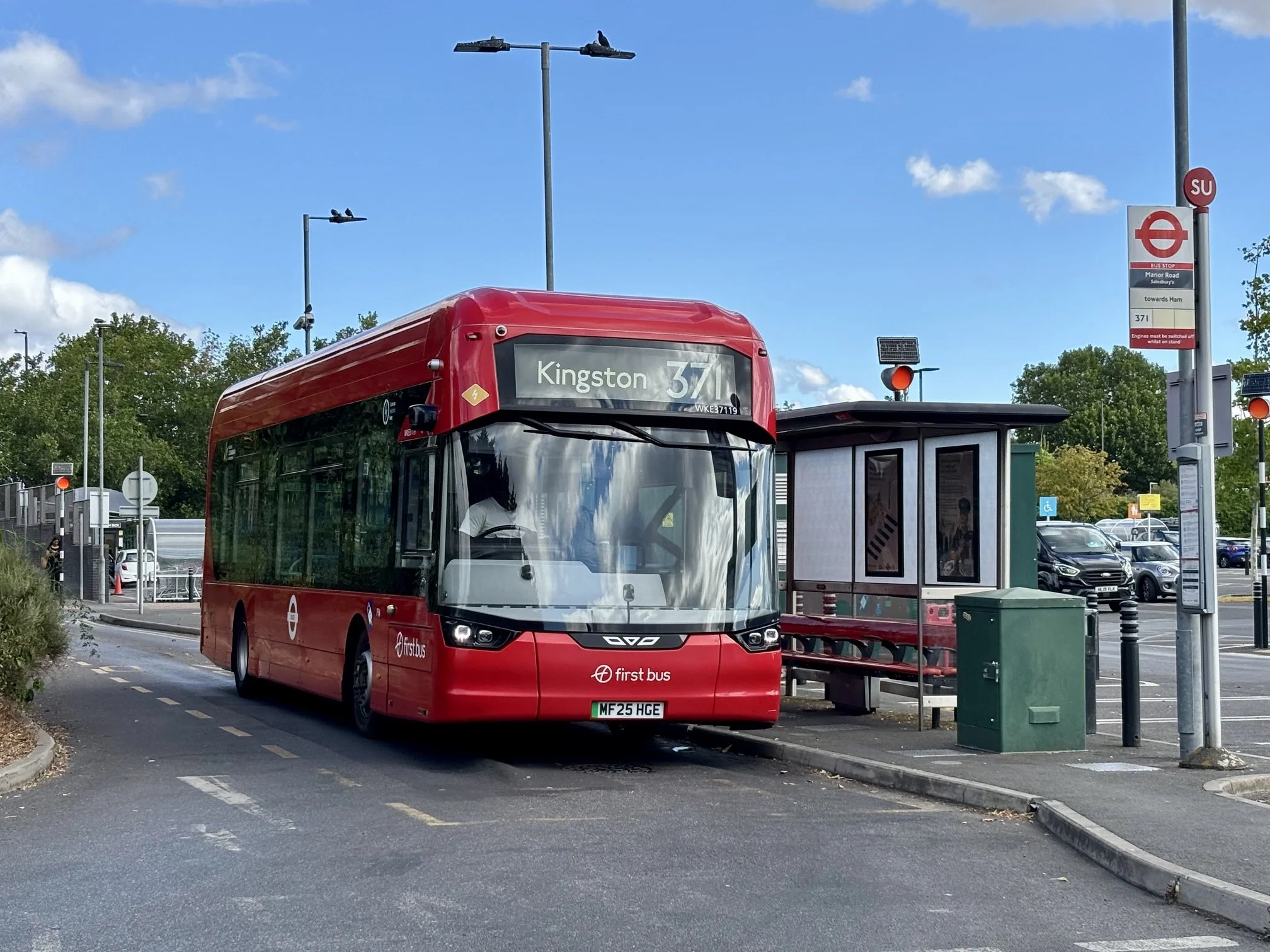
First Bus Wright Kite Electroliner WKE37119 of Fulwell (FW) Garage shows off the chunky lines of the class on the 371 at Richmond Manor Road Sainsbury’s before I travelled on it to Kingston.
This was my first ride on the type from FW, which shares its WKEs between routes 33 and 371 at the time of writing.
Route 371: Richmond Manor Circus - Kingston
Arriving by the London Overground Mildmay Line at Richmond Station, I was able to take a moment to admire the recently restored 1930s Art Deco interior and facade, before walking east along the Lower Mortlake Road to Manor Circus Sainsbury’s, start point of my first bus route of the day, the 371.
This service is operated by First Bus London from Fulwell (FW) Garage and has recently gained a partial Wright Kite Electroliner allocation to support its 5 year old BYD Enviro200 EVs, so I wanted to sample the new type on the route. LVF showed a similar number of each class out to play, with WKE37119 being on the second departure. Although nominally single deck, the route is not restricted in any way and one or two double deckers often appear, with 2 BCEs seen during my journey.
We departed Manor Circus on time, initially just me and the driver, although we soon began picking up in small numbers at subsequent stops. Three lanes into one at the Richmond Circus roundabout only caused a brief hiatus and we called at the station before swinging left into Queens Road away from the town centre. A couple of minutes delay at the Sheen Road / Church Road junction due to 4 way temporary lights, but once past we had a clear run around the twists and turns of Richmond Hill. This area was once covered by short local route 235 between 1955-66 using 1 RT which shuttled between Richmond Station & Richmond Hill - after withdrawal by London Transport as a result of the 1966 Overtime Ban, it passed through various private operators in subsequent years. Eventually, the 71 was diverted to serve the area, a situation inherited by the 371.
After this, we descended towards Petersham, passing a couple of the entrances to Richmond Park. The road here was famously closed for 18 months in 1979-80 due to “The Petersham Hole”, caused by the collapse of a buried stream culvert and sewer beneath the street, with bus route 71 cut back and the 65 split to operate from each side. From here, we turned right into Sandy Lane, to run around the estate roads of Ham, passing close to Ham House, an atmospheric 17th Century House set in gardens beside the River Thames and now a National Trust property. Crossing the main A307 road again at right angles, we continued along suburban Tudor Drive, before turning into Park Road, which we followed to the bottom of Kingston Hill. It was then a straight run past Norbiton Church into Kingston Town Centre, dropping off at various stops including Eden Street and The Guildhall, before terminating at Kingston Hall Road after a 50 min run. A smooth run on a modern electric bus to begin the day.
The 371 began in 1990 when the 71 was split, the new number taking the northern portion of the former route between Richmond & Kingston. Essentially, apart from one or two minor rerouteings, the route has remained the same since, except for short extensions at each end - from Dee Road to Manor Circus in Richmond and from the Bus Station to the High Street in Kingston. The original operator was Westlink, which used in turn LS Leyland Nationals, DWL Dart Wrights and then MV Optare Vectras, to which some XL Optare Excels were later added. Westlink came under the ownership of London United in 1995, which was the operator for 30 years through its periods with Transdev and RATP Group. Low floor Darts of the DPS class took over in 2002, until these were superseded by Enviro 200 DE types in 2009. Electrification with the current BEs occurred in 2021 and then in 2025, First Bus acquired the former RATP operations.
Whilst the main allocation has always been single deck, the odd double decker has appeared, with one scheduled for school journeys for most of the life of the route, although unscheduled visits have also happened in ones and twos over the years. The school journeys were scheduled for one Leyland Olympian operated by Armchair for a while in the 1990s, although this responsibilty later passed to London United, who operated various types including VA Olympian, TA Trident and SP Scania, either on the school working or helping out at other times.
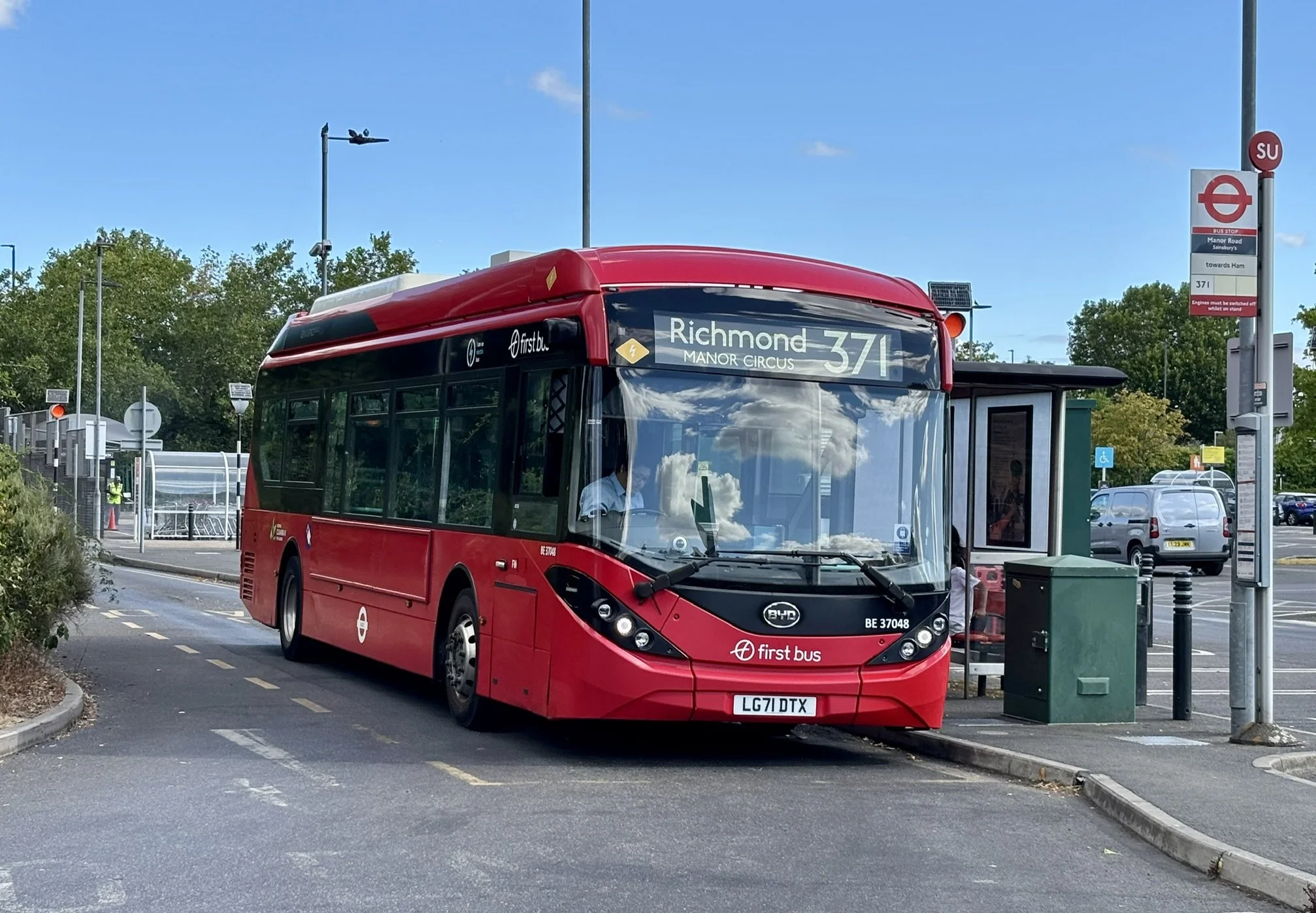
By way of contrast to the previous picture, here is First London BYD Enviro200 EV BE37048, also of FW Garage, once again at Manor Road Sainsbury’s on the 371. This was on the working ahead of the one I took.
The 371 is typically around 50:50 operated by BE and WKE types, often supported by the odd BCE double decker.
Part Route K4: Kingston Town Centre - Kingston Hospital
Crossing Kingston Hall Road, I had around 20 mins to wait for my next bus on the K4 on the short trip to the end of the route at KIngston Hospital. This route is fairly unusual for a TfL service these days in that it operates on M-S only, with a 30 min frequency decreasing to Hourly late evenings. Operated by First Bus from Tolworth (TV) Garage, its normal allocation comprises short single door Enviro200 MMC single deckers, with the next to arrive being SDE20298.
Most of those already on board alighted at the various stops around the town centre, with just a few continuing up to Norbiton Station and around the corner to the terminus at Kingston Hospital. Just a 15 min journey.
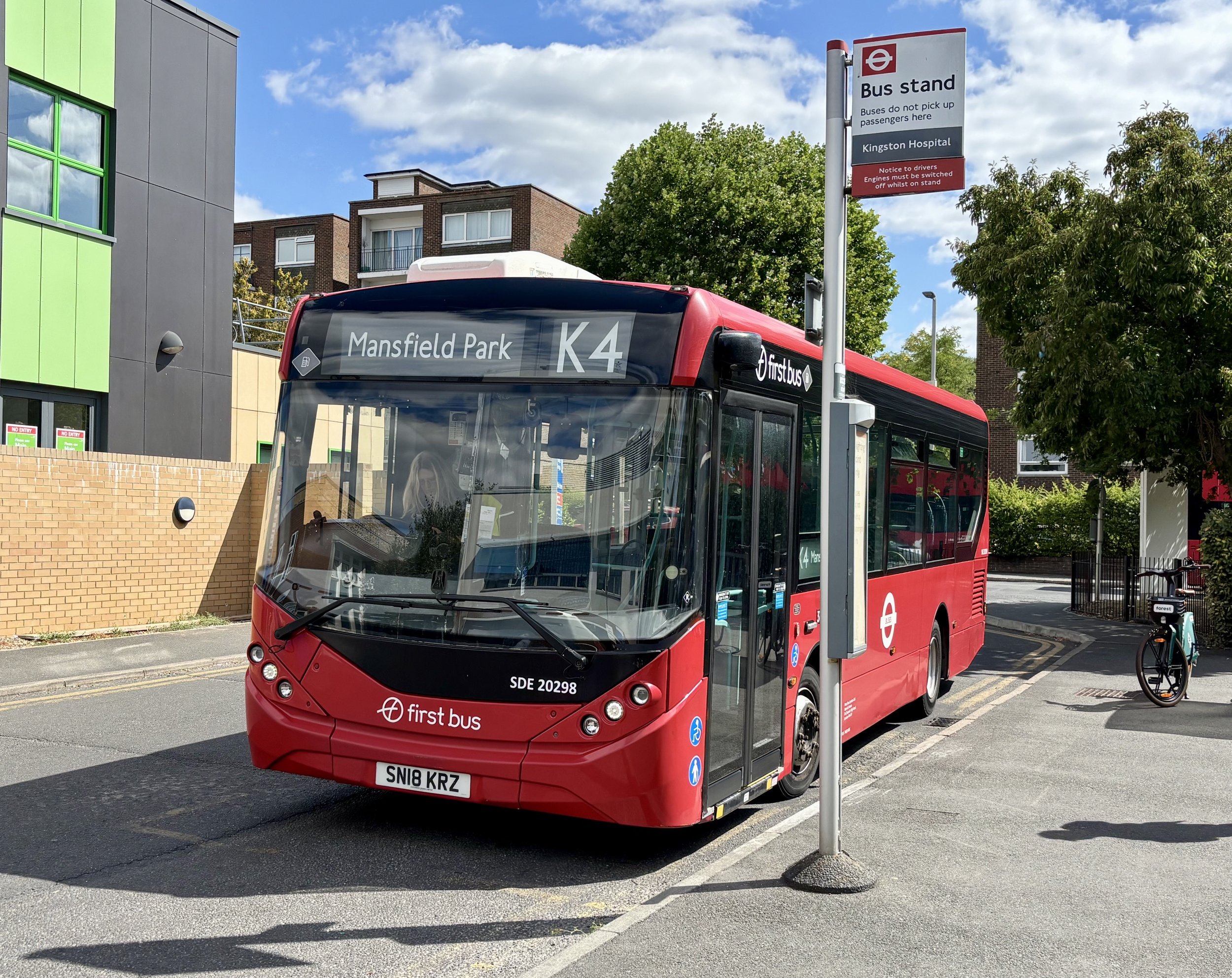
First Bus single door Enviro200 MMC SDE20298 of Tolworth (TV) Garage is on stand at Kingston Hospital before departing for Mansfield Park with me on board.
This route is one of the few these days with TfL to operate only on M-S with no Sunday service.
Route K4: Kingston Hospital - Mansfield Park
After the break, I reboarded the same bus, which due to two K2s on stand at the pick-up stop opened its doors to let us on at the set down stop! Then, as there was insufficent space to pass the other two buses to leave the hospital, we had to continue along the car park access road to leave via the next exit, having to negotiate the muddle of cars which were vying for the limited parking spaces available. Eventually, we were free and continuing back through Norbiton to Kingston once again, over which section the traffic was by now a bit stickier than earlier on the 371.
The K4 circumnavigates the town centre calling at various stops including the Guildhall and Kingston Hall Road after Eden Street, when it could take the short cut via Brook Street without too much inconvenience and save a couple of minutes or so. Moving into Fairfield South beside the Recreation Ground, we entered a 20mph zone, which continued all the way to Surbiton (and beyond), progress seeming painfully slow. Along Villiers Road/Avenue and then down St Mark’s Hill to Surbiton Station, with a crawl along narrow Victoria Road past the shops and lines of parked cars. Turning left into Upper Brighton Road, the 20mph limit now continues all the way to the junction with the Kingston By-Pass at Hook - completely unnecessary on this stretch, where pedestrian numbers are usually fairly low and there are no sharp corners or other hazards requiring such a low speed.
Just before the roundabout at Hook “Ace of Spades” (closed), a set of temporary lights with single lane working due to more roadworks didn’t delay us more than a minute or so, although there was a queue onto the roundabout in the other direction which was blocking the flow. An easier run from here down to Hook Library, but then at the Bridge Road Roundabout we encountered another queue, this time southbound, due to more temporary lights and single carriageway working just beyond the junction. Eventually, we made it through, before turning off into the Winey Estate over narrow estate roads on the “Hail & Ride” section through to the terminus at Mansfield Park. Our trip time was 50 mins, amazingly only 5 mins late after the various delays en route and we had a 15 min layover to absorb this.
The K4 dates from 1989, when it began as a Midibus Route operated by Westlink with MR class MCW Metroriders. The original route operated from Kingston Bus Station on a one-way loop via Mansfield Park and back. This arrangement was amended several times at the Winey Park / Mansfield Park end until settling on the “out and back” route operated today. Other minor rerouteings have taken place between Kingston & Surbiton. The KIngston Hospital extension was introduced in 2000, came off again in 2001 only to be reinstated in 2005.
Initial operator Westlink was taken over by London United in 1995, to whom the contract passed formally the following year, with DT and then DR class Darts replacing the MRs. Small buses have always been a necessity on the K4 due to the narrow roads traversed and so a special short batch of low floor Darts (DPK class) were introduced in 2001. The same occurred on conversion to “classic” Enviro200s in 2011 with SDE types, which were in turn replaced by the MMC version in 2018. As with other routes in the area, First Bus took over from the RATP Group in 2025.
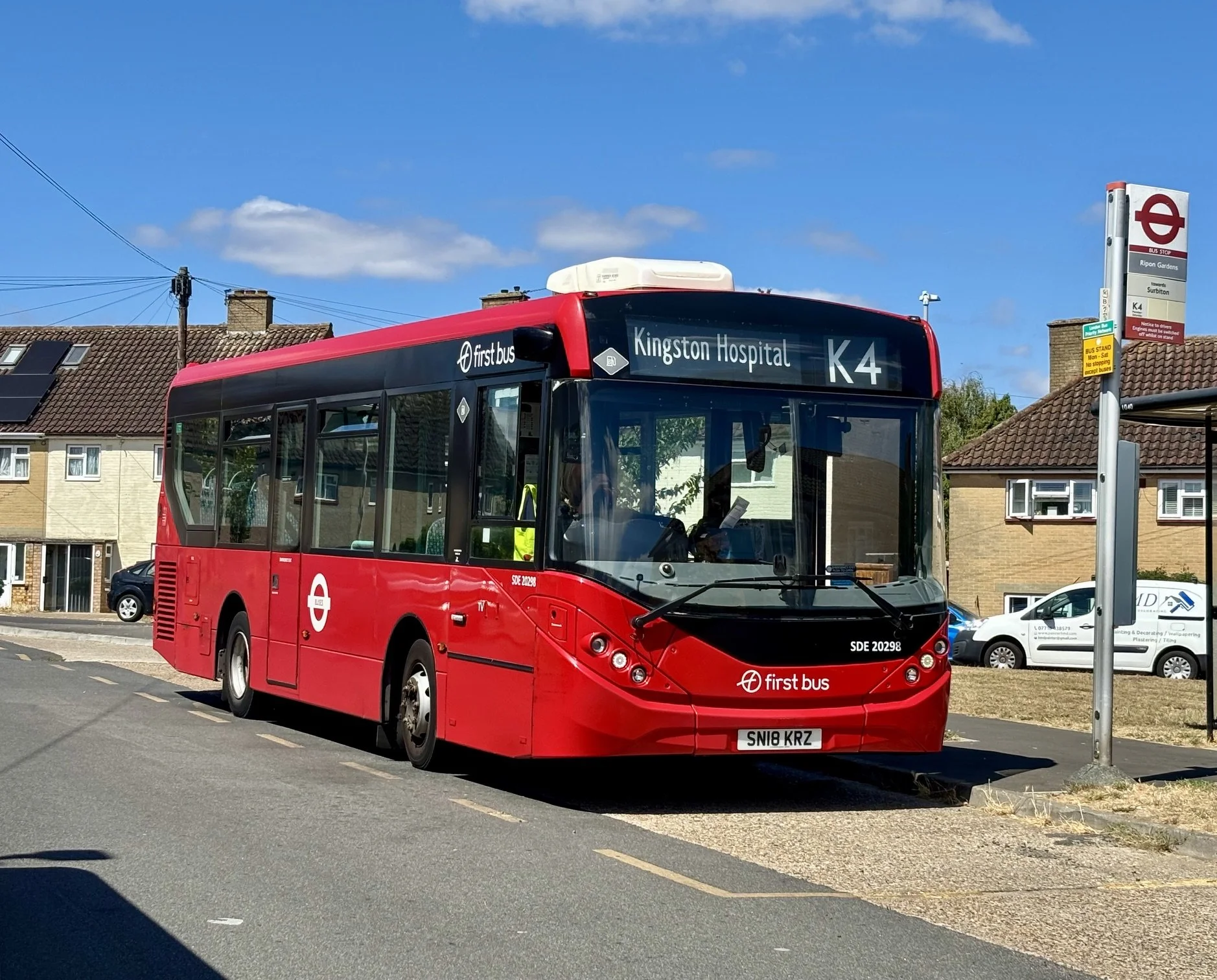
Here is SDE20298 again, this time an offside view at the other end of the K4 at Mansfield Park Ripon Gardens.
After going around the estate, buses used to operate direct to Hook when leaving this point, but now return via the reverse of the outward route after the terminal loop.
Part Route K4: Mansfield Park - Hook
After the break, I reboarded SDE20298 and we continued around the block before retracing our steps via the reverse of our outward route through the Mansfield Park estate, picking up in ones and twos. Unfortunately, back on the main road, we had to join the queue to pass the temporary lights near Bridge Road once again! Then it was a straight run down to Hook Parade, where I alighted after a short 10 min ride.
Route 467: Hook - Epsom
My third route of the day is a most unusual beast, more akin to a provincial service than a TfL one. The 467 operates between Hook & Epsom on an approximate Hourly frequency, M-S daytimes only, with school journeys extended at each end - to/from Hinchley Wood School and to/from Epsom General Hospital. The contract for the route is due to pass from current operator First Bus to Falcon Coaches in September 2026, being the latter’s first foray into TfL work, so a chance for me to sample the old regime for one last time.
Unfortunately, I had picked the wrong time to ride the route, as although it was the school holidays, extensive roadworks were taking place in Epsom Town Centre (of which I was unaware), with a double set of temporary lights at the High Street/East Street junction (4 way) and then at the East Street/Hook Road junction (2 way). As a result, delays were occurring to all routes serving Epsom, including the 467. Checking on LVF as I waited at the Hook “North Star” stop for the 13.01 departure, I saw that the bus to form this was about 20 mins late on its trip from Epsom, but that if the driver foresook his stand time, we would only be 10 mins late leaving. This duly happened and I boarded Volvo B5LH VH45125 of Tolworth Garage with one other passenger at 13.11, not too bad in the circumstances.
Naturally, we then encountered the roadworks and temporary lights south of the Bridge Road roundabout, which cost a couple of minutes, but after that we had a free run, turning into Garrison Lane past Chessington South Station and through the Copt Gilders Estate, with passegers joining and leaving in ones and twos. At the last stop in Gilders Road, two passengers boarded paying absolutely no attention to what bus they were on and were then shocked when we turned right into Moor Lane rather than left - clearly not noticing that we were a 467 not a 71, both of which serve Copt Gilders. After furiously ringing the bell, they alighted at the next stop and began walking back the way we had come!
Calm now restored, we continued along Chessington Road, picking a trio of young golfers at Horton Golf Park. Others on and off in small numbers as we continued towards Ewell, calling at Ewell West Station before entering the one way section past the ponds into Ewell Village, joining up at this point with the 406. The roads were eerily quiet for a while until we reached Kiln Lane Sainsbury’s where the ominous sight of non-moving brake lights appeared ahead. Several alighted at the Rainbow Leisure Centre, our penultimate stop, but we were then stuck in a queue to negotiate the two sets of temporary lights, with many on board using much choice language to voice their opinions about the council and the utility companies for creating this situation. In the end, we were not delayed too long in this direction and made it to the final stop at the High Street after a 35 min run, some 15 mins down on schedule, our driver having done well to drop only 5 more mins since the start.
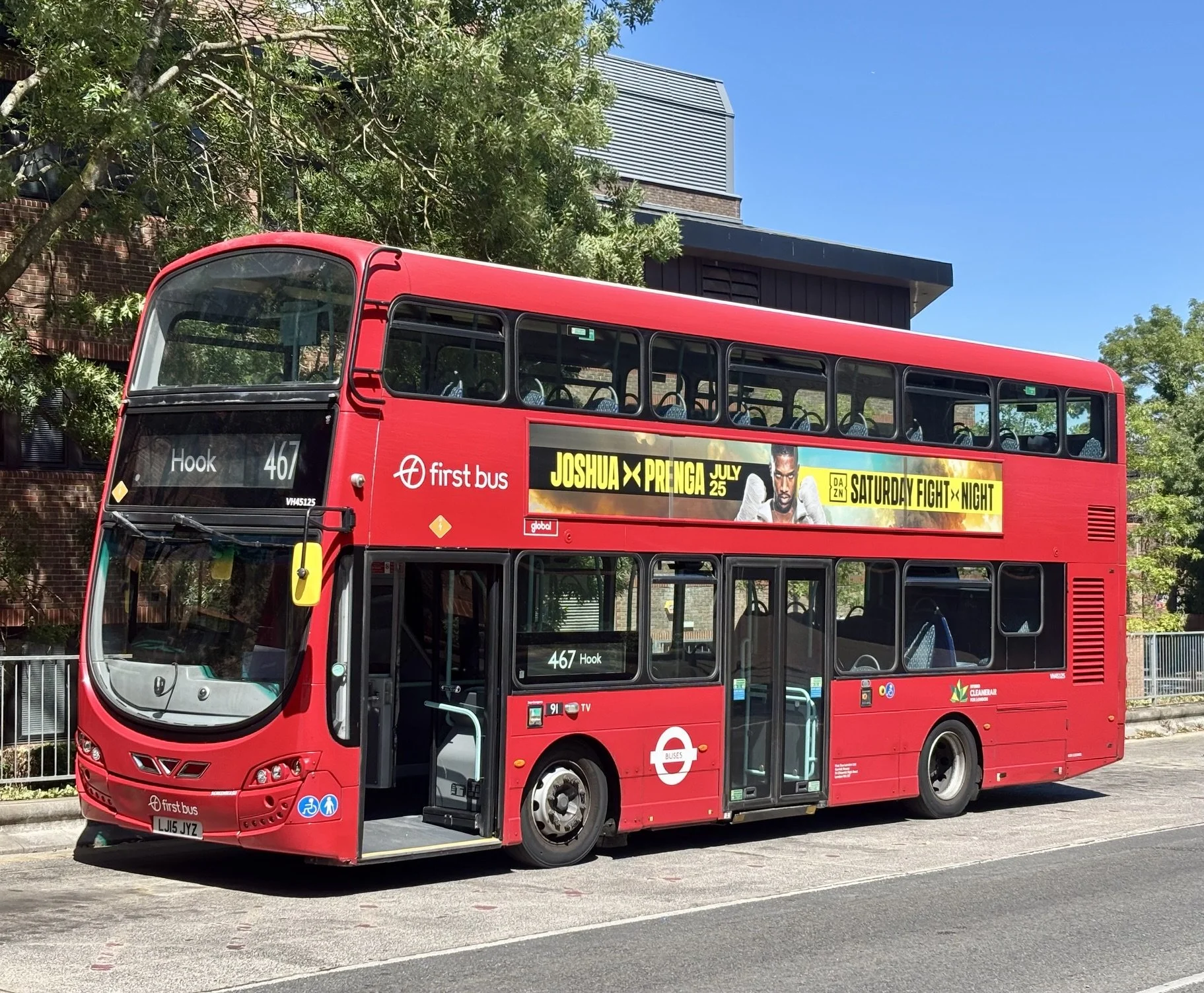
First Bus Volvo B5LH VH45125 of Tolworth (TV) Garage rests between duties at Epsom Town Centre on the infrequent 467 to Hook. 2 buses provide an approximately hourly service M-S except evenings.
The route is due to pass to Falcon Coaches with new electric buses from 5th September 2026, so scenes like this will soon no longer be possible.
Part Route 467: Epsom - Chessington South
The 467 schedule appears at first sight to be somewhat inefficient, with 2 buses operating an Hourly service but on around 30 mins running time each way, with a 10 min break at Hook and a 50 min one at Epsom. It could be argued that, with the same 2 buses, you could run an improved 45 min frequency, still with 10 mins break at Hook and 20 mins at Epsom. However, I suspect that the 50 mins at Epsom is often used for the driver’s break, so an increased headway would need more drivers and thus increase the cost of the service.
Indeed, my return working from Epsom, due at 14.20, did not appear until 14.35, even though there was nothing to delay the bus from the stand to the first stop near the station by this much. As it was the same driver, I surmised that as he had arrived 15 mins late in Epsom and was leaving there 15 mins late, he had taken his allocated 50 min break, not unreasonable in the circumstances. Just three of us boarded at the station, but then it took about 10 mins to reach the next stop in the High Street, a few hundred yards away due to a superglue jam up to the temporary lights with two lanes into one and then another set of temporary lights soon after the previous set.
After what seemed an age, we were free of the roadworks and shot off like a cork out of a bottle! Despite taking the best part of 20 mins to travel just 3 stops, it was easy work back through Ewell Village to Ewell West Station and then on to Copt Gilders. I alighted at Chessington South Station after a 35 min run, which should have taken nearer 20 mins. Nevertheless, an interesting route providing a useful link, not particularly busy but with passengers well into double figures on each trip.
The 467 has its roots in London Country route 468, which ran between Chessington Zoo and Effingham via Epsom. It was renumbered 467 in 1999 and became part of the TfL network in 2000, by which time it ran between Hook and Epsom only. School journeys at each end have been a feature since the beginning, although the original northern destination of Claygate for these trips was later cut back to Hinchley Wood. The route was originally run by London United with DR then DP type Darts, although one double deck working with a Metrobus was introduced in early 2001 on M-F, later in the year this was extended to both workings. Low floor conversion in 2003 saw TA and VA double deckers used.
Quality Line took the contract in 2011 using Enviro400s, but the contract reverted to London United in 2017 when they purchased the former operator. From 2021, VH class hybrids largely took over, although the odd Enviro still appears - for now. All to change when Falcon Coaches take the contract with new electrics.
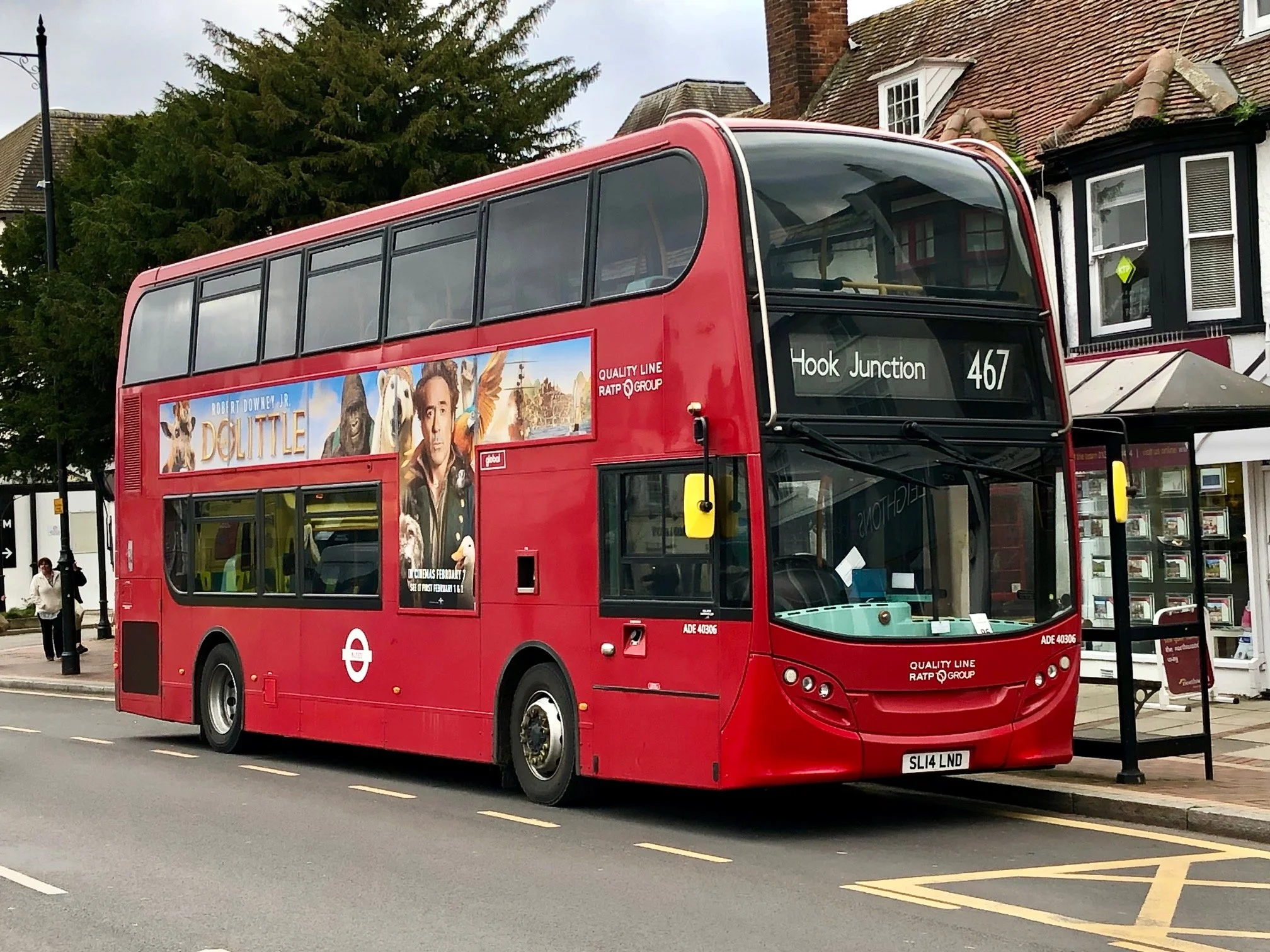
First Bus have a handful of Enviro400 double deckers remaining at Tolworth Garage. They normally appear on the 406 & 418, but also occasionally on the 467. Back in February 2020, ADE 40306 was captured at Epsom Clock Tower before commencing a trip to Hook.
This bus was originally DD14 with Epsom Coaches, trading as Quality Line. By the time of this photo, they had been taken over by the RATP Group, as the decals show. Note the black window surrounds which were a feature of this batch.
Part Route 71: Chessington South - Chessington WOA
At Chessington South Station, I had less than a minute to wait before another First Bus Volvo B5LH, VH45190 of Fulwell Garage, drew up to the stop on the 71. I hopped on for the short 4 min trip to Chessington World of Adventures. This is a large theme park, zoo and hotel complex, which originally opened as Chessington Zoo in 1931 and was developed into a larger resort and tourist destination which debuted in 1987.
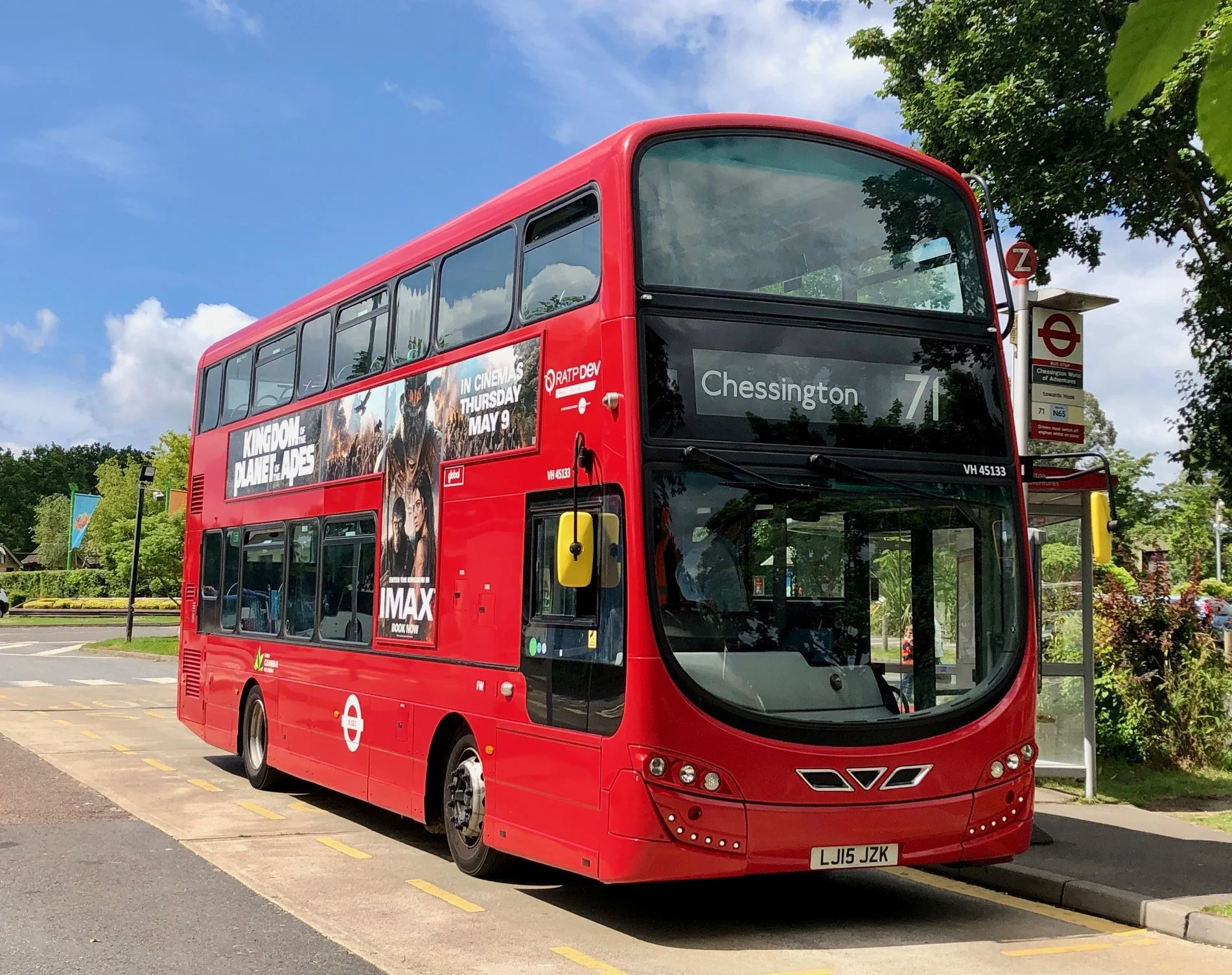
Due to the angle of the sun, photography at Chessington World of Adventures was difficult on my latest trip, so instead here is one from my previous visit in June 2024. Another Volvo B5L hybrid, VH45133, of Fulwell (FW) Garage on the 71 after I had ridden it here from Kingston on that occasion.
This was before RATP had sold their London operations to First Bus in 2025, as can be seen by the ownership name between decks on the side.
Route 71: Chessington WOA - Kingston
Having travelled on the former northern section of the 71 at the start of the day (now the 371), I wanted to complete the southern part of the route which retains the original number. It also formed the first step on my journey home.
Arriving at Chessington WOA on VH45190, I was able to step up a working and board VH45193, another FW Garage bus, which was ahead on the stand. Incidentally, both vehicles were of the later design with the angular front, rather than the classic rounded front of the example I had ridden on the 467. Boarding with a number of WOA workers who were going off shift, we had a nice easy run for once! Back up to Garrison Lane, past Chessington South Station, terminus of the branch line from Waterloo, then through the Copt Gilders Estate, named after the farm which was once in this area, passing the attractive little church of St Mary’s Chessington.
Picking up good numbers all the way, we continued around the loop to Chessington North Station and then onwards to Hook, traversing the dual carriageway section up to the “Ace of Spades” roundabout, where the pub of that name is now sadly closed and boarded off in a derelict state. A short delay of a minute or two due to the temporary lights north of the junction as mentioned earlier during my southbound ride on the K4. Then we rolled onwards up to Surbiton, setting for the famous BBC TV sitcom “The Good Life”, which was actually filmed in Northwood rather than here.
Passing along Victoria Road to the Clock Tower, we then continued with a good load over the final section via the main road into Kingston. At the University, it must have been Graduation Day, as we went by crowds of students decked out in mortar boards and gowns. After dropping off at the town centre stops, we passed the site of the former Kingston (K) Garage, which was unusual as it originally featured both a garage and a Bus Station under its roof. The site closed completely in 2000 and is now occupied by the Rotunda complex including a cinema. We arrived at Cromwell Road Bus Station opposite after a reasonable run of just under 40 mins from the start.
The 71 began in 1950 between Richmond & Kingston serving new roads in Ham. Initially STL operated, RTs and RTLs soon replaced them. In 1951, the route was extended from Richmond to Hammersmith via Chiswick, replacing part of the 111. Then, in 1959, came a Sats extension from Kingston to Sunbury replacing shorts on the 216, which lasted until 1964. Meanwhile, at the other end, changes in connection with the Trolleybus Replacement Scheme in 1960 saw a further extension to East Acton, although this came off in 1966 when changes were made to the 72. The main service was cut back to Richmond in 1967, replaced to Hammersmith by the 90C, the 71 then assuming its original Richmond - KIngston course once again.
In 1968, the route was extended south of Kingston to Chessington & Leatherhead in replacement of parts of the 65 & 65A. Then in 1971, the Sunday service was converted to RF OPO. I first rode the route in the mid 70s when it was RT operated and well recall trips all the way down to Leatherhead Garage, where red 71s looked out of place amid the green London Country Buses when turning at that point. In fact, the 71 was the final route to retain RTs in the SW quadrant of London, only receiving RMs in early 1978, by which time the OPO Sunday service was BL.
The 71 began its retreat in 1979, being cut back from Leatherhead to Surbiton, which section was replaced by OPO Route 265, although the following year saw an extension back as far as Chessington Zoo. 1980 also saw a rerouteing via Richmond Hill at the northern end replacing the privately run successor to local route 235. Full OPO came to the 71 in 1985 when it was converted to M class Metrobus operation. As mentioned earlier, in 1990, the Richmond - Kingston section was hived off to daughter route 371, the 71 number itself now just applying to the short Kingston - Chessington part.
In the privatised era, the route remained with London United, through its various ownerships and passing to First London in 2025. Low floor double deck conversion came in 2002 with TA types replacing the long serving Ms. These were later replaced with SP class Scanias, although there were visits from most LU double deck types over the years. Contract renewal in 2021 saw VH type hybrids replace the previous diesels.
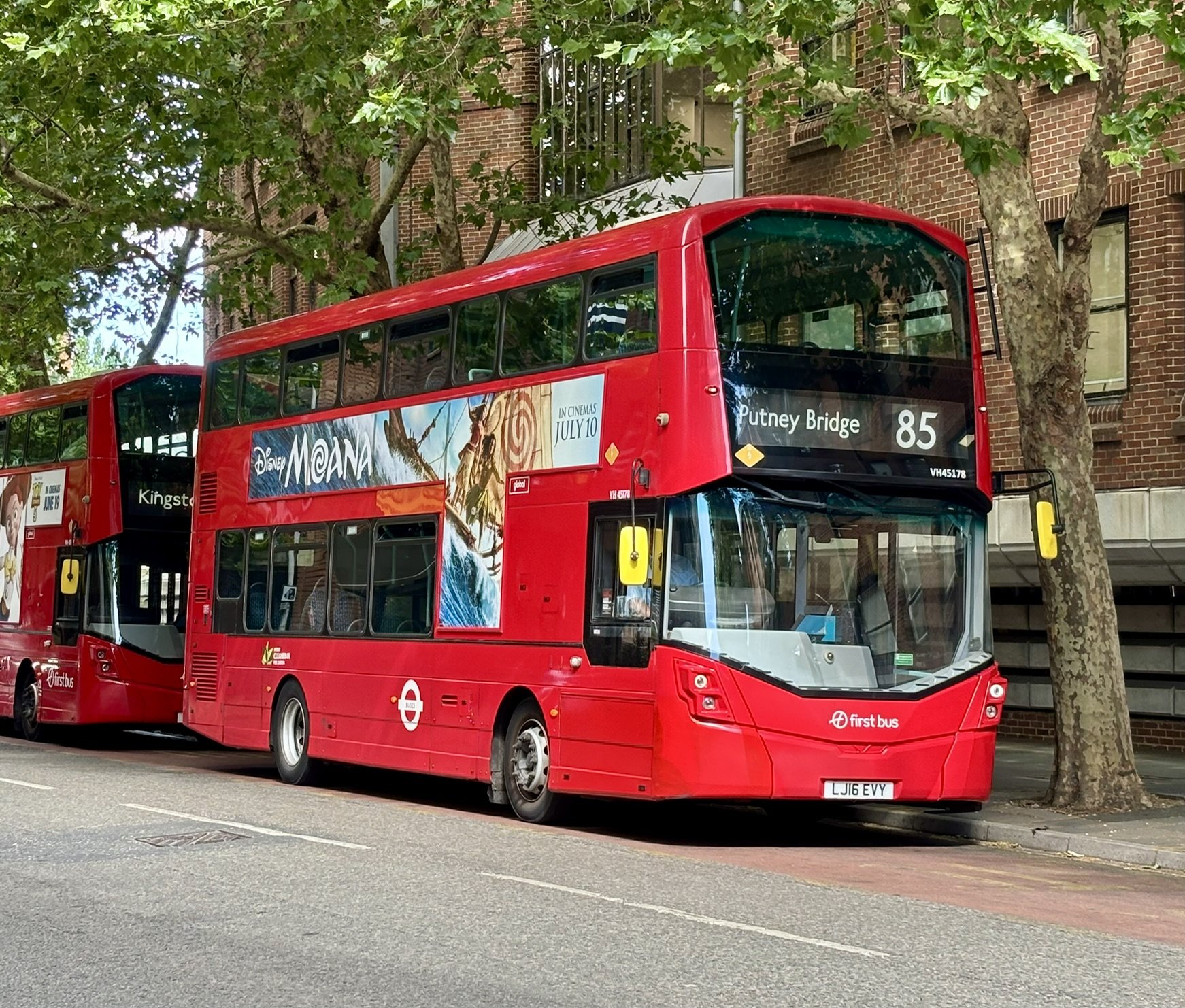
My final route of the day was the 85. Not the example I travelled on, but sister Volvo B5LH VH45178 on the Kingston Hall Road stand illustrates the normal allocation on the route with First Bus, once again from Tolworth (TV) Garage.
In contrast with the other two VHs featured in this article, this bus has the later angular front end with lozenge shaped windscreen, compared with the rounded style of the older examples.
Route 85: Kingston - Putney Bridge
Back in Kingston, I strolled back through the town from Cromwell Road Bus Station to Kingston Hall Road to pick up my final bus of the day, this time on the 85 to Putney Bridge. As it was now the start of the PM peak, I was half expecting a delay on this route, which is often affected by congestion on the A3 at Kingston Vale and by the ever-present traffic wall in Putney High Street. However, it was the school holidays, so traffic volumes were lower than usual and a check on LVF showed that a reasonable service was in operation.
I had just 5 mins to wait before VH45163 (another First Bus Volvo Hybrid from Tolworth Garage) departed the stand, circled the roundabout and drew up to the first pick-up stop, where I boarded with a couple of others. A rumble through Kingston Town Centre for the final time that day, picking up in reasonable numbers, then out of town at a crawl through to Norbiton. However, once at Kingston Hill we had a magnificent fast run over the long pleasant leafy stretch to Kingston Vale, during which we hardly stopped. Luckily, the by-pass was flowing well and we took the short detour to serve Roehampton Vale ASDA, where we rubbed shoulders with a couple of single deckers on the K3.
Back to the A3, which we traversed at speed, before turning off into the Alton East Estate at Roehampton. This section of route is odd in that it is only served in this direction, southbound buses having to continue along the main road due to the lack of a road connection from the estate to Kingston Road in that direction. So, if you live on the estate and want to go to Kingston, you have to take a northbound bus a few stops and change to a southbound one at Roehampton Lane, whereas on the return you can travel direct!
From Roehampton, we turned onto the section beside Putney Heath, until we reached the “Green Man” PH, where we were ordered to hold for 4 mins or so due to early running, with several leaving us to jump on to one of the various other services between this point and Putney. When we got going again, what happened? We hit the usual log jam in Putney High Street which seemed to take an age to traverse. Eventually we reached the Thames, crossed Putney Bridge and arrived at the terminus by the station 4 mins late - if we hadn’t been held earlier, we would have been on time. An example of poor control, there are several services between Putney Heath and Putney Bridge, so holding a particular bus to time for that short stretch seems completely unnecessary, with no discernable benefit to passengers. Our trip had taken exactly 1 hour end to end.
The 85 is a very old route, linking Kingston & Putney Bridge for decades. Back in the 50s, it hosted all RT variants at times - RTL, RTW and standard RT. From 1958, the Sunday service was replaced by a extension of the 14, a situation which continued until 1971. Conversion to RM came quite early for a suburban route, in 1963. OPO came in 1971 using single deck SMS, which clearly didn’t work as the route was double decked again the following year with DMS. A partial M operation in 1982 preceded full conversion to the type in 1985.
Tendering in 1990 saw the route awarded to London & Country using Volvo and later DAF DB250 double deckers, by which time the ownership had passed to Arriva. London United took the contract in 1999, unusually using the same DAFs but repainted from Arriva blue into LU red, white and grey. The next operator, in 2002, was London General, who employed WVLs plus a few VE class Volvo Enviros. London United assumed the route in 2016 with the current VHs, which have continued when the ownership passed from RATP Group to First Bus in 2025.
Whilst the 85 hasn’t changed that much, it has had a couple of interesting bifurcations. Firstly, the Alton East Estate section, which was initially introduced as a bifurcation from the Putney Bridge direction under the same number, then changed to a double-run on the main service, before becoming a rerouteing in the northbound direction only. Secondly, there were a few journeys that deviated via the Telegraph Inn on M-S at irregular intervals, following requests to serve some flats at that location. These operated from 1970 to 1990, although for part of that time they were transferred to the 85A (see below). This section is now covered by today’s 424.
Finally, a mention of the 85A variant, which followed the 85 from Putney Bridge to Roehampton Lane and then bifiurcated to the Alton West Estate, today referred to as Roehampton Danebury Avenue. This was a M-S service, introduced with RTL in 1961, converted to RM in 1963 in line with the 85, then converted to OPO with DMS in 1973. The Telegraph Inn trips on the 85 were transferred to the 85A in 1979 until 1981 when they reverted to the 85. This was because the 85A was withdrawn, the Danebury Avenue section being transferred to an extended 170.
At Putney Bridge, I made my way to the adjacent District Line Station for the journey home after an interesting day out.
Watton
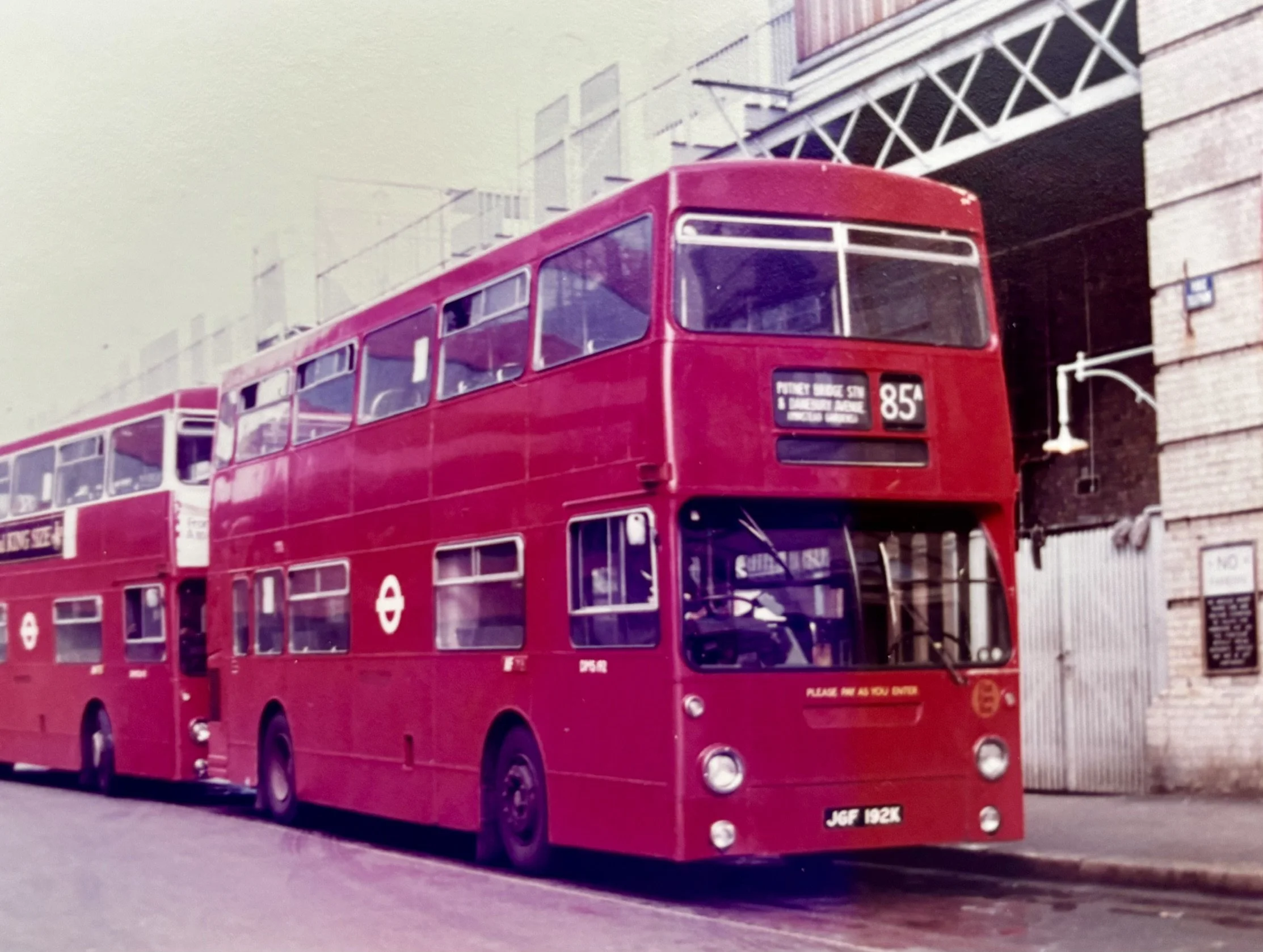
Taking the “And Finally” spot this time, we have this view of Daimler Fleetline DMS192 of Putney (AF) Garage on the former 85A at Putney Bridge Station back in 1981 shortly before the route was withdrawn in April of that year and replaced by an extended 170.
Note the lazy blind in the “via” box which is a bit cramped but reads “PUTNEY BRIDGE STN & DANEBURY AVENUE MINSTEAD GARDENS”.
