
Redeployed Diesels in North West London
Despite declining numbers across the capital, diesel buses still play a significant role with Metroline in North West London. On this journey, I ride double and single deck versions plus one of the few remaining minibuses.
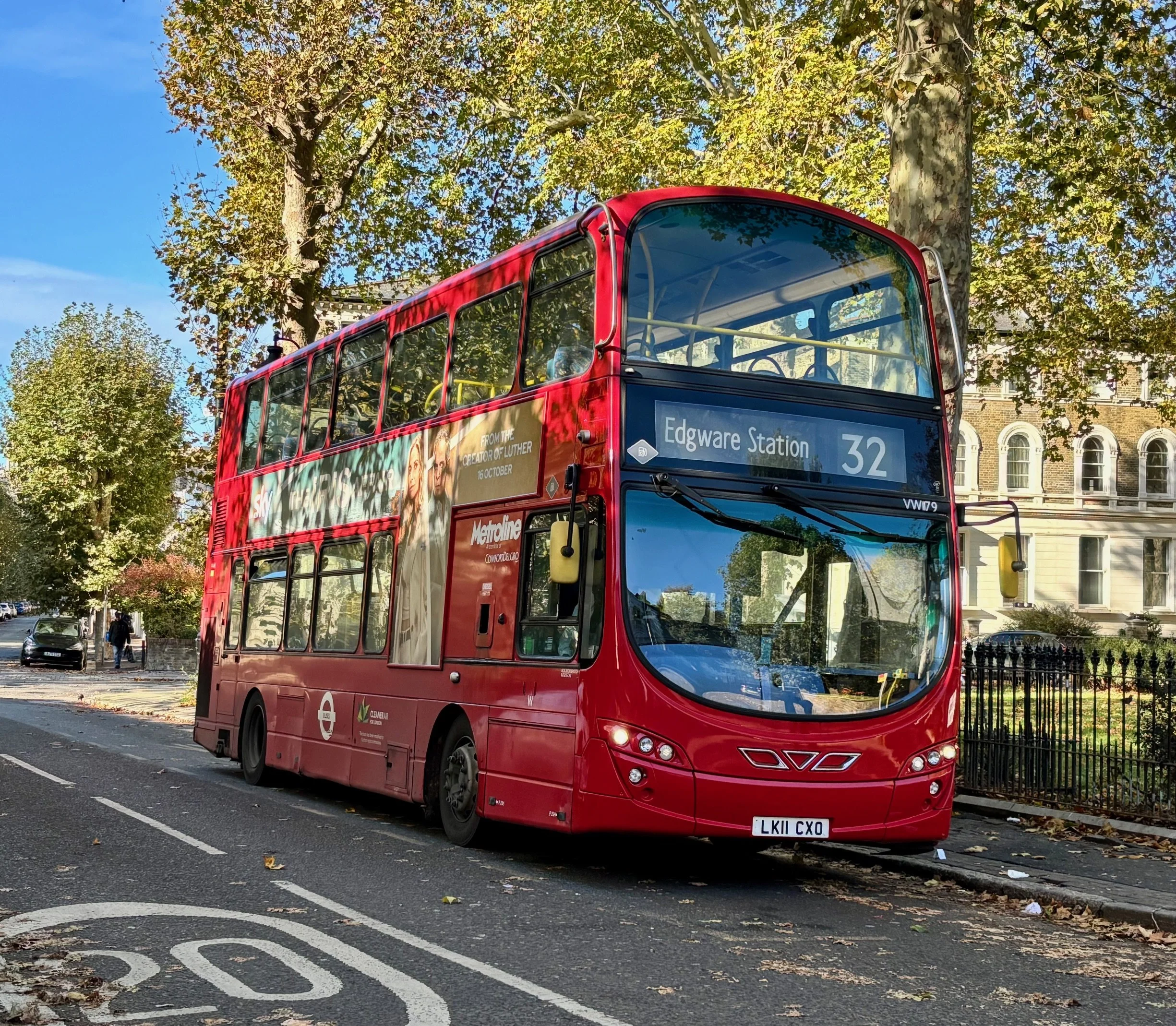
This autumnal scene at Kilburn Park is perhaps a suitable metaphor for the autumn years of the Volvo B9TL with Metroline! VW1179 of Cricklewood (W) Garage rests between trips on the 32.
The majority allocation on the route is comprised of LT class New Routemasters, but a few VWs were providing support at the time of this visit.
Route 32: Edgware - Kilburn Park
My day began after the morning peak at Edgware Bus Station. Despite the conversion of Edgware (EW) Garage routes to electric in recent times, a few diesels still appear on routes from other Metroline garages in the area including the 186 and 292 (Harrow Weald) and 32 (Cricklewood). My target on this occasion was the latter route, with LVF showing 4 Volvo B9TL VW types out in support of the usual LT class New Routemasters. Since conversion of the 210 and 266 to electrics earlier in 2025, I had thought that VWs might have been removed from Cricklewood Garage, so the retention of a handful was a surprise.
After letting a few LTs go, one of the quartet, VW1179, duly appeared and I boarded for its next southbound trip. A reasonably quiet run at first, as we turned out of Station Road for the long straight run down the Edgware Road. Good progress through Burnt Oak and Colindale to West Hendon, before crossing the North Circ at Staples Corner. No driver change at Cricklewood Garage on this trip, but we picked up a large number at the next few stops, presumably due to a gap in the parallel 16s. Full and standing by Brondesbury, our good timekeeping was marred by roadworks in Kilburn with temporary 3 way lights, which cost a few minutes. Depositing most of the crowd in Kilburn High Road, just a few of us continued around the corner to the terminus at Kilburn Park Station. Our journey time of just on an hour was some 8 mins more than scheduled.
There were two previous incarnations of the 32 route number: Firstly, between St Helier & Worcester Park, operated with RT until 1956, when it was replaced by the 77A and 127. Secondly, between Victoria & Wanstead via the 25 and 10, operated with RTL as part of the Trolleybus replacement programme (!) from 1959-64, always a sickly child which soon withered and died.
The current version of the 32 is one of those rare routes in London - one that still runs between its original terminals with minimal change! It came in 1970 between Edgware and Kilburn Park to replace the southern section of the 142. Crew RM operated for just a few months, it was converted to OMO with DMS the following year. It enjoyed M operation for a long period between 1980-2000, although LN class Lance single deckers appeared for a short period in the late 90s. The route had a M-F peaks bifurcation to Grahame Park / Mill Hill Broadway of a few journeys between 1981 and 1996.
The noughties saw low floor conversion, with types including TA, TP and TE appearing, although the odd M was still seen for a while and this became one of the last routes on which I rode the type. Hybrids became the norm from 2016, with TEH and then LT classes being the usual fare. The 32 has remained with Metroline throughout the period of tendering and has only ever operated out of Edgware and Cricklewood Garages.
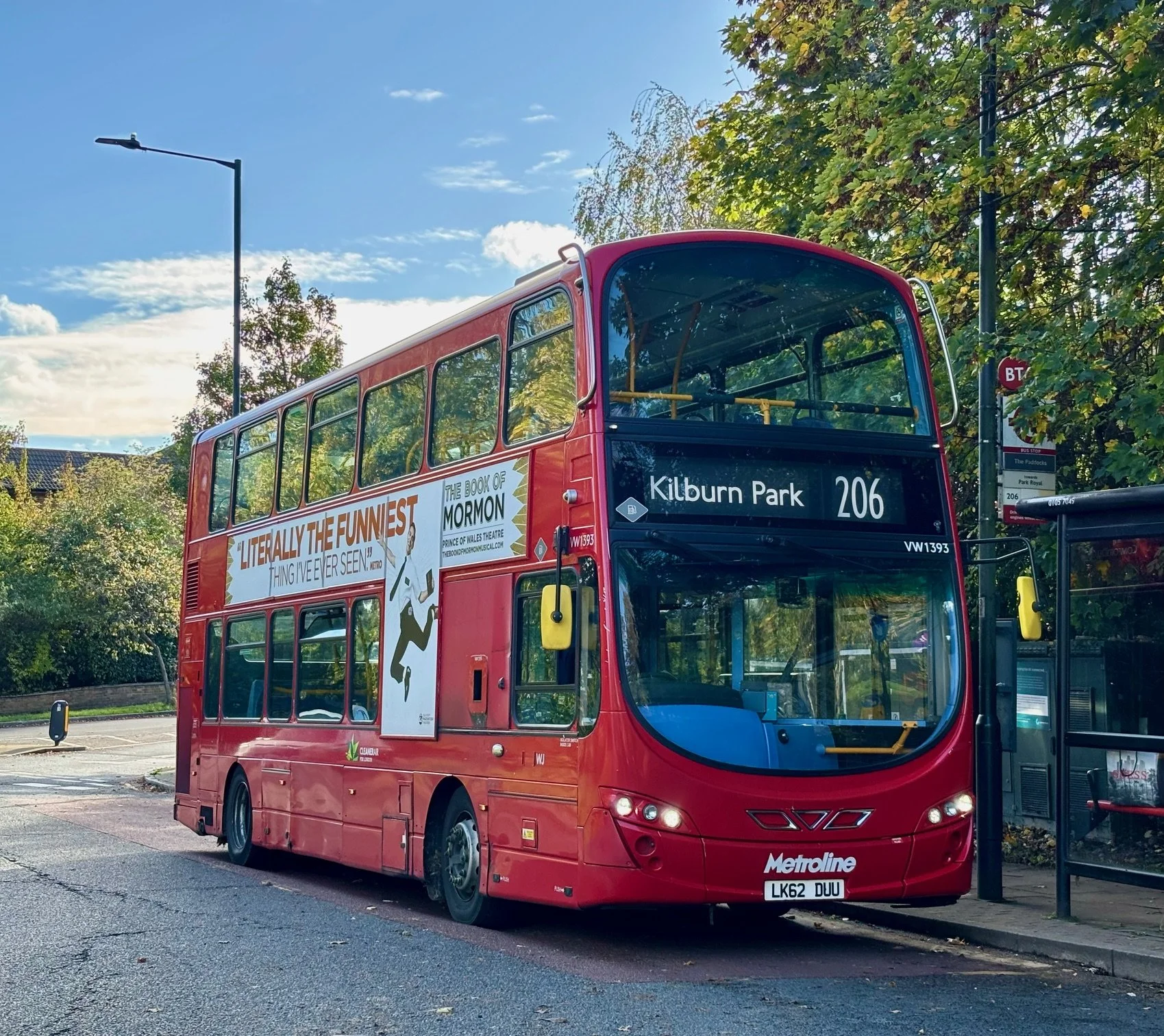
Metroline have part-converted the 206 at Willesden Junction (WJ) Garage to double deck with spare VWs to release DEL single deckers for the new contract on the 224 from mid October. VW1393 is at Wembley Park The Paddocks after my ride on it here.
When delivered, new VMSL electric single deckers will comprise the principal allocation on the 206, with one BDE double decker at school times, so this is a temporary situation.
Route 206: Kilburn Park - Wembley Park
At Kilburn Park Station, I transferred to my second route of the day, the 206. This has hit the headlines recently by receiving a partial double deck allocation of spare VW diesels to free up DEL class single deckers for the takeover of the 224 by Metroline from 11th October. On the day of my trip, LVF showed an eclectic mix of buses out, the double deckers comprising a few VWs plus one BDE electric, the single deckers consisting of an older DE, a couple of slightly newer DELs plus a VMSL electric! In due course, the plan is for new VMSL electrics to be the main type on the route, with a BDE double decker on school-time journeys.
I let a couple of single deckers go, before boarding VW1393 of Willesden Junction (WJ) Garage on the following departure. This bus is one recently released from Lampton (SG) Outstation by the conversion of the 81 to hybrids. Our driver for the first part of the trip was apparently route-learning, as he was accompanied by an instructor who was pointing out key features of the road layout as we progressed. A slightly protracted trundle through the narrow back streets on the first part of the route, with parked cars reducing road width to a single lane in places. Nevertheless, we took on a reasonable number of passengers as we continued via Queens Park, Brondesbury Park and Willesden to Harlesden.
A driver change at the nearest stop to the garage took a few minutes, but we made better progress from Harlesden Station along Brentfield Road past the grand edifice of the Swaminarayan Temple and across the North Circular. After “looping the loop” to serve Brent Park Tesco, we continued up to Wembley, where we served the new developments in the stadium area. Emptying out at Wembley Park Station, it was then a short hop up to the terminus at The Paddocks, where we arrived a few minutes down on schedule after a run of 1h15m.
I can recall two previous versions of the 206 route number - the first being a long-standing route between Hampton Court & Claygate, RF operated until 1976 and then BL until withdrawal in 1978 as a victim of Surrey County Council cuts; the second a route between Walthamstow Central & Loughton via Chigwell, LS operated from 1981-86 and then passing to Eastern National with their single deckers until replacement by the W14/W15 in 1989.
The current 206 started in 1990 as a new route between Kilburn Park and St Raphael’s Estate, with the latter remaining the terminus until 2011 when it was rerouted to Wembley Park The Paddocks in lieu of withdrawn route PR2, the 224 taking on the St Raphael’s leg in its place.
Metroline were the initial operator with DT high floor Darts, supplanted in due course by various low floor Dart types. First took the route in 2012 with DMV class Enviro200s, although the contract novated back to Metroline the following year when First left London. Latterly, older Enviro200 plus newer MMC versions formed the principal allocation.
Part Route 206: Wembley Park - Brent Park Tesco
After a truncated break at The Paddocks of just over 5 minutes, I reboarded VW1393 and retraced my steps a short distance to Brent Park Tesco, where I alighted 15 mins later, taking the opportunity to stock up on lunch supplies.
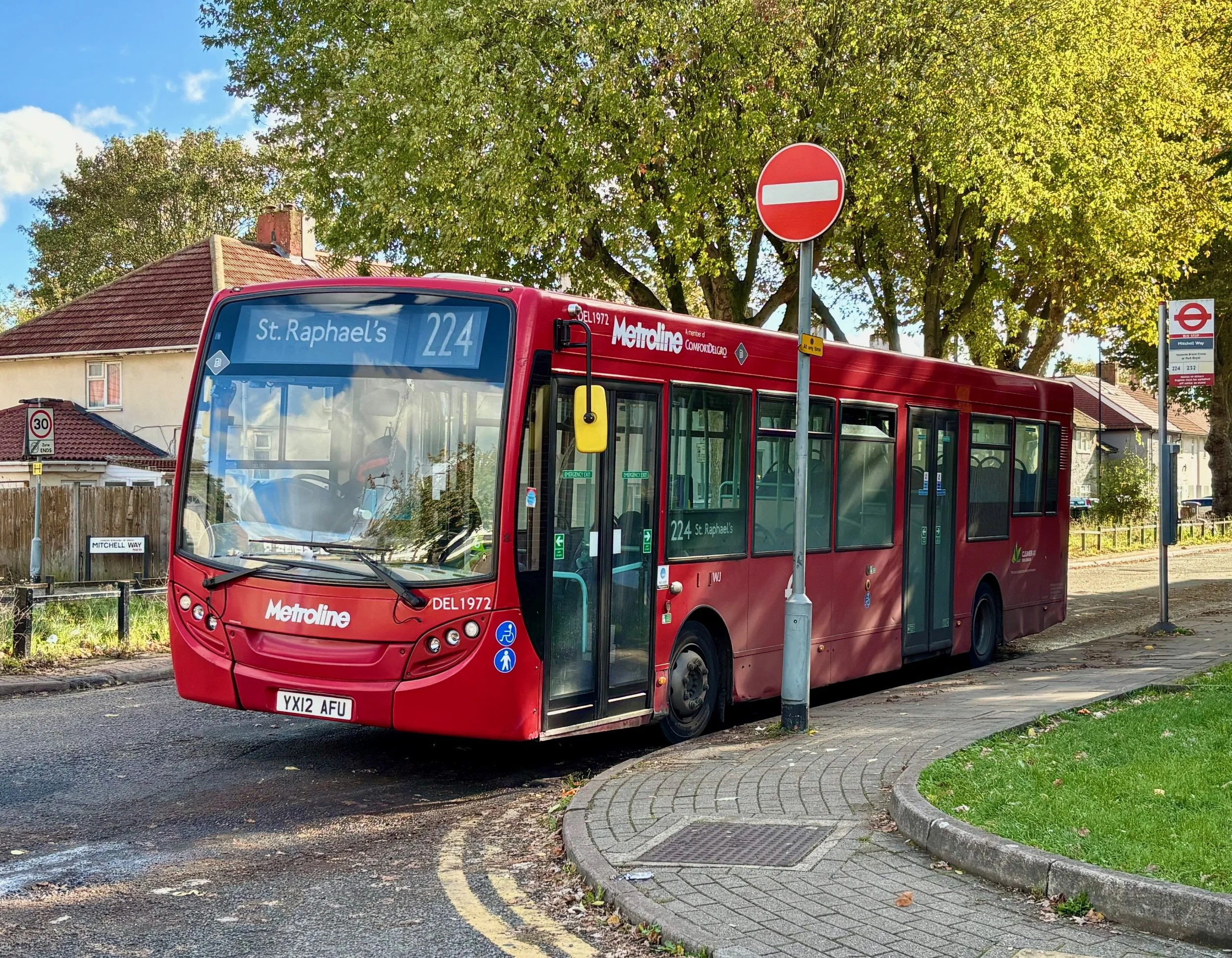
Enviro200 DEL1972 of Athlon Road (AO) Garage on the 224 at the St Raphael’s Estate terminus before I rode it through to Alperton.
This is one of a batch that was inherited from First after their previous period in London as seen from the light blue and purple interior.
Part Route 224: Brent Park Tesco - St Raphaels
Next, I tackled the 224, which transferred from First to Metroline on 11th October. Enviro200 DEL1972 of Athlon Road (AO) Outstation was first to arrive, so I boarded for the short run of just 5 mins to the St Raphael’s terminus, where there was a long break as the previous working was just leaving as we reached the terminus on the 20 min frequency.
Route 224: St Raphaels - Alperton
I rejoined DEL1972 for its next trip over the full route to Alperton. A fairly quiet journey compared with the other routes on this adventure, as although passengers were on and off in ones and twos throughout, we only once got into double figures. In fact, I was the sole passenger from St Raphael’s, no-one else joining until Brent Park where we picked up a few. After going round the loop to serve Tescos, we broke free and continued via a short stretch of the North Circ, before turning left along Brentfield Road in the reverse of the way I had come earlier on the 206.
At Harlesden Station, we turned right over the railway bridge and then looped around Central Middlesex Hospital and Park Royal ASDA, before passing through the area of industrial units to Twyford Abbey Road and the double run to Iveagh Avenue. This section is due to be replaced with a new routeing to better penetrate the new Park Royal development, but is on hold until a new “bus gate” is installed. For now, we continued over the existing route up to Stonebridge Park, passing the famous ACE Cafe on the North Circ, known as a meeting point for rockers, bikers and petrolheads.
On the final stretch, we were making good progress through the Heather Park Estate, now shared with the 79, before being brought to a halt by a long queue up to the lights just before Alperton Station, which cost probably 7 or 8 mins. Depositing most of our remaining clients at the station, I continued with the driver and a couple of others to the final stop at Sainsbury’s, arriving after a trip of just under an hour.
The 224 number also had a couple of previous incarnations, the first being a route between Uxbridge & Poyle / Staines / Laleham, RT, then RF, then SMS operated, until withdrawal in 1978, another to fall foul of “out county” cuts. The second iteration applied for a route between Uxbridge & Stockley Estate from 1979-89, essentially the former 224B renumbered and featuring DMS, SMS, M and LS operation at different times, until replacement by the U5.
Today’s 224 was another born in 1990, initially a double deck M operation by Centrewest (later First) between Willesden Junction and North Wembley Preston Hotel, replacing part of the 226. It was converted to MA midibuses in 1991 and cut back to Wembley Hill Road in 1995, the 223 taking the abandoned section. Low floor conversion came in 2001 with DML / DM Dart types appearing in the ensuing years. 2011 saw the rerouteing to St Raphael’s in place of the 206, as mentioned earlier, by which time Enviro200 DMLs were the norm. When First left London in 2013, the route passed to Metroline with the same vehicles.
London United (RATP Group) took the contract in 2018 with DE class Enviro200 MMCs, with the route being cut back from Wembley to Alperton the following year to assume its existing form. RATP sold out to First in early 2025, but this was short-lived on the 224, which has now returned to Metroline!
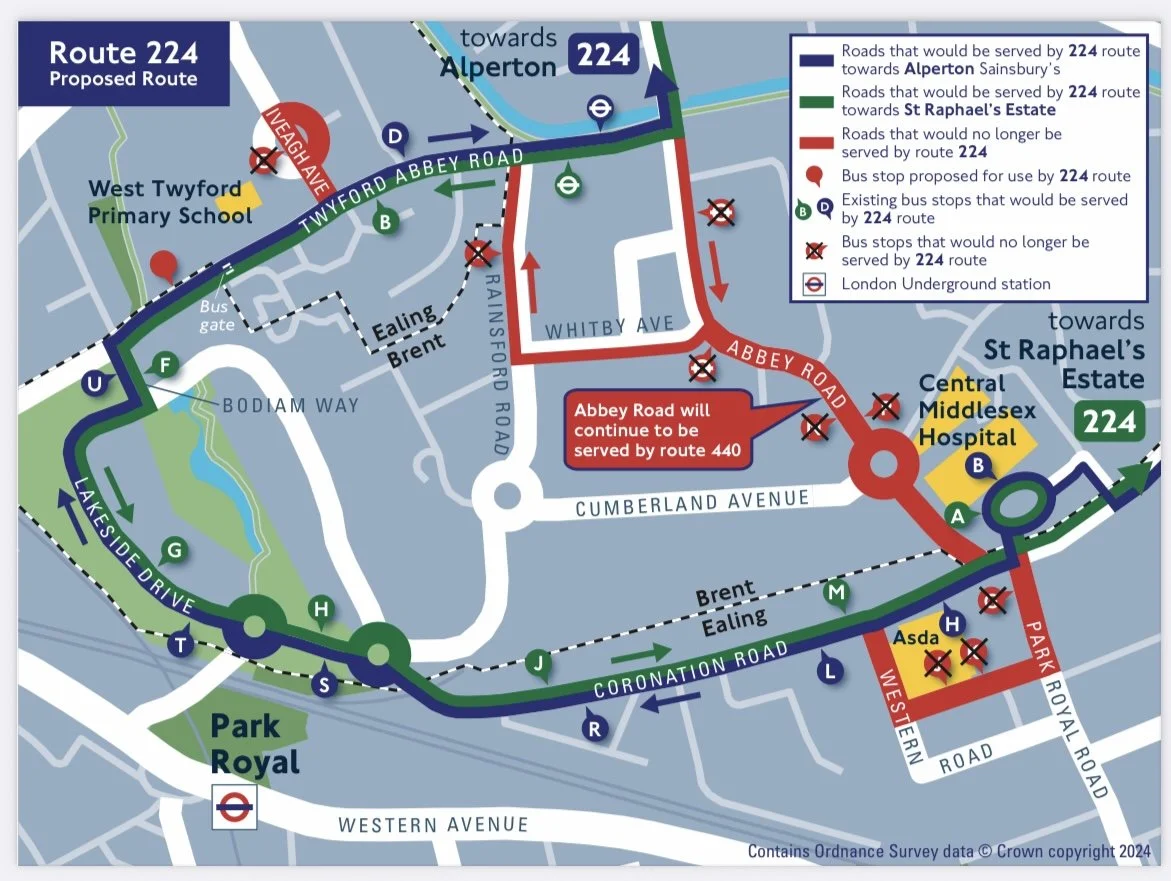
The proposed rerouteing of the 224 in Park Royal is shown in green and blue on this diagram. However, on my trip, we followed the traditional route shown in red.
Despite being intended for introduction when the contract passed from First to Metroline earlier in October, the new routeing was delayed due a bus gate in Twyford Abbey Road not being ready.
Route 83: Alperton - Golders Green
A quick changeover at Alperton Sainsbury’s, where I barely had time to cross the road after getting off the 224, before VW1401 roared up to the stop on my next route, the 83. This is a well-known North West London trunk route, operated by Metroline out of Perivale (PV) Garage and Athlon Road (AO) Outstation, with buses frequently swapped between the two locations. The former Alperton (ON) Garage site which was once associated with the route is now unrecognisable, with a new development rapidly replacing the old bus depot which closed in 2021 after a “last hurrah” with an Open Day that I attended.
Despite an expected busy run, we made good time past Alperton Station and along Ealing Road up to Wembley Town Centre. The usual slog along the High Road, followed by a protracted run past Wembley Stadium through Wembley Park, after which we sped up as we past the Grade 2 listed former Brent Town Hall, now the Lycee International de Londres Winston Churchill and down to Blackbird Cross. A good thrash along Church Road then down the hill in KIngsbury Road, catching up with the 83 in front at The Hyde, which we pursued up the Edgware Road.
At West Hendon, we swung a left past Hendon Station, overtaking the other bus. It was then via Hendon Central to Brent Green, a section of route which was swapped with the 183 back in 1978 so that the latter could pass its then operational garage at Hendon (AE). Over the final stretch across the North Circular and on to Golders Green Station, we encountered unusually slow-moving traffic, but we terminated at the Bus Station after a total journey time of just 1 hour, a few minutes quicker than scheduled.
I first encountered the 83 in the 70s, by which time it had been converted from RT to RM (back in 1966) and operated from Golders Green to Ealing Broadway / Hanwell Broadway, although in former times it had reached Hayes and Brentford, together with a Summer Sundays extension (until 1964) to serve the then tourist attraction (!) of London Airport Central (now Heathrow). The route was extended to Ealing Hospital in 1979, but a major change came in 2016 when daughter route 483 took over the western section and provided new direct links to Harrow, at which time the 83 was cut back to Alperton from the north.
There was an 83A variant, which operated on Sundays only between Golders Green to Kew Green with RT until 1955. The suffix was revived in 1969 when part of the 83 between Wembley and Ealing Broadway was converted to one man operation on Sundays with MB, although it was removed in 1971 when the whole route went over to this form of operation on Sundays only. That day of the week saw in turn MB, DMS then M operation over the following years, until the M-S service also submitted to OPO with Ms in 1982.
The 83 received a batch of VN class Volvo Olympians in 1997, which were the last new ones of this type in London and in fact anywhere. Sadly, they were short-lived, being replaced by low floor deckers in 2004, with TN, VTL and VNZ types all putting in an appearance. After being operated by Centrewest, then First for many years, the route passed to Metroline in 2013, by which time Volvo B9TLs were the usual fare, although the inherited First examples have now been supplanted by Metroline’s own. Some hybrids now join in the mix, with the route about two thirds VW and one third VWH on the day of my visit.
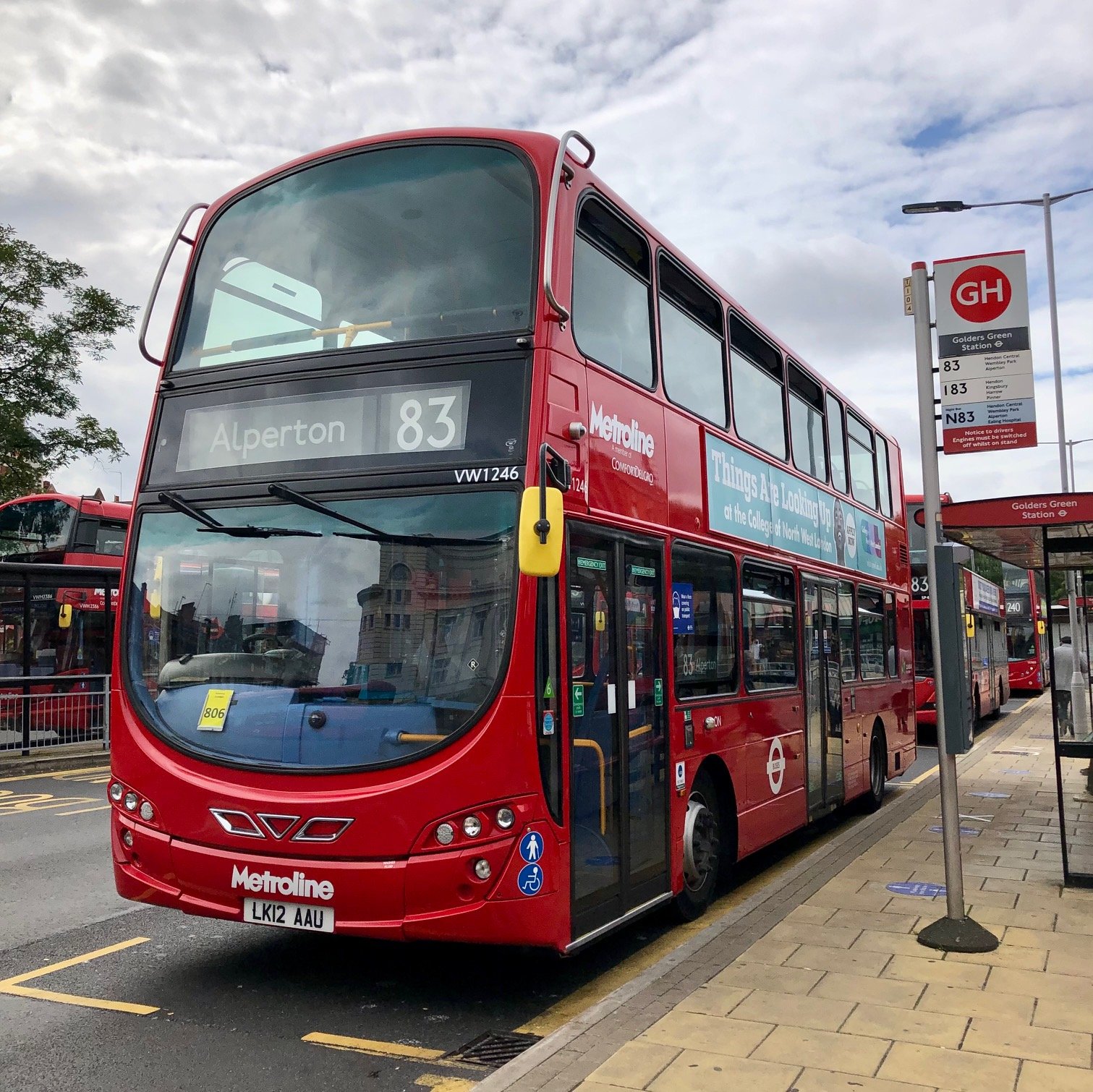
Not the one I travelled on during this trip, but sister Metroline Volvo B9TL VW1246 of Perivale (PV) Garage at Golders Green Station illustrates the type on the 83 during a previous visit to the area in 2021.
At the time of my latest journey, the 83 was about two thirds VW diesel and one third VWH hybrid operated.
Route H2: Golders Green & Hampstead Garden Suburb Circular
At Golders Green, there was just time to squeeze in a final short ride on the local H2 route. This is unusual for London (these days) in being a midibus route, serving the narrow roads of Hampstead Garden Suburb.
I boarded Metroline’s OS2499 of Cricklewood (W) Garage, although the bus sported incorrect “CW” codes! This is one of a batch of 6 Optare Solos for the H2 & H3 routes. We departed with half a dozen on board and picked up a few more at the fixed stops in Golders Green Road and Hoop Lane, before entering the “Hail & Ride” section in Hampstead Garden Suburb. A circular route is followed, via various narrow roads. The suburb was founded by Henrietta Barnett in 1906, with the local school being named after her. The idea of the “Garden Suburb” was based on the planning and development of Letchworth Garden City, with cottage type housing and gardens. However, in this case, it was not intended to be self-contained, with no industry, shops, pubs or other services. Green space was provided, as we passed an extension of Hampstead Heath and other areas of park and woodland.
Halfway around the loop, the route traverses a short section of Falloden Way, providing access to local shops, before diving back into the Garden Suburb and serving Henrietta Barnet School, followed by the Central Square dominated by two large churches. Users on and off throughout the trip, arriving back at Golders Green Station after a 30 min perambulation.
The H2 reaches its 50th Anniversary next year, having started in 1976 as a replacement for the former “Dial a Ride” service in the area. Initially operated with FS type Ford Transit minibuses, these were replaced by Iveco midis in 1989 when R&I Coaches took over the contract from London Buses. Metroline became the operator in 2000 with Metroriders, Marshall Midis and then Optare Solos performing in turn. Arriva had a stint from 2006 with their Solos, until Metroline returned in 2018 with the current vehicles.
MInor changes have been made to the routeing of the H2 over the years, with an H1 variant operating at school times between 1993 and 2013 to Henrietta Barnett School. Another variant, the H3, replaced a former bifurcation of the H2 to serve the Hilltop area in 1996 and still operates today.
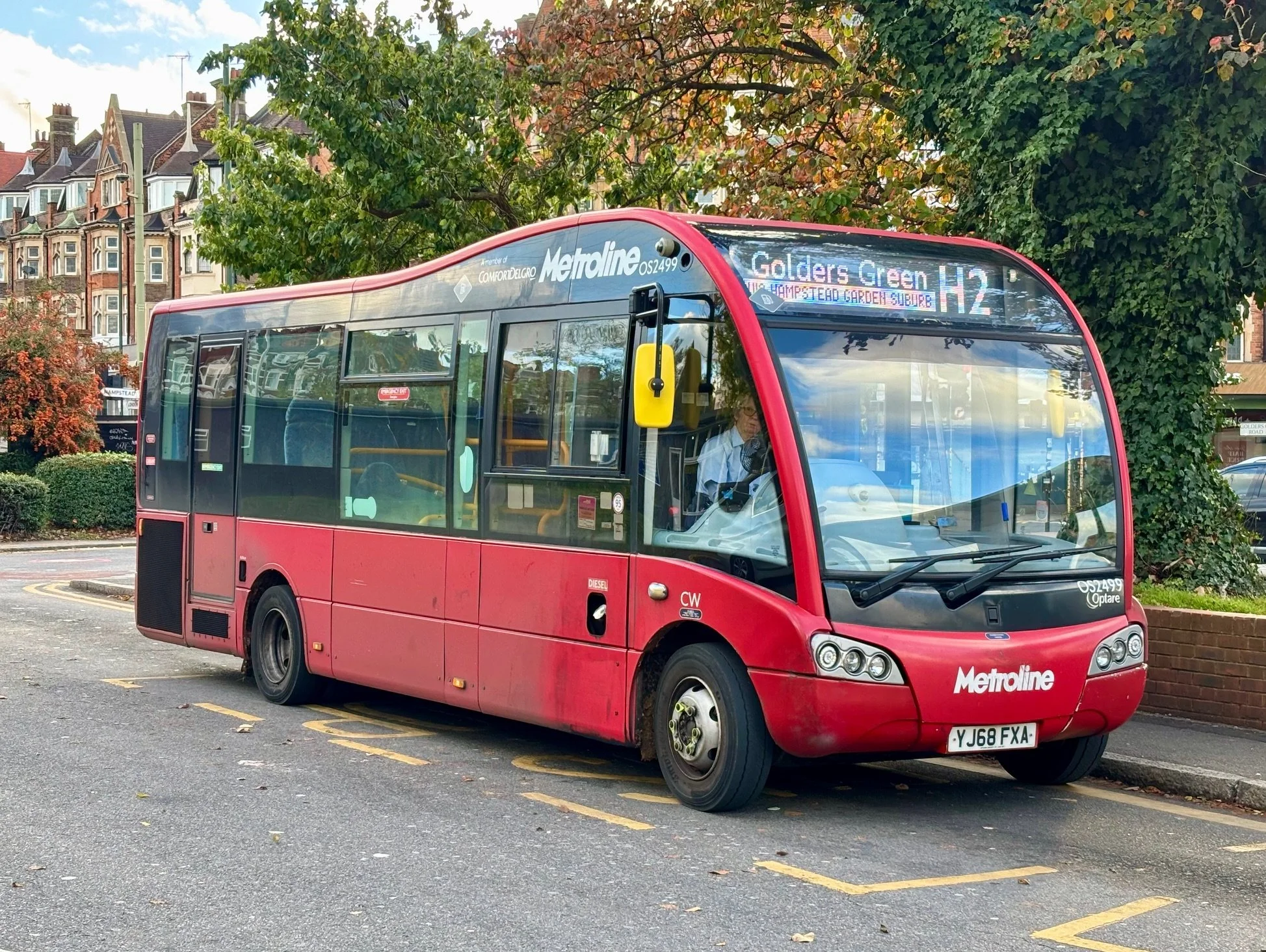
Metroline Optare Solo OS2499 of Cricklewood (W) Garage on Hampstead Garden Suburb circular H2 at Golders Green Station before my spin on the route.
This type of vehicle was never common in London and is now very rare. Note the incorrect “CW” garage code above the front wheel!
To complete my journey, I adjourned to the adjoining Northern Line station at Golders Green for the short trip by London Underground back to my start point at Edgware, after a successful day of interesting bus rides.
Watton
And Finally…
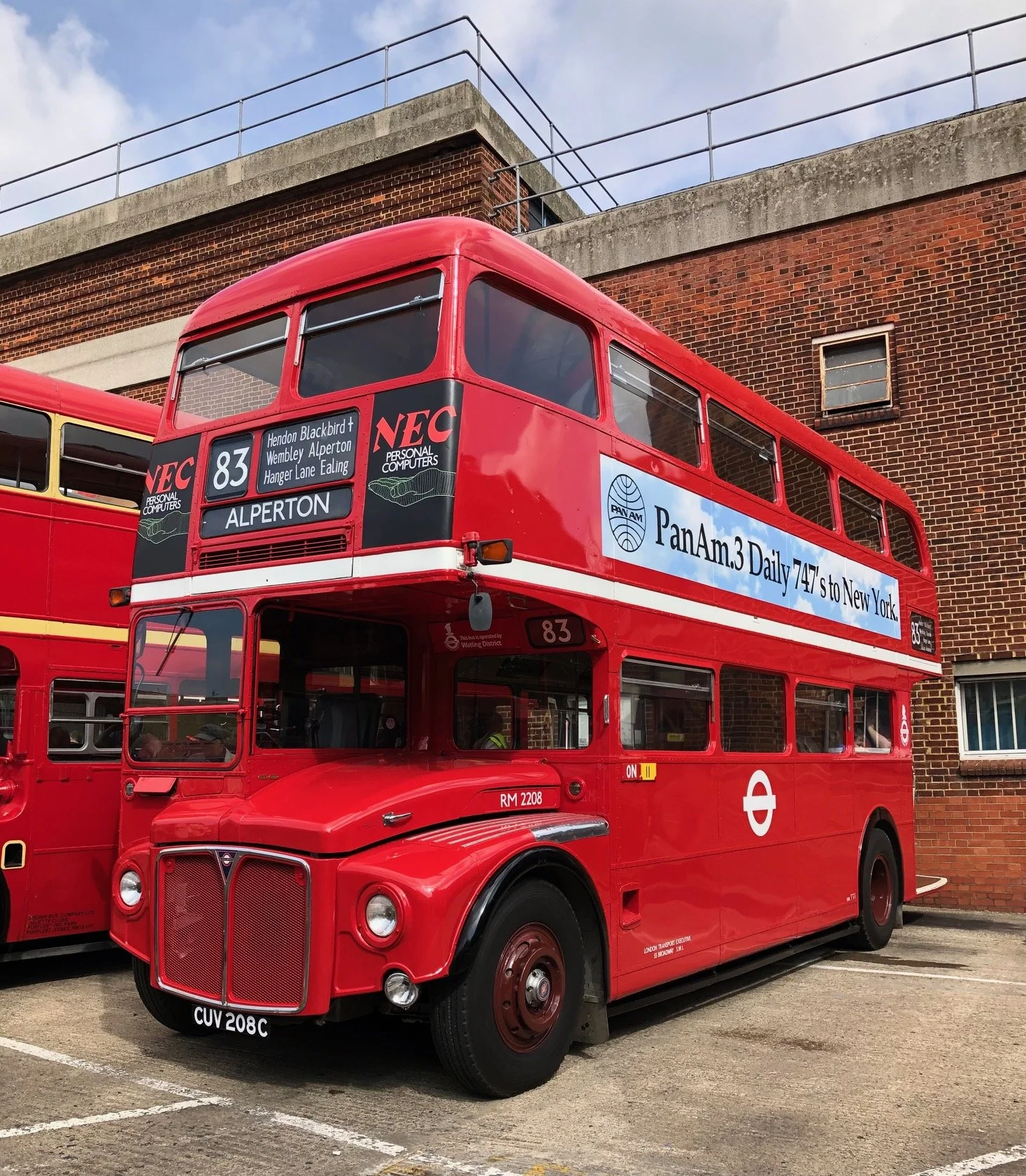
Preserved RM2208 recalls the Routemaster period on the 83 on the occasion of the Alperton (ON) Garage Open Day in September 2021. RMs appeared on the route from 1966 to 1982.
The garage, part of which is seen in the background, closed after this event and has now been demolished. It existed from 1939 to 2021 as an operational bus depot.
