
Clear Blue Water
On my latest travels, I ride TfL and Fastrack routes in the news, mainly based on Bluewater Shopping Centre, with journeys to and from South East London and the Kent borderlands.
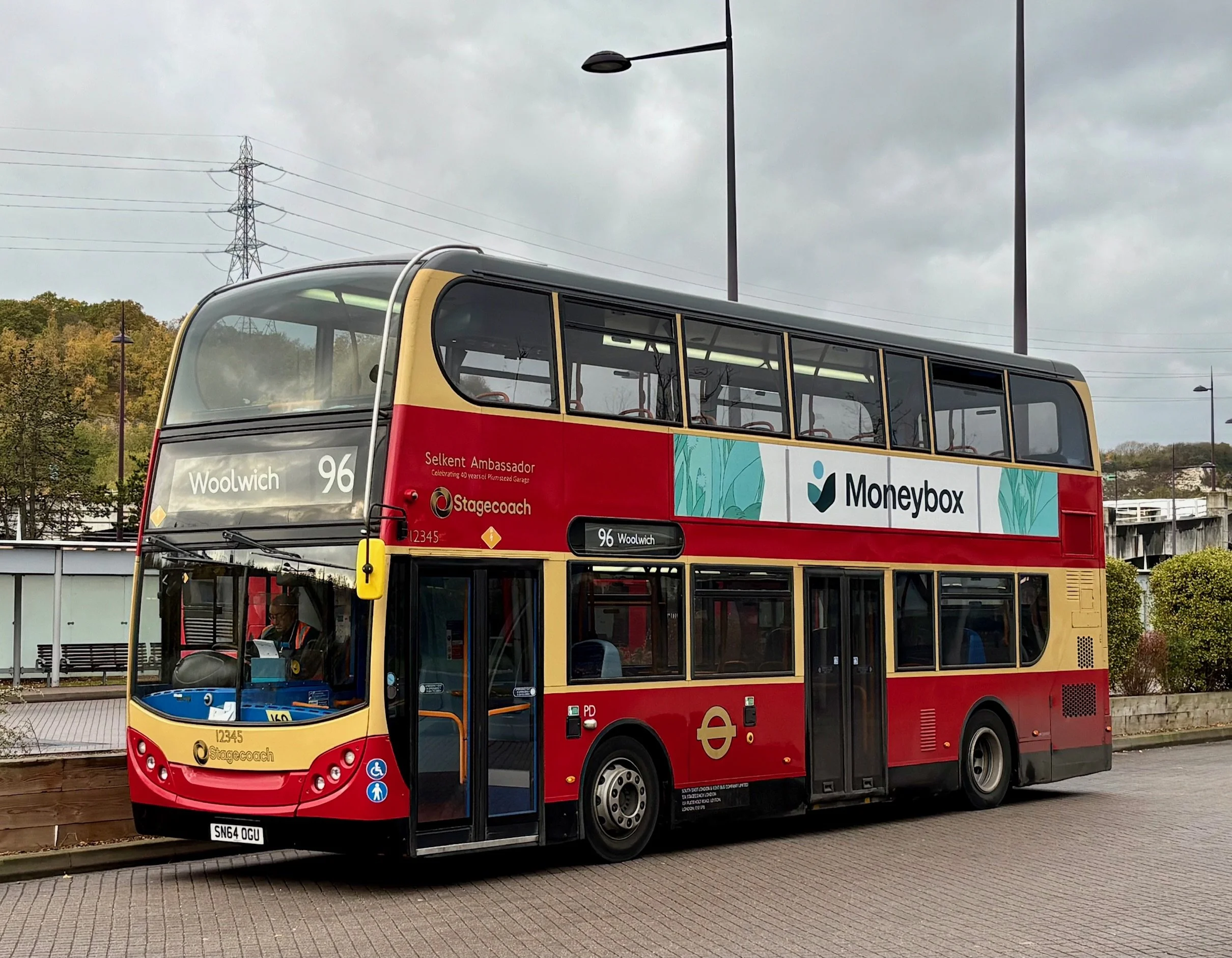
Although I travelled on a subsequent departure, Stagecoach celebrity Enviro400 hybrid 12345 “Selkent Ambassador” of Plumstead (PD) Garage makes a fine sight on stand between trips on the 96 at Bluewater Bus Station.
The “retro” livery is a version of that worn by London Transport buses in the 1930s, but is a view that will no longer be possible on the 96 after 24th January 2026, when the route passes to Arriva.
Route 96: Bluewater - Woolwich
My day began on arrival at Bluewater Shopping Centre, over the border from London in Kent, but a point served by 3 TfL routes in addition to various local services including the “Fastrack” network, of which more later in this article. The large out-of-town shopping centre opened in 1999 and is located in a former chalk quarry just outside the M25 motorway.
First route of the day was TfL route 96 from Bluewater to Woolwich, which is due to transfer to Arriva on re-tender from January 2026, so probably my last opportunity to sample it with the incumbent operator, Stagecoach. The current offering comprises a mix of “classic” Enviro400s and the newer MMC version, both diesel and hybrid, out of Plumstead (PD) Garage. Although I espied Enviro400H 12345 “Selkent Ambassador” on stand in its smart retro 1930s style livery, I caught a standard diesel version, 10183, on a subsequent trip.
A surprising number of takers despite the relatively early hour before many of the shops opened, after which we powered up the reserved road out of the quarry to the first stop at Darent Park Hospital, where we exchanged a few passengers. The 96 then runs non-stop to Dartford Town Centre, although not via Fastrack roads, but along Watling Street, The Brent and East Hill. A reasonable number boarded at Dartford Station, before we made our way out of town up West Hill towards Crayford. After negotiating the one-way system here, we continued through the brief leafy stretch of the route onwards to Bexleyheath, where a “bus jam” at the Clock Tower cost us a couple of minutes.
Good progress out of Bexleyheath until temporary lights at Crook Log, which cost a few more minutes, followed by more of the same at Welling Station. I have to say that the proliferation of road works seems to have almost reached plague proportions in many parts of London in recent years - I can’t recall it ever being as bad back in the “good old days”, or is it just my selective memory? After this, things quietened down as we continued into Plumstead, passing the site of the old Plumstead (AM) Garage at the junction of King’s Highway, closed in 1981 and now occupied by a Wickes store. Then along Plumstead High Street to the station and the new garage (PD) which replaced the old one together with the former Abbey Wood (AW). A driver change, then we got going again for the final section into Woolwich. Oddly, despite being accurate throughout the rest of the journey, the on-board i-bus announcement described the Woolwich Station stop as “Shoreditch High Street”, which caused some consternation! I continued two more stops to the final one in Thomas Street, alighting after a run of 1h15m, almost 10 mins more than scheduled.
The number 96 was previously given to a route between Putney Common and Redbridge, latterly RT/ RTL operated, but withdrawn in 1958 as part of the Post Bus Strike cuts. However, it was re-used the following year, 1959, for a Trolleybus Replacement Service between Woolwich and Dartford, the former 696 simply losing its first 6 in the process. There was a glut of spare RTs in the late 50s, which were used on the initial phases of the Trolleybus conversions and the 96 was a beneficiary of this. Route-wise, there was a M-F Peaks extension to Woolwich Victoria Way and then Charlton, which lasted from the late 60s to the early 80s.
OPO came fairly early on to the 96, as it was one of the first routes to be converted to DMS in 1971. The type was replaced in the 80s first by T and then L types, although with the coming of “Bexleybus” in 1988, the route received blue and cream Olympians plus some re-purposed DMSs, the latter being seen as a retrograde move at the time. Further tendering in 1991 saw the route pass to Kentish Bus with more new Olympians, until yet more change in 1999 resulted in the route passing to Stagecoach, who have operated it ever since. That year also saw the extension from Dartford to Bluewater, initially express, but later with an additional stop added at Darent Park Hospital. During the Stagecoach era, types operated have included Northern Counties Olympians, Trident ALX400s and Scania OmniCities, until the current mix of Enviros took over.
Part Route 96: Woolwich - Welling
After a short break, I returned to Thomas Street and retraced my steps part way on the 96, this time taking one of the hybrid Enviros, 12288. An ok run until we hit the queue for the temporary lights at Welling Station, which caused a frustrating delay, given that I was alighting at the next stop! 25 mins from Woolwich on this one.
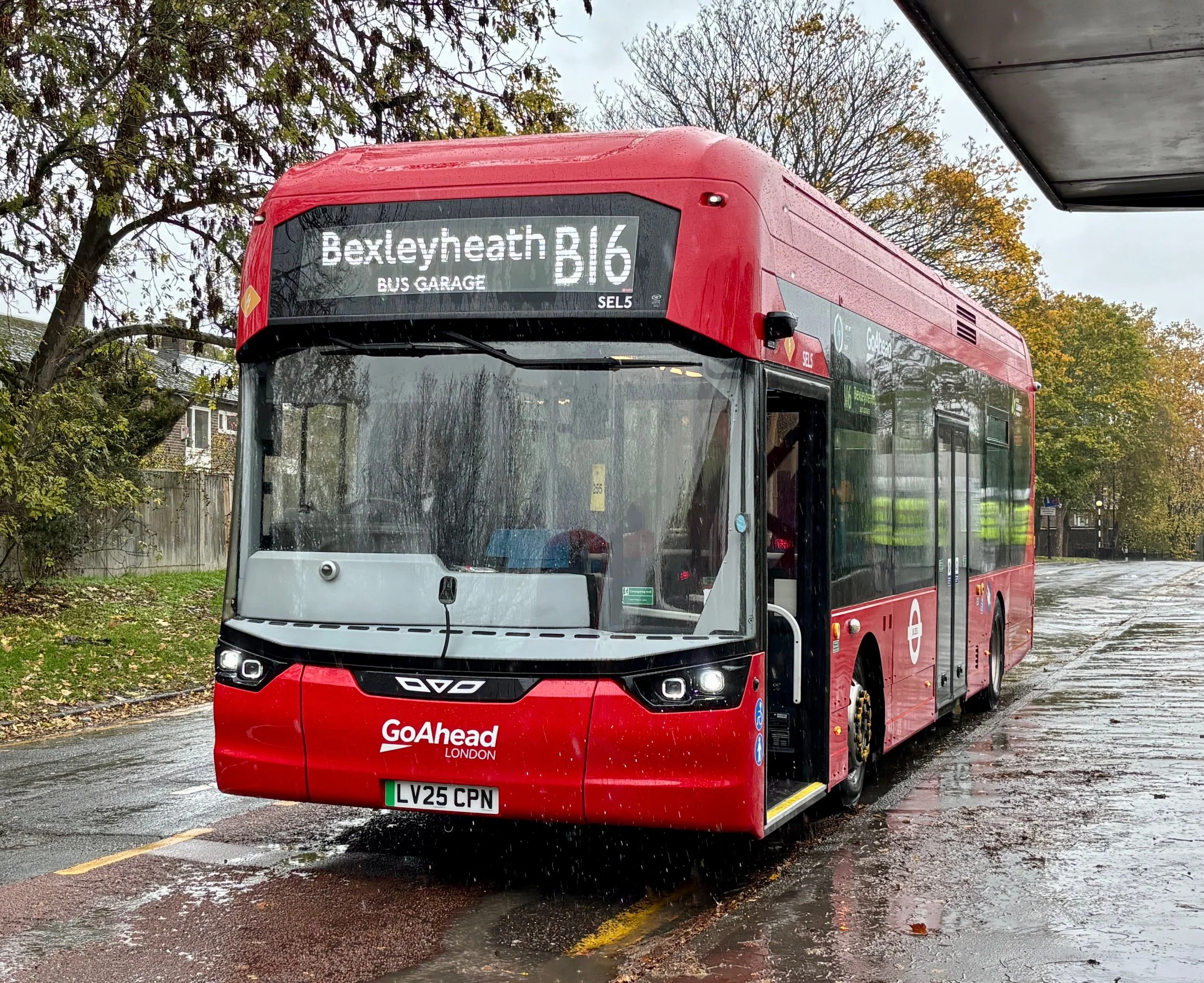
Go Ahead London have recently converted the B16 to new Wright GB Kite Electroliners. SEL5 of Bexleyheath (BX) Garage is seen in the pouring rain at Kidbrooke Wingfield School after I rode it to this point.
The B16 has been operated continuously from BX since the route’s introduction in 1989.
Part Route B16: Welling - Kidbrooke
From Welling, there was a choice of routes on my itinerary. Either the B15 - to ride it with Arriva before it passes to Go Ahead in January - or the B16 - to sample the new SEL class electrics for the first time. In the end, I plumped for the B16, as the B15 seemed to be affected by various roadworks resulting in late running and short-turns on the day I travelled.
Go Ahead London’s SEL5 of Bexleyheath (BX) Garage duly appeared in Welling High Street, with a good load, bound for Kidbrooke, so I boarded. The interior gave a reasonably good impression of a new electric single decker, with the usual modern features we now take as standard. The only issue was the info screens, which although displaying the correct route and ultimate destination, kept showing incorrect next stop information, often two or three stops behind the one coming up. However, the verbal announcements were accurate, which must have caused some confusion to the unwary. This seems to be a recurring issue with new TfL buses - why is it so difficult to get accurate next stop information, when other operators outside of London rarely appear to have such problems?
Nevertheless, I made it through to the Kidbrooke Wingfield School terminus, after a run of some 40 mins, by which time the rain was bucketing down!
Route B16: Kidbrooke - Bexleyheath
At the terminus, I decided to await the next departure on the B16, which was in the hands of SEL9. Upon boarding, it soon became apparent on the return run that the same issues were affecting the info screens on this vehicle as on the previous one. Making our way around the loop in Kidbrooke, we served the station followed by the Tudway Road area, before making our way past Sutcliffe Park to the Eltham Road. We then sped up and had a decent run up to Eltham Church, although progress was impaired by busy traffic in the High Street. Then along Westmount Road and Rochester Way, before skirting the greenery of Oxleas Wood down to Falconwood Station. After this, we negotiated the twists and turns of the back doubles around the suburbia that characterises this area of London, before turning into Westwood Lane back up to Welling High Street.
From Welling, we were fairly busy as we continued back up to the roadworks at Crook Log and then encountered turgid traffic into Bexleyheath Town Centre - a distinct contrast with the rapid progress we had made for most of the run until Welling. After dropping everyone else at the Clock Tower, just me and the driver continued to the Garage, where I alighted after a total journey time of just under an hour from the start.
The B16 began with “Bexleybus” in 1989 between Kidbrooke Ferrier Estate and Bexleyheath, replacing parts of the 160 and B1, and operated out of BX Garage where it has stayed ever since. Apart from minor rerouteings in the Kidbrooke area, the basic route structure has also remained the same. Initially SR and MRL midibuses were used, later replaced with DRLs. Low floor conversion in 1999 saw DML then LDP Dart types, until SE class Enviro200s took over in the mid 2010s. These have just been replaced with new SEL electrics, although I did see one old SE out in support on the day of my trip.
Double decks have played a small role on the route over the years, as there is no physical restriction to their use, with PVL, WVL, WVN, E and EN classes all popping up from time to time.
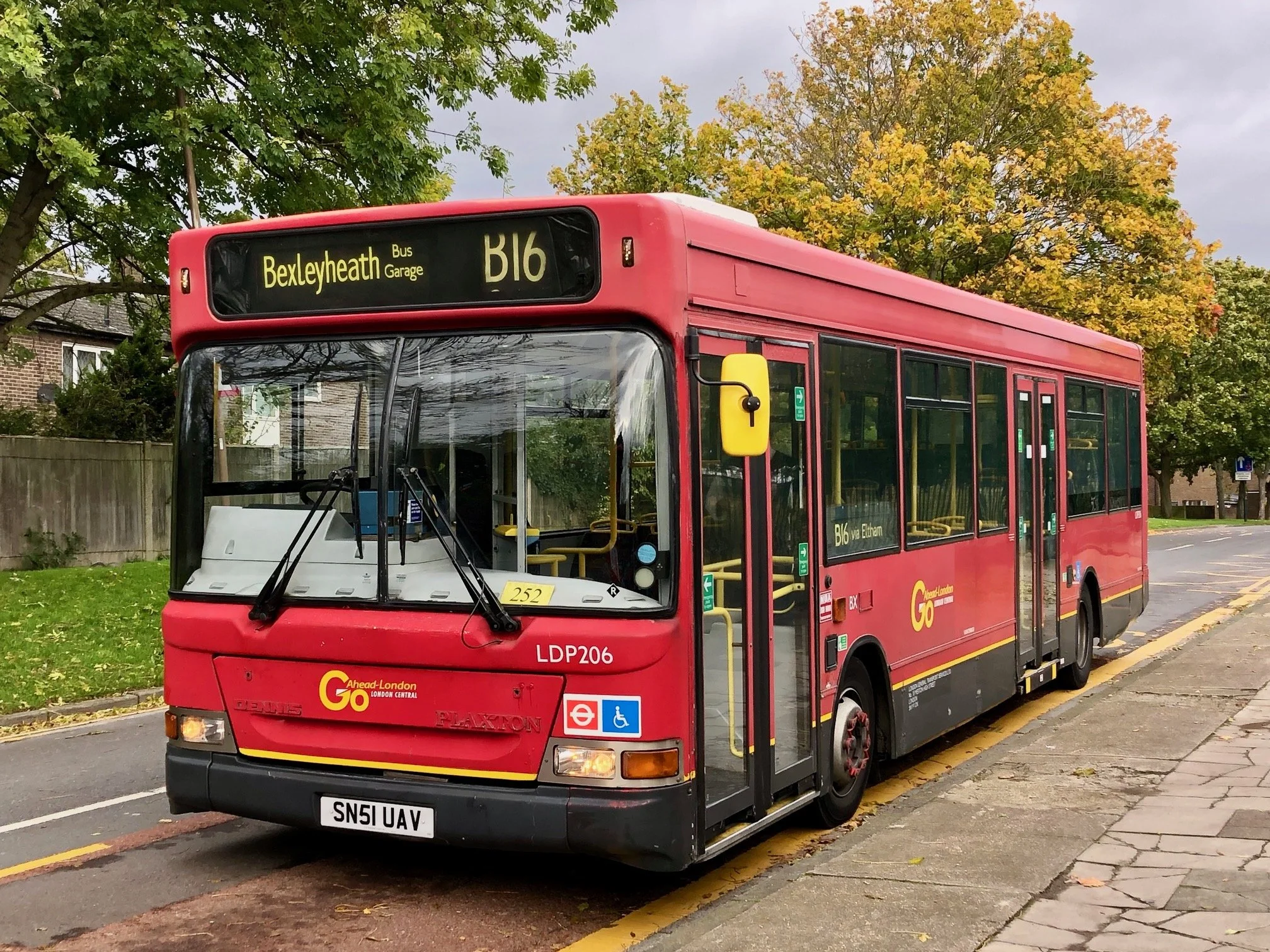
Back in October 2019, Dennis Dart Plaxton LDP206, also of BX Garage, is on almost the same spot as the previous picture at the Kidbrooke terminus of the B16.
This was one of the last of the type then in service at BX and indeed with GAL. It was withdrawn shortly afterwards.
Part Route 229: Bexleyheath - Erith
At BX Garage, I was able to observe comings and goings for quite a while, as I had an extended 25 min wait for my next bus on the 229. This was annoying, as I was only on a short positioning trip to Erith Town Centre. No idea as to the reason for the delay, although I suspect that roadworks further along the route played a part. Eventually, I boarded a packed Arriva T323 of Dartford (DT) Garage, which was full and standing after the gap in service. Luckily, only a 15 min journey to Erith, where I alighted.
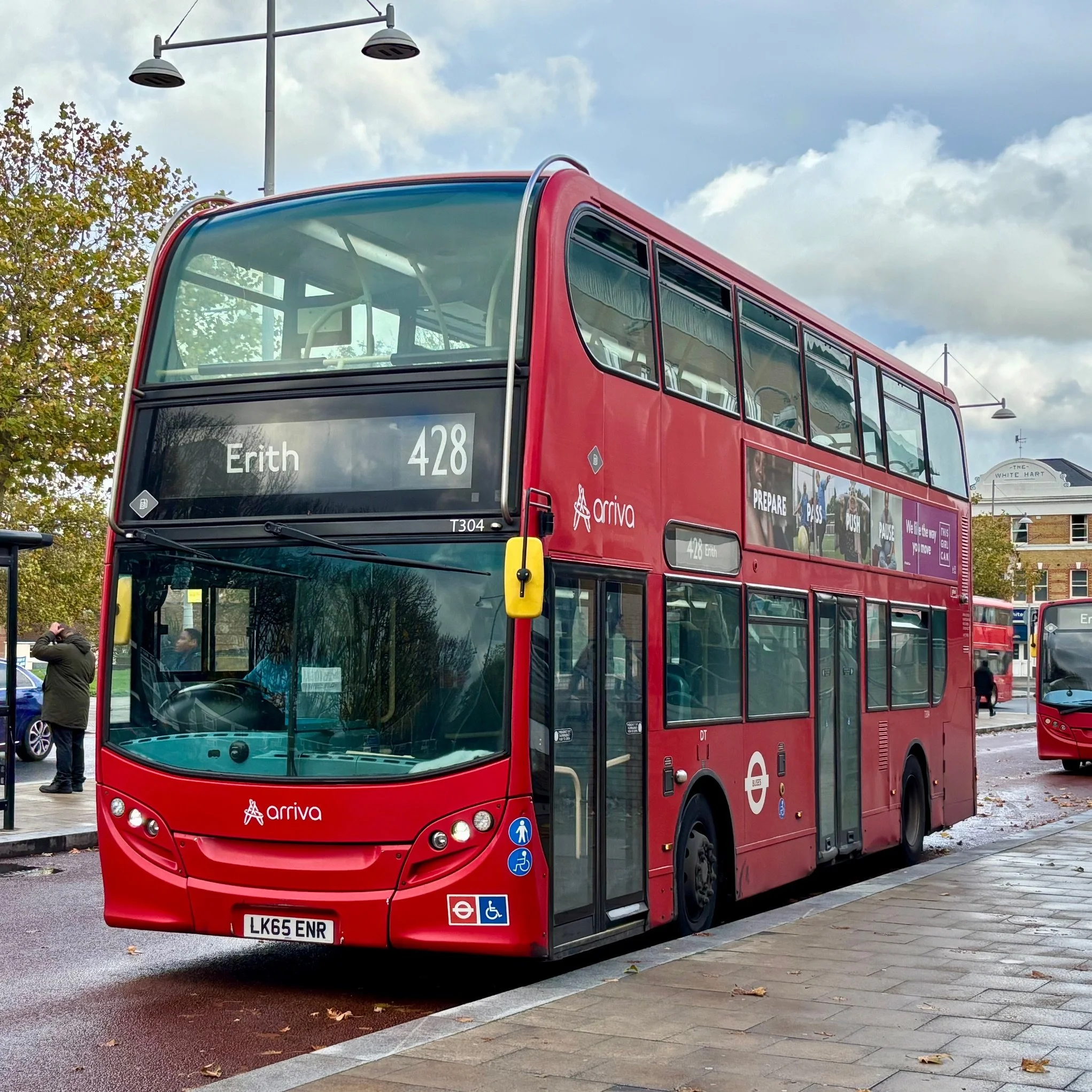
Arriva’s Enviro400 T304 of Dartford (DT) Garage is at Erith Town Centre on the 428 before I travelled aboard it to Bluewater.
The route has been retained by Arriva on retender from January 2026, with conversion to new electric vehicles intended in due course.
Route 428: Erith - Bluewater
I arrived at Erith just as Arriva Enviro400 T304 of Dartford (DT) Garage appeared on an inbound 428 and I had only a 5 min wait before it departed on its next trip back to Bluewater. A fair crowd boarded with me and we bowled along the dual carriageway section through to Slade Green, before taking the detour around the narrow roads to penetrate the housing in that area. Back on the main road, it was a straight run along Thames Road and Crayford Road to Crayford Town Centre, where we joined up again with the 96 that I had ridden in the opposite direction earlier.
Whilst traffic was queuing by now coming into Crayford in the other direction, we had a free run out of town and on to Dartford. After calling at the station, the 428 becomes express like the 96, calling only at Darent Valley Hospital and Bluewater. Like the 96, it traverses East Hill, The Brent and Watling Street to the hospital, but then it takes a long diversion around the “normal” roads into Bluewater, whereas the 96 runs direct via the Fastrack road. This added maybe 5 mins to the journey, which seems extraordinary - why can’t the 96 and 428 follow the same route over this section? Nonetheless, the overall 50 mins trip time wasn’t too bad!
The 428 was the successor to well-known London Country trunk route 480 over its Erith - Dartford section, which began as a commercial service and became a TfL route in 1999, still with Arriva as operator who succeeded London Country and Kentish Bus. It was initially single deck with Darts, later replaced by Cadets and then by ENX type Enviro200s. Double decking with T class Enviro400s occurred in 2021, although the odd DW has also appeared.
The route has been retained by Arriva on retender from 2026, with new electrics expected in due course.
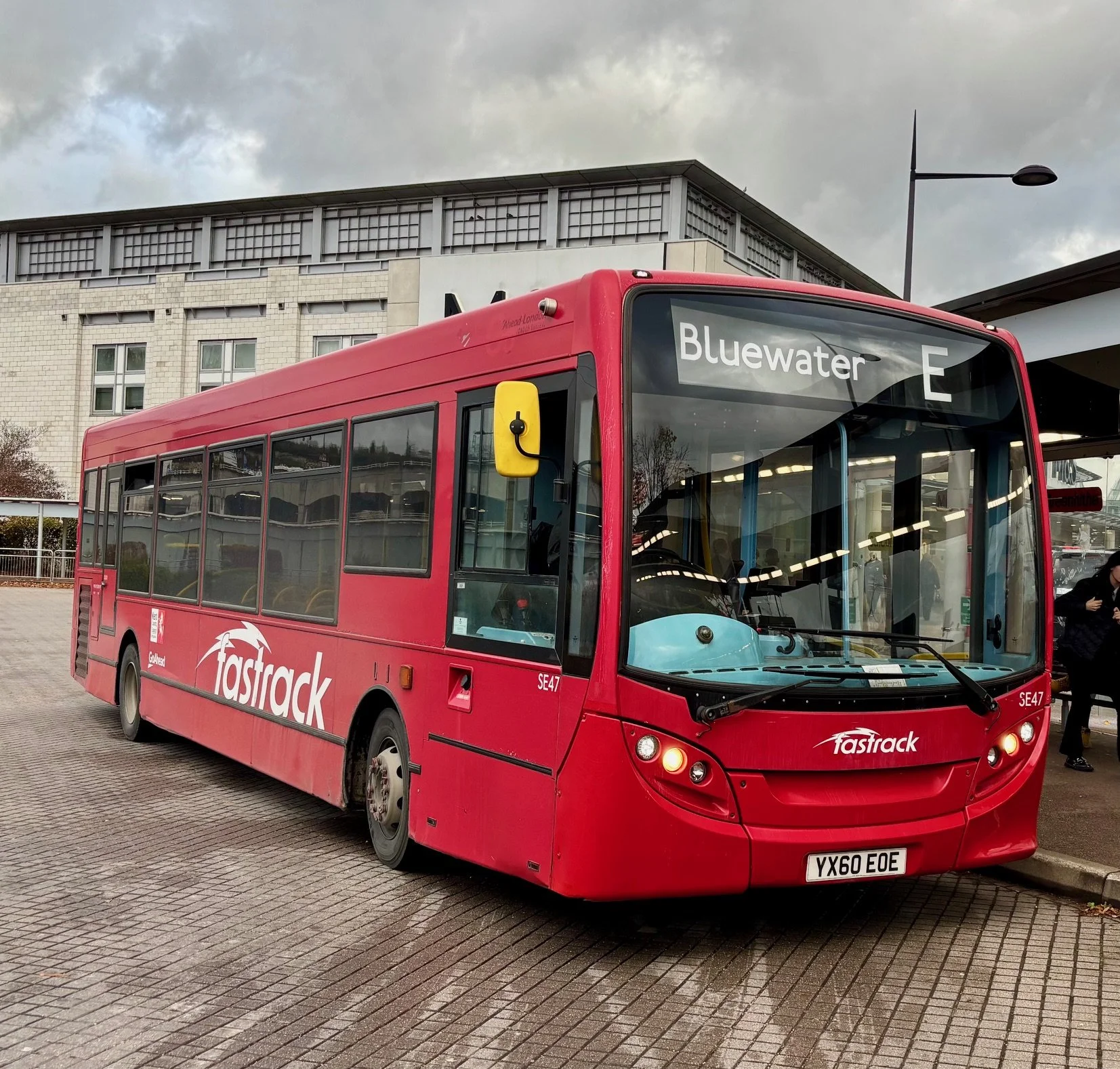
Go Ahead Enviro200 SE47 on Fastrack Route E at Bluewater Bus Station before my trip on it to Gravesend. The route was extended from Castle Hill to Bluewater in August.
This bus is the lowest numbered of the class still in normal service with GAL.
Fastrack E: Bluewater - Gravesend
Back at Bluewater, I had one more order of business to deal with before concluding my rides for the day. Since Go Ahead assumed control of the “Fastrack” routes from Arriva in late 2024, I had made two visits - one to sample the initial network and a second to ride the revised services some months later - both of which featured in previous articles.
A further small change was made in August 2025, when Route E between Gravesend and Castle Hill was projected to Bluewater via a new Fastrack only section, which had always been the intention but was delayed pending necessary roads being ready. Route E runs every 30 mins daily and I had just over 10 mins wait for the next departure from Bluewater Bus Station, formed of elderly Enviro200 SE47, the lowest numbered example of the class left in normal everyday service.
Boarding with a few others, we stormed away from Bluewater and made our way immediately onto the new section of route, serving new housing in Eastern Avenue and Longhoughton Avenue. We then turned into the new “bus only” road, which currently serves a sea of nothingness except mud and building sites. Before long, we emerged into Castle Hill, where we lost and gained a few clients. It was then over the existing section of route through the Castle Hill development and down to Ebbsfleet International Station (which has no international trains!) before continuing through the woods and on to the section beside the River Thames at Rosherville, another area of new housing, finally emerging in Gravesend Town Centre where we terminated after a run of just under half an hour.
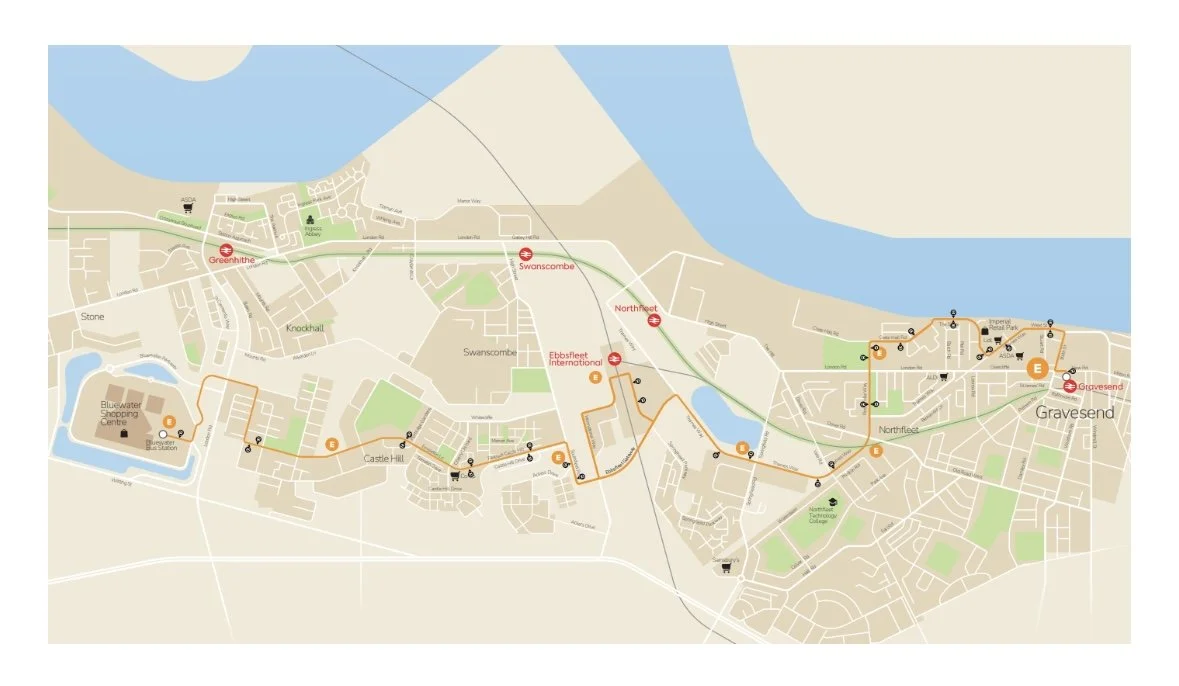
Diagram showing Fastrack Route E, including the recent extension from Castle Hill to Bluewater over a new bus only road.
Fastrack E: Gravesend - Bluewater
Route E interworks with the B at Gravesend, so SE47 that I had arrived on duly transformed into a B, leaving me to await the next E off an inbound B - currently a mix of SE, SEN and MEC types. As it happened, the next E was in the hands of SEN65, a former Sullivan Buses and Abellio London Enviro200 MMC that I had ridden on Route A during my first trip a year previously.
We departed bang on time with a few on board, making our way back through Rosherville and Ebbsfleet to Castle Hill. A number continued on the new section, which seems to be building usage, arriving back at Bluewater Bus Station after another trip of a touch under 30 mins. A useful little addition to the network to end my rides for the day.
Watton
And Finally…
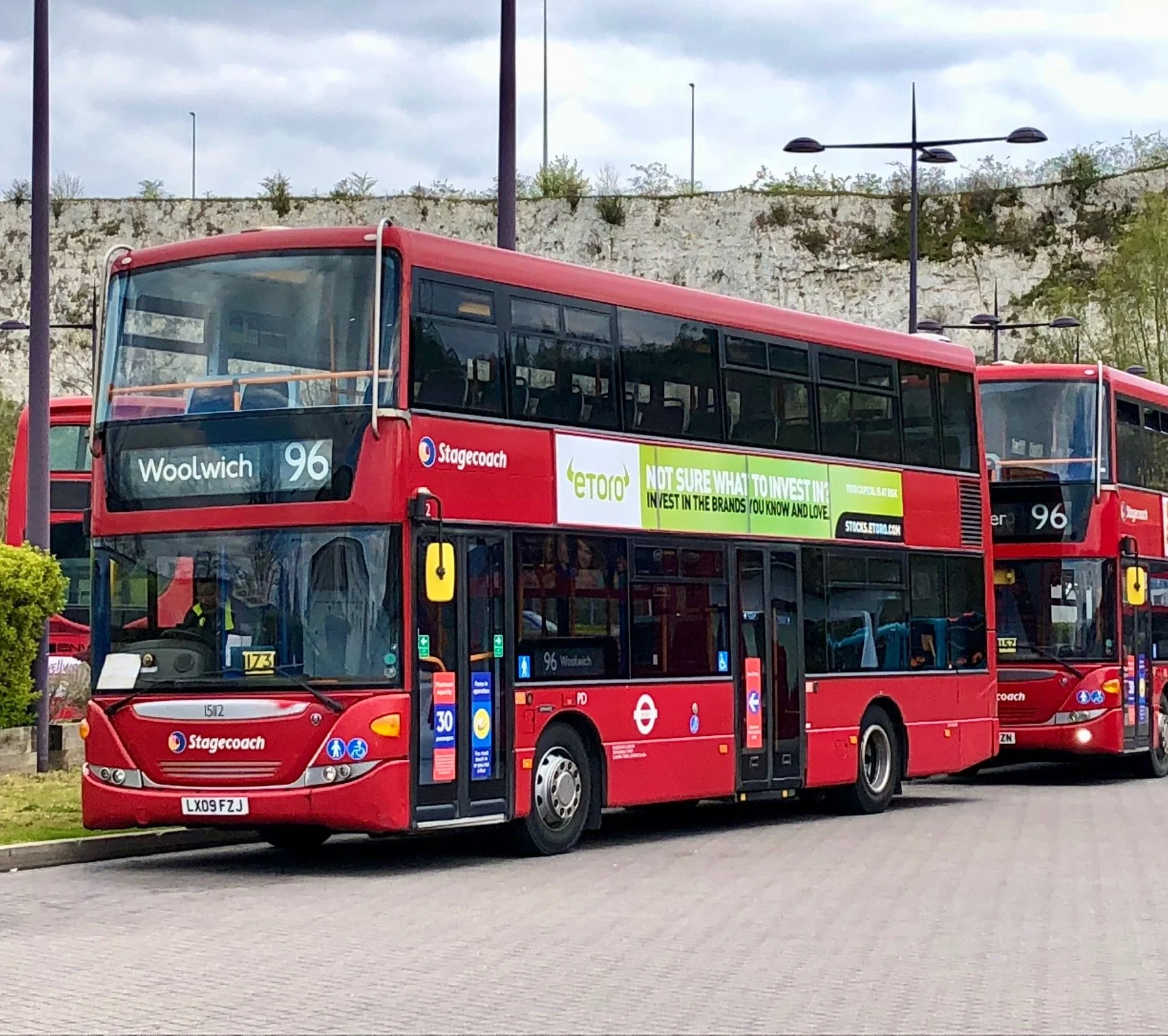
Back in 2021, when Scania OmniCity types were still in service with Stagecoach London, we have 15112 of Plumstead (PD) Garage on the 96 ahead of another on stand at Bluewater Bus Station.
Note the maximum 30 passengers poster on the entry doors which applied on double deckers at the time due to the Covid pandemic.
