
East London to Essex
Back on TfL territory, on this trip I ride a mixture of diesel, hybrid and new electric buses on a journey beginning in the East End and ending over the border in Essex.
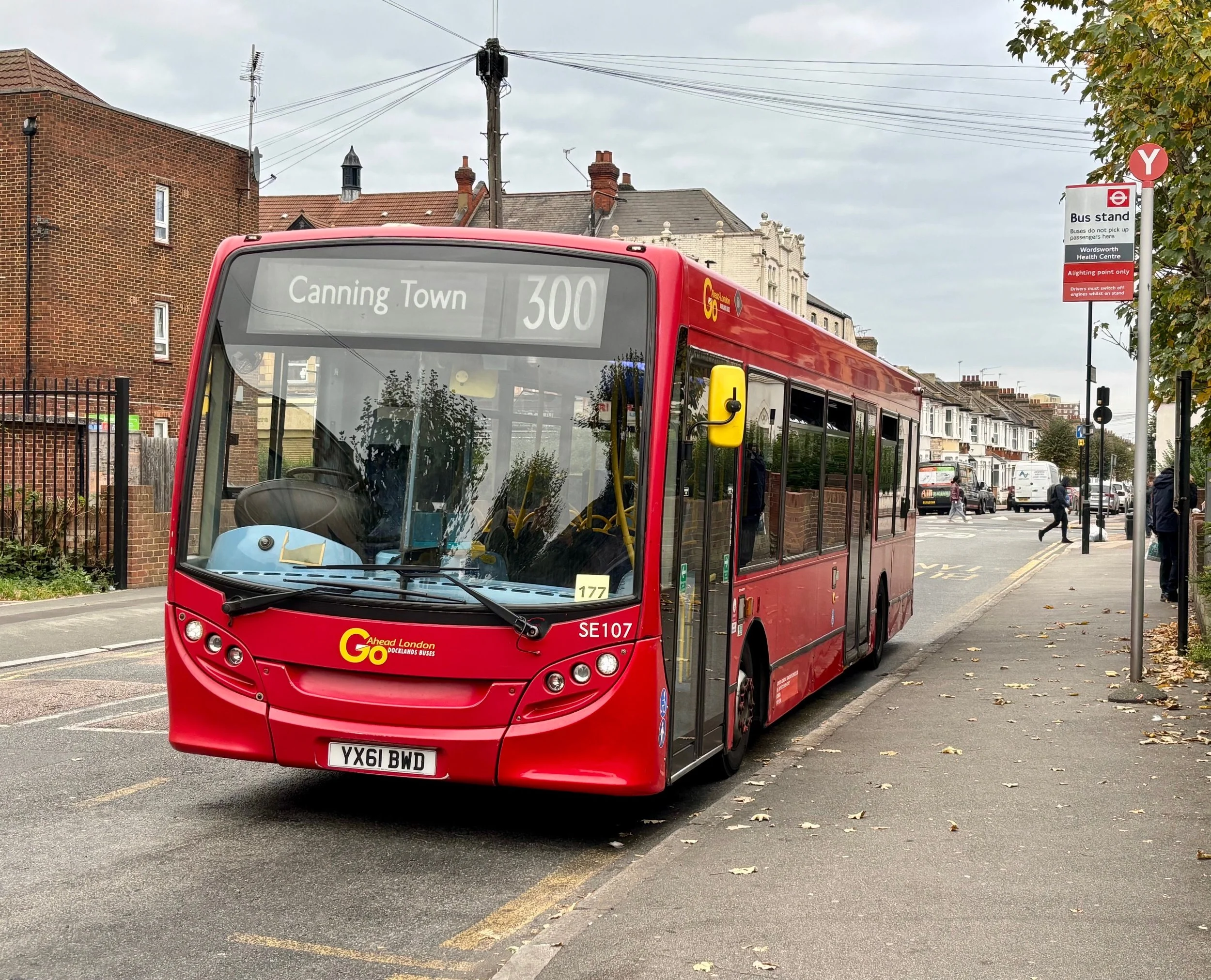
My day began with a ride to Canning Town on Route 300 aboard Go Ahead London’s elderly Enviro200 SE107 of Silvertown (SI) Garage, seen at the East Ham Wordsworth Avenue terminus.
This type is becoming rare in TfL service, the 300 being one of their last strongholds in East London.
Route 300: East Ham - Canning Town
My adventure began at Loughton Station in Essex on a Saturday morning, where I travelled to East Ham via the Central, Jubilee and District lines of London Underground.
A short walk brought me to Wordsworth Avenue, start point of the 300 bus to Canning Town. This route is operated by GAL out of Silvertown (SI) Garage and is one of the last homes in East London to the classic Enviro200 single deck type. SE107 was on stand and I boarded when it departed, receiving a friendly “Welcome to London!” from the driver after I explained I was from Hertfordshire!
This route is one of those rambling services TfL is so keen on, which takes a circuitous journey between terminals not that far apart. Being fairly early in the day, it was a quiet trip, with passengers on and off in ones and twos, but never more than a dozen aboard. We set off around the back streets of East Ham, before emerging in the High Street and making our way along the Barking Road, then turning off around the narrow roads of typical East London housing along Park Avenue, Folkestone Road and Vicarage Lane. Back on the main road, we continued over the A13 to Beckton Bus Station, where we exchanged a few customers. Then along Tollgate Road to Newham Way, before turning off down Prince Regent Lane to Custom House and then back up Freemasons Road across the A13 again to Barking Road. Swinging a left, the final stretch was along the main drag into Canning Town, where the traditional East London Market was just getting going. We terminated at the Bus Station a touch under 50 mins from the start.
The 300 dates from 1993, when it began with MRL midibuses between East Ham and Cyprus Windsor Park Estate. After conversions to SR, DRL and PD types, it was rerouted away from Cyprus to Canning Town in 1999. Low floor Dart conversion came in 2005, with the route passing from its original operator Stagecoach to GAL five years later using Enviro200s. There was a rerouteing in the Custom House area in 2022 as part of changes in connection with the opening of the Elizabeth Line.
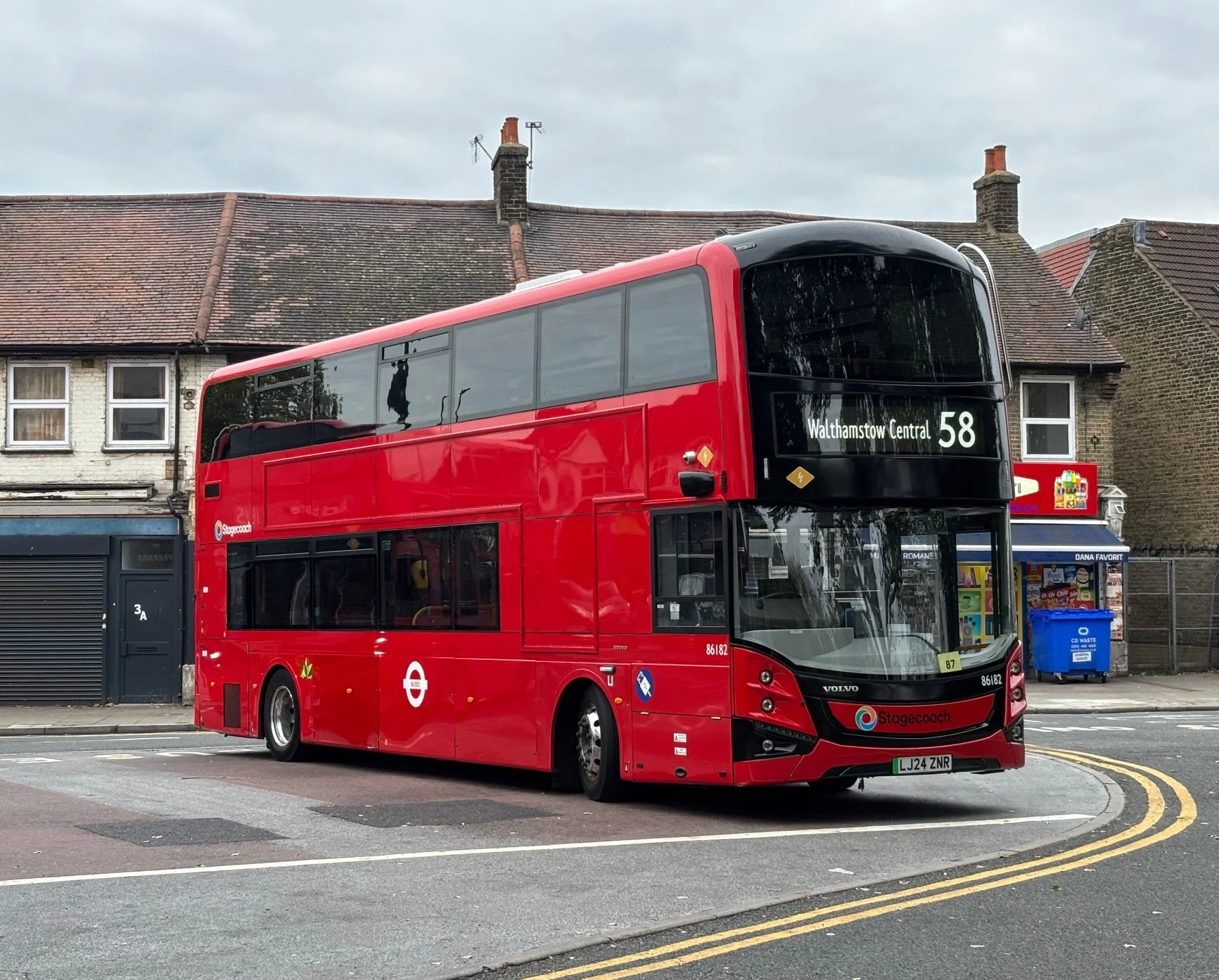
Stagecoach have been putting new Volvo BZL MCV electrics into service at Lea Interchange (LI) and Ash Grove (HK) Garages. 86182 looks shiny at the East Ham Central Park stand before I rode it to Walthamstow Central on the 58.
This was my first trip on the class with Stagecoach London.
Part Route 115: Canning Town - East Ham
From Canning Town, I took a 20 min positioning trip back to East Ham the quick way straight along the Barking Road aboard GAL Enviro400 MMC hybrid EH158 of River Road (RR) Garage on the 115, alighting at the Central Park terminus.
Route 58: East Ham - Walthamstow Central
Next on the agenda, a new type for me, with a ride on Stagecoach Volvo BZL MCV electric 86182, one of the type which converted the 58 from diesel Volvo B9TLs in 2024 out of Lea Interchange (LI) Garage. LVF was a bit confusing, as it showed buses terminating at South Grove in Walthamstow, but buses were indeed running through to Walthamstow Central via the normal route, although there was a diversion in place in the opposite direction due to roadworks.
Boarding the bus, I was struck by the seeming low height of the lower deck interior which had fairly flat cove panels. TfL style moquette on the seats rather than the usual Stagecoach design, together with new style information screens. Nevertheless, a smooth ride with rapid acceleration, as our driver made a quick getaway up to the Barking Road and a speedy run to the Boleyn, where we turned off. Passing the redeveloped former West Ham stadium site and close to the long-gone Upton Park (U) Garage, progress was retarded by temporary lights just past Upton Park Station, which cost us a few minutes.
A busy run over this stretch, with plenty of passengers, as we continued up to Forest Gate Police Station and along the Romford Road a short distance, before turning north to Forest Gate and Wanstead Park Stations. A slower run bumping over the humps in Dames Road and Cann Hall Road, before hanging a right up to Leyton Station. A couple of minutes whilst we had a driver change at Leyton Town Hall, but then we continued with reasonable progress along Church Road, across the Lea Bridge Road into Markhouse Road, before turning off into South Grove just before St James’ Street Station. After a trip time of 1h10m, we arrived at our destination of Walthamstow Central, not a bad run.
The 58 was a replacement for Trolleybus 685 in 1960, operated for many years with RMs. It ran between Walthamstow Crooked Billet and Canning Town, with peak time extensions to Silvertown / North Woolwich when the docks were still a significant source of custom. 1978 saw a northern extension to Chingford Mount, although when route 158 assumed this leg in 1981, the 58 shrank back to Leyton Gloucester Road apart from certain times of day. OPO conversion to Titans came in 1983, with the rerouteing to Walthamstow Central and the loss of the docks extension beyond Canning Town following in 1988. The final route change occurred in 1993, with East Ham becoming the southern terminus.
Low floor conversion with Tridents happened in 2001, with First replacing Stagecoach as operator in 2005 using TNLs initially, later replaced with VNs. In due course, Tower Transit took over First’s operations in the area, but Stagecoach returned in 2022, using the same vehicles until electrification in 2024.
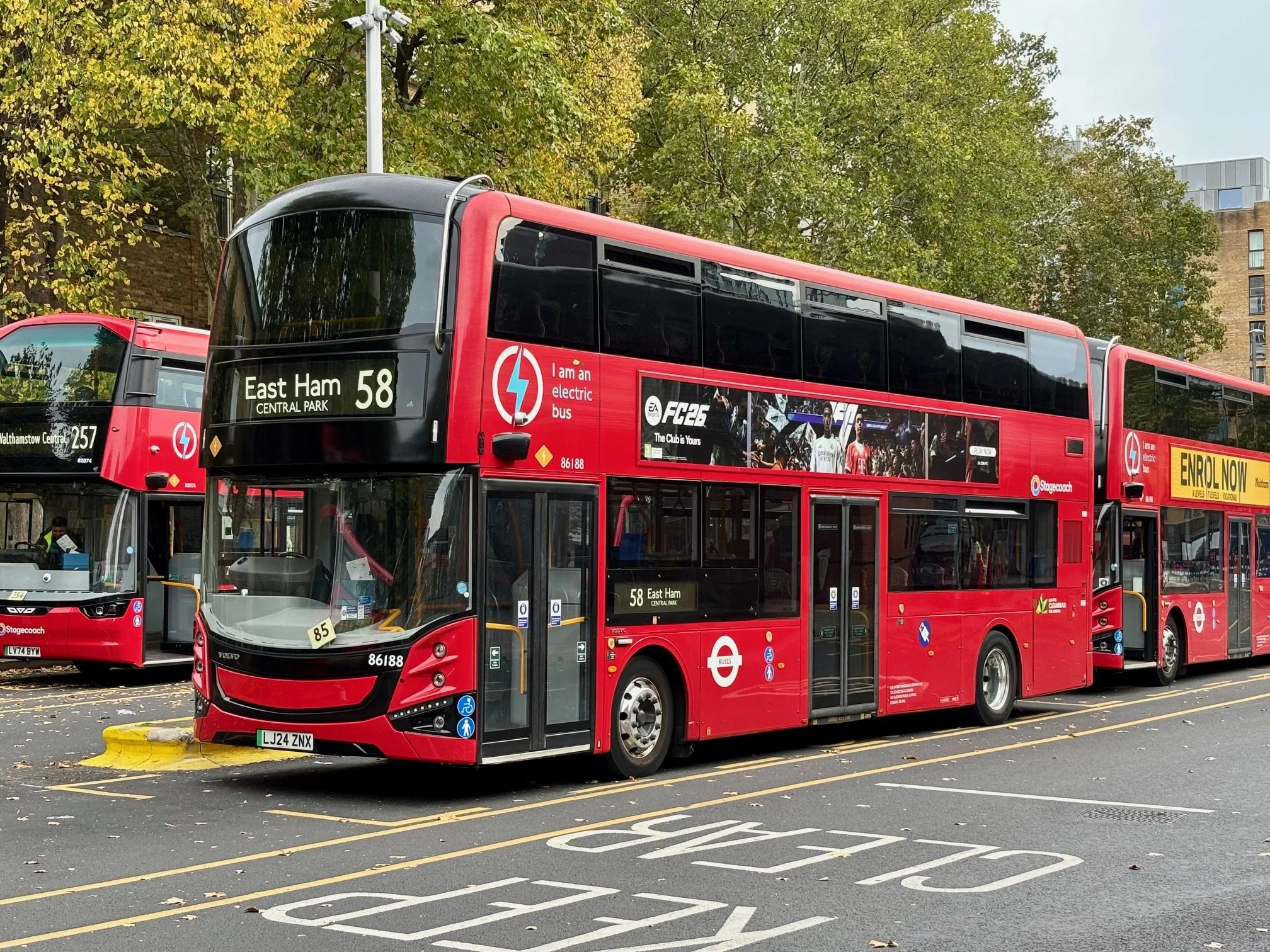
Demonstrating the nearside view of the class, fellow Volvo BZL MCV EV 86188 leads another at Walthamstow Central Bus Station bearing its electric bus credentials.
The 58 was the first route to use the type, being introduced to Lea Interchange (LI) Garage in 2024.
Route 275: St James’s Street - Barkingside
After a brief lunch stop, I walked from Walthamstow Central up to St James’s Street for my next route, the 275. This has been retained by Stagecoach on contract renewal from February 2026, but with new electrics intended in due course, so I took the opportunity to ride the existing diesels and hybrids which form the existing allocation.
I joined Enviro400 diesel 19870 of Leyton (T) Garage, one of the highest numbered of the class, for its next trip to Barkingside. As with the 58, a diversion was in force due to the roadworks at Walthamstow Central, but the normal route was being followed in this direction. We ambled back up to the Bus Station, picking up a good load, before continuing past the market to Bell Corner, where we turned right past the art deco Town Hall, before turning off along Hale End Road where there was another set of temporary lights. A bit of a queue up to Highams Park due to the level crossing gates being closed when we arrived, but then a better run along The Avenue through inter-war suburbia. Then through the leafy edges of Epping Forest to Woodford Green.
From here, there is a major diversion due to the bridge over the Central Line in Broadmead Road being closed for repairs. Therefore, we turned south along Woodford Green High Road, Woodford New Road and then a speedy run along the North Circ from Waterworks Corner to Charlie Brown’s Roundabout, before taking Chigwell Road and Broadmead Road back to line of route. This is obviously long term, as “E” tiles and timetables were in place on stops along the diversion.
Back on route, we continued via Woodford Station to Woodford Bridge, before the final stretch up the hill and down into Barkingside, finishing at the Tesco Superstore terminus after a total run of 1h10m.
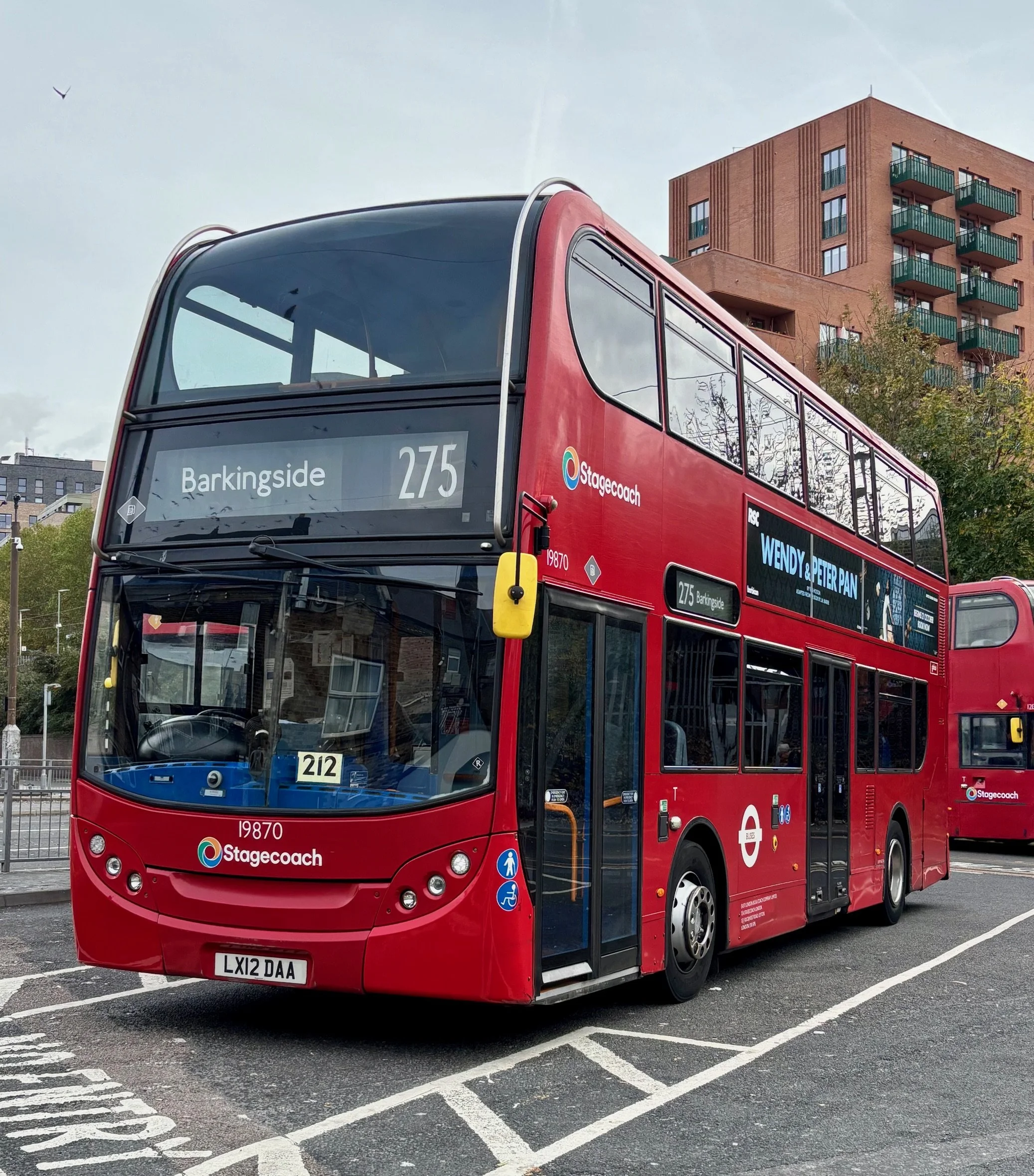
Classic diesel Enviro400 19870 of Stagecoach’s Leyton (T) Garage at St James’s Street before my trip aboard to Barkingside.
Just peeking in behind is Enviro400 hybrid 12133 on which I travelled for the return trip. New electrics are promised for the 275 with its forthcoming tender renewal in 2026.
Part Route 275: Barkingside - Walthamstow Market
For the return run, I was able to step up a working, as Enviro400 hybrid 12133 was ahead on the stand and left 5 mins later. This was one of the early batch of hybrids with its dark and light green interior providing a contrast with the usual blue and orange Stagecoach scheme. It had been retrimmed with standard blue moquette though, which looked a little odd against the green.
A fairly rapid run in the reverse direction, but this time I alighted at Walthamstow Market 55 mins later, before the roadworks diversion to St James’s Street, which was via Leyton Bakers Arms, Lea Bridge Road and Markhouse Road.
The 275 was another Trolleybus replacement route, also beginning in 1960, in place of the 625. It was extended beyond the former Trolleybus turning circle at Woodford Napier Arms, which still exists and I saw on my ride, to Woodford Bridge. At the other end, it ran to Turnpike Lane, Winchmore Hill or Enfield Town at different times of day and days of the week in typical confusing London Transport fashion! It was simplified on OPO conversion to MB in 1968, becoming a shorter route between Walthamstow Central and Woodford Bridge only, with a short extension to Claybury Hospital added 5 years later.
After double decks came back with DMS types in 1975, it was projected to Barkingside Fulwell Cross in 1977. The early 80s saw periods with Titan and then Leyland National operation, before tendering resulted in the route passing first to Eastern National then Thamesway with Bristol VRs. For a short time, there was a Sunday extension to Claybury Broadway, covering part of the 129, which didn’t run on that day at the time. In 1992, Grey Green took the contract, during whose tenure the route was extended to the then new Barkingside Tesco. Arriva acquired Grey Green in 1998, with Olympians being the usual fare by then.
2000 saw the extension at the other end to South Grove and eventually St James’s Street. Low floor buses in the form of VLWs came in 2005, but Stagecoach gained the route in 2012, initially with Tridents but later replaced with Enviro400s.
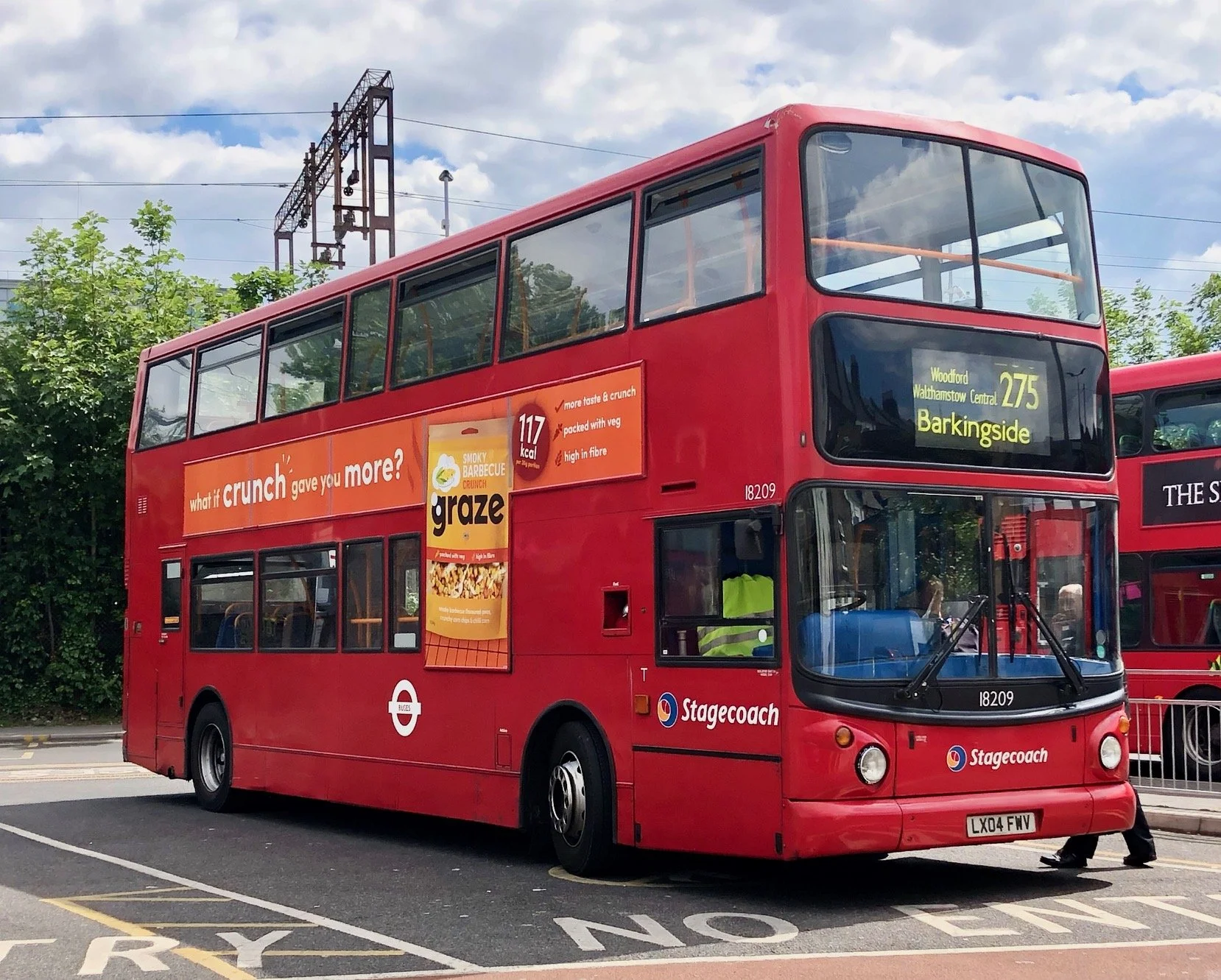
A reminder of how it used to be on the 275, with Trident ALX400 18209 on stand at St James’s Street Station back in 2019.
Leyton Garage was both the first and the last to operate Tridents with Stagecoach London and this shot was taken in their final months.
Route 20: Walthamstow Central - Debden
Final route of the day was the 20, which was also operating on diversion towards Walthamstow Central, but via the normal route towards Debden. Despite some evident late running and one or two buses being turned short at Leyton Green, I was lucky to secure an on-time departure aboard another Stagecooach Enviro400 hybrid, this time 12136, also of Leyton (T) Garage. The service is intended for the Enviro400 City hybrids acquired from HCT Group when Stagecoach took them over, but since reallocation from Walthamstow Avenue (WA), the older “classic” hybrids based at Leyton often appear - in fact, 6 of the 9 buses out on the 20 when I travelled were these, with a number of the City versions being on the 56 instead.
A strangely quiet run from Walthamstow to Leyton Bakers Arms over deserted roads, with a 2 minute “hold” at Shernhall St for early running. Once past Whipps Cross, we sped up as we entered the pleasant section through the forest up to Waterworks Corner, then on to Woodford Green. Fairly empty from here past the “Horse & Well” and the outskirts of Buckhurst Hill through more greenery into Loughton, where we performed the double run to serve the station. In the High Street, we picked up quite a few returning shoppers, before ascending the hill to the site of the two former Loughton (L) Garages, the older one marked with a plaque. Sadly, nothing remains of the “new” garage opposite, only opened in 1953 and now replaced with a housing development. Memories of happy days here riding RTs on the 20A, 167A, 205A and 217A.
We then trundled around the Debden Estate, dropping off and picking up a few short-riders. Arrival at Debden Station was just a couple of minutes over the hour from the start.
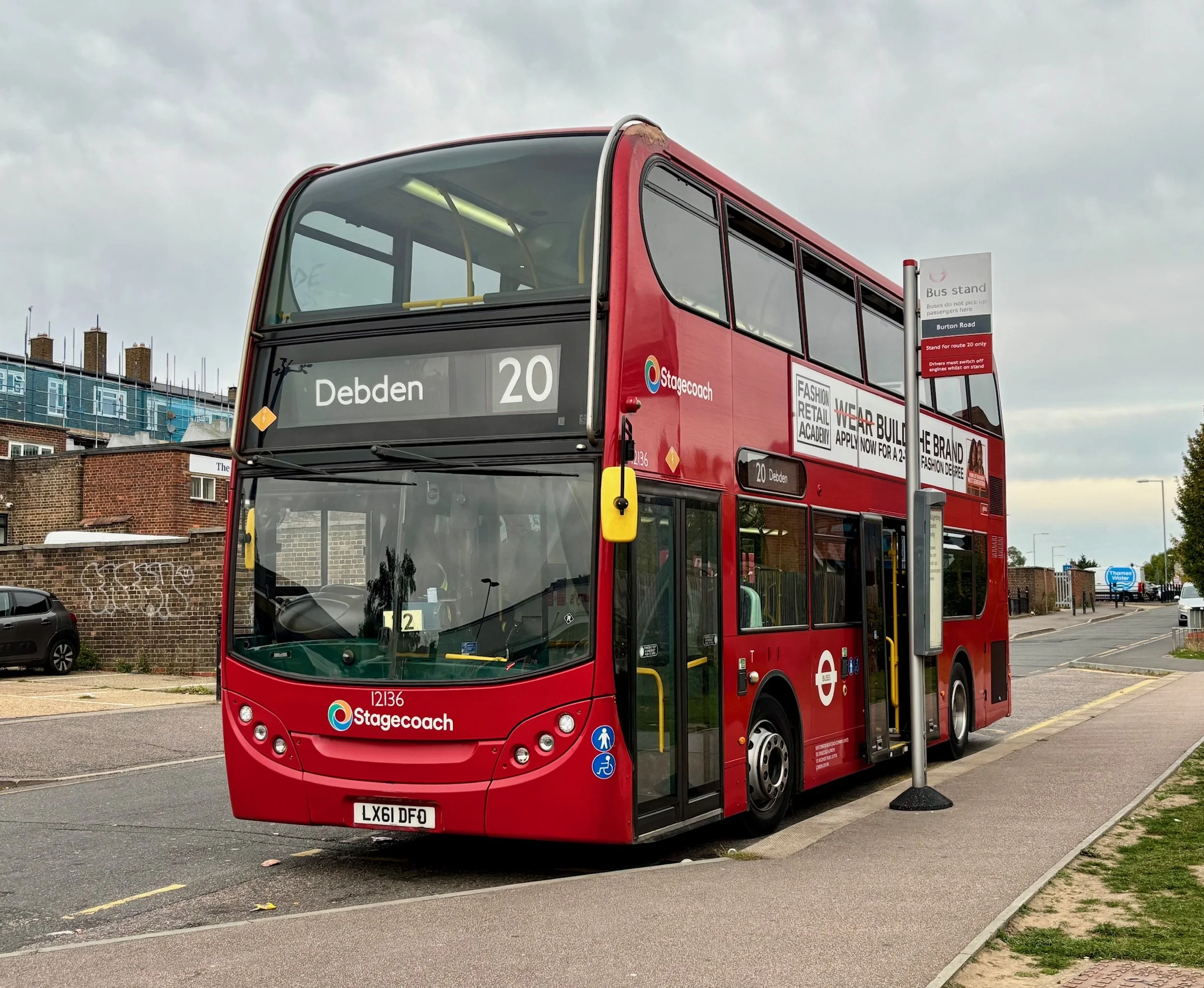
The 20 is scheduled for Enviro400H City vehicles but older “classic” bodied Enviro400 hybrids also appear. 12136 is at Debden Station after I rode it here from Walthamstow.
Such appearances have become possible since Stagecoach reallocated the route from Walthamstow Avenue (WA) to Leyton (T) Garage.
Part Route 20: Debden - Loughton
After the 10 min layover in Debden, I reboarded 12136 for the short 20 min trip back to Loughton Station, where I alighted at the end of my trip.
The 20 group has an interesting history, with the parent route first appearing between Leytonstone & Epping in 1948 when the 10A was renumbered. In 1966, it was withdrawn, replaced by the 20A and 20B, although the number returned with “Reshaping” in 1968 between Walthamstow Central and Loughton. RT operated for just a few months, it was converted to OPO with MB the following year and extended to Epping in place of the 20B. Upgrade to DMS came in 1976, with the route then being diverted to Debden rather than Epping when it swapped this leg with the 20A. Titans had a short stay at Loughton Garage during 1982, before they were replaced with Leyland Nationals.
Tendering in 1986 saw the 20 pass to Eastern National using Bristol VRs and the closure of Loughton Garage. Grey Green took over in 1992 with Volvo single deckers apart from a few double deck journeys at school times. By the noughties, Arriva had acquired Grey Green and introduced low floor double deck operation with VLW then DLA types. Go Ahead took a turn from 2012 using WVLs, until HCT Group assumed the contract 7 years later with new Enviro400 City hybrids, which passed to Stagecoach in 2022.
Daughter route 20A began in 1954 using STDs between Leytonstone and Debden, although these were replaced within a year by RTs. Upon OPO conversion to DMS in 1976, the swap of northern ends with the 20 saw the 20A go to Epping instead of Debden. In its final year of 1982, the 20A was converted first to T and then LS operation and ended as a short route between Loughton & Epping only, with just a 1 bus PVR, a sad comedown and the victim of “out county” funding cuts.
The 20B took over the northern bit of the 20 in 1965, running between Epping Town and Loughton Station, with projections at one end to St Margaret’s Hospital and a M-F peaks extension to Buckhurst Hill Station at the other. OMO RF operated, it ran at first just on M-F and Sun, with the 20 continuing to cover it on Sats. However, a year later, the 20B became a daily service, although Sats curiously retained crew RT operation. It was withdrawn in 1969 when further changes were made to the 20 and 20A as outlined earlier. Although I never rode the 20B back then, I was able to put the omission right on the occasion of a Running Day organised by the Epping - Ongar Railway in February 2023, when the route was recreated for one day with vehicles which included an RT!
Watton
And Finally…
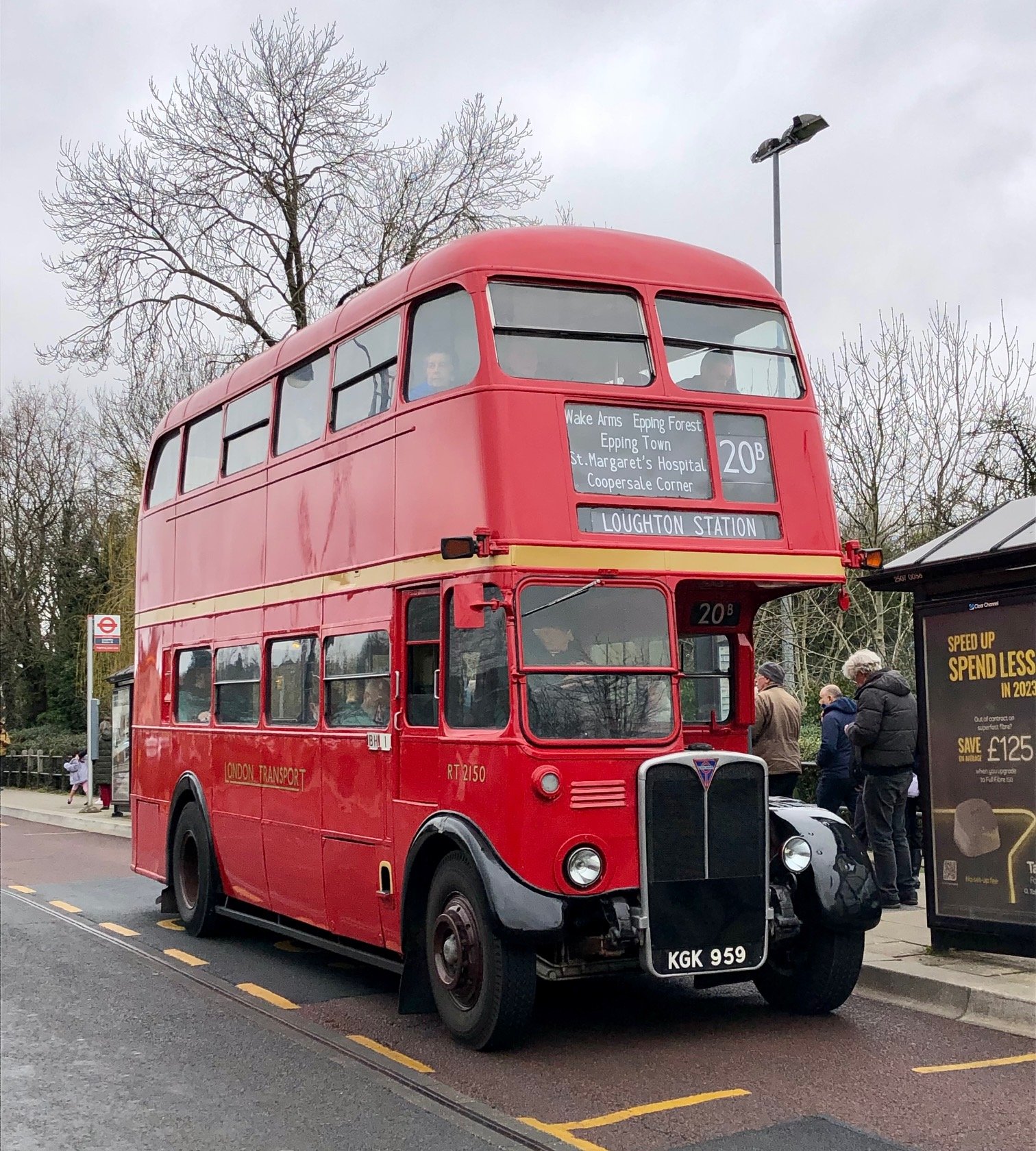
Back in 2023, Route 20B was recreated during an Epping - Ongar Railway organised Running Day. Here is RT2150 at Loughton Station during my trip on it.
The 20B ran from 1965-69 between Epping Town & Loughton with journeys to/from St Margaret’s Hospital and a M-F Peaks extension to Buckhurst Hill Station. Unusually, it was RF OPO on M-F & Sun, but crew RT operated on Sats.
