
Isle of Wight Part 2: Railways Old & New
In the second episode of my visit across The Solent, I travel on the Island Line with its former London Underground rolling stock, walk an abandoned trackbed and recall a previous trip on the IOW Steam Railway.
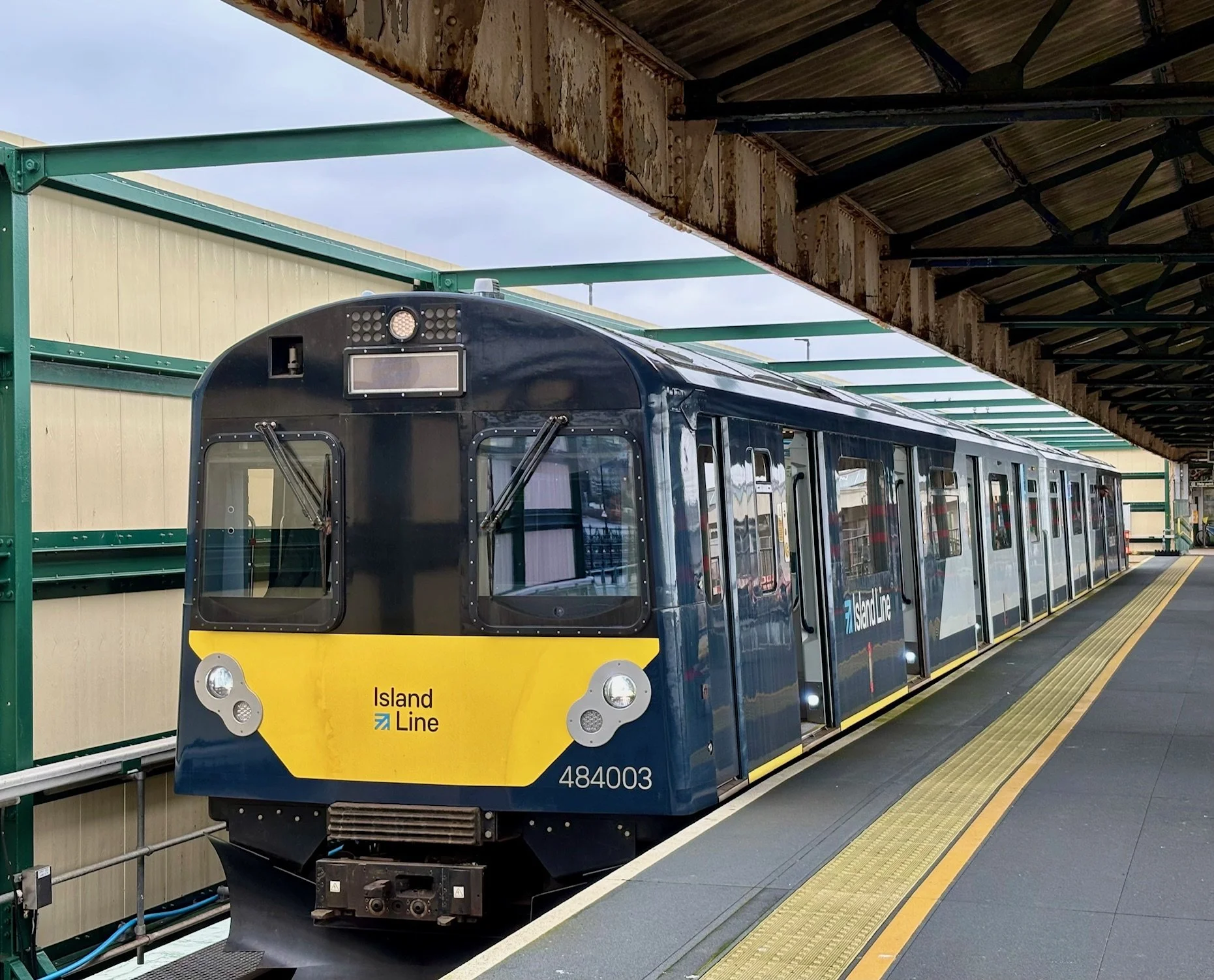
Refurbished former London Underground D78 stock has run on the Island Line between Ryde & Shanklin since 2021. Two car unit 484 003 forms a departure from Ryde Pier Head at the start of my visit.
There are 5 such units in operation, based at Ryde St John’s Road depot and operated by South Western Railway.
IOW Railway History
The Isle of Wight once had a 55 mile network of railways comprising the following lines:
Ryde - Ventnor
Ryde - Cowes
Newport - Freshwater
Brading - Bembridge
Sandown - Newport
Ventnor West - Merstone
Opened in stages between 1862 and 1901, the routes were operated initially by several companies that merged under the Southern Railway at “The Grouping” in 1923. After passing to British Railways on nationalisation in 1948, they were closed between 1952 & 1966. Two lines were left at the end: Ryde - Ventnor and Ryde - Cowes, both slated for closure under the Beeching Report, but happily parts of both survive. The Ryde - Shanklin section of the Ventnor Line was electrified and reopened in 1967 to cope with the (then) large numbers of holidaymakers to Sandown and Shanklin that visited the island in summer. Meanwhile, the IOW Steam Railway began a heritage operation over part of the Cowes Line based at Havenstreet that eventually extended to run from Smallbrook Junction to Wootton.
I first encountered the island’s railways as a very young boy in 1965 on a family holiday to Ventnor, when we arrived by steamer ferry at Ryde Pier Head and entered a Victorian world of steam tank engines and ancient compartment rolling stock for the final part of our journey. I still recall the excitement of that ride, along the eastern side of the island and through the long tunnel under the downs before emerging at the little terminus station at Ventnor. The good thing was that we had the return journey to look forward to on the way back! Sadly, the next time we came to the island a few years later, the steam trains were gone and we had to complete the journey from Shanklin to Ventnor by bus.
It was not lost on me that the line to Ventnor closed exactly 60 years prior to my current visit, so the aim was to recreate my original 1965 journey in the present day, by train on the open part of the line and walking the remainder that was closed.
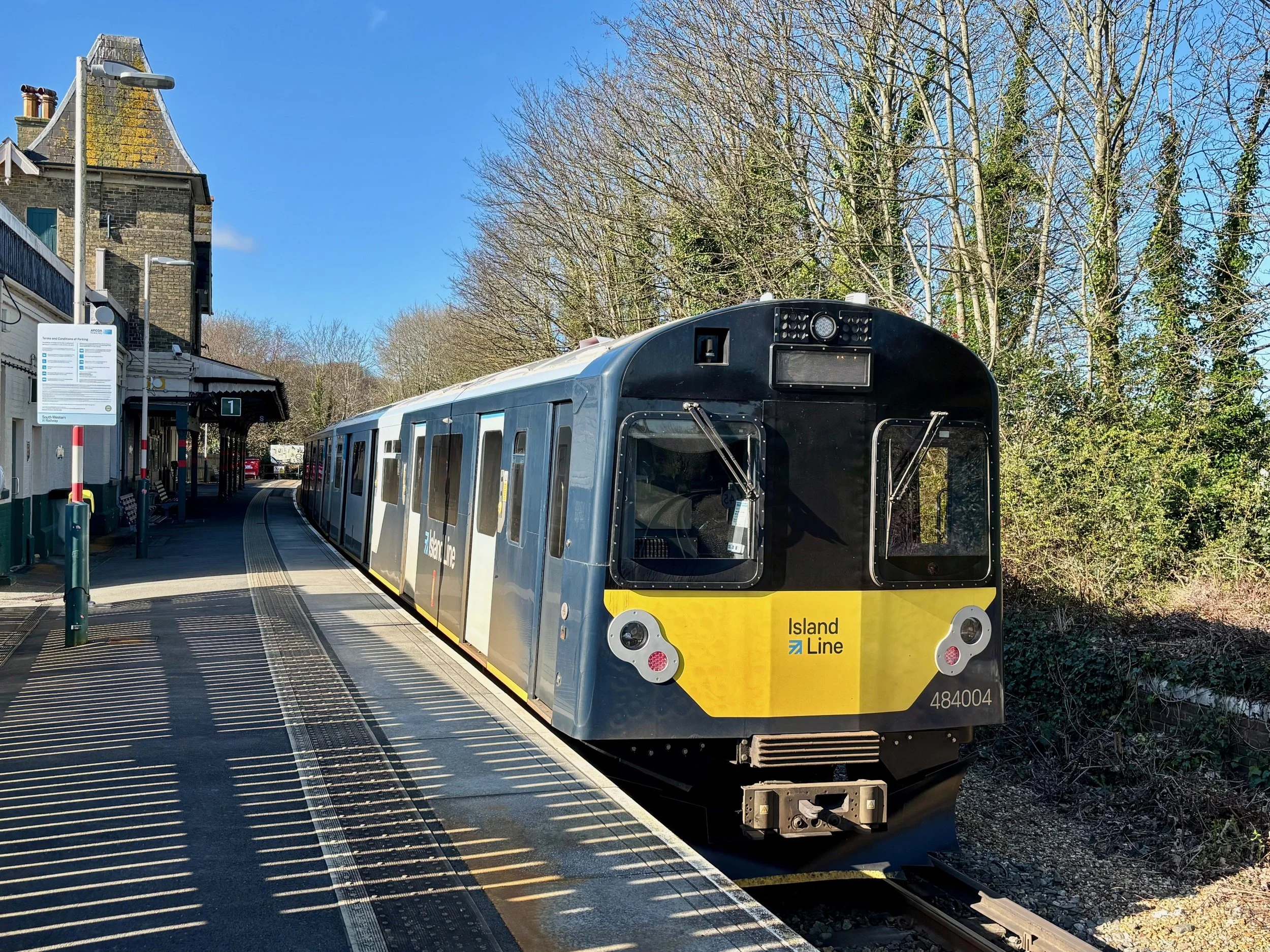
Unit No 484 004 is pictured at the southern terminus of the Island Line at Shanklin after I travelled aboard from Ryde.
At the time of my visit, 2 trains were in operation, providing an approximate 40 min interval service.
Island Line: Ryde - Shanklin
Today’s Island Line runs for 8.5 miles between Ryde Pier Head and Shanklin. It is operated by South Western Railway using former London Underground District Line D78 stock, refurbished and converted to third rail electric operation. There are 5 units of 2 cars now classified as Class 484. A passing loop was reinstated at Brading to enable the previous 40/20 min interval service to be replaced by a regular 30 min one, but when I travelled there was an unmemorable frequency of about every 40 mins (but not quite) in place using 2 units. Departures from Ryde Pier Head were typically at 03 and 47 mins past the even hour, then 26 mins past the odd hour, with those from Shanklin at 07 and 51 past the even hour, then 30 past the odd hour. Not sure of the reason for such a bizarre timetable, which negates all the expensive work done at Brading to allow a half hourly service!
I covered the short section along the pier to Ryde Esplanade when I arrived via the “Fastcat” from Portsmouth, but returned to Esplanade Station on Day 3 of my trip to continue along the line. Like all the Island Line stations, Ryde Esplanade has been nicely refurbished in Southern Region style with green totems and has a ticket office plus waiting room. It is also adjacent to the Bus Station for easy interchange of transport modes. The line operates as a single track between Pier Head & Esplanade.
I boarded Unit 484 004 in its smart Island Line livery, the interior being nicely refurbished and clean. The former advert panels above the windows are still used for that purpose, with some displaying a line diagram of the route. Soon we were off towards Ryde St John’s Road, with the conductor/guard checking tickets or issuing them from a machine as required. We then entered the double track section through Ryde Tunnel, the small dimensions of which always dictated the use of locomotives and rolling stock of diminutive size. Bypassing the town centre, we emerged into daylight again and pulled into Ryde St John’s Road Station. This is the location of the depot for the line, where I noted one unit in the shed and two stabled outside. Interestingly, the only signalbox on the railway is here, with traditional semaphores in the station area but colour light signalling elsewhere along the line
Leaving St John’s Road, we continued southwards into open country, soon reaching Smallbrook Junction, where the line becomes single track again. This was once the junction where the line to Newport & Cowes diverged, but now provides an interchange with the IOW Steam Railway. The station was added in 1991 as a new facility and is only open when the heritage service is in operation and as it was closed on this day, we ran through without stopping.
The next section, to Brading, is probably the nicest part of the line, through green countryside with a decent speed attained. Arriving at Brading Station, we entered the passing loop restored in 2021 to stop on the down platform, whilst the other unit in service arrived beside us at the same time on the up platform. The signalbox here is also restored but not in use. Services on the Bembridge Branch (closed in 1953) used to leave from a bay platform that is no longer in use.
After leaving Brading loop, we were back on the single track heading towards Sandown, with a short country section soon replaced by a more urban environment. Sandown Station has another passing loop with two platforms. The branch line from Sandown to Newport closed in 1956, with part of its course built on with housing, although a section remains as a footpath.
From Sandown onwards the line mainly passes through urban areas over the final single track section, although we called at the single platform station at Lake, midway between Sandown and Shanklin. This is a basic structure, added to the line in 1987. From here, we continued another mile or so to the terminus at Shanklin, now a single platform but with the main station building still in place and also restored in Southern style. Journey time end to end is scheduled at 27 mins, although this seems to include a couple of minutes of recovery built into the schedule.
Passenger usage throughout the trip was reasonable with people on and off at all stops, although not crowded. The two coach unit was ample for the numbers conveyed. The Island Line continues to play a useful role in the local transport network, although it is a pity it does not still continue to Ventnor!
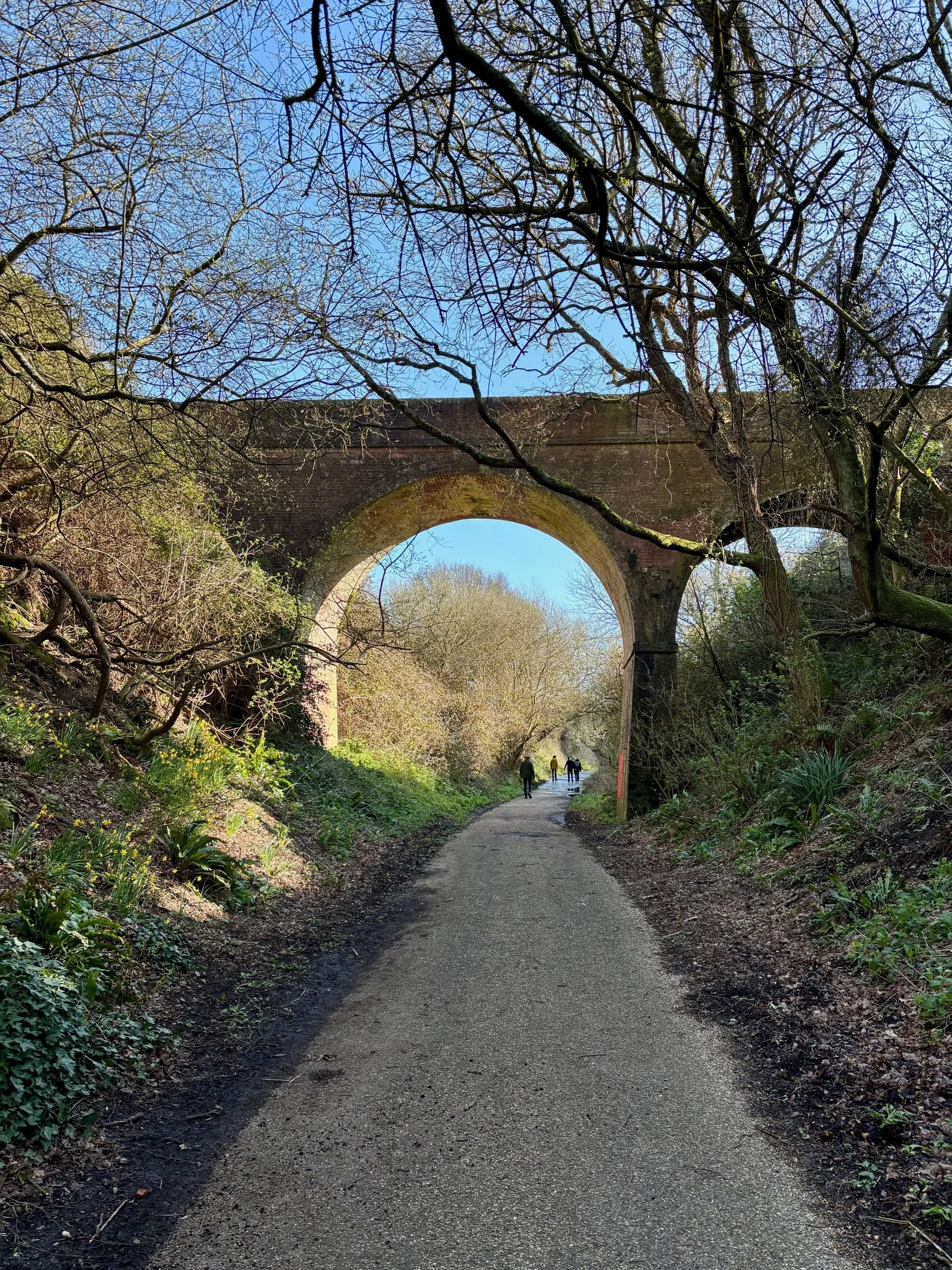
The line beyond Shanklin to Ventnor closed in 1966, but the section to Wroxall is now a footpath and cycle way. This is one of the overbridges seen from the old track bed.
Unfortunately, there is nothing left of Wroxall Station, the site of which is now a builder’s yard, apart from the former Station Hotel now converted into apartments.
Old Railway Walk: Shanklin - Wroxall
However, for me, this trip marked a return to the old line from Shanklin to Ventnor for the first time in over 60 years, as it is possible to walk over at least part of the old trackbed. Beyond the buffer stops at Shanklin Station is a hedge and by walking around it, I crossed the road which was once passed over by a railway bridge, entering the course of the old line southwards. The first short section is now a road to a new development with a path beside, but soon the road veered away and I was on my own on the path following the trackbed.
The houses of Shanklin soon gave way to gently rolling country with fields and farms, although we passed through wooded areas in parts. At several points, I walked under brick arch bridges carrying roads above or over short underbridges taking narrow lanes or streams beneath. The route seemed quite popular, as it was a bright and sunny day, with dog walkers, joggers, cyclists and horse-riders encountered along the way. All too soon, we came into the little village of Wroxall, where the footpath ends. Sadly, Wroxall Station is no longer there, although the site can still be discerned and is occupied by a Travis & Perkins builders yard. The adjacent former Station Hotel is now converted into apartments.
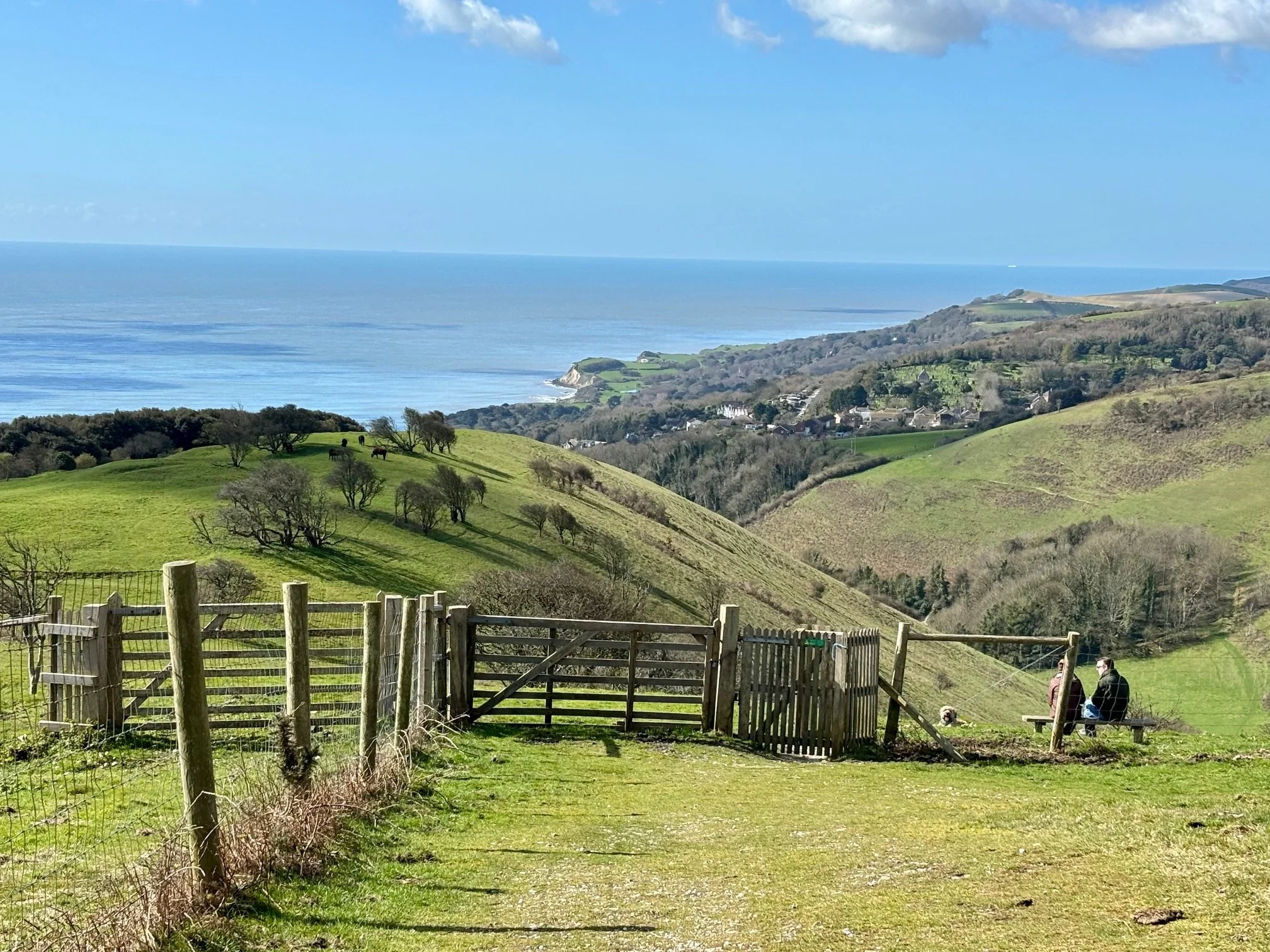
The section of line between Wroxall and Ventnor cannot be walked directly as the old railway tunnel under St Boniface Down is now used by Southern Water for sewer and water pipes. Therefore, a detour is required over St Boniface Down itself.
This is the highest point on the island at 241m and is worth the climb for the magnificent views on a clear day.
Old Railway Walk: Wroxall - Ventnor
From the site of Wroxall Station, I deviated from the former track bed for a short distance along a residential road, before rejoining the route, which became extremely muddy due to use by the local cows to move between their fields and milking. At one point, I had to cross a farm track over two stiles which was blocked by a slow moving herd - fortunately, they parted to allow me to pass!
Soon after this, I had to deviate from the old railway course more significantly, as the tunnel under the downs to Ventnor is impassable due to being used by Southern Water for water and sewer pipes. A shame that this could not have been retained as part of the walking route. Instead, I had to begin a long slow climb up Wroxall Down, high above the former railway, through fields and woods, where I saw some of the native red squirrels which are rare in Britain but remain in large numbers on the island due to the predatory grey squirrels not being able to swim across The Solent and take over as they have elsewhere on the mainland.
At the top of Wroxall Down, I had a superb view back over Wroxall Village and a good panorama of the central part of the island. From here, it was not much further to the top of St Boniface Down, the highest point on the IOW at 241 metres. This is the site of a radio transmitter, formerly a radar station that formed an important part of the early warning system for the country during the Battle of Britain and was bombed by the Luftwaffe but not completely put out of action. During the Cold War, a nuclear bunker was situated underneath. I took time to take in the view from the summit, from where I could look out over the island interior, down towards the Ventnor area and out to sea.
I then made my way along a very steep downhill path, into a valley between the hills and through some woods, finally emerging into an industrial estate which is on the site of the former Ventnor Station.
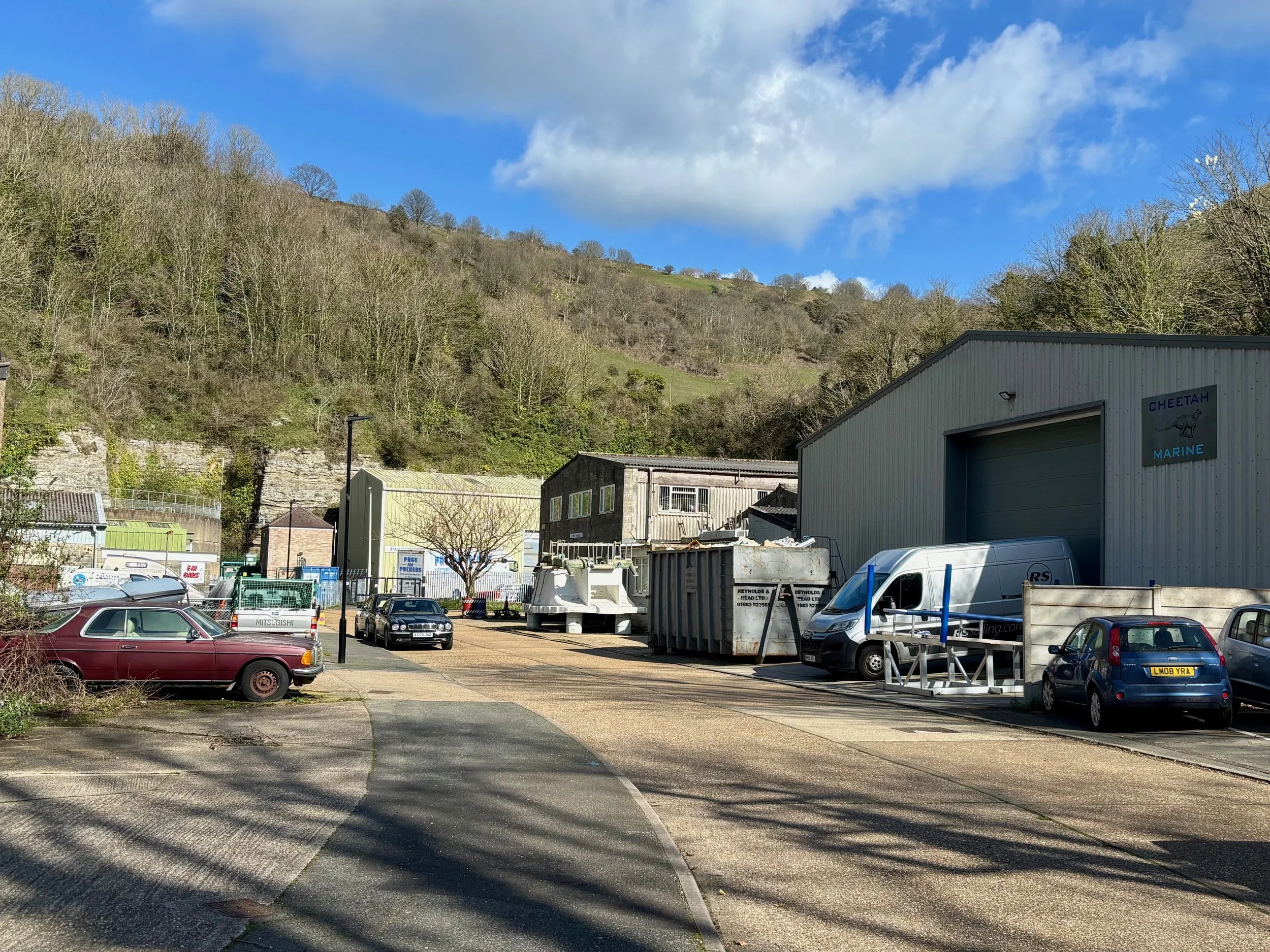
The site of the old Ventnor Station is now home to an industrial estate. The old tunnel entrance is in the “V” shape in the rock on the left above the brown car but can no longer be seen behind the buildings and foliage.
The station site was extremely cramped and located on a ledge quarried out of the downs.
Ventnor Station
The former station at Ventnor was built on a ledge 90 metres above sea level which had been quarried into the hillside. It was quite a hike uphill from the town, especially with suitcases after returning from a holiday to catch the train! The railway emerged from the 1,200m tunnel under St Boniface Down in a single track, passing the signal box and into the station itself which had a platform connected to the station buildings and a narrow island platform. There were also goods sidings which served the coal merchants who operated from caves in the chalk sides of the cutting in which the station was located.
I have memories of catching the train home from Ventnor Station in 1965 at the end of the holiday mentioned earlier, with the sights and sounds of the little tank engines and the ancient green compartment stock. While we were waiting for our train, I recall being given a penny by my parents to put in a machine on the platform which enabled me spin a pointer to various letters to spell out my name which was imprinted on a thin strip of silver metal. Simple pleasures but happy days!
The station closed in April 1966, the official reason being that the bulk of the traffic on the line was to Sandown and Shanklin. However, the budget for the electrification of the line was £500k, which just about covered the infrastructure needed for the Ryde - Shanklin section. To include Ventnor in this would have required an additional substation which could not be afforded. By 1970, the track had been lifted and the station demolished. An industrial park was built on the site in the late 70s and has since expanded. The former tunnel entrance used to be visible, but has now disappeared behind buildings and foliage.
Over the years, there has been talk of reinstating the railway to Ventnor, but whilst it might be possible between Shanklin & Wroxall, it is difficult to see how it could be done onwards to Ventnor given that the tunnel is now in alternative use and the station site has been built on. An alternative route would likely be prohibitively expensive, unless the line was converted to a light rail or tram system which could perhaps utilise “on road” sections.
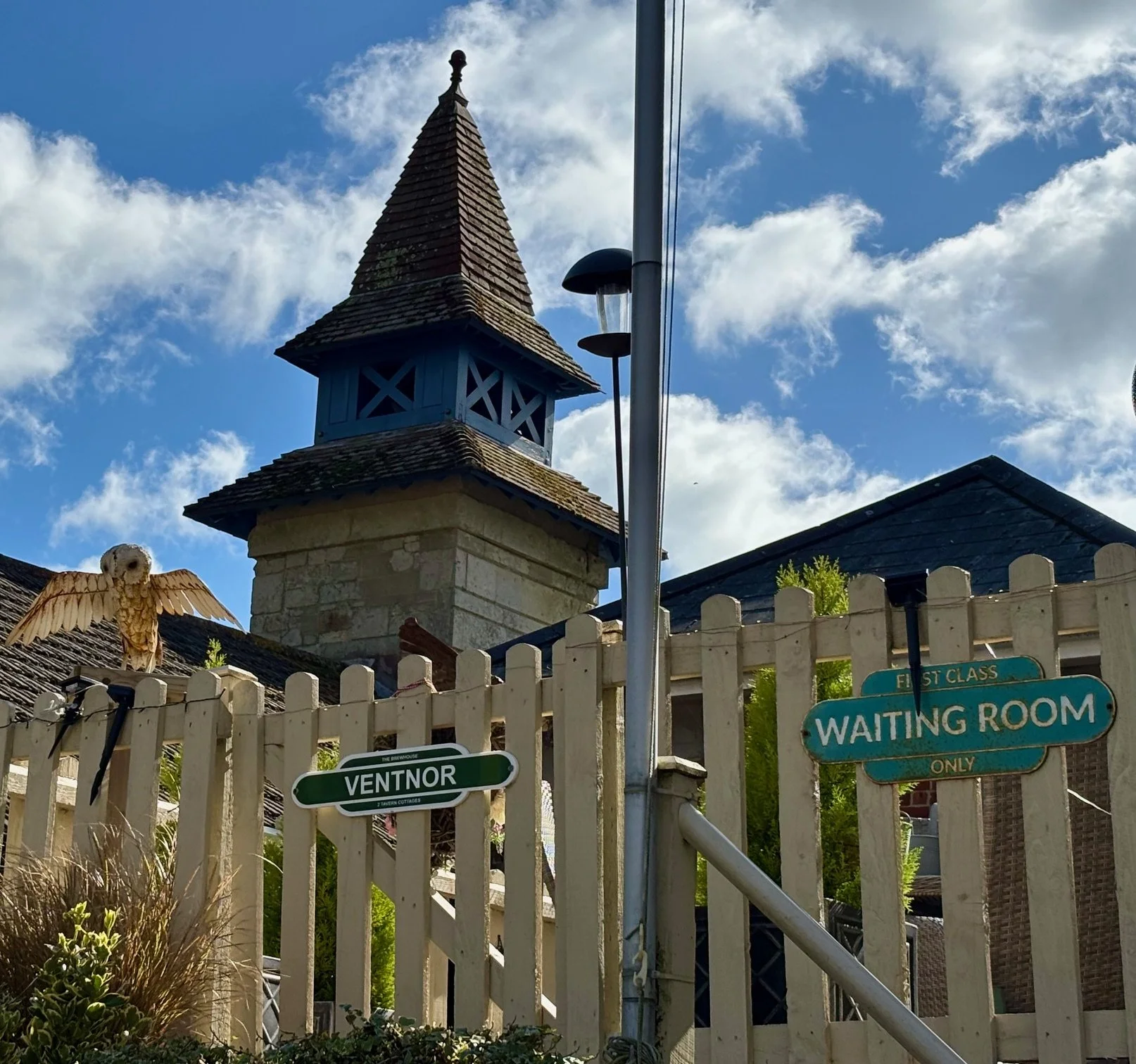
The only indication that there was once a station at Ventnor are a few signs erected by a local property owner in Old Station Road, at the entrance to the industrial estate.
Island Line: Shanklin - Ryde
From the old Ventnor Station site, I walked down into the town and caught a bus back to Shanklin Station. There, I transferred to the Island Line once again, for the 25 min return trip to Ryde Esplanade, via the reverse of the route described in detail earlier.
Later, I completed the route back to Ryde Pier Head to connect with the “Fastcat” back to Portsmouth Harbour, there to return to London courtesy of South Western Railway.
IOW Steam Railway
During the journey home, I reminisced about my previous visit to the island in the summer of 2020, when I had visited the IOW Steam Railway. On that occasion, I had caught the bus from Ryde to Wootton Station, situated at the western end of the heritage line.
This runs over part of the former route between Ryde & Cowes and started when a small group of enthusiasts formed the Wight Locomotive Society and raised funds to preserve one of the last steam locomotives, W24 Calbourne, together with a number of the remaining carriages. Then, in 1971, the Isle of Wight Railway Co. Ltd. was formed to buy the 1.5 miles of track between Wootton and Havenstreet. Eventually, the line was extended eastwards and in 1991 reached Smallbrook Junction on the Ryde – Shanklin line, where a new interchange station was built. There are stations at Wootton, Havenstreet, Ashey and Smallbrook, with the main depot and workshops at Havenstreet.
An extension of the line westwards from Wootton to Newport has been talked about, although it would be difficult to restore the full length of this as there is now a road on the site of Newport Station and houses have been built on another part of the route. However, a stretch of trackbed from Wootton to the outskirts of Newport is still free from development and perhaps could be used. Another possibility is to extend from Smallbrook Junction to Ryde St John’s Road, using one of the two tracks on this section of the Island Line.
Heritage services were due to recommence for the season soon after my visit in late March 2026 and the IOW Steam Railway website should be consulted for details.
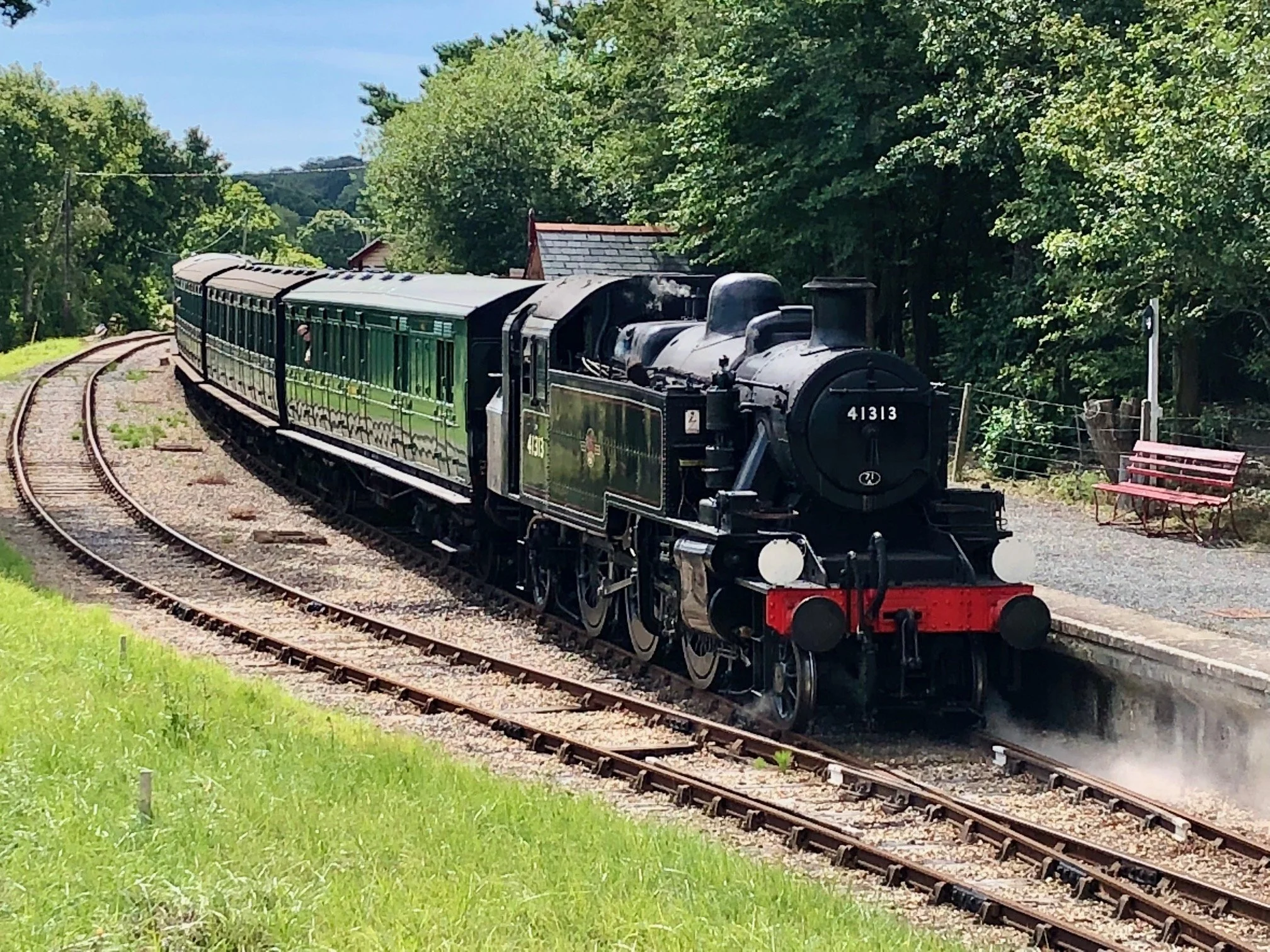
Ivatt Class 2 41313 built in 1952 was the duty steam engine when I travelled on the IOW Steam Railway in July 2020 and is seen at Wootton with its train of restored Southern carriages.
Whilst this engine is not native to the IOW, the railway has three locos, “Calbourne”, “Freshwater” & “Newport” which spent much of their life working on the island’s railways.
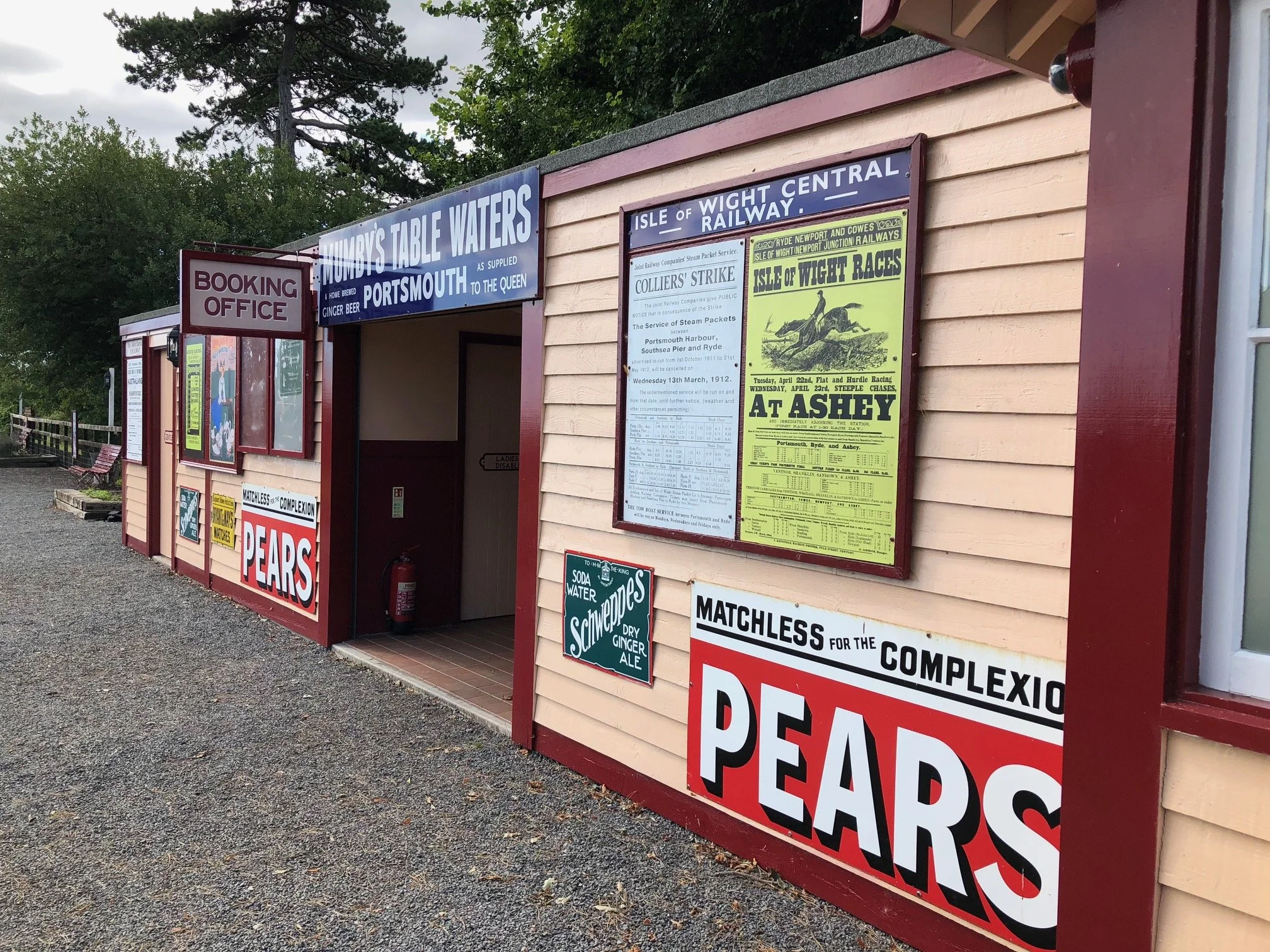
The station buildings including Booking Office at Wootton showing period posters and signs.
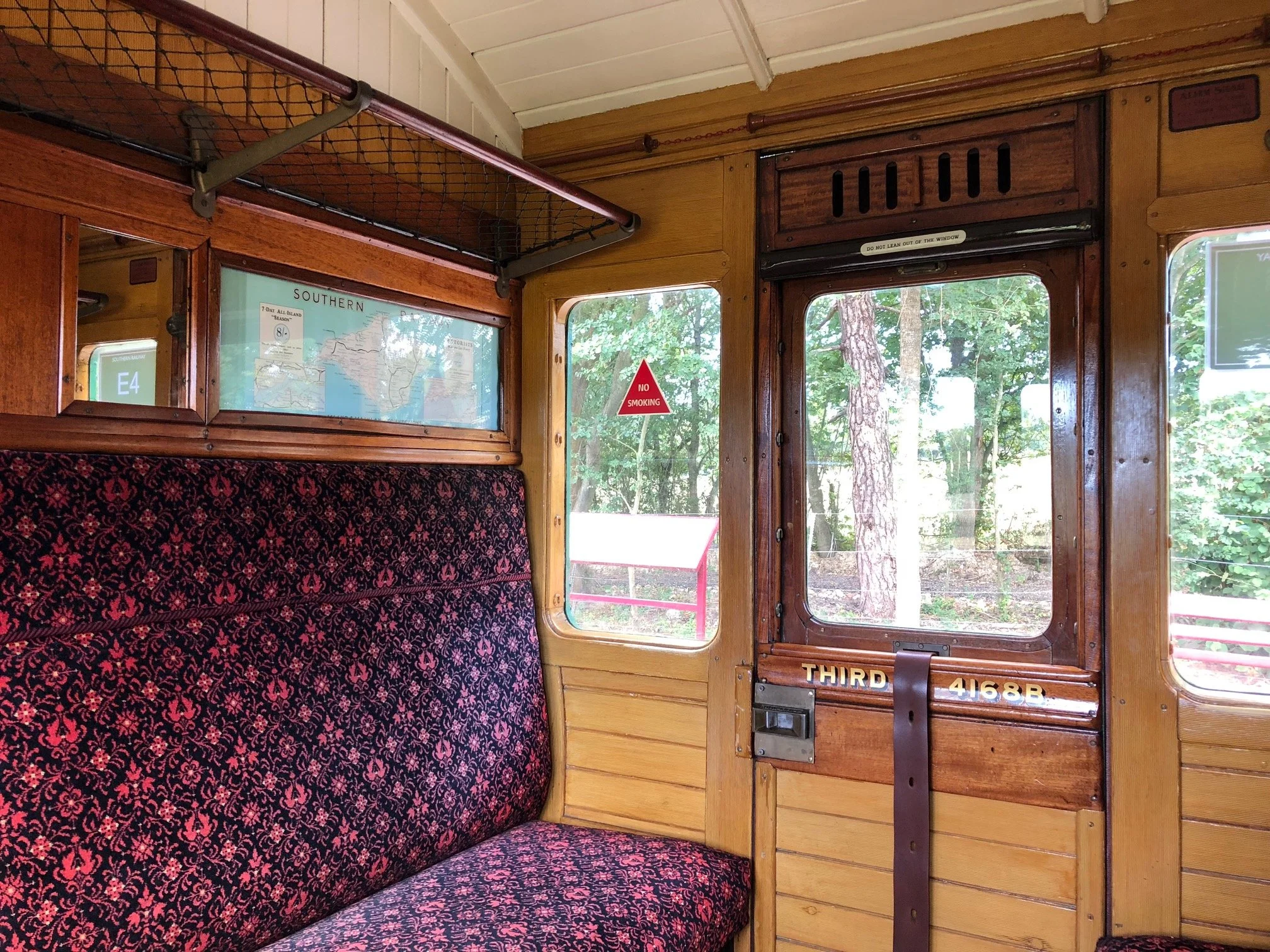
Interior of the Third Class compartment in which I travelled. Like all the rolling stock on the railway, expertly restored. Note the Southern Railway map of the island above the seat on he left.
Whilst of differing ages, all the carriages are at least 90 years old and of the type that would have run on the island.
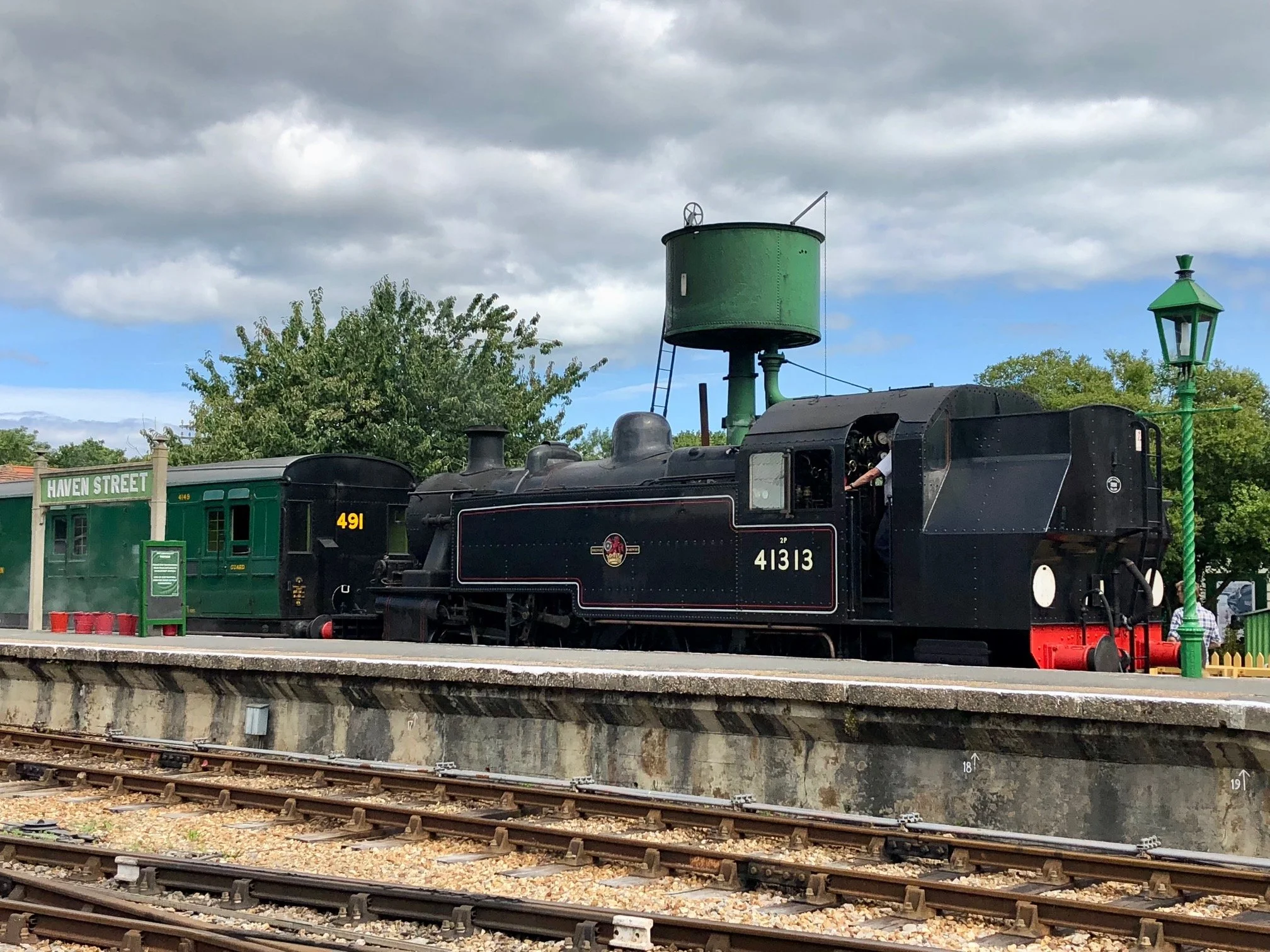
Ivatt tank engine 41313 again, seen from a different angle at Haven Street Station, where the main headquarters of the line are based.
The line is over 5 miles long and connects with the electrified Island Line at Smallbrook Junction, where a station exists purely for interchange with no road access.
1938 Tube Stock
And Finally… we began with the current D78 Underground Stock used on the Island Line, so now a quick look at the previous generation of 1938 Tube Stock which was still very much in service at the time of my previous visit in July 2020. 10 sets of these refurbished former London Underground trains operated on the island from 1989 to 2021. Classified as Class 483, they operated usually as 2 car units.
They replaced the even older “standard stock” former London Underground trains dating from 1923-34 which were used between 1967 and 1992, made up into 4 and 3 car sets designated “4-VEC” and “3-TIS” in the BR Southern Region EMU classification system, which later became Class 485 & 486.
Watton
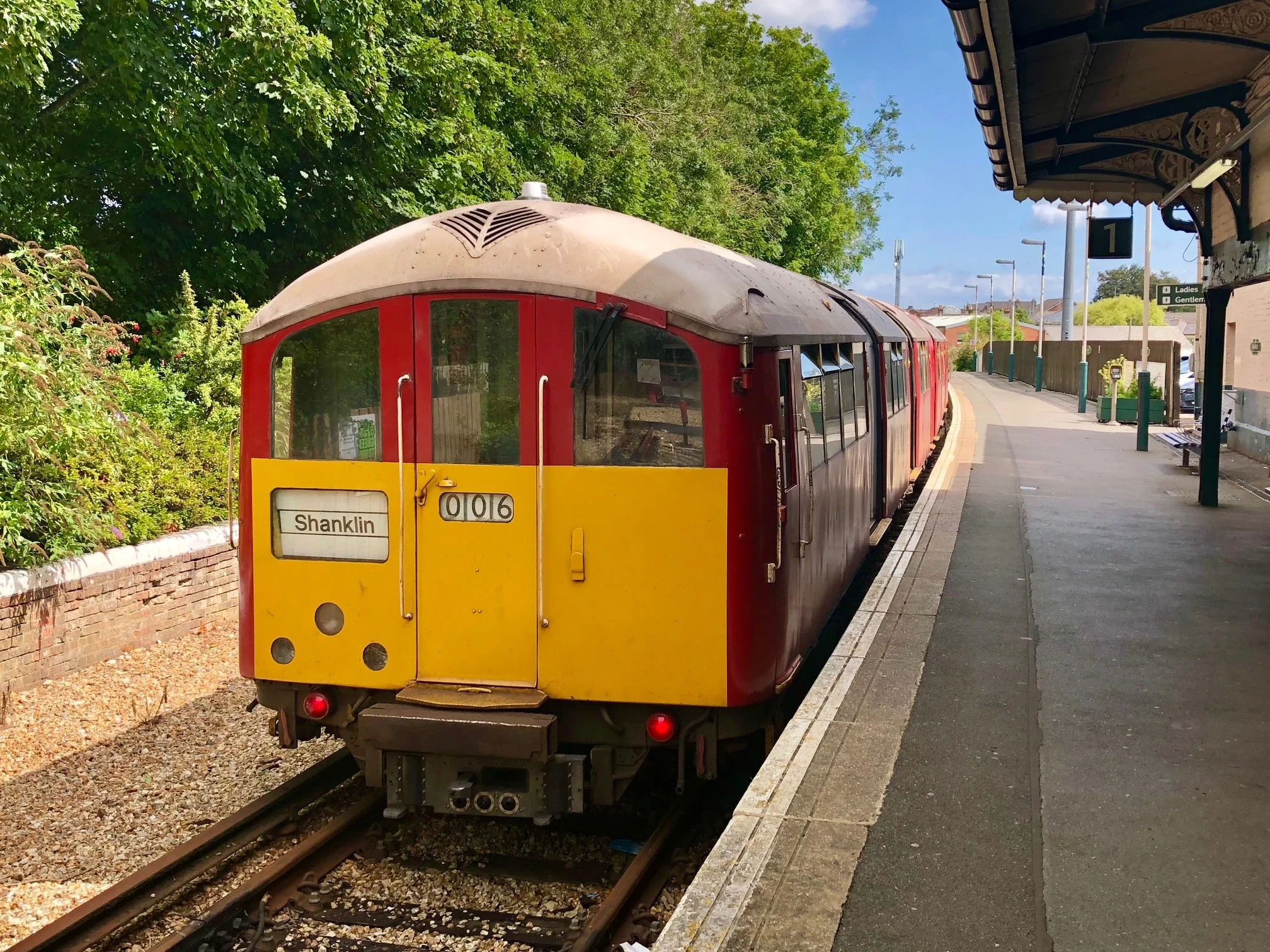
During my 2020 visit, the former 1938 Tube Stock was still in service on the Island Line. Unit 483 006 is at the buffer stops at Shanklin after a trip on it from Ryde.
These units were refurbished between 1989 & 1992 for use on the island and lasted in service until 2021, by which time they were the oldest passenger trains in regular service in Britain.
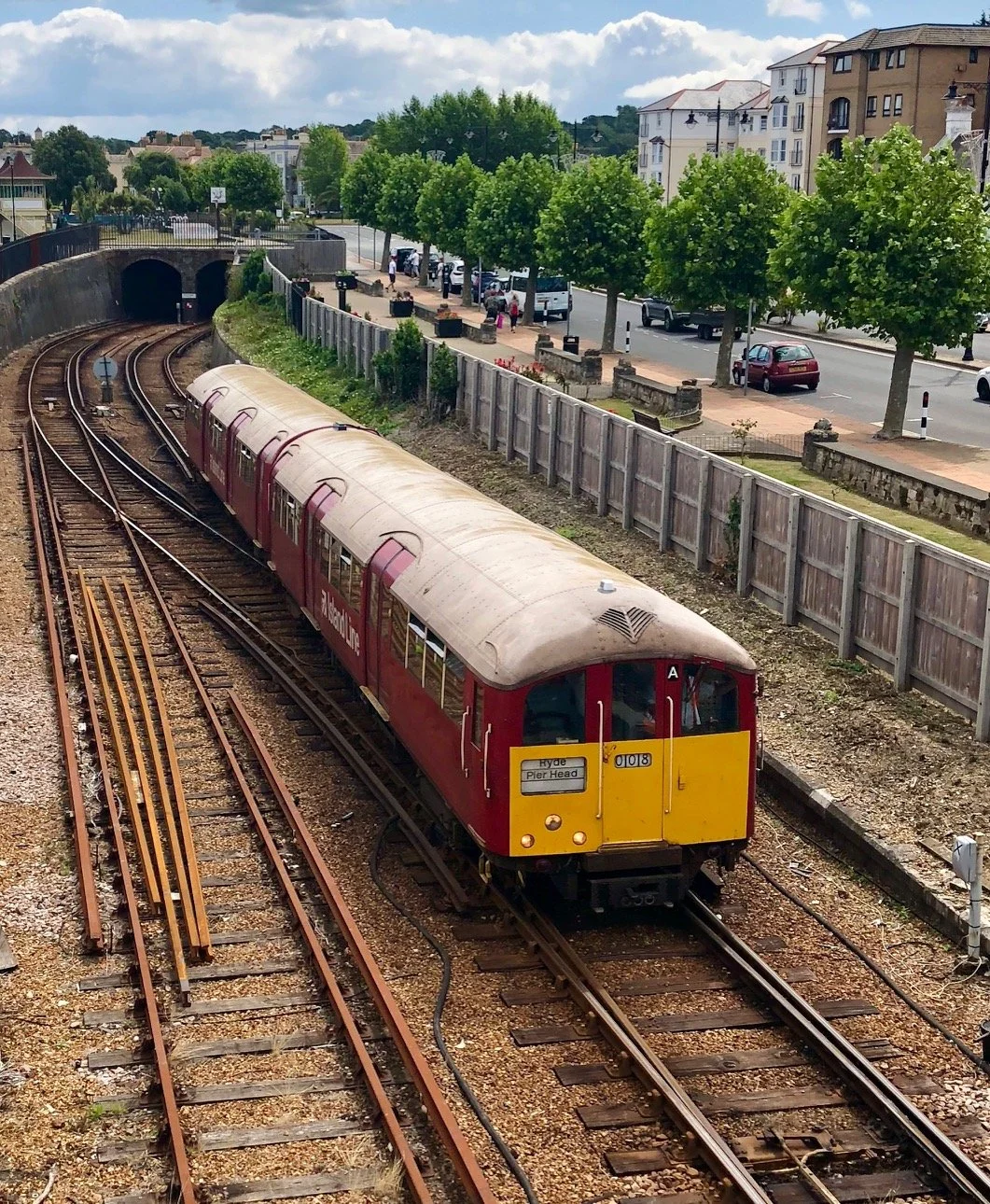
1938 Tube Stock Unit 483 008 has just emerged from Ryde Tunnel on approach to Ryde Esplanade Station during my July 2020 visit and is seen from the overbridge.
These trains carried various liveries on the island, but traditional London red was the best in my opinion. Luckily, a number have been preserved including one unit (483 007) at the IOW Steam Railway.
