
Isle of Wight - Part 1: All Diesel with Southern Vectis
A few days on the Isle of Wight saw me ride mainly Enviro400s on a selection of Southern Vectis routes, before many of these diesels are replaced by a fleet of new Wright StreetDeck Electroliners in the coming weeks and months.
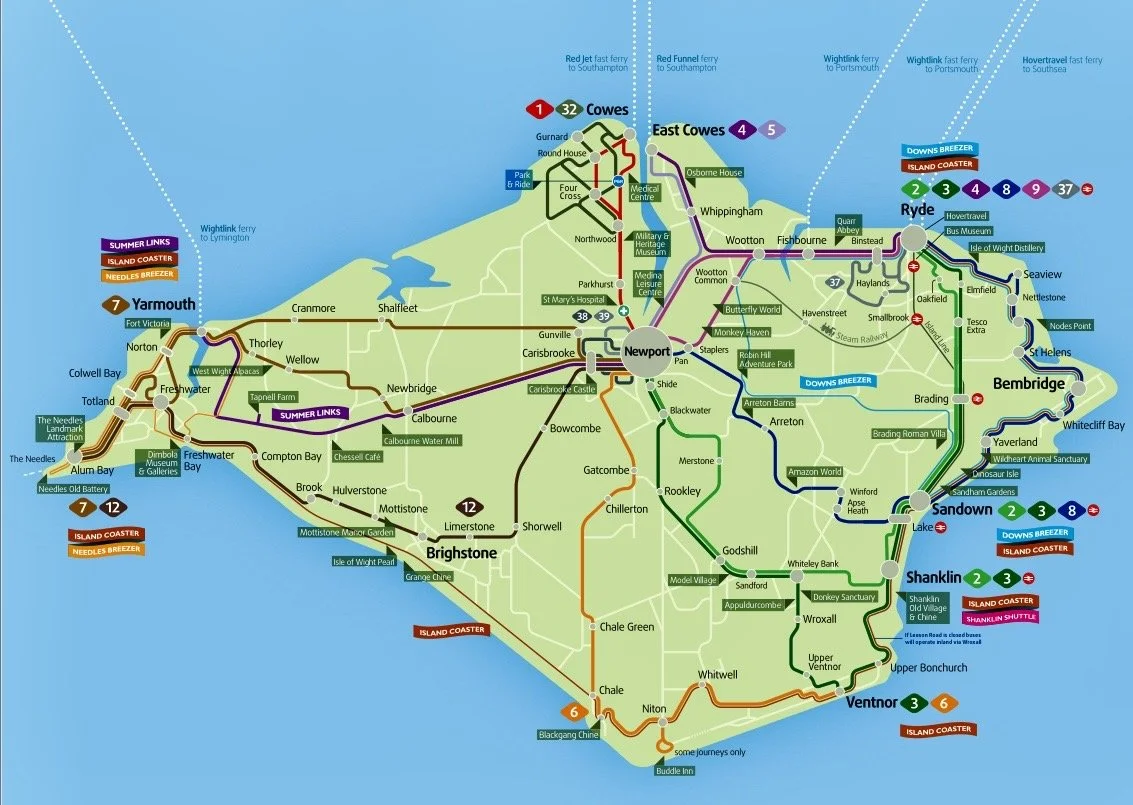
Southern Vectis Route Map showing principal routes, including the seasonal “Breezer” and “Coaster” services. Note how services radiate out from Newport, where the main depot for the company is located.
Arrival
After taking the South Western Railway train from London Waterloo to Portsmouth Harbour, I transferred to the Wightlink Ferry for the crossing to the Isle of Wight. Unfortunately, there was an initial glitch in my plans, as a track inspection near Hilsea requiring a 5mph speed restriction over the affected section caused a 12 minute late arrival at Portsmouth Harbour, which meant I missed my ferry, which was not held, so had to wait nearly an hour for the next one! I obtained the distinct impression that South Western Railway and Wightlink personnel do not cooperate as they should to maintain connections, each sticking to their departure times, without concern that many customers of one company are also customers of the other.
Luckily though, I had time in hand on my personal schedule and was able to enjoy the crossing from Portsmouth to Ryde aboard Wight Ryder 1, one of the two “FastCat” ferries new in 2009, which transport foot passengers to and from the island in 22 minutes. An Hourly service operates, increasing to every 30 mins on Summer Weekends.
At Ryde Pier Head, I transferred to the Island Line, also operated by South Western Railway, for the short hop along the pier to Ryde Esplanade. A full report on IOW trains will appear in Part 2 of this article.
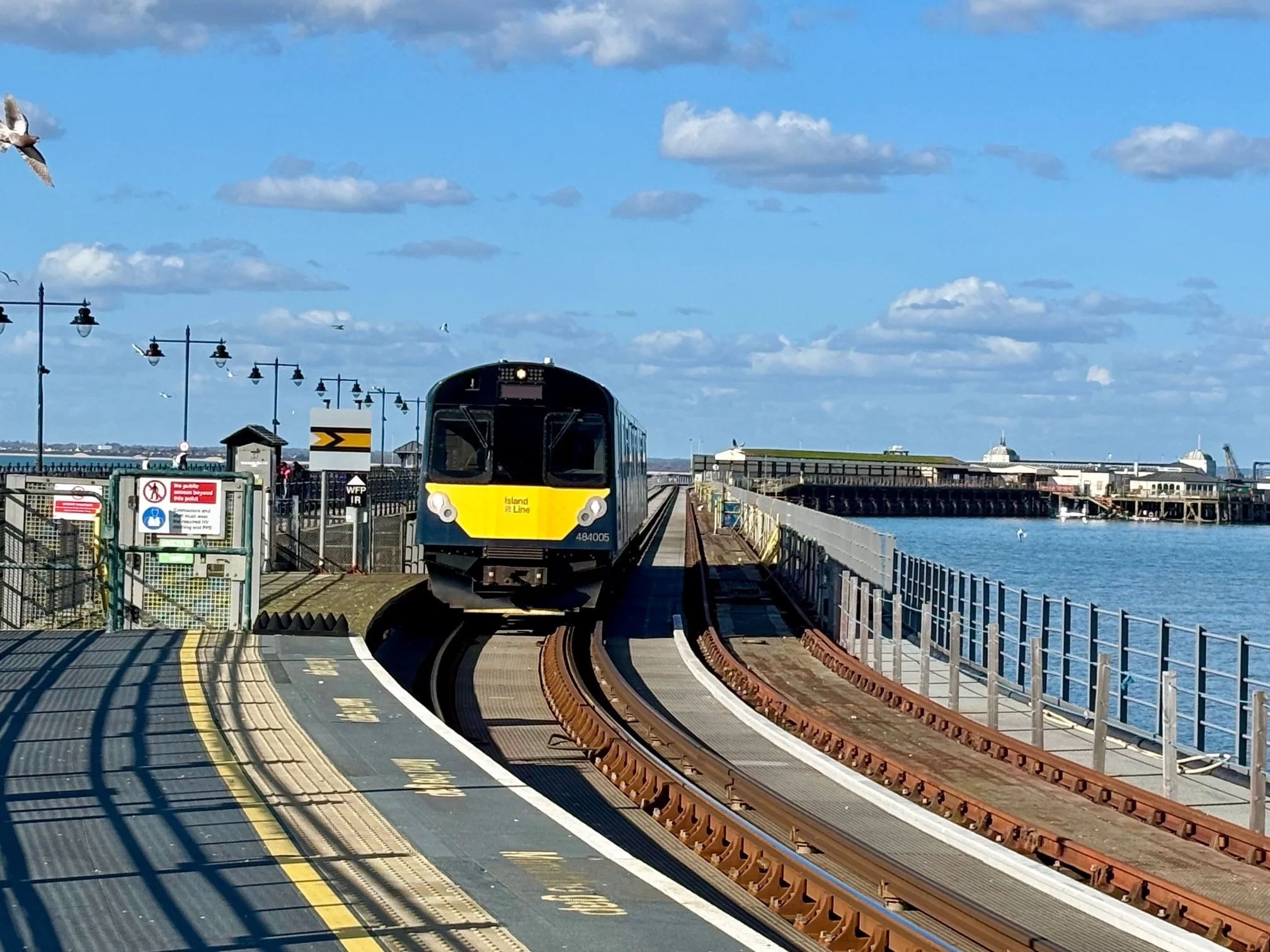
Having disembarked from the Wightlink “FastCat” at Ryde Pier Head (seen in the right background), I travelled to Ryde Esplanade aboard one of the former London Underground D78 stock trains. Unit 484 005 approaches Ryde Esplanade station.
Part 2 of this article will feature more on the Island Line together with a walk along an abandoned section of track and a ride on the IOW Steam railway during a previous visit.
Southern Vectis History
Southern Vectis is the main bus operator on the Isle of Wight. It was founded in 1921 as Dodson & Campbell, becoming the Vectis Bus Company in 1923, the title “Vectis” being the Roman name for the island. The company became “Southern Vectis” after being purchased by the Southern Railway in 1929 and later in 1969 became part of the National Bus Company. With deregulation in 1986, the business was sold in a management buyout, but in 2005 the company was acquired by the Go Ahead Group.
Recently, the company announced a big investment in new electric vehicles, with an initial 31 Wright StreetDeck Electroliners being obtained with help from the UK Government’s ZEBRA (Zero Emission Bus Regional Area) scheme and due to enter service during 2026. A further investment of 23 additional vehicles has since been added, taking the total to 54.
As a result, the reason for my trip was to sample the existing diesels in service for a final time before the majority are replaced by the incoming electrics. The current Southern Vectis fleet is highly standardised, with Enviro400s of both “classic” and MMC version predominating, although there are a few Optare Solo single deckers in service. A few “non standard” vehicles operate on the seasonal Open Top “Breezer” services, but my visit was too early in the year for these on this occasion.
In personal terms, I have visited the island many times over the years and sampled various generations of Southern Vectis buses, ranging from Bristol Lodekkas and Bristol RELL types in the 1960s/70s, through Bristol VRs and Leyland Nationals, Olympians and Dennis Darts, to the low floor era of Volvo B7TL Plaxton Presidents and Scania OmniCities in the noughties.
Southern Vectis once had several garages, but following closure of those at Freshwater, Ryde, Shanklin and Ventnor, operations are now concentrated on the main depot in Newport, from where the network now radiates out around the island, although some buses are out-stationed overnight in some locations. The former Ryde Garage is now the home of the Island Bus Museum, which organises periodic running days in historic vehicles.
Timetables
I began my bus travels at Ryde Transport Interchange, the modern Bus Station outside Ryde Esplanade Station, where a Travel Shop provides maps and leaflets, including a “Bus Times” booklet of all routes on the island. Interestingly, the Winter edition not only included the standard timetables, but also the special Christmas Day ones for 2025 that operated on 5 main routes between about 0800 and Midnight - a situation which puts London and many other places in the country to shame! The booklet also included a fold-out map of the network inside the cover, plus town plans at the back. The print-run must be enormous, as I encountered copies everywhere on the island, not just at the Ryde & Newport Travel Shops, but including libraries and even at the two hotels I stayed in during my visit!
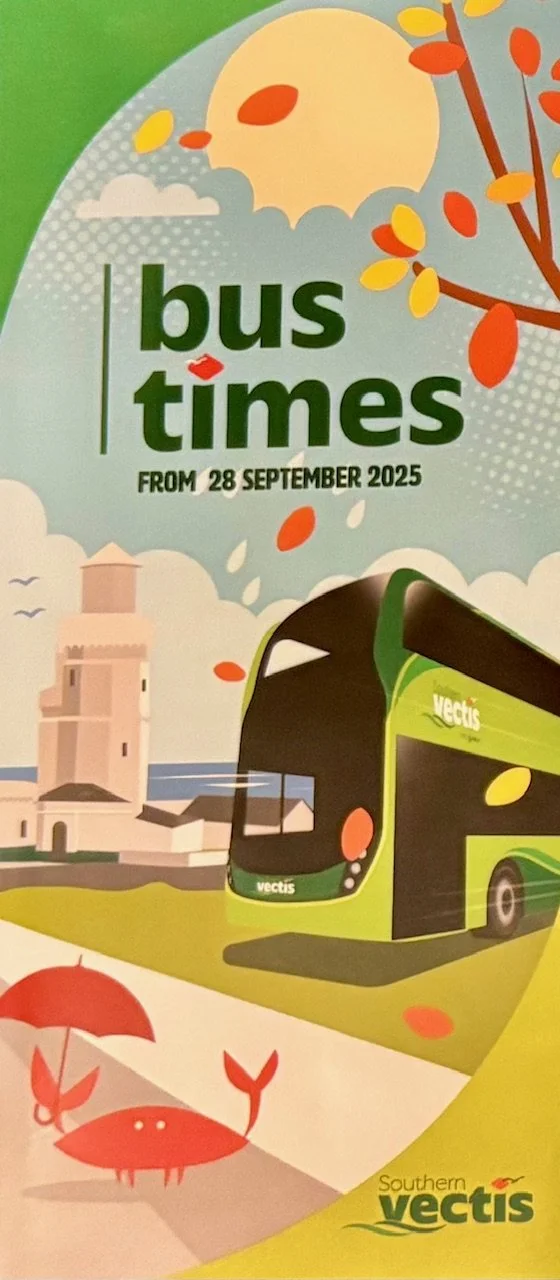
Cover of the Southern Vectis “Bus Times” booklet for Winter 2025/6. There is a fold out map of the network inside, plus town plans and full timetables for all routes, including Christmas Day services.
Copies were widely available at various outlets across the island, even hotels!
DAY 1
Route 9: Ryde - Newport via Medina
My first route was the 9, which links Ryde with the island’s “capital” Newport. A frequent 10 min service operates M-S daytimes, 15 min eves & Suns, dropping to 30 mins early & late on Suns. There are 3 Night journeys between midnight and 3AM on Fris & Sats. Oddly, whilst journeys operate alternately via Medina and Staplers on the intermediate section between Wootton & Newport, this is not distinguished on the route number by means of a suffix as might be expected (9 and 9A, perhaps?), but only by a via point on the destination display, which seemed to cause a little confusion amongst some passengers unfamiliar with the set up.
The route was mainly in the hands of Enviro400 MMCs when I travelled, but there were a couple of “classic” versions out, including fleet no 1594 which I boarded. As expected with this operator, a clean and well presented bus inside and out, with next stop announcements and screens on board. A reasonable number boarded at the various stops in Ryde Town Centre as we made our way west through the suburb of Binstead. Then the more countrified section past Quarr Abbey, which is a monastery open to the public, before passing the turn off to the Fishbourne Car Ferry. Soon, we arrived at Wootton Bridge, with its picturesque little harbour teeming with boats.
After this, the route splits, but we took the main road route out of Wootton to Whippingham and on into Newport, calling at the Medina Leisure Centre. On approach to the town, we negotiated a couple of roundabouts and new road layouts, before arriving at the Bus Station after a 30 min trip. Once again, a Travel Shop is located here, which was bristling with leaflets on local attractions plus the ubiquitous “Bus Times” booklet, whilst outside on the wall was a massive map of the island showing the bus routes and where to board them - Southern Vectis certainly know how to do publicity!
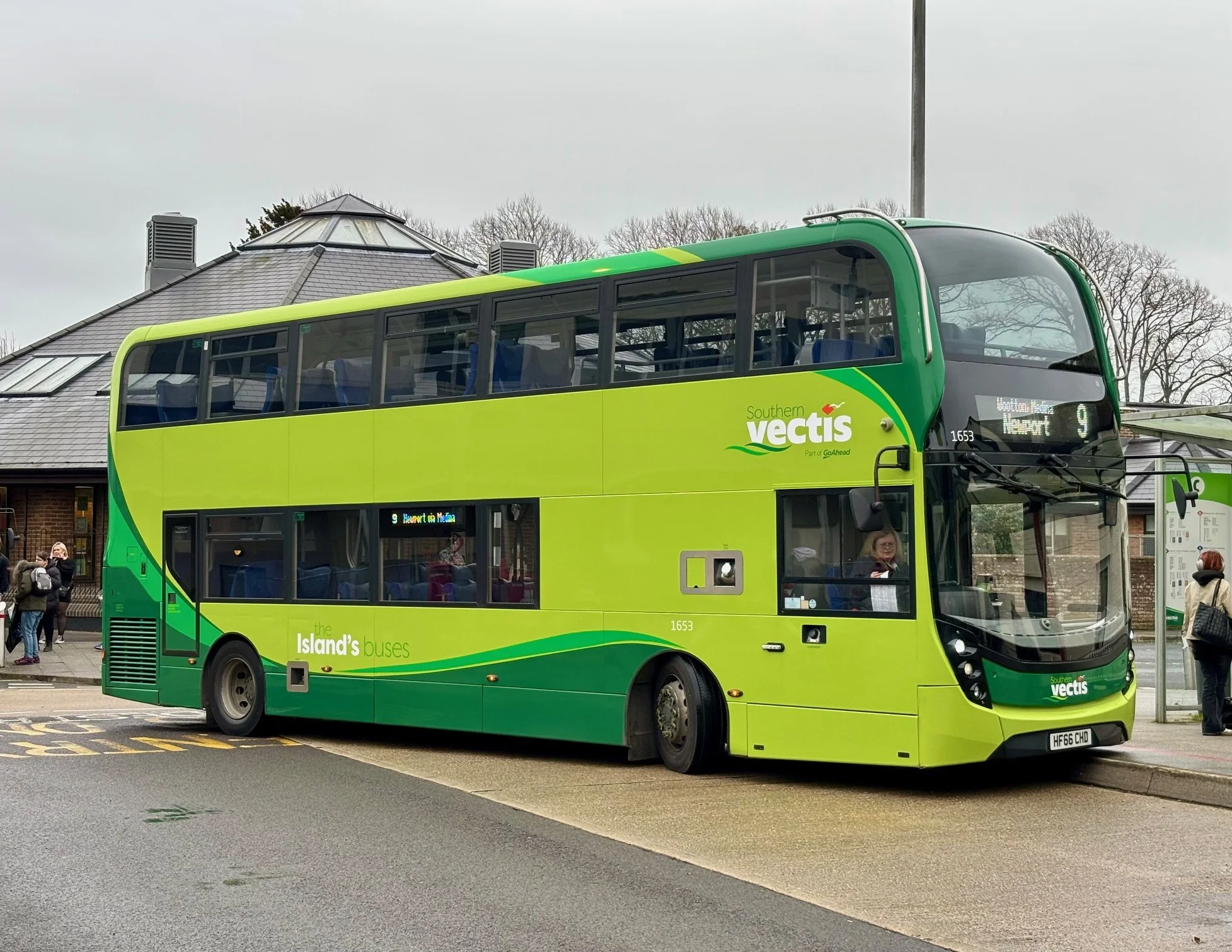
Although I travelled on a “classic” version on the 9, Enviro400 MMC 1653 at Newport Bus Station illustrates the majority fare on the route at the time of my trip.
There is much interworking of routes with Southern Vectis and this bus then moved on to Route 3 to Ryde via Ventnor.
Route 1: Newport - Cowes via Park & Ride
Next, I switched my attention to Route 1, which operates between Newport & Cowes and, like the 9, has two intermediate routes, in this case one via Cowes Park & Ride and one via Round House, again with no distinguishing suffix. Frequencies are similar to the 9, with a bus every 10 mins M-S daytimes, 15 mins eves & Suns, 30 mins early & late on Suns. There are 4 Night journeys between 0100 & 0330 on Fris & Sats only. At one time, the 1 did have suffixed variants and operated as a through service between Ryde & Cowes via Newport, although it is now split into two separate routes at Newport, the 1 and the 9.
At the time of my visit, the service was solidly Enviro400 MMC operated and I took fleet no 1742 on its next trip from Newport Bus Station. A well-used route, as it serves local schools and the large St Mary’s Hospital on its way out of town. Beyond this, we passed Parkhurst and Albany Prisons, before a short country stretch up towards Cowes. The main road here was closed northbound to normal traffic due to roadworks, but buses were allowed through the affected section which was controlled by temporary lights.
At Northwood “Horseshoe Inn”, we took the right hand fork, past the BAE Systems Factory to the small Park & Ride Car Park on the outskirts of Cowes, which is served by a double run off the nearby roundabout and produced no takers, although a couple alighted. It was then into town via the Medical Centre and suburban housing, terminating at Carvell Lane M&S Store, adjacent to the High Street. Just under half an hour for the trip. Interestingly, the M&S Store is on the site of the former Cowes Station, which was at the end of the line from Ryde to Cowes via Newport, which closed in 1966.
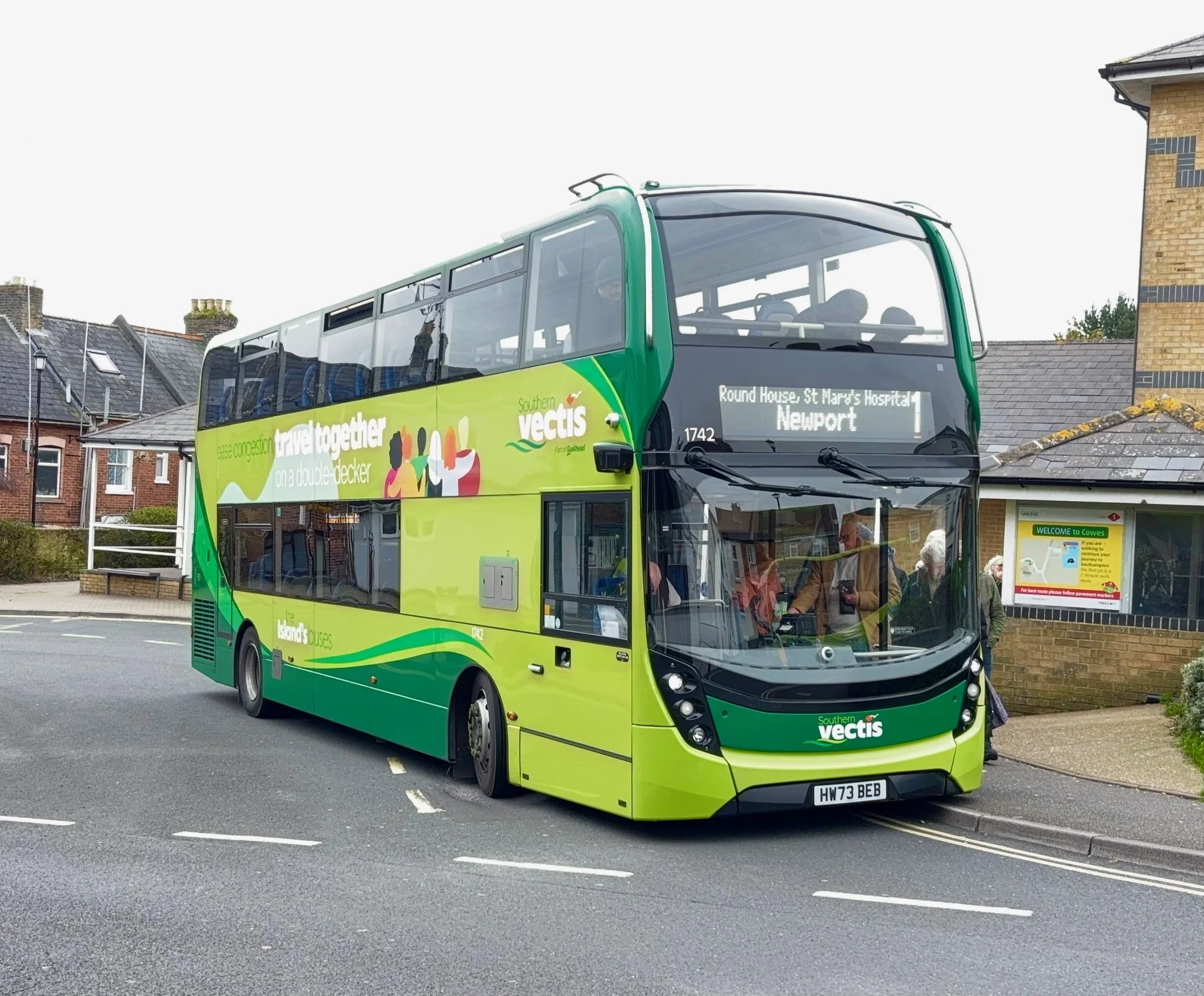
Enviro400 MMC 1742 at Cowes Carvel Lane M&S on Route 1 after I had travelled to this point from Newport on board. There are 2 variants of the 1, via Park & Ride and via Round House, this bus displaying the latter on its return trip to Newport.
Note the side branding on this example which many of this type have but was absent on the previous one illustrated on the 9.
Route 32: Cowes & Gurnard (Circular)
After a short stroll around the pleasant narrow streets of Cowes with views of boats in the harbour and the larger ferries, it was back to the bus terminus for my only single deck ride of the trip. This was on one of the small fleet of Optare Solos (no 3814) which operate on some of the less frequent services. One such is the 32, which provides just 6 trips on a couple of slightly differing circulars to the Gurnard area from Cowes on Tues, Wed, Thurs & Sats only between about 0930 and 1330.
Such a route does not seem designed to generate much custom and indeed, apart from me, only 2 other passengers boarded for the penultimate trip of the day, at the ridiculously early time of 12.20! The bus proceeded via the back streets of Cowes not served by mainstream routes, emerging onto the coast road at Egypt Point, which it followed around to the village of Gurnard, with views of ships and boats in The Solent to the right. We dropped one passenger on this section and then traversed a narrow country lane to the Round House (literally that - a circular house at a crossroads) before veering off along the aptly named Solent View Road to Gurnard Pines, where our other passenger alighted.
That was it in terms of passengers - just me and the driver, back to Northwood and the Medical Centre, before another back doubles stretch unserved by other routes, through to Carvel Lane once again. A 30 min round trip transporting mainly fresh air around Cowes. Gurnard used to have an all day service at one time, so this appears to be an example of a minimal facility being provided for shoppers, rather than an attempt to offer a useful regular link.
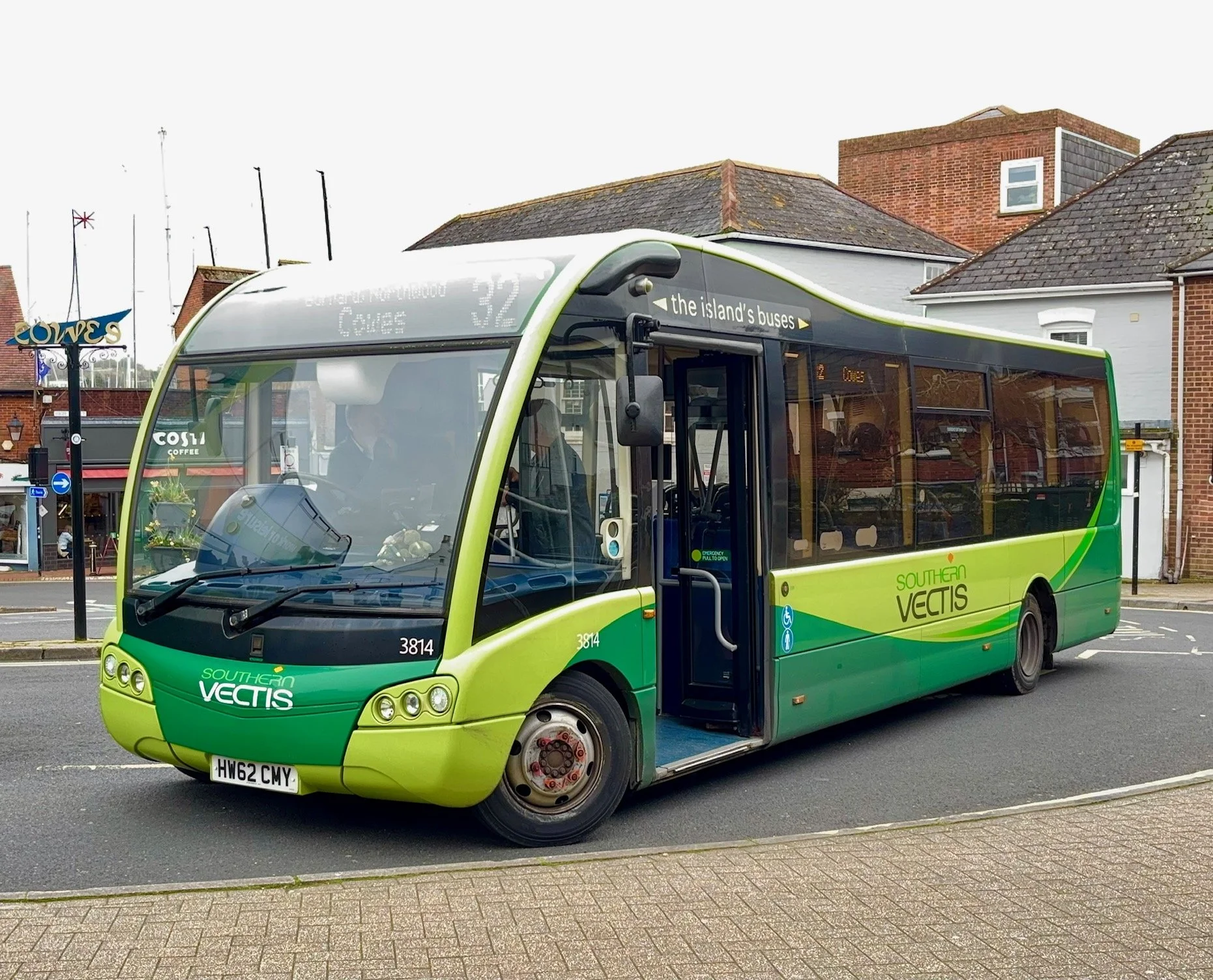
My sole single deck journey of the trip was aboard this Optare Solo, fleet no 3814, on local circular 32 between Cowes & Gurnard. Only 2 other passengers joined me on this working!
This is one of a dozen of the type with Southern Vectis, which operate mainly on the more infrequent town services, often in between school duties.
Route 1: Cowes - Newport via Round House
Back at Carvel Lane, I switched back to Route 1 for the return run to Newport, although this time taking the variant which operates via Round House. The vehicle was the same Enviro400 MMC as on the outward run, no 1742. After taking a slightly different intermediate route out of Cowes, we rejoined the main alignment at Northwood for a straight run back past Parkhurst and the Hospital into Newport. Just 25 mins in this direction for the run.
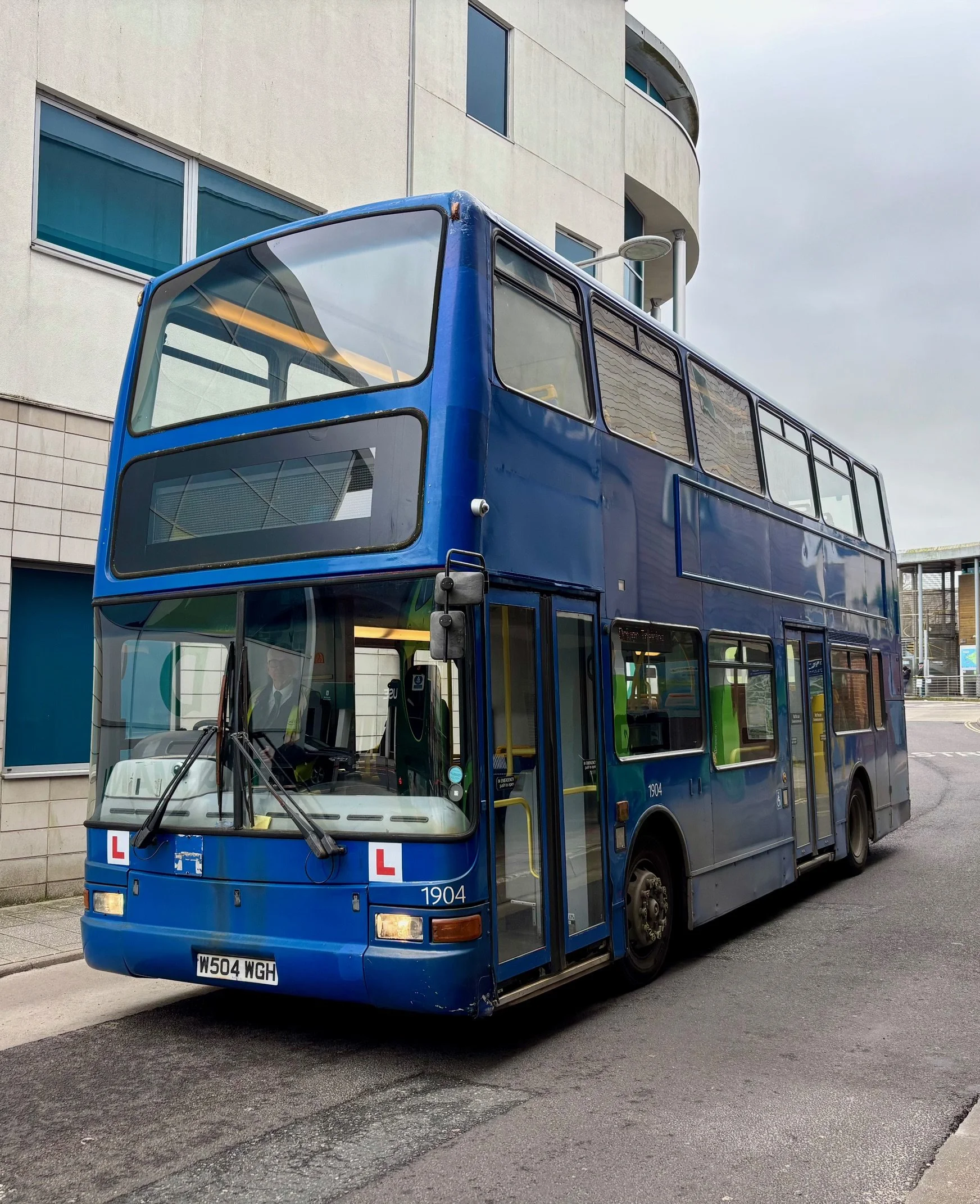
Back at Newport Bus Station, I had a surprise encounter with this Volvo B7TL Plaxton President, now fleet no 1904, but better known as former Go Ahead London PVL104.
The vehicle is in “Bluestar” livery from its time on the mainland but is now a driver trainer, although here was being used as a driver ferry bus.
Route 7: Newport - Alum Bay - Newport
After obtaining some supplies for lunch, my rides continued with a trip out to West Wight. Routes 7 & 12 operate from Newport to Alum Bay via different routes, although the former is the more frequent. Once again, as with the 9 and the 1, there are two variants to the 7, although this time not just over a short section, but over a significant part of the route between Newport & Yarmouth, as can be seen on the route map at the start of this article. A 30 min frequency operates daily during daytimes, Hourly evenings, alternately over the two routeings.
When I travelled, the 7 was the expected mix of Enviro400s including classic and MMC types, but I had fleet no 1522, one of the older version, for a run over the northern variant of the route via Shalfleet. A reasonable number joined me on the trip at Newport Bus Station, with more boarding as we made our way through the town and out towards Carisbrooke, famous for its castle which sits above the town and dates from Anglo-Saxon times, although the current building is mainly medieval. King Charles I was imprisoned there for a time prior to his execution in 1649. Today, it is run by English Heritage as a popular tourist attraction.
However, we continued through the narrow Carisbrooke High St and onwards out of the town into open countryside, finally attaining a reasonable speed over the winding roads towards the west of the island. A few passengers on and off in the small intermediate villages of Shalfleet and Cranmore, before arriving into the little town of Yarmouth, where there is a car ferry link to and from Lymington on the mainland. Pausing at the small Bus Station, we took a scheduled 5 mins “hesitation”, before continuing along the main road over the River Yar and close to Fort Victoria Country Park at Norton, before turning off down a narrow winding lane towards Freshwater, the western-most town on the island, which once had a small Southern Vectis Bus Garage, closed some years ago. Freshwater was also the terminus of a branch line railway from Newport, although services were withdrawn in 1953 and part of the trackbed is now a public bridleway.
Several of our passengers alighted in Freshwater, but we gained a few short riders through to adjacent Colwell Bay and Totland, where most got off at the War Memorial in the village. Just 3 of us continued on the country section between the downs to Alum Bay, by which time the winds which had been brewing all day were becoming ever more blustery. We terminated at the Needles Landmark Attraction after a run of 1 hour from Newport.
Alum Bay was named after the mining of alum here in the 16th Century, but became more famous in the 19th Century due to its deposits of coloured sand, which were sold in vials to holidaymakers or made into ornaments. The nearby Needles rocks and lighthouse just offshore are a famous sight, often viewed from the Needles Battery on top of the cliffs and served in season by the “Needles Breezer” Open Top bus, which I had ridden several times over the years in glorious summer weather, but not operating on this particular occasion when conditions could not have been more different!
Instead, I sheltered from the wind and drizzle as best I could for a few minutes, before reboarding 1522 for the return run to Newport the way we had come. Another 1 hour journey, with a fair number of users and a generally speedy ride across some pleasant countryside and through the small villages.
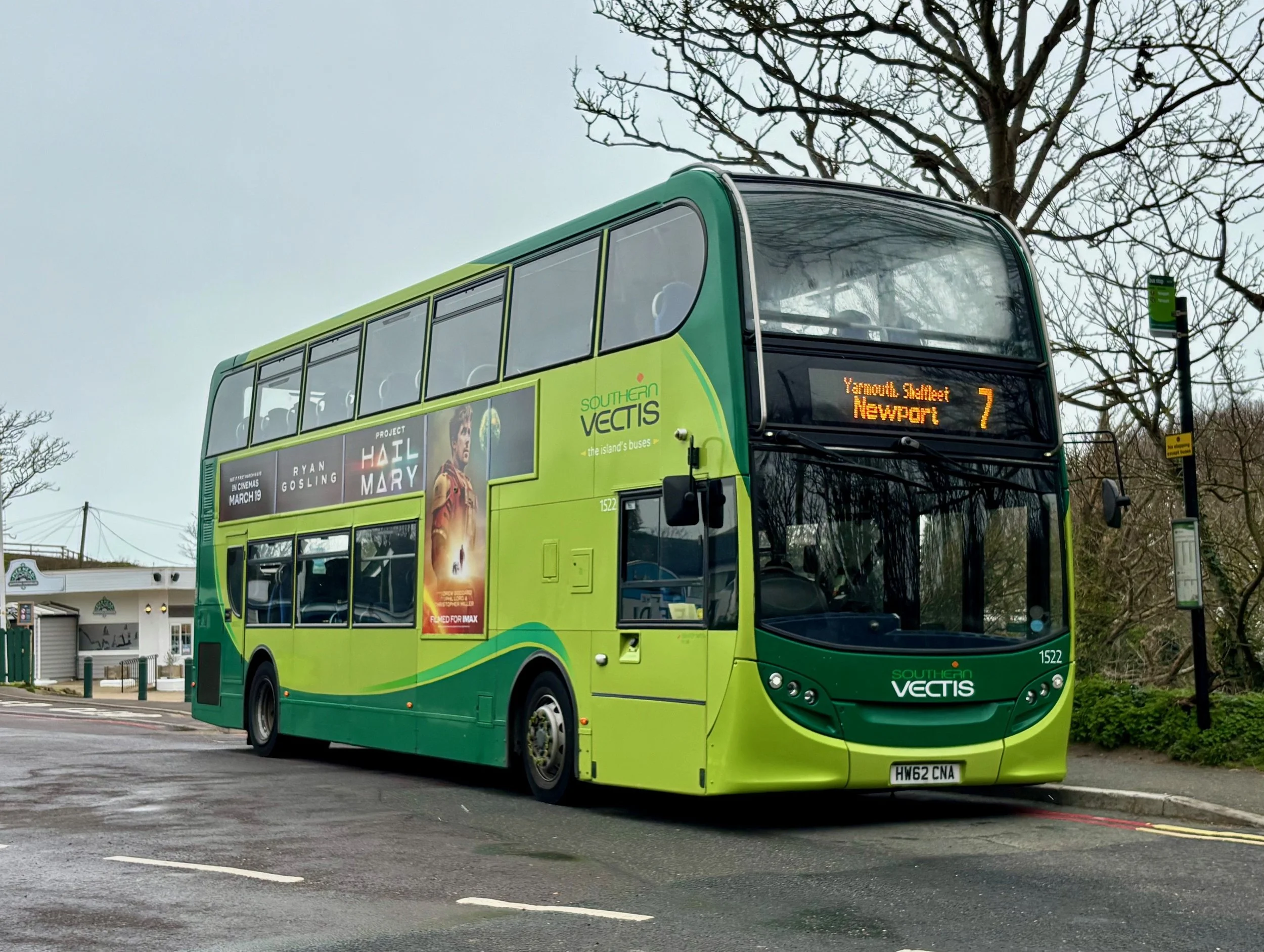
Enviro400 fleet no 1522 at a very blustery Alum Bay during my return run aboard on Route 7 from Newport. Once again, the 7 has two variants, this time between Yarmouth and Newport, one via Calbourne and one via Shalfleet, as seen here.
By my calculations, there were 37 classic Enviros in the Southern Vectis fleet at this time, most of which are likely to be replaced by the incoming electrics.
Route 5: Newport - East Cowes - Newport
Back at Newport once again, I transferred to one of the shorter routes on the island, the 5 to East Cowes. This operates every 15 mins M-S daytimes, 30 mins Sun daytimes and every 40-50 mins evenings daily.
My bus for this journey was another Enviro400, fleet no 1525. A number of returning shoppers boarded with me at the Bus Station and soon we were off eastbound out of town. For the first part of the journey, past Medina Leisure Centre and on to Whippingham Roundabout, we ran in parallel with Route 1. Then we hung a left past farmland through Whippingham, where we encountered one of the new Wright StreetDeck Electroliners on driver training duties.
Soon, we reached Osborne House, former home of Queen Victoria, Prince Albert and their family on the island, which is now a visitor attraction run by English Heritage and where a couple of tourists alighted. However, I continued into the outskirts of East Cowes, where we turned off the main road via Victoria Grove & Adelaide Grove through housing, down to the terminus at Waitrose, close to the car ferry. In addition, there is a “floating bridge” between East Cowes & Cowes, effectively a chain ferry, which conveys vehicles, bikes and foot passengers across the river estuary between the two places.
I remained on the bus for the return run after the 5 min break, retracing my steps back to Newport via the reverse of the outward route, 25 mins each way.
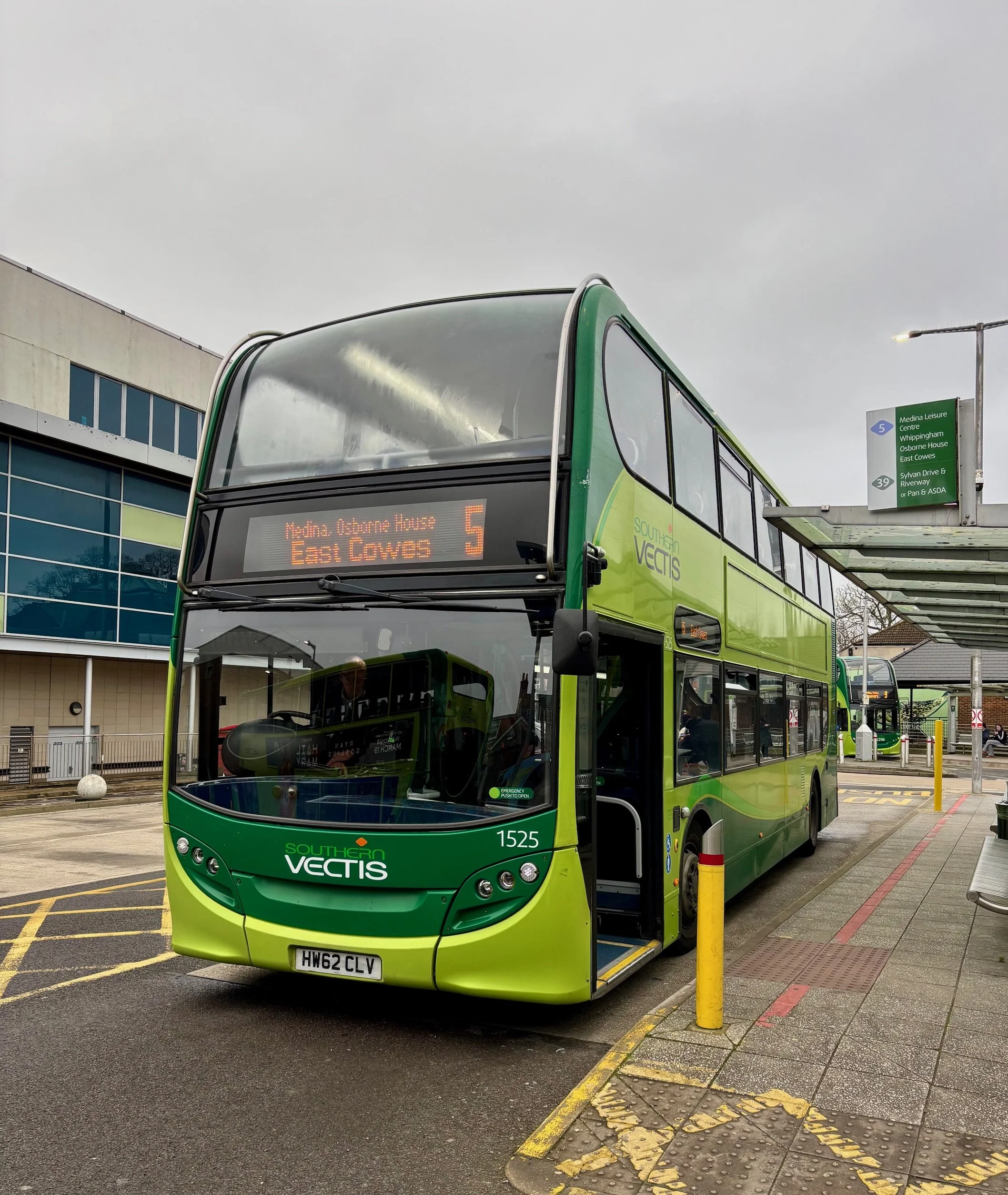
Enviro400 1525 prepares for a journey to East Cowes on Route 5 at Newport Bus Station. I did a round trip aboard.
A sister Enviro400 can be glimpsed in the background on Route 9 to Ryde.
Route 38: Newport & Carisbrooke (Circular)
To end the day, there was just time to squeeze in a quick round trip on Newport Local Circular Route 38. This is normally double deck operated, but the passengers on the trip I took could have fitted into a Solo! Enviro400 no 1595 formed the next departure on the route, which was the penultimate trip of the day. The 38 operates with 1 bus on a 30 min frequency between about 0730-1800 M-S and 0930-1800 on Sun. Buses interwork from other services, so it is not the same bus all day.
We set off through the town, taking the Carisbrooke Road at first, but then turning off via housing estate roads, serving Christ The King College, Carisbrooke College and Carisbrooke Retail Park. Then it was back into Carisbrooke High Street, before swinging right up Cedar Hill, calling at the bottom of Castle Hill for the nearest stop to Carisbrooke Castle. From here, we picked up a handful of inbound passengers on Whitepit Lane, Shide Road and Medina Avenue, with a few hairy moments as we squeezed along the narrow streets between parked cars.
Just 25 mins for the circuit, after which I made my way to my hotel for the night.
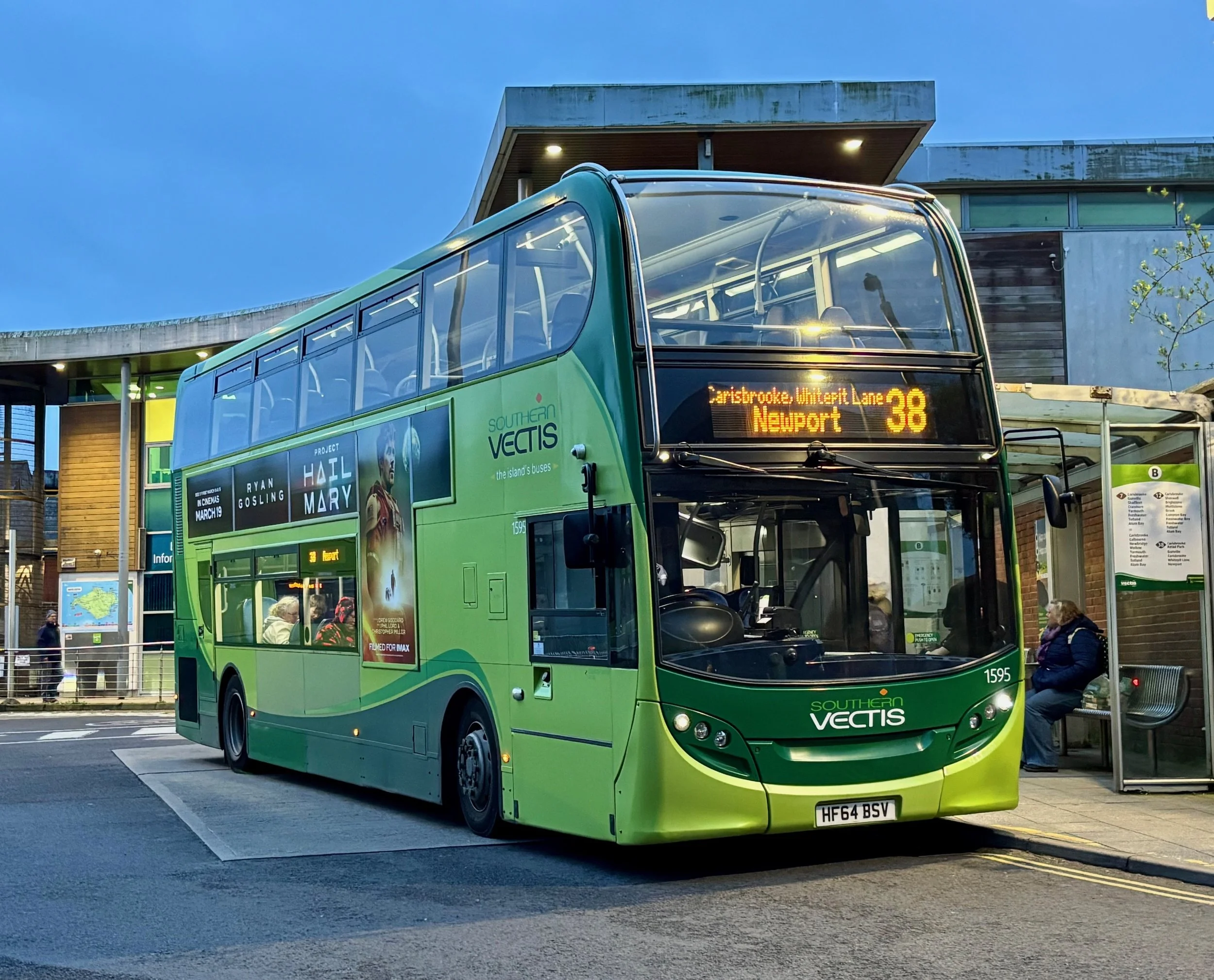
My final ride on Day 1 was a quick spin on Newport Local Route 38, which operates as a circular via Carisbrooke. Enviro400 1595 was the vehicle and is seen at the Bus Station as dusk falls.
In the left background, the large route map of the island can be seen on the Travel Shop wall.
DAY 2
Route 8: Newport - Ryde via Sandown & Bembridge
After a delicious Full English Breakfast, I returned to Newport Bus Station on a brighter day to resume my bus rides. Having concentrated on the north and west sides on Day 1, the intention was to visit the east and south sides on Day 2.
First route of the day was the 8, one of the longer ones, which operates through the centre of the island to Sandown and then around the coast via Bembridge to Ryde. An Hourly frequency applies Daily during daytimes, 2 Hourly Sun eves. Additional shorts between Newport & Sandown on M-S daytimes provide a 30 min service over this section.
The usual mixed bag of Enviros was out and I hopped on no 1593 with a few others. At first, we were essentially a town service, running east through the Pan Estate, before reaching open country at Staplers. We then made our way through the rural centre part of the island along winding roads in company with sheep, cows and horses at various points. The first significant settlement reached was the village of Arreton, where we had views of nearby Arreton Manor, a Jacobean manor house once open to the public but now a private residence although offering accommodation in its guest rooms. Beyond this, we continued along lanes to Amazon World, an out of town zoo where we dropped a handful of employees. Then on through Winford where we described a difficult right turn of almost 180 degrees on a hill with a blind corner, with the adjacent Bus Stop named appropriately “Hairpin Bend”. Joining the main road at Apse Heath, we soon came abruptly back into civilisation at Lake Morrisons, roughly half way between Shanklin and Sandown. A short way further on, we arrived into Sandown Town Centre, with a 5 min hesitation at Victoria Road, enabling a brief stretch of the legs.
Then we were off once again, passing along the sea front serving the Boating Lake, Dinosaur Isle and Wildheart Animal Sanctuary, all of which were deserted at this time of year, although there were various hardy souls walking along the beach. Making our way up the hill out of Sandown, we twisted and turned around the narrow roads through Yaverland and Whitecliff Bay on to the town of Bembridge. After looping around the estate roads in the Crossway area, we continued through town to the High Street and on to Bembridge Harbour, close to the old station which was once the terminus of a branch from Brading, another which closed many years ago in 1953 and now the site of a new development. As we circled around the pleasant little harbour, we passed various boat repairers, houseboats and the yacht club. Coming into the adjacent settlement of St Helens, we called at the old station site, before moving uphill to the village green.
From here, it was through more open country, picking up a few holidaymakers with suitcases at Nodes Point Holiday Park, then on to Nettlestone before looping around the suburban streets of Seaview, where we gained a large number of passengers. The final approach to Ryde was via St John’s Hill, St John’s Road Station and into the town centre, before finally terminating at the Interchange. Total journey time - 1hr50m.
I have to say that the choice of running extra shorts over the Newport - Sandown section of the 8 appeared odd, as the Bembridge - Ryde section seemed to be the busiest and would benefit more from a half hourly service - the basic hourly all day frequency being a bit stingy in my opinion. However, the number 8 did bring back memories for me, as I recall riding it way back during the days when it was crew operated with Bristol Lodekkas and ran from Shanklin to Ryde via Sandown and Bembridge.
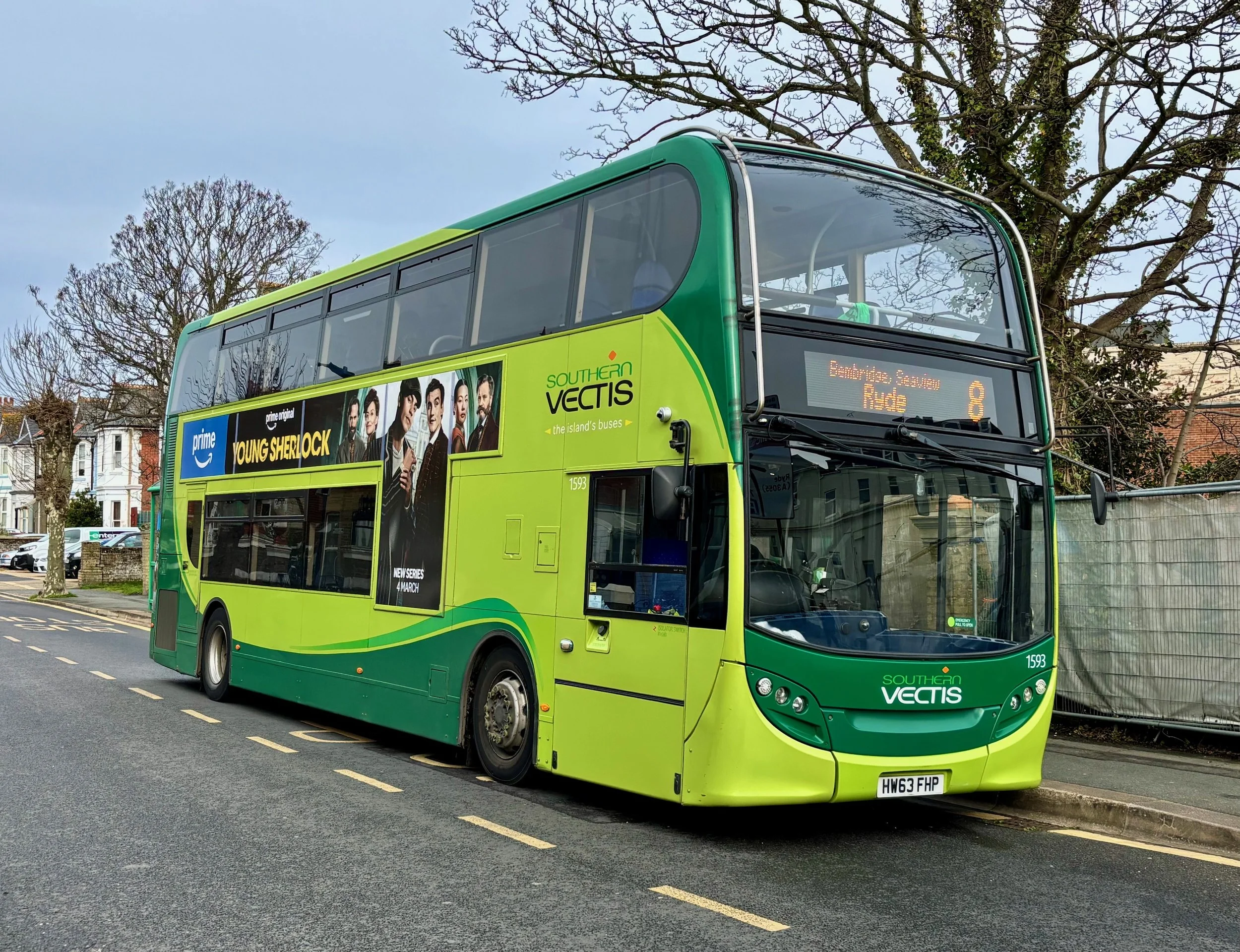
Enviro400 1593 is seen at Sandown Victoria Road during its 5 minute “hesitation” at this point whilst on Route 8 to Ryde.
I rode this bus from Newport to Ryde via Sandown and Bembridge.
Route 37: Ryde & Binstead (Circular)
Whilst in Ryde, there was time for another short local service, this time the 37, which like the 38 in Newport, operates on a one way loop basis. An Hourly service runs M-S daytimes only with departures between about 0800 and 1700. Buses were interworking with Service 4 (Ryde - East Cowes), there being 2 vehicles operating on each route alternately, an inbound 4 becoming an outbound 37 at Ryde Interchange and vice versa.
I joined Enviro400 1587 at the Interchange on its next circuit of the 37, another route on which the clientele could have easily fitted into a single decker at the time of day I travelled, mid morning. Basically, a service of three parts - firstly, a town section to the Haylands area, followed by a sweep around the country lanes to the south passing various farms, then another town segment from the Binstead area back into Ryde. Users on and off in ones and twos, but not that busy. 45 mins for the circular tour.
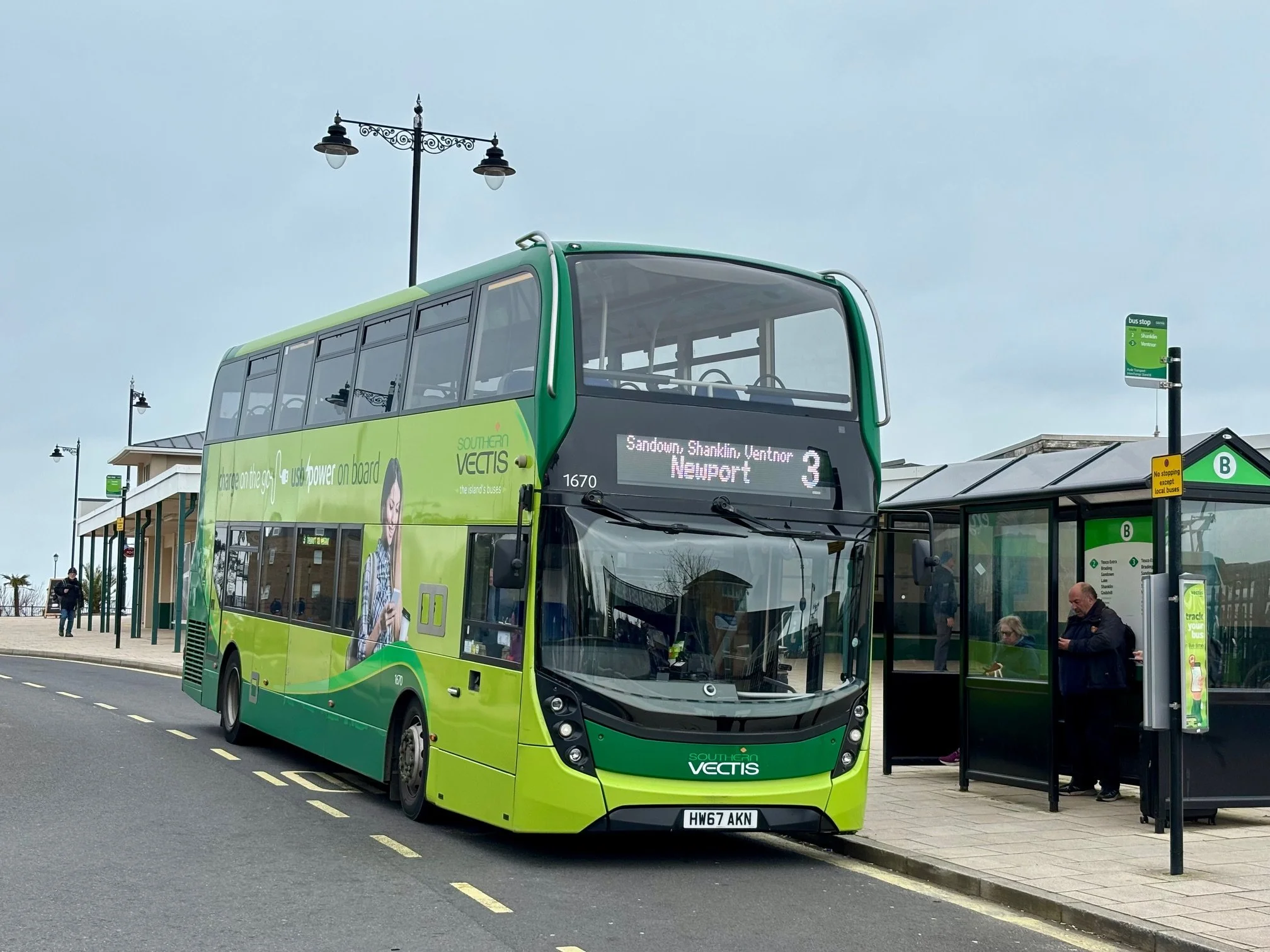
Enviro400 MMC 1670 is at Ryde Interchange before setting out on its Route 3 journey to Newport the long way round via Sandown, Shanklin and Ventnor. I rode sister vehicle 1664 over this route.
Back in the day, the famous Route 16 covered the Ryde - Ventnor section, with some journeys running on to Blackgang Chine.
Route 3: Ryde - Newport via Sandown, Shanklin & Ventnor
Next on the agenda, my longest route of the visit, the 3, which runs along the eastern side of the island between Ryde, Sandown, Shanklin and Ventnor, essentially over the former Route 16 which covered this corridor, before doubling back on itself inland via Wroxall and Godshill to Newport. A basic 30 min service operates Daily, with some longer gaps early and late in the day. There are 3 Night departures on Fris & Sats between Midnight and 03.00 from each end. Together with Route 2, which parallels the 3 between Ryde & Shanklin (apart from a slightly different intermediate routeing in Ryde) then runs direct to Newport, a joint 15 min frequency applies over the common section. This time, I had an Enviro400 MMC, no 1664, and positioned myself in the front seat upstairs.
From Ryde Esplanade, we made our way through the town via St John’s Road, with a quick view of the nearby IOW Bus Museum, formerly the Southern Vectis Bus Garage and beside which a few vehicles are still outstationed. Then via the Elmfield area onto the Brading Road, diverging briefly to serve the Tesco Extra Superstore on the edge of Ryde, where we met another new Wright StreetDeck Electroliner on driver training. From here, the route entered a country section through to the little town of Brading, which has a station on the Island Line and a picturesque narrow main street. The stop at Brading Bull Ring recalls the site where a chained bull would be baited by dogs in past centuries. Further on, we passed close to Brading Roman Villa, which remains have been extensively restored and is open to visitors.
After Brading, it was but a short hop to the next town of Sandown, which I had been through earlier in the day on the 8. This time, we continued along the High Street and through the suburban sprawl of Lake, where we were delayed a few minutes due to temporary lights. Arriving into Shanklin, we called at the station (southern terminus of the Island Line) and then the Bus Station, which these days is a few stops around a supermarket, which now occupies the site of the old Bus Station and former Southern Vectis Garage. A passenger exchange and then we continued onto probably the nicest part of the route, via Shanklin Old Village with its thatched cottages, pubs and restaurants, and onto the winding coast road to Ventnor. This is very hilly in parts, with glimpses of the sea and plenty of trees and greenery all around. Soon, we entered Upper Bonchurch, a short walk from Bonchurch Village below which has picturesque litle houses, a nice pond and the small Norman Church of St Boniface. Then it was into Ventnor Town Centre, which we looped around, passing the small former Southern Vectis Garage, still there but empty and chained shut despite various attempts to redevelop the site over the years which have all fallen through. This reminded me of family holidays here as a child when we took trips aboard Bristol Lodekkas on Route 16 out to Niton and Blackgang Chine.
At the timing point of Ventnor Boots, our few minutes of late running was briefly made up, as we didn’t take the scheduled hesitation and left immediately bang on time once again. However, the expected run past Ventnor Old Station and on via the village of Wroxall didn’t happen, as the road was closed for roadworks between Wroxall and Whiteley Bank. The diversion route was therefore back the way we had come (!) through Upper Bonchurch and back to Shanklin, where we turned left along Victoria Avenue following the 2 route to Whiteley Bank Cross Roads, where we regained line of route. Our driver did very well to lose only 5 mins on the long diversionary route. Interestingly, a temporary shuttle service was in operation between Ventor and Wroxall Church using a double decker at 30 min intervals during the roadworks, which I saw in Ventnor displaying “Shuttle Service” in the route number / destination box.
Back on the official route, our 3 continued through the centre of the island, the next major port of call being the scenic village of Godshill. This has won the title of “Prettiest Village on the IOW” on several occasions and is famous for its thatched cottages, pubs and restaurants, gift shops, model village and medieval church on the hill. All of which seemed fairly deserted at this time of year - a stark contrast with the tourist hordes that often overrun it in summer! Beyond Godshill, we continued through the lanes to the villages of Rookley and Blackwater, before finally entering the suburbs of Newport and being brought back to reality by a double run to serve the ASDA store on the edge of town. Finally, we came into Newport Town Centre, arriving at the Bus Station after a lengthy run of 1h55m - but dead on time - a credit to our driver given the traffic hazards on the journey.
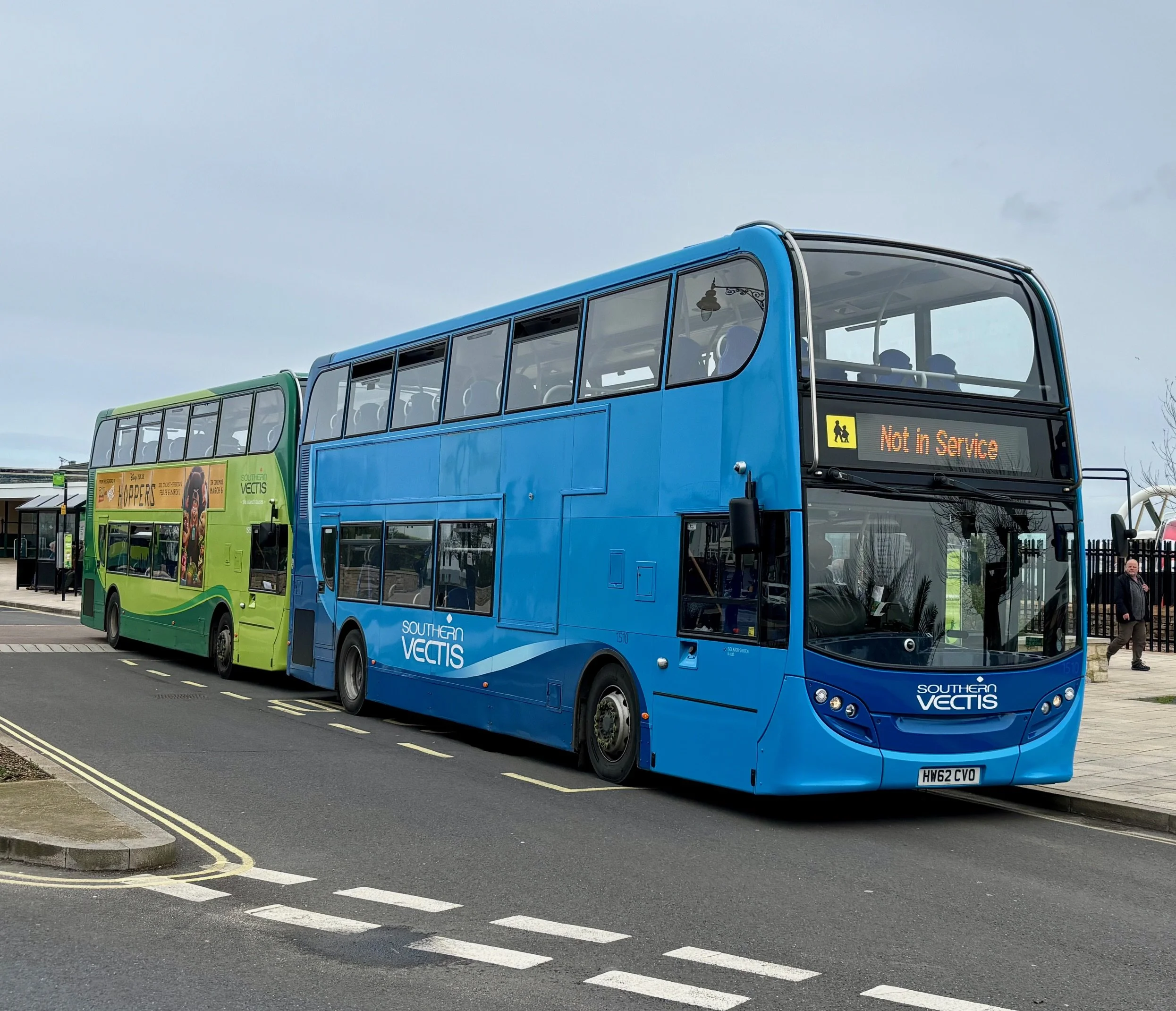
A handful of vehicles are in “Vectis Blue” livery, including Enviro400 fleet no 1510, seen here between school duties at Ryde Interchange, parked up with a fellow Enviro in standard livery.
Route 9: Newport - Ryde via Staplers
The afternoon saw me return to Ryde, but this time along the direct number 9 route, although in contrast to my westbound trip the day before, I chose the other variant via Staplers. Once again, I was lucky to have a traditional Enviro400, no 1522, which I had ridden the day before on the 7 to Alum Bay.
This version of the 9 departs Newport via Staplers Road and the Barton area of town, before reaching open country and serving a number of attractions including Monkey Haven, Butterfly World and Wootton Bridge Station on the IOW Steam Railway, which was closed but which I had ridden on my previous visit in 2020. Rejoining the other leg of the 9 at Wootton, we continued on to Ryde via Fishbourne & Binstead, taking just 30 mins overall for the well used trip.
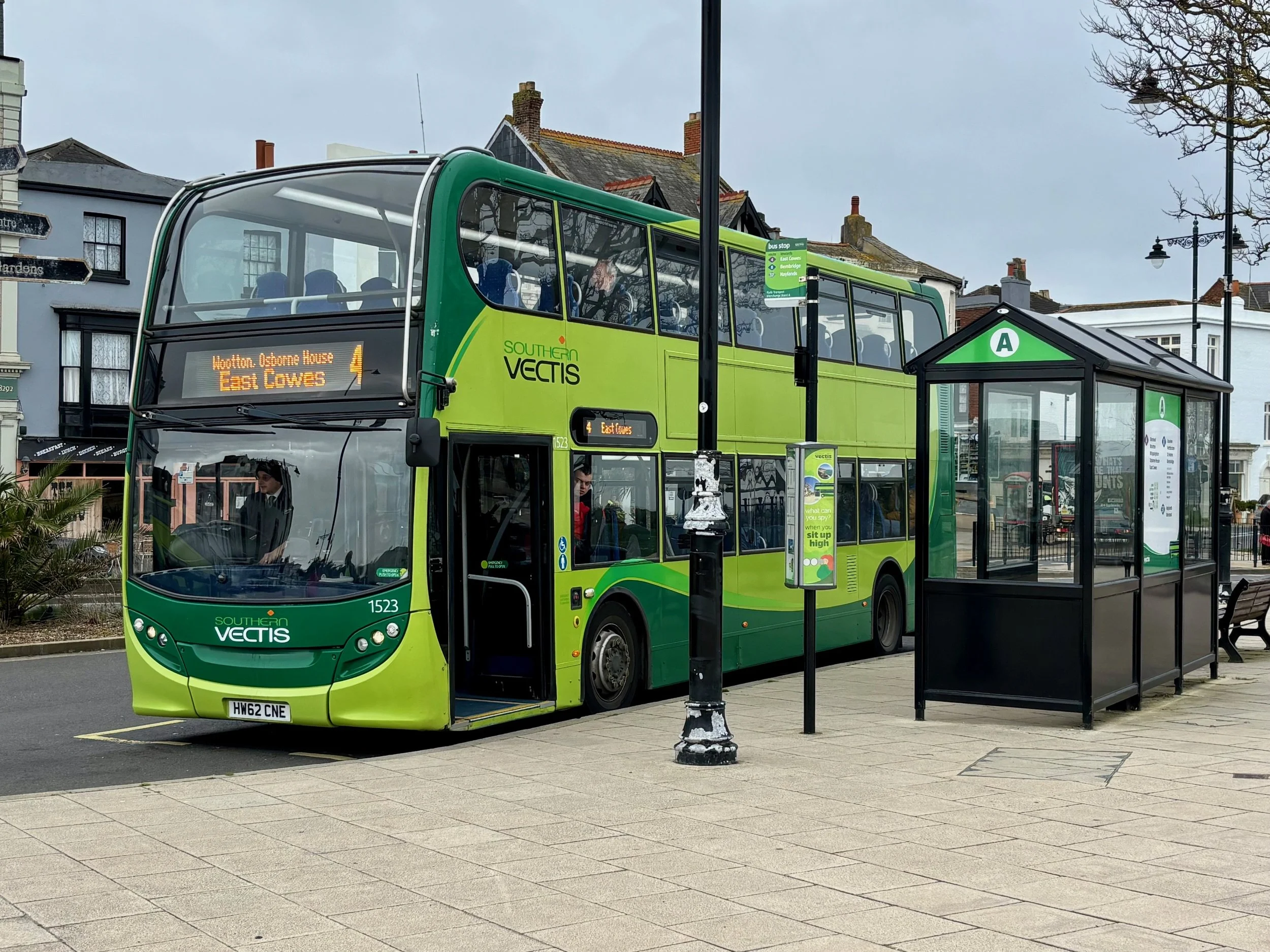
My final route on this trip was the 4 from Ryde to East Cowes and back. Enviro400 1523 was the bus and is seen here amidst the street furniture at Ryde Interchange.
New Wright StreetDeck Electroliners are promised for this and many of the other routes featured very shortly and indeed began entering service just a few days later.
Route 4: Ryde - East Cowes - Ryde
Back at Ryde, there was just time to finish off with a final trip, a return to East Cowes and back on Route 4. This operates Hourly daily including evenings and, as mentioned earlier, interworks with Ryde Town service 37. My last bus of this adventure was another Enviro400, no 1523, which was waiting at Stop A in the Interchange, so I hopped on with a handful of others and we departed on time.
This service is largely an amalgam of parts of the 9 and 5 routes, covered earlier in this article, apart from a slightly different intermediate routeing in East Cowes. So, out via Binstead, Fishbourne and Wootton to Whippingham Roundabout, then on to Osborne House and into East Cowes, although this time remaining on the main road (York Avenue) to the terminus at Waitrose near to the ferry terminal. A 30 min run.
After a 5 min break, I returned on the same vehicle to Ryde, this time picking up two large groups of tourists at the stops nearest to Osborne House. At Quarr Abbey, our driver kindly stopped a few yards past the stop in response to a lady who was running down the drive waving furiously and wanted the bus! This seemed to be fairly typical of the service provided by the Southern Vectis drivers I encountered during my visit, the majority of whom appeared extremely courteous and helpful. Arrival back at Ryde Interchange was after another 30 min trip.
Breezers
Although it was too early in the year to ride any of the Open Top Bus Routes on the island, I had covered these on previous trips. These are shown on the map at the start of this article and include:
Downs Breezer (Circular from Ryde via Wootton, Robin Hill, Sandown & Bembridge)
Shanklin Shuttle (Circular via Old Village, Chine & Esplanade)
Needles Breezer (Circular from Yarmouth via Freshwater, Totland & Alum Bay including Needles Battery)
In addition, there is the “Island Coaster” which is the island’s longest route from Ryde to Yarmouth via Bembridge, Sandown, Shanklin, Ventnor, Blackgang, Freshwater Bay, Freshwater & Alum Bay around the coastal roads. This provides 2 or 3 daily trips each way during the summer and is normally operated by a covered top bus.
Finally, there is the “Summer Links” service between Newport and Yarmouth via Calbourne Water Mill and Tapnell Farm, which has one or two Open Top “positioning” journeys for the Needles Breezer, but is otherwise operated by covered top buses.
All these services were due to recommence at the end of March 2026 and operate through to at least the end of September - full details are available on the Southern Vectis website.
Watton
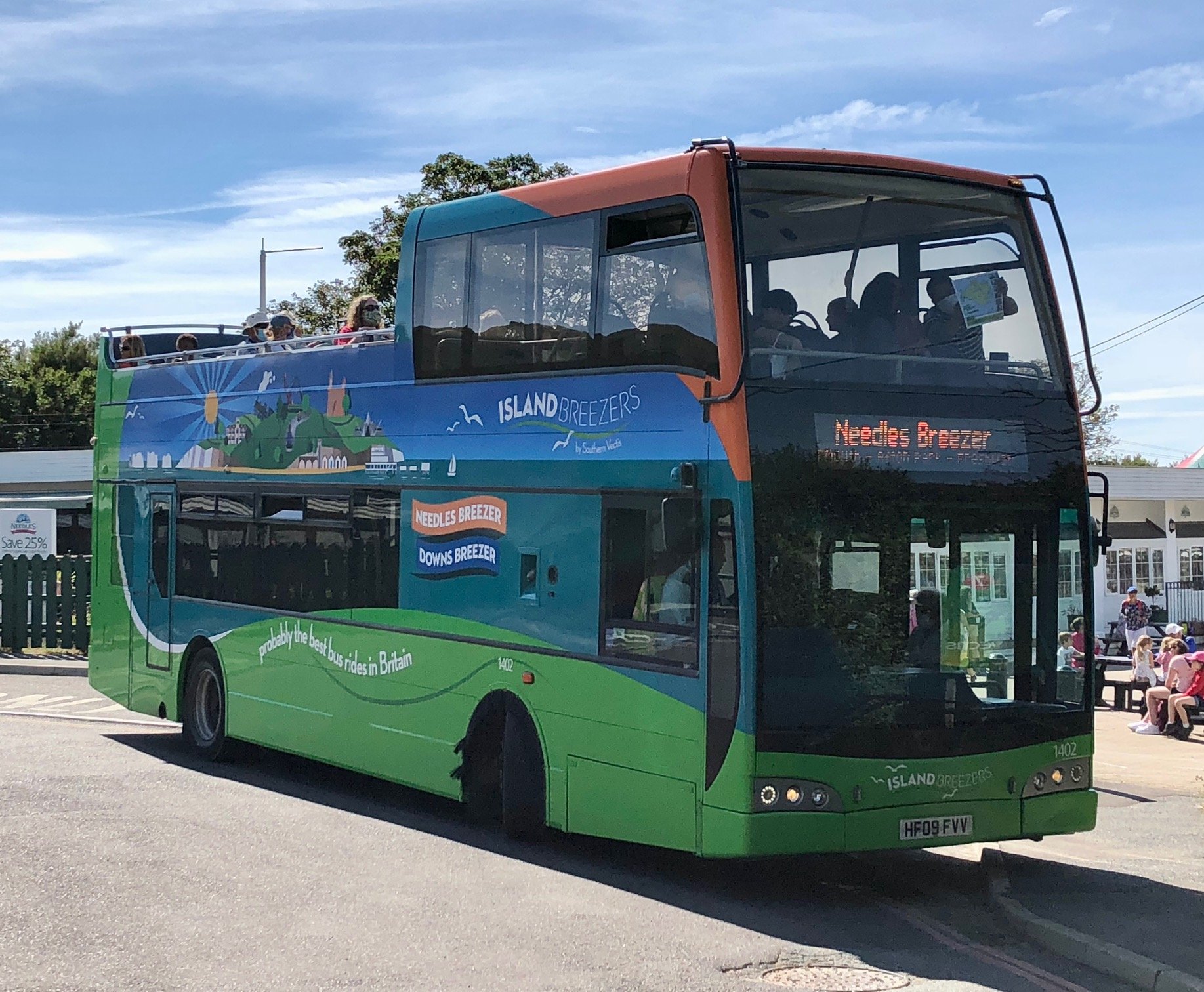
Whilst it was too early in the year to ride any of the Southern Vectis Open Top routes on this trip, I did cover them on my previous visit in July 2020, where we see Scania Optare Visionaire 1402 at Alum Bay on the Needles Breezer in Island Breezers livery.
The latest order for Wright StreetDeck Electroliners includes 3 Open Top versions for this service.
