
In with the old and in with the new in Walthamstow
Back in London, I visit the Walthamstow area to ride some older buses that have found a new use, plus some new electric vehicles that have recently entered service.
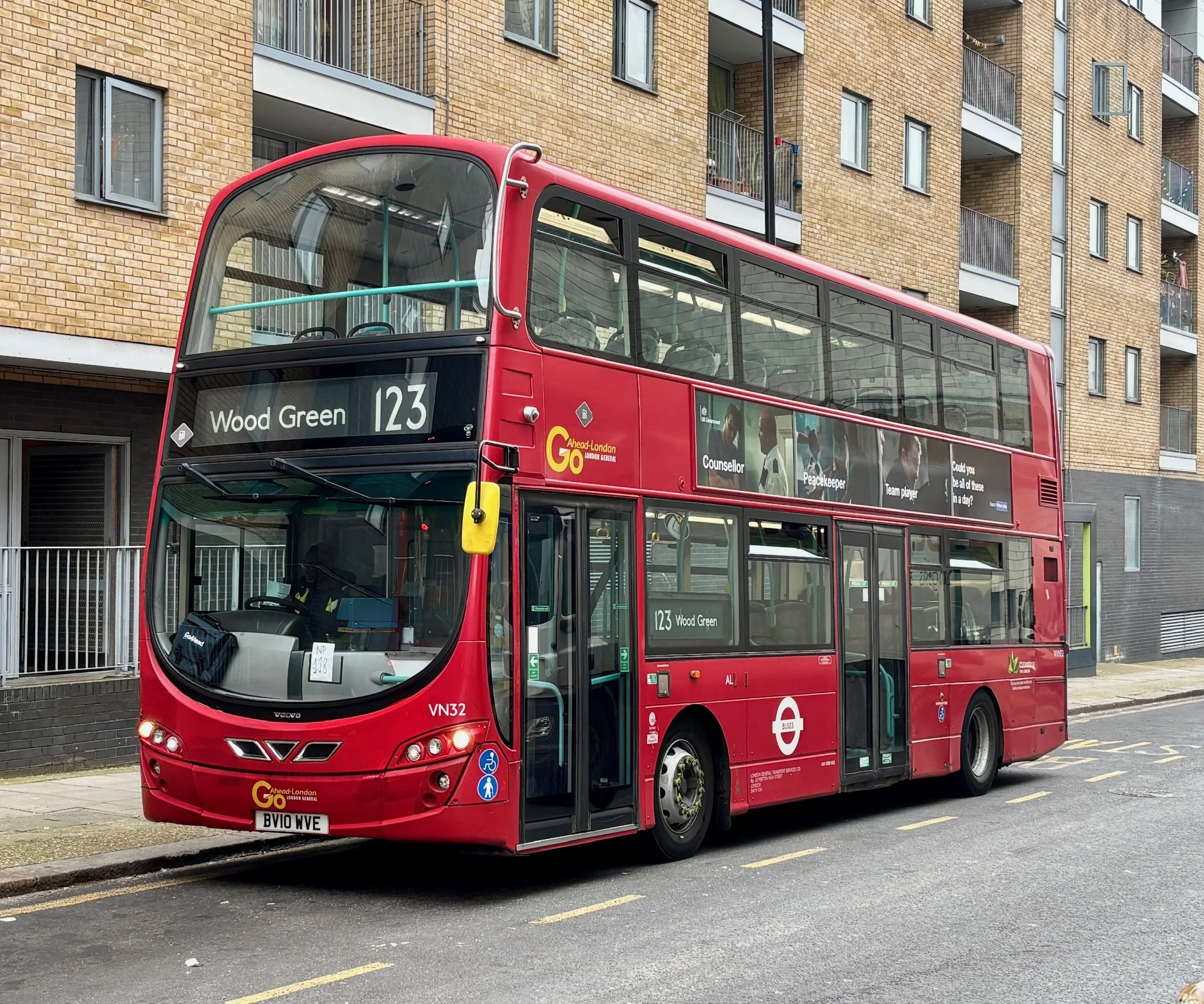
Go Ahead London took over the contract for the 123 from Arriva on 28th February 2026. Whilst mainly intended for hybrid operation, a few diesels have been drafted in to Northumberland Park (NP) Garage to help out, comprising Volvo B9TLs like WVN32, seen here on stand in Wood Green before I rode it to Ilford.
This WVN (which seems to have lost its “W”!) is one of those new to First, starting life at NP Garage, then transferred to Merton (AL) under Go Ahead for the 131, before passing recently to Morden Wharf (MG) for the SL11 and now returned home to NP.
Route 123: Wood Green - Ilford
Arriving by Great Northern Train at Alexandra Palace at the end of the morning peak, I walked down to Wood Green to begin my bus rides for the day with a trip on the 123 to Ilford. I had last ridden the route a few months ago in the opposite direction when it was still with Arriva, but at the end of February 2026, it passed to Go Ahead, so my first opportunity to sample the activities of the new operator.
A 3 year contract has been obtained using existing hybrids of the MHV and WHV classes, including some MHVs freed up from conversion of the 22 at Putney Garage to DEL class electrics. However, due to insufficient hybrids being available, a few diesels have been drafted into Northumberland Park (NP) to help out, at least in the short term. These comprise some of the peripatetic WVNs previously at Merton (AL), which passed to Morden Wharf (MG) for the SL11 in January and have now completed the circle by returning to NP, the garage they were based at when new to First London! A few WVLs have also joined in the mix.
When I arrived at Wood Green Station, WVN32 was waiting on stand and formed the second departure behind MHV59. Climbing aboard, I settled in for a quiet run, as the streets seemed unusually free of traffic. Down Wood Green High Road to Turnpike Lane Bus Station, which we circumnavigated, to which point the route may soon be truncated from the east as part of route changes associated with the nearby “Harringey Heartlands” development.
Then it was along Westbury Avenue, before turning right into Lordship Lane and on to Bruce Grove Station, where we turned into Tottenham High Road. Taking a left turn opposite Tottenham (AR) Garage, we powered down to Tottenham Hale Bus Station, before continuing over the River Lea past the famous Ferry Boat Inn and through the Walthamstow Wetlands area. Soon we were at Blackhorse Road Station and made good progress onwards through the roadworks to Bell Corner. Following this, we passed Waltham Forest Town Hall and the eastern outskirts of Walthamstow at Beacontree Avenue, touching the fringes of Epping Forest. At Waterworks Corner, we joined the North Circular for a fast run through Woodford, before peeling off along the dual carriageway to Gants Hill roundabout. By now we were a touch early on schedule, so it was a gentle amble into Ilford beside the delights of Valentines Park. We terminated at Hainault Street virtually on time after a run of 1h15m.
For a route history of this version of the 123, which began in 1960 as the successor to Trolleybus 623, refer to my previous article “Totting Up in Tottenham” dated 25th August 2025. However, it is worth mentioning that the 123 number was used before this for a route between South Hornchurch & Ongar, RT operated and withdrawn in 1958, being largely replaced by the 175.
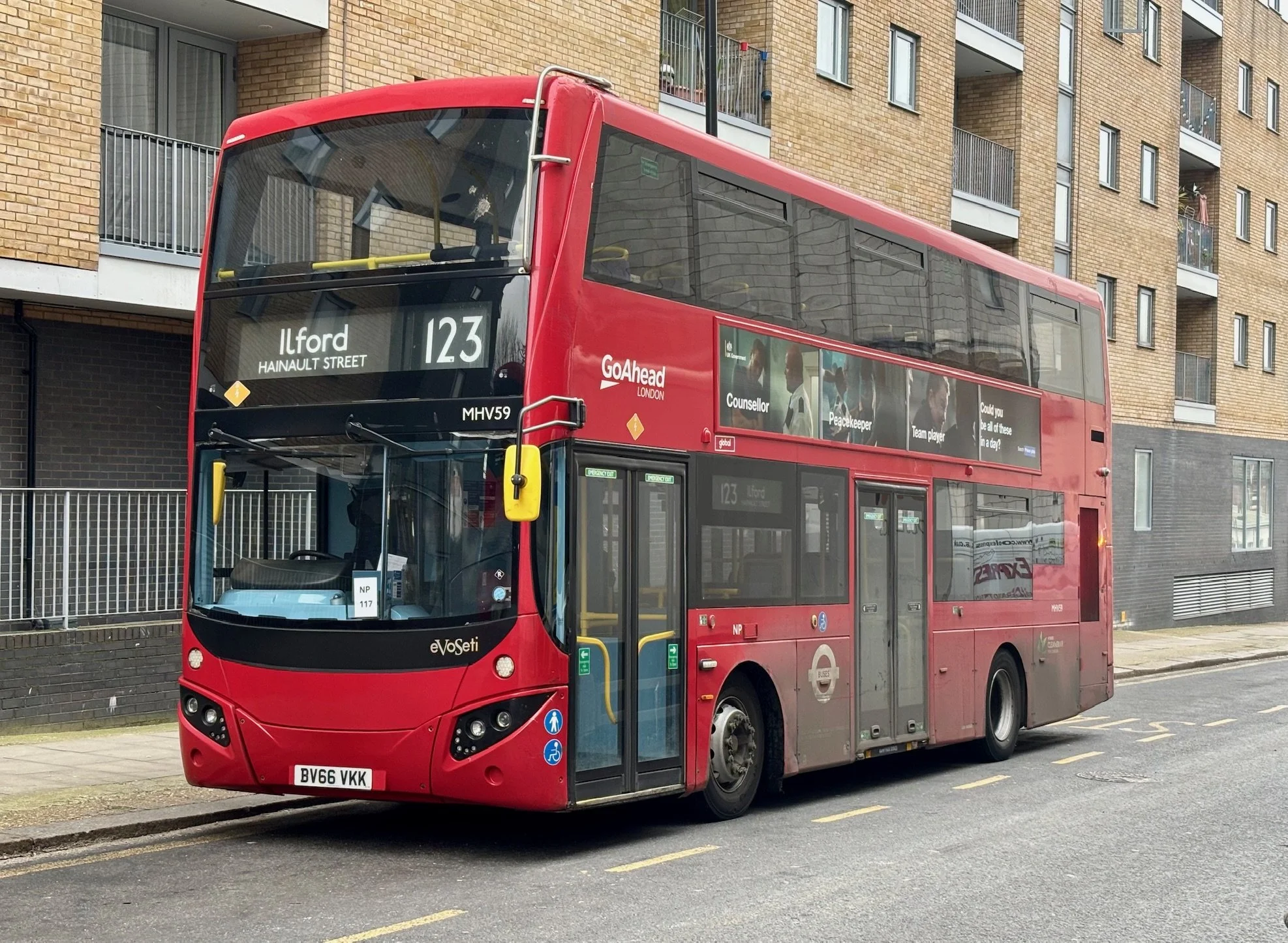
The hybrid allocation on the 123 comprises MHV and WHV classes. Volvo B5LH MCV EvoSeti MHV59 illustrates the former type at Wood Green and formed the departure ahead of the one I took aboard WVN32.
Some of the MHVs gathered together were those from Putney (AF) made spare by the arrival of new DELs for the 22, but this example was one of NP’s existing inmates.
Part Route SL2: Ilford - Walthamstow
At Ilford, I walked through the town to Sainsbury’s, where I had only a couple of minutes to wait for my next bus on Superloop SL2 back to Walthamstow, largely parallel to the 123 but even quicker as only key stops are served. I had HA39, one of the Enviro400H City vehicles in Superloop livery from Arriva’s Barking (DX) Garage that form the current allocation.
A rapid 35 min trip through to Walthamstow Central, where the SL2 now terminates and picks up in the Bus Station itself, rather than outside in Selborne Road as previously.
The SL2 joined the Superloop network in March 2024, running between North Woolwich and Walthamstow Central.
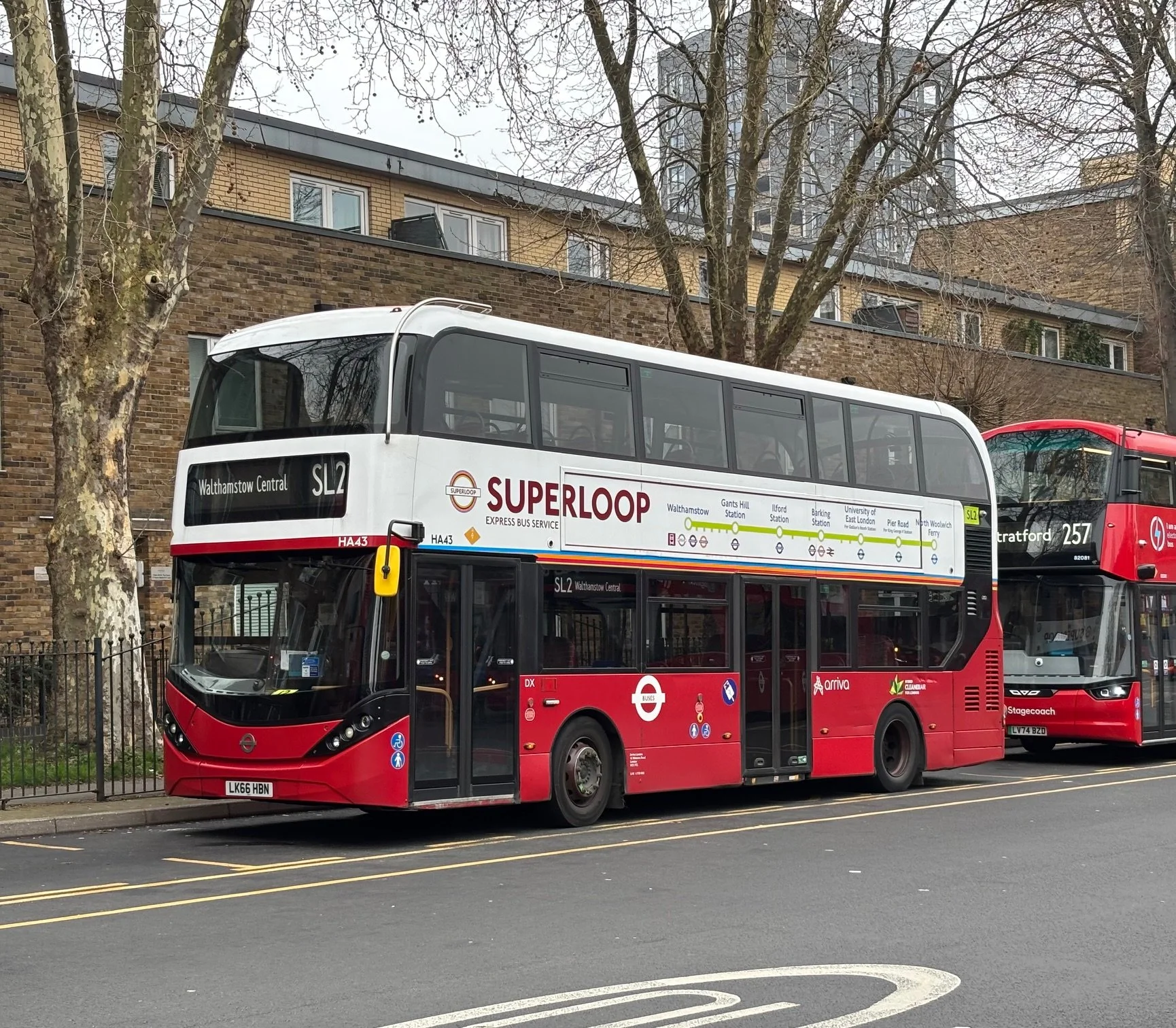
Arriva Enviro400H City HA43 of Barking (DX) Garage on the SL2 at Walthamstow Central Bus Station, after I had travelled here from Ilford on sister Superloop liveried HA39.
The SL2 moved its Walthamstow terminal from outside to inside the Bus Station from 28th February 2026.
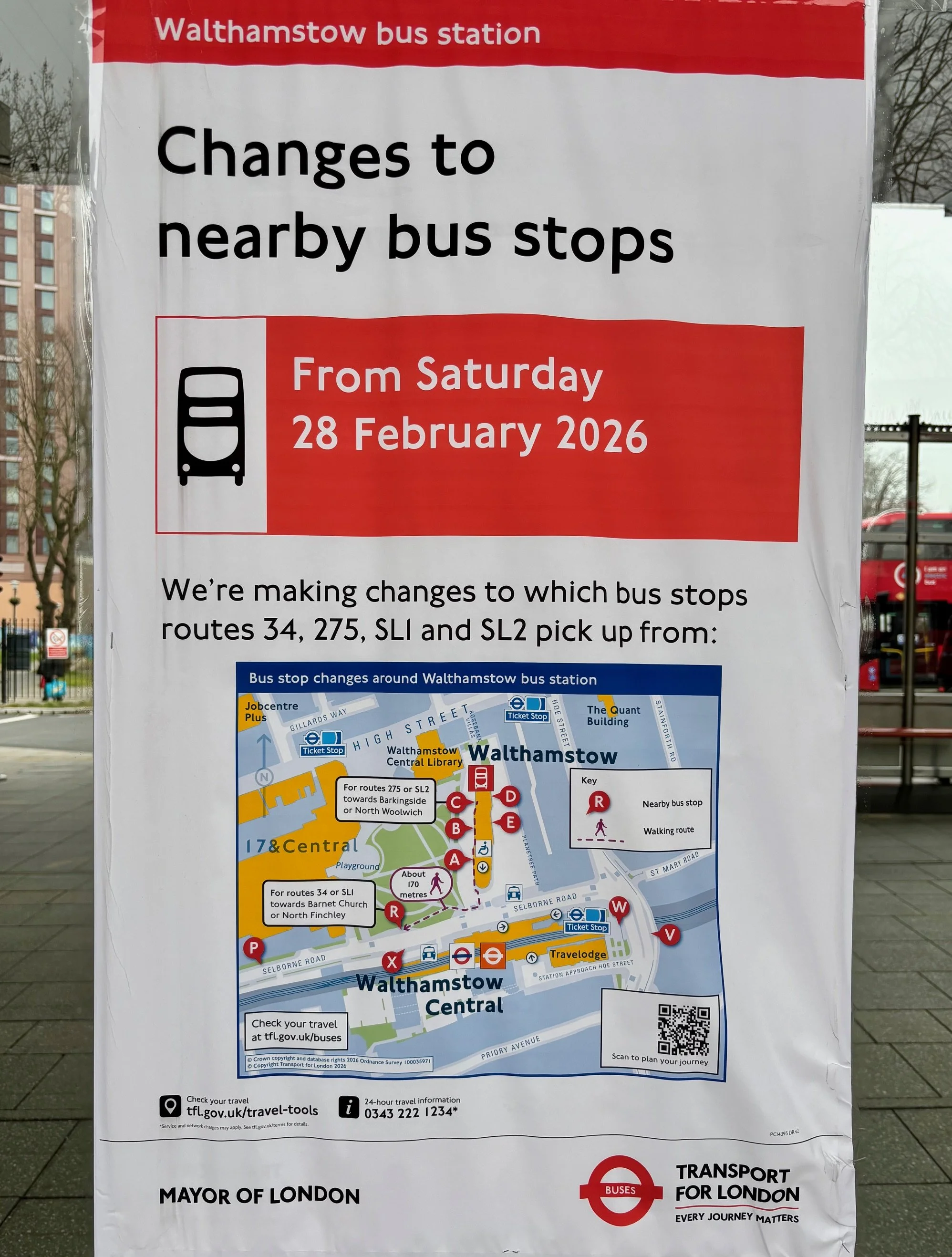
Poster showing changes to Bus Stops at Walthamstow Central Bus Station from 28th February 2026.
Whilst the SL2 moved into the Bus Station to terminate and depart, the SL1 and 34 moved the other way to terminate and depart in Selborne Road.
Route 215: Walthamstow - Lee Valley Campsite - Walthamstow Stadium
In recent times on Watton’s Wanderings, I have been riding NRMs on some of the outer suburban routes to which they have been transferred from their original duties nearer to Central London. One of these routes still on my “To Do” List was the 215, operated by Stagecoach out of Leyton (T) Garage, so I took the opportunity to put that right on this latest journey.
Next to depart from Walthamstow Central Bus Station was LT386, so I boarded with a small number of other takers. A gentle run followed, past Walthamstow Market to The Bell, then along Chingford Road passing the site of the late lamented Walthamstow (WW) Garage, now long gone apart from the former Tramway Offices converted into housing. Up to the Crooked Billet roundabout on the North Circ, which we crossed and called at Walthamstow Stadium for the adjacent Sainsbury’s store. Continuing up to Hall Lane and Chingford Mount, we ascended the hill past Chingford Old Church, before parting company with trunk route 97 which we had shadowed up to this point and taking the freehold stretch of the 215 via Mansfield Hill to the foot of Kings Head Hill.
As we entered the final section of the route northbound, we deposited most of our passengers in the Yardley Lane Estate area, with only 4 of us continuing over the countrified stretch beyond to Lee Valley Campsite, a total run of just over half an hour from start. Interestingly, all 3 of the other customers began walking from the terminus towards Sewardstone Village, indicating that there may be scope for extending the service further - indeed, there has been talk of operating through to Waltham Abbey with assistance from Essex County Council. This would restore a long lost regular link, add only about 10 mins more running time and perhaps require only 1 or 2 extra buses.
After a 15 min layover, I rejoined the same bus to return as far south as Walthamstow Stadium, where I alighted 20 mins later.
The 215 number originally applied to a route between Kingston & Ripley, later cut back to Esher, probably best known for its many years of RF operation. It was renumbered K3 in 1987 and continues today in modified form.
The current 215 began in 1988, replacing a withdrawn section of the 212 between Walthamstow Central and Yardley Lane Estate, although this recreated exactly the previous route 276 between the same points which opertaed between 1968 and 1982! The extension to Lee Valley Campsite was added in 1989, initially just odd journeys on a seasonal basis, although eventually the whole service went there throughout the year.
Initial operator London Buses used Titans, but in 1991 the route passed to Capital Citybus (later First London) with Olympians and other double deck types. Low floor conversion came in 2005 with TNL class Tridents, but Stagecoach won the contract in 2010, using Scanias and Tridents, followed later on by Enviro400s, both diesel and hybrids performing. The route’s claim to fame is that the very last Stagecoach London Trident Alexander ALX400 (17811) operated on it in 2019, attracting a number of enthusiasts (including me!), who rode it on its last official day in service. NRMs took over in 2023.
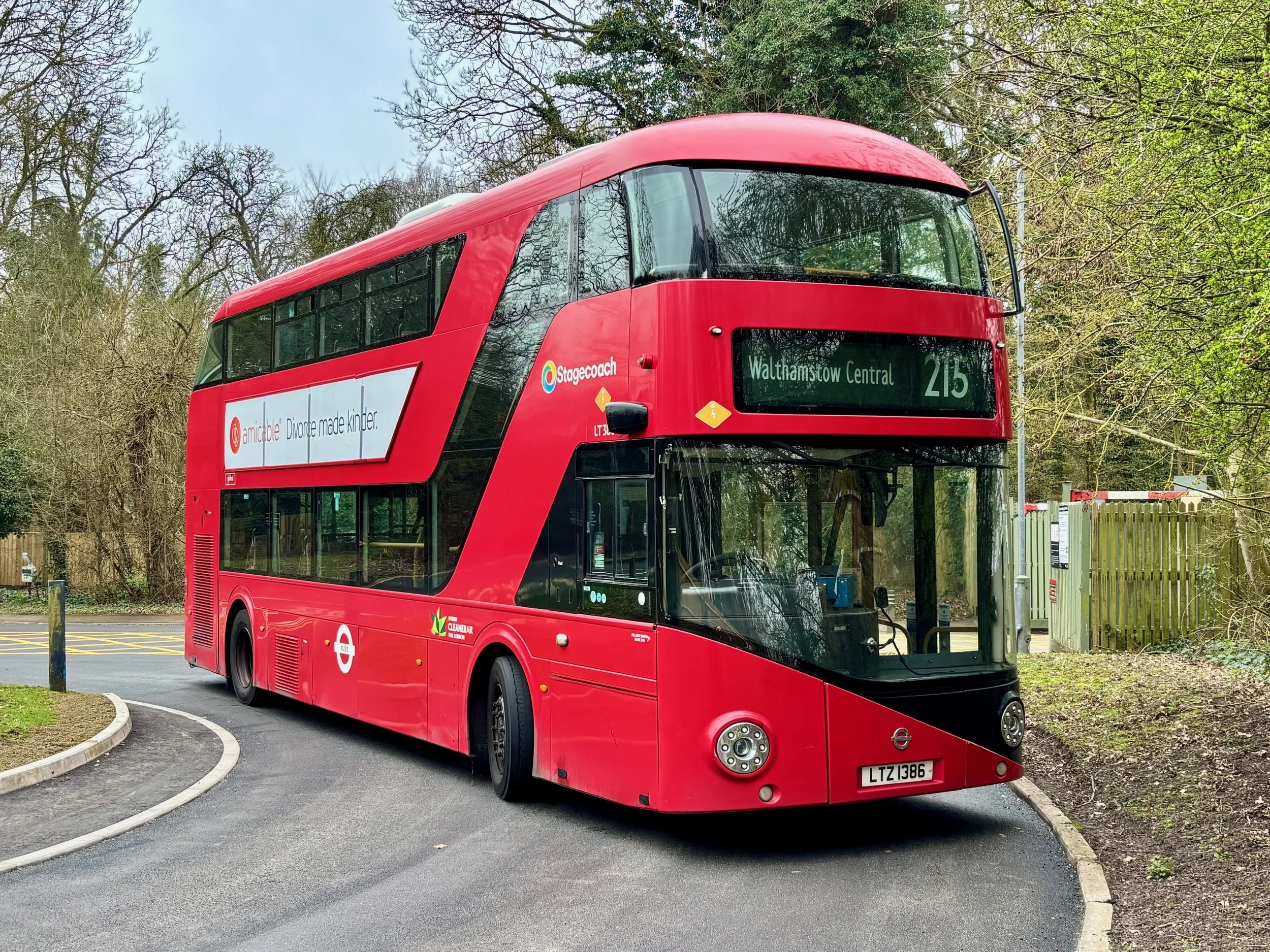
Stagecoach London New Routemaster LT386 of Leyton (T) Garage sits amid the trees at the rural Lee Valley Campsite terminus of Route 215 between my rides aboard. LTs have been on the route since 2023.
Like the nearby 313, the outer suburban 215 is an unusual choice for these 3-doored vehicles, which were designed for busier Central London routes.
Route W11: Walthamstow Stadium - Chingford Hall Estate - Walthamstow
At Walthamstow Stadium, I crossed the road just as Stagecoach Switch Metrocity EV 67013 was approaching, bound for Chingford Hall Estate. The route was electrified with these vehicles in 2024, but this was my first chance to sample the new type. A short run of no more than 10 mins via Sainsbury’s Superstore and then northbound along Chingford Road before turning off via the narrow estate roads to Chingford Hall, Silver Birch Avenue. These new buses are bright and airy with “sunshine roof” panels in the ceiling plus all the current modern internal features.
I took a short break and awaited the following working 12 mins later, formed by sister vehicle 67014. I was the sole passenger boarding at the terminus, although we picked up a few more as we progressed through the estate back to the main road. Then south, back via Walthamstow Stadium and Sainsbury’s, before continuing to the Crooked Billet Roundabout. Entering Billet Road, we were in hot pursuit of a 158, before turning off via North Countess Road and the back doubles to Forest Road, where a recalcitrant cyclist running the temporary lights just stopped from colliding with us. We continued down to Blackhorse Road and then up to St James’s Street, before the final section to Walthamstow Central, where we terminated after a 35 min run.
The W11 began in 1988 as a midibus route between Walthamstow Central & North Countess Road, marketed as “Walthamstow Hoppa” using MR midis. The service was extended to Chingford Hall Estate in 1994, whilst in 2017 came the intermediate rerouteing via Blackhorse Road rather than direct via Palmerston Road. Initial operator London Buses was replaced by Thamesway (later First Capital) in 1991 with Mercedes midis, although low floor DM Dart Marshalls replaced them in 2001. Arriva had a 5 year turn from 2012 using ADL then ENS types, with CT Plus taking charge in 2017 with Enviro200 MMCs. Stagecoach purchased CT Plus in 2022, which meant that the W11 transferred together with the other operations at Walthamstow Avenue (AW) Garage.
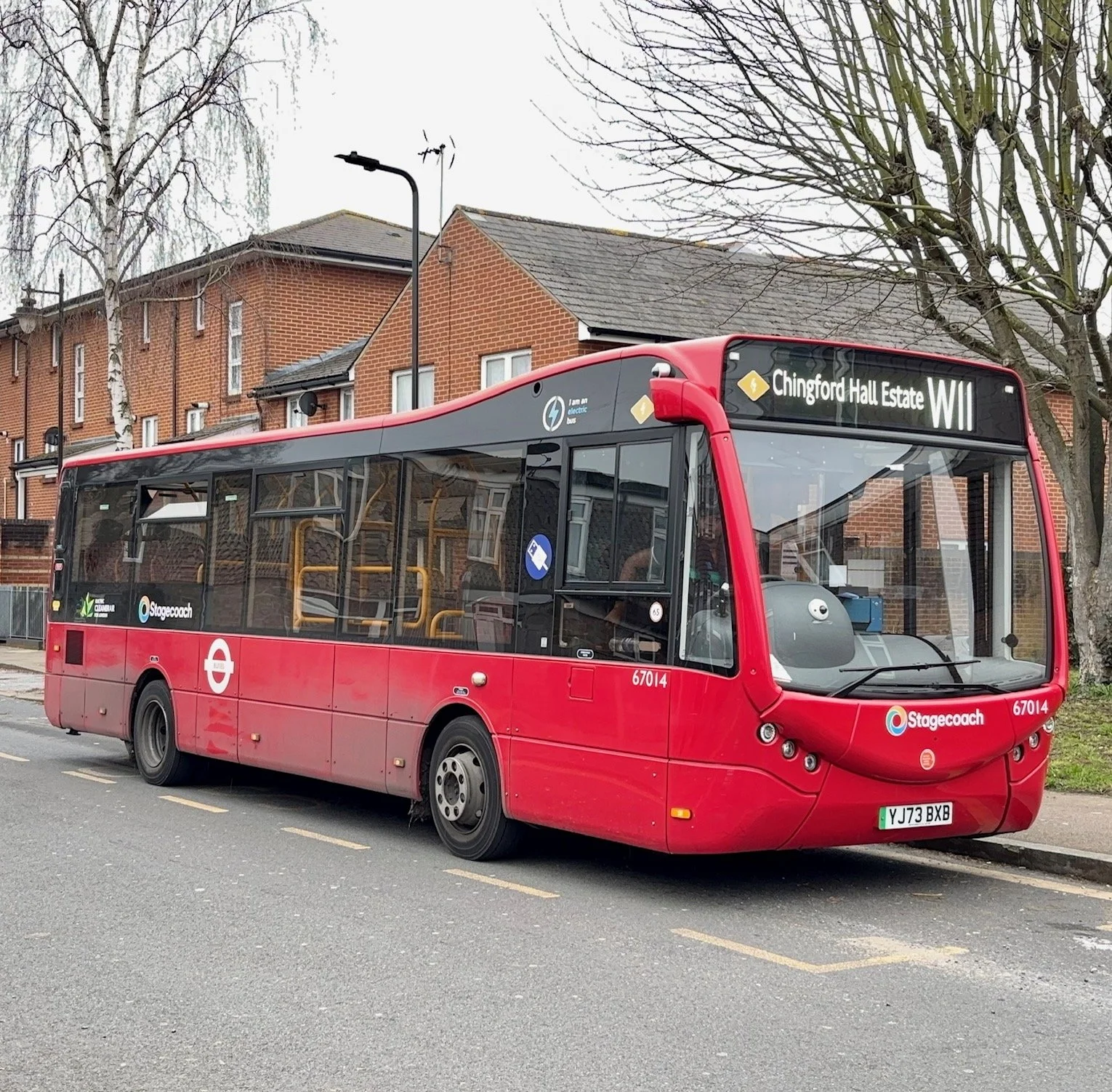
The W11 is operated by Stagecoach with a batch of Switch Metrocity EVs new in 2024. 67014 of Walthamstow Avenue (AW) Garage is seen at Chingford Hall Estate prior to my journey on it to Walthamstow Central.
Stagecoach has another batch of these vehicles at Lea Interchange (LI) for the 339.
Part Route 230: Walthamstow - Upper Walthamstow
Up to this point, my rides had all been relatively free and easy, with no significant delays, but all this was about to change!
However, no real sign of what was to come as I boarded new GAL Wright StreetDeck Electroliner DEL18 of NP Garage in Walthamstow Bus Station, bound for Upper Walthamstow on the 230. This route was recently converted from its earlier Ee type Enviro400EV City buses, making it one of the few routes (so far) to be onto its second generation of electrics, so giving the excuse to ride it on this occasion. A reasonably short trip followed, via Leyton Bakers Arms and Whipps Cross, to the Upper Walthamstow terminus at Bisterne Avenue, which is a little off the beaten track and set amongst trees. A 25 min run, during which the rain that had started falling lightly at lunch-time became heavier.
During the journey, I pondered the history of the 230 number, recalling that it was once associated with a route in the Harrow area between Rayners Lane and Northwick Park, famously operated by RLH (low height) double deckers due to passing under a low bridge at Harrow & Wealdstone. This version was withdrawn in 1969 and replaced by Flat Fare Route H1.
The number re-emerged in 1973 for a new route between Manor House & Stratford, RM operated and mainly replacing a section of the 241. I recall riding it in 1976 when a few RTs were deployed due to a vehicle shortage, the RTs having masked RM via blinds.
OPO conversion to LS came in 1981, with the route changed at each end to then run between Finsbury Park & Whipps Cross, although an extension to Leytonstone was added in the following year. The western terminus was amended to Wood Green in 1987, at which point the service became double deck operated with Titans, although a year later the route was diverted intermediately to serve Walthamstow Central, in place of the previous route via Markhouse Road and Lea Bridge Road. 1992 saw another rerouteing, this time in Tottenham, along Philip Lane direct in lieu of Seven Sisters and the eastern part of West Green Road.
It was in 1996 that the route was diverted to Upper Walthamstow instead of Leytonstone and reconverted to single deck, using DAL high floor Darts until the SLD low floor version were delivered some months later. However, double deckers returned in 2004 with Trident Alexander ALX400s.
Having always been a Leyton (T) Garage route up to this point, change came in 2013 when Arriva gained the contract from Stagecoach, using DWs from Tottenham (AR), although HVs were later added to the mix. After one 7 year term, GAL acquired the route in 2020, using new Ee electrics, which have recently been replaced by the new DELs.
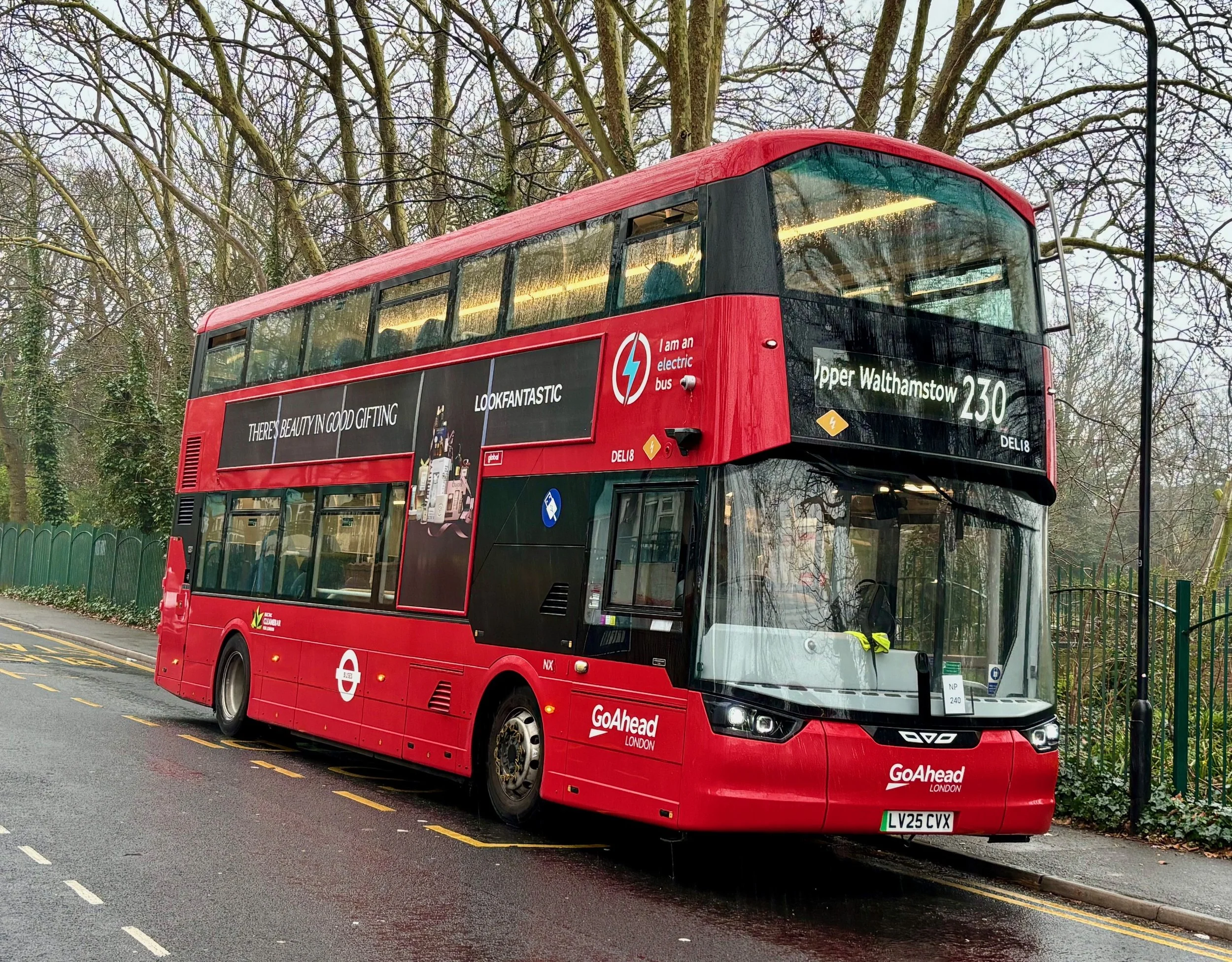
The 230 is already on to its second generation of electric buses, with new Wright StreetDeck Electroliners replacing older Enviro400EV City Ee types.
DEL18 of NP Garage is seen at a soggy Upper Walthamstow terminus before my protracted run to Wood Green on the route.
This bus has New Cross (NX) codes as it was one of those intended for routes at that garage but was switched to NP instead. There are some other higher numbered DELs which were ordered specifically for the 230.
Route 230: Upper Walthamstow - Wood Green
At Bisterne Avenue, I now had one simple journey left to fulfill in order to complete my itinerary for the day - a straight run on the 230 back to my start point at Wood Green. However, I was in for a rude awakening, as the trip soon descended into chaos.
The kindly driver let me and another passenger who was waiting board the bus a few minutes before departure time to escape the rain, enabling me to appreciate the modern interior features of the new DEL class. We set off bang on schedule, but that was the last time on this trip. At Wood Street Station, we encountered school chucking-out time and although we only picked up a few adults with their kids, indiscriminate parking by those on the school run caused an extended journey up to Whipps Cross. After circling around the Bus Stand, we continued at a more reasonable pace through to Leyton Green, passing beside the Stagecoach Leyton (T) Garage.
Then, after crossing the Bakers Arms junction, we hit a traffic wall which was moving at barely a snail’s pace, all the way up across Queens Road to Walthamstow Central. What should have taken a few minutes took more than 20. After calling at the Bus Station again and continuing along Selborne Road to St James’s Street, we then encountered another slow queue all the way to Blackhorse Road Station, dropping another 20 mins or so. During this extended journey, it was no surprise when the driver received a call from the Controller to curtail at West Green Philip Lane, although extremely annoying for through passengers.
It was only after Blackhorse Road that we finally attained a decent speed again as we crossed the Lea Valley through calmer road conditions to Tottenham Hale. Our driver helpfully informed boarding passengers that he was turning short, so that those wanting Wood Green would await the next bus. Strangely, the driver played the “This bus terminates here” at Tottenham Garage, 3 stops short of the curtailment point, so all alighted including a wheelchair user who wanted Wood Green. The situation then descended into farce, as the next 2 buses on the 230 to arrive were also displaying the West Green destination, with many disgruntled passengers expressing their annoyance and disgust to the drivers, who whilst apologising and saying they had to do what the Controller told them, also agreed with the assembled passengers that it was an odd decision to turn so many buses in a row short!
Eventually, after waiting more than 30 mins at Tottenham Garage, a Wood Green bound 230 arrived, DEL22. After double-checking with the driver that he was indeed going through to Wood Green, I boarded and we set off. At the next stop, we again encountered the aforementioned wheelchair user, who had got fed up with waiting and begun to make his own way to his destination. After deploying the wheelchair ramp, another problem as it failed to retract fully. The driver then had to shut down the bus and “reboot” all the systems in an attempt to resolve the issue, which it did - but only after a 5 minute stand! Finally, we got going again and made our way through West Green to Turnpike Lane and up to Wood Green Station, where we terminated - a massive 2hr20m after I had left Upper Walthamstow, taking exactly twice the scheduled journey time for the trip.
Whilst I understand that traffic conditions in the Walthamstow area were atrocious and the 230 drivers were generally sympathetic and apologetic, in my view the decision made by the controllers to curtail 3 consecutive Wood Green bound buses was extremely unhelpful and did not serve the best interests of the public. One would have thought that a curtailed bus should be followed by a through journey on the next working and that curtailments should be split more evenly between the ends of the route - most eastbound trips seemed to still be working through to Upper Walthamstow, which is in any case the quieter end of the service.
At Wood Green, I made my way back to Alexandra Palace Station for the train journey home, reflecting that it had been a disappointing end to my travels which had gone so well for the rest of the day, but such are the vagaries of modern bus usage in London!
Watton
“And Finally”…
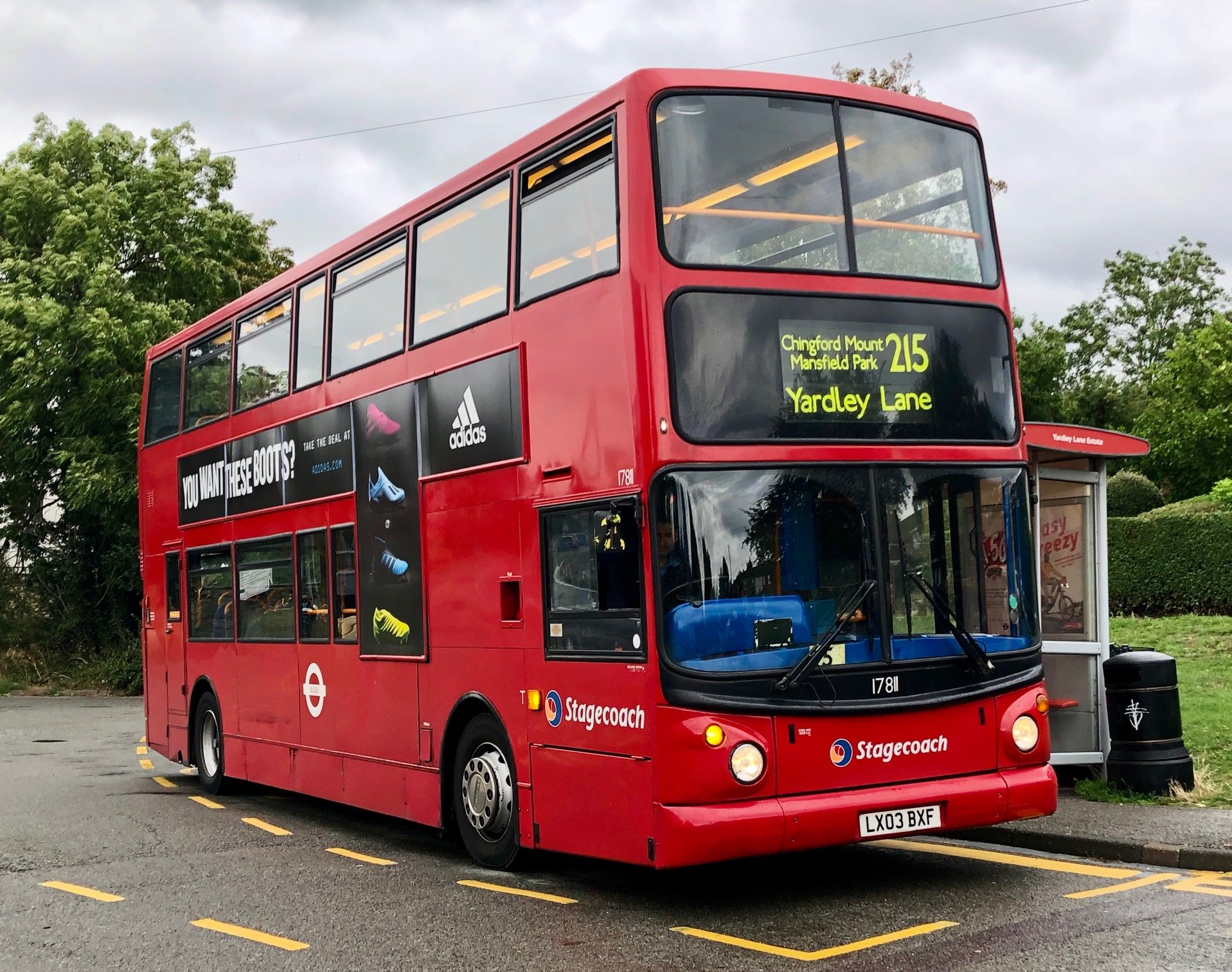
The very last Trident Alexander ALX400 with Stagecoach London operated on the 215 back in August 2019. 17811 of Leyton (T) Garage is pictured at Yardley Lane Estate on its official final day in service, during a ride which attracted a good number of enthusiasts.
Fittingly, Leyton was both the first and the last garage to operate Tridents, although 17811 had the last laugh on the enthusiasts, as it crept out for a couple of final runs over the few days after this!
