
Red Nose Routemasters
A day out in London with a difference this time, as I ride preserved Routemasters north and south of the capital to mark Red Nose Day in association with Comic Relief and reflect on the history of the two routes involved, one very longstanding and the other relatively new.
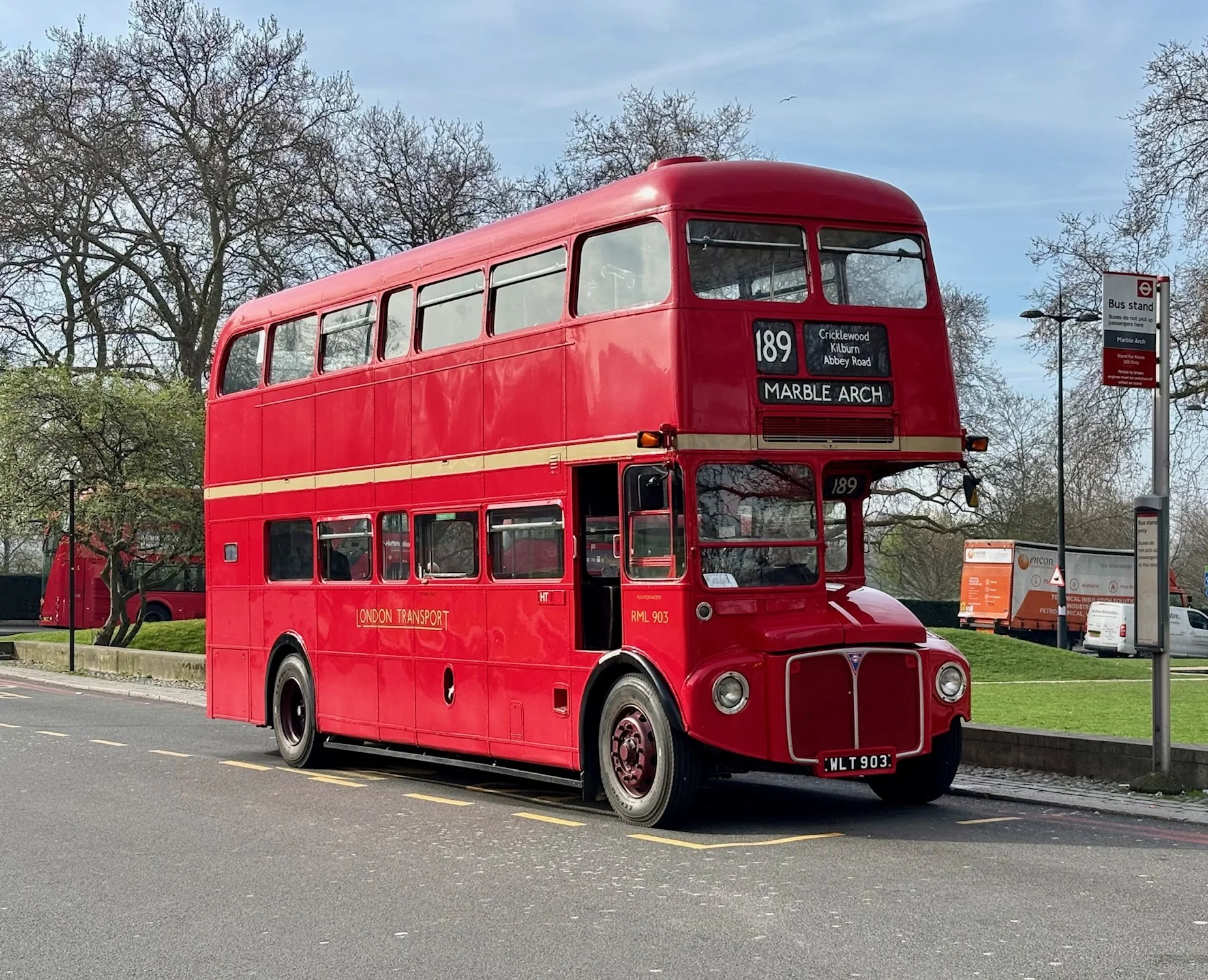
Metroline owned Routemaster RML903 performed a number of trips on Route 189 on Friday 20th March 2026 for Red Nose Day. The bus is seen on the Marble Arch stand before my journey aboard to Brent Cross.
The 189 was OPO from inception and so never saw crew operation in normal service, although the route it largely replaced, the 16A, was RML operated for a period.
Charity Operations
We are all familiar with the Heritage Bus Running Days in London and the Home Counties, on which it is possible to ride previous generations of buses, often on recreated or actual routes on which those types once ran.
However, in addition, it has become a tradition for certain operators or private owners to run one or two preserved vehicles on particular routes to mark certain charitable events in the calendar, such as Children in Need, Remembrance Poppy Appeal and Red Nose Day for Comic Relief. Fares are not charged on these services, although a donation to the charity involved is usually encouraged. To mark Red Nose Day 2026 on Friday 20th March, there were at least a couple of TfL routes featuring preserved Routemasters, so I determined to seek these out as something a bit different from the normal heritage operations.
Route 189: Marble Arch - Brent Cross
I began at Marble Arch just after the morning peak, start point of the 189, on which Metroline were running their preserved RML903 on 3 or 4 trips over the route, with a timetable being published on line. The bus duly arrived a little early on its schedule and parked up on the 205 Stand in Tyburn Way, which was conveniently vacant due to a strike at Stagecoach Bow Garage on that day.
The vehicle was neatly turned out in original 1960s livery with gold fleet numbers and underlined “LONDON TRANSPORT” fleetnames, whilst the interior was in original condition. The bus was one of the first batch of longer Routemasters delivered in 1962 for Trolleybus Replacement Route 104 between Barnet & Moorgate Finsbury Square, but escaped briefly on a tour to the USA in 1963 before returning to service in the capital. It became a Showbus in the mid 1970s being exhibited at shows and special events but remaining in normal service into the privatisation era, passing through the ownership of MTL London to Metroline. Last allocated to Holloway (HT) Garage, it performed mainly on the 390 until Routemaster operation ended on that route in 2004, when it was moved to the special purposes fleet, appearing on routes including the 43 and 134 for Red Nose Day in prior years.
A couple of minutes after the scheduled departure time, RML903 arrived at the first 189 pick-up stop in Oxford Street and I boarded with a few others. We turned left at Selfridges and proceeded via Portman Square up to Baker Street Station, passing close to the Sherlock Holmes Museum and attracting the attention of several tourists. Turning left into Rossmore Road, we then hung a right into Lisson Grove and on to Abbey Road, passing the studios and the zebra crossing made famous by The Beatles on one of their album covers. Arriving into Kilburn, we negotiated some temporary lights due to roadworks, before entering Quex Road which took us down to the main Kilburn High Road, where we turned right.
It was then a straight run through Kilburn, past Brondesbury and Kilburn Stations then over Shoot-Up Hill, which takes its name not from the activities of local highwaymen as some have surmised, but due to the sudden incline in the main road between Kilburn and Cricklewood which horses used to “shoot up”. Entering Cricklewood Broadway, we passed the large edifice of “The Crown”, where buses on the 16 used to stand in the car park many years ago. However, we continued via Cricklewood Station, passing under the railway bridge and then left into Claremont Road. With Clitterhouse Playing Fields on our right, we turned left past Claremont Park on the double run to the new Brent Cross Station which was introduced with its opening in 2024. Then back to Claremont Road and on over the North Circ to terminate at Brent Cross Shopping Centre after a run of almost exactly 1 hour.
We were busy with passengers throughout, many of whom were delighted to travel on an old Routemaster, although one or two had to be encouraged to move inside and not stand on the platform by the conductor! The operation of heritage buses like this always seems to turn the heads of passers-by and this was no exception, with plenty of smiling faces and a number of selfies taken in front of the bus during the trip.
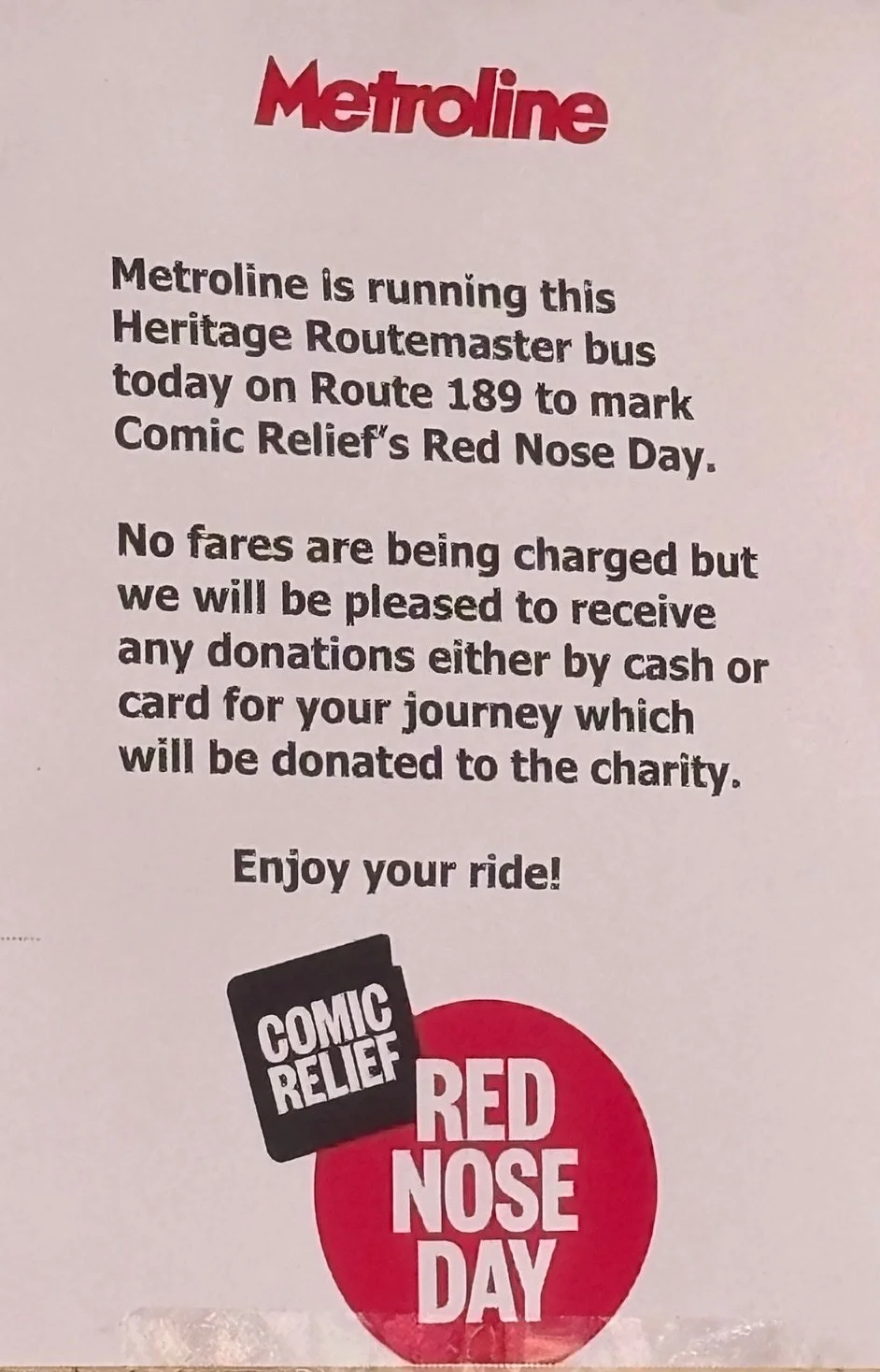
This poster inside RML903 explained the reason for the special operation.
Route 189: Brent Cross - Marble Arch
After a break of 10 mins or so, I reboarded RML903 at Brent Cross for the return run to Marble Arch. More of the same on this trip, with happy passengers enjoying the atmosphere and the “ding ding” on the bell by the conductor every time we set off from a stop. This was my first time on a crew operated bus on the 189, which never officially had this form of operation, being OPO from the start, although the route it partly replaced, the 16A, did host RMLs for a time.
I arrived back at Marble Arch well satisfied after a slightly longer journey of 65 mins, partly caused by heavier traffic in Abbey Road and Lisson Grove on this trip.
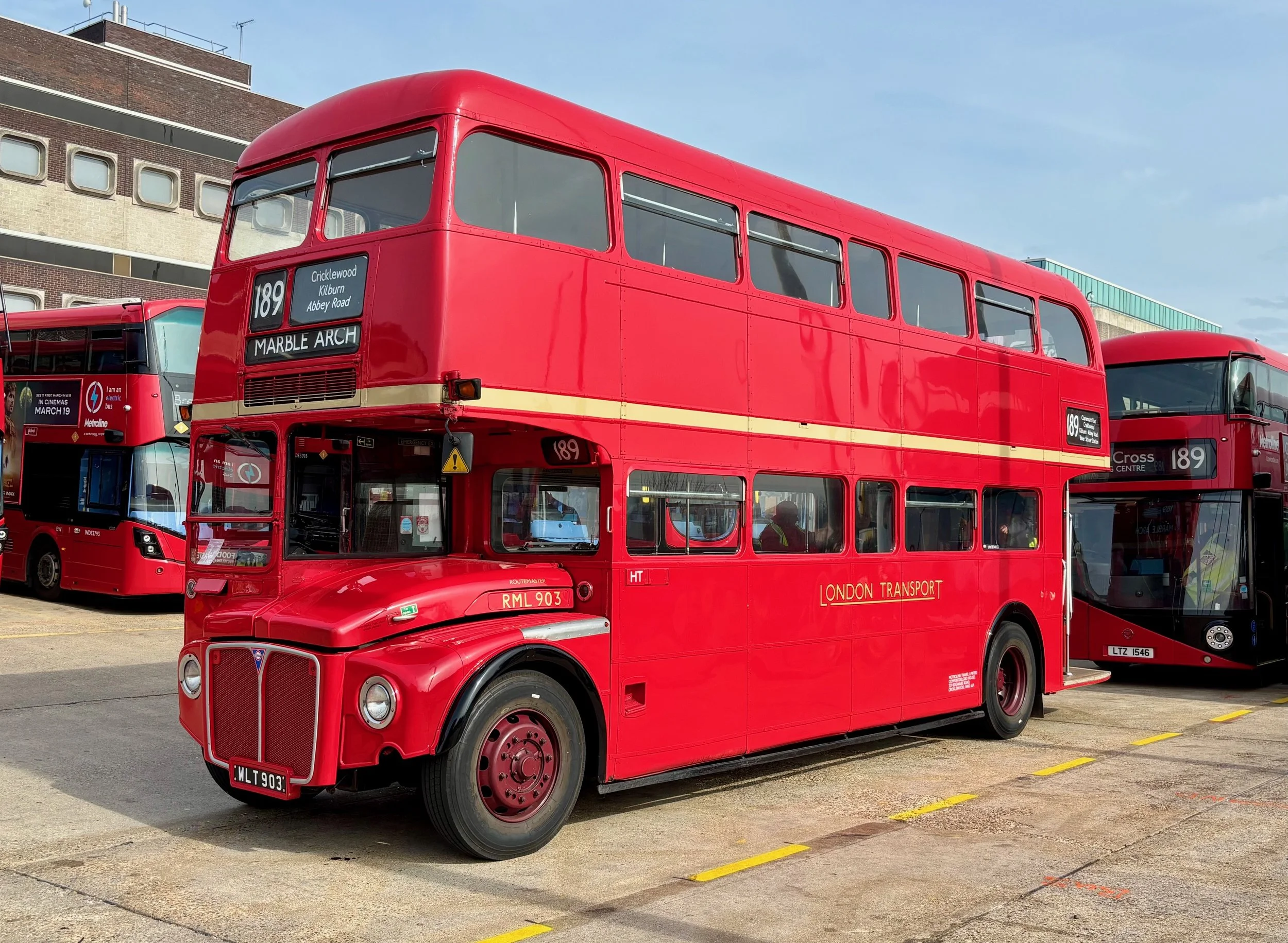
Nearside view of RML903 at Brent Cross Shopping Centre between my rides aboard, with a normal service LT on the 189 tucking in behind.
This RML was one of the initial batch of the type introduced in 1962 for Trolleybus Replacement Route 104 between Barnet and Moorgate.
Route 189 History
The current 189 has always been operated by Metroline out of Cricklewood (W) Garage. It began in 1997 between Kilburn Park and Brent Cross, replacing the link formerly provided by the 16A between Kilburn and Brent Cross, although via a different intermediate route. It was extended from Kilburn to Oxford Circus in 1998, but then rerouted at Selfridges to Marble Arch in 2017. A double-run to serve the new Brent Cross West Station was added in 2024.
The 189 was initially single deck with DLD class Darts but was double-decked in 2003 with TP plus a few TA type Tridents, although these were later supplanted by TE class Enviro400s. Conversion to the present New Routemasters came in 2016.
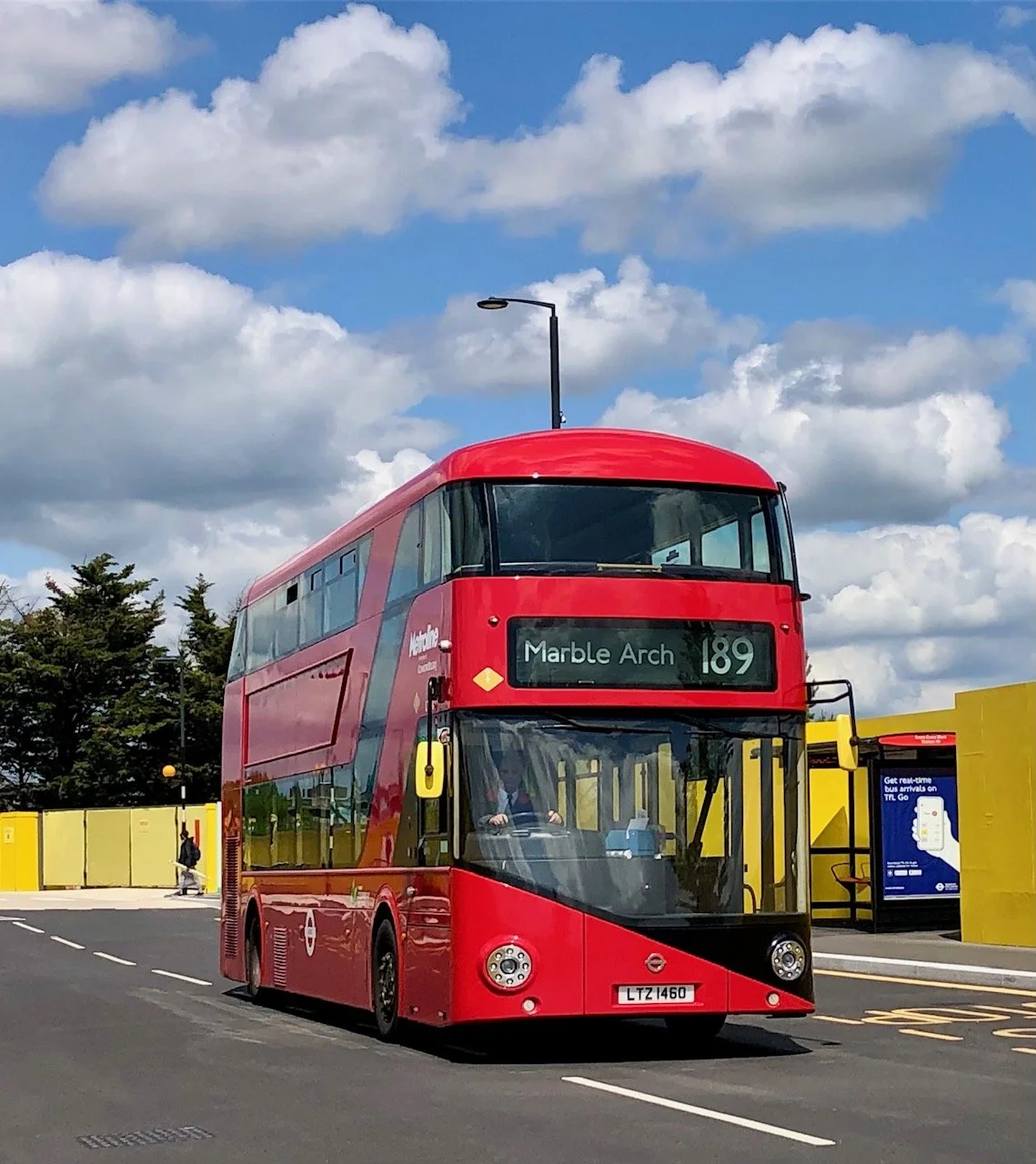
New Routemaster LT460 of Metroline’s Cricklewood (W) Garage represents the usual allocation on the 189 and performs the double run to serve Brent Cross West Station back in May 2024.
The route was diverted to this point in February 2024 soon after the new station opened.
Tube: Marble Arch - Ealing Broadway
From Marble Arch, I adjourned to the Central Line for the 20 min journey to Ealing Broadway, where I sought out my next Red Nose Routemaster!
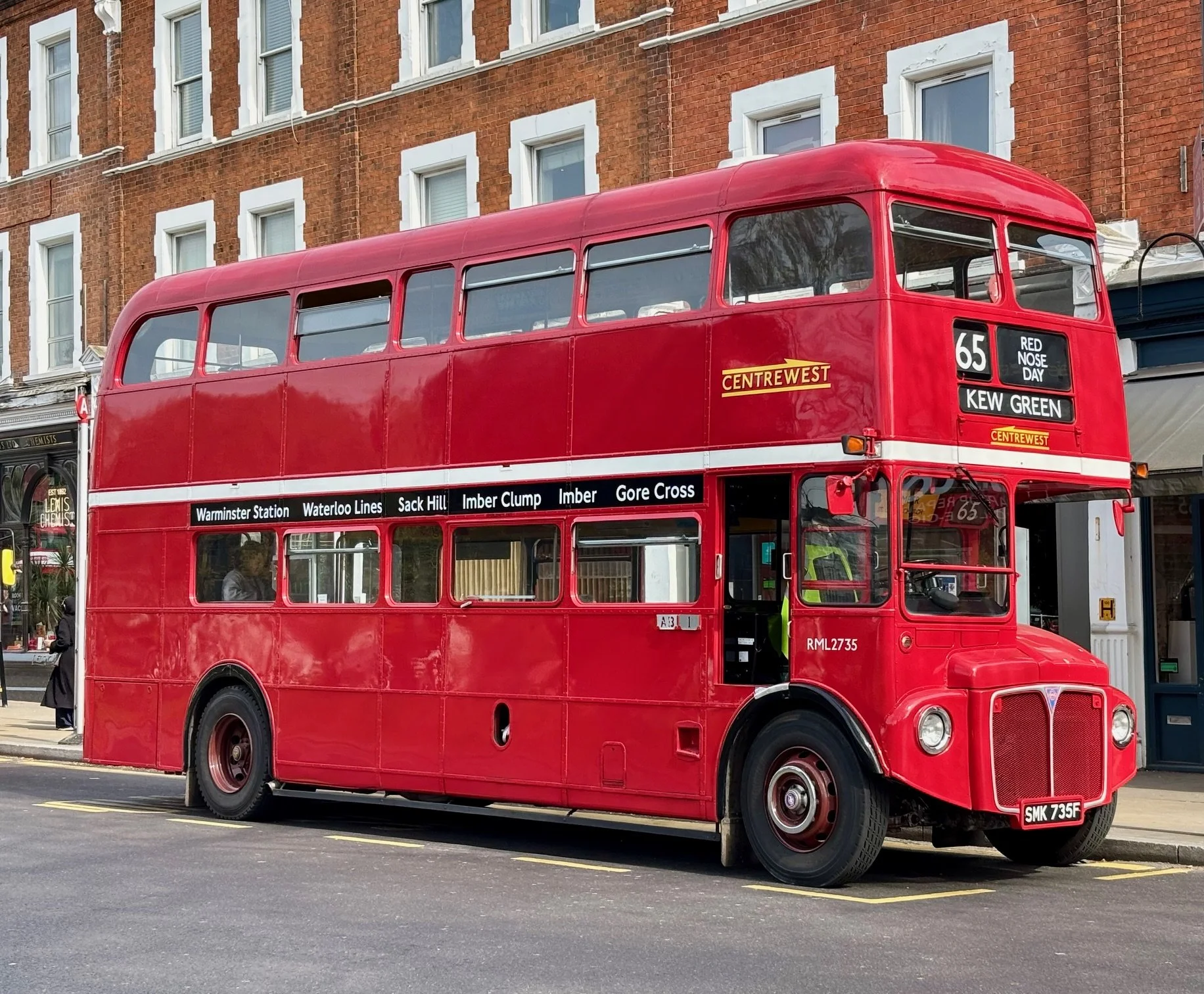
RML2735 is owned by Lord Hendy and kept at the London Bus Museum and was one of two Routemasters which turned out on Route 65 for Red Nose day, as the via blind shows. Pictured at Ealing Broadway Station before setting out for Kew Green.
The “Centrewest” fleetnames refer to its time with that operator, whilst the places listed on the side of the bus are the points served on an the annual Routemaster Running Day between Warminster & Imber in Wiltshire.
Route 65: Ealing Broadway - Kew Green
My second route of the day was the 65, on which the London Bus Museum was running a couple of Routemasters, although as there was no published timetable in this case, it was back to the old system of “dead reckoning” and using a bus enthusiast’s nose to sniff out the rare beasts!
Fortunately, only 15 mins or so after I arrived at Ealing Broadway, the unmistakeable shape of an RML came into view across Haven Green, which when it arrived at the stand turned out to be RML2735, owned and driven by Lord Hendy, former Transport Commissioner for London and more recently Chairman of Network Rail. Also on board, Leon Daniels, former Head of Surface Transport at TfL, who was sharing the driving. The smartly-attired conductor was from the London Bus Museum, where the vehicle is kept.
In contrast to the example I had ridden earlier on the 189, RML2735 was one of the last batch of Routemasters to be delivered to London Transport in 1967. It passed to Centrewest on privatisation and was used in a special operation on the first day that First (!) took on the contract for Route 61 (Bromley - Chislehurst) in 1995. It is preserved in the livery from this era although a nice touch is the addition of signwriting above the lower deck side windows listing points served on the annual “Imberbus” heritage operation in Wiltshire between Warminster and the normally closed village of Imber.
After a short break at Ealing Broadway, we departed on the 65 with Leon Daniels in the driving seat, bound for Kew Green, part way along the route. As with the earlier ride, we soon picked up a decent load, with many passengers pleasantly surprised to see a traditional Routemaster in service instead of the usual bus. Some were a little confused, asking what number it was and where it was going, despite this being clearly displayed on the blinds! From Ealing, we made our way south through South Ealing across the Great West Road down to Brentford, where we swung left past the The Musical Museum and the London Museum of Water & Steam, before turning right to cross Kew Bridge over the River Thames.
We terminated at Kew Green after a run of around half an hour, where we paused for the lunch break. After a while on the stand, the other Routemaster out on the route arrived from Kingston, this being RM1400 which is also based at the London Bus Museum, both buses posing together on the stand for photos.
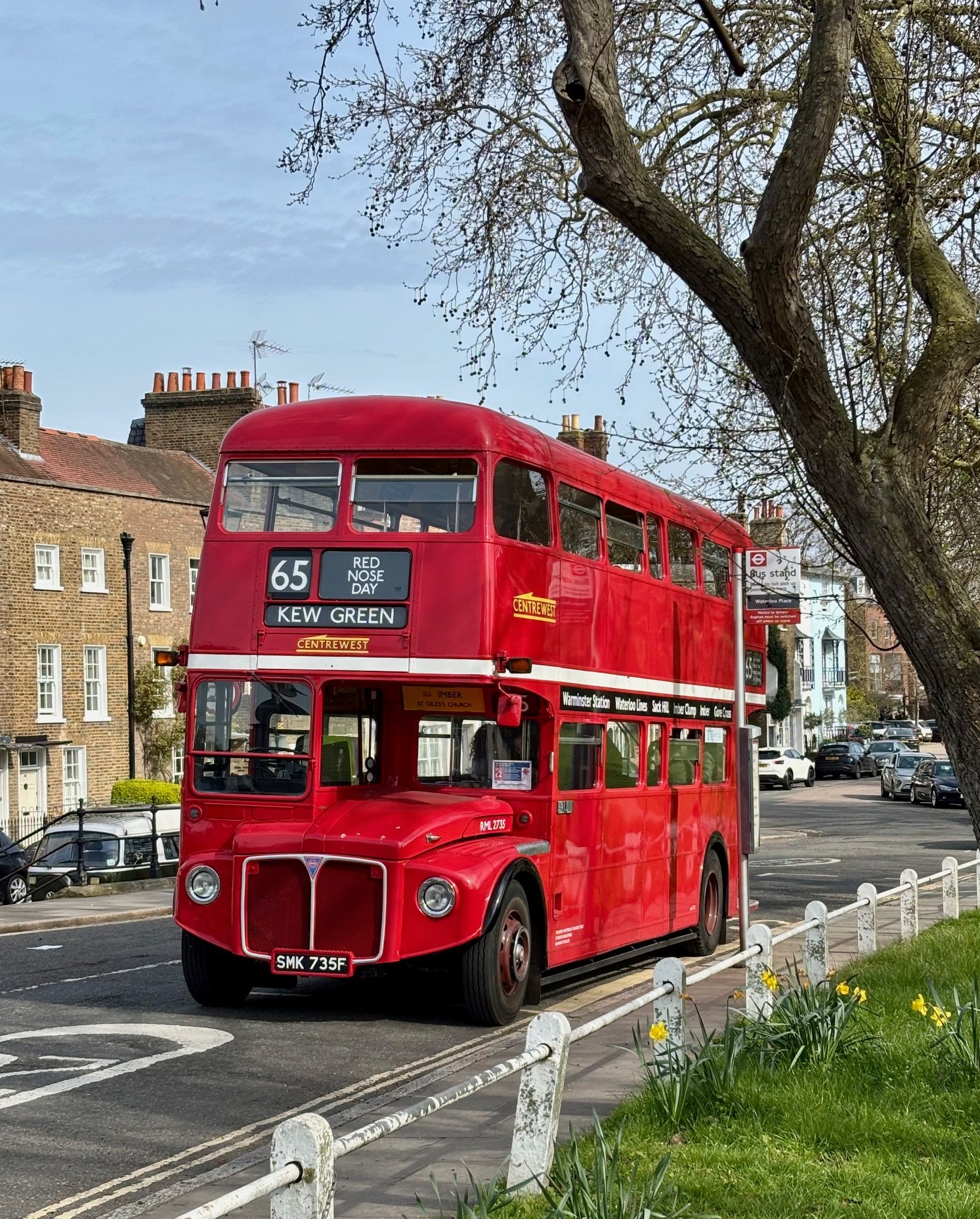
Nearside view of RML2735 on stand at Kew Green during the lunch break, after which I rode it over the remainder of the route to Kingston. This bus was one of the later examples and was new to LT in 1968.
The longer Routemasters were only officially allocated to the 65 for a short period in 1985-6 when Hanwell (HL) had a small allocation on Sundays only, although standard RMs were on the route from 1975 to 1986 provided mainly by Norbiton (NB) with Kingston (K) also joining in at different times.
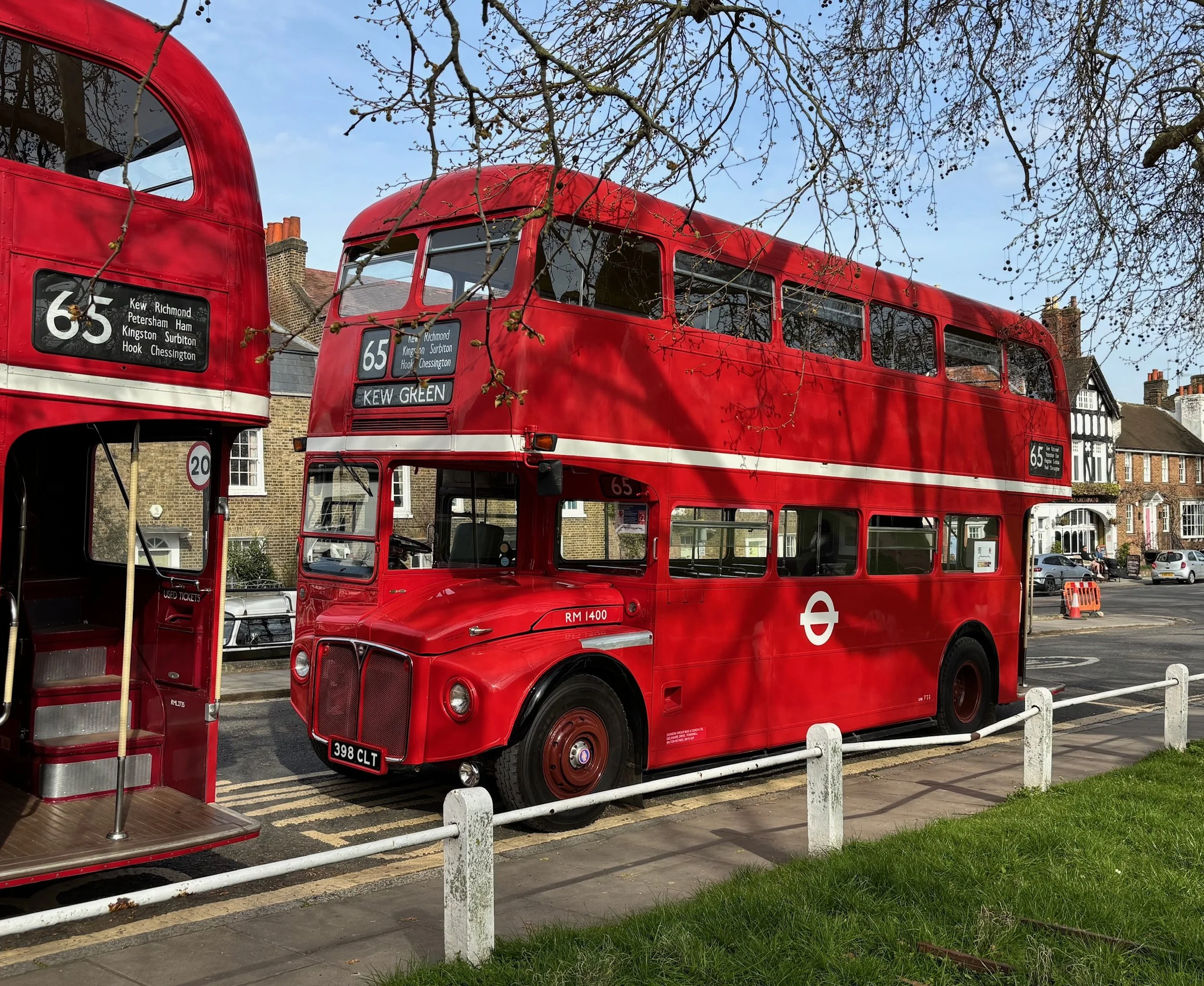
The other Routemaster out on the 65 for Red Nose day was RM1400 and has arrived at Kew Green behind RML2735.
This RM bears the later white band and roundel livery that the class carried in LT days. The 65 was converted from this type to OPO with Metrobuses in 1986.
Route 65: Kew Green - Kingston
After the break, I rejoined RML2735 which continued on its way from Kew Green to Kingston, whilst RM1400 headed in the opposite direction to Ealing Broadway. A decent run ensued at a fairly rapid pace where conditions allowed, as we continued via the gates of Kew Gardens down to Richmond. Making our way past the nicely restored Southern Railway frontage of Richmond Station, we followed the narrow streets of the one way system through the town, which was busy with Friday afternoon traffic.
Then along the pleasant stretch of greenery beside the river to Petersham, negotiating the narrow winding road where the famous “Petersham Hole” appeared in 1978-9, requiring the 65 to operate in two sections either side of the hole until it was filled in - unusually, crews walked with their passengers along the path beside the gap and took the next available bus parked on the other side to complete the trip!
Onwards through Ham, after which we encountered a crowd of home-going school students who piled aboard at a couple of stops. No doubt for many of them, their first time on a Routemaster but a journey home they are likely to remember for a long time. Soon we arrived into Kingston, depositing most of our clientele at Cromwell Road Bus Station, before continuing around the one way system to Eden Street and the terminus at Brook Street. There I alighted after a 45 min run which revived many memories.
However, this was not my first time riding old buses on the 65, as I attended a London Bus Museum Running Day over the whole original route from Ealing Argyle Road to Leatherhead Garage in 2021, when I had ridden preserved RTs, providing memories of an older era in the history of the service.
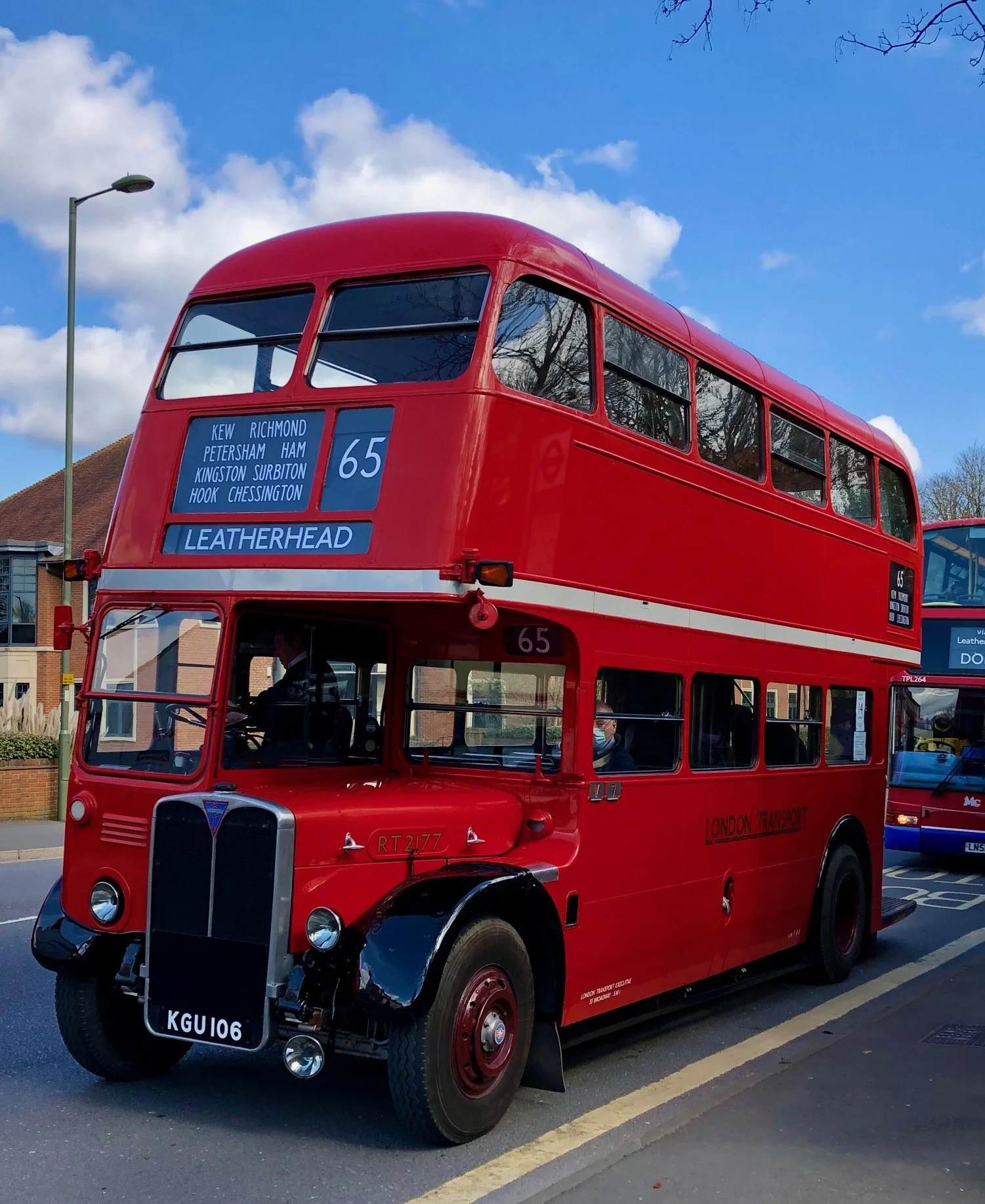
The 65 ran on beyond Kingston to Leatherhead until 1968 when it was cut back to Chessington Zoo. It was further retracted to Kingston in 1987. Preserved RT2177 is at the site of the old Leatherhead Garage terminus back in April 2021.
This was on the occasion of a London Bus Museum Running Day which recreated the whole of the original 65 from Ealing Argyle Road to Leatherhead.
Route 65 History
The 65 was a longstanding route which ran for many years between Ealing Argyle Road and Leatherhead via Ealing Broadway, Richmond, Kingston & Chessington. As part of Reshaping in 1968, the route was cut back from Leatherhead to Chessington (replaced by the 71) and withdrawn between Argyle Road and Ealing Broadway except in M-F Peaks, this section lasting until being withdrawn in 1982. The service was cut back again from Chessington to Kingston in 1987, with further changes to the 71 taking over that part of the route.
The 65 was associated with the RT type from 1948 to 1975, with the RTL variant also joining in during the early 50s. RM types took over in 1975 after several postponements, with a small RML contingent on Sundays only in 1985-6 provided by Hanwell (HL) to support the main RM allocation from Norbiton (NB). OPO came in 1986 using Metrobuses (with a few DMS types for a brief period). Tendering saw the route pass to London & Country with Atlanteans in 1990, but the contract passed to Armchair Travel in 1991 who used Atlanteans then Olympians. London United assumed control in 2002 with TA class Tridents, later replaced with SP type Scania OmniCities, although VH class Volvo Hybrids also appeared. The current BCE type electrics arrived in 2021, with ownership of London United passing to First Bus London in 2025.
There was also a suffixed variant, 65A, which had two incarnations:
1950-51, Ealing Argyle Road to Copt Gilders Estate, with RT/RTL. Basically, a bifurcation of the main 65. This was replaced by the 265 after just a few months.
1963-68, route as above but on Suns only with RT to replace the 265 on that day. It became daily from 1966 and was extended to Chessington Zoo on M-F and Leatherhead Sat/Sun, partly replacing the withdrawn 265 on M-S and the main 65 at weekends. The parent route became daily again in 1968 and took over the Copt Gilders routeing, negating the need for the suffix. The 71 then assumed the direct Hook - Chessington route vacated by the 65.
And Finally…
As usual with these special operations, thanks are due to the vehicle owners and volunteers who made the day possible. Long may they continue!
Watton
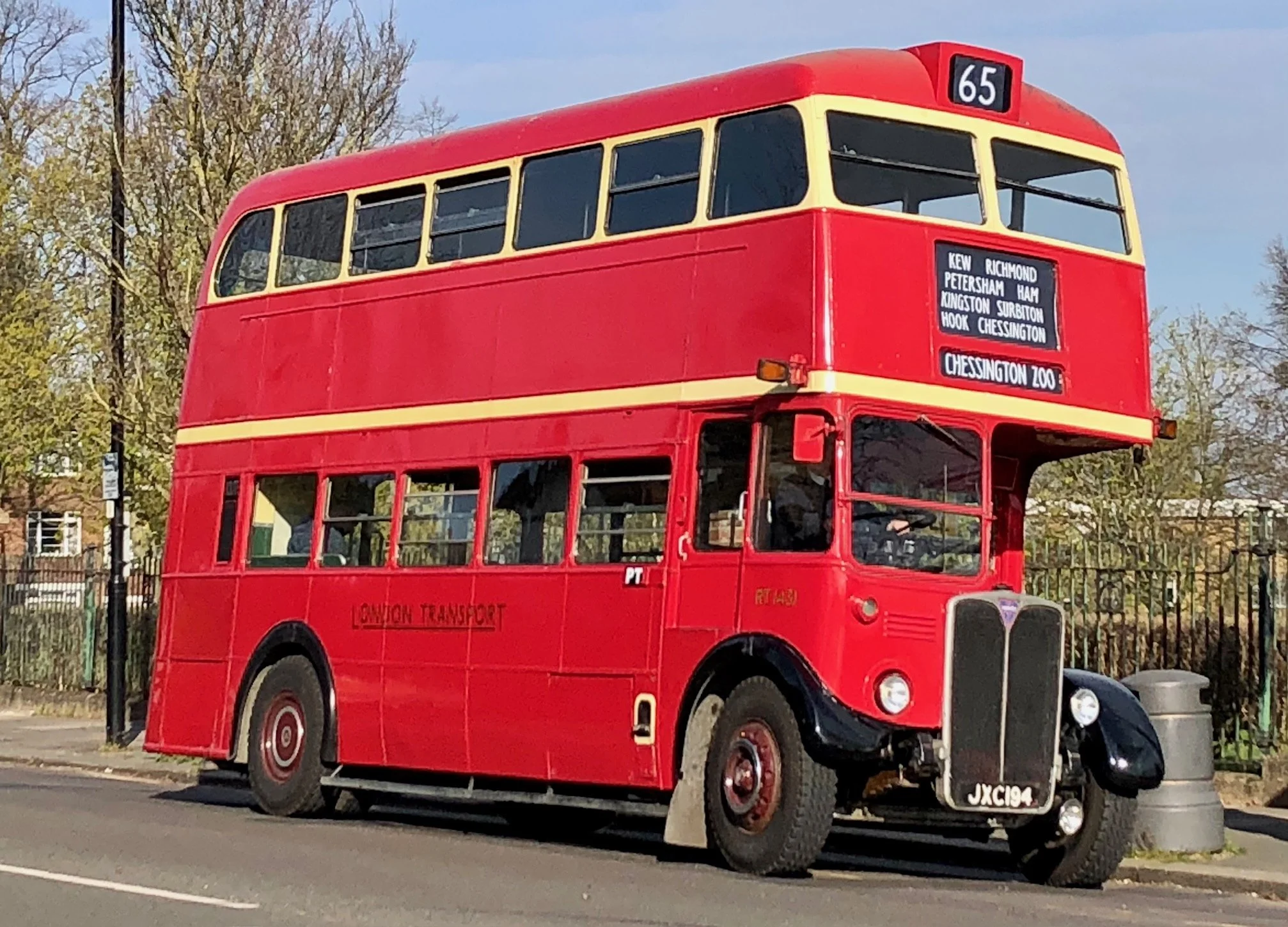
One of the unusual Cravens bodied RTs, RT1421, is seen on the April 2021 Running Day at the other end of the original 65 route at Ealing Argyle Road. This terminus became M-F Peaks only in 1968 and was withdrawn completely in 1982 when the whole daily service was truncated at Ealing Broadway.
The Cravens RTs were non-standard in the LT fleet and suffered early withdrawal in 1956, although many went on to give further service elsewhere.
