
Barneying in Barnes
This time, a trip to the Barnes area of South West London, in order to ride the revised local bus services following changes introduced on 15th August 2026, top and tailed by journeys on a couple of trunk routes.
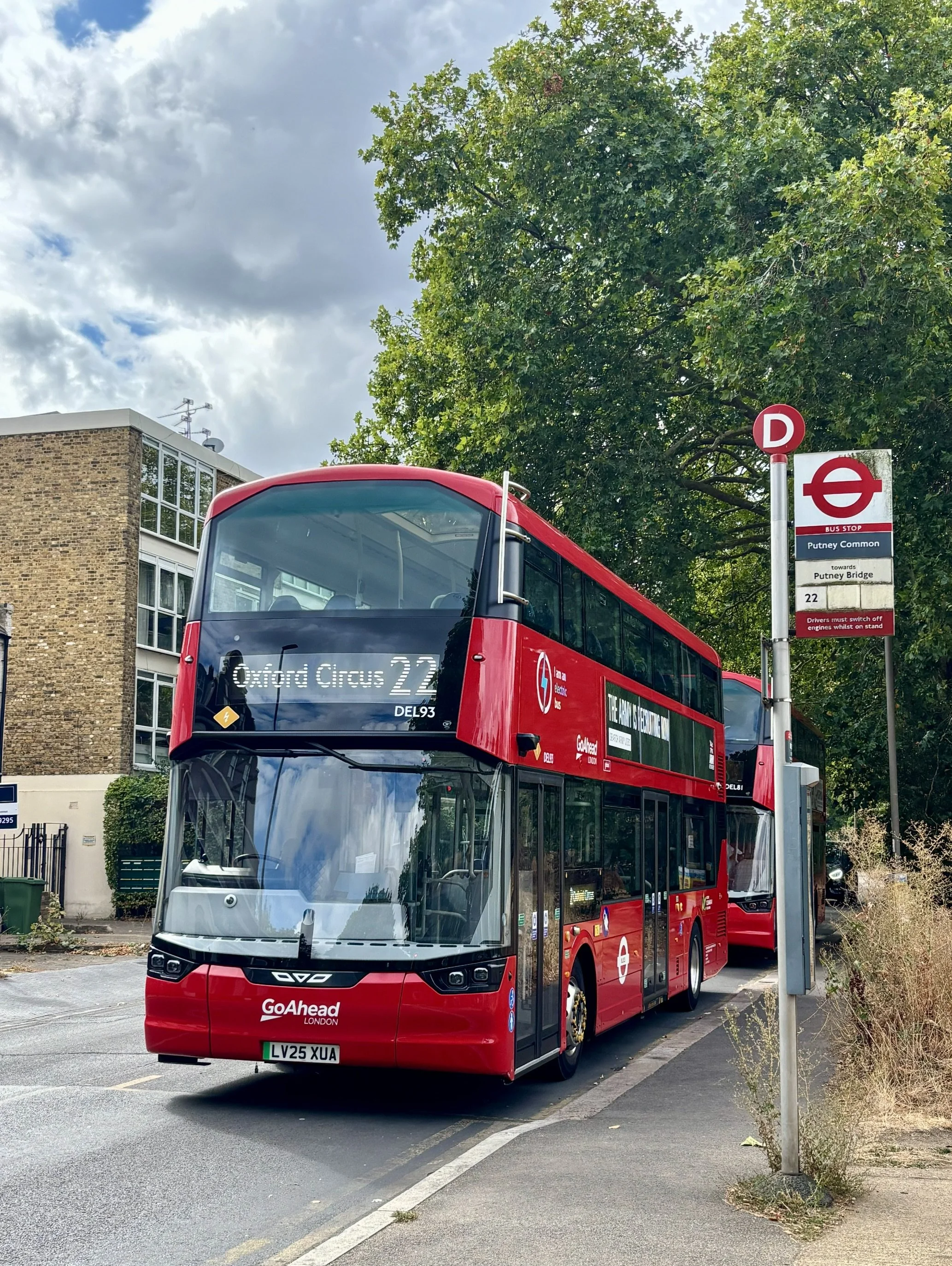
Trunk route 22 (Oxford Circus & Putney Common) has been converted to electric buses over recent months. GAL’s Wright StreetDeck Electroliner DEL93 of Putney (AF) Garage is at the time-honoured stand opposite The Spencer Arms at Putney Common.
I had travelled on another class member, DEL81, to this point from Oxford Circus, the vehicle just visible behind.
Route 22: Oxford Circus - Putney Common
I began my day at a quiet Oxford Circus before the tourists and shoppers arrived. Ascending from the Underground, I made my way towards Margaret Street, first pick-up stop of the 22, with views of All Souls Langham Place in front of me and the famous BBC Broadcasting House beyond opened in 1932 as the UK’s first purpose-built broadcast centre.
The 22 was converted over several months earlier this year to new electrics by GAL as part of its contract renewal terms, so a first chance for me to try them out. I only had a 5 min wait for DEL81, one of the Wright StreetDeck Electroliners which now form the allocation from Putney (AF) Garage. Boarding with a few others, we were soon gliding across Oxford Circus and into Regent Street, before turning off around the back streets, where progress was slow due to numerous parked cars and delivery vans impeding us. A builder’s lorry caused a couple of minutes delay in Berkeley Square, but a few toots from our driver caused him to move off the road and allow us through. At Green Park, we swung right and exchanged a couple of passengers at the station, before a free run beside the park to Hyde Park Corner, which fortunately was free-flowing at this hour.
A reasonable run down to Sloane Street and along it to Sloane Square, before more congestion encountered through Chelsea past the Old Town Hall, which is always a sticky spot. On via Worlds End and Wandsworth Bridge Road to Parsons Green, where the traffic seemed to vanish (as did any passengers!) and we hardly stopped at all on our way to Putney Bridge Station / Fulham High Street. Crossing the Thames over the bridge, we turned right on the final stretch past Putney Pier to the terminus at Putney Common. Unlike hostelries at many famous terminals, the “Spencer Arms” PH seemed to be alive and thriving. At a couple of minutes under the hour, it wasn’t a bad run considering.
The 22 was a traditional cross-London route between Homerton and Putney Common for many decades, with allocations at each end featuring various garages over the years. Famously, it was the very first route to host RTs, with the prototype RT1 operating from Putney (AF) Garage towards the end of 1939, although when the production batch of “Pre War” RTs started there in early 1940 (initially for the 37), the spare bus often popped up on the 22. STLs were the main type until 1951, when RTWs replaced them and enjoyed a relatively long tenure until 1966. After just a few months with RT/RTL operation, the route was converted to RM in 1967.
In 1987, the Sunday service went over to OPO with Ms and Ts, whilst the M-S service saw the longer RMLs take over. The same year saw the eastern section hived off to new route 22B between Homerton & Trafalagar Square with OPO Ts, initially only M-S as the Sun (OPO) service continued to run through as the 22 until 1990 when the 22B became daily. The 22B retracted in Central London over subsquent years, first to Piccadilly Circus, then to Tottenham Court Road, before being renumbered 242 in 1998.
Meanwhile, the plain 22 also shrank, its initial new in-town terminus of Bloomsbury being cut back to Piccadilly Circus in 1990. By now operated from Putney (AF) and Victoria (GM) with a part Sunday share from Merton (AL), it lost the GM allocation the following year. By 2005, it had become one of the last crew operated routes in London and was converted to OPO with WVLs from AF, although the Sunday Merton allocation continued for a while with PVLs. In 2017, hybrids took over, with EH, MHV and WHV types appearing, but the AL Sunday portion finally came off and the route became an all AF operation. DEL electrics took over in 2026, Go Ahead being the operator throughout the period of tendering.
I mentioned the 22B, but there was also a 22A, which came in 1972 between Clapton Park Estate, Homerton & Liverpool Street, always an OPO route, initially with DMS. This was extended to Wapping on Suns only in 1975, but this became daily in 1979 when the M-S 67 was withdrawn over this section. The early 80s saw the DMS types replaced by Ts and then Ms. In 1990, the service was rerouted at the southern end to London Bridge and passed to Kentish Bus with Olympians (as did the 22B at this time). When the 242 replaced the 22B in 1998, the 22A was also withdrawn, being also replaced by the 242 and by an extended 149.
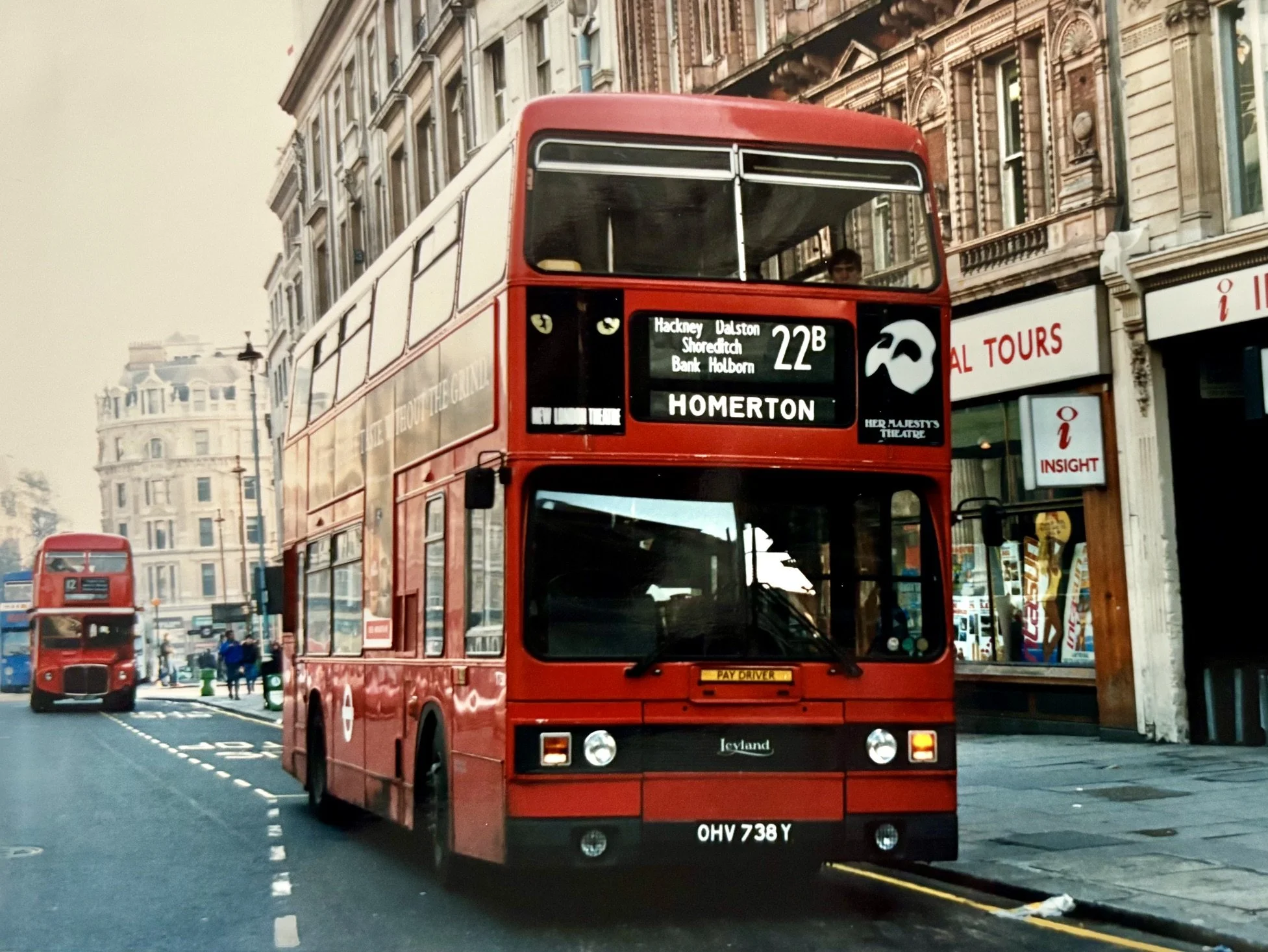
The 22B was a new route in 1987 to enable the OPO conversion of the eastern section of the 22 between Homerton & Trafalgar Square, where Leyland Titan T738 of Ash Grove (AG) Garage is seen soon after the route began. Initially running Mon-Sat only, the parent 22 continued to run through on Sun (but in OPO mode) until the 22B became daily in 1990.
The Central London terminus of the 22B was cut back first to Piccadilly Circus and then to Tottenham Court Road, before the route was renumbered 242 in 1998.
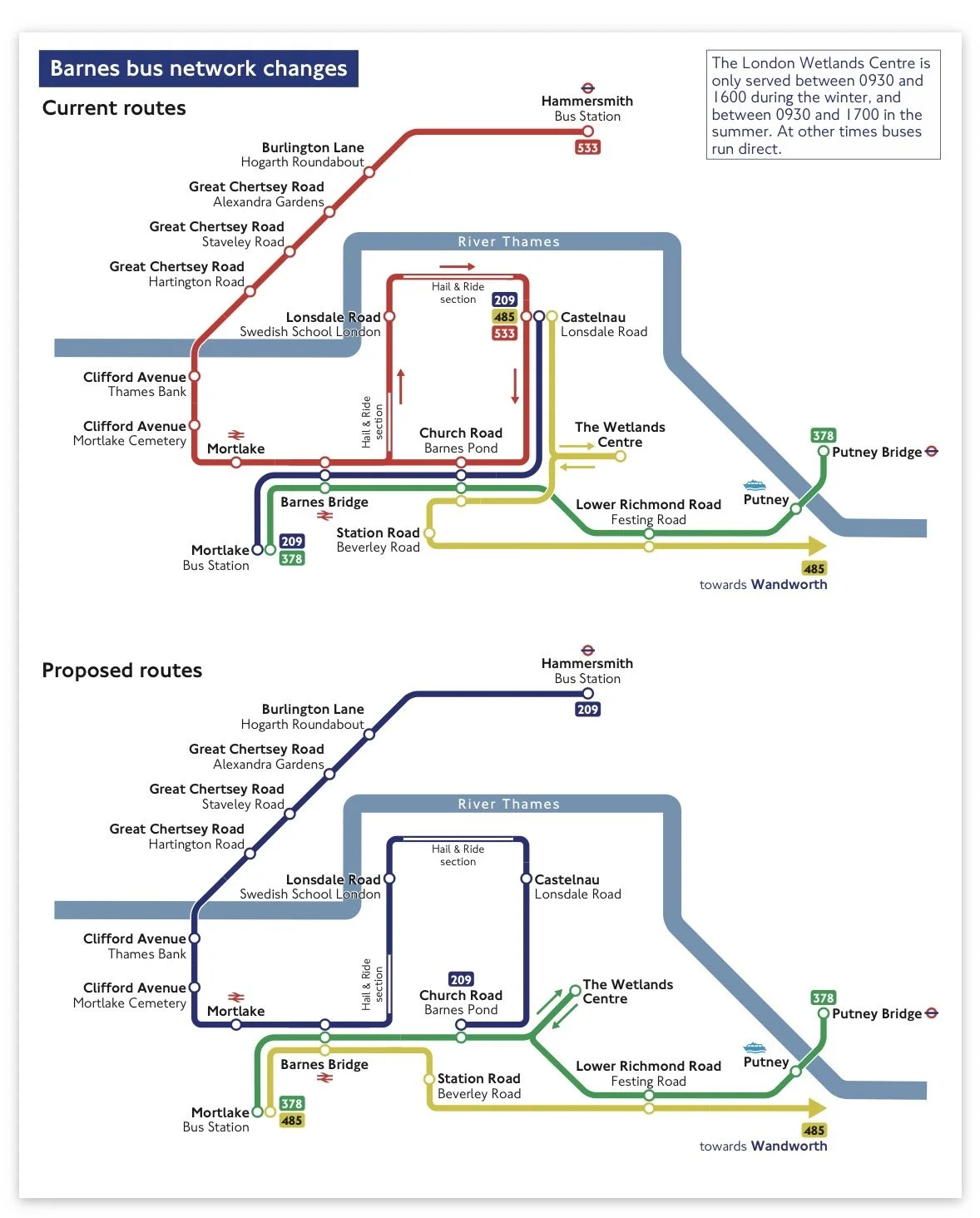
Changes to the bus network in Barnes were implemented as from 15th August 2026. TfL produced this consultation diagram in advance, which shows the “before” and “after” situation.
The net effect was the withdrawal of long-term temporary route 533, which was largely replaced by the restructured 209, together with more minor changes to the 378 and 485.
Part Route 378: Putney Common - Putney Bridge
At Putney Common, I turned my attention to the routes affected by the Barnes Area changes, which were enacted on 15th August 2026. First on the list, the short local 378 between Mortlake & Putney Bridge. Previously operated by GAL with SE class Enviro200 MMCs, Transport UK took the contract from the August changes.
Intended for electric single deckers, only a few were available initially, so a mixed bag of Enviro200s was brought into Battersea (QB) Garage to help out in the interim. I began by riding the short section from Putney Common back to Putney Bridge aboard Enviro200 no 8322, an elderly “10” reg example but still in good form. Just an 8 min trip on a surprisingly full bus.
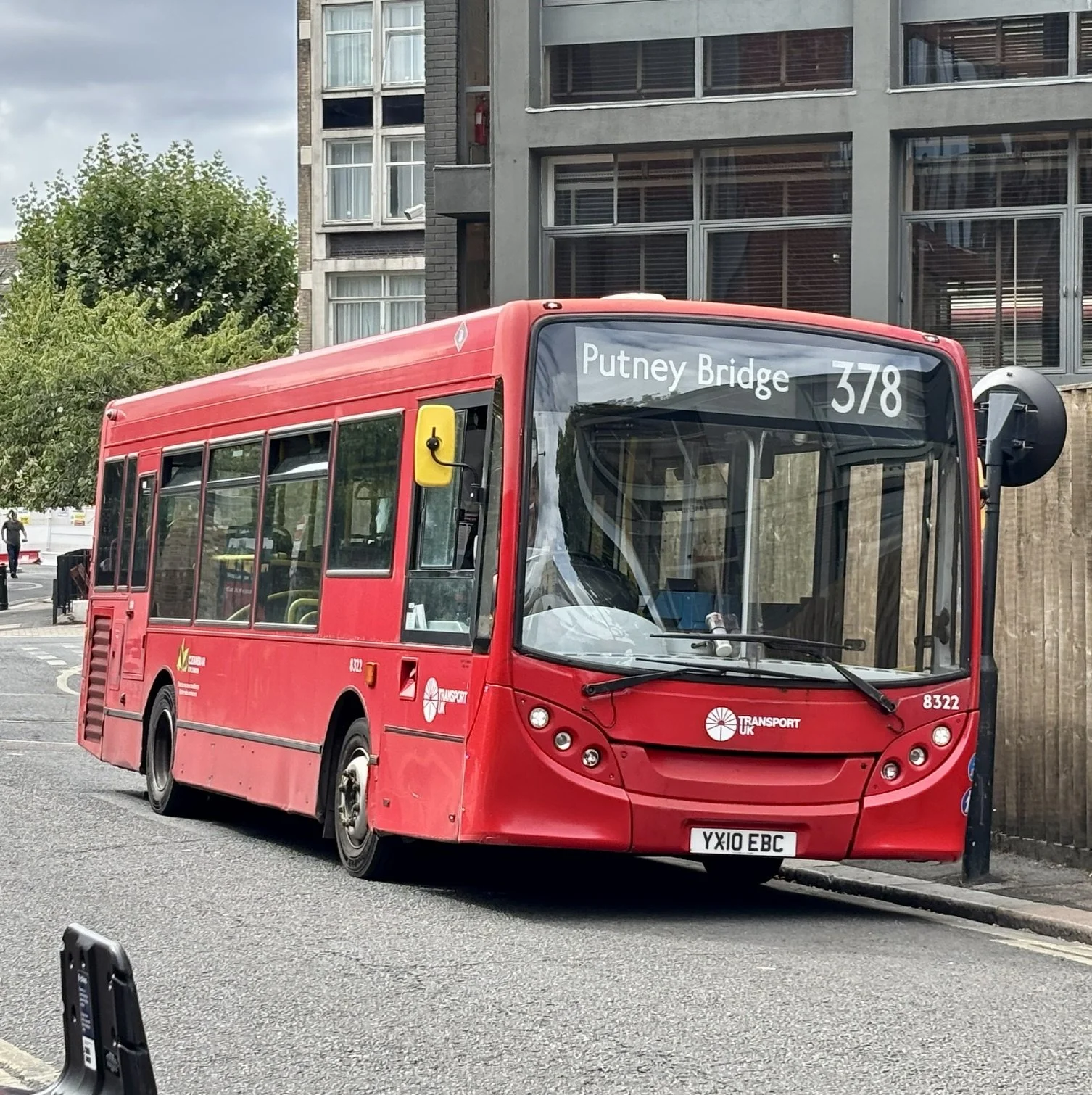
The 378 passed from GAL to Transport UK with the 15th August changes. Elderly Enviro200 fleet no 8322 of Battersea (QB) Garage is at Putney Bridge between my rides on it.
The route has received a short extension and now picks up outside Putney Bridge Station on return to Mortlake, in addition to the stop at the north end of the bridge itself. Also, it now performs a double run to serve The Wetlands Centre, taken over from the 485.
Route 378: Putney Bridge - Mortlake
As we arrived at Putney Bridge, the 378 in front was just leaving, so I had nearly 15 mins to wait before 8322 commenced its return trip. A small change has been made here, in that Mortlake-bound buses now pick up more convienently outside the Underground Station, rather than enforcing a walk to the next stop at the north end of the bridge. I was the only passenger at first, but we picked up a few at Putney Pier and had just a single digit load for the rest of the trip. Incidentally, a couple of stops further on, at Festing Road, I recalled that this was where the author David McKee lived and wrote his “Mr Benn” books which later became an animated BBC series for children. Mr Benn lived in the fictional Festive Road, inspired by the author’s address, a commemorative pavement slab later marking the spot.
Back to the Spencer Arms once again, where this time we continued across the greenery of the common, turning right into Rocks Lane and up to the “Red Lion”, where we performed the short double-run to the Wetlands Centre, which was transferred from the 485 to the 378 with the August changes. No-one on or off there, but worth a visit if you are so-minded, to see the lakes, pools and gardens featuring wild birds and otters. Back at the Red Lion, we continued on through Barnes, calling at the Pond and the High Street, before the stretch beside the river to Barnes Bridge Station. Then on to what TfL call Mortlake, but is actually a little short of that location. Indeed, in early days, buses displayed “Barnes Avondale Road”, before it became the more familiar “Mortlake Garage” and then “Mortlake Bus Station” we know today. We terminated there after a run of just 22 mins from Putney Bridge.
The current Bus Station is tiny and can take just 2 buses (or 3 at a push!). It is built on part of the site of the old Mortlake Garage, the rest of which has been given over to housing. This garage was known for its all RM fleet in the last 20 or so years of its life before it closed in 1983 and had a reputation for turning out buses in immaculate condition on its main route the 9 (and Sunday 9A), together with small allocations on the 33 & 73 at different times.
The 378 was new only in 2019, taking over from the 209 which had been rerouted to Putney Bridge only months earlier when Hammersmith Bridge was closed to provide a link to the Underground for Mortlake residents. Operated by Metroline for just a couple of weeks with DEs, GAL then took the contract using SE class Enviro200 MMCs, until the latest transfer to Transport UK.
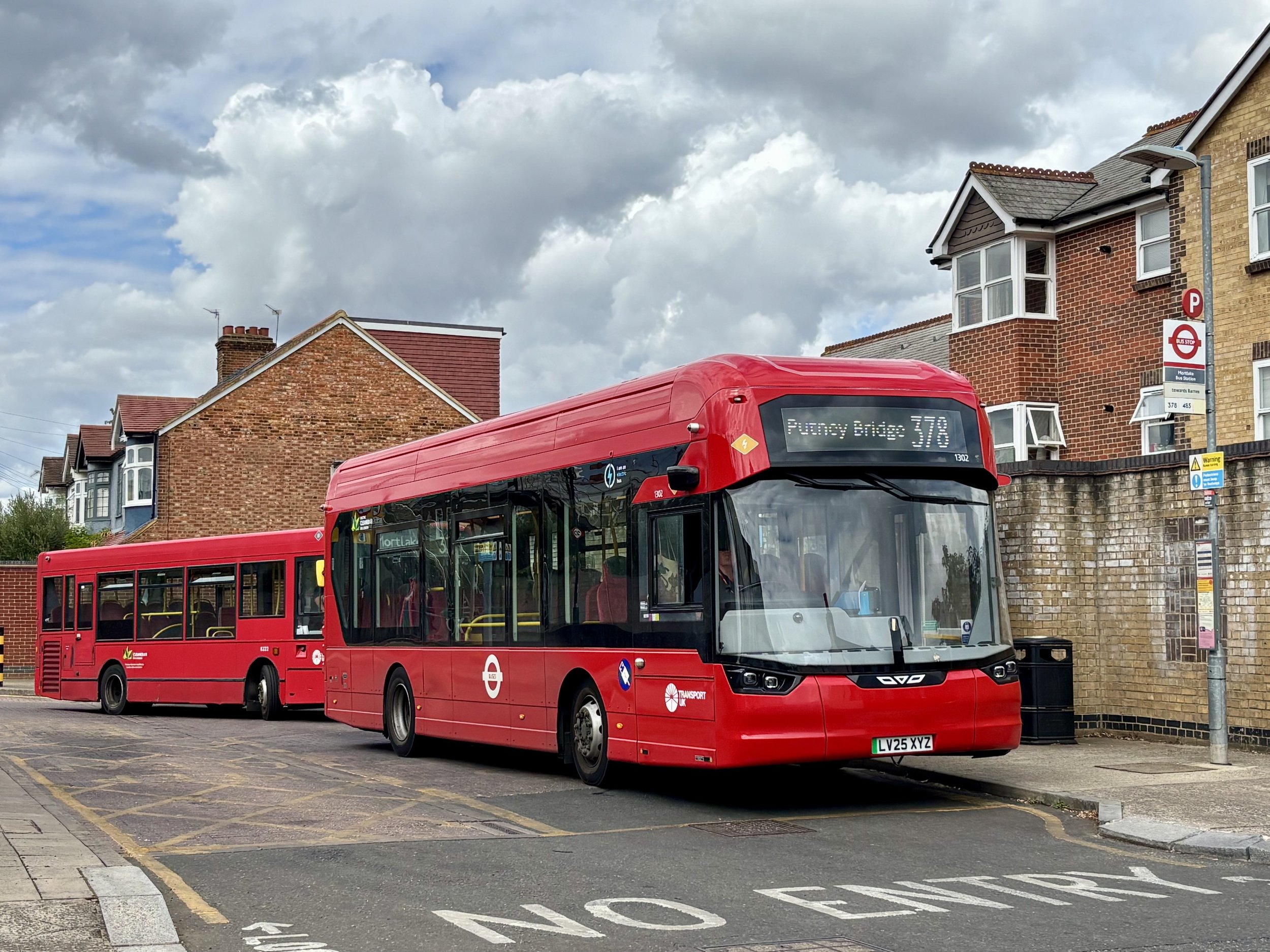
The 378 is intended for electric vehicles, but at the time of this visit, only 2 or 3 a day were available. Wright Kite Electroliner 1302 (QB) was one of those out on the route when I travelled and is seen at Mortlake Bus Station. The 378 & 485 interwork from here and so these buses appear on both routes.
In the meantime, the balance of the allocation is made up of a motley collection of Enviro200s, like 8322 seen behind on the stand.
Route 485: Mortlake - Wandsworth
Unlike the 378, which is every 15 mins M-S daytimes, the 485 is only every 30 mins. Both services are now operated by Transport UK under the new arrangements and interwork at Mortlake Bus Station, switching from one route to the other, quite rare in London although common elsewhere in the country. The next incoming 378 after mine was formed by Enviro200 no 8583 (QB) and changed to a 485 on arrival. After switching drivers, we departed, returning along Avondale Road and then turning right towards Barnes Bridge, before serving Barnes High Street, this being a new section for this route, which used to run to Castelnau rather than Mortlake prior to the recent changes.
At Barnes Pond, we turned right along Station Road beside Barnes Green, then turning left into Mill Hill Road across the common before joining up with the 378 once again. Back via Putney Common to Putney Pier, then right past St Mary’s Church before swinging left into Putney Bridge Road and alongside Wandsworth Park. We did the loop around the new Wandsworth Riverside Quarter development where we picked up a couple of passengers, before continuing into Wandsworth itself, terminating in Ram Street. Just over half an hour trip time.
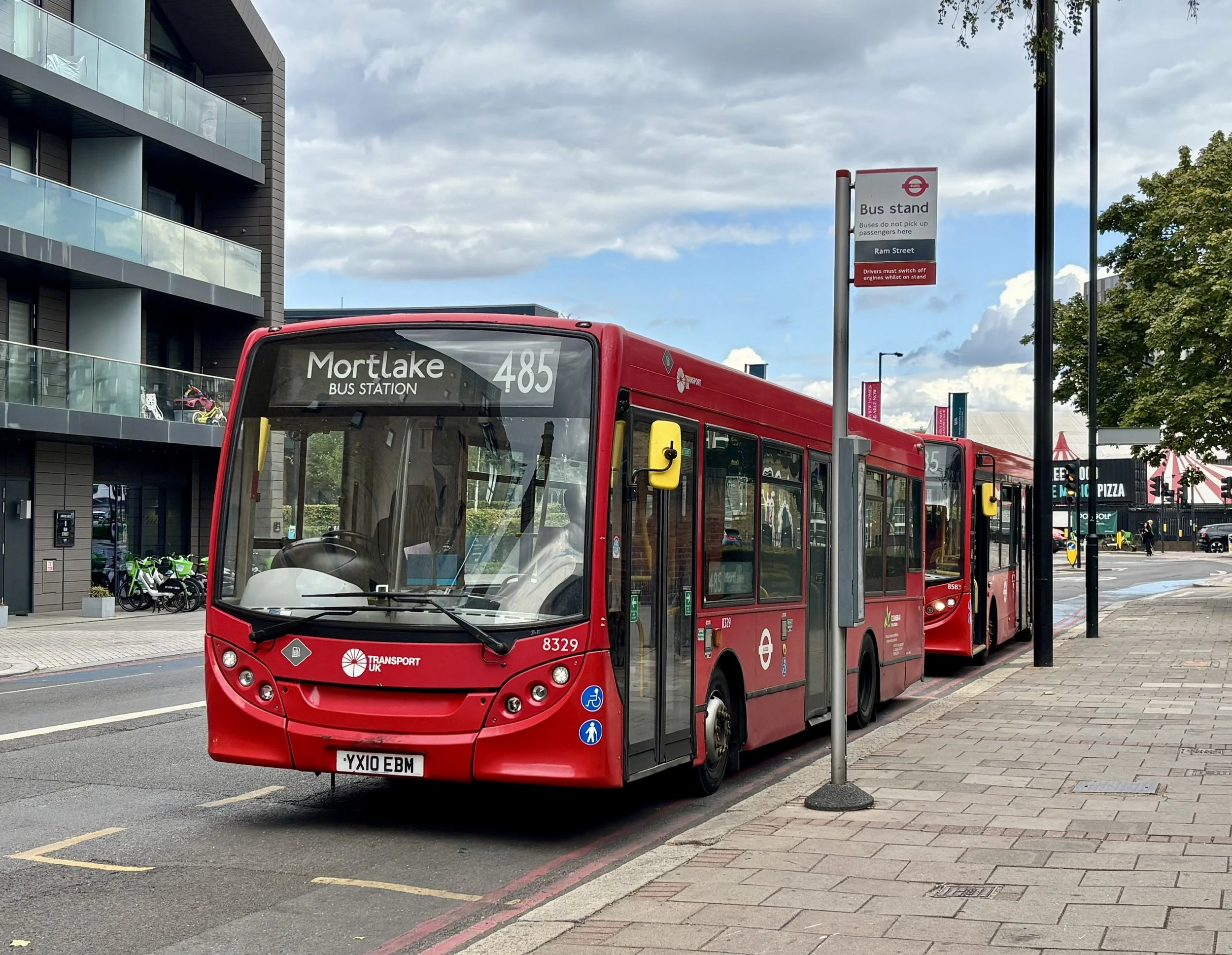
Transport UK were already operator of the 485 before the 15th August changes, with Enviro200 no 8329 of QB Garage seen at Wandsworth Ram Street before I rode it back to Mortlake. I had arrived here on slightly newer Enviro200 8583 behind.
The 485 was rerouted at the Barnes end with the latest changes to run to Mortlake rather than Castelnau.
Route 485: Wandsworth - Mortlake
Despite arriving 10 mins or so before the next departure time, there was another 485 on the stand ahead, another “10” reg Enviro200, no 8329, meaning that buses appear to have a 40 min or so break at this point on the 30 min frequency at certain times. First pick up westbound is around the corner at Southside Shopping Centre and I was the sole person boarding when 8329 departed.
A slightly quicker run in this direction, with less traffic and fewer passengers to impede us. Reverse of the outward route back to Mortlake Bus Station, taking a couple of minutes under the half hour on this occasion.
The 485 dates back to 1998, starting as a very different animal between Richmond, Mortlake, Barnes, Roehampton, Kingston & Ham. It was operated then by Arriva with a couple of Mercedes midibuses in M-S daytimes only, replacing parts of the former K6 and R61. The contract was reassigned to Tellings Golden Miller in 1999. In 2000, it was rerouted in the Barnes area and cut short to Kingston, the Ham section replaced by a revised K5. Further changes in 2001 saw the service pass to Armchair Passenger Transport using Darts, with a further cut back to Roehampton, the Roehampton Vale - Kingston section going to an extended K3. Then, in 2003, it was rerouted away from Roehampton to Wandsworth.
The next contract change in 2006 saw the route withdrawn between Barnes & Richmond and rerouted instead to Hammersmith. By now, the operator was London General using LDP Darts, although in later years SE type Enviro200s and SOE type Darts replaced the LDPs. The Hammersmith Bridge closure in 2019 saw the route curtailed on the south side at Castelnau. The double run to serve the Wandsworth Riverside Quarter was added in 2023, when a new evening and Sunday service was introduced. The contract was reassigned to Transport UK in 2025 with Wright Kite Electroliners, which now provide part of the 378 & 485 allocation. The final change involving the rerouteing away from Castlenau to Mortlake came with the August 2026 scheme, together with the swap of the Wetlands Centre double run from the 485 to the 378. A complicated history!
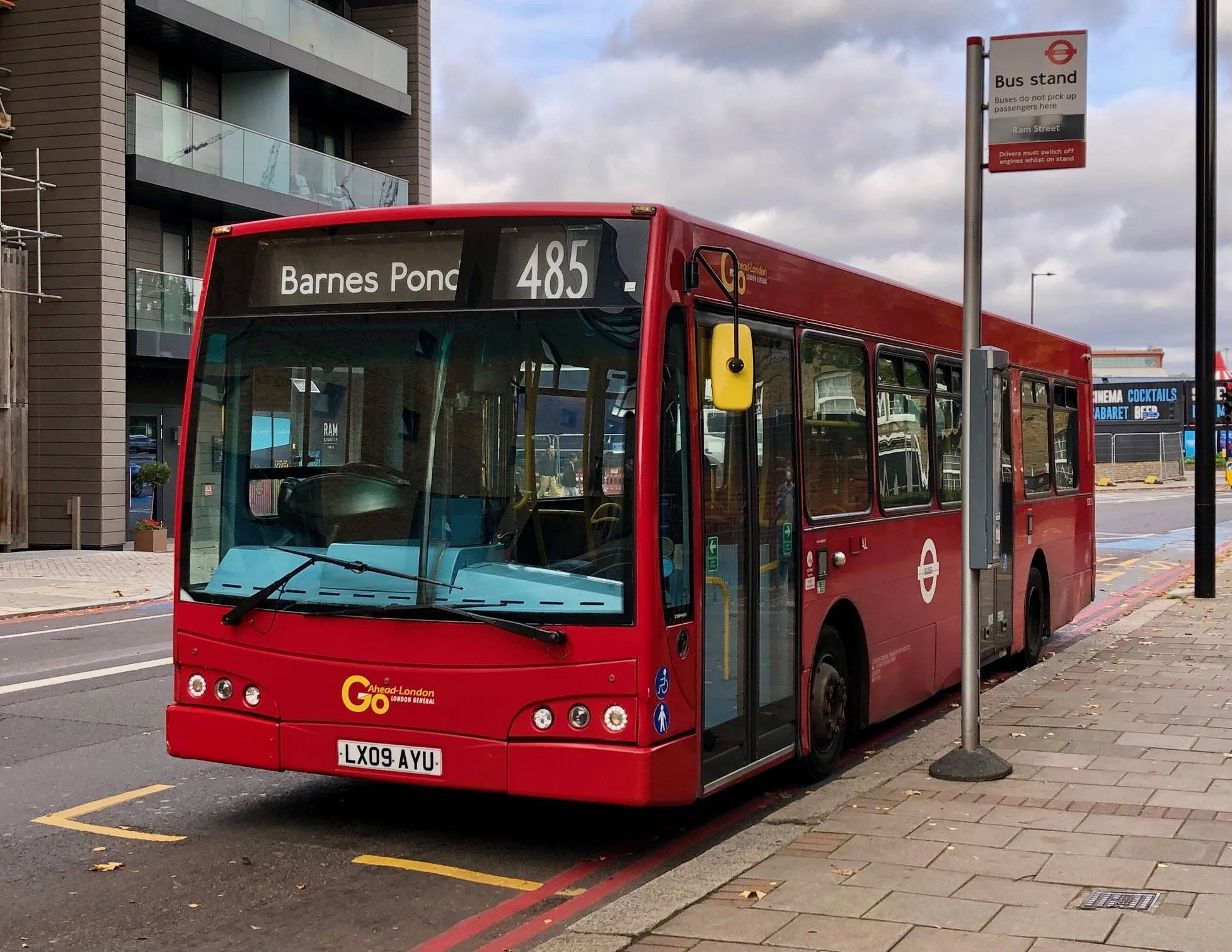
Back in October 2022, when GAL were still in charge, we see Enviro200 Optare Esteem SOE13 of Plough Lane (PL) Garage on the 485 at the Wandsworth Ram Street stand. The contract passed to Transport UK in 2025.
Despite what it says on the blind, the bus was going to the then destination of Castelnau, at the south end of Hammersmith Bridge. This type is now extinct in London.
Part Route 209: Mortlake - Barnes Pond
Back at Mortlake once again, I walked up Avondale Road for the last of the trio of routes affected by the latest changes, the 209. This now loops around the Barnes area to form almost a complete circuit, but not quite, terminating at Barnes Pond. The route also saw an operator change, the SE type Enviro200 MMCs of GAL being replaced by the similar DLE class vehicles of First Bus London.
The next eastbound bus was DLE30347 of Stamford Brook (V) Garage and was relatively full. I hopped on for the loop via Barnes Bridge, then the “Hail & Ride” section to Lonsdale Road and Castelnau, turning into that thoroughfare at the south end of Hammersmith Bridge. The name “Castelnau” is an old French word meaning “new castle” and is called after the 10th Baron of Castelnau who fled France in the late 17th Century at the time of the Hugenot persecution and settled in Barnes.
We ambled down to the “Red Lion” junction and then turned towards Barnes Pond, where we terminated after a 12 min run.
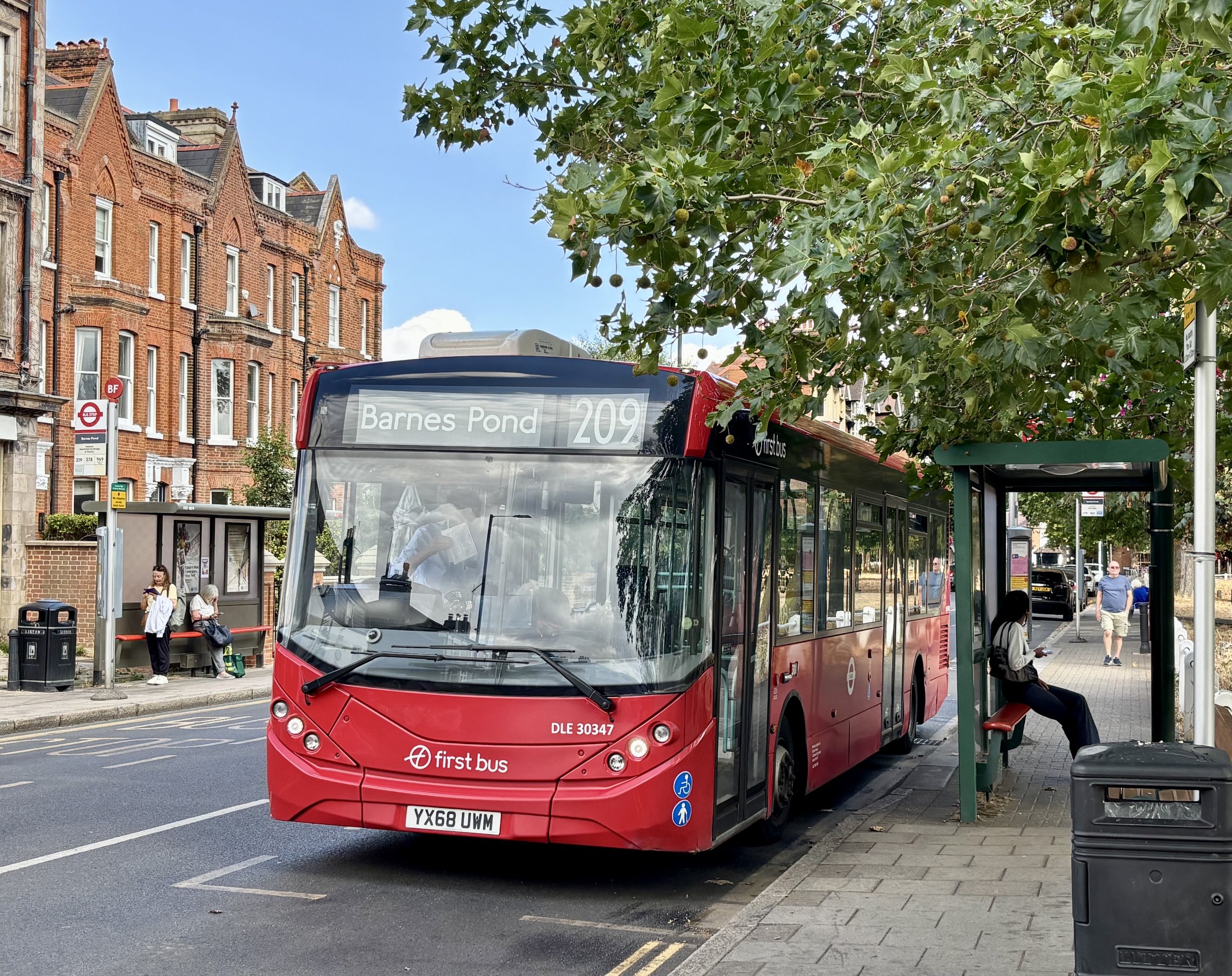
The 209 passed from GAL to First Bus London from 15th August. It is now operated from Stamford Brook (V) Garage with Enviro200 MMCs pending delivery of new electrics. DLE30347 is seen at the new Barnes Pond terminus between my trips aboard.
The 209 was restructured with the changes to run between Barnes Pond & Hammersmith via Castelnau, taking over much of long term temporary route 533 in the process. The first pick up stop is on the opposite side of the road on the left of this picture.
Route 209: Barnes Pond - Hammersmith
Crossing the road at Barnes Pond to the stop opposite, I awaited the departure of DLE30347 after its break. During this time, a couple of other passengers were discussing the recent changes to services and commenting on how confusing they were. One person wanted Wandsworth on the 485 and was surprised that the route no longer called there, so I politely directed her either to the next stop in Barnes High Street or the one around the corner in Station Road. In the end, she decided to abandon her trip and return home to Lonsdale Road on the 209!
The revised 209 largely replaces the former “temporary” route 533, which in the end lasted over 7 years. This was intended to provide a through service between Barnes & Hammersmith after Hammersmith Bridge was closed, but had to take a somewhat circuitous route over Chiswick Bridge. However, whilst the 533 operated a one-way loop through Barnes, the 209 is an “out and back” route, as can be seen by comparing the two diagrams above in this article.
Leaving Barnes Pond, it was back to the “Red Lion”, up Castelnau and via Lonsdale Road to Barnes Bridge, then onwards to Mortlake. As usual, congestion was encountered on the section near to the level crossing at Mortlake Station and past the Stag Brewery, historically associated with Watney’s ales, but closed in 2015 and now being redeveloped. No time for a beer though as we continued in a slow moving queue up to the junction of Lower Richmond Road and Clifford Avenue. Turning right at the lights, we had a fast run across Chiswick Bridge and along the Great Chertesy Road through Chiswick, passing the famous Chiswick House and gardens, built in the 18th Century and now a tourist attraction. Another traffic queue to be dealt with at the Hogarth Roundabout, with views of the Fullers Brewery across the way. Once through, a fast non-stop run along the Great West Road to Hammersmith, calling at the north side of Hammersmith Bridge, before continuing on to terminate in the Lower Bus Station. The total journey time of 40 mins wasn’t too bad in the end.
The number 209 is perhaps associated most in many minds with the Harrow area, where it operated between 1952 & 1992. It began as a short local between South Harrow & Harrow Weald via Pinner, later receiving an extension to Northwick Park. This was changed in 1985 for an extension to Edgware in lieu of the 286. However, with the “Harrow Buses” scheme of 1987, it was reduced to M-F school journeys only between South Harrow & Stanmore, the main service being renumbered H12, the 209 school journeys lasting until 1992. After a couple of years with STL operation in the 1950s, RTs took over until OPO conversion in 1971 with MBS types. These were replaced in turn by SMS then LS single deckers, although the mid 80s saw some M double deck operation.
Today’s 209 is really the former 9A renumbered in 1997. When a weight restriction was placed on Hammersmith Bridge in 1992, the Mortlake - Kensington section of double deck route 9 was converted to OPO with Darts as 9A, the 9 itself being curtailed from the east at Hammersmith. When the 209 replaced the 9A, it lost the Kensington section and terminated at Hammersmith from the south. Operated at first by London United with DR / DT Darts, it was reassigned to Armchair in 1999 with their Darts. Metroline took over Armchair in 2007, initially using the same DA Darts, but later DP Darts, which were in turn replaced in 2012 with DE type Enviro200s.
With the Hammersmith Bridge closure of 2019, the route was forced to turn short at Hammersmith Bridge South Side, later that year passing under re-tender to GAL with SE class Enviro200 MMCs. For a short period, the 209 was diverted to Putney Bridge, until the 378 came and took over that section. The latest change sees First Bus become the new operator of the 209.
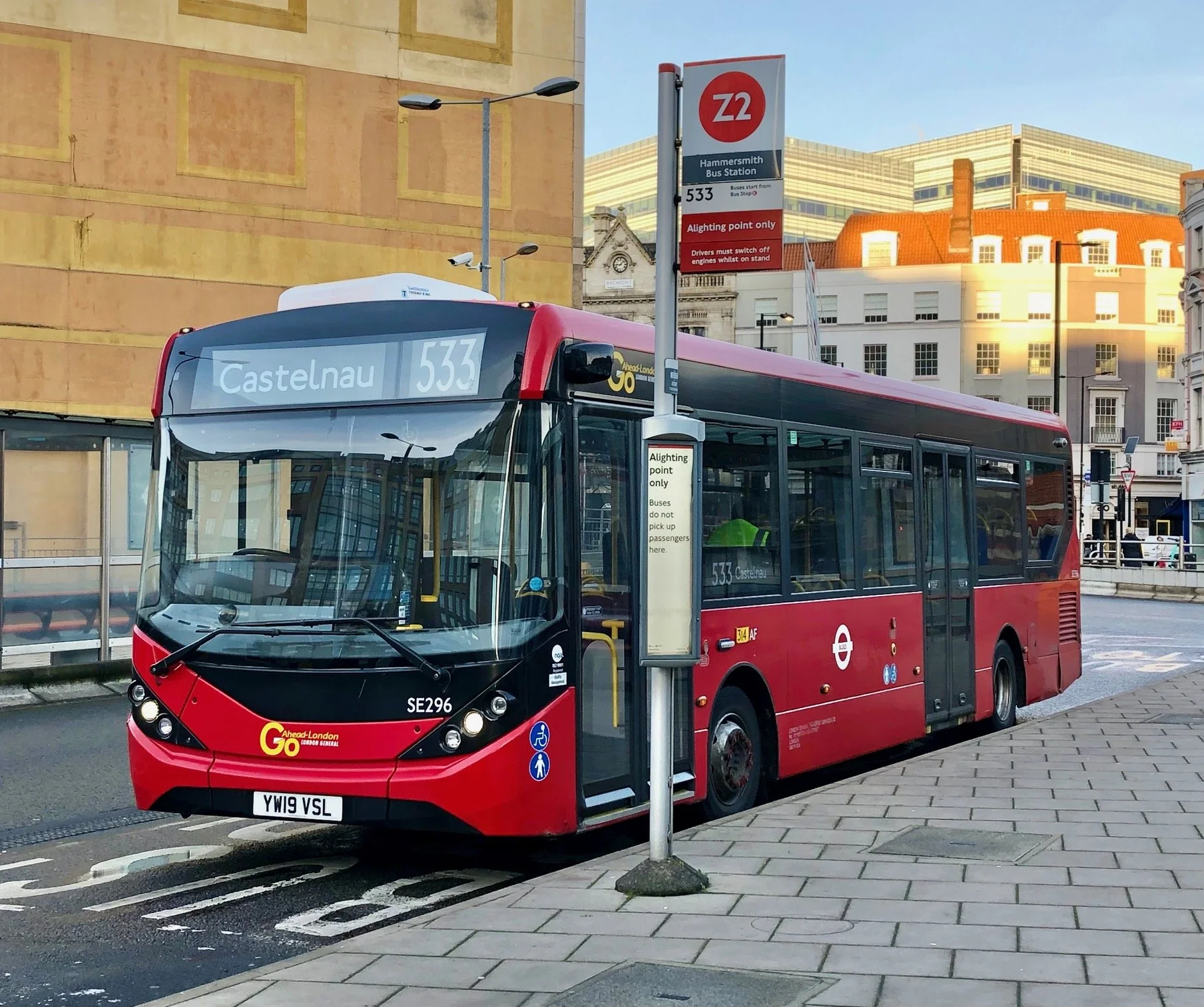
Intended as a temporary route, the 533 lasted over 7 years and was withdrawn with the Barnes changes. Back in January 2023, GAL Enviro200 MMC SE296 of Putney (AF) Garage was on duty and is seen at Hammersmith Lower Bus Station.
The route was introduced in 2019 when Hammersmith Bridge was closed to traffic to provide a direct if somewhat roundabout link with the Barnes area. Metroline were the initial operator, with GAL taking over in 2022. This batch of SE also appeared on the 209 & 378.
Route 27: Hammersmith - Chalk Farm
At Hammersmith, I decided to end my day with a ride on another trunk route, the 27, now just the rump of a former longer service, operating only between Hammersmith & Chalk Farm but still difficult operationally with all the intervening traffic hazards to tackle. Transport UK run the route out of Battersea (QB) with NRMs and first off the Hammersmith Grove stand was LT615, carrying an advertising wrap for Emirates airlines, a largely red based scheme.
A good crowd boarded with me at the first stop outside Hammersmith H&C Station and soon we were off, double-running to serve the upper level of Hammersmith Bus Station. Then along Hammersmith Road in tandem with the LTs on the 9 to Kensington Olympia and onwards to High Street Kensington. Parting company with the 9, we turned off up towards Notting Hill Gate, where there is often congestion in the afternoons, but today we were lucky to have a free run. A large queue of people beside Notting Hill Gate Station were waiting, not for a bus, but for a new frozen yogurt store which had just opened! We continued right and on via Pembridge Villas to busy Westbourne Grove, then into Bishops Bridge Road to reach Paddington Station.
After progressing along Praed Street, calling at St Mary’s Hospital, we crossed the main Edgware Road to join a queue waiting to access Marylebone Road, which cost a few minutes. Once on the main road, it was a straight run past Marylebone Station, Baker Street Station and the queue of tourists waiting to enter Madame Tussaud’s waxworks museum on to Regents Park, where another LT on the 27 seemed to be in trouble parked up by the kerb. Another traffic queue to turn off into Hampstead Road, where we then had to negotiate the various roadworks associated with the HS2 construction site - a nightmare. Finally, we reached Mornington Crescent and the art deco edifice of the former Carreras Cigarette Factory, also known as the “Black Cat Building” after the large bronze cat statues guarding the entrance, which seemed to be undergoing renovations and refurbishment for its new use as commercial office space.
Dropping off most of our clientele at Camden Town Station, it was a short hop around the back to the final stop at Camden Market, the bus not quite making the stated destination of Chalk Farm since the closure of the Morrisons store it used to serve. Perhaps the destination should be changed to “Camden Market” rather than Chalk Farm for greater accuracy. I alighted with the last few passengers after a journey of 1h25m, around 10 mins down on schedule but probably not that bad given the road conditions encountered.
The 27 was another long-standing cross-London service, operating for many years between Archway & Teddington. There was a Summer Sundays extension to Hampton Court which operated until the 1965 season. In the 1950s & 1960s, the route was mainly associated with RT class, although there was a partial RTL allocation for some years. In 1970, the Richmond - Teddington section was converted to OPO with SM single deckers, although unusually this was on M-F only, the crew 27 continuing to operate through to Teddington on Sats & Suns. The same year saw the RTs on the 27 replaced with RMs plus a few RMLs.
In 1982, the 27 was cut back to Richmond daily, the Teddington section being taken over by a rerouted 33. Then, in 1986, OPO came to the route with Ms. Further snipping in 1991 saw the northern terminus cut back to Camden Town (Archway section replaced by new route 135), whilst the southern terminus retracted to Turnham Green (Richmond section replaced by the 391). 1995 saw a short extension from Camden Town to the new Chalk Farm Safeway Store (later Morrisons).
The contract passed from London United to First Centrewest in 2000, with low floor conversion the following year to TN class Tridents. Then, in 2005, re-tendering saw the route go back to London United using SLE and TA types, although SP and ADH types later joined in, the latter of these eventually becoming the predominant type. An extension from Turnham Green to Chiswick Business Park was added in 2012. In 2018, the allocation was converted to LT class New Routemasters, then in 2019, the Chiswick Business Park - Hammersmith section was withdrawn and partly replaced by the 440. This year also saw the contract pass to Abellio (later Transport UK), which now operate the route.
There was a 27A variant (twice), the first running via the 27 from Archway to Twickenham and then on to Hounslow Garage on Sundays only between 1952 & 1958. Even earlier than this, the 27A had been a daily service. The number emerged again in 1965 for a service between East Acton & Teddington on M-F only, replacing part of the 265, later also inroduced on Sats. This version ended in 1970. Both incarnations were RT operated.
In addition, there was a 27B which covered the Archway - Hampton Court route on Summer Suns in the late 1940s / early 1950s, operated with RT/RTL, until these journeys passed to the main 27 from the 1953 season onwards.
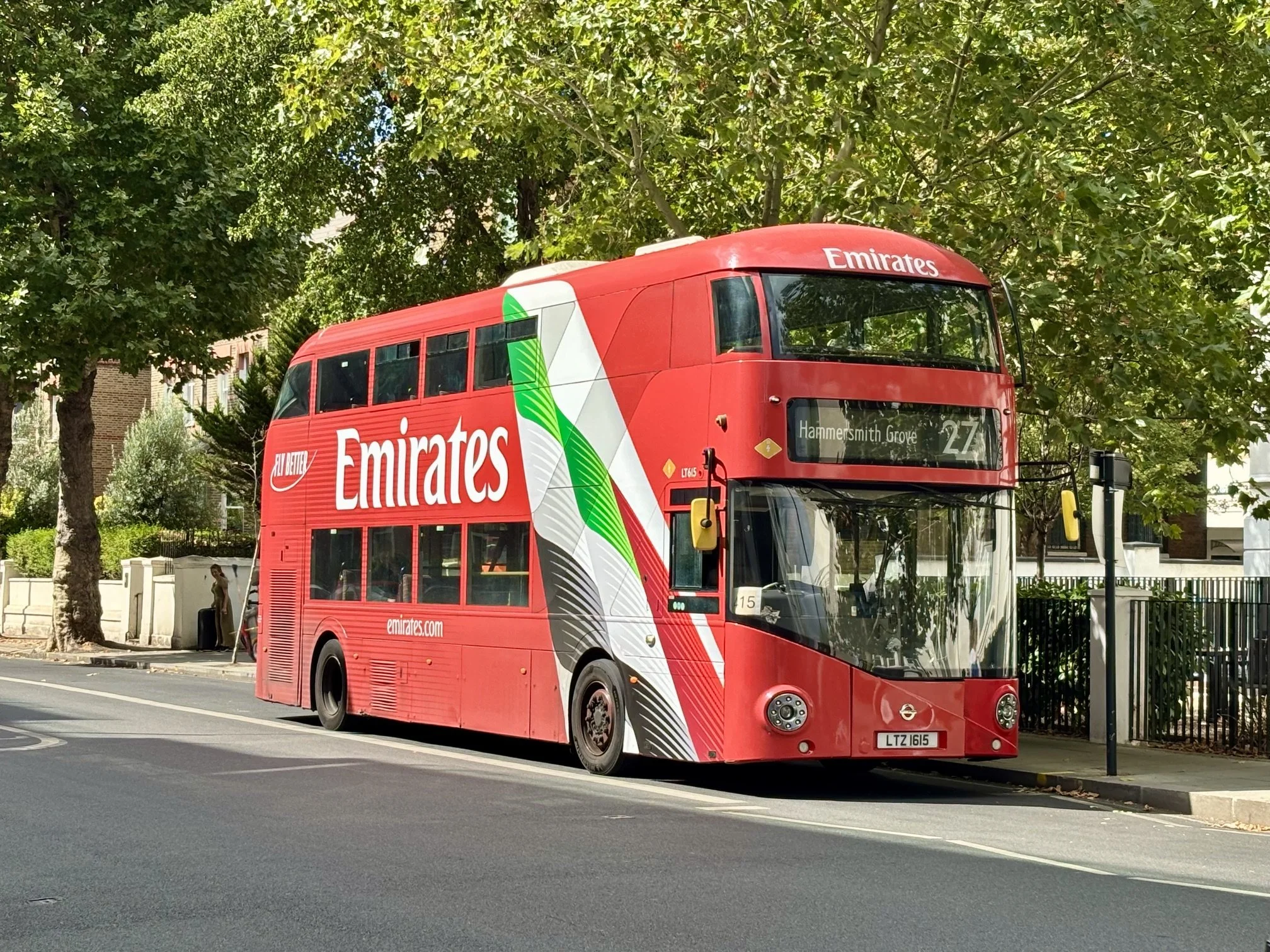
Busy trunk route 27 runs between Hammersmith & Chalk Farm and is operated by Transport UK with New Routemasters. LT615 carries a special advertising wrap for Emirates airline and is seen at the Hammersmith Grove terminus before I travelled on it.
This is one of the higher numbered LTs resident at Battersea (QB) Garage, but there were many low numbered double-digit examples out on the route when I travelled, which are intended for replacement by new examples when available.
From Camden Market, I took a short walk up the road to Chalk Farm Station, where I descended to the Northern Line for the journey home after an enjoyable day out.
Watton
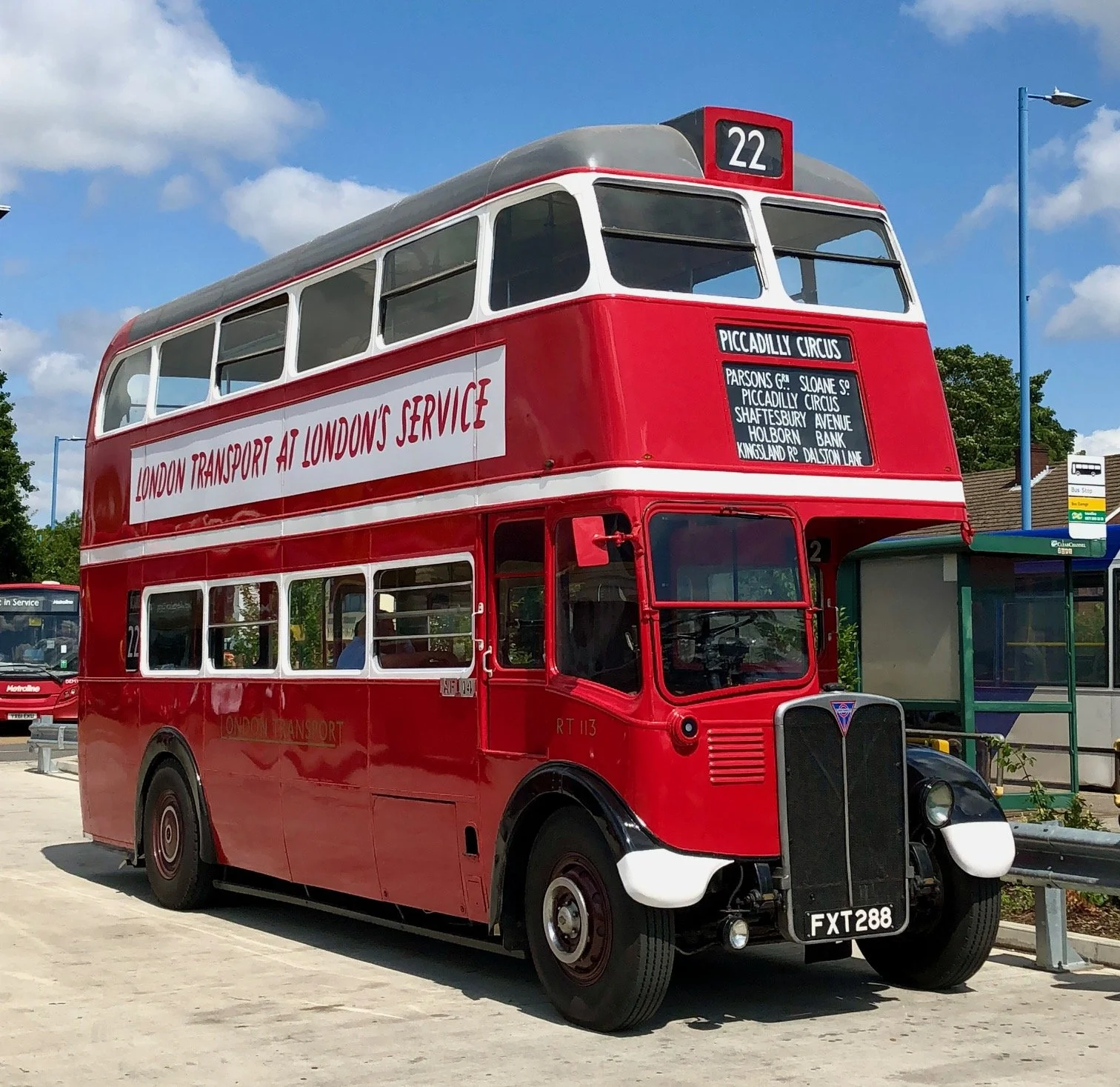
“And Finally”… we have this splendid shot of nicely preserved “Pre War” RT113 blinded for the 22 on the occasion of a Metroline Running Day at Potters Bar Garage in July 2019.
The 22 was the first route to operate RTs, being allocated the prototype RT1 in 1939 and with occasional visits into 1940 by the production batch. Note the wartime livery with grey roof to make it more difficult to see from the air and the white “cat’s whiskers” to enable pedestrians to see the bus more easily in the blackout.
