
West End to West London & Back
On this adventure, I start and end in Central London, riding older hybrid and diesel buses to, from and around the western suburbs.
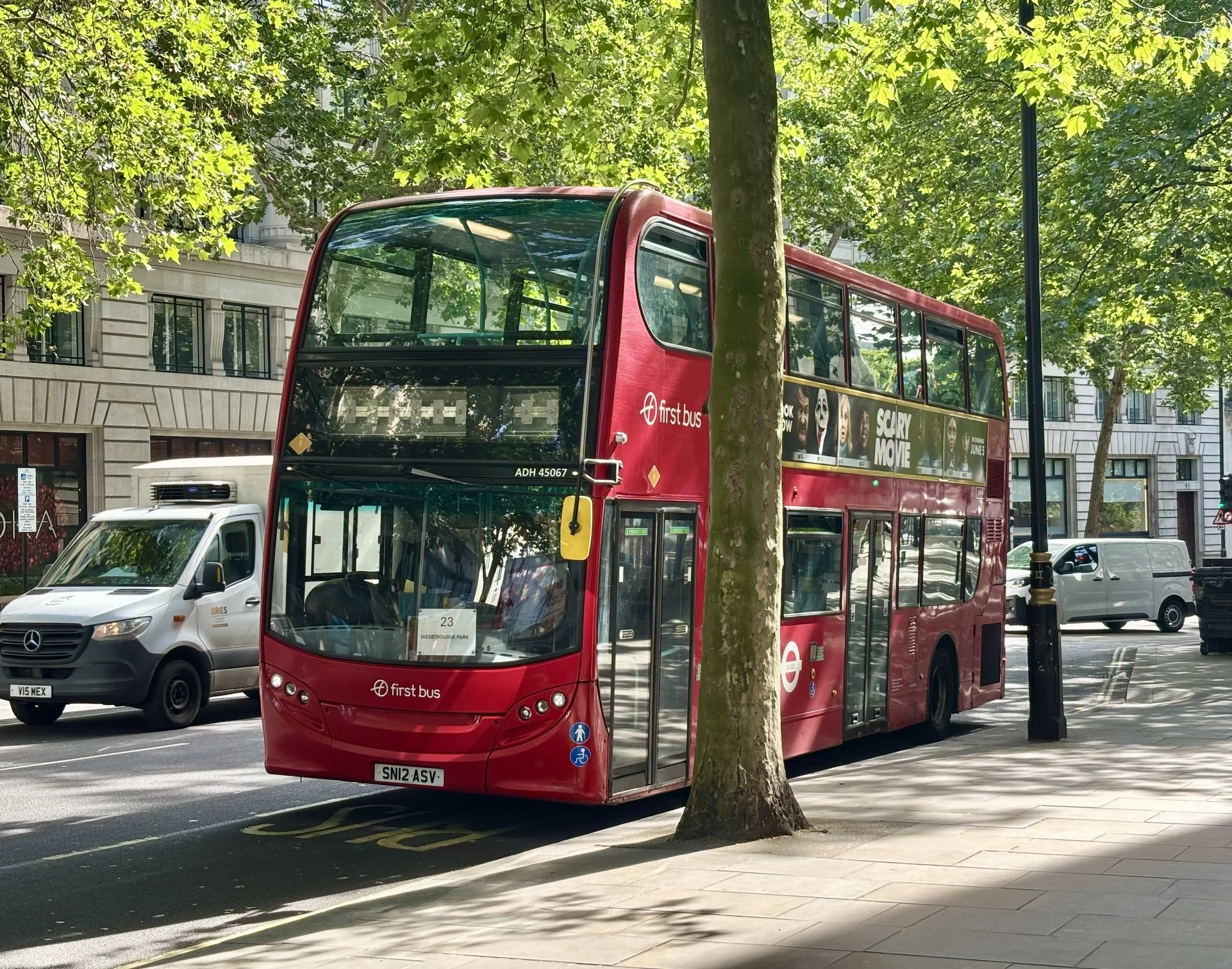
After First Bus London Optare MetroDecker OME46035 caught fire at Westbourne Park Garage on 24th June 2026, all examples of the type with the company (together with those operated by GAL) were temporarily grounded for checks. For First, this meant that their duties, mainly on Route 23, had to be covered by other vehicles, mostly ADH & ADE types brought in from other garages.
Enviro400H ADH45067 is seen at Aldwych before I rode it to Westbourne Park. As with many of the vehicles brought in, it has not yet been fitted with blinds, so has the number and destination on a windscreen notice.
Route 23: Aldwych - Westbourne Park
The Optare MetroDecker electrics have had an unfortunate time on TfL routes over the few years they have been in service. Several vehicle fires have seen the whole fleet taken out of use for periods to enable checks to be performed, the latest involving First Bus London OME46035 which caught alight at Westbourne Park Garage in June. Their duties, mainly on the 23, but also visits to the 295 and 452, have been covered since by a collection of ADE, ADH and VH types hurriedly brought in from other garages. The similar buses at Merton Garage on the 200 have been temporarily replaced by a mix of WHVs, WVNs and DELs. Metroline’s examples at Potters Bar Garage (mainly for the 134) were already off the road for new engines to be fitted.
However, the situation provided an excuse to ride unusual buses on the 23, so I headed to Holborn on the Piccadilly Line, before walking down Kingsway to Aldwych, the Central London terminus of the route. The sudden nature of the need to restock the route meant that initially, only a limited service was provided between Westbourne Park & Paddington, but a full timetable over the whole length was soon restored. When I arrived, Enviro400H ADH45067 was just arriving on stand, a bus which had been at Westbourne Park (X) until early this year mainly on the 31s, until that was restocked with new electrics. It then moved to Edgware (BT) for routes there, but has since been recalled to its former base. As yet, no blinds had been fitted and this seemed to be the case for most of the replacement vehicles I saw on the 23. Instead, the number and destination were on a windscreen card, not ideal perhaps but better than nothing!
We left on schedule, just after the morning peak and had a gentle run initially through the West End, passing along The Strand with few takers, potential customers perhaps enjoying a late breakfast at The Savoy Hotel. Pausing at Charing Cross Station, we continued across Trafalgar Square, where a stage was being prepared for the Pride celebrations the following day. Whenever I see Nelson’s Column, it reminds of the time many moons ago when John Noakes of BBC TV’s “Blue Peter” climbed it on ladders (and without safety equipment) to give it a wash and brush up!
Then up to Piccadilly Circus, known as the “hub of the empire” in the old days, before turning left along Piccadilly itself where Fortnum & Masons was about to open its doors for its well-to-do clientele. After calling at Green Park Station, we encountered the usual congestion at Hyde Park Corner roundabout, where the traffic flow needs sorting out. Then up Park Lane, in close pursuit of another older bus, Enviro400 E250 on the 36 to Queens Park. At Marble Arch, we made our way across to the Edgware Road, which we followed until turning left via St Mary’s Hospital to Paddington Station.
After a relatively quiet journey up to this point, we became busier with short-riders over the Inner London suburban section through Westbourne Grove and Portobello Market to Ladbroke Grove, causing us to drop a bit of time. Following calls at Ladbroke Grove Station and double-running to Sainsbury’s, we were fairly empty on the final stretch over Kensal Road and Golborne Road, terminating opposite Westbourne Park Garage after a run of 1h10m. A decent performance, given the conditions.
The number 23 was once associated more with East London, being a long trunk route between Marylebone and Becontree Heath, which was eventually cut back to its Aldgate - Becontree Heath rump through the East End. However, in the 1980s, it began to retreat in the east but gain ground in the west, ending as an RML operation between East Ham and Ladbroke Grove. However, in 1985, it was withdrawn and replaced by adjustments to the 15 and 15A.
The number re-emerged in 1992 for a daily route between Westbourne Park and Aldwych, extended to Liverpool St on M-F, crew RML on M-S but OPO M on Suns. It was fully converted to OPO in 2003 using TAL type Trident Alexanders (later reclasified TNA), with the Liverpool St section then becoming daily, the route by now being operated by First. In 2013, the contract novated to Tower Transit, using mainly DN type Enviro400s, although other classes appeared. Then, in 2018, came an extraordinary rerouteing away from the City out to Hammersmith, covering part of withdrawn route 10, giving a “U” shaped route from Westbourne Park, which few passengers probably rode the whole way, the 295 being much more direct between the two terminals. Tower Transit in turn gave way to the RATP Group, by which time the new OMEs had largely taken over.
In 2023, the route was restructured, the Hyde Park Corner - Hammersmith section being left to the 9, whilst the 23 instead gave assistance to the western leg of the 9 between Hyde Park Corner and Aldwych. Finally, in 2025, First returned to London and once again took charge at Westbourne Park Garage, including the 23.
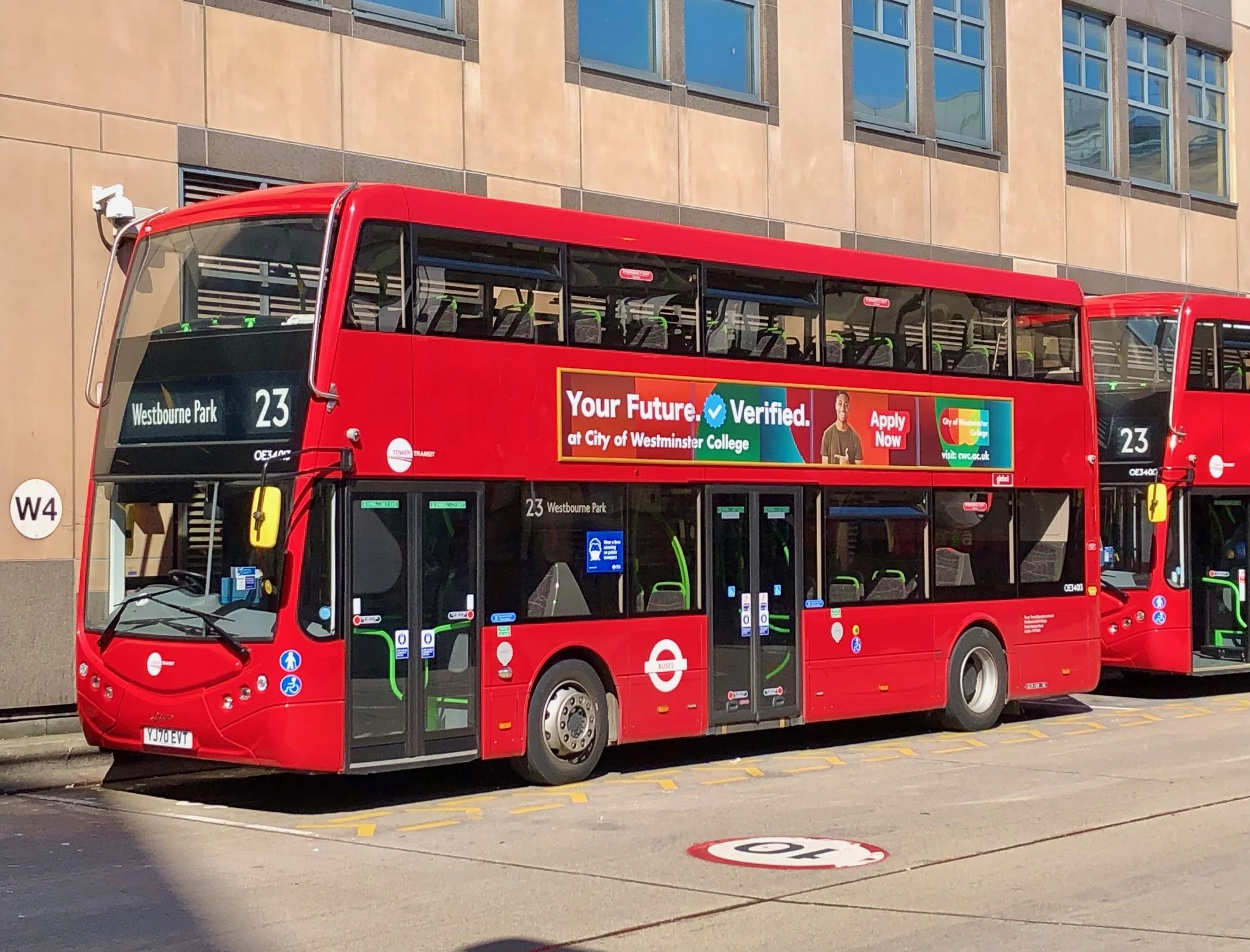
This is one of the recalcitrant Optare MetroDeckers, OE (now OME) 34013 at Westbourne Park (X) Garage when new in 2021. At the time, Tower Transit was the operator, although the depot subsequently passed via RATP Group to First Bus London.
At the time of this photo, the 23 ran to Hammersmith via Kensington after Hyde Park Corner, only being rerouted to Aldwych via Piccadilly in 2023.
Underground: Westbourne Park - Ealing Broadway
At Westbourne Park, I made my way to the adjacent Hammersmith & City Line Station, taking the train a few stops to Wood Lane. It was then just a short walk past the former BBC Television Centre (affectionately known as “The Concrete Doughnut”) to White City Station on the Central Line, where I boarded a westbound service to Ealing Broadway.
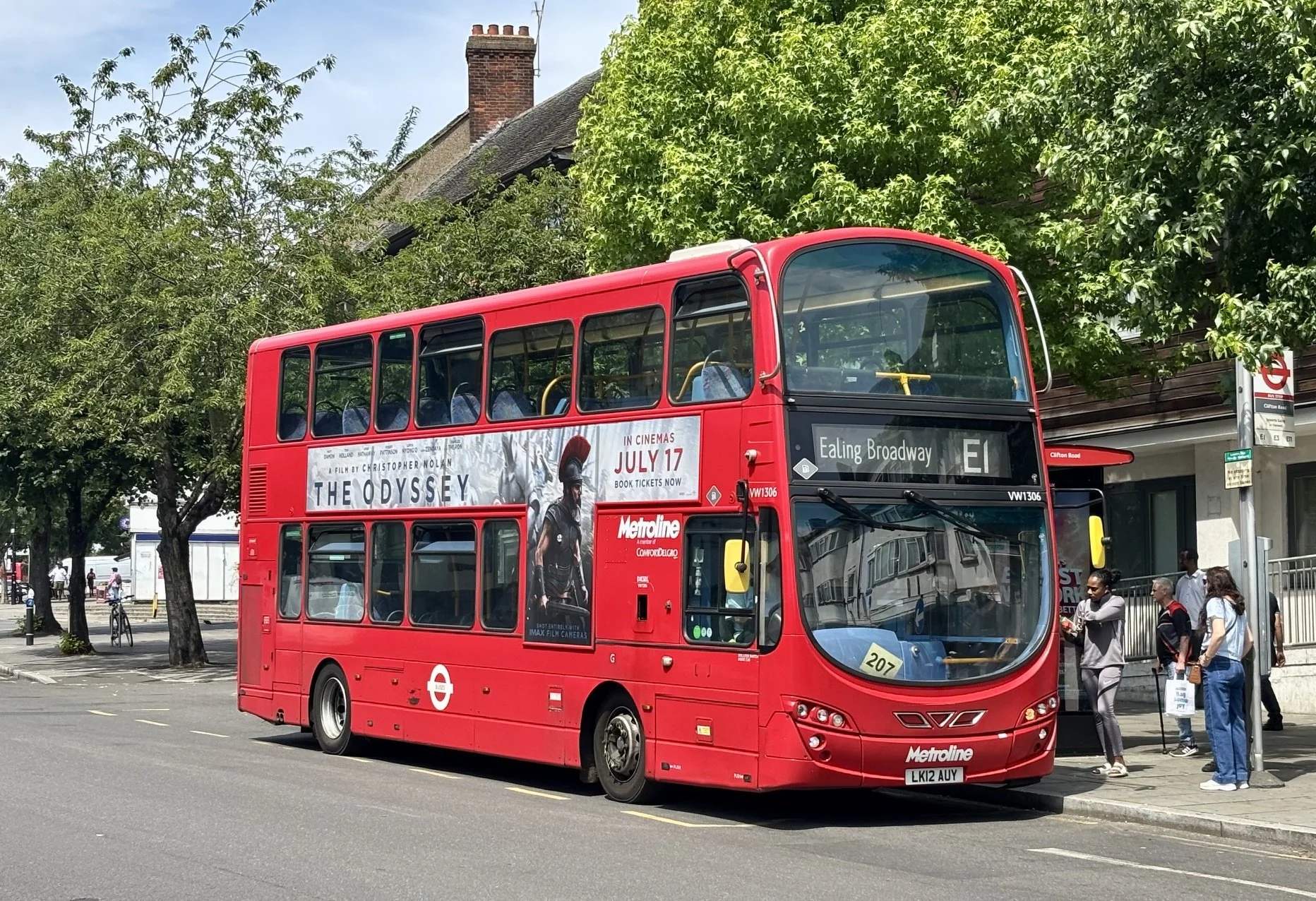
Volvo B9TL VW1306 of Greenford (G) Garage finds custom at Clifton Road Greenford on the short E1 local service to Ealing Broadway. The route is on a 3 year contract with Metroline using these vehicles which expires in May 2027.
I arrived here on sister vehicle VW1305 and departed on the next working formed of VW1374.
Route E1: Ealing Broadway - Greenford
My second route of the day was one of TfL’s shortest - the E1, which runs back and forth between Ealing Broadway & Greenford. This is 2 years into a 3 year contract with Metroline, using mostly VWs out of Greenford (G) Garage, although the odd TEH and VWH also turns out in support. I had only a short wait for Volvo B9TL VW1305 at the shady Haven Green stand, with only a handful of us boarding when it departed. An easy trundle through the back-doubles of Ealing, pausing for a couple of minutes to await time only a few stops in. Crossing Argyle Road, we soon arrived at Drayton Green Station on the West Ealing - Greenford branch line, which now sees occasional use by one of the rechargeable battery-operated units converted from former District Line tube stock and on my list to sample on another day.
After passing along narrow Drayton Bridge Road, we turned right into Greenford Avenue, climbing Cuckoo Hill and down the other side. This was the site of a battle between Romans and Saxons in the 6th Century, this bloodshed being the likely origin of the name Hanwell, which is nearby, “haenwael” meaning a slaughter on high ground. We then swung left beside Brent River Park and along to the terminus at Greenford Broadway. Just an 18 min journey, after which the bus continued out of service along Greenford Road to the garage to stand.
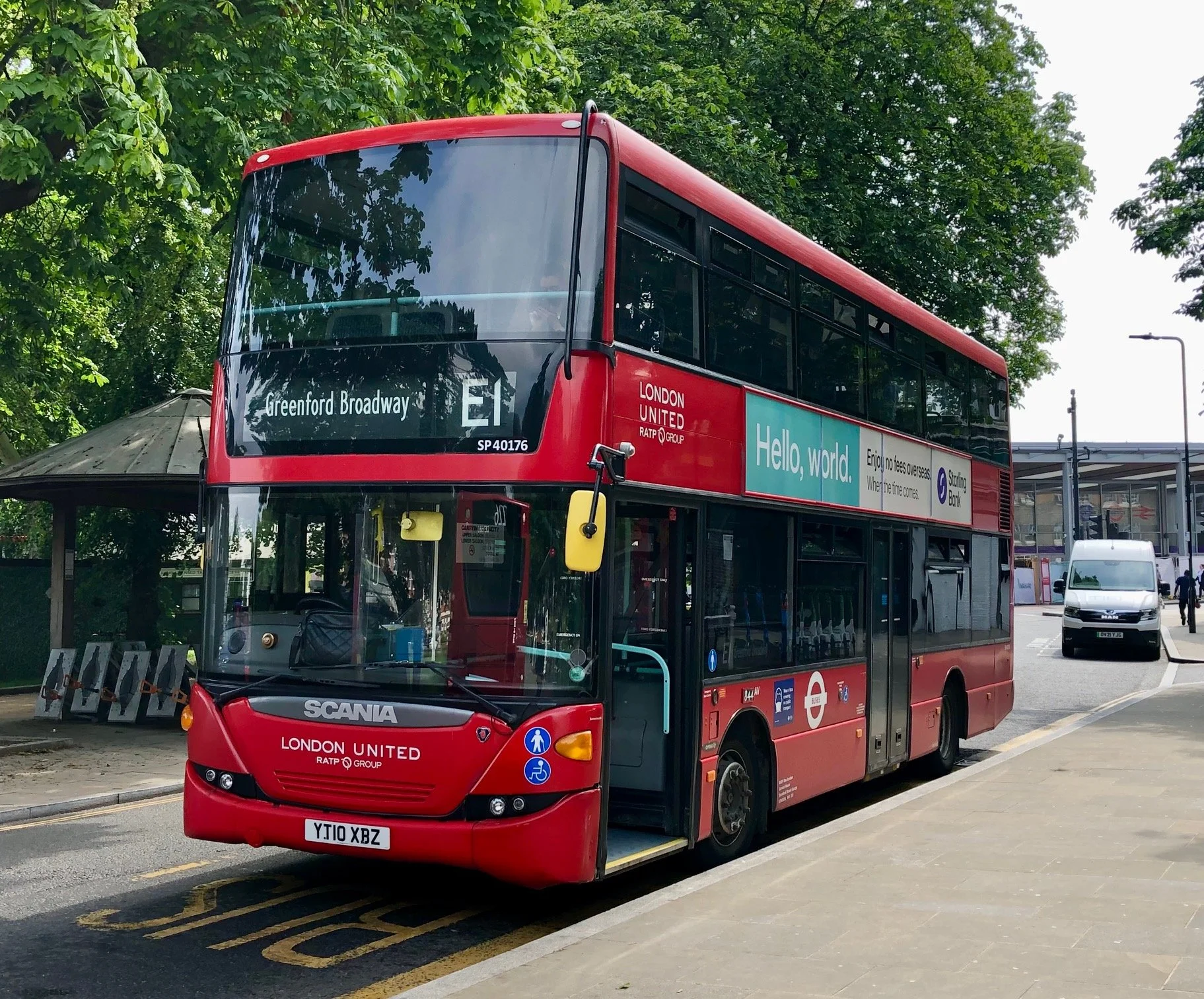
Flashback to 2021, when London United (RATP Group) had a 3 year contract on the E1. Scania OmniCity SP40176 is seen on stand at Haven Green, Ealing Broadway, in July of that year.
At the time, this type shared the allocation with ADE and ADH classes.
Route E1: Greenford - Ealing Broadway
After a short break, I returned to Ealing Broadway on the E1, this time aboard VW1374, another uneventful and short 18 min trip. Reasonably well used with a number of end to end passengers.
The E1 was one of the Ealing Flat Fare Routes which came with “Reshaping” in 1968. Running between Greenford & Brentford via Ealing Broadway, it took over parts of the 211 and 83 routes. Initially single deck with MBS type Merlins, the Sunday service was extended to Syon Park from 1970. The allocation was upgraded to double deck with DMS in 1975, with the Syon Park extension ending in 1979. Ms replaced DMSs in 1981.
In 1990, the route was split at Ealing Broadway - the Greenford section remaining as E1 and the Brentford portion becoming E8. At the same time, the service was converted to RW minibus, under the “Ealing Buses” brand-name, although double deck operation with M remained during M-F peaks. The Metros were later replaced with LA class Olympians. Then, in 1997, by now with First, the main M-S service reverted to full double deck with Olympians, but with low floor single deck DM type Darts on Suns. Finally, in 2002, the whole daily service became double deck once again with low floor TN class Tridents, although these were replaced in 2009 with DN type Enviro400s, later redesignated TEs after the contract novated to Metroline in 2013 when First pulled out of London.
Since then, several operator changes have taken place, firstly with Abellio using Enviro400Hs from 2014-21, then RATP Group using ADE/ADH/SP types from 2021-24, before the current era with Metroline using mainly VWs.
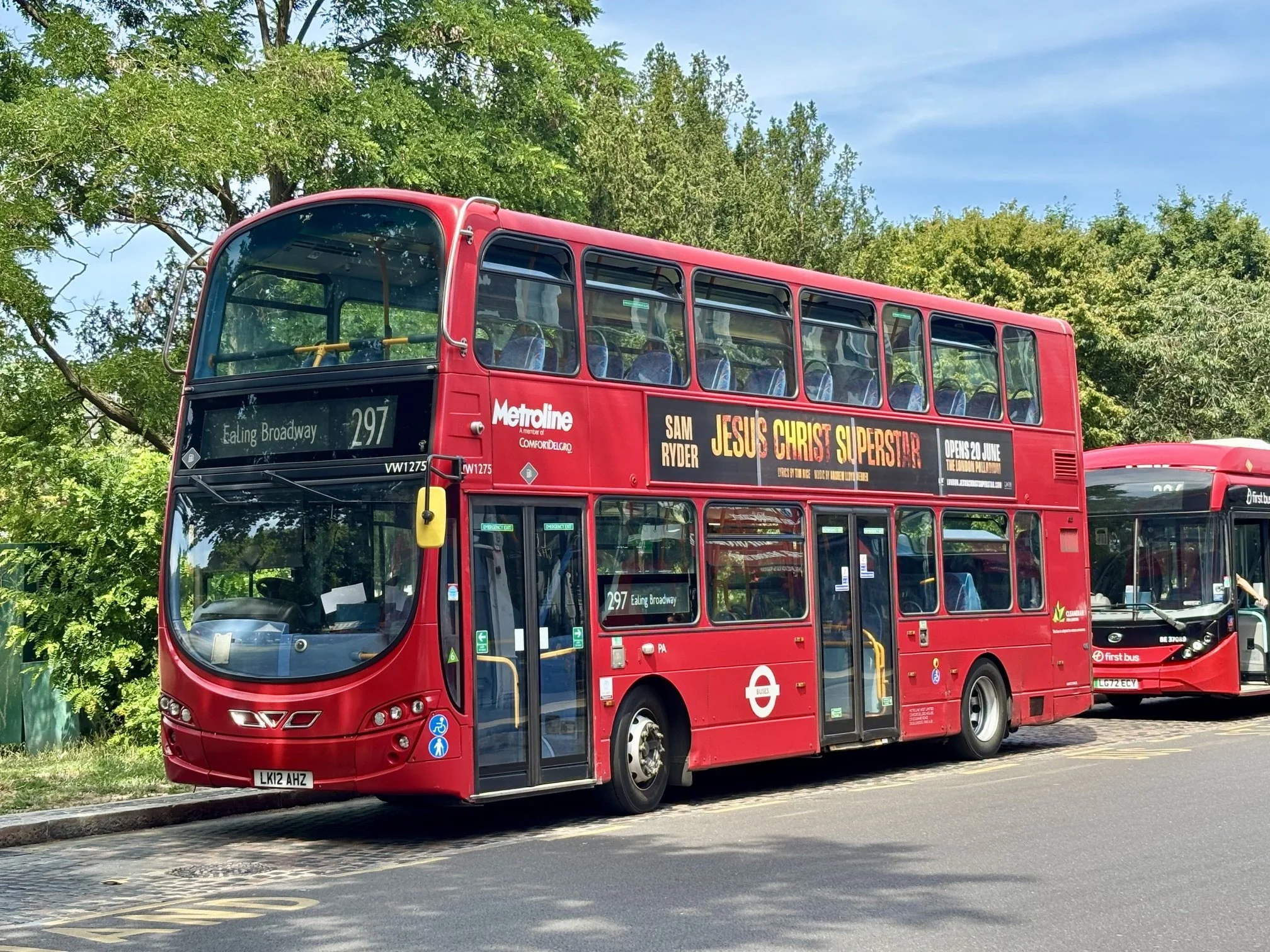
Metroline VolvoB9TL VW1275 of Perivale (PV) Garage on the 297 stand at Haven Green, Ealing Broadway, before I rode this bus to Willesden Garage.
Whilst the latest contract renewal specified new electrics, these have yet to be introduced pending necessary infrastructure works at the garage.
Route 297: Ealing Broadway - Willesden Garage
Back at Ealing Broadway, my next route was the 297, the contract for which was renewed with Metroline way back in December 2022 on the basis of new electrics, but is still being operated with a mix of VW diesels and VWH hybrids all this time later, due to the usual reasons involving awaiting suitable infrastructure improvements at the garage, in this case Perivale (PV). Nevertheless, this provided an opportunity for another ride on one of the veterans, which in this case was Volvo B9TL VW1275.
At first, our journey was relatively peaceful, with not too many on board as we ambled through the Ealing suburbs via Scotch Common and Pitshanger Park across the A40 Western Avenue to Perivale. Past the station to almost the foot of Horsenden Hill, one of the higher points in the area at 85m above sea level, site of an Iron Age Fort, then more recently an anti-aircraft battery in WW2 to protect the local factories and now the location of a nature reserve, together with golf courses and a grazing project for cows!
However, we continued through the suburban housing of Bilton Road, then along Manor Farm Road passing close to Perivale Garage, before turning into Athlon Road where there was a glimpse of the new bus depot (coded AE) which operates as an outstation of PV and partially replaced the former Alperton (ON) Garage, which closed in 2021 and of which no trace remains, the site having been used for a new housing / commercial development. After serving Alperton Sainsbury’s and Station, we had an unusually easy run along Ealing Road, prompting a 4 min “hold” at the stop before Wembley High Road to await scheduled departure time. This was slightly unfortunate, as we then lost time in the busy High Road, due to both heavy traffic and large numbers boarding at the next few stops. Down Park Lane and along Wembley Park Drive the “quick way” to Wembley Park Station, where we had a lengthy passenger exchange. Luckily there were no events on at the adjacent Wembley Stadium, which often hinders efficient operation in the area.
After turning into Forty Lane, past the old Brent Town Hall, now the Lycee International Winston Churchill, it was a free run down Blackbird Hill, although the queue at the bottom waiting to join the North Circular threatened to hold us up. However, our driver made use of the Bus Lane to navigate around the obstacles and we powered up to the loop around Neasden Shopping Centre, before continuing down Neasden Lane past the station to Willesden High Road. We terminated just short of Willesden Garage after a journey of 1h15m, around 10 mins down on schedule.
The 297 was another route to emerge in 1968 from the “Reshaping Plan”, initially running between Willesden Garage and Perivale on M-S only as a replacement for part of the 46. Crew RT operated to begin with, it was intended for early OPO conversion, which occurred in 1969 with MB class Merlins, although strangely the Sat service retained RT for a few months. As with many single deck routes of the period, double deckers came back fairly swiftly, in this case with DMSs in 1972, which in turn were replaced by Ms in 1980. During this period, there was a short lived M-F Peaks bifuraction to Wembley Trading Estate from the Willesden direction, which oddly was not given the natural 297A suffix. 1984 saw the extension of the main service from Perivale to Ealing Broadway and later that year, a Sunday service was added, although this was very limited at first.
1990 saw the route converted back to single deck with DW Darts, although with a couple of Ms retained in M-F Peaks initially. The Wembley Trading Estate journeys came off at this time and the route essentially became the one we know today, apart from one or two subsequent minor intermediate rerouteings. By 1997 the route was with First Challenger and used DP class high floor Darts, although Metroline took the contract from 1998 with DLD low floor Darts. These were replaced by double deckers in 2003 in the form of TP type Trident Plaxton Presidents, which were in turn replaced by the end of the decade with TE class Enviro400s. The late 2010s saw mainly mixed VW and SEL (Scania East Lancs) operation, although the latter withdrew from the mix in the early 2020s.
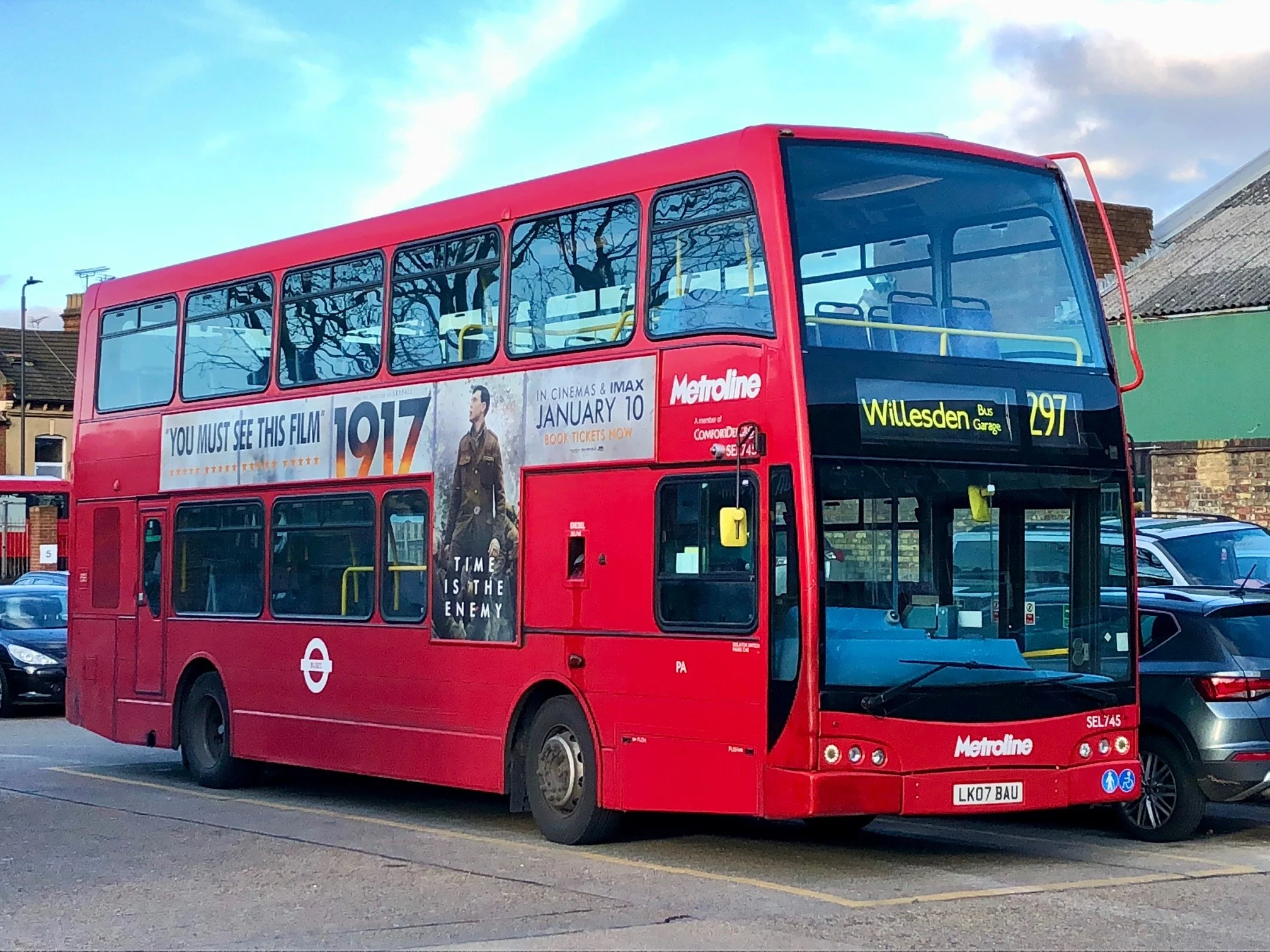
Back in January 2020, Metroline Scania East Lancs Olympus SEL745 is seen on the 297 at Willesden Garage.
This type provided a part allocation on the route at the time but the class was withdrawn shortly afterwards, although at least one remains in preservation.
Route 52: Willesden Garage - Victoria
To finish, I had a choice to reach my final destination - the 6 and the 52 both link Willesden Garage with Victoria Station, but by very different intermediate routes. However, whilst I was weighing up the options, the decision was made for me when Metroline VWH1416 emerged from Willesden (AC) Garage to take up service on the 52. This was one of the older batch of Volvo Hybrids with Gemini 2 bodywork, very similar to the VW diesels, rather than the later Gemini 3 version which predominates at AC. It was also the only one out on the route that afternoon, so I jumped aboard for the ride.
Unfortunately, this was to prove a frustratingly slow journey in the build-up to the PM Peak, but we started off reasonably ok as we progressed along Willesden High Road, with plenty of takers. On the suburban section towards Kensal Rise, we encountered the first delay with roadworks and single-lane working protected by temporary lights. Then, after calling at the Overground Station, the habitual queue down to the Harrow Road reduced speed to a very slow crawl. Once across this major artery, we sped up a bit, calling at Ladbroke GroveSainsbury’s but then getting caught in yet another traffic jam on approach to Ladbroke Grove Station!
From here, it wasn’t too bad through the back streets to Notting Hill Gate, where many left us, but it took an age to perform the right turn into the one-way system at the top of Kensington Church Street. Once in that thoroughfare, a gentle run down to High St Ken, before swinging left past Kensington Palace and Gardens. A better run from this point and we were soon passing the Royal Abert Hall on one side and the Albert Memorial on the other. The hall was the brainchild of Prince Albert following The Great Exhbition of 1851 as a public concert venue but took several years to come to fruition and was opened by Queen Victoria in 1871 after Albert’s death. The memorial opposite is a Gothic Revival structure designed by George Gilbert Scott featuring a gilded Prince Albert below an ornate 54m tall canopy, commissioned by Queen Victoria in memory of her late husband and opened in 1872.
Soon we were running parallel with Hyde Park and passing Knightsbridge Barracks, home of the Household Cavalry, famous for their ceremonial duties at Horse Guards Parade including the annual Trooping The Colour ceremony. A slight delay at the lights where Knightsbridge joins Brompton Road, but then a clear run up to Hyde Park Corner, where most of our remaining clientele alighted. Just a few of us on the final stretch along the back of Buckingham Palace Gardens to Victoria Station, where we arrived after a very long 1h40m journey - nearly half an hour late on the schedule. However, it was interesting to note that almost all buses on the 52 were completing the full route, despite delays of 30-50 mins being noted from a quick review on Bustimes.org - presumably due to some judicious scheduling at the garage and missing out certain trips? The only bus I saw turned short was one in front of us at Notting Hill Gate, but that looked to be due to some kind of mechanical issue (perhaps overheating) rather than purely late-running.
The 52 is a long-standing trunk route between Victoria & Willesden Garage, although it once ran much further out to Mill Hill Broadway and Borehamwood. However, for much of the week, it ran in overlapping sections, until the northern section was gradually hived off to daughter routes. As far back as 1955, the main M-S service between Colindale & Borehamwood was replaced by a new 52A, using a mix of RT/RTL types as per the parent route. This in turn was replaced in 1962 by a new RT route 292 between Willesden Garage & Borehamwood, which is the origin of today’s route of that number.
Back to the plain 52, the main northern destination became Mill Hill from 1955, although it retained some M-F Peak & the Sun service to Borehamwood at first. In 1966, the 52A variant returned, this time on Suns only for the full route between Victoria & Borehamwood, although this only lasted a few months and didn’t see the year out. By now, RMs were starting to enter the allocation mix, with full conversion from RT achieved by the end of that year. Final withdrawal of the remaining Borehamwood journeys came in 1969, the route now being Victoria - Mill Hill daily. This continued through to 1985, when the Sun service went OPO using Ms, but this was merely the precursor to full daily conversion the following year.
In 1981, Victoria - Ladbroke Grove shortworkings were extended off the main route to Westbourne Park Garage and renumbered 52A, this being the third use of the suffix. Initially RM, the route received Ms and OPO conversion at the same time as the parent in 1986, but in 1987 was rerouted away from Westbourne Park to Acton via Wormwood Scrubs & East Acton. After various cut-backs, the 52A was withdrawn in 1991 and was partly replaced by new Route 70.
The next major change came in 1992, when the 52 was cut back to Willesden Garage at all times, the Mill Hill section now being covered by a new 302, which continues to this day. Tendering saw London Coaches win the route using Titans in a red and white livery with signwriting ‘tween decks, which presented an unusual sight in North West London, normally Metrobus territory. In 1995, the operation passed to Metroline, who returned Ms to the route before a batch of AV class Olympians took over. Low-floor conversion in 2001 brought VPLs (Volvo Plaxton Presidents) to the route, although the shorter VP version also appeared. The 2010s saw conversion to VWs, the initial diesels soon being replaced by VWH hybrids, which brings the story up to date.
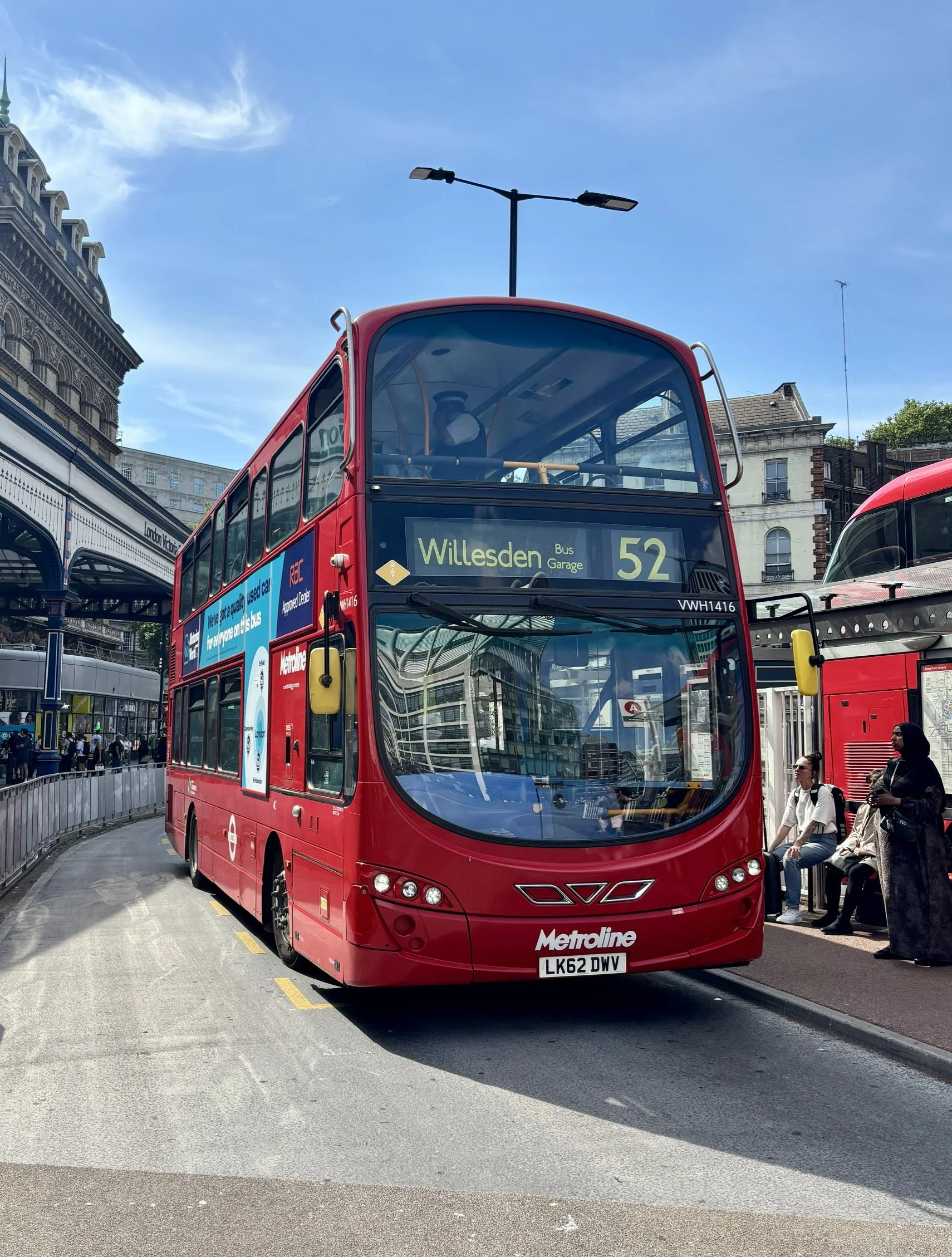
Metroline Volvo B5LH Wright VWH1416 of Willesden (AC) Garage is at Victoria Station on the 52 after my marathon journey aboard and prepares to return home. The route has been retained on re-tender with new electrics promised later in 2026.
This was the only one of the early batch Volvo Hybrids on the route when I travelled, having the older Wright Gemini 2 body rather than the later Gemini 3 version worn by newer members of the class.
At Victoria, my bus rides were over for the day, so I made my way down to the Underground for the trip home via the Victoria Line.
Watton
“And Finally”…
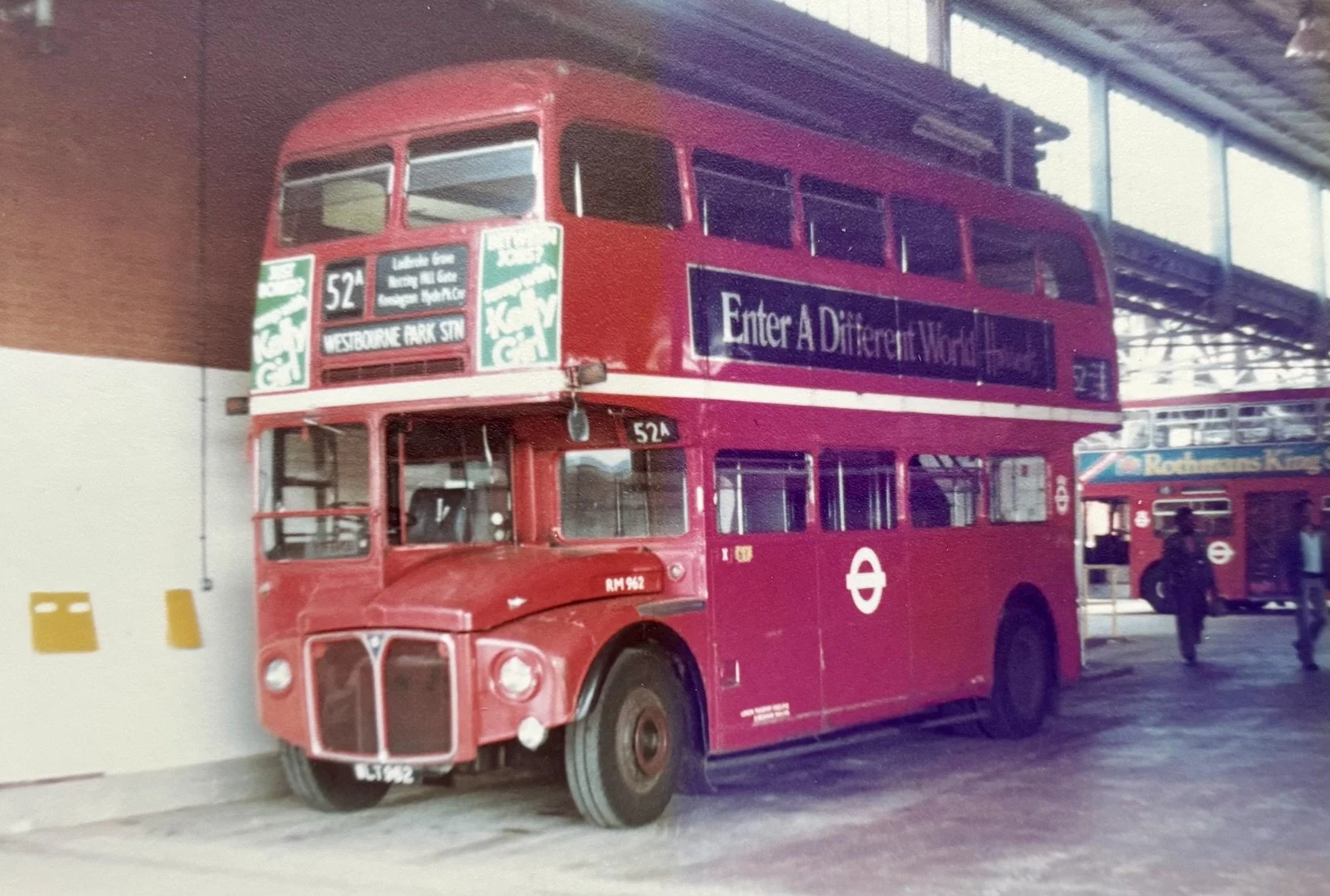
The 52A was a new route in 1981 between Victoria and the then new Westbourne Park (X) Garage. It started with crew operation, as Routemaster RM962 demonstrates inside the garage on the first day, 15th August 1981. After various cut-backs, this service was withdrawn completely in 1991.
The route deviated from the 52 at Ladbroke Grove via Golborne Road & Elkstone Road to reach the garage, a section now mostly covered by today’s 23, bringing us back to where this article started!
