
Jams & Jaunts in North London
An unusual set of bus rides this time, with some decent runs across outer North London and into Herts, topped and tailed with some sticky ones due to roadworks and general congestion.
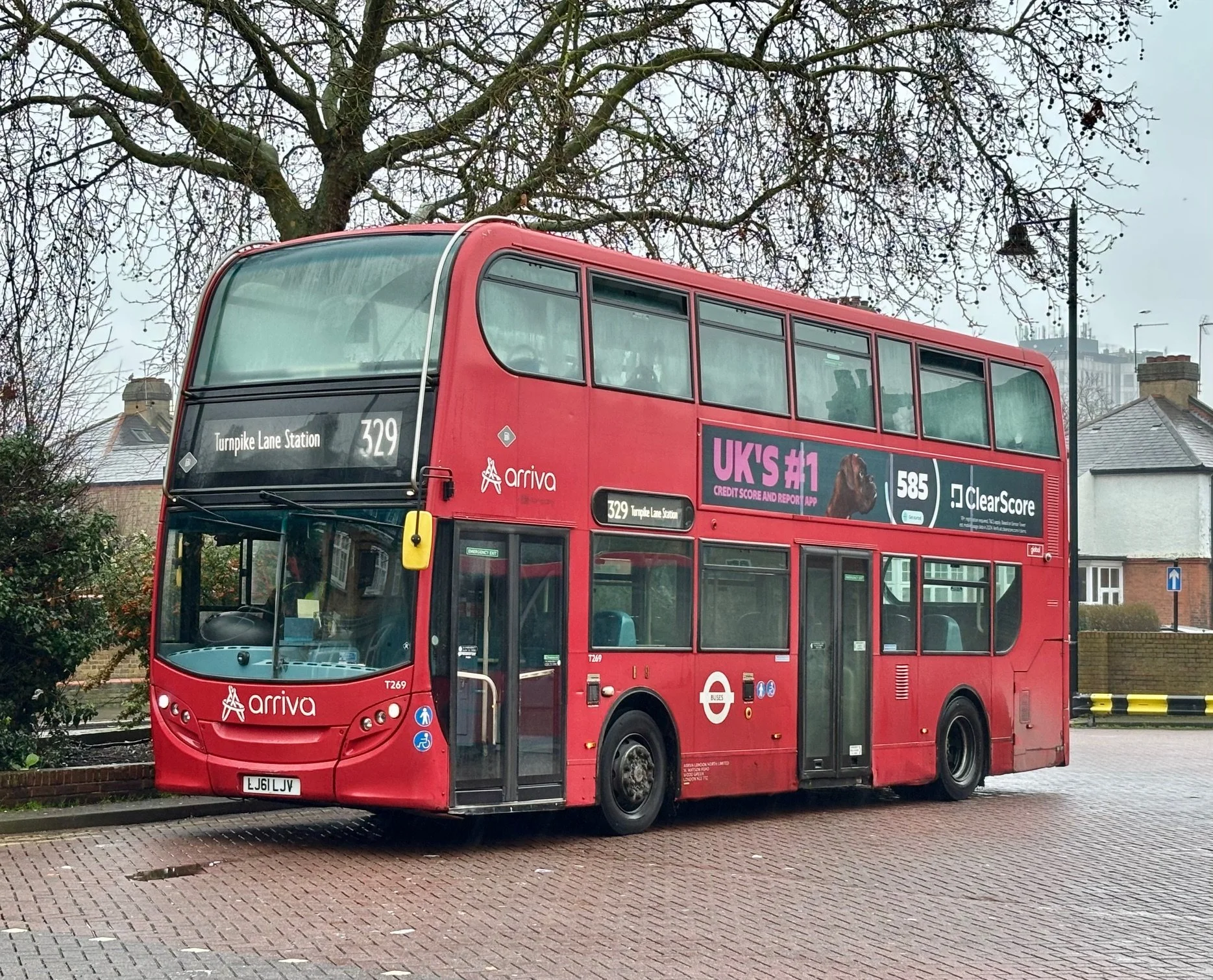
Stormy weather at Enfield Little Park Gardens, with Arriva London Enviro400 T269 of Wood Green (WN) Garage in the rain on the 329 after a long gap in service.
Despite the destination, this bus was turned short at Wood Green due to severe traffic congestion caused by temporary lights in Palmers Green.
Part Route 329: Enfield - Wood Green
Weeks of rainy weather in the early part of the year have meant that it has been difficult to pick good days for bus rides - sometimes I have been lucky, other times not so fortunate. Rain inevitably seems to increase traffic levels and congestion as people take the car even for short journeys where they would normally walk. Combine this with multiple roadworks, 20mph limits, cycle lanes reducing road width - all of which are prevalent in London - and you have the recipe for a perfect storm which conspires against effcient bus operation in the capital. No wonder that operators are triggering break clauses in contracts as they find many routes no longer sustainable to run as costs increase!
All of which preamble brings me to a visit to Enfield on a wet Friday. Alighting from the Great Northern train at Enfield Chase, my plan was to start my bus rides with a run to Turnpike Lane and back, but I was debating in my mind whether to “do a rounder” on the 231, or take the 329 there and 231 back in order to cover an extra route. I plumped for the latter choice - but all too soon was wishing I had taken the first option!
Arriving at Little Park Gardens, there were 192s and 317s a-plenty, but no 329s to be seen. I decided to walk into town to get a coffee, but when I returned 10 mins or so later, there was no change and the same people were still waiting at the stop. One lady said she had been there over half an hour, when suddenly T269 rolled up, considerably late on its schedule, but the driver (understandably) needed a break. Around 10 mins later we finally got under way, taking an age to negotiate the one way system, where roadworks had reduced the section past the market place to a single lane, causing a queue onto the next two sets of traffic lights.
A large and annoyed crowd boarded at Enfield Town Station, but after this we finally began to make some kind of reasonable progress, although not that fast due to the narrow road layouts encountered. Picking up at most stops, we began to pass 329s coming the other way, often in pairs, then once through Winchmore Hill we hit a traffic wall at Hedge Lane. A very slow crawl with numerous periods of going nowhere through to temporary lights and single lane working just south of Aldermans Hill. It was at this point that the driver received the instruction to turn short at Wood Green, but I alighted at the next stop to answer a much needed call of nature due to the extended journey time!
Countdown was showing three 329s within the next few minutes, all going to Turnpike Lane, but the first two were displaying Wood Green when they arrived, also turned short. Meanwhile, in the other direction, at least three northbound buses I saw were short-turning at Palmers Green Hedge Lane. Eventually, a southbound bus arrived showing Turnpike Lane, T270, so I clambered aboard. Once we were past the North Circ, although there was a queue northbound into the roadworks, the road was almost empty southbound and we soon reached Wood Green Town Hall. Just as I was anticipating an easy ride to the end of the route, came the announcement “The destination of this bus has changed” and we were all turfed off at Wood Green Garage, the driver offering his profuse apologies.
The general sentiment of the passengers was that every 329 was terminating here, but this didn’t seem to be entirely true, as I espied a northbound bus approaching from Turnpike Lane. However, I had lost patience by that time, so walked to Turnpike Lane Station, where I finally arrived 1h30m after leaving Enfield. Not a single 329 passed me on the way there.
Whilst I have sympathy with the operators in trying to run a service when there is such severe congestion, in my view the communication to passengers and operation of the service could be improved. Firstly, there was no message on the TfL website about delays to the route, which sometimes appears in such circumstances and could have provided some warning, as would a scrolling message across the Countdown screens at the affected stops. Secondly, rather than random turns northbound and southbound, would it not be better just to withdraw the route between Wood Green & Turnpike Lane for the duration, so that people know to change buses at Wood Green when required.
I haven’t had much luck with the 329 recently, as my previous ride in the opposite direction last year also took an age, although at least that time I made it to the end of the route on one bus! For further details on that trip and for historical notes on the route, refer to my article “Enveloping Enfield” dated 1/2/25.
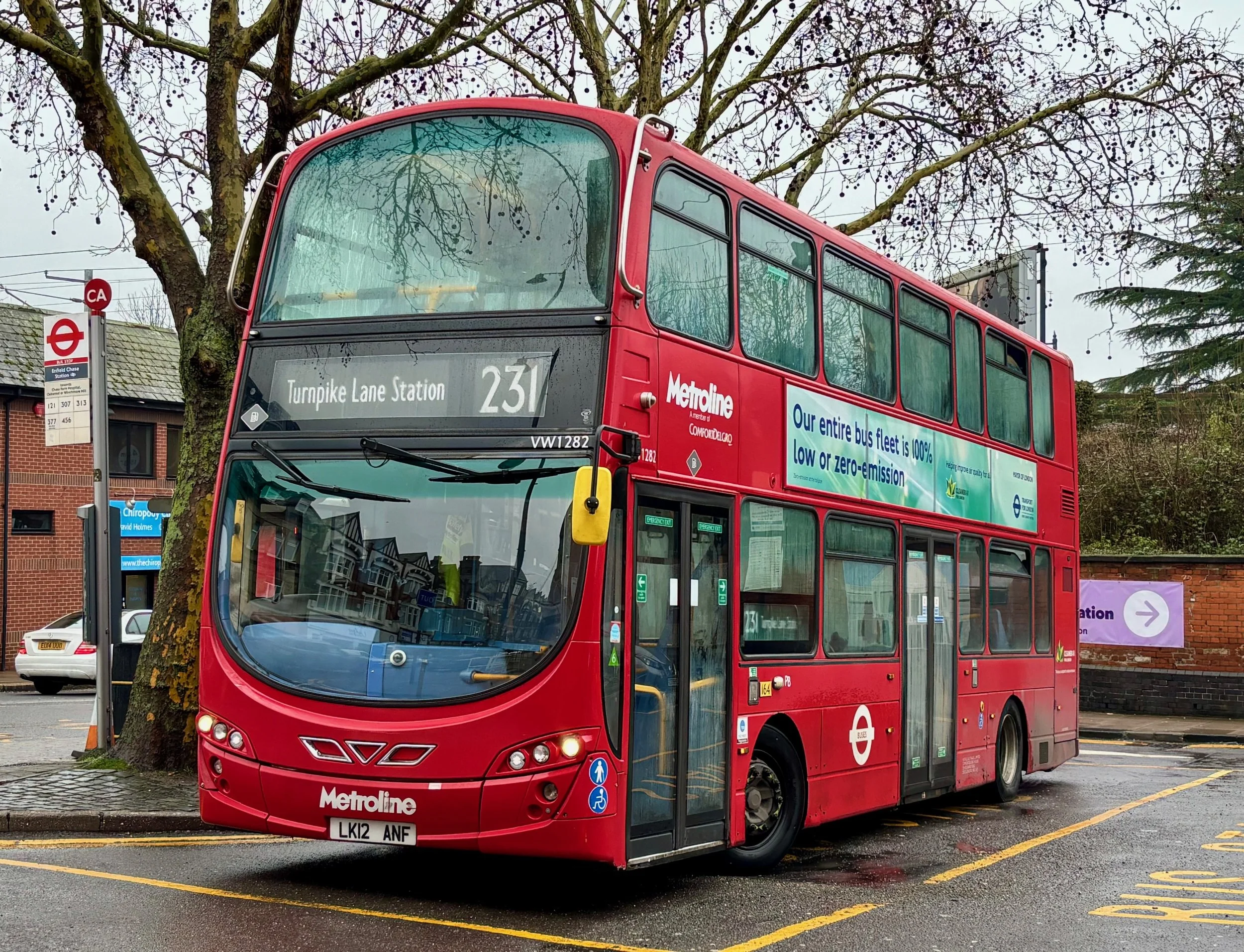
Metroline VW1282 of Potters Bar (PB) Garage on the 231 at Enfield Chase Station after I rode it back from Turnpike Lane. This was considerably quicker than the alternative 329 which was experiencing severe disruption as mentioned in the text.
The 231 was granted a 3 year contract renewal with Metroline in June 2025 using existing diesels, which feature VW & TE types.
Route 231: Turnpike Lane - Enfield Chase
Having reached Turnpike Lane somewhat flustered, I began to calm down again as the ensuing rides signalled a return to more normal conditions. I kept to the plan and awaited the next 231 back to Enfield using the alternative route via the Great Cambridge Road. This route is operated by Metroline out of Potters Bar (PB) Garage, mainly with existing Volvo B9TL and Enviro400 diesels, although the odd Volvo Wright Hybrid does sneak out. I had VW1282, which was the next to depart, but fortunately most of the large crowd waiting when I arrived had boarded the 217 & 444 which left just ahead of us, so it was a reasonably calm and quiet trip.
We made good progress along Westbury Avenue, crossing the bridge which once spanned the Palace Gates branch railway from Seven Sisters, closed in 1964 and now mostly built upon, although I reflected as we passed over that this would now be a useful local link had it survived and a means of reducing traffic congestion. Onwards via Lordship Lane and onto the dual carriageway along The Roundway, before reaching the Great Cambridge Road proper at White Hart Lane. Then a reasonable run up to the Edmonton Cambridge Roundabout, avoiding the queues on the North Circ which were stretching back to this point from Palmers Green. On to Church Street and the Bush Hill Park area, our progress retarded a few minutes by a broken down car in the left hand lane of the A10 just short of the Southbury Road junction, which was causing an annoying traffic queue.
However, this was the only delay on the trip and we powered up Southbury Road back into Enfield Town, with no delays this time on the one way system which seemed to be flowing better than earlier. Arrival at Enfield Chase Station was only slightly behind schedule, my 40 min journey constrasting markedly with the outward one which had taken more than double this as mentioned above!
The 231 dates from 1954, when the former 144B between Alexandra Park & Forty Hill was renumbered (the 217 starting at the same time as a renumbering of the 144A). Initially RT & RTL operated, RTs had sole charge by the early 60s, the route being cut back from Alexandra Park to Turnpike Lane in 1968 (as was the 217) when “Reshaping” produced new Flat Fare Route W2 over that section instead.
OPO conversion to SMS in 1971 was meant to apply also to the 217 but restricted road layouts in Waltham Abbey meant the latter retained RTs for the time being. However, as the new vehicles were longer and could not access the Forty Hill terminus at “The Goat” PH, the 231 was diverted and extended along Carterhatch Lane to the “Halfway House”, which LT chose to call “Carterhatch” on bus blinds - a made-up name, as this was not what the district was ever known as locally. Eventually, a new stand just short of the junction with the A10 was built to replace the lay-by in Carterhatch Lane itself used previously, after the roundabout at Halfway House was replaced with traffic lights which prevented buses from turning there.
In common with many other single deck OPO conversions of the period, double deckers returned in 1976 with DMS types, with an extension over new territory for buses in 1980 when the 231 was projected over the rest of Carterhatch Lane to Enfield Highway and Brimsdown. The following year, Ms arrived to replace the DMSs. However, in 1985, the 191 took over the Brimsdown leg and the 231 shrank back to Carterhatch once again, although it gained another unusual extension in 1987, this time to Waltham Cross, but on Sundays only due to the withdrawal of the 217 on that day of the week. This didn’t last and this oft-forgotten part of the 231 history ceased in 1990.
Tendering that same year saw the 231 pass from its traditional home at Enfield (E) Garage to Potters Bar (PB), when London Northern (later MTL London and eventually Metroline) took the contract. Whilst Ms were used to begin with, single deckers returned for a second time in 1998 with DML class Dart Marshalls. Also at this time, the route was cut short from Carterhatch to Enfield Chase, leaving that section to the 191 alone. Double deckers returned again in 2003 with TP class Trident Plaxton Presidents, although in 2008 the route passed to First London on retender using DN type Enviro400s. First transferred their Northumberland Park (NP) Garage operations to Go Ahead in 2012, the same buses continuing but reclassified as ENs.
However, former operator Metroline was not done on the 231 and came back at the next contract change in 2018, the route returning to PB, since when VW & TE types have prevailed, a new 3 year term being obtained in 2025 with the existing buses.
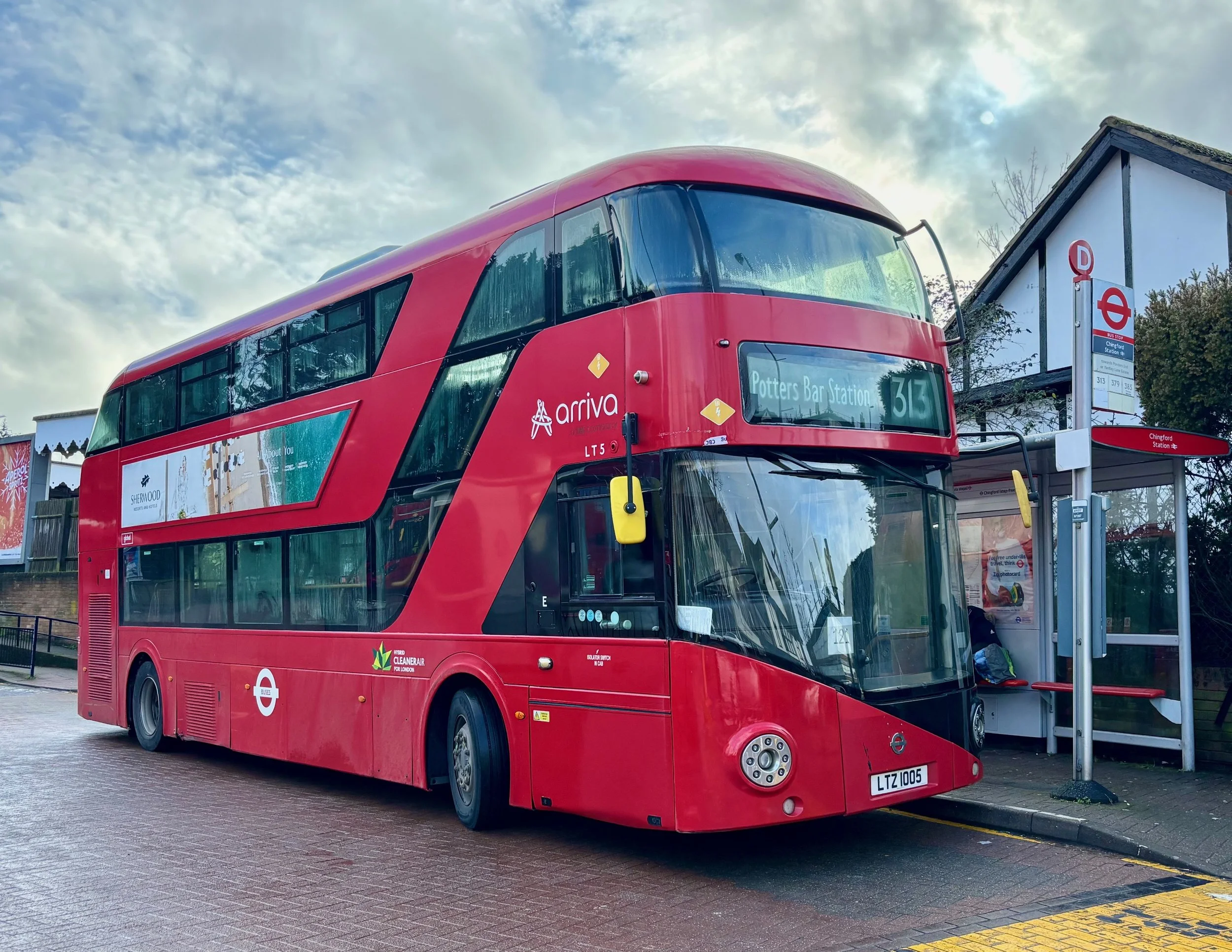
NRMs still look a little odd on the 313 which is an outer suburban service with countrified sections, rather than their normal haunts in Central & Inner London. LT5 of Arriva’s Enfield (E) Garage is seen at Chingford Station during my trip on it.
The 313 is currently home to some of the very earliest NRMs, with LT1-6 often out on the route. However, this is due to change in November 2026, when the route passes to Metroline with existing electrics promised.
Route 313: Enfield Chase - Chingford - Potters Bar
At Enfield Chase, I simply crossed the road to the stop near the War Memorial to await my next bus, on Route 313 to Chingford Station. This service has been retendered recently and is due to pass to Metroline with existing electrics later in 2026, so this was maybe my final opportunity before then to ride the route whilst it remains with Arriva at Enfield (E) Garage. Unusually, the allocation mainly comprises NRMs, which look distinctly out of place on this semi-rural run on the northern fringes of the TfL network. However, DW diesels are often out in support, mostly at least one and sometimes more appearing each day.
I had ridden a DW on my previous trip on the 313 a couple of years ago, so this time I opted for one of the NRMs, which turned out to be LT5, one of the early examples that predominate on the route. Despite earlier delays in the area, the bus arrived bang on time and I took an upstairs front seat for the run. This is not a particularly busy service other than at peak times, so I had the top deck to myself for most of the journey. A straight run through Enfield Town this time, along Southbury Road to Ponders End Garage, where we had a speedy driver change. Then on across the Lea Valley past the reservoirs to Kings Head Hill, which we then ascended to Chingford Town Centre. After just about half an hour, we drew into the Chingford Station terminus.
A 15 min scheduled break followed, after which I rejoined LT5 for the full run across the top of the London Bus Map to Potters Bar. Passengers on and off, but not that busy, enabling a decent overall time to be achieved, which was a pleasant contrast to my travails earlier that morning. Back through Chingford and down the hill to Sewardstone Road, before a fast run between the William Girling and King George’s Reservoir to the more prosaic delights of Ponders End. It always makes me smile to remember the quote of author Charles Lamb (1775-1834) who lived in the area and once wrote in a letter to William Wordsworth: “I had thought in a green old age to have retired to Ponders End - emblematic name, how beautiful!”
Back to reality as we crossed the Hertford Road and once more passed the garage, before a strangely traffic free run along Southbury Road back into Enfield Town. After this, we continued through Enfield Chase via The Ridgeway with its big houses to Chase Farm Hospital, where due to roadworks in Hunters Way, we entered and left the grounds through the main gates. After this, the nicest part of the journey, at speed on the country section through Botany Bay, the name first being used in the late 18th Century as it was then in a remote and inaccessible part of Enfield Chase, apparently an ironic reference to the penal colony of the same name in Australia! With views over the green fields beside us, which may sadly disappear if redevelopment plans for the area go ahead, we eventually reached the M25 Roundabout and the final stretch into Potters Bar, arriving at the station after a good run of 55 mins.
My ride on the 313 took me back to the 1960s when this was an LT Country Bus route, Green RT operated, remembering a very hot day when my parents took my brother and I as small boys from Enfield via Potters Bar & St Albans all the way to the then summer only terminus of Whipsnade Zoo for a day out. After later OPO conversion to RF and then SNB operation in LCBS days, the route joined the London Buses network in 1982, but initially only between Enfield & Potters Bar, with the 84 taking over the St Albans section, before being extended from Enfield to Chingford in replacement for the 121 a few months later. The original terminus of Cranbourne Road in Potters Bar eventually retracted to the station at all times.
Initially operated by London Buses with Ms from Potters Bar Garage, the route was one of the early ones to be tendered, passing to London Country (later LCNE) with LR Olympians in 1985, briefly restoring the old firm. In 1988, Grey Green took over, mainly single deck with Lynxes. Then in 1996, operation transferred to Leaside Buses (later Arriva) from Enfield Garage, where it has remained ever since. Types have progressed through LDR, DWL and ENX single deckers with the odd double deck, to all double deck with LT (from 2020) plus DW and T appearances.
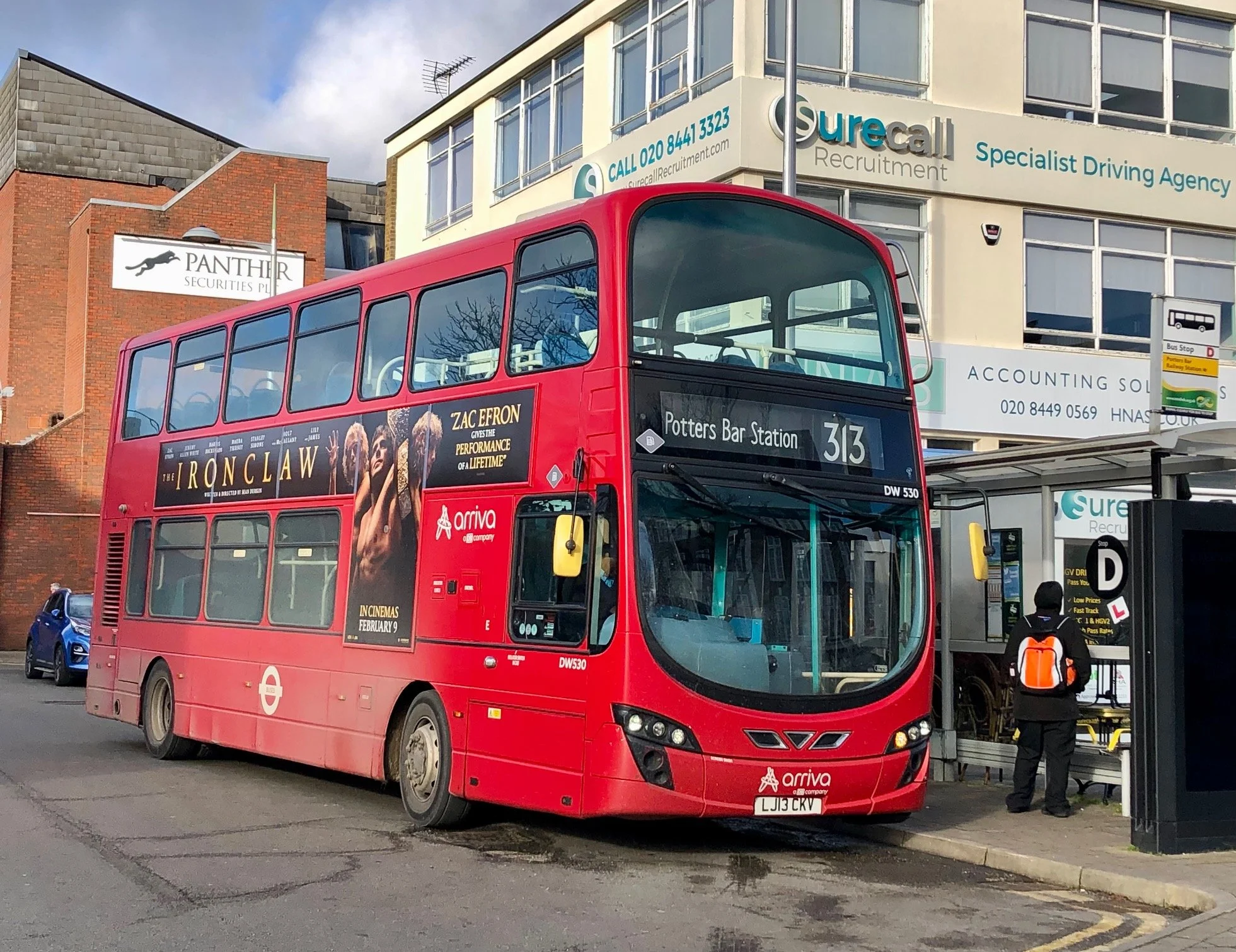
VDL DB300 Wright double deckers provide a support role on the 313 with Arriva, as DW530 of Enfield Garage demonstrates at Potters Bar Station which I rode on my previous visit to the route in January 2024.
At least one DW a day is usual with Arriva, although sometimes 2 or 3 appear. All set to change when Metroline take over in Nov.
Route 298: Potters Bar - Arnos Grove
At Potters Bar Station, I switched to the other TfL route to serve that location, the 298. This service was one of those handed back by Sullivan Buses at short notice in August 2024 and taken on by UNO, initially as an emergency contract and later formalised as a 3 year term. The next departure was undergoing a driver change when I arrived, formed of Enviro400 1489 one of those previously with RATP / First Group at Hounslow (AV) Garage and previously known as ADE40415. Not only did this bus retain its interior scheme from its prior owner, but also its inside adverts for businesses in Twickenham and other areas of South West London, hardly of relevance in the northern suburbs!
A few of us boarded and we were soon off back through Potters Bar and out of town, over the M25 again and then the long straight downhill ride through the country section to Hadley Wood and Cockfosters, picking up and setting down in ones and twos. Past Trent Park, where the former house has now been turned over to housing and which played a role in WW2 as a secret location where senior German POWs were detained.
Several left us at Cockfosters Station to connect with the Piccadilly Line, but we continued through the suburban part of the route and inter-war developments to Southgate, where the iconic circular 1930s station was temporarily exit only due to renovation works. This meant we picked up a fair number for the final leg to Arnos Grove Station, the next station south on the line. Along Waterfall Road the route is “Hail & Ride”, comparatively rare for a double deck service in London. Just 40 mins after leaving Potters Bar, we arrived at the Arnos Grove terminus.
The 298 began with “Reshaping” in 1968, taking over the northern part of the 29 plus the 29B, operating between Turnpike Lane and Potters Bar / South Mimms with a couple of M-F peak journeys to Borehamwood. It was RT operated, although the 29 continued to provide the Sunday service for a while. Further change came in 1970 when the 298 was extended to Finsbury Park at the southern end but cut back to Cockfosters at the northern end, being converted to RM at the same time. New offshoot route 299 took over the northern section. In 1973, the route retracted from Finsbury Park to Turnpike Lane again, only to be restored to Finsbury Park 2 years later, before being cut back yet again to Turnpike Lane in 1977! I recall riding a rogue RT on the route in this period when they were still at Palmers Green (AD) Garage for the 34, 102 & 261.
OPO came in 1980 with DMS, the route again being restructured to run through to Potters Bar & South Mimms with the 299 withdrawn. Conversion to M occurred in 1981, which continued until tendering saw London Country (soon to be London Country North East) take over with Olympians in 1986. The route was reassigned to Grey Green in 1988 mainly with Metrobuses. However, further change came in 1992 when Capital Citybus took the service with Mercedes midibuses being cut back from the north at Southgate Station, the busier section to Turnpike Lane passing to the extended 121.
1997 saw Arriva assume control with DRL and then LDR Darts, but in 2002 more tinkering resulted in the extension to Arnos Grove at on end and the cut back to Potters Bar Cranbourne Rd at the other. DWL class Cadets became the main type later in the noughties, although the odd double decker did appear. In 2010, the section between Cranbourne Road and the station in Potters Bar came off. Local operator Sullivan Buses were the next operator in 2012, operating AE type Enviro200s, but with frequent double deck substitutions, which brings us finally to UNO from 2024.
There was a suffix route, 298A, also introduced in 1968, between Turnpike Lane & Oakwood Station, essentially the former 29A renumbered. Initially M-F only with RT, the 125A provided the Saturday service between Southgate & Oakwood, there being no Sunday service over that section at the time. Converted to RM in 1970 in line with the parent route, the odd RT continued to appear. In 1971, the 125A was withdrawn and the 298A became M-S. The status quo remained until 1980 when the extended 121 swept the suffix route away for good.
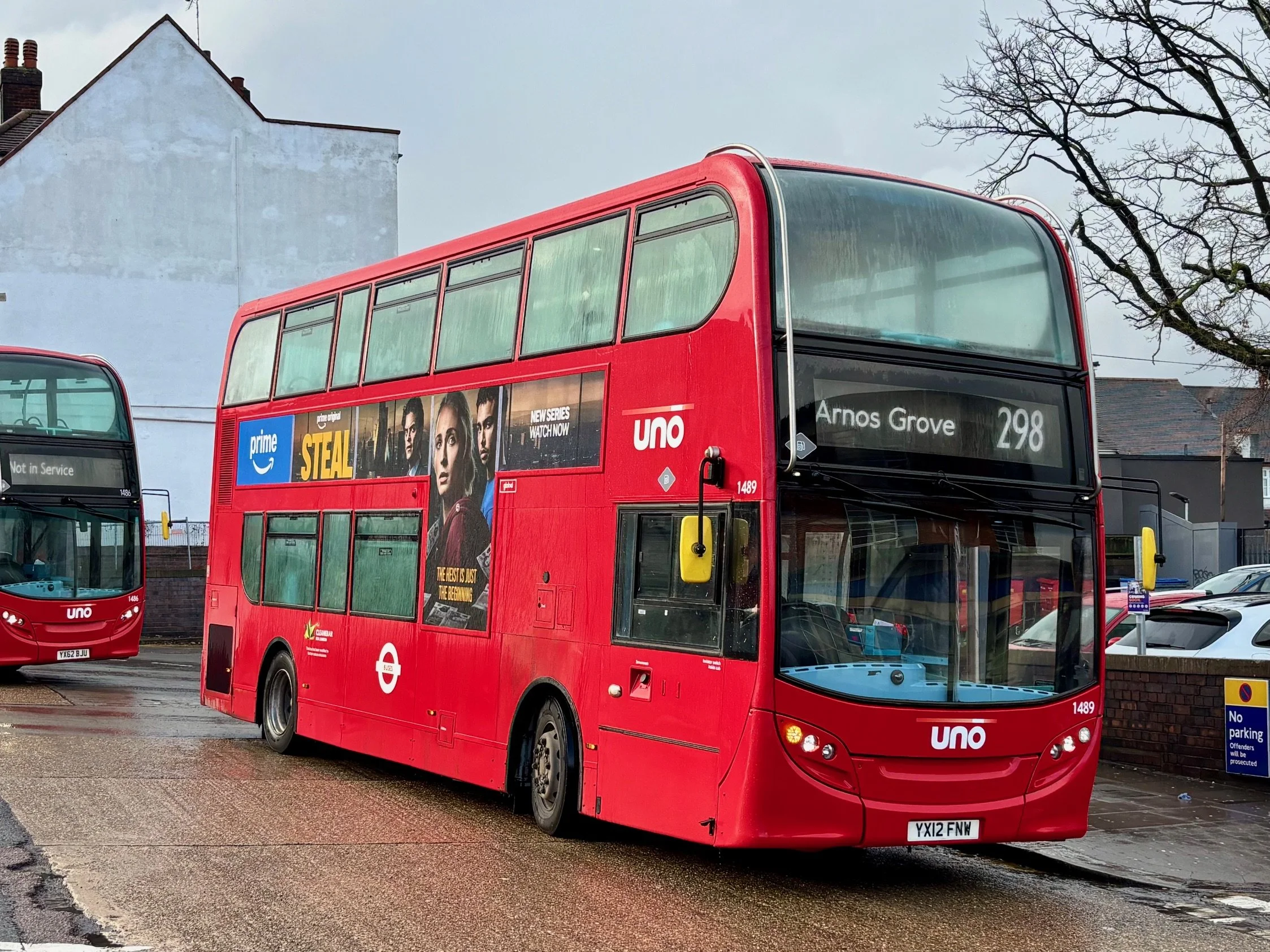
UNO Enviro400 1489 at Arnos Grove Station after my ride aboard from Potters Bar. This bus was formerly ADE40415 with RATP / First Bus at Hounslow (AV) Garage. The route is on a 3 year contract with existing diesels.
Just peeking in behind is sister Enviro 1486, which arrived out of service and formed the next departure back to Potters Bar.
Part Route 298: Arnos Grove - Southgate
As we arrived at Arnos Grove, another Enviro400 (1486) appeared out of service behind us and formed the next service back to Potters Bar. I took this a short distance back to Southgate Station, where I alighted 10 mins later.
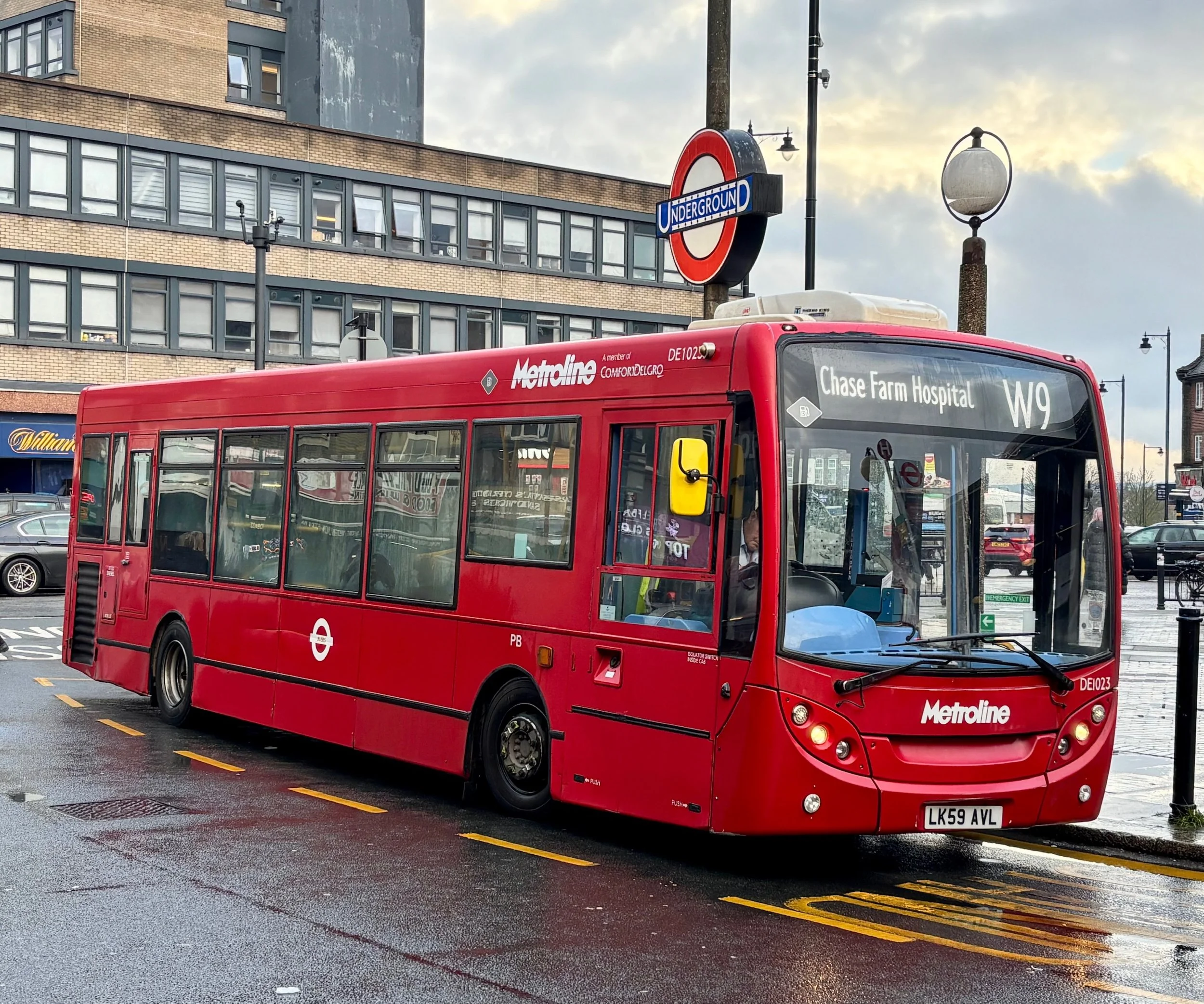
Early Enviro200 DE1023 of PB Garage on the W9 at Southgate Station beneath a classic 1930s style “Underground” bullseye before my protracted trip on this bus to Chase Farm.
The W9 is due to get slightly newer Enviro200s as these are released from the 382 by the arrival of new electrics, meaning that these older examples are on borrowed time.
Route W9: Southgate - Chase Farm Hospital
My last route of the day was the W9, which I had last ridden in the other direction in January 2025. This is due to receive newer Enviro200s (DEM class) from the 382, now that new VMSS electrics are starting to enter service on that route. So, a last chance to catch the older DE Enviro200s on the W9 and next off the blocks was DE1023 of Metroline’s PB Garage.
A ride of 3 parts - quiet & fast, packed & slow then quiet & fast again! We left Southgate with just 3 of us on board and made good time through the back doubles that characterise the route through to Winchmore Hill Station. Arriving at Highlands Village, we circumnavigated the development that replaced the former hospital, but then chaos on World’s End Lane as we coincided with local school chucking out time.
A traffic queue caused by the school run plus temporary lights further down Green Dragon Lane combined with large numbers of students boarding caused a significant delay, shooting the schedule to pieces. We gradually dropped people off as we progressed through Grange Park but another traffic queue on approach to Enfield Town retarded us further.
After this, calm was restored over the final section via Holtwhites Hill to Chase Farm, but by now we were 20 mins late. The closure of the Hunters Way entrance to the hospital meant we had to join another traffic queue onto The Ridgeway and in via the main gates. I eventually arrived at the terminus after an extended run of 65 mins - compared with my previous trip the other way in quieter traffic of just over 40 mins. However, at least we made it through, our bus then returning out of service to the garage.
Therefore my day had been one of mixed fortunes, with annoying delays at the start and the end, but with some good rides in between. From Chase Farm, I walked the short distance through the rain to nearby Gordon Hill Station for the Great Northern train, reflecting that I had known the W9 since its introduction as the first minibus service with London Transport back in 1972. For those wishing to read more on its history, please refer to my previous article “Enveloping Enfield” of 1/2/25.
Watton
“And Finally”…
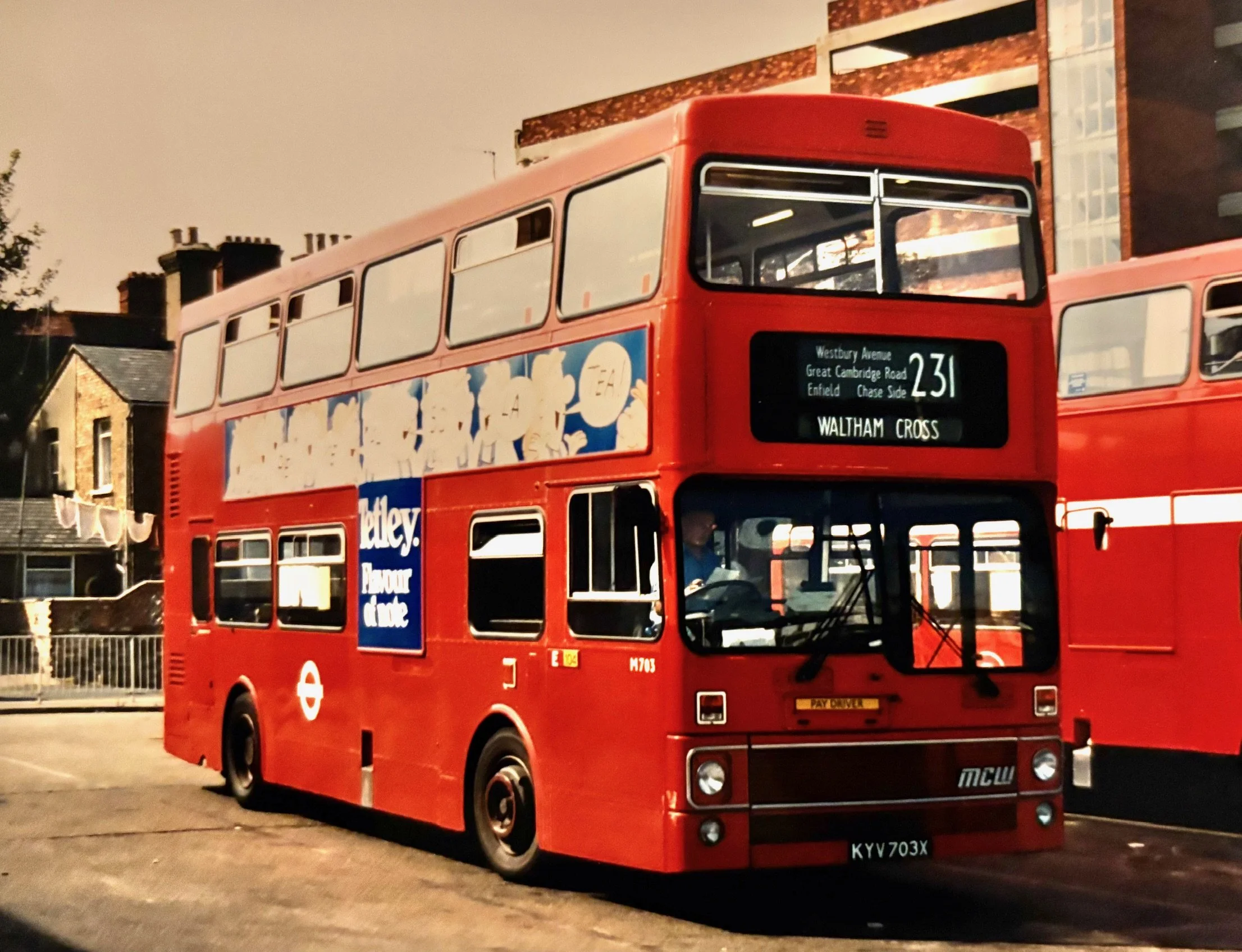
Surprisingly perhaps, this is not an AI image, it is a genuine photo I took of a 231 at Waltham Cross Bus Station back in June 1987! Metrobus M703 of Enfield (E) Garage looks out of place in that location.
The 231 was extended from its then normal terminus of Carterhatch to Waltham Cross on Sundays only from 1987-90 to part replace the 217, which was withdrawn on that day. This arrangement was short-lived and the 217 eventually became daily again.
