
Developments along the Thames
On this trip, I travel from Central London to North Greenwich, ride a new Superloop route to Thamesmead and back, then cross the river to sample services in East London, covering the Docklands and Barking Riverside areas.
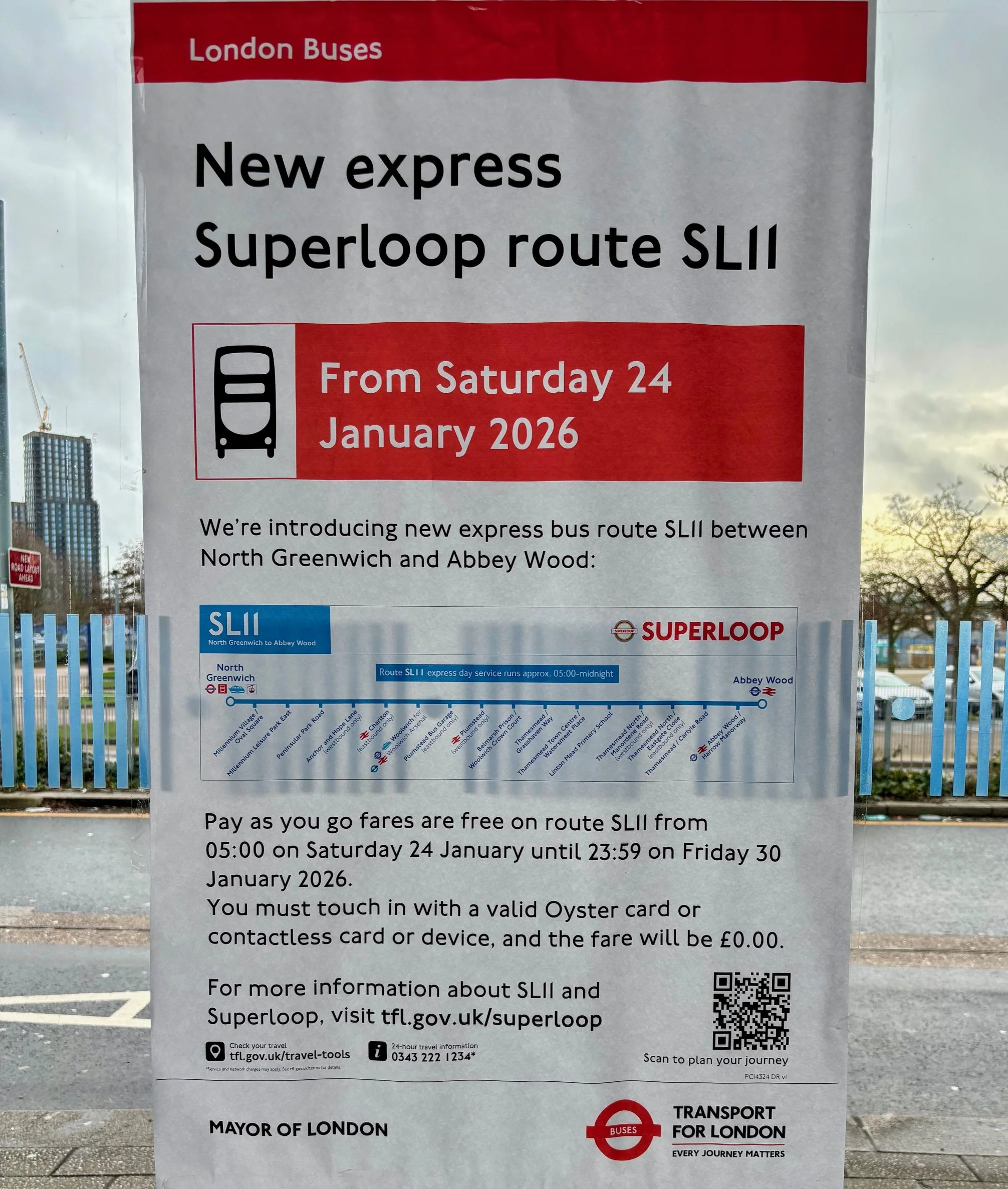
New “Superloop” Route SL11 from North Greenwich to Abbey Wood began on 24th January 2026, as this poster at North Greenwich Bus Station describes.
Unlike previous “SL” routes, this one directly replaced an existing service between the same points, the 472, although operating “Express” with fewer stops, as shown on the diagram. The SL11 is operated by Go Ahead London, the 472 having been a Stagecoach preserve.
Route 188: Tottenham Court Road - North Greenwich
The Northern Line took me to Tottenham Court Road on a Saturday morning, the normally bustling streets in that part of the West End being almost deserted at that early hour on the weekend. I only had a few yards to walk to the first pick-up stop of my initial bus route for the day, the 188 to North Greenwich. This route was renewed with Go Ahead London in 2024 with new electrics promised eventually, the service being reallocated from Morden Wharf (MG) to Camberwell (Q) in August 2025 to permit this. New BYD B11 double deckers have since entered service and I had EBD131 which was on the next departure.
Just me and the driver to begin with, but we began picking up more passengers as we progressed to Holborn Station and down Kingsway to Aldwych. Crossing the Thames over Waterloo Bridge, we were then on diversion due to roadworks on the direct route past Waterloo Station. This involved a detour via York Road, Westminster Bridge Road and Baylis Road, regaining line of route near the Old Vic Theatre. From here, it was business as usual, continuing on via Elephant & Castle and Bricklayers Arms, almost back to the river again in Tower Bridge Road.
We then ran virtually parallel with the south bank of the Thames along Jamaica Road to Rotherhithe, looping round to serve Canada Water Station and the new developments around Surrey Quays. Then back to the traditional route via Evelyn Street to Deptford, before passing along Creek Road into Greenwich Town Centre, with views of the main tourist attractions including the preserved 19th Century clipper ship “Cutty Sark” and the National Maritime Museum. Incidentally, I only recently discovered that the name “Cutty Sark” comes from the Scottish term for a short shirt or undergarment. This was referred to in a Robert Burns’ poem for a scanty undergarment worn by a witch, which was later used to signify the speed of the clipper ship, a term unlikely to apply to many present-day TfL buses!
From here, the final stretch was along the narrow and speed-restricted Trafalgar Road, before breaking free and turning left along Blackwall Lane and crossing under the Blackwall Tunnel Approach Road up to the terminus at North Greenwich, for the O2 Centre. Built for the Millennium Exhibition in 2000, “The Dome” (as it is known colloquially) is now a 20,000 capacity arena, entertainment venue and leisure complex. Our journey from town took 1h10m in all, a smooth and quiet ride.
The 188 was a replacement route for the 68 tram starting in 1951, running initially between Chalk Farm & Greenwich Cutty Sark with RT operation. Eventually, it retracted at the northern end to Euston, Aldwych or Waterloo on different days of the week, settling on Euston at all times in 1978, although with a projection to King’s Cross added later on M-F for a while. In 1999, it was cut back to Russell Square at that end, but extended at the other end to North Greenwich (for the then new Dome). It was in 2023 that the “in town” terminus was switched to TCR in a swap with the routeing of the 1.
The route was converted to OPO with SMS single deckers in 1971, but reverted to double deck with DMS in 1976, which in turn were replaced by T in 1982 and then mainly by L in 1986. Contracting saw numerous changes of operator over the following years, using a variety of principal double deck types:
Boroline Maidstone - 1988-1990 (Volvo Ailsa)
Selkent - 1990-1993 (T & L types again)
London & Country - 1993-1997 (Titan then Volvo East Lancs D/D)
Cowie South London / Arriva - 1997-2000 (Volvo Alexander D/D then DLA)
London General / Go Ahead - 2000-2005 (PVL with a few AVL & WVL)
Travel London / Abellio - 2005-2017 (Volvo B9TL with a few Enviro400)
Go Ahead London - 2017 to date (WHV with a few MHV)
The latest change saw the former hybrids replaced by EBD electrics in 2025.
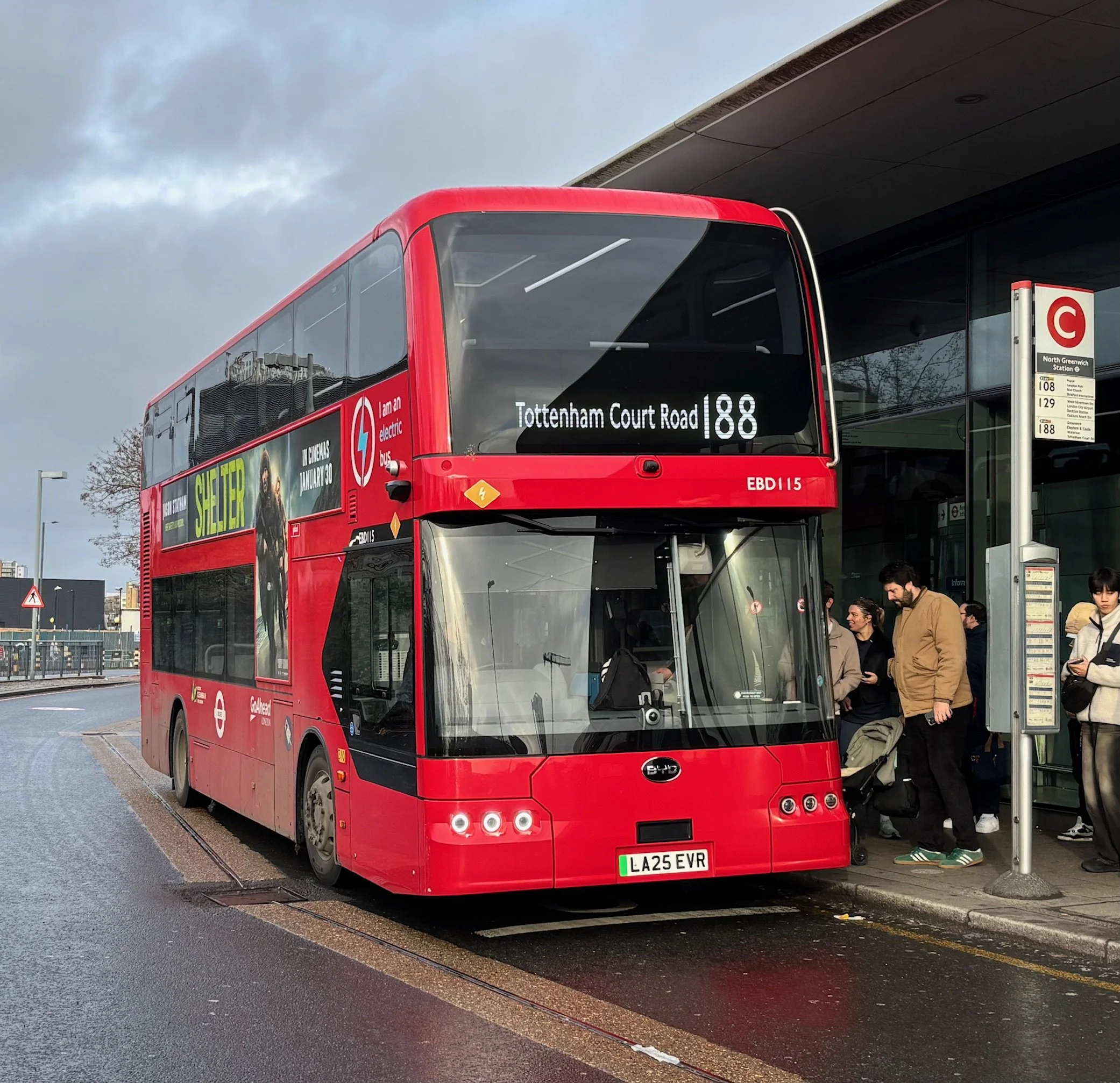
The 188 links North Greenwich with the West End and has recently been converted by GAL to new BYD BD11 electrics. EBD115 of Camberwell (Q) Garage picks up a good load at North Greenwich Bus Station.
I had just arrived here from TCR on fellow electric EBD131.
Route SL11: North Greenwich - Abbey Wood
Next on the agenda, the exciting prospect of a new TfL bus route! This was the SL11, the latest addition to the “Superloop” fold, which began on 24th January 2026. Slightly different from previous “SL” services, in that it directly replaced a former “all stops” route, the 472, with an “express” limited stop version, operating between the same terminals of North Greenwich and Abbey Wood. Interestingly, at nights, the all stops service remains under the number N472. The SL11 is also surprisingly frequent, with a 6 min M-S daytime headway, dropping to 10 min evenings and 12 min on Sundays.
Another surprise was that despite being intended for operation with New Routemasters, mostly those from the batch made spare from the SL3 after Stagecoach converted that route to new electrics, the majority of the allocation comprised elderly diesels to begin with. These were mainly the batch of ex First WVN class Volvo B9TLs previously at Merton (AL) where they had been recently displaced by the arrival of new Wright StreetDeck Electroliners for the 131, the former moving to Morden Wharf (MG), where they were joined on the SL11 by a few WVLs already at the garage. A driver on the route told me that many of the expected LTs from Stagecoach were found to be unfit and only 4 were available on the first day of the new route, although there were 8 by the end of the first week, some being transferred from within GAL instead. Others appear to be slowly filtering into service as they are made ready. Although the LTs I saw had “Superloop” red and white livery with suitable signwriting, the WVNs and WVLs had no such adornments and remain in plain red, presumably as they are only a temporary allocation.
For the outbound run, I had WVN27, still with faded First purple interior, the moquette looking distinctly worn and hardly providing the high profile image expected for Superloop! Nevertheless, any bus is better than no bus, and at least this elderly vehicle was in decent shape mechanically, giving what may be a farewell performance on TfL work and enabling me to ride a new route with the class at the eleventh hour of their service. There appeared to be a bit of confusion amongst some passengers along the route as to where the bus was stopping, with people putting their hand out at stops not served or those on board ringing for stops other than the scheduled ones - clearly the concept of an express limited stop service is unfamiliar in this part of London and will take a while for locals to get used to!
Leaving North Greenwich Station, we made our way down to Millennium Village, calling at the Oval Square stop, where we picked up a few more. At the Millennium Leisure Park, only one of the two stops is served (the east one), with the next stop being at Peninsular Park Road for the various retail outlets there. After this, we continued to Charlton Station, stopping in Woolwich Road. It was then a non-stop run to Woolwich, negotiating the various “urban realm” roadworks along this section. At Woolwich Ferry, we parted company with the former route of the 472, ignoring the town centre and proceeding direct to Woolwich Elizabeth Line Station, where there was a healthy exchange of clientele. Then express to Plumstead Garage, where no-one wanted to board or alight, so we continued without stopping.
From here, we were into Thamesmead, following the former 472 routeing but stopping only at Princess Alice, Grasshaven Way, Watersmeet Place and Linton Mead. Only one stop is served on the loop section around Crossway, at Eastgate Close, where only one passenger boarded. Back on the main road, we called only at Carlyle Road (Boiler House) before running express to Abbey Wood, dropping off on Harrow Manorway by the station, then looping around and terminating underneath the flyover at Gayton Road. At 40 minutes, this was around 10 mins quicker than my previous journey on the 472 between these points.
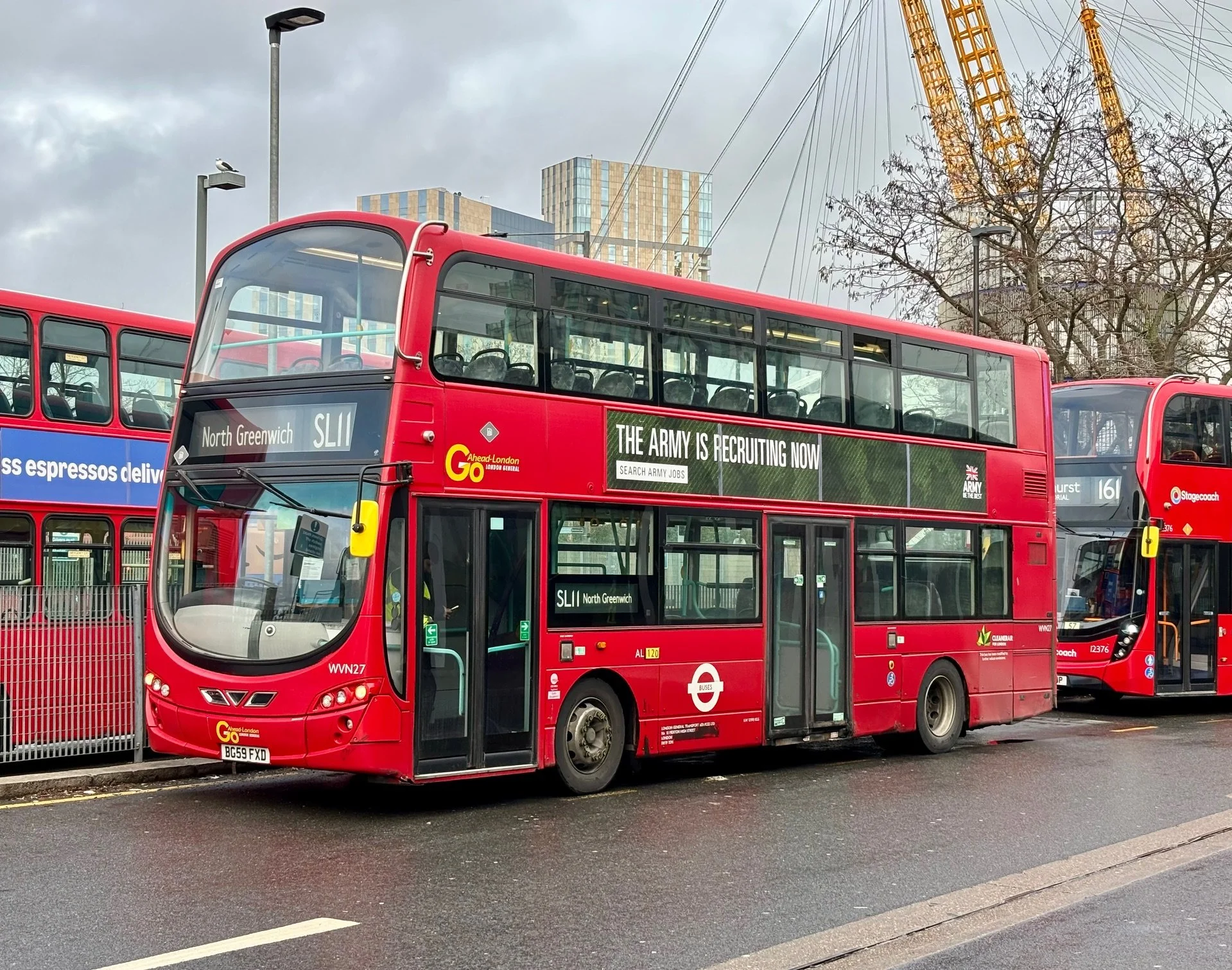
A surprise in the early days of the SL11 was the appearance of a number of Volvo B9TLs due to a shortage of the intended New Routemasters.
WVN27, now at Morden Wharf (MG) Garage, takes stand time at North Greenwich before I rode it to Abbey Wood.
Several of these ex First London vehicles were transferred from their former home on the 131 at Merton (AL) Garage, where they have been made spare due to the arrival of new electrics.
Route SL11: Abbey Wood - North Greenwich
At Abbey Wood, I took a short break, during which I observed the mix of WVN, WVL and LT types coming and going on the SL11. For the return trip, I opted for one of the NRMs, LT125, which was one of the few ex Stagecoach examples that had made it across to GAL at that time. In red and white Superloop livery with appropriate blue signwriting showing the main points served between decks on each side, we departed Abbey Wood with a few takers, some of whom had never ridden a bus of this type before and were surprised by the three doors and two sets of stairs!
Back via the reverse of the outward route, this time a busier trip, with good numbers joining at the various stops in Thamesmead for the fast run into Woolwich. Not the first time that an express link has operated between these places, as there was a 472 EXPRESS and then an X72 over this corridor from 1988-99. A mass exodus at Woolwich Station, before we again took the direct route back to Charlton and the Greenwich peninsula. Despite many more users than the outward journey, we only took a couple of minutes longer than the previous trip, disgorging our final load at North Greenwich Bus Station.
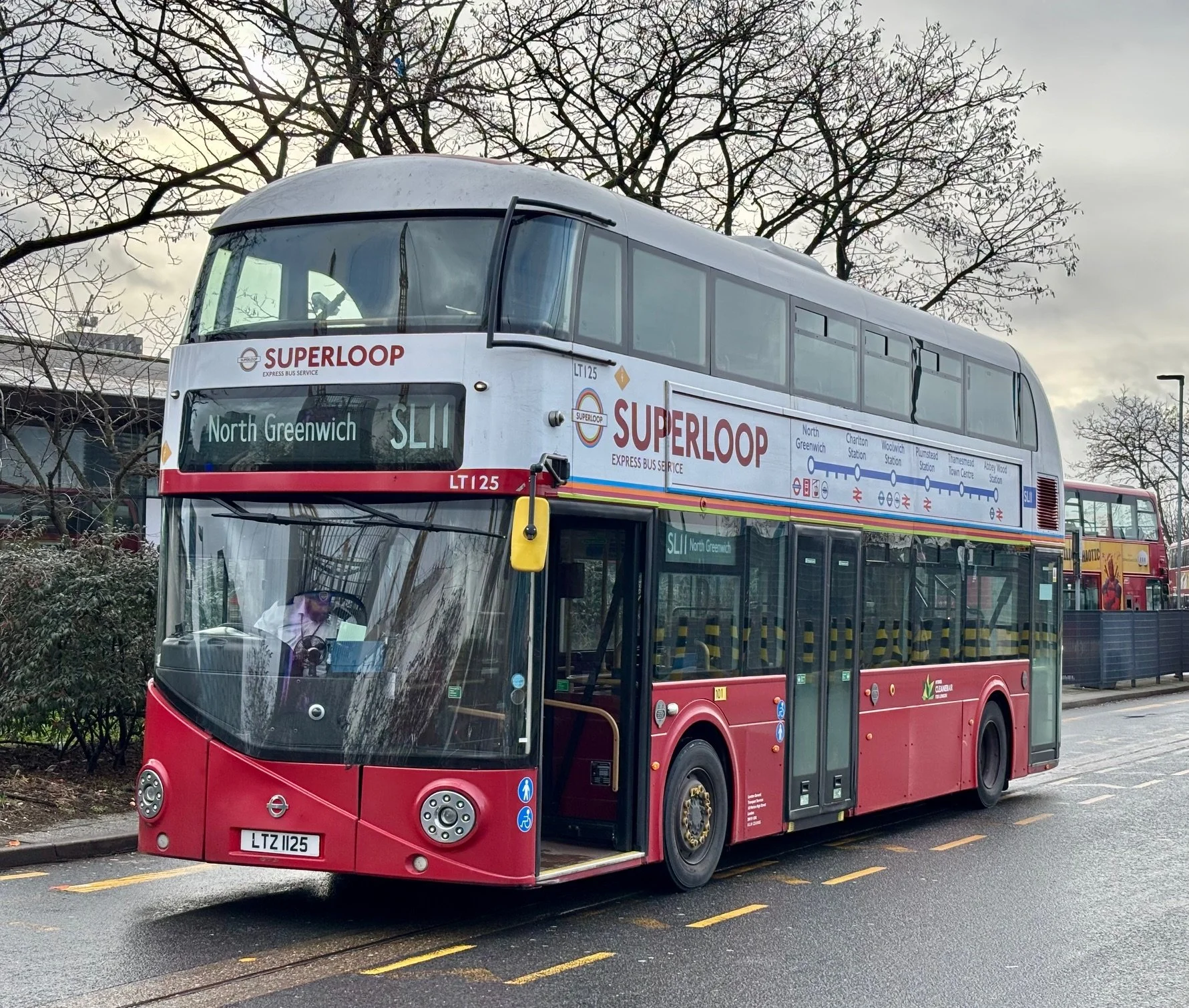
The intended allocation on the SL11 of NRMs is represented by LT125 of MG Garage, also caught at North Greenwich, with full signwriting for the new route. I travelled on this bus later back from Abbey Wood.
This was one of the batch formerly with Stagecoach on the SL3 now displaced by new electrics. Unfortunately, many were deemed unfit for service on the SL11 in time, leading to the emergency use of the WVNs.
Route 104: Stratford - Beckton
It was then time to turn my attention to routes in Docklands on the other bank of the Thames, so I transferred to the Jubilee Line for the short trip from North Greenwich to Stratford.
Walking to the adjacent Bus Station, my next bus route was the 104, which has recently been retained by GAL on retender from mid 2026 with new electrics expected in the fullness of time. For now, the mostly hybrid mix of EH and WHV types from River Road (RR) Garage continues, but there were a couple of diesel Enviro400s out to play, including E186 which arrived at the Bus Station as I did and pulled round to the pick up stop without stand time. Presumably there had been a bit of a gap in the service, as a large crowd boarded with me.
Leaving Stratford, even more piled on at the Tramway Avenue stop, with a busy run following past Stratford Park and then West Ham Park, with frequent halts to give way to oncoming traffic in narrow Portway and Plashet Road. At the Green Street junction, a short delay at the lights before exchanging passengers at Upton Park Station. Onwards past the new development which has replaced the former West Ham United Football Ground, then across the main Barking Road at the “Boleyn”. We were now into the narrow back streets section of the route through inner city housing, with the 104 behind catching us up at this point but maintaining its position.
Emerging from Lonsdale Avenue at East Ham Nature Reserve, we hung a right and crossed under the A13 Newham Way down to the terminus at Beckton Bus Station, where most of our crowd disappeared into the adjacent shopping centre. A short but busy run of just under 40 mins.
The 104 number still seems a little out of place in East London, as I still associate it with its previous incarnation as a route between Moorgate & Barnet (later cut back to North Finchley). This version replaced Trolleybus 609 in 1961 and was the first in London to operate the longer RML version of the Routemaster. Converted to DMS OPO in 1982, it enjoyed a brief period with M operation before being withdrawn in 1985, replaced by parts of the 17 and 43.
The current 104 came in 1989, running between Stratford and Manor Park in a “U” shape via Upton Park and East Ham, replacing part of the former circular S1. It followed that course until 2022, when it was split into two routes, the new 304 from Custom House taking the East Ham to Manor Park leg, whilst the 104 was shortened and diverted to Beckton from the Stratford end.
For many years a Stagecoach / East London route, it was initially Titan operated, although midibuses appeared on Sundays for some years. The mid 90s saw S class Scanias, whilst in 2000 low floor single deckers took over in the form of Dennis Darts. These soon proved inadequate and a top deck returned in 2003 when Trident Alexander ALX400s assumed control, although from 2012 Enviro400s began to enter the mix. Go Ahead London took over the contract in 2018 with E, EH and WHV types being the main performers in subsequent years.
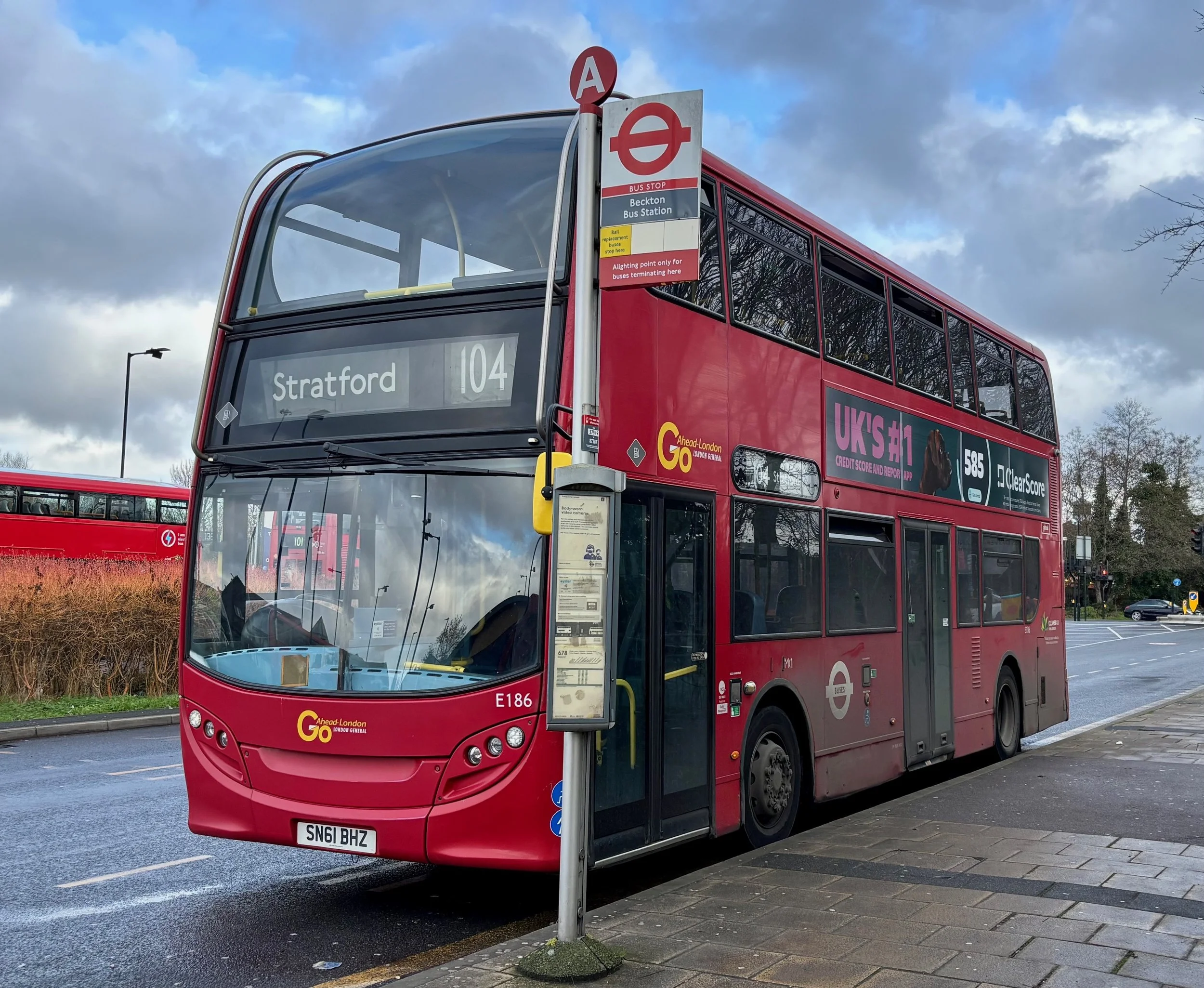
The 104 has been retained by GAL on retender from June 2026 with new electrics due to take over eventually. Meanwhile, existing vehicles continue, like Enviro400 E186 of River Road (RR) Garage, seen at Beckton Bus Station after my trip on it from Stratford.
The allocation when I travelled was mainly EH and WHV hybrids, but with a couple of diesel E types helping out.
Part Route 129: Beckton - Thames Barrier
At Beckton Bus Station, I had only a 5 min wait for my next bus, a positioning journey on GAL operated 129, which I had ridden in full in 2025. Boarding my second electric of the day, EBD101 of Henley Road (DS) Garage, it was just a 20 min trip via London City Airport to Thames Barrier / Pontoon Dock, where I alighted conveniently at the first pick up stop of my next full route, the 330.
Route 330: Thames Barrier - Wanstead Park
I had ridden the 330 in the opposite direction a year previously whilst it was still with Stagecoach. However, since then, it had passed to GAL, also from DS Garage. Although hand-me-down hybrids are intended when new deliveries allow, existing diesels provide most of the allocation in the interim, using E and WVL types. WVL429 was just pulling off the stand as I arrived, so I hopped aboard when it drew up at the stop with a few others, a now rare chance to ride this type in East London.
Reasonable progress at first as we made our way in parallel with the DLR through Docklands to Canning Town, calling at the Bus Station and then the Market. From here on, the run became more turgid due to large numbers of passengers and busy traffic. Along the Barking Road via Plaistow to Green Street “Boleyn” where I had been earlier on the 104 in the other direction. Back through Upton Park with its hustle and bustle, before reaching the Romford Road at Forest Gate Police Station. By now, most of our load had alighted and it was a quiet finish on the final stretch up to Wanstead Park Station. A 50 min journey.
I covered the history of the 330 in my article “Docklands Diesels & Eastern Electrics” dated 14/04/25, which should be referred to for details of how the route developed from introduction as an East London “hoppa” in 1993 to the service we know today.
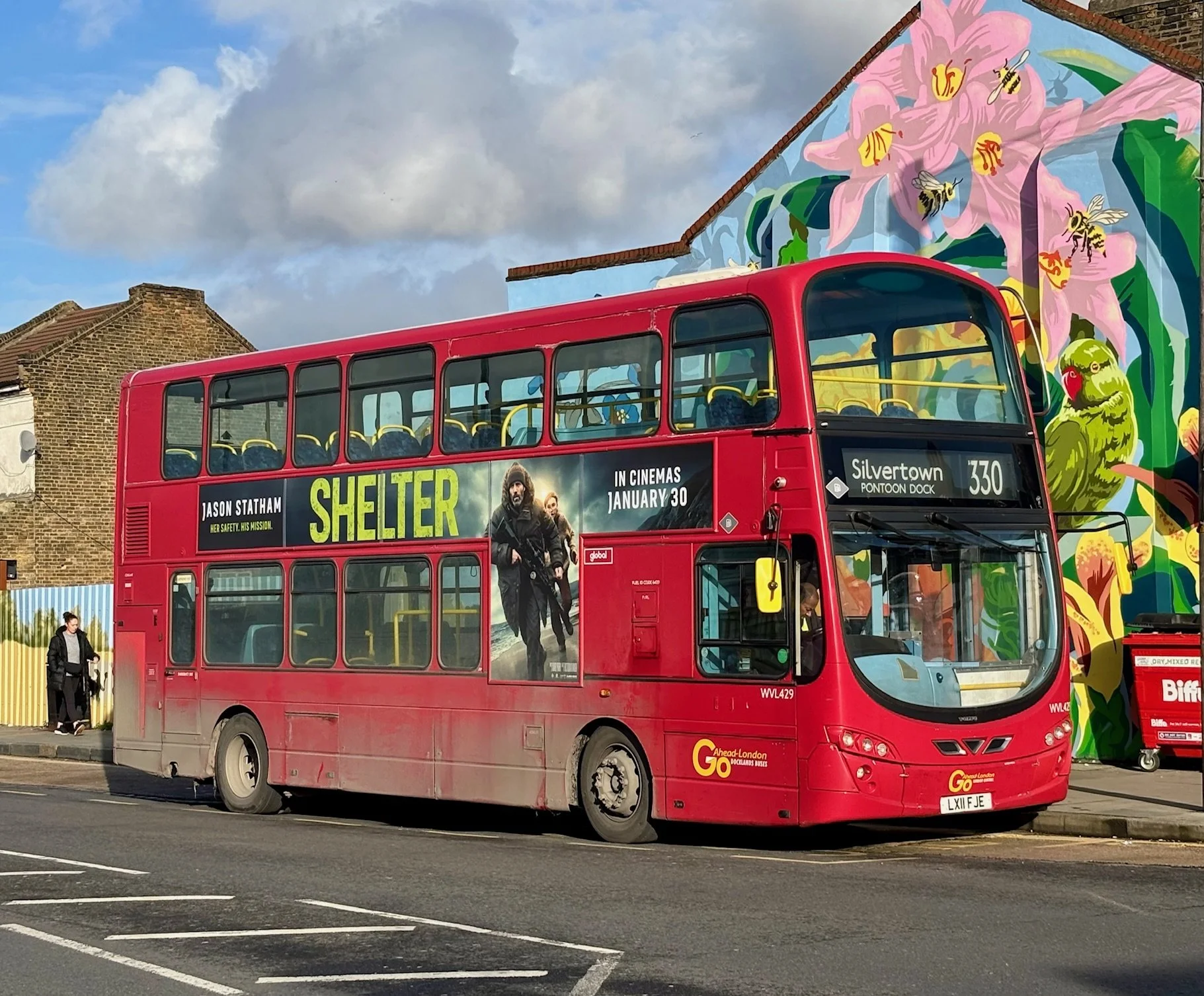
The 330 passed from Stagecoach to GAL in May 2025, mainly with existing diesels for now of the E and WVL classes. Volvo B9TL WVL429 of Henley Road (DS) Garage stands beside a colourful wall mural at Wanstead Park Station after my journey here aboard.
The route is due to get cascaded hybrids when these become available from other services after they receive new electrics.
Route EL1: Ilford - Barking Riverside - Barking Reach
From Wanstead Park, it was a short walk to nearby Forest Gate Station, where I was able to take the Elizabeth Line a couple of stops east to Ilford, to connect with the final section of my journey around new developments along the Thames, this time focusing on the Barking Riverside area.
This is served by a trio of routes branded as “East London Transit”, originally envisaged as a tram network, but then watered down considerably to “normal” bus routes with a different livery! The EL1, EL2 & EL3 are operated by GAL using some of the final NRMs in the 9** series in two tone red and peach colours, which when introduced was quite a departure from their usual allocation to routes in Central London. The operational garage is River Road (RR).
I began with the EL1, boarding LT923 at Ilford Hill just around the corner from the station, for its next trip to Barking Riverside. This is a fairly short route, but the first section along Ilford Lane to Barking Town Centre was its usual congested self, with progress being slow. Together with the 169, the EL1 provides the main stopping service between Ilford & Barking, although the SL2 provides a non-stop (but maybe not express!) option between the two places. This corridor is crying out for bus priority measures, but it is difficult to see what options are available over this narrow road.
At Barking Station, we took the short-cut through the market to serve the Vicarage Field Shopping Centre, served only by the “EL” routes, other services taking the long way round. Many returning shoppers joined us here and we continued along Ripple Road and Movers Lane across the A13 to River Road, before turning off to serve the Thames View Estate, where most alighted. We were then onto the newer developments in the Riverside area, serving the new housing before swinging east to Barking Riverside Station on the recently extended Overground line. Passing through an open area where building has still to be completed, we called at Riverside Campus before arriving at the Northgate Road terminus. Just 35 mins end to end on this trip.
Ahead on the stand was sister LT951, so I was able to step up a working and board this when it departed, retracing my steps just a few stops to Barking Reach, Minter Road, where I got off 5 mins later.
The EL1 has been around since 2010, when it replaced former route 369 between Ilford and Thames View Estate. GAL have always been the operator, the original allocation comprising WVLs in the special East London Transit livery, which has been perpetuated on the LTs which replaced them in 2017. The route received a short extension from Thames View to Barking Reach in 2013 and then to Northgate Road when new roads later became available.
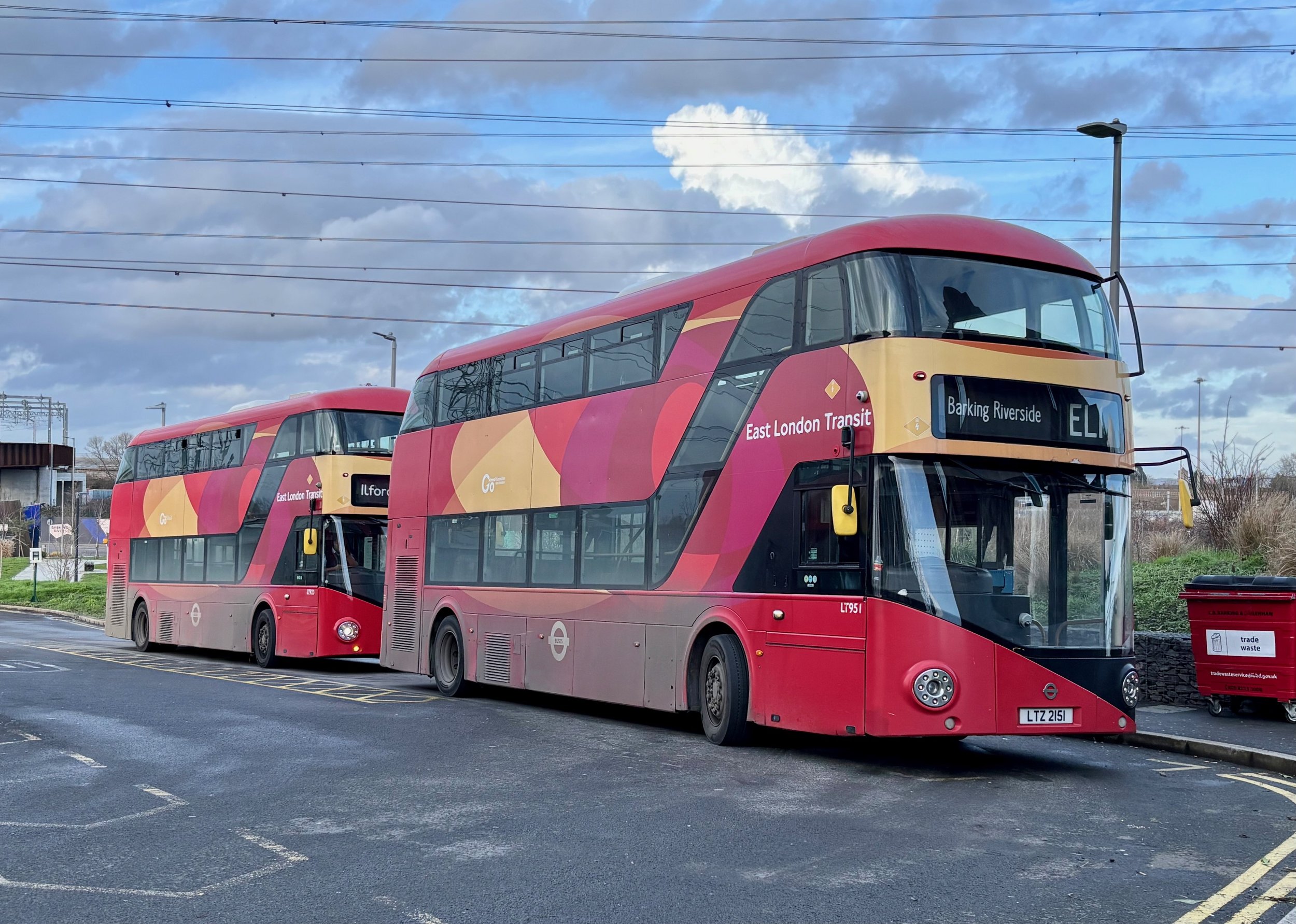
A pair of grubby NRMs at Barking Riverside on the EL1, with LT951 ahead of LT923. Both allocated to GAL’s River Road (RR) Garage.
I had arrived on the rear vehicle from Ilford and departed on the front one. The East London Transit livery gives the “EL” routes a special look, but some are now repainted in plain red.
Route EL3: Barking Reach - Little Heath - Goodmayes
I had time to squeeze in one more route, so opted for the EL3, where LT919 was waiting on the stand. I had just missed the previous working, which was a plain red example of the class, several of which share the load on the “EL” routes, whilst branded ones turn out on “normal” routes from River Road Garage!
A quieter route than the EL1, returning to Barking via a different intermediate route. From Barking Reach, we served the industrial area around Creekmouth, where I once rode RTs on special Sunday journeys of the 62 to the now-gone Power Station. This route is the only one to pass the operational garage in River Road itself, which is a somewhat bleak mainly open site. No driver change though and we continued at pace back across the A13, joining the EL1 again for the short section back to Barking Town Centre and the station.
After this, we parted company and continued along Longbridge Road past Barking Park to Fair Cross, location of Barking (BK) Garage, now with Stagecoach and famously the last to operate RTs in London service on the 62 back in 1979. On this trip, I noticed new electric charging kit in the garage yard where rows of parked RTs used to stand, such is progress. Soon, we turned off the main road up Goodmayes Lane, negotiating two sets of temporary lights through roadworks without too much delay. A little bit of a queue past Goodmayes Station to the main Romford Road, but early running meant a 2 min “hold” at the first stop north of this. Then the final section via Goodmayes Hospital and KIng George Hospital up to the terminus at Little Heath. A 40 min run.
Once again, I was able to step up a working and board the EL3 in front, plain red LT934, which I rode on the 10 min trip back down to Goodmayes Station.
The EL3 was a later addition to East London Transit, joining the brand in 2017 when the 387 was renumbered. It has been LT operated ever since. The only route change was the extension of a couple of M-F school journeys within the Riverside area to Northgate Road in 2018. Interestingly, the Barking - Little Heath leg has been served by 4 different routes at different times over the last 35 years, these being in turn the 238, B1, 387 and now the EL3.
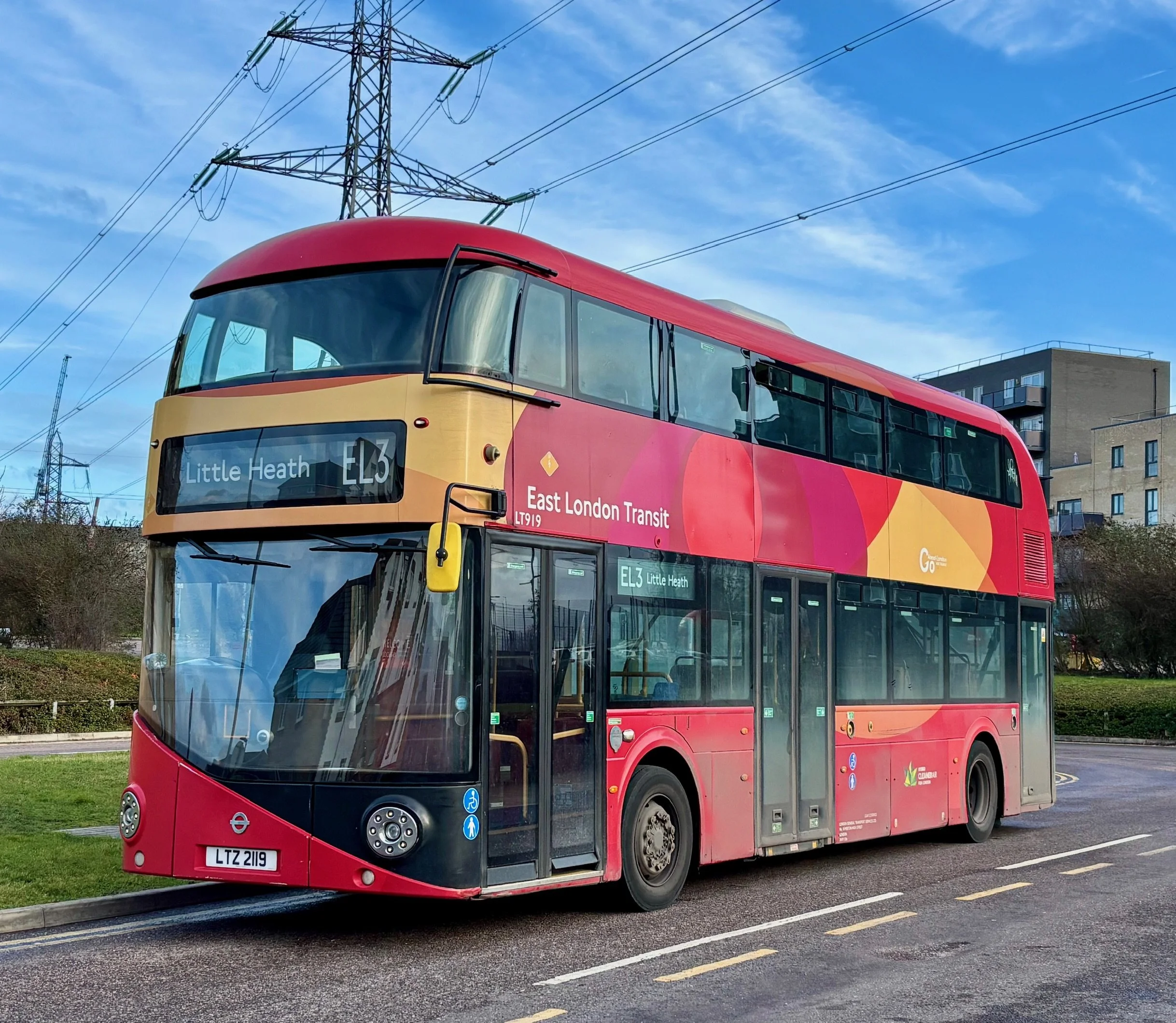
The nearside view of the East London Transit livery is demonstrated by LT919, also of RR Garage, seen at Barking Reach on the EL3 before I departed on it to Little Heath.
Whilst plain red LTs also appear on the “EL” routes, some East London Transit liveried ones were seen on the 5 during my travels!
Elizabeth Line: Goodmayes - Tottenham Court Road
After completing my bus rides for the day, I rejoined the “Lizzie” line at Goodmayes, for a fast 30 min run back to my start point at Tottenham Court Road. During the journey, I was able to reflect on the interesting selection of bus routes covered both north and south of the river visiting several areas which have undergone a rejuvenation with new developments in recent decades.
Watton
My journey ended with a ride on the Elizabeth Line.
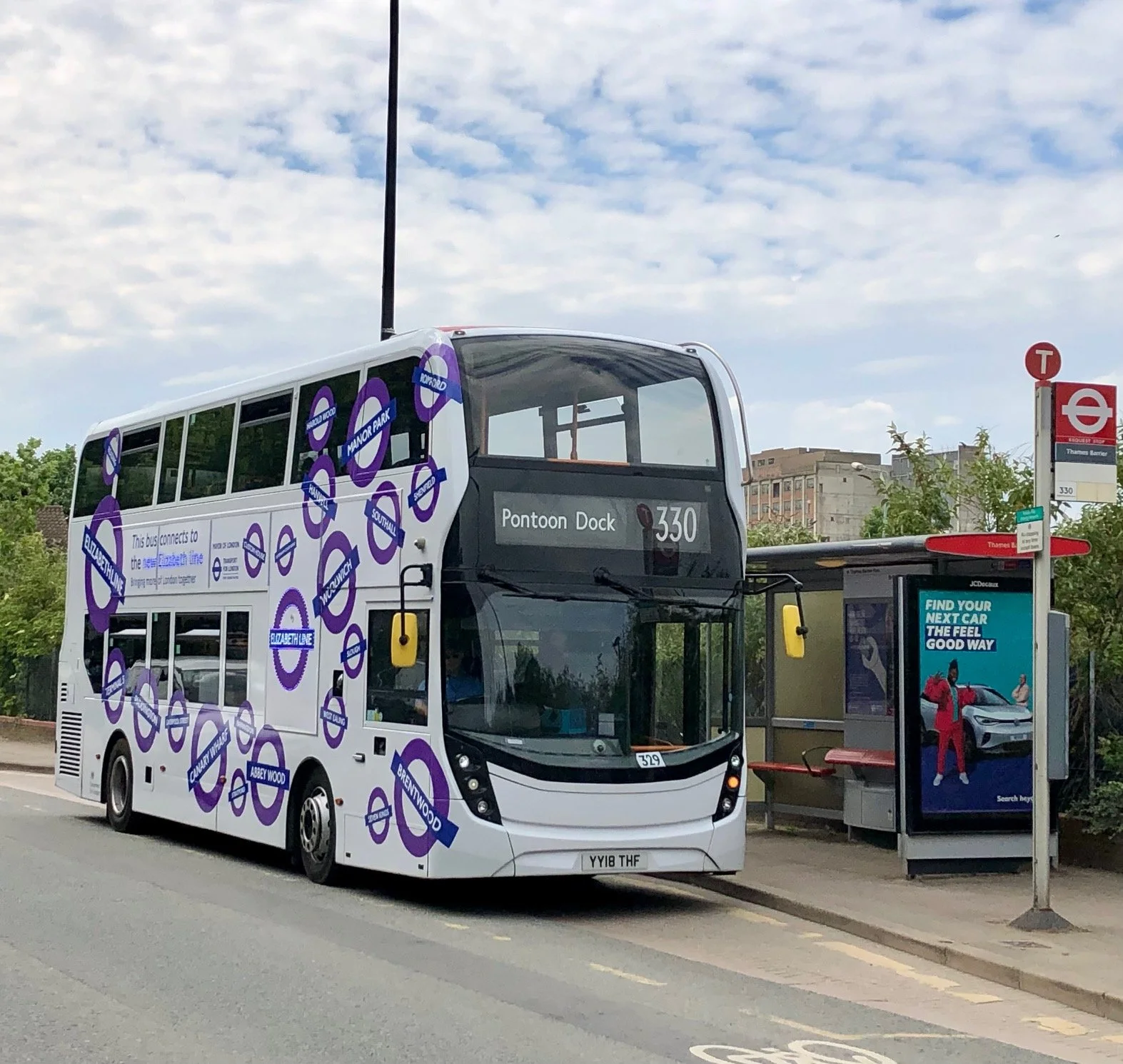
Back in June 2022, when Stagecoach were still in charge on the 330, their Enviro400 MMC 11053 was one of several in the area to receive this special scheme highlighting the various destinations served by the (then) new line. Seen at the Pontoon Dock Thames Barrier terminus.
The 330 was extended to this point from Canning Town in May 2022.
