
Remember, Remember, the Fifth of September
Back in TfL-Land, Wattons Wanderings checks out the latest addition to the “Superloop” fold in East London, together with various route changes in North London, all of which happened in early September, plus a catch up on recent type changes in the area.
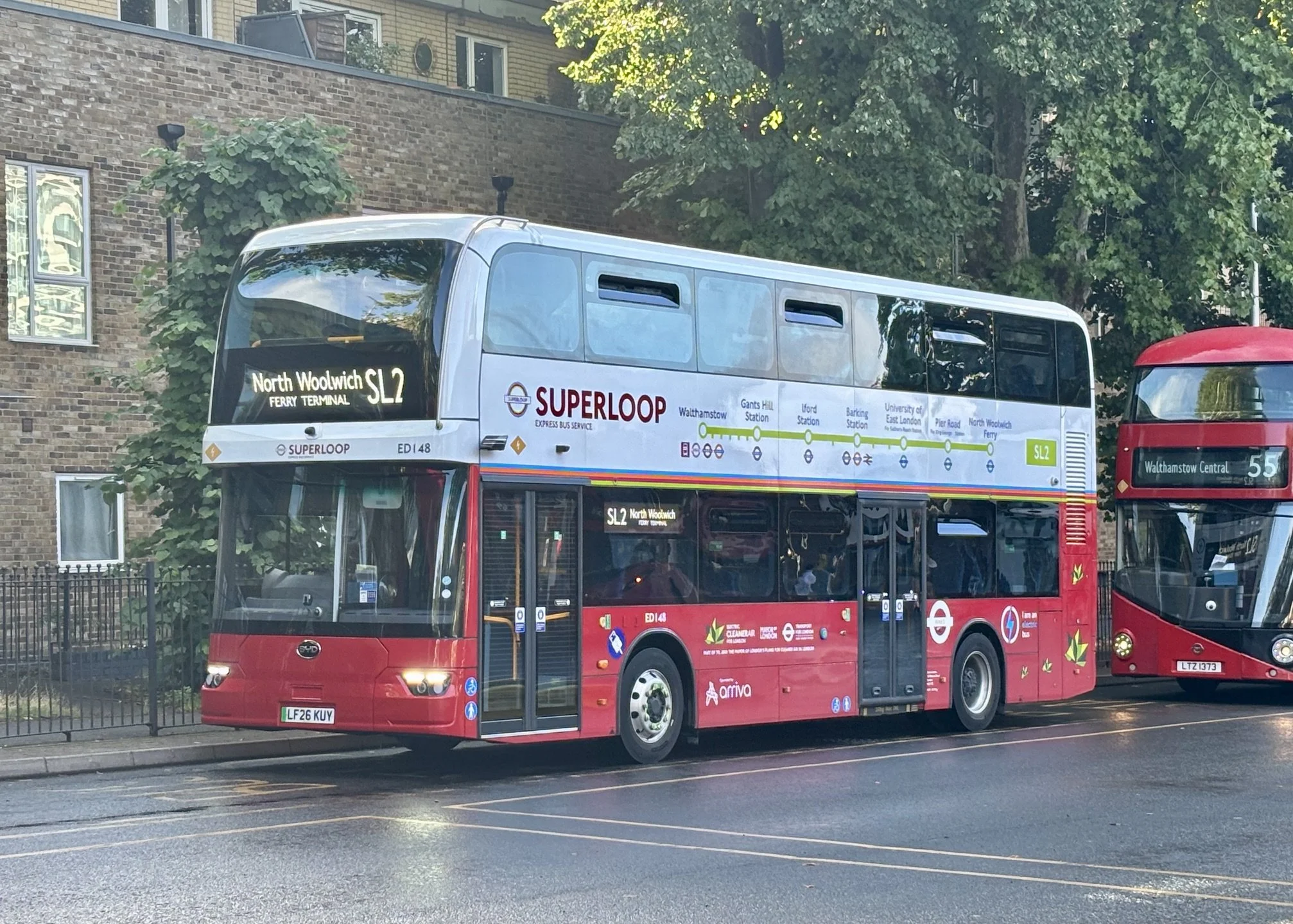
Whilst remaining with Arriva London, Superloop SL2 was converted in July 2026 from the HA class Enviro400H City hybrid types which had started it off in 2024 to new BYD BD11 electrics. ED148 with appropriate livery and signwriting demonstrates the new batch at Walthamstow Central before I rode it to North Woolwich.
At the same time, the route moved from Barking (DX) to Tottenham (AR) Garage, due to lack of suitable charging facilities at the former location.
Superloop SL2: Walthamstow Central - North Woolwich
A number of TfL route changes were implemented in North & East London from 5th September 2026, which I tackled over a couple of visits in the subsequent couple of weeks.
However, I began Part 1 at Walthamstow Central, arriving via the Victoria Line, where I wanted to catch up with the electrification of “Superloop” SL2, which occurred back in July when it was converted from HA class hybrids to ED type electrics, as illustrated above. An example of the former type can be seen in my previous article “In with the Old and In with the New in Walthamstow” dated 15/03/26. The route had begun in March 2024 between Walthamstow Central and North Woolwich using HAs initially.
First to depart was ED148 of Tottenham (AR), to which garage the route was reallocated from Barking (DX), as the latter does not yet have the necessary infrastructure to charge electric buses. Just a small number of customers aboard, as we left the Bus Station and proceeded through the town to the next stop at Walthamstow Market, where a few more joined us. A gentle run down to the lights at “The Bell”, before turning right to the art deco edifice of Walthamstow Town Hall. Then on to Wood Street, before negotiating various roadworks through to the fringes of Epping Forest, where we turned onto the North Circ through South Woodford. A fast run to Roding Lane North and on to Gants Hill Station, leaving intermediate stops to the parallel 123. Non-stop along Cranbrook Road to Ilford Station, then calling at Chapel Road before the narrow congested section along Ilford Lane to Barking, where we served stops at the station and the town centre. The final section saw us speed up again as we rejoined the North Circ and its extension along Royal Docks Road, calling at Gallions Reach Retail Park then at UEL Docklands Campus, where a number of students left us. Just a few on board by now, for the final stretch through Docklands to Pier Road and North Woolwich Ferry, which we reached after a run of a touch over 50 mins.
At North Woolwich, there was a long queue of traffic for the ferry, although pedestrians have the option of using the adjacent Foot Tunnel, which I once used regularly during my student days in Woolwich! On the opposite side of the road, the former North Woolwich Station building is still there, now boarded up, after its brief role as a railway museum some years ago, although the platform area is now a construction site. Back in the day, I rode first-generation DMUs from Tottenham Hale & Stratford to this point, often with local dock workers during the dying days of operations in the former Royal Docks.
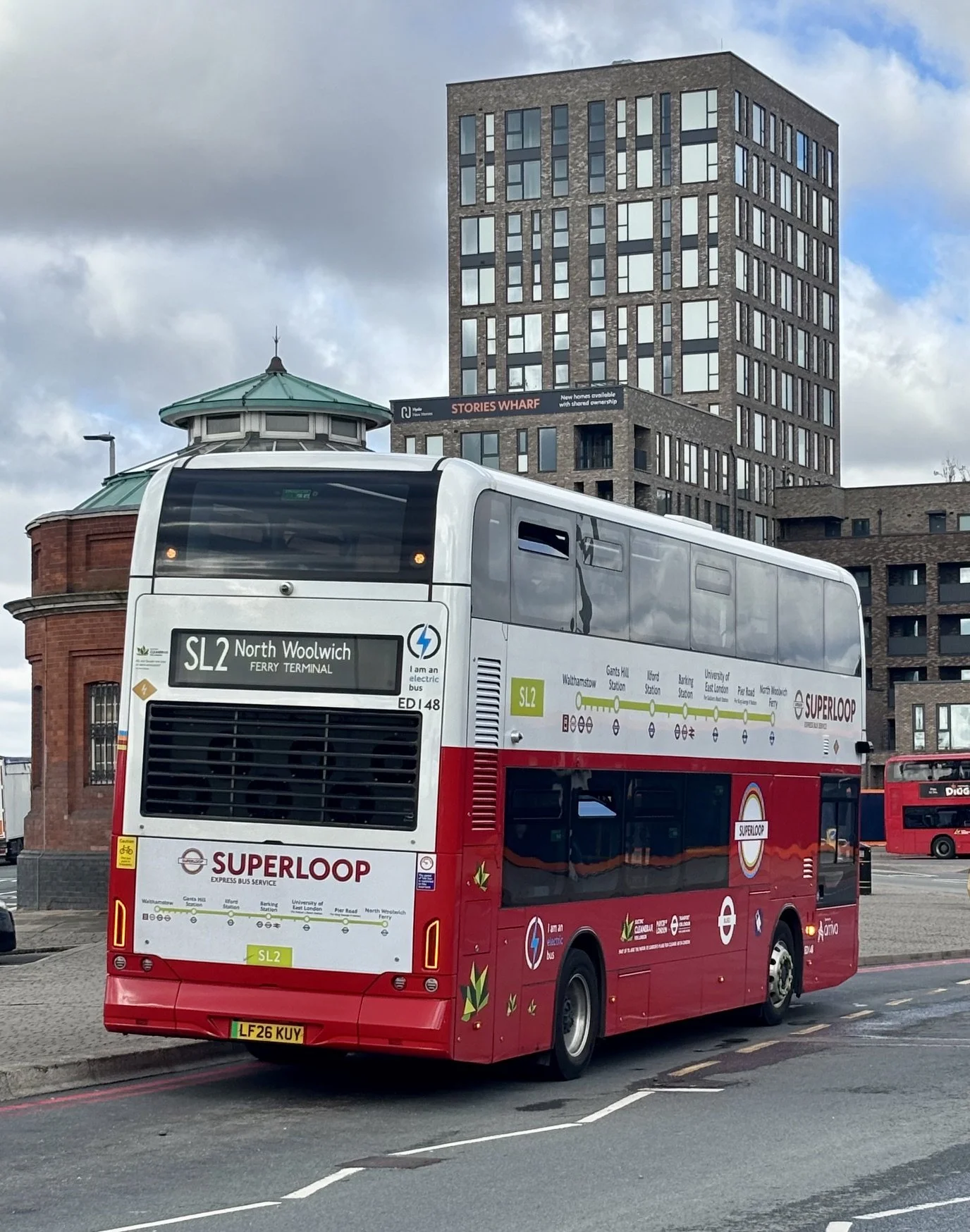
ED148 again, this time a rear aspect at the other end of the SL2 beside the foot tunnel at North Woolwich.
This batch of EDs have some design detail differences from earlier examples, including different shaped front and rear light clusters. There are also a series of horizontal lines across the front doors, just about visible in the previous picture, supposedly to improve safety.
Part Superloop SL2: North Woolwich - Gants Hill
Whilst the bus I travelled on was more or less on schedule, there was clearly some late running on the route that day, as the bus in front of us was not there when we arrived at North Woolwich, a check on bustimes.org showing it had turned short at Gallions Reach. Therefore, despite the advertised 12 min frequency, I had a 15 min wait until ED148 was ready for its return trip.
Around the corner at Pier Road, lots of complaints from a crowd of passengers, who said they had been there for ages. At UEL, another large group was waiting, then at Gallions Reach we saw the bus behind us, which had also been turned short at this point. A short discussion ensued between the drivers, who could not understand why a number of buses were still being curtailed here, given that any previous congestion in the area had long since dissipated!
However, we continued on schedule, back through Barking and Ilford, then up to Gants Hill Roundabout, where I alighted.
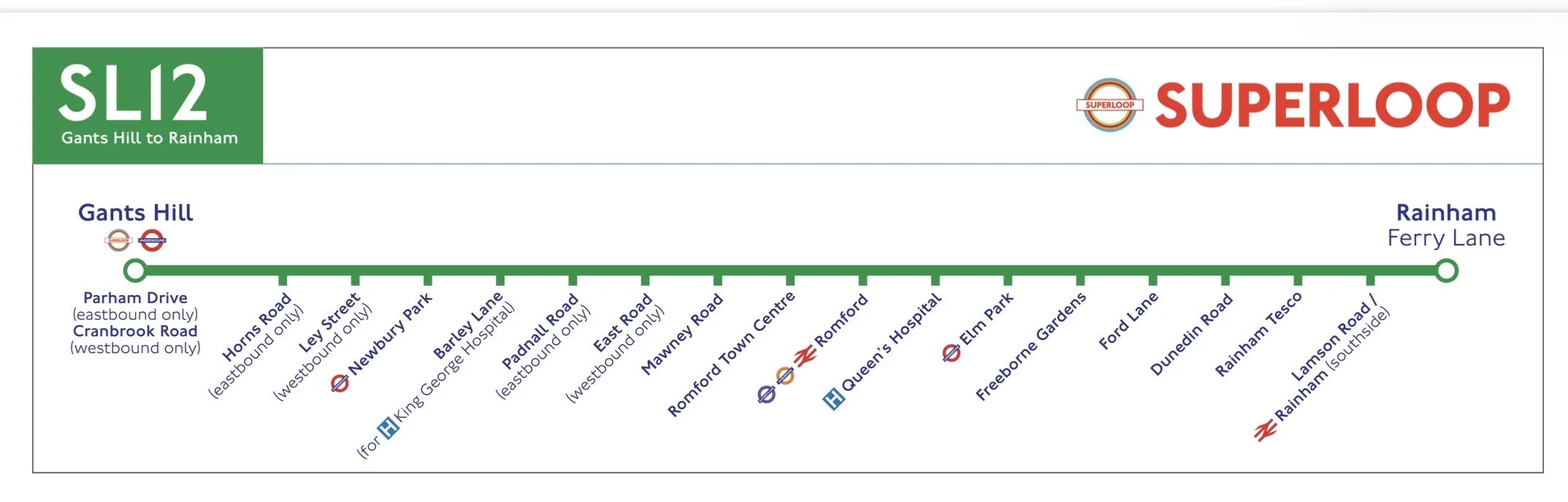
Line diagram of the new Superloop Route SL12 showing all stops, which appears on the cove panels inside the vehicles. The Rainham Tesco stop was a late but important addition to the original plan. The route began on 5th September 2026, the second new Superloop service of the year after the SL11 in January.
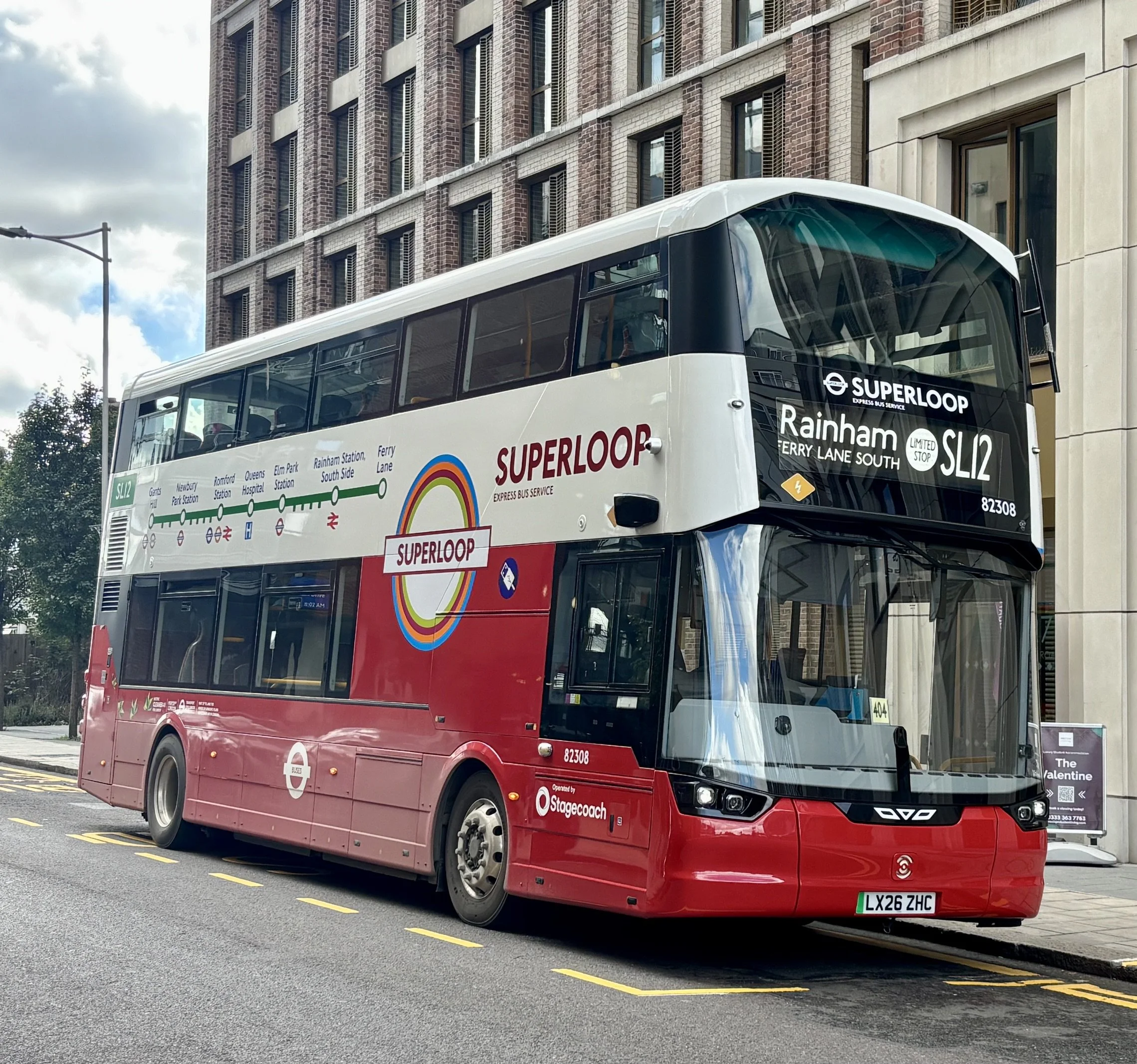
Stagecoach London Wright StreetDeck Electroliner no 82308 of Rainham (RM) Garage is seen at the new Gants Hill stand of the SL12 in Perth Road, just off the Eastern Avenue, before I joined it for its next trip to Rainham Ferry Lane. The route was just 7 days old at the time of this visit.
Although there are plenty of plain red examples in service with Stagecoach London (and with other operators), this batch is the first of this type of vehicle to wear Superloop livery. Note the “Limited Stop” legend in a circle next to the route number, the first time this style has been used, although it has now appeared on certain other SL routes, so may be a new standard.
Superloop SL12: Gants Hill - Rainham
At Gants Hill, I switched from one Superloop route to another, with a first ride on the new SL12 to Rainham, introduced only a week prior to my visit. This is operated by Stagecoach London from Rainham (RM) Garage using a batch of new Wright StreetDeck Electroliners, a familiar type now in East London, but the first time any have been seen in Superloop livery. Another “first” (at least that I have seen) is a “Limited Stop” legend on the front blind, which appears in a circle next to the route number as depicted in the above photo.
As with many Superloop routes, a 12 min M-S daytime frequency operates, 15 min Eves & Suns, with fleet no 82308 being on stand in Perth Road when I arrived. However, the first pick up stop is on Eastern Avenue opposite, which I reached via the subway. Interestingly, whilst I was there, a 66 “all stops” to Romford arrived, but most passengers waiting let this go, preferring to await the faster SL12 over the parallel section. After boarding, we accelerated rapidly for a run at speed along the dual carriageway Eastern Avenue through typical inter-war suburbia, calling only at Horns Road, Newbury Park Station, Barley Lane, Padnall Road and Mawney Road, before turning right along North Street, non-stop past Romford (NS) Garage, calling only at Romford Town Centre and Romford Station. Oddly, the on-board annoucements were saying “SL12 to Leytonstone” (which the route doesn’t serve in either direction), rather than Rainham, although the interior info screens were displaying the correct destination!
From Romford, we parted company with the 66 and made our way to Queen’s Hospital, before continuing on to the next stop at Elm Park Station, by now in parallel with the stopping service on the 252. We then switched to following the 165 to Rainham Tesco, calling only at Freeborne Gardens, Ford Lane and Dunedin Road. Less busy over this stretch, although with a significant time saving over existing routes. After Rainham Tesco, it was onto the new section, previously unserved, to Rainham Marshes, calling at Rainham Station Southside and terminating at Ferry Lane. An impressive 55 min run end to end.
The new bit of route serves a mainly industrial area and whilst providing a useful link for local workers is probably a bit much for the potential custom on offer, at least until more people get used to the fact that the bus route is there. Incidentally, this is the first time a bus route has served Rainham Marshes since LT Country Bus 375 ran between Rainham and Rainham Ferry during peak hours only. This was replaced in 1959 with a private “works contract” service, which lasted until 1971.
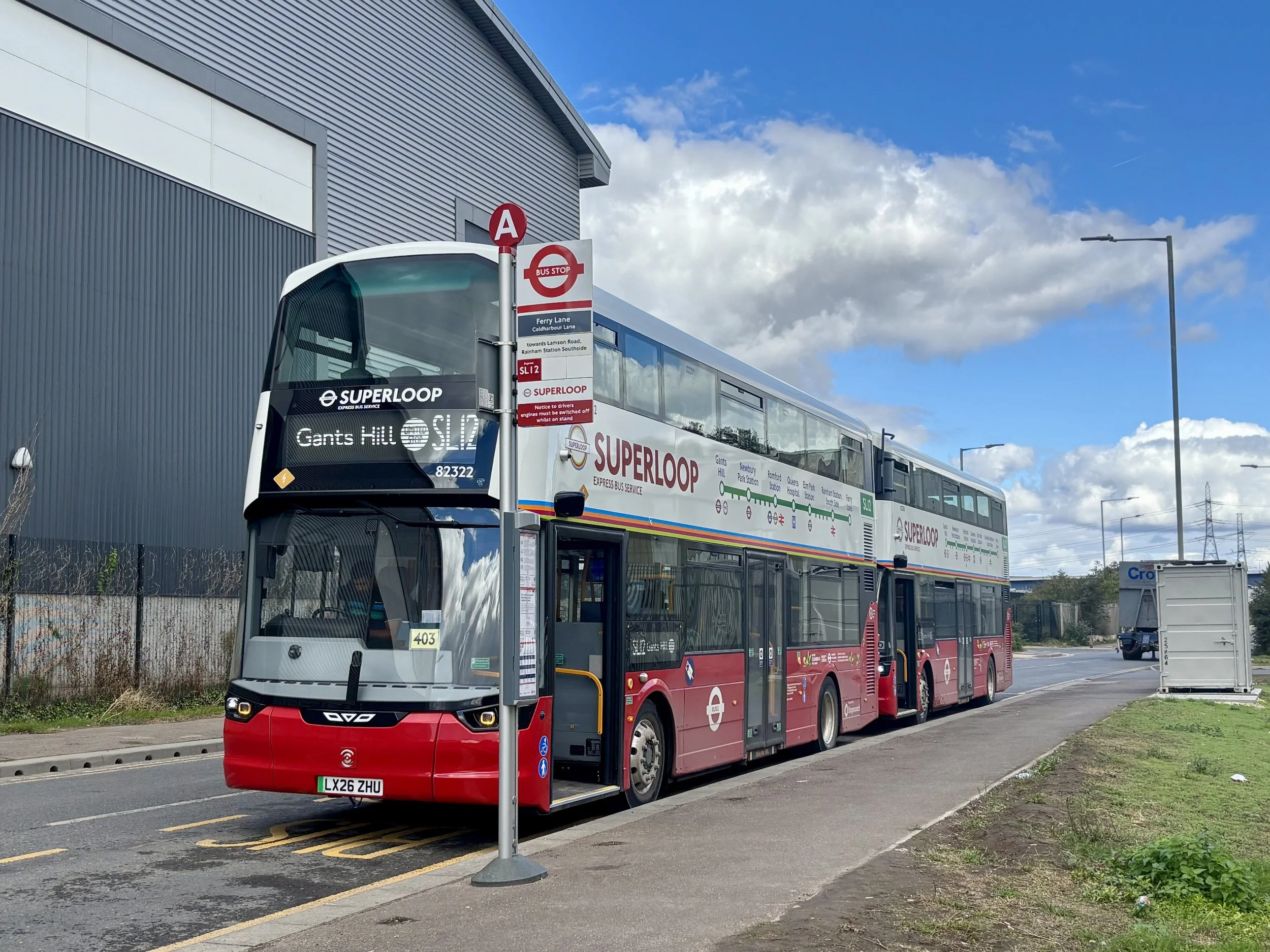
Wright StreetDeck Electroliner 82322 (RM) stands ahead of 82308 at the new Rainham Ferry Lane terminus of the SL12 before I returned on the former to Gants Hill.
Whilst the new section of route between Rainham Tesco and Ferry Lane provides a useful service to the Rainham Marshes industrial area and is convenient for crew changes from nearby RM Garage, a 12 min M-S daytime and 15 min Eve & Sun service is probably a bit excessive for the demand on this part of the route!
Superloop SL12: Rainham - Gants Hill
For the return run, I was able to step up a working and boarded fellow Electroliner 82322, which was waiting on the stand ahead of the bus I had arrived on, with a couple of passengers already present. At the scheduled time, we departed, continuing around the terminal loop past various industrial units, including the link road to RM Garage, which I was seeing for the first time! After about 4 mins, we arrived back at the roundabout just short of the terminus again and then continued back to civilisation at Rainham Tesco.
Busier from this point on, with a reasonable number of users back through Elm Park to Romford and then on via the Eastern Avenue to Gants Hill. Slightly longer in this direction due to circling through the industrial estate, with a 1 hour total trip time. On arrival at Gants Hill, the last stop is around the corner in Cranbrook Road, providing a direct interchange with the southbound SL2 to Ilford. The on board annoucements were also wrong in this direction, proclaiming that we were the “SL12 to Romford” rather than Gants Hill, quite shameful that TfL cannot get details like this right from the word go, as it can only serve to confuse passengers.
However, the SL12 is an interesting addition to the Superloop network, usage will probably grow as more people become aware of its existence, although with possible abstraction from parallel stopping services.
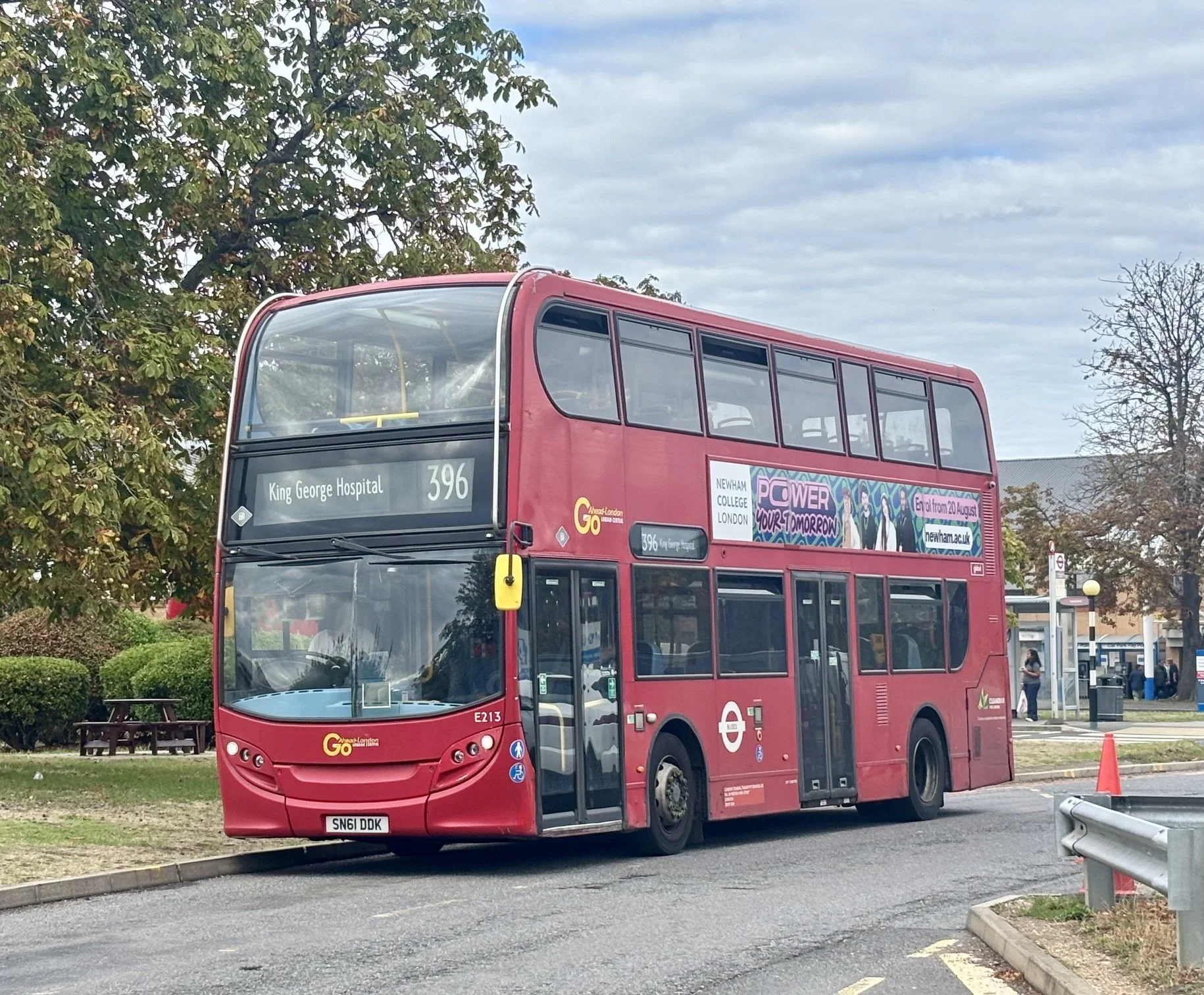
The 396 is scheduled for SEe type electric single deck operation, but GAL sometimes put out the odd diesel double decker as a sub. E213 of River Road (RR) Garage provides the evidence at King George Hospital before I returned aboard it to Ilford Hill.
There must have been a particular shortage of electrics on this day, as 2 of the 4 buses out were Enviro400s, the other one being E277.
Route 396: Gants Hill - King George Hospital - Ilford
After my Superloop rides, a change of mood, as I ended the first part of this adventure with a quick spin on local route 396. I had been on this only 18 months previously when I had sampled the new SEe electric single deckers now allocated, but it grabbed my attention on this occasion as LVF was showing that 2 of the 4 buses out were double deckers in the form of E class Enviro400s. This is now quite a rare type with GAL in East London.
Seeing that one of the pair, E213 of Go Ahead London’s River Road (RR) Garage, was only 5 mins away from Gants Hill on its next trip to King George Hospital, I didn’t have long to wait before it arrived. Hopping on, it was only an 18 min thrash back down the Eastern Avenue and then via Little Heath to the hospital terminus. After the break, I rejoined it for the full run back to Ilford via Gants Hill again for the final time that day. A couple of minutes under half an hour to Ilford Hill on this short but useful route. A full history of the 396 was included in my article “Docklands Diesels & Eastern Electrics” dated 15/04/25.
I was then able to join the Elizabeth Line from nearby Ilford Station for the journey home.
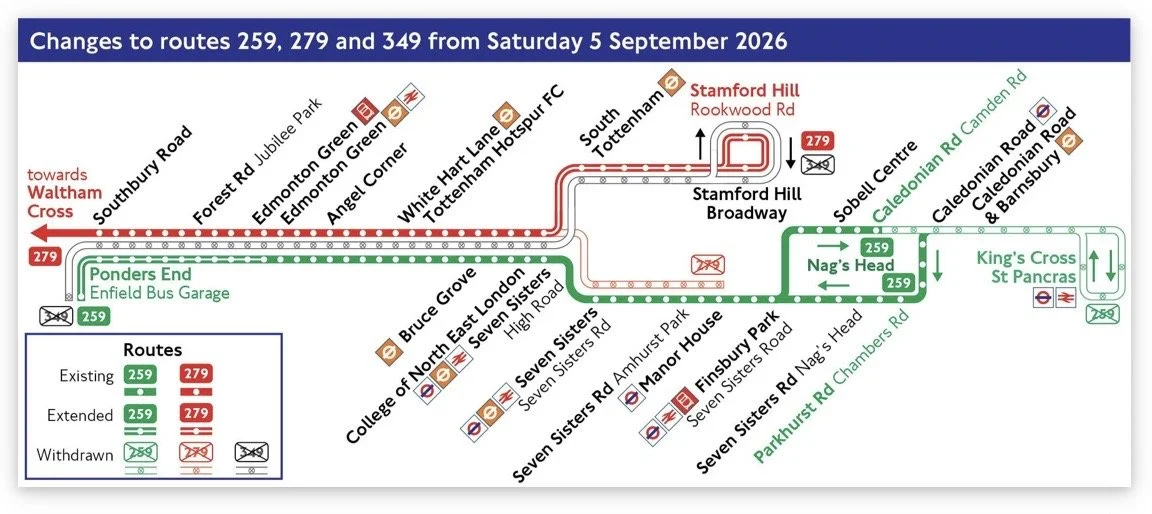
Other route changes on 5th September 2026 in North London included the withdrawal of the 349 and its partial replacement at each end by an extension to the 259 and a rerouteing of the 279. However, the Holloway - Kings Cross section of the 259 was withdrawn completely and left to the 17 & 91, whilst the Edmonton to Tottenham section of the Hertford Road saw an overall reduction in the number of buses using it, as did the section between Seven Sisters and Manor House. This slightly complex diagram issued by TfL attempts to explain the changes.
Part Route 279: Waltham Cross - Ponders End
Another day, and I commenced Part 2 of my adventure at Waltham Cross Bus Station at the end of the morning peak, with the aim of covering the September changes on the 259, 279 & 310 routes. Things did not bode well though, as although there were plenty of buses about, there was not a single 279 to be seen. After a few minutes one arrived, then another, but both parked up for a while. Eventually, after about a 15 min gap on what should be a 6-7 min frequency, ES168 drew forward to the stop and I boarded with several others who had been waiting some time. This particular bus was one of the later batch of Wright StreetDeck Electroliners intended for the 217, but now freely mixed with earlier examples for the 279 & 307 at Arriva London’s Enfield (E) Garage.
Just a short run on this bus through to Ponders End Southbury Road, although it seemed to take an age, with 20mph limits, narrow roads due to cycle lanes and poor traffic light phasing to contend with, plus temporary lights / single lane working just before Ordnance Road. What used to be a 10-15 min journey in earlier times took 23 mins on this occasion!
Route 259: Ponders End - Holloway
Walking around the corner to Enfield Garage, I spotted an NRM on the 259, parked in the forecourt. The 259 was extended to this point from Edmonton Green with the 5th September changes, replacing this section of the 349, which was simultaneously withdrawn. Not new territory for the 259 of course, as it used to serve Ponders End until 1998. This time, the 259 is operated by Arriva out of Tottenham (AR) Garage, although several of the LTs I saw were still displaying the old “Edmonton Green” destination on northbound journeys, presumably as Ponders End Garage is not on the current blinds. A recipe for confusion and not a good start for a newly extended service, although the bus stops I saw seemed to have been updated with the route number tiles and new timetables.
At the appointed time, LT492 departed the garage and I joined it at the first stop opposite with a couple of others. Fortunately, at this hour of the day, traffic was fairly light and we had an acceptable run southbound along Ponders End High Street and on to Edmonton, with even the roadworks at South Street not really delaying us. At Tramway Avenue, we past the road leading to the long gone Edmonton (EM) Garage, once a Trolleybus Depot and before that, home to Trams. Then on to Edmonton Green Bus Station, which is served in this direction by a stop outside it on the main road. A number of routes pick up here, which causes something of a melee when more than one bus arrrives at once.
Having completed the extension, we continued on the rump of the route onwards via Edmonton Angel Corner, crossing from the LB of Enfield into the LB of Haringey, soon arriving at White Hart Lane and the Tottenham Hotspur Stadium, which was rebuilt on a much larger scale on the site of the old Football Ground, opening in 2019. It is now used for concerts and other events in addition to football matches. Our reasonable progress up to this point was then slowed a bit, as we encountered a queue on approach to the Lordship Lane junction at Bruce Grove Station. Once through this, we were held for a couple of minutes at Tottenham Police Station to “even out the service”. Then it was up to Tottenham Garage, although no driver change on this occasion, before continuing to Seven Sisters, where the 259 is now the only route from here to Manor House, as the 279 is now diverted to Stamford Hill.
Whilst we had been quite busy up to this point, from here on we were barely into double digit numbers of passengers as we passed the Woodberry Down development, where there are vast numbers of new flats/houses and evidence of further building still going on the approach to Manor House. The former 279 stand is still there, presumably available as a short-working terminus, and possibly unique as the only place in London where buses perform a 180 degree turn in the road, a manoeuvre dating back to the early days of Trolleybuses in the 1930s. We continued beside the green space of Finsbury Park down to the station, before taking the southbound leg of the one way system via Tollington Road to Holloway Nags Head. The 259 has been truncated here with the recent changes, although passengers requiring the former destination of King’s Cross can change to the 17 or 91 at a common stop at Caledonian Road / Camden Road. 65 mins for the trip from Ponders End.
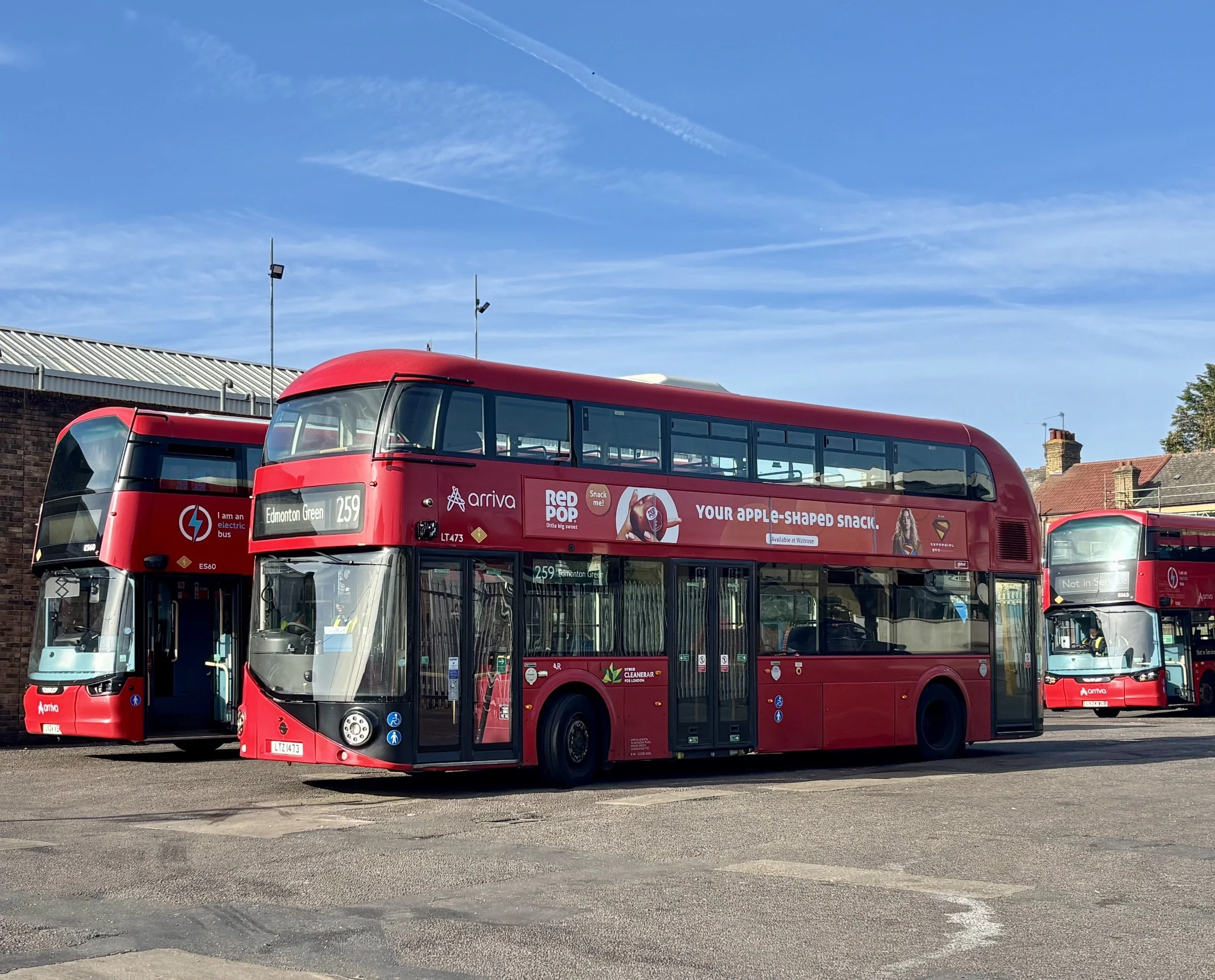
Arriva London New Routemaster LT492 of Tottenham (AR) Garage lays over on the forecourt of Ponders End Garage, between trips on the 259, which was extended to this point from 5th September 2026 to replace the northern section of the 349.
This was the bus I then rode through to the new southern terminus of Holloway Nag’s Head. Note the former destination “Edmonton Green” in the front blind box, which many northbound buses were still showing, as some Tottenham LTs did not have Ponders End Garage on their displays at this time.
Part Route 259: Holloway - Seven Sisters
On the return run, the 259 picks up around the corner at Holloway Delivery Office and I was the only passenger to reboard LT492 here after the break. A little bit of confusion here, as the 259 numbers had been removed from this stop (incorrectly), although a new timetable was in place below and the TfL website confirmed this as being the new first stop northbound. We continued around the one-way system, turning right into Parkhurst Road by the site of the former HMP Holloway, a famous women’s prison that closed in 2016 and now another building site undergoing redevelopment. The last woman to be executed in the UK, Ruth Ellis, was hanged here in 1955 but given a posthumous conditional pardon by King Charles earlier in 2026.
This time, we took the direct route from Holloway to Finsbury Park along the northbound side of the one-way system between the two places, then on via Manor House back to Seven Sisters Station, where I alighted after a 25 min trip.
The 259 dates back to 1961, when the new RM operated bus route replaced Trolleybus 659, running between Holborn Circus and Lower Edmonton Stn, with a M-F Peaks extension to Edmonton Tramway Avenue and a further Sat/Sun extension to Waltham Cross. Reductions over the years saw the Sun service withdrawn in 1966, with the residual Sat extension to Waltham Cross withdrawn and the Sat evening service cut back from Holborn Circus to King’s Cross in 1970. OPO conversion to DMS came in 1973, with the service largely standardised as part of “Busplan” in 1978 to operate Lower Edmonton - Holborn Circus at all times, although still only M-S.
Metrobuses gradually took over the allocation in 1982, with some complexity reinjected in 1985 when the service was extended from Edmonton to Hammond Street via Waltham Cross, at which time the southern terminus became Holborn Circus (M-F daytimes), Holloway (M-F eves) or Manor House (Sat/Sun), with some sectional working introduced. This arrangement proved short-lived, as in 1986, the Hammond St service was transferred to new route 359, with the 259 dropping back to Lower Edmonton (M-F daytimes), Ponders End (M-F eves) and Waltham Cross (Sun). Strangely, the Sat service was withdrawn completely at this time, but the following year, this was followed by the Sun service, the route then becoming M-F only.
A daily service was restored in 1992 in another complicated format: Holborn Circus (M-F + Sat/Sun early), King’s Cross (Sat/Sun) to Lower Edmonton, extended to Ponders End (Sat/Sun except eves), although the Sun service did not last the year out and was withdrawn (again!) after just a few months. Yet more tinkering in 1993/4 saw a M-F extension to Ponders End, followed by the reintroduction of the Sun service (for the third time!). Some M-F peak journeys were later extended to Enfield Highway.
In 1998, the route passed from its traditional operator, Arriva and its predecessors, to First Capital under re-tendering, finally assuming the simple daily King’s Cross to Edmonton Green routeing that endured until the 2026 changes. After operation with Ms, then AE class Dennis Arrows, low floor conversion in the early noughties saw VTL and VNL types performing. These were replaced in due course by Volvo B9TLs, initially classified VN, but when First sold its Northumberland Park Garage operations to Go Ahead in 2012, these became known as the WVN class. The route returned to Arriva in 2017 using HV type hybrids, although these were replaced by the current LTs during 2022.
Part Route 279: Seven Sisters - Stamford Hill
I rode the 279 in its previous format last year, so for an account of that journey and a history of the route, please refer to my article “Enfolding Enfield & Educing Edmonton” dated 27/06/25.
However, with the recent changes, the 279 has been rerouted from Seven Sisters to Stamford Hill instead of Manor House, as a replacement for the withdrawal of the 349 over this section. Once again, some delays in the service were evident and, having just missed one southbound working, it was over 10 mins before the next one arrived, formed of early Electroliner ES8 of Enfield Garage. One man seemed a bit confused as he questionned the driver over the Stamford Hill destination, asking “Doesn’t the 279 go to Manor House?”, to which the driver advised him to take the 259 behind!
Despite this, there were a good number on board as we made our way over the new section via South Tottenham Station to Stamford Hill, with everyone apart from me alighting at Egerton Road. Just me and the driver continued around the corner to the new terminus in Rookwood Road, adjacent to Stamford Hill (SF) Garage. A short trip of just 8 mins. Ironically, although three routes now terminate here (279, 310 & 318), none are operated by this garage, despite the convenience if this were to be the case. Such are the vagaries of tendering!
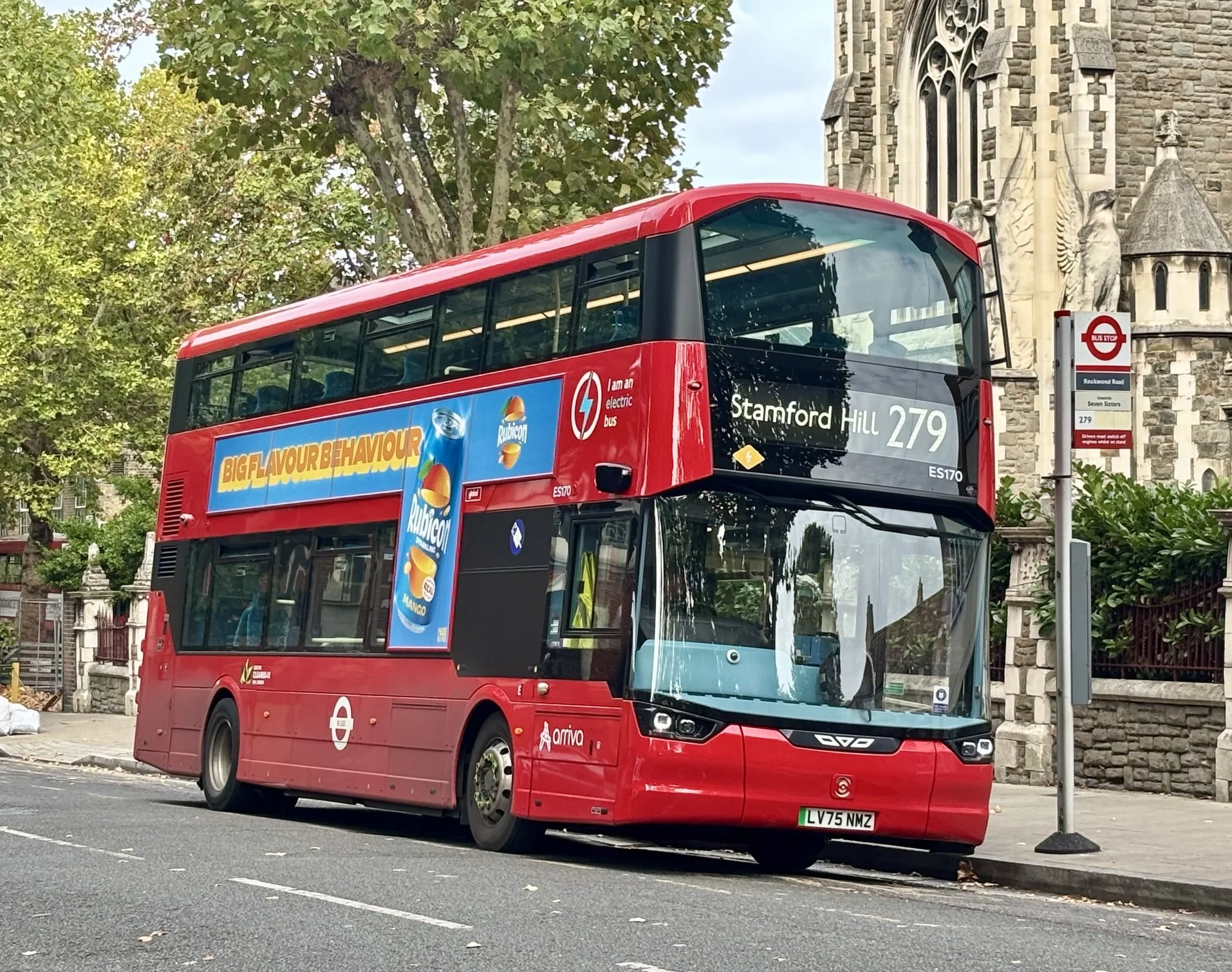
Not one of the examples I travelled on, but Arriva Wright StreetDeck Electroliner ES170 of Enfield (E) Garage sits at the new Stamford Hill terminus of the 279. This was introduced from 5th September 2026 instead of the former routeing to Manor House and replaced the southern section of the withdrawn 349.
This particular bus is part of the newer batch intended for the 217 which are mixed freely with the earlier examples for the 279 & 307.
Route 310: Stamford Hill - Golders Green
It was then time to turn my attention to the other route affected by the 5th September changes, the 310. This route began 2 years ago on 1st September 2024 and was specifically intended to link the two predominantly Jewish communities of Stamford Hill and Golders Green. The initial routeing was via the 253/254 between Stamford Hill and Finsbury Park, then via the 210 to Golders Green, incidentally passing under the low bridge at Finsbury Park Station and thus requiring a single deck allocation.
The revised service from September 2026 saw the following changes:
Rerouteing between Finsbury Park & Archway via Holloway, providing a new “round the corner” link at the Nag’s Head.
A short extension in Stamford Hill between the Broadway and Rookwood Road.
Introduction of a late evening service daily rather than the previous early finish.
Conversion to electric double deck operation, replacing diesel single deckers.
The route remains with Stagecoach London from Ash Grove (HK) Garage.
Alighting the 279 in Rookwood Road, I walked back the short distance to the 310 stand, where Wright StreetDeck Electoliner no 82178 was waiting. After a few minutes, it was time to depart and I boarded with one other passenger. Unlike the Arriva examples of the type which feature Arriva style moquette/interiors, the Stagecoach ones have TfL-style moquette with yellow handrails.
We departed beside Stamford Hill Common and turned right, back to the Broadway, picking up a few before crossing the main Hertford Road. The servce now runs in parallel with the busy 253/254 via Amhurst Park, Manor House & Finsbury Park through to Holloway Nag’s Head, although we were only carrying low double digit numbers over this section. Maybe, if current TfL plans to withdraw the 254 come to fruition, the 310 may become more important and hence busier on this stretch of route.
A number of passengers made use of the “round the corner” link at Holloway and stayed on with us through Upper Holloway to Archway. After this, we joined forces with the 210, dropping a couple at Whittington Hospital who had boarded in Stamford Hill and were making use of this direct facility. Up Highgate Hill, passing the now abandoned former Trolleybus then Bus terminus at Highgate Village, before turning off towards the delights of Hampstead Heath, via Kenwood House and the narrow section at the famous Spaniards Inn between the pub and the tollhouse opposite. Turning right at Jack Straw’s Castle, we glided gently down the hill past the “Old Bull & Bush” into Golders Green, terminating opposite the Hippodrome after a run of just under 50 mins.
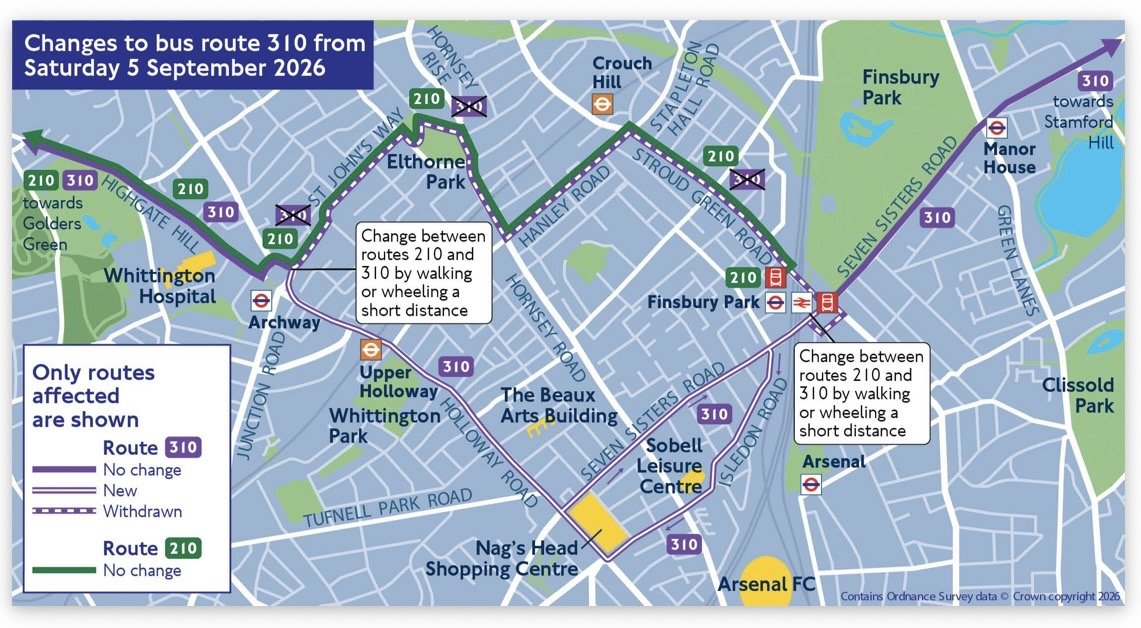
Map produced by TfL showing the rerouteing of the 310 via Holloway Nag’s Head from 5th September, which indicates the alternative intermediate route now provided between Finsbury Park and Archway compared with the 210.
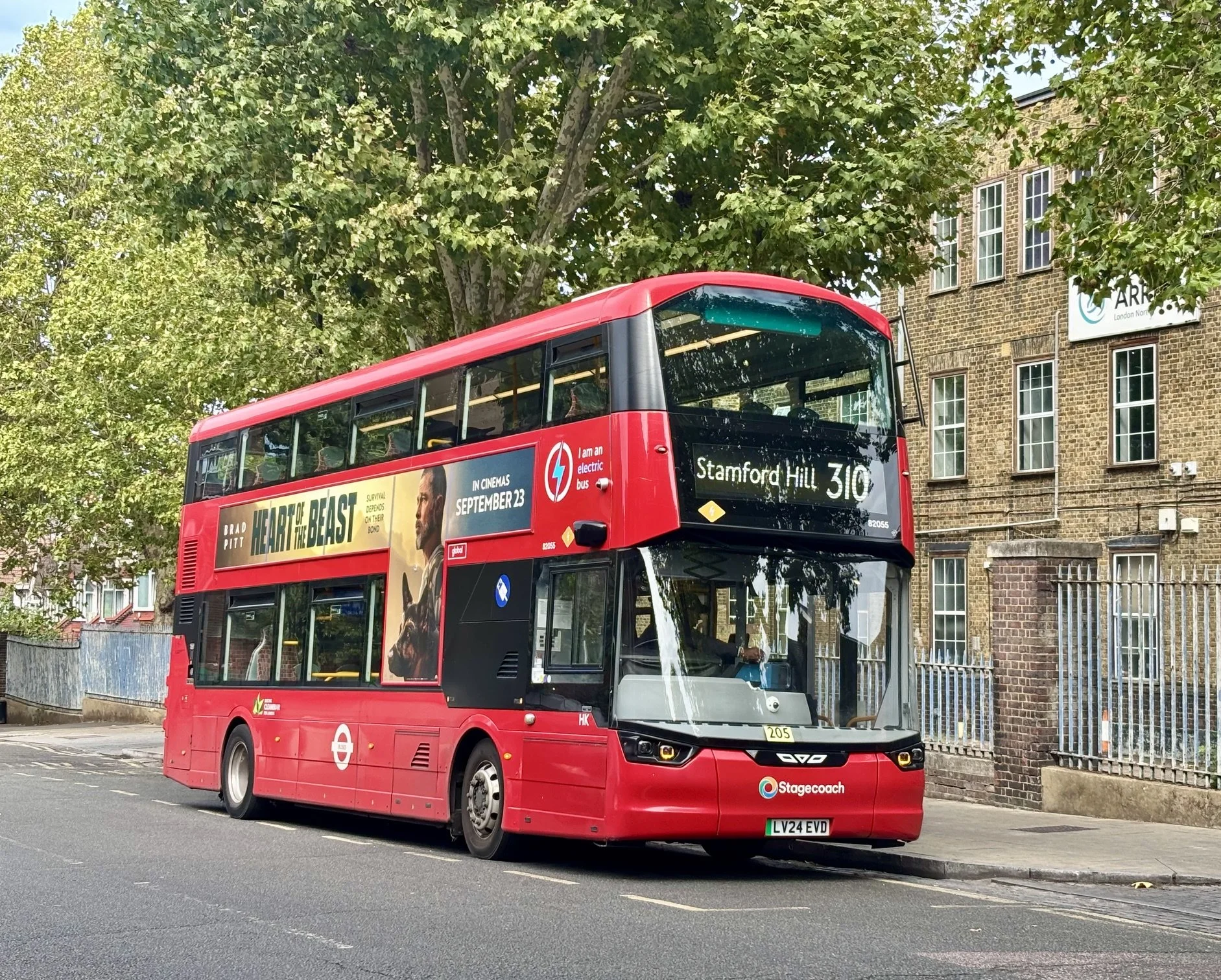
The diversion of the 310 away from the low bridge at Finsbury Park Station enabled its conversion to double deck. Stagecoach London Wright StreetDeck Electroliner fleet number 82055 of Ash Grove (HK) Garage is seen outside the Arriva Garage at the Stamford Hill end of the route after my ride on it back from Golders Green.
The route was extended the short distance from Stamford Hill Broadway to this stand in Rookwood Road as part of the changes.
Route 310: Golders Green - Stamford Hill
After purchasing some lunch, I returned to the stop beside the Golders Green Hippodrome to await the next 310, which turned out to be Electroliner no 82055. The adjacent theatre was built in 1913 as a music hall to serve North London, following the opening of the Northern Line extension into the area. After serving as a theatre, concert venue and a BBC TV/Radio studio at different periods, it later became a place of Christian worship.
On schedule, the driver opened his doors and I was the only passenger to board at this point, the rest of the crowd having been hoovered up by a 210 which left a couple of minutes ahead of us. We made our way back up the hill to Hampstead Heath and then via Spaniards again through to Highgate Village, gradually picking up more along the route. Then down to Archway, before again assuming the revised routeing to Holloway and then back to Finsbury Park, Manor House and Stamford Hill. Another trip of a touch under 50 mins. The changes to the 310 seem to make sense, providing more new links than the previous version, which was a simple amalgam of parts of the 253/254 and 210. Already, it appeared that people were making good use of these.
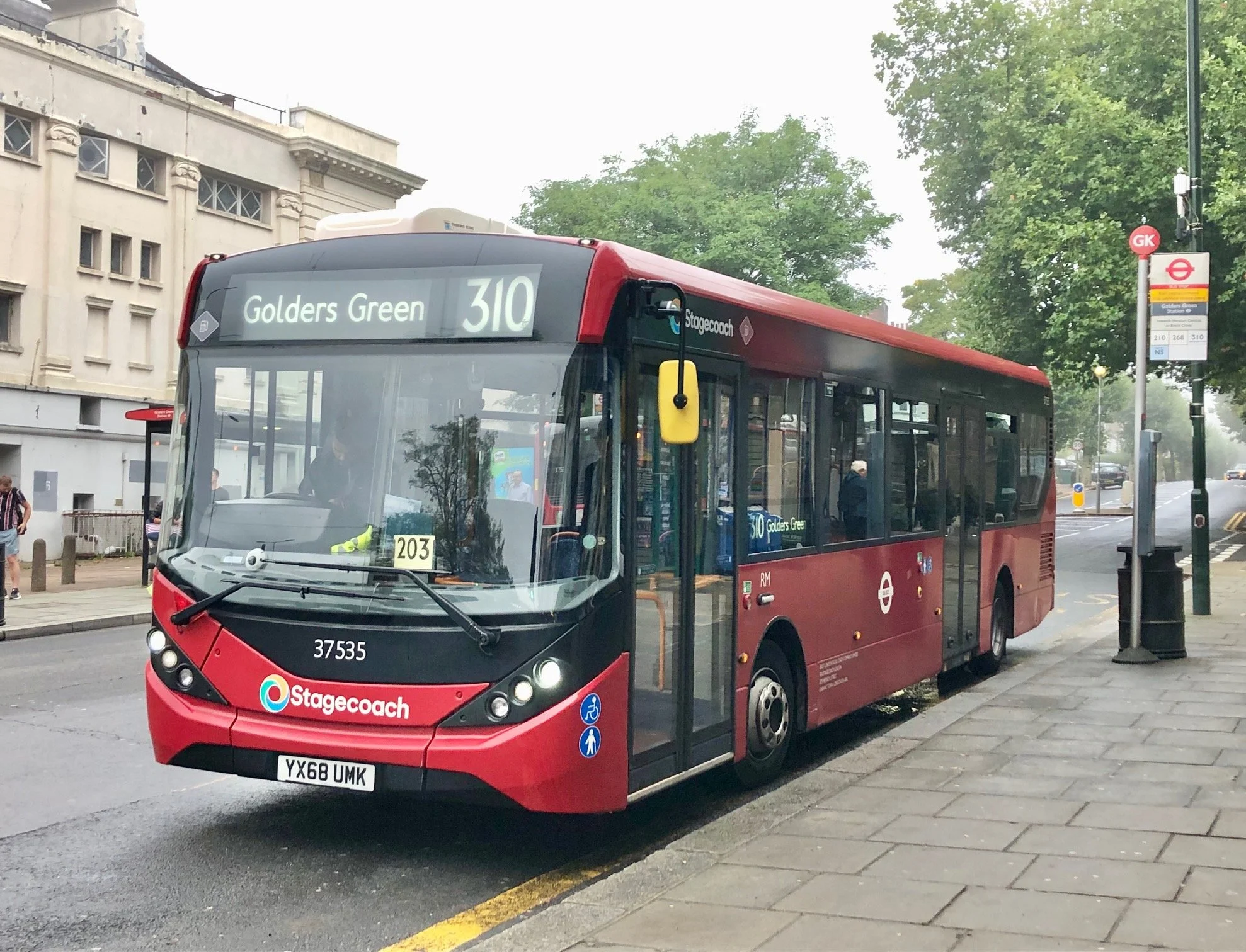
Single deck operation on the 310 is recalled by Stagecoach London Enviro200 MMC no 37535 of Ash Grove (HK) Garage, but transferred in from Rainham (RM). The bus is seen at the Golders Green end of the route in September 2024, opposite the Hippodrome.
This was soon after the route had commenced, single deckers being required due to passing under the low bridge at Finsbury Park at that time.
Part Route 279: Stamford Hill - Carterhatch Lane
To end, I merely needed to complete the new section of the 279 northbound from Stamford Hill, but as I needed to get back to my start point of Waltham Cross, I had intended to ride the full route. Once again, gaps in service were apparent, but eventually I boarded ES81 (E) for its next northbound trip from Rookwood Road. At first, we had a reasonable run, despite early afternoon traffic beginning to build up.
At Tottenham Garage, we were asked to wait a couple of minutes by the Controller, as we were catching up with the bus ahead. Nevertheless, as we continued through Bruce Grove & White Hart Lane into Edmonton, we caught it up and passed it. Through Edmonton Green and on to Ponders End, where we hit a slow moving queue through the South Street roadworks. At Ponders End High Street, we got the dreaded “Destination of this bus has changed” announcement, although strangely the screens and verbal messages continued to say “Waltham Cross”. At Carterhatch Lane, where a large crowd was waiting, the driver announced that she was terminating at the next stop, Enfield Highway. This confused many passengers, as although she had changed the exterior blinds, the interior screens and accompanying announcements were still indicating Waltham Cross, as already mentioned.
Everyone trooped off to await the next bus - which was also only going to Enfield Highway - as were the following 4 buses. The only explanation offered by the drivers was “late running” with no indication of when the next Waltham Cross bus might be. A check on bustimes.org showed not a single bus on the section north of Enfield Highway, so it seemed a reasonable assumption that the service was suspended beyond this point. One driver advised passengers to take a 121 to Ordnance Road and switch to a 327 to Waltham Cross, but the next 121 was also curtailed at Enfield Highway and the following one was rammed solid!
After hanging around for about half an hour, I lost patience and took a 10 min walk down Green Street to Brimsdown Station, where I had a 7 min wait for a train to Waltham Cross, which took just 5 mins for the two stops. I arrived there around 2 hours after leaving Stamford Hill on what should have been a scheduled 1h20m bus journey (bad enough in itself). It was lucky I was not in a huge rush, but the poor service provided on the 279 that day and the lack of information made me grateful that I don’t have to rely on it for regular travel!
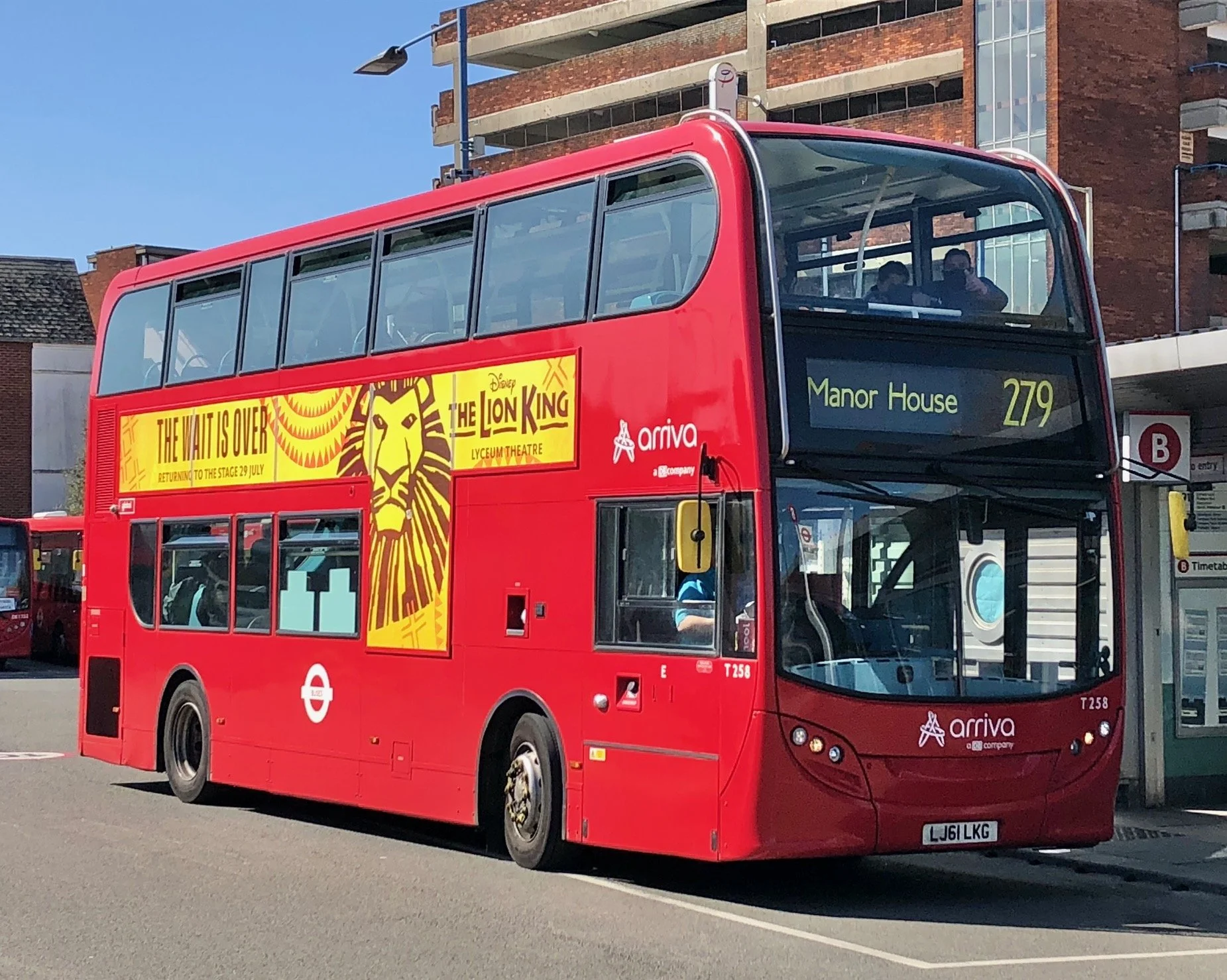
Back in April 2021, we see Arriva London Enviro400 T258 of Enfield (E) Garage on the 279 at Waltham Cross Bus Station. At the time, this was the usual allocation on the route, although a few DWs also appeared.
This was before conversion to electric operation in 2024 and shows the traditional Manor House destination which was lost with the September 2026 changes.
Route 349 History
To end this report, a brief look at the 349, which was withdrawn with the 5th September changes and which I last rode in November 2021.
The recent use of the number was its second incarnation, the first version appearing in 1991 for a short-lived route between West Brompton and Streatham Garage (M-S) or Crystal Palace (Sun). This was M operated and took over a section of the 49. In 1992, the southern terminus was altered to Streatham Hill Telford Avenue and the type changed over to T. Withdrawal came in 1993 when it was replaced by the 319.
The number reappeared in 2004 for a route between Ponders End Garage and Stoke Newington, replacing the Ponders End - Edmonton section of the 149 with an overlap. Although officially DLA operated, other types such as DLP and VLW also put in a turn. In 2010, the route was cut back at the southern end to Stamford Hill Egerton Road, although in 2016 a short extension to SF Garage in Rookwood Road was implemented. Meanwhile, the principal allocation switched to DW in 2015, with LT types taking over in 2021. This route was always with Arriva, operating at different times from Stamford Hill, Enfield (twice), Edmonton and Tottenham Garages, until withdrawal with the September 2026 scheme.
Watton
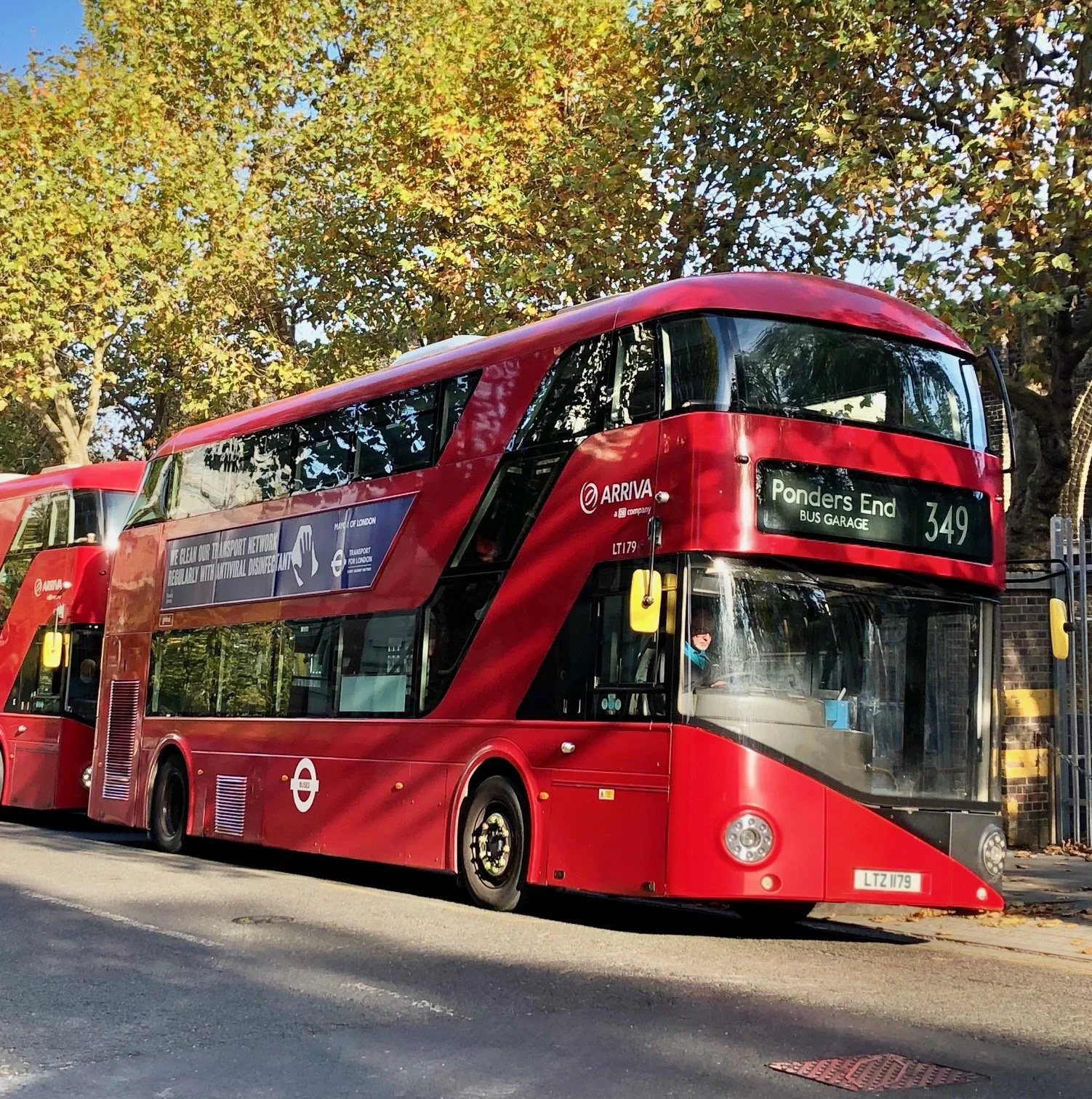
Arriva London New Routemaster LT179 is seen on stand outside Stamford Hill Garage on the 349 back in November 2021. The route was withdrawn on 5th September 2026, having been introduced in 2004.
The route was with Arriva all its life, but operated from 4 different garages over that period. At the time of this photo, it was allocated to Edmonton (EC) Garage.
