
Returning to the capital, Watton’s Wanderings samples a few bus routes where older diesels and hybrids have temporarily supplanted newer vehicles, followed by a visit to the Oxford Street area to review the new routeings introduced with the traffic-free scheme implemented on 26th October.
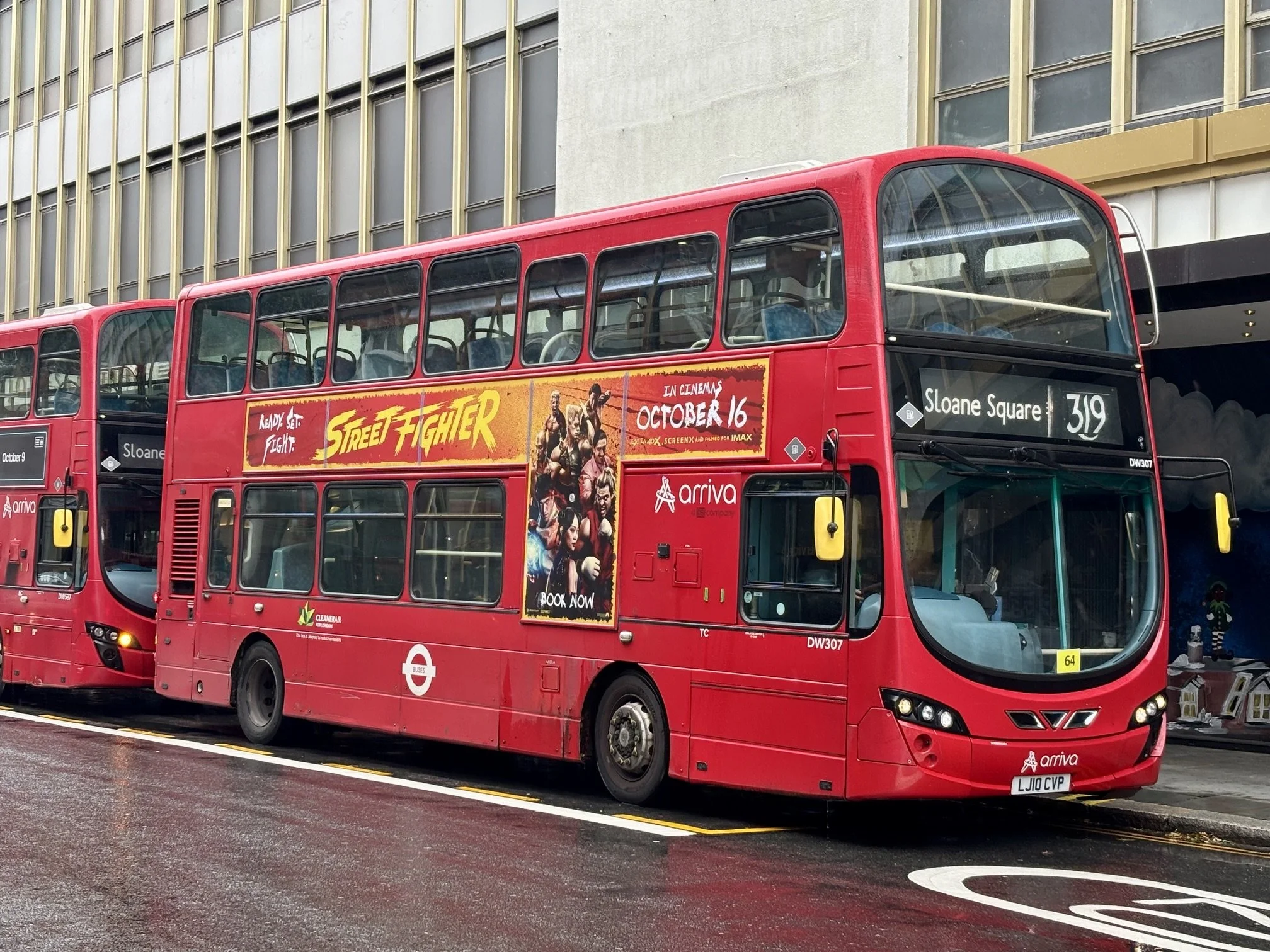
A surprise in late October was the temporary conversion of the 319 from EA class electrics back to diesels, using DB300 Wright Eclipse Geminis made surplus from Croydon (TC) following the arrival of new ED type electrics there. DW307 leads another on the Sloane Square stand, after I had ridden it from its new home at Brixton (BN) Garage.
This allocation is expected to last around one month, whilst roadworks outside the former Brixton Tram Shed (used as an outstation of BN Garage) prevent the usual electrics from accessing the recharging facilities there.
Part Route 250: Brixton Station - Brixton Garage
Emerging from the Victoria Line at a rainy Brixton Station, I began my latest set of bus rides with a short hop on Arriva Wright StreetDeck Electroliner ES152 on the 250 southbound up Brixton Hill to BN Garage, a jaunt of around 10 mins. This bus was one of the large batch of electrics which have recently replaced elderly T class Enviro400s at Thornton Heath Garage. Passing the former Brixton Tram Shed, I noted the roadworks taking place outside, which have enforced a temporary change to the allocation on the 319 from electric to diesel, as its EA type electrics cannot access the charging facilities inside for the duration of the works.
Route 319: Streatham Hill Telford Avenue - Sloane Square
Alighting at the garage, my first full route was the 319, which suddenly hit the headlines when its conversion back from electric to diesel for a month or so was announced, due to the reasons set out above. After some speculation as to what vehicles would be used, it appeared that DWs made redundant recently from Croydon (TC) by the arrival of new ED electrics would fill the gap. I had just a couple of minutes to wait before DW307 exited the garage and roared up to the first pick-up stop, where just two of us boarded. As we chugged our way southbound towards Streatham Hill Station and on to the Streatham High Road, traffic seemed unusually absent, but this could have been because it was just after the morning peak during Half Term Week.
Taking the right hand fork at St Leonard’s Church, we finally picked up a decent load at the next stop and went around the one-way system to join the green section across Tooting Bec Common. Incidentally, whilst the name Tooting comes from the Anglo-Saxon word “Totinges”, meaning the place of Tota’s people, referencing an early Saxon chief, the word Bec refers to the Abbey of Bec, a Benedictine monastery in Normandy. After the Norman Conquest in 1066, William the Conqueror granted the manor of Upper Tooting to the abbey and the name stuck!
Continuing on, we reached Tooting Bec Station on the Northern Line, then crossing the Balham High Road / Upper Tooting Road and traversing narrow Trinity Road amid suburban housing. Reaching Burntwood Lane, we turned right to skirt two sides of Wandsworth Common, providing another welcome stretch of greenery. Then back into the built up streets leading into Northcote Road and into the shopping area of Clapham Junction, where many passengers alighted. Continuing under the wide railway bridge by Clapham Junction Station, we made our way into slow-moving Battersea High Steet up to “The Latchmere”, where we turned left. A bit of a queue on the approach to and over Battersea Bridge, but once across, we made better progress up to the KIng’s Road and along the final section past Chelsea Old Town Hall and the fashionable shops which line the route from here to the terminus at Sloane Square. Almost exactly on the hour for the whole trip and fun to do it once again on diesel traction.
The 319 is a daughter route of the 19, coming in 1993 between Sloane Square and Streatham Hill Telford Avenue to replace parts of sisters 219 and 349. Apart from a cut back to Streatham St Leonard’s Church between 1996 & 1998, the route has stayed unchanged throughout its life and has always been operated by Arriva (and its predecessors) from BN Garage. Starting with Titans, it had a period with Metrobuses, before being converted to single deck with LDR Darts in 1996. Low floor conversion to DDL single deckers came in 1998, although these were replaced with DWL class Cadets in 2001. A welcome return to double deckers took place in 2006, mainly with DLA types, although DWs also appeared. Hybrids took over in 2016 with HVs, followed by electrification using EAs in 2021.
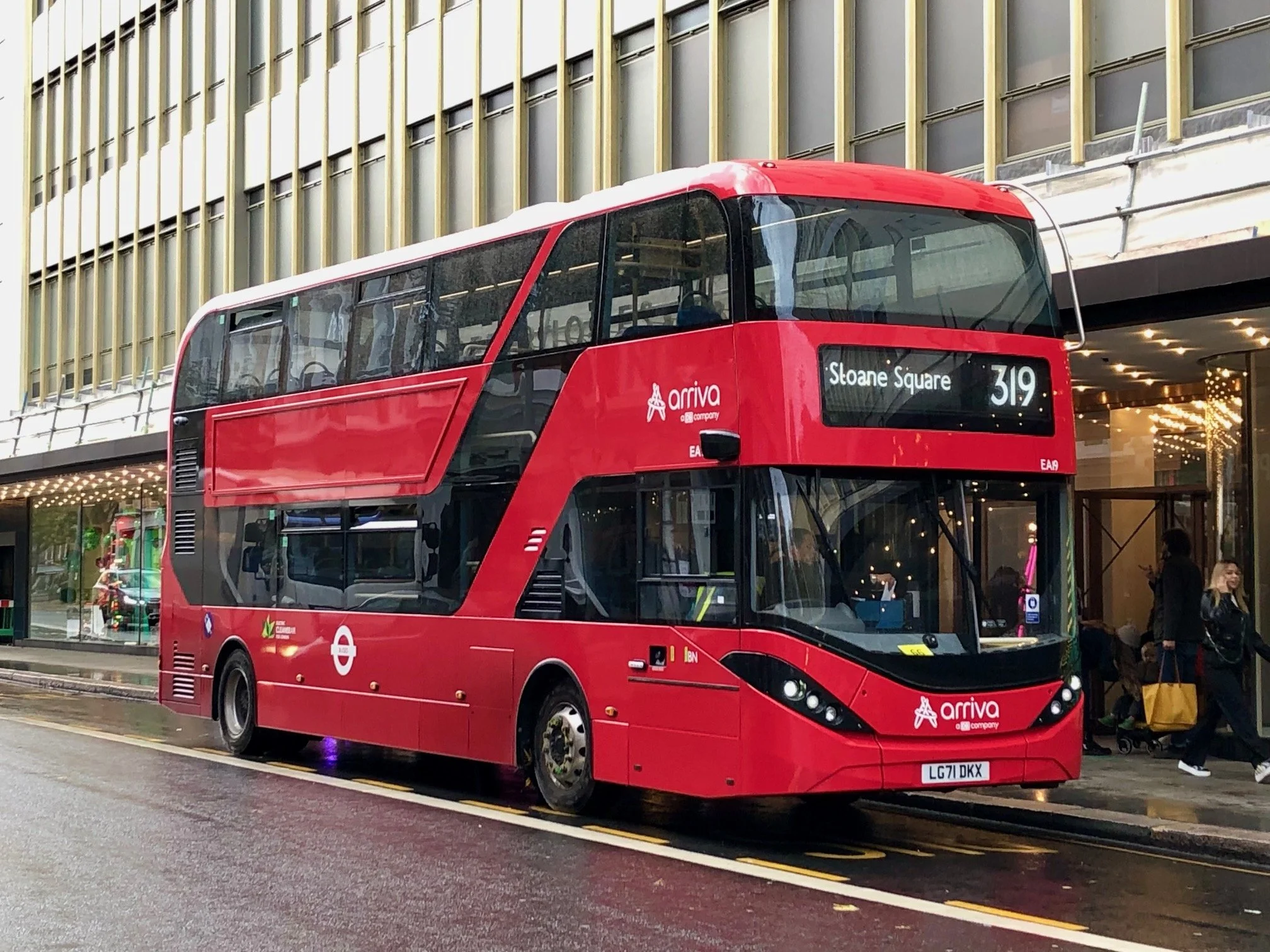
The displaced allocation on the 319 comprises BYD Enviro400 EV City types, like EA19 (also BN Garage) seen at almost the same spot as the previous photo back in November 2021, soon after the route had been converted to the type.
Whilst this is a common vehicle class in London amongst some of the big operators, this batch remains a unique combination with Arriva London.
Route 44: Victoria - Tooting Station
From Sloane Square, I hopped onto the District Line one stop eastbound to Victoria, where I was able to interchange with my next bus route, the 44. This is another to see a recent type change, as it was the home of the ill-fated WSD (Wright StreetDeck) class, which never really settled down with GAL and where the final examples left service in recent weeks. Replacements came in the form of some low-numbered EH class Enviro400 Hybrids, moved into Stockwell Garage from their former home in East London and joining similar examples already at SW for the 88. Both routes now feature a mix of “classic” and MMC type Enviro400Hs plus some WHVs.
Fortunately, the next 44 departing from Victoria was showing on LVF as EH21, so I duly boarded when it arrived after a 5 min wait. Another relatively straight run through light traffic, away from the bustle of Victoria Rail & Coach Stations, before crossing the river at Chelsea Bridge. Passing alongside Battersea Park, I recalled that this was the site of the famous Battersea Fun Fair, opened in 1951 for the Festival of Britain and closed in 1974 following a steady decline in attendance, especially following a tragic accident on the Big Dipper in 1972 in which 5 children were killed and 13 injured after a train broke loose and the rollback brake failed.
At Battersea Park Station, we turned right along Battersea Park Road, which we followed through to The Latchmere and on via York Road past newer developments to the roundabout at the south end of Wandsworth Bridge. In Wandsworth Town Centre, we caught a bit of congestion due to roadworks closing off one lane on the one-way system, but once into Garratt Lane this dissipated. Fairly busy with short-riding passengers on and off from the Southside Shopping Centre down through Earlsfield and Summerstown all the way to Tooting. Most left us at the Broadway, from where it was a quick stint through Amen Corner to our final destination of Tooting Station. Our total journey time was a couple of minutes under 1 hour end to end.
The 44 dates back to 1950, when it began as a replacement for Tram 12 and Trolleybus 612, running between London Bridge & Mitcham. The allocation switched from RT to RTL and back to RT again during the 50s & 60s, with the route gaining a Sunday extension from London Bridge to Poplar for market traffic, although this was later cut back to Aldgate, these journeys continuing right up until the route split in 1991! OPO conversion to DMS came in 1972, although most of the allocation went over to M operation from 1983. Interestingly, the trial L class Leyland Olympians for the 170 in 1985 appeared on the 44 on Sundays when the 170 didn’t then run. A reversion to DMS occurred in 1987, whilst between 1988-91 there was a Sunday extension to Sutton Station in lieu of the 280, which was withdrawn on that day.
The main allocation switched back to M in 1991, at which point the route was split, the new 344 taking the London Bridge - Clapham Junction portion, leaving the 44 as Vauxhall - Tooting Station only. Low floor buses came in 2000 in the form of PVLs, whilst it was in 2006 that the route gained a more worthwhile “in town” destination with the diversion to Victoria via Chelsea Bridge. Other types such as WVLs occasionally performed, but in 2018 came the conversion to WSD class Wright StreetDecks, which soon became unreliable and had to be supported by other double deckers as available.
During LT days, Wandsworth (WD) was the operational garage, later supported by Stockwell (SW), Merton (AL) and Sutton (A) at different times. In the privatised era, Go Ahead became the operator out of Merton Garage, until this switched to Stockwell in 2023.
Finally, a brief mention of suffix route 44A, which was a Sunday only route between 1953 & 1958, introduced for visiting hours at St Thomas’s Hospital in replacement for withdrawn route 170 on that day. It ran from Trafalgar Square to Mitcham, joining the main 44 at Lambeth Bridge. It was RTL operated out of WD Garage like the parent at that time.
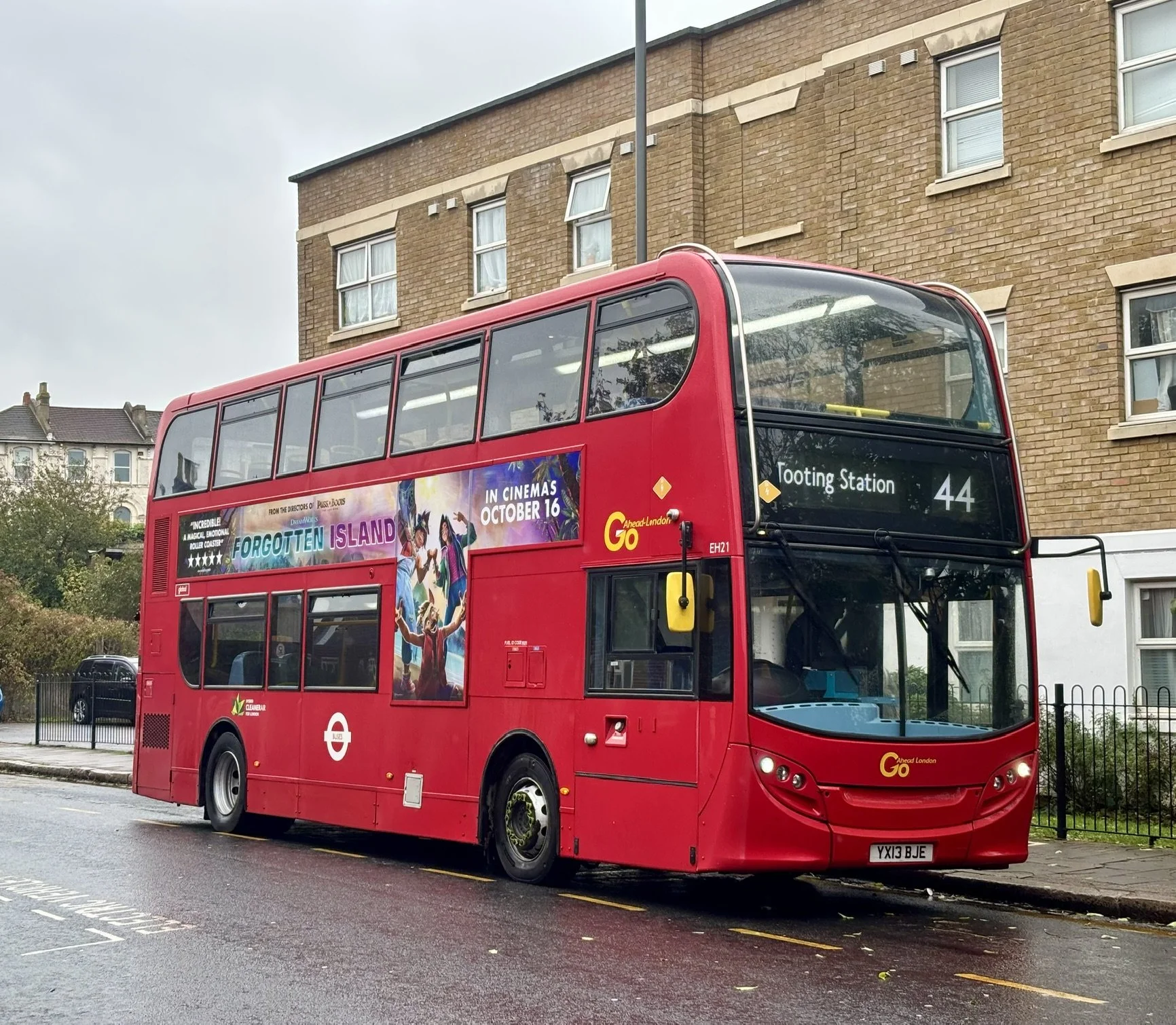
The Wright StreetDeck (WSD class) proved problematical in service with Go Ahead London, the last few examples being withdrawn in recent weeks. To replace them on their usual route, the 44, a number of early Enviro400 hybrids were drafted in to Stockwell (SW) Garage from East London, where they joined a number of sisters already in residence for the 88.
EH21 (now at SW) rests on the Longley Road stand at Tooting Station after my trip aboard from Victoria. The 44 now comprises a mix of “classic” and MMC versions of the Enviro400H plus a few WHVs.
Part Route 44: Tooting Station - Tooting Broadway
From Tooting Station, I retraced my steps a short distance to Tooting Broadway, taking Enviro400H MMC EH141 (also of SW Garage) on the 5 min journey. Transferring to the Underground, I took the Northern Line a few stops northbound to Clapham Common.
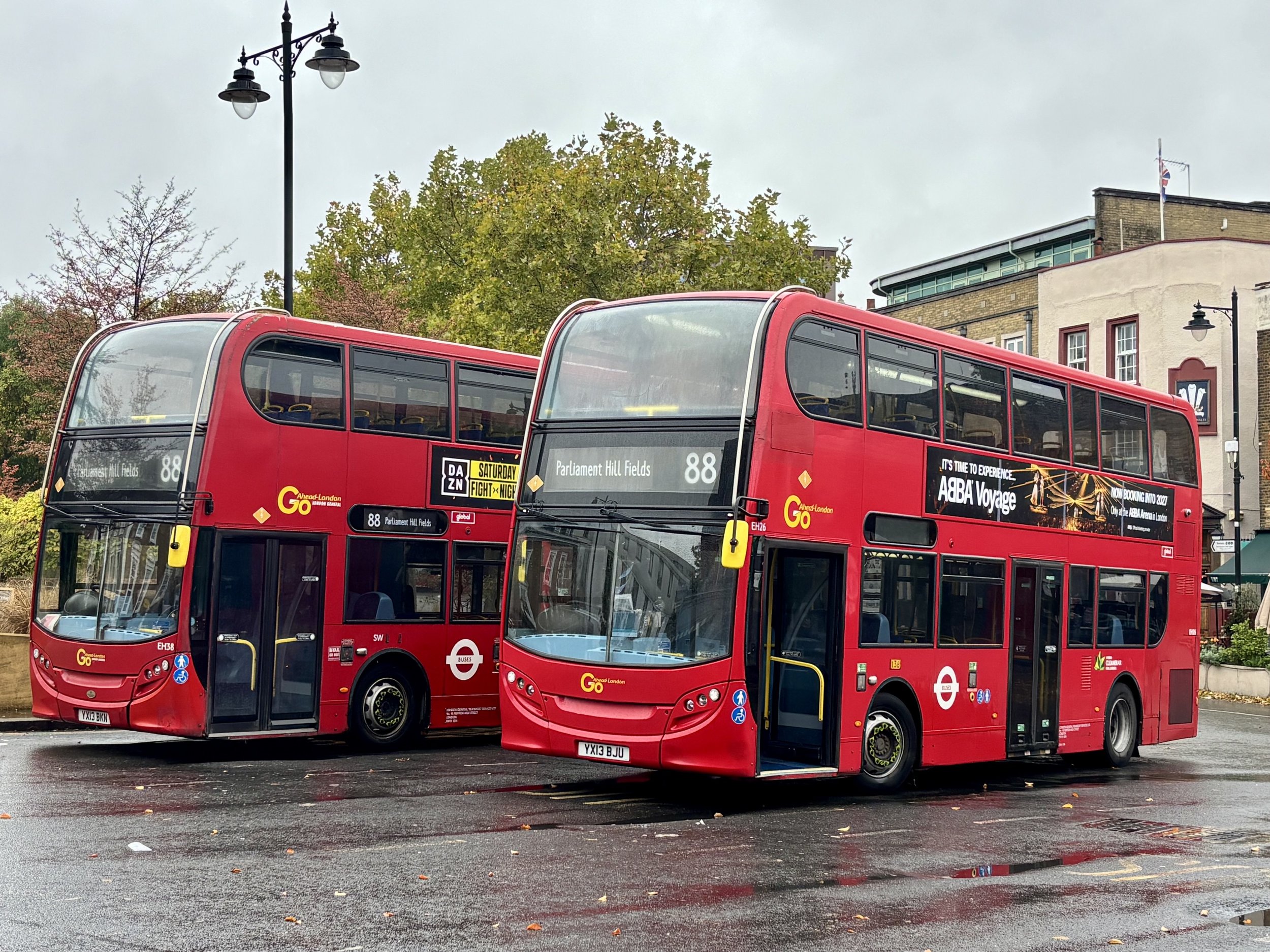
A pair of “classic” GAL Enviro400 hybrids on the Old Town stand at Clapham Common, with EH38 to the left and EH26 to the right, both of Stockwell (SW) Garage. I then rode the latter bus through to Parliament Hill Fields via Central London.
The 88 was retained on retender some months ago on the basis of new electrics, but as SW Garage is still awaiting charging infrastructure, a hybrid mix of EH & WHV types continues for now.
Route 88: Clapham Common - Parliament Hill Fields
A short stroll beside the common brought me to the time-honoured “Old Town” terminus, where a brace of older Enviro400 hybrids were on the stand awaiting their next trips on my next route, the lengthy 88. EH26 (SW) was the first to leave and I was the sole passenger boarding at the first pick-up stop. The last time I had been on the route was back in 2019, soon after it had been extended from Camden Town to Parliament Hill Fields to replace the withdrawn C2, so it had been a while. The scheduled end-to-end off-peak running time was around 1h35m, which seemed a bit excessive, but as events were to prove, we needed all of this plus a bit more!
Nevertheless, we started off easily enough, meandering across Clapham Common to the station and picking up in small numbers at subsequent stops. A straight run along the main road past Clapham North Station and up to Stockwell, where we had a leisurely driver change at the stop closest to the garage. Then we continued past the War Memorial and up to Vauxhall, where we called at the Bus Station, before making our way across the Thames at Vauxhall Bridge in the shadow of the M16 Building guarding the southern end, although no sign of James Bond, M or Q on this occasion!
Once across the river, we turned onto the freehold section of route along John Islip Street and past the Tate Britain Art Gallery into Marsham Street, emerging beside Westminster Abbey. Making our way around Parliament Square, overlooked by the statue of Sir Winston Churchill, we hung a left into Whitehall, passing The Cenotaph, Downing Street and the various Government Offices lining this thoroughfare. A traffic queue caused by short-phasing lights caused a slight hiatus on approach to Trafalgar Square, where adjacent Admiralty Arch was covered in scaffolding and is undergoing a major renovation. A passenger exchange, before continuing up to Piccadilly Circus, where we charged past the statue of Eros and into Regent Street. Unfortunately, it took an age on the short section up to Oxford Circus, as the road here has been pointlessly narrowed and doesn’t allow one vehicle to overtake another, so each time a bus stops at a Bus Stop, it holds up everything else behind - a poorly designed layout in my view, as there is plenty of room for lay-bys to be included.
Finally, we reached Oxford Circus, where there was another exodus and we began picking up fresh punters on the northern section of route. Onwards past the bastion of the BBC at Broadcasting House, before crossing the main Euston Road at Great Portland Street Station. Our reasonable progress was then interrupted by roadworks on approach to Camden Town, which caused an annoying delay as we sat through various cycles of temporary light changes awaiting our turn. Eventually, we reached Camden Town Station, where several left us and we had a quieter run on the final section through Kentish Town and then up to the terminus at Parliament Hill Fields. The hill is on the edge of Hampstead Heath, the leading theory being that the name comes from it being used as a military look-out and defensive position for troops loyal to the English Parliament (the Roundheads) fighting against King Charles I in the English Civil War. An overly extended 1h40m time for the trip, but not bad considering all the intervening hazards we had to negotiate!
I first remember the 88 as a long route between Acton Green & Mitcham via Central London, which in the 1950s/60s had extensions to St Helier (M-F Peaks), Belmont (Suns) and Banstead Hospital (Sun Afternoons). It was RT/RTL operated during this period, until RM conversion in 1966. The projections south of Mitcham were withdrawn in 1974 when changes were made to the 280 in compensation. RMLs mostly replaced the shorter RMs in 1975. When Merton (AL) gained a Sunday allocation in 1981, garage journeys were extended in service beyond Mitcham to/from that point. In 1987, the Sunday service was converted to OPO using DMS & M types, whilst the main service was cut back from Mitcham to Tooting upon introduction of the 219, although the AL Garage journeys continued. Meanwhile, at the western end of the route a short extension from Acton Green to Turnham Green via Chiswick Park Station was implemented in 1988, although this only lasted a couple of years or so.
It was in 1990 that the 88 was split - the western section going to new route 94, leaving the rump of the 88 as Oxford Circus to Clapham Common only, although the Sun service terminated at Marble Arch until 1992. The latter year also saw full OPO conversion using Ms. However, in 1993, the route was strangely converted to single deck using a batch of VN class Volvo B10Bs with Northern Counties Paladin bodywork, the route then being marketed as “The Clapham Omnibus”. Naturally, single deckers were inadequate and the route reverted to double deck M operation in 1997. Low floor conversion came in 2000 using PDL & PVL types, plus an extension from Oxford Circus to Camden Town in replacement for part of the withdrawn 135. A further type change in 2010 saw WVLs plus a few Es take over, but “hybridisation” came in 2015 using LT class NRMs.
The final significant change came in 2019, when the 88 was pushed further north to Parliament Hill Fields to replace withdrawn route C2. At the same time, its LTs were swapped with EHs off the 87, as the NRMs were deemed too long to make the turn at PHF.
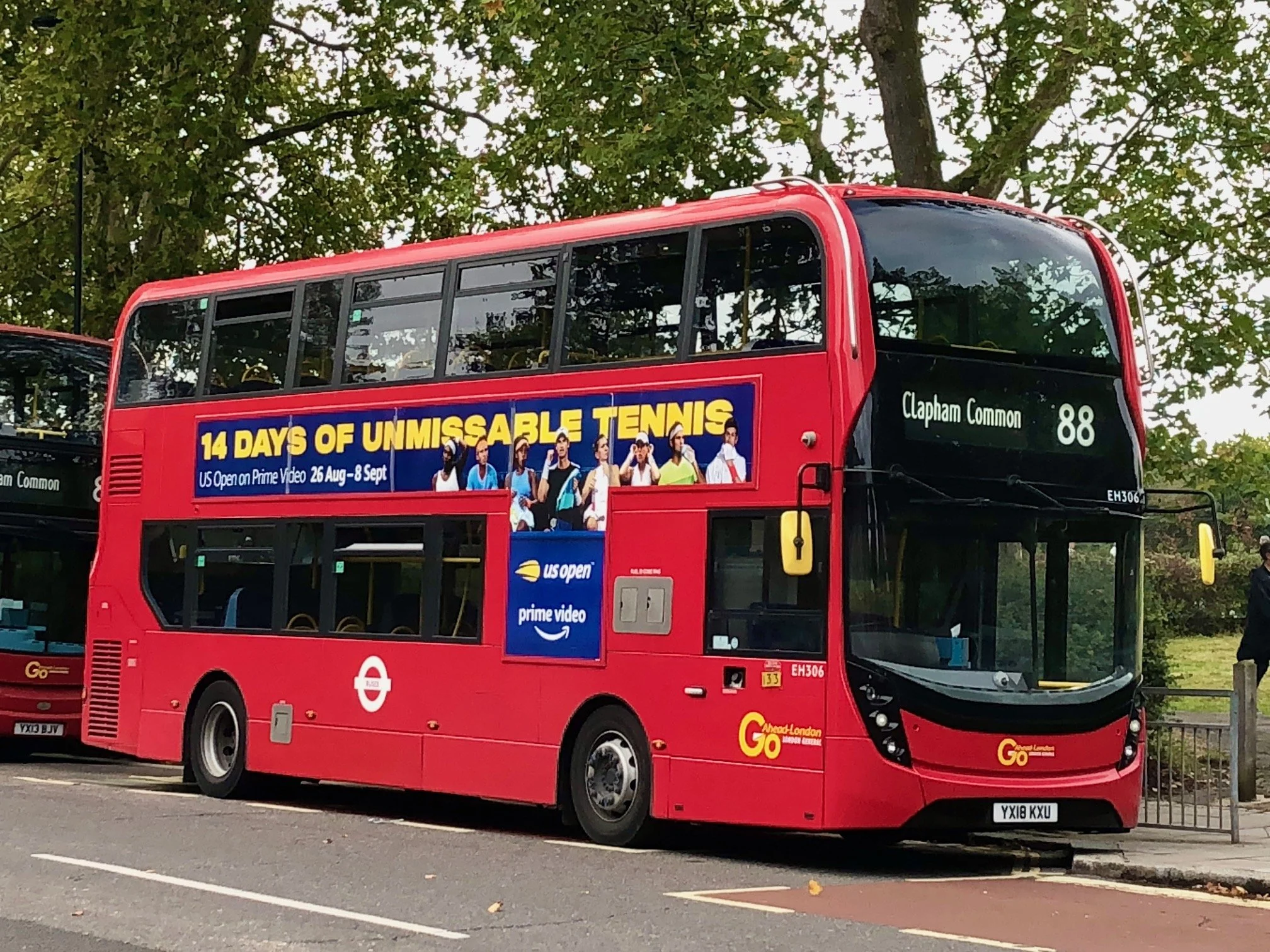
At the other end of the 88, we see Enviro400H MMC EH306 (SW) laying over at Parliament Hill Fields, representing the more modern version of the class on the route. This was taken back in September 2019, soon after the service was extended from Camden Town to this point in replacement of the withdrawn C2 route.
At the same time, the 88 was converted from LT to EH, as the longer NRMs were unable to turn safely at PHF and so were swapped with the 87 allocation.
Part Route 214: Parliament Hill Fields - Kentish Town
After a brief stroll around the adjacent parkland to get some air and relief after my previous long journey, I crossed the road and boarded the next southbound bus to get me back to the Underground at Kentish Town, which happened to be Enviro200EV SEe87 of Waterloo (RA) Garage on the 214. A short trip of just over 5 mins, before I dived down into the Northern Line Station and took the next southbound Charing Cross Branch service to Tottenham Court Road.
To conclude my day, I switched my attention to Oxford Street, which had been closed to all traffic between Oxford Circus and Orchard Street (Selfridges) over the previous weekend as part of the Mayor’s plan for pedestrianisation, necessitating various changes to local bus services that I was keen to check out.
Apart from some minor changes to routes terminating at Oxford Circus, the main effect was the cut back of the 7 & 94 to Marble Arch and the rerouteing of the 98, 139 & 390 via Wigmore Street in lieu of Oxford Street. I rode each of the latter three routes in turn over their new section, incidentally all services operated by Metroline.
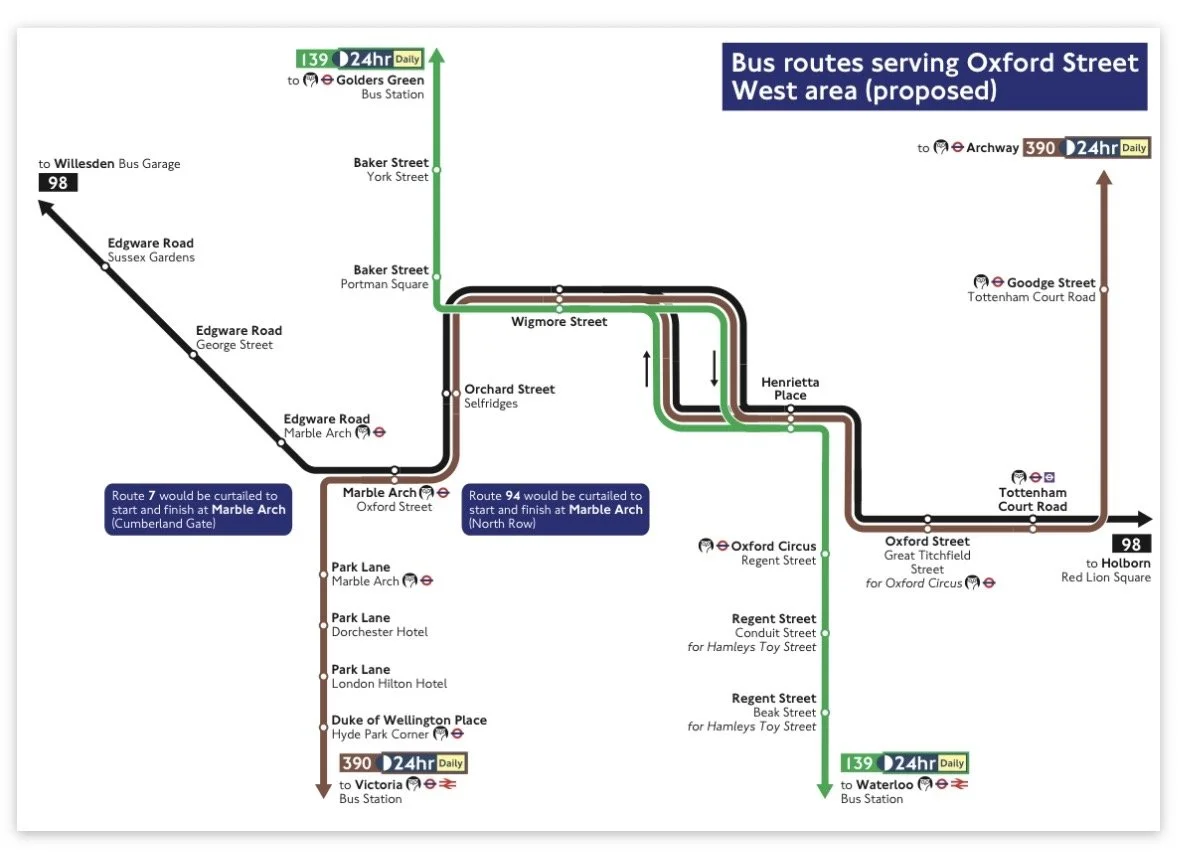
Diagram showing the revised daytime routeings for the 98, 139 & 390 following the closure of Oxford Street with effect from 26th October 2026. The Henrietta Place stop is currently only available westbound until road layouts are changed, eastbound buses are calling at Cavendish Place instead for the time being. The curtailments of the 7 & 94 at Marble Arch are also noted, although the 94 was standing in Oxford Street itself, rather than at North Row, at least to begin with. Not shown here are the revised stand arrangements for the 55, 73 & 159 at Oxford Circus.
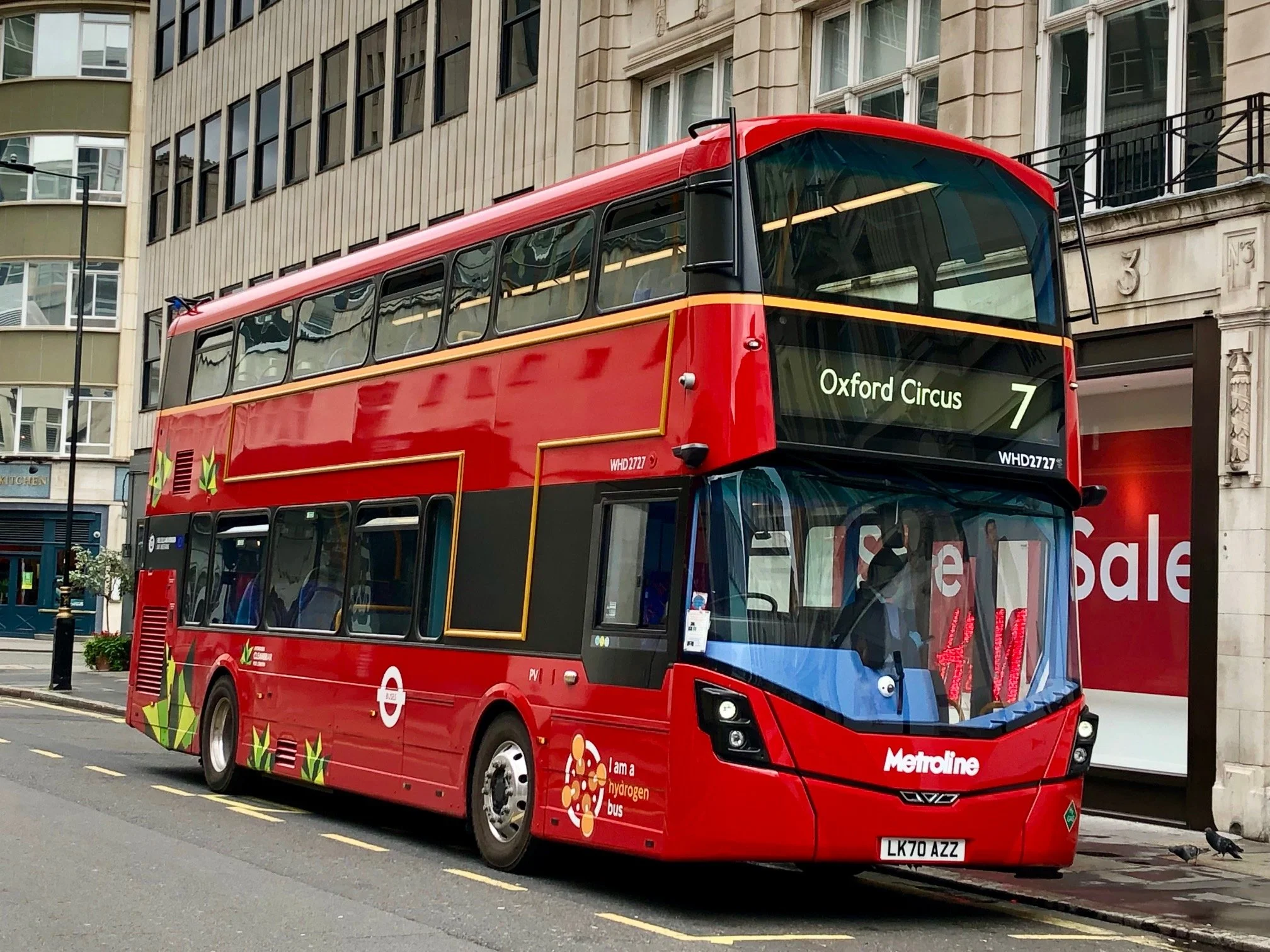
The old 7 stand at Oxford Circus was in John Princes’s Street, as Metroline WHD2727 recalls back in August 2021. The route is cut back to Marble Arch with the Oxford Street changes.
These Wright StreetDeck Hydrogen Buses, unique to Metroline at Perivale (PV) Garage, have now been superseded by new electrics on the 7.
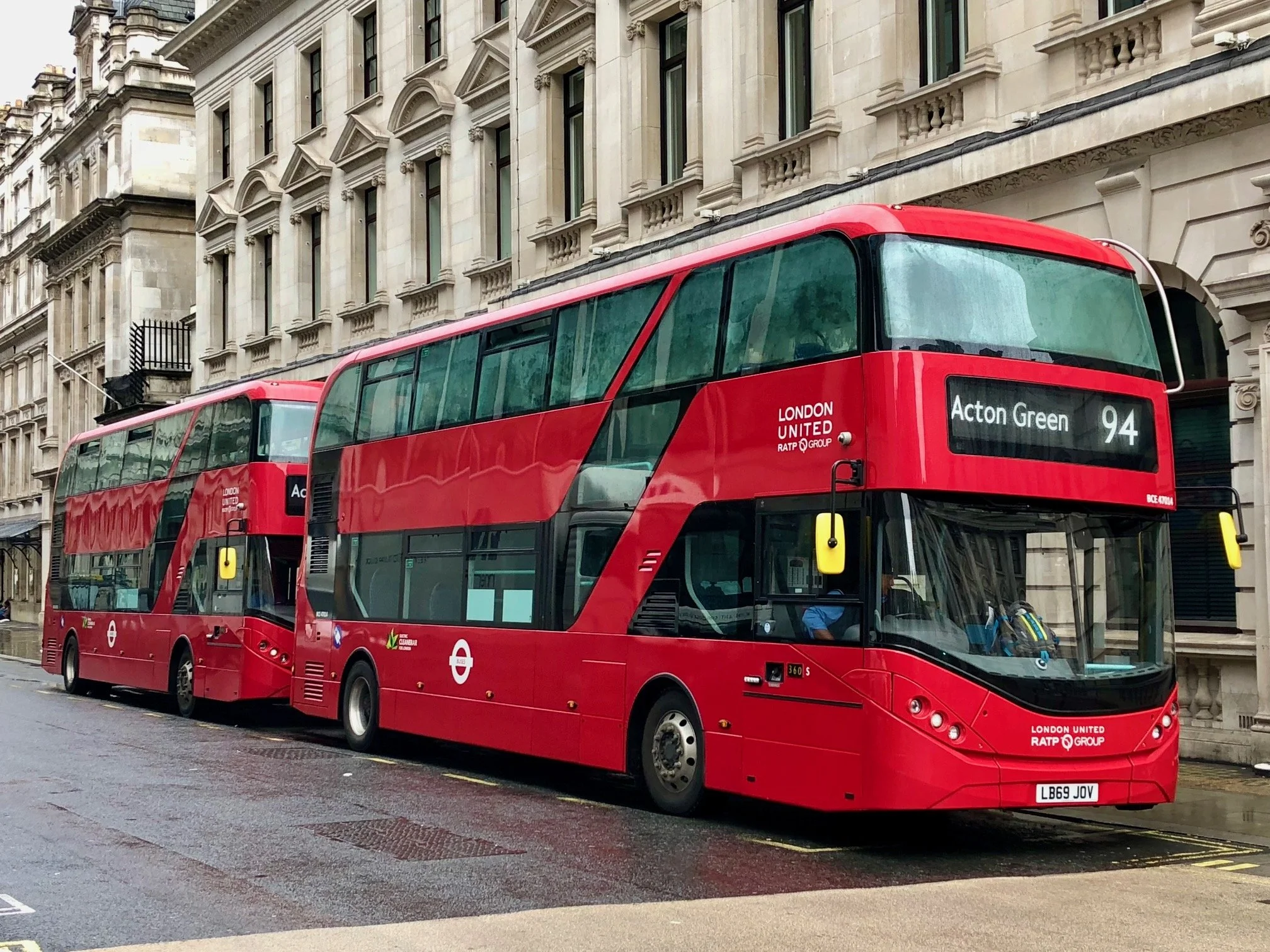
Also cut back to Marble Arch with the Oxford Street scheme is the 94. Here is London United BYD Enviro 400EV City BCE47014 of Shepherds Bush (S) Garage in company with a classmate at the old terminus just south of Piccadilly Circus in Setember 2020.
Since then, London United has passed from RATP Group to First Bus London ownership.
Part Route 390: Oxford Circus - Marble Arch
I began on the section of Oxford Street between Tottenham Court Road and Oxford Circus, where I joined a Victoria bound 390 in the form of New Routemaster LT803 of Holloway (HT) Garage, which had a good crowd on board. After calling at Great Titchfield Street and just short of Oxford Circus, we turned right into Great Portland Street, where the sharp turn was guarded by one-way temporary traffic lights. We had some difficulty passing a couple of 73s on their new stand, which seems poorly placed on the narrow street. Then left into Margaret Street and across to Henrietta Place, where we served the stop at the rear of John Lewis.
Then on past the rear of the shops on Oxford Street to a point near Bond Street Station, where strangely there is no stop. Instead, we turned right into narrow Marylebone Lane up to Wigmore Street, where we turned left to a new stop. From here, there was a bit of a traffic queue up to Orchard Street, where we swung left to serve the next stop at the side entrance of Selfridges. Good that the two main stores in Oxford Street still have a stop close to them westbound at least. Then we turned right into the western part of Oxford Street to Marble Arch, back on the old line of route and where I alighted. An 18 min ride.
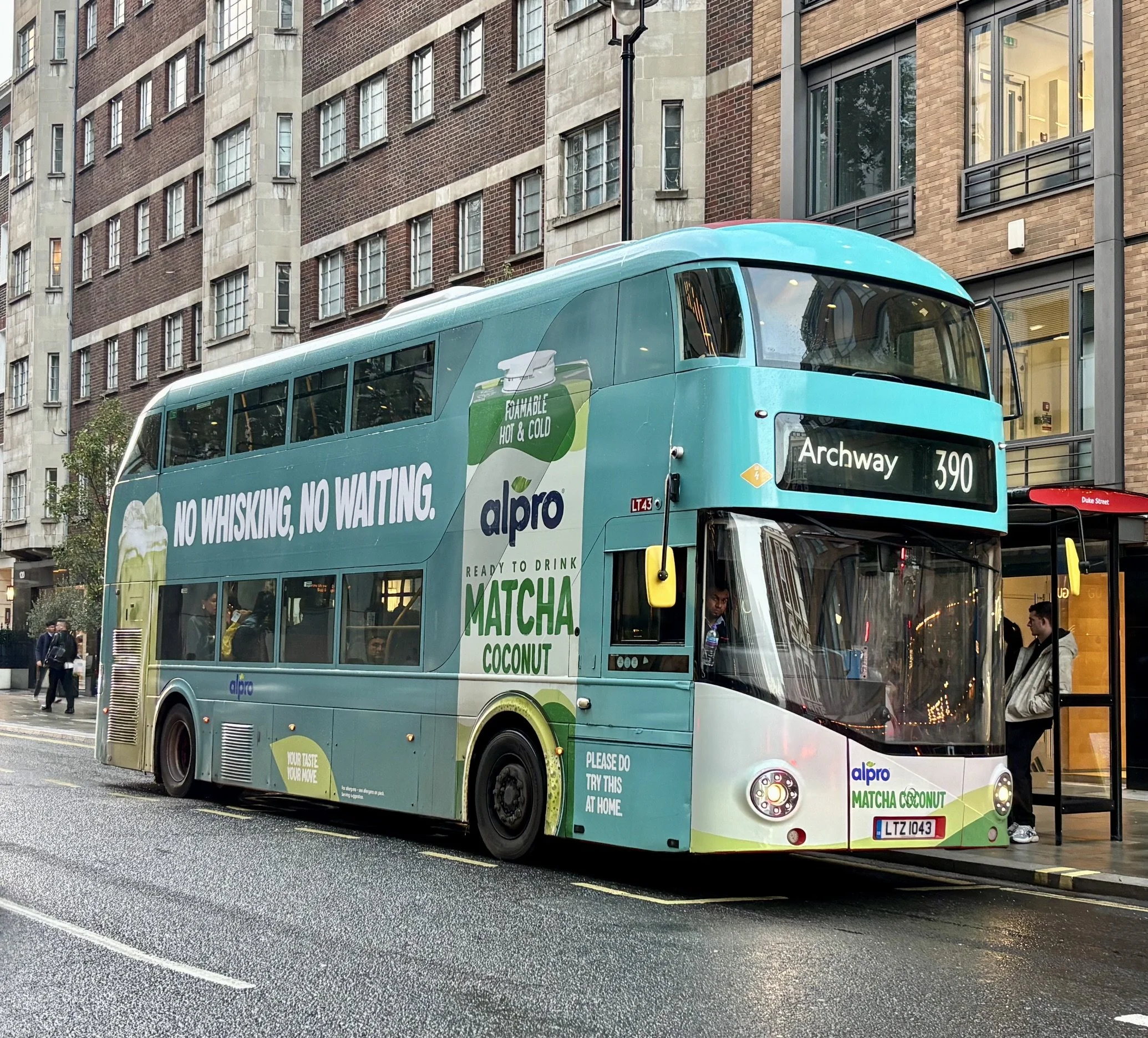
New Routemaster LT43 of Metroline’s Holloway (HT) Garage calls at the Duke Street stop on the new section of route in Wigmore Street whilst working an eastbound 390 journey to Archway.
The bus bears an allover advert wrap for Alpro Matcha Coconut, the UK’s first ready-to-drink, plant-based soya-coconut green tea.
Part Route 98: Marble Arch - Oxford Circus
Crossing the road, I opted to return on a 98, although there appeared to be some late running / bunching, as the next one was more than 15 mins away with three then expected within a 5 min period! Eventually, after what seemed an eternity, BYD B11 electric BDE3053 of Willesden (AC) Garage purred up to the stop and I boarded another virtually full bus for the eastbound run. Essentially the same journey in reverse - left from Oxford Street into Orchard Street, then right into Wigmore Street where we served another new stop.
However, until changes are made to road layouts, eastbound buses continue straight along past Cavendish Square to Cavendish Place, Mortimer Street and into Great Portland Street. Eventually, the plan is for buses to stop at Henrietta Place, closer to the shops. When we turned back into Oxford Street, I had completed the new section and alighted at the next stop. Another 18 min journey.
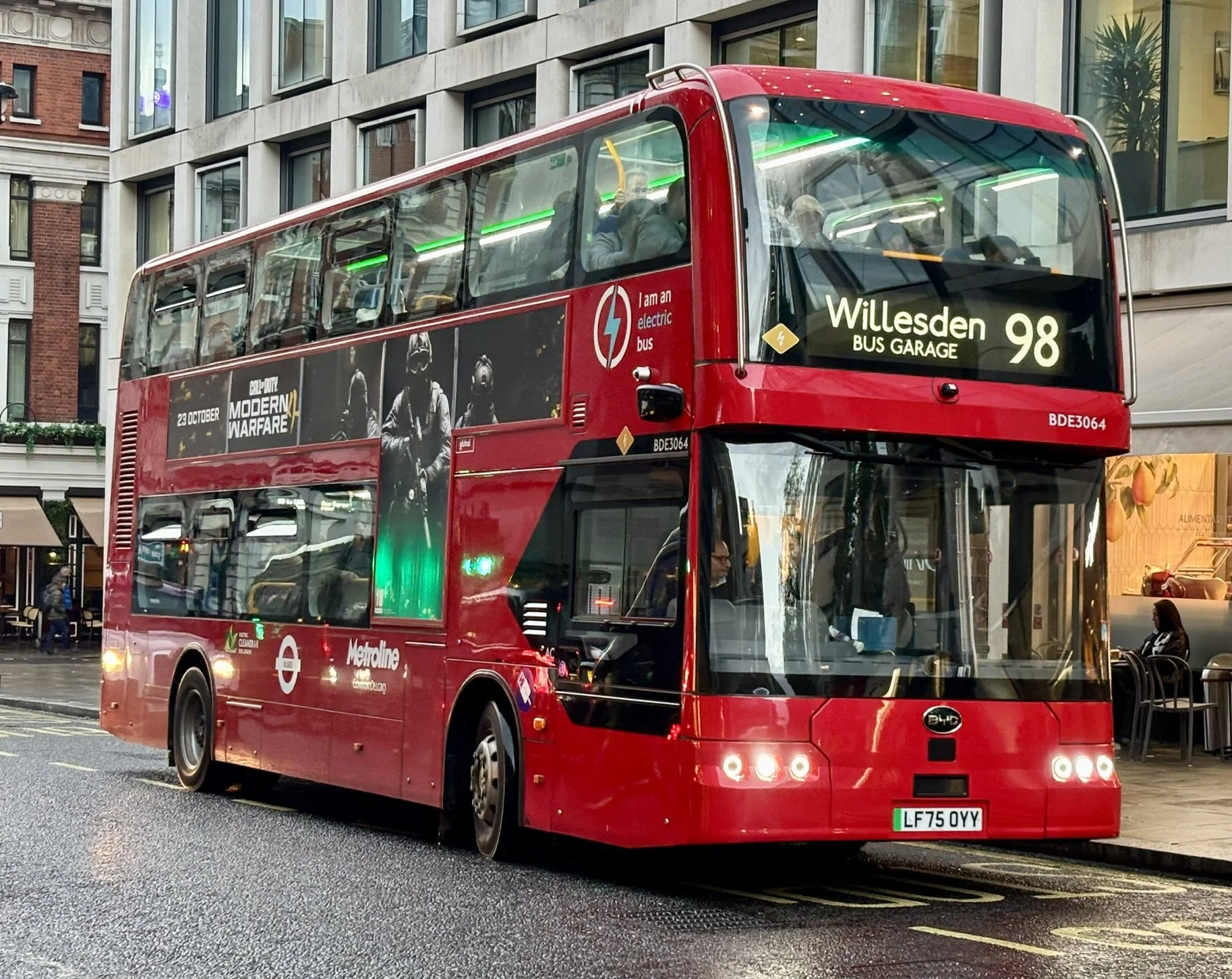
Meanwhile, across the road in Wigmore Street, we see Metroline BYD B11 electric BDE3064 heading westbound on the 98 towards its home garage of Willesden (AC).
Note the impromptu green & white light show in the reflections of the interior lights, car headlamps and nearby traffic signals!
Part Route 139: Oxford Circus - Portman Square
To end, I tackled the last of the three rerouted services, the 139. Walking back to Oxford Circus, I turned into Regent Street where I had just a few minutes to wait for TEH2078 of Cricklewood (W) Garage on its northbound trip. Crossing Oxford Circus south to north, we turned left via the south side of Cavendish Square to Henrietta Place and the same route as the 98/390 via Wigmore Street.
However, rather than turning left at Orchard Street, we turned right to Portman Square, where we were back on the previous line of route and I alighted. Just 15 mins for this short trip.
In summary, the revised arrangements seemed to be working reasonably well and probably the best that can be achieved for now, although some further tweaking is needed, in particular to bring buses nearer to some of the shops eastbound, which I understand is the ultimate intention. Some of the stands for terminating buses at Oxford Circus / Marble Arch also require changing to avoid causing congestion, although I appreciate that in some cases the current situation is an interim arrangement.
Watton
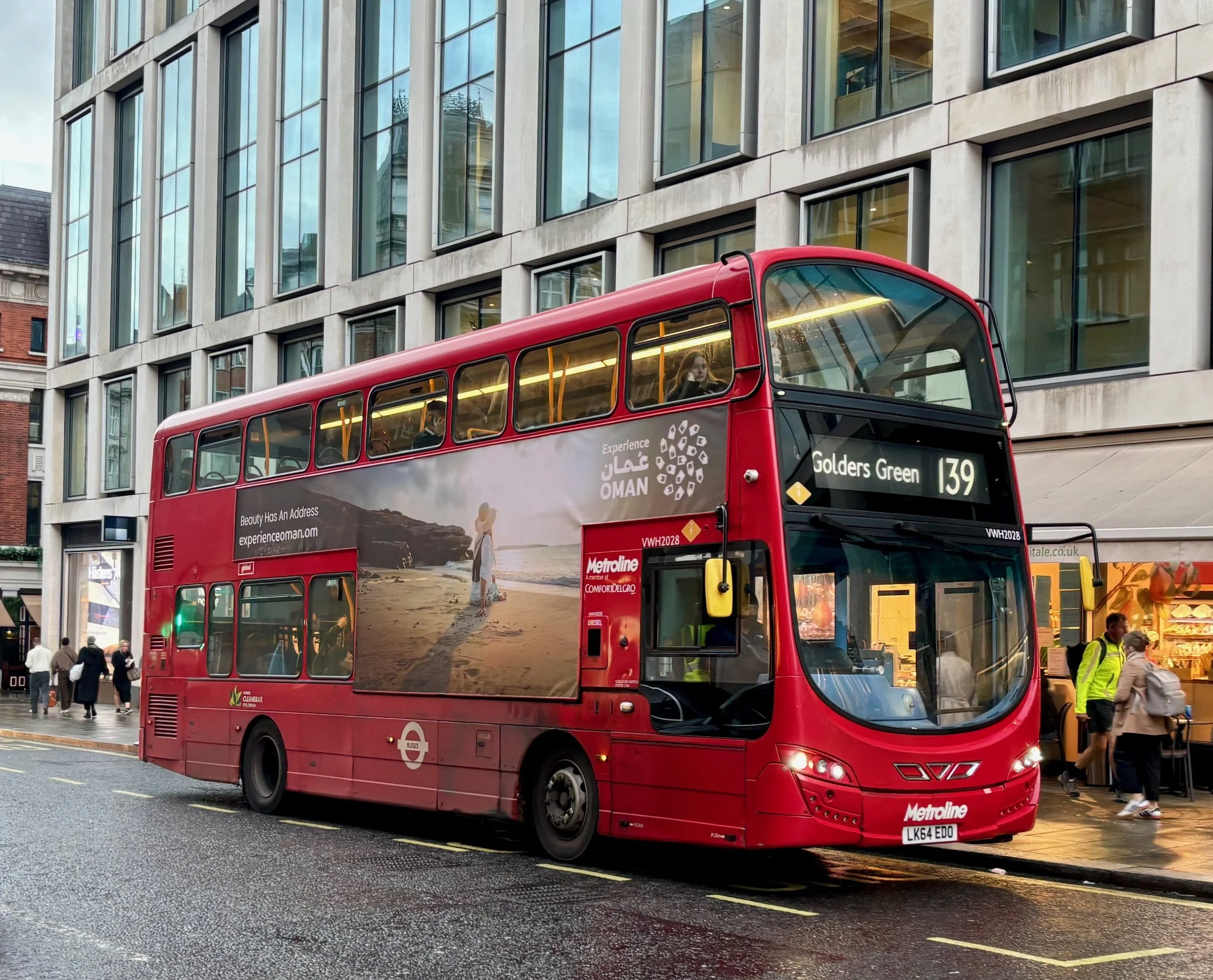
Illustrating the last of the trio of services rerouted from Oxford Street to Wigmore Street, we have Metroline Volvo Wright Hybrid VWH2028 of Cricklewood (W) Garage proceeding west along Wigmore Street towards Portman Square on the 139.
The larger than usual size side advert looks totally out of proportion and does not suit the lines of the vehicle.
