
Caught in Hampton
On this bus adventure, I begin in Staines-on-Thames, making my way along the river to Hampton Court & Kingston, then to Heathrow & Hounslow covering a few “H” routes, before returning to my start point.
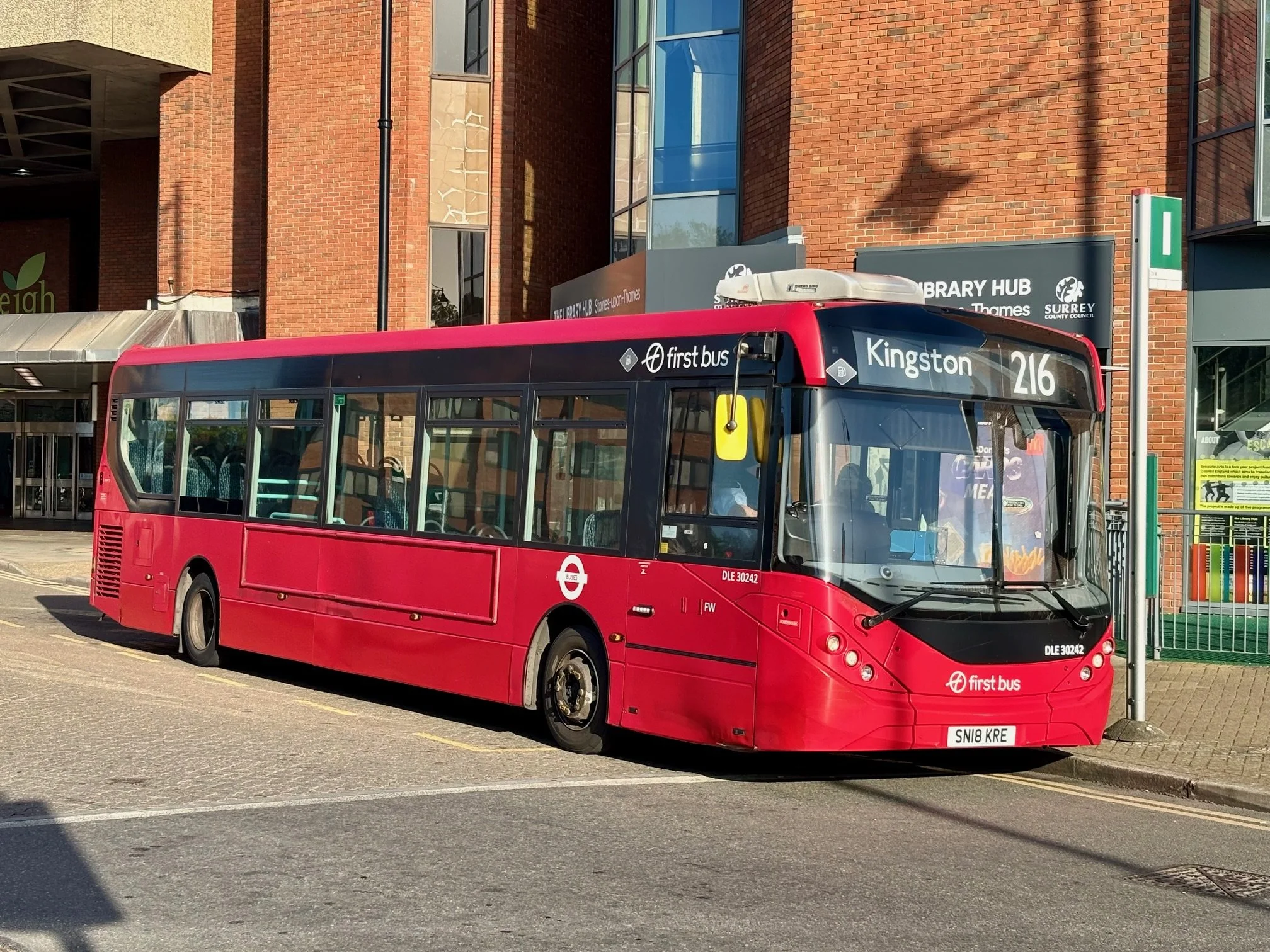
Staines Bus Station was where I began my rides, where we see First Bus London Enviro200 MMC DLE 30242 of Fulwell (FW) Garage on the 216.
I travelled on a similar example of the class which formed the following working.
Route 216: Staines - Kingston
I began bright and early on a Saturday morning at a sunny Staines Bus Station, close to the River Thames, which I was to meet up with again later on my first route of the day, the 216 to Kingston. This is currently operated by First Bus London using mainly DLE class Enviro200 MMC types from Fulwell (FW) Garage. After grabbing a fortifying coffee, I boarded the next working formed of DLE30321 with a couple of other passengers. Soon we were on our way out of town, passing the site of the long gone Staines (ST) Garage of LT Country Buses and its successors which closed in 1996 and now replaced by an office block.
A straight run over London Road between Staines Reservoirs and Ashford Park, before turning right down to Ashford Town Centre, picking up more along the way. From here, we continued via suburban Feltham Hill Road and Chertsey Road to Ashford Common, before swinging left into Staines Road West. A double run off the main road to serve Sunbury Tesco, where we had a brief pause to await scheduled departure time. Then on to Sunbury Cross and down to Sunbury Village, where we met up with the Thames again, turning left to follow the river for a while. Then a small deviation past the reservoirs in Staines Road East to Hampton, negotiating the dog-leg to serve the station, with a short hiatus whilst we sat in a queue waiting for the level crossing gates to open.
We set off from Hampton Station in hot pursuit of a 111, which runs in parallel with the 216 from here to Kingston. Soon we were back beside the river again, which was busy with small boats, following the pleasant stretch between Hampton and Hampton Court. As it was a nice day, traffic was busy on the approach to Hampton Court Roundabout, but soon we were skirting the palace grounds and whizzing through the green stretch between Bushy Park and Hampton Court Park, a section which used to be treated as a bit of a racetrack back in the days of Trolleybuses, which lasted until the last day of operation in 1962 in this part of London.
After crossing the river over Kingston Bridge, we deposited most of our load in the town, before terminating at Cromwell Road Bus Station after a 1h10m run.
The 216 number has operated over the Staines - Kingston corridor since 1934, when the former service 198 was renumbered. Following withdrawal of the pre-war types, the route was TD operated from 1949 until 1959, when RFs took over. These were crew operated until 1964 when OMO (as it was then called) was introduced. Replacement with BLs came in 1976, although these were superseded by larger LS Leyland Nationals in 1982, at which point the Staines terminus was cut back from Bridge Street (standing at the old Staines West Station) to Staines Bus Station.
An extension was introduced from Kingston to Tolworth Broadway to 1983 to replace part of the 211, although it was cut back again to Kingston in 1987 when the K2 took over this leg. At the other end of the route, there was an extension to Thorpe Park between 1985 and 2002, which ran on Summer Suns only in some years and daily in Summer in others, although the Sunday service came off completely beween deregulation in 1986 and 1988 when it was reinstated, initially with midis but later reverting to full size single deckers. Interestingly, the route left the London network between 1986 and 2002, becoming a commercial service over this period.
From 1991, the service was operated by Westlink, with the LS types replaced by DWL long Darts in 2000 plus some appearances by DRLs. 2002 saw a short term contract awarded to Tellings Golden Miller (TGM Buses) using Excels, but London United took over in 2003 with mainly DPS Darts. These were succeeded in 2015 by DE Enviro200s and later by the MMC versions of the DLE class. First Bus acquired RATP, then owners of London United, in 2025.
Whilst mostly associated with single deckers, the route has seen occasional double deck operation over the years, with Ms appearing on the Kingston - Tolworth section in the 1980s, for example, and SPs over the whole route in the mid 2010s.
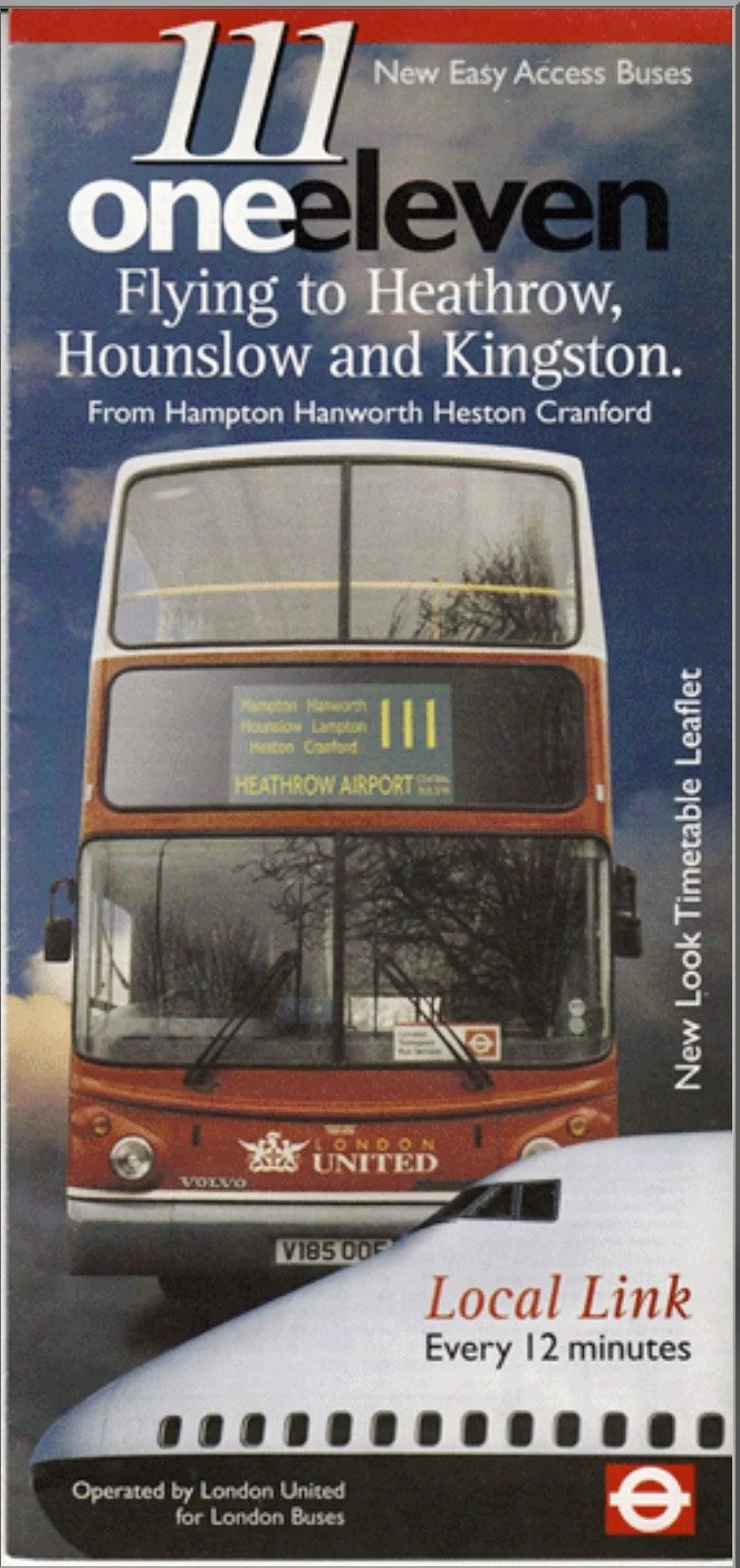
The 111 from Kingston to Heathrow was converted to low floor double deckers in 2000. This leaflet was produced to advertise the change and included a timetable & map.
The bus featured is one of the Volvo Alexander ALX400 “VA” types which London United operated on the route.
Route 111: Kingston - Heathrow Central
The revamped Cromwell Road Bus Station in Kingston seems hardly any different from the old one in terms of facilities or ambience, so I was wondering what all the time, effort and money had been for! There were two buses on stand beside each other for the 111, which was to be my next route, prompting two queues to form. However, I saw from LVF that Wright StreetDeck Electroliner no 3030 from Transport UK’s half of Fulwell Garage (coded TF) was due to leave first and indeed the driver soon appeared and opened the doors, so I was first aboard. A decent modern electric bus with the usual interior features now expected, although an odd quirk was that although the next stop and destination announcements were correct, the display screen showed “111 to Kingston” rather than “111 to Heathrow Central”, although this magically changed to the correct display part way through the journey. For some reason, inaccurate displays are not uncommon on newer TfL buses, whereas the older “i-bus” screens seem generally more reliable.
It was a slow departure from Kingston as we negotiated the multiple sets of traffic lights in the town centre and picked up a good load, before returning over the river and then alongside through the parks to Hampton Court. Incidentally, the former royal palace here is worth a visit, originally built in Tudor times as the seat of Henry VIII and his many wives, then upgraded a century and a half later by William III, together with its 60 acres of gardens. Having revisited a few years ago, I forewent the opportunity this time and continued on the 111 beside the river, until we turned off to serve Hampton Station.
Then we continued over the railway level crossing and through the various twists and turns which characterise the route in the Nurserylands Estate area, before arriving into Hanworth, where we turned right onto the long straight suburban section via Hounslow Road and Hanworth Road up to Hounslow Town Centre. The 111 feels very much like two routes joined together, as we exchanged virtually all our passengers in Hounslow, passing the garage and then continuing via Hounslow East Station and Lampton, crossing the Great West Road into Heston. After serving the Vicarage Farm area, we proceeded along Cranford Lane and High Street to the Bath Road, with a short delay leading to the lights where we crossed The Parkway. We picked up a few passengers with suitcases on this section, clearly bound for the airport.
Once on the Bath Road, it was a faster run from Cranford to Harlington Corner and then on to Heathrow North, before the final spin through the tunnel down to our final destination of Heathrow Central Bus Station. A long run of 1h35m, but more or less as scheduled. I suspect that only a mad bus enthusiast would ride the whole route, the SL7 or even the 285 providing a faster journey from Kingston to Heathrow!
The 111 can be traced back to 1944, when it was introduced between Hounslow (where it operated in a loop), Hanworth and Richmond, replacing part of the 110, although its subsequent history often saw it altered in tandem with its “minus one” sister route. It was in 1955, by now RT operated, that the 111 first saw London Airport Central (as it was then known), although the initial daily extension must have been too extravagant, as it was reduced west of Cranford to M-F peaks only the following year. At the other end, Hanworth was the “normal” terminus, with a Suns extension to Richmond (later Twickenham). By 1963, the extensions were taken off and the route was reduced to its Cranford - Hanworth rump. However, it didn’t stay still for long, as in 1964 came an eastern extension to Hampton and on further to Kingston on Sats only.
OPO conversion to MBS single deckers came in 1969, when the route was reduced to Cranford / Hounslow to Hanworth, the 211 taking the Kingston section. SMS types took over 2 years later, with a re-extension to Hampton Station (and Kingston on Sats) in place of the 211 once again. Conversion to LS Leyland Nationals happened in 1978, at which point the former complex operation was simplified to Cranford - Kingston daily. In 1981, the route was re-projected to Heathrow Central at the western end, becoming essentially the route we know today.
Double deckers returned in 1982 with conversion to M types, which lasted a remarkably long time until 2000, when low floor VA types took over, although other classes such as VP and TA often put in a turn. From 2010, SP Scanias became the principal allocation, with occasional visits from other double deck types. 2021 saw LT class New Routemasters take over. Having been a Hounslow Garage route for many years through its various ownerships, the contract passed to Abellio in 2022, still using LTs at first. In 2023, Abellio was taken over by Transport UK and new Wright StreetDeck Electroliners replaced the LTs.
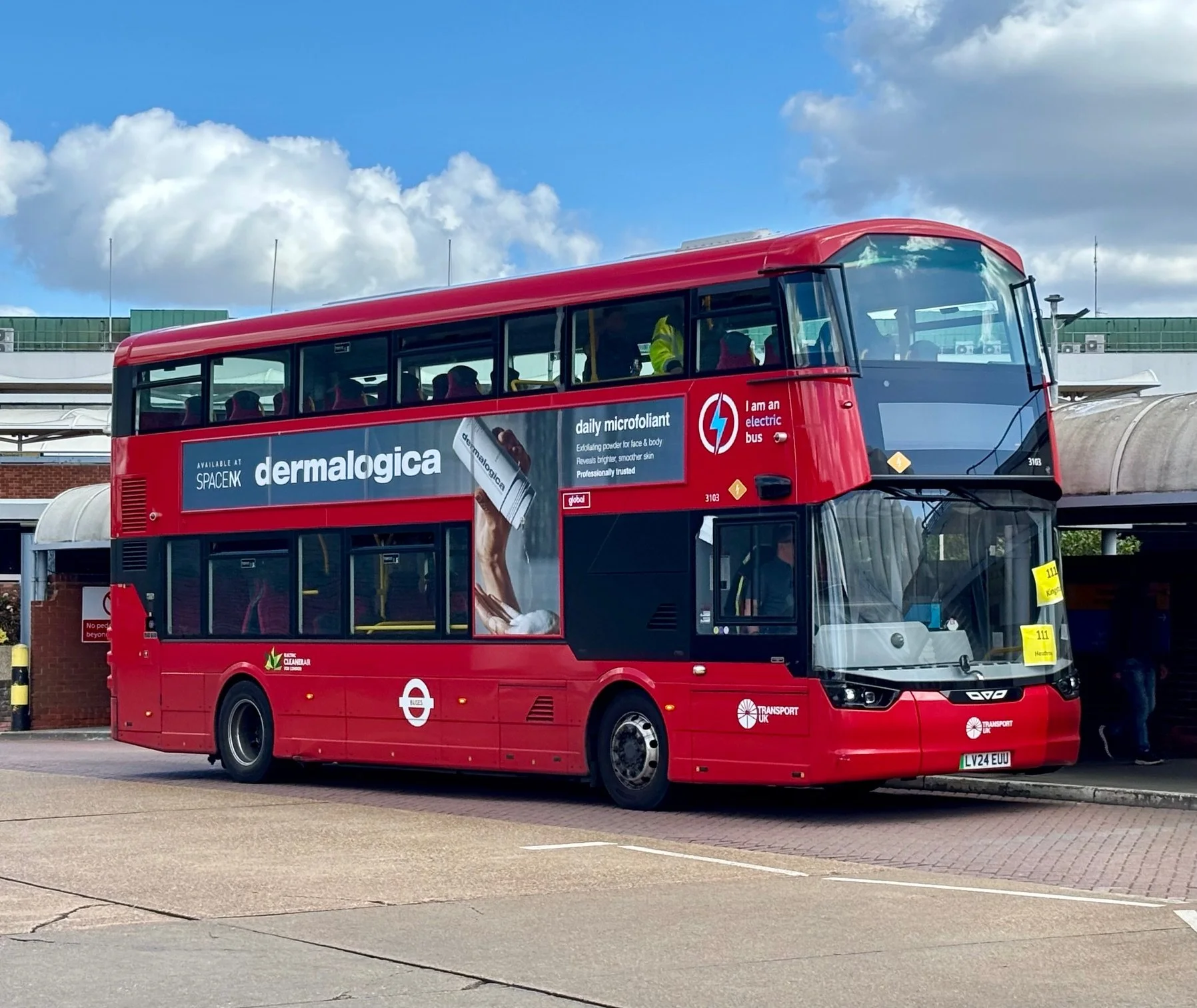
The 111 is currently operated by Transport UK from Fulwell (TF) Garage using Wright StreetDeck Electroliners. Fleet number 3103 displays its electric bus credentials at Heathrow Central Bus Station.
This bus had non-working destination displays and has a couple of badly-placed notices in the windscreen showing “111 Kingston” and “111 Heathrow” simultaneously! I travelled on similar 3030 which did have working destination displays.
Piccadilly Line: Heathrow Central - Hatton Cross
From Heathrow Central Bus Station, I descended to Heathrow Terminals 1, 2 & 3 Station for a short trip on the Piccadilly Line just one stop to Hatton Cross.
Route H25: Hatton Cross - Hanworth Butts Farm - Feltham
On the agenda for the afternoon was a ride on three reasonably short “H” routes, beginning with the H25, Hatton Cross to Hanworth. I joined Transport UK Enviro200 no 8791, another TF Garage resident, at Hatton Cross Bus Station. A straight run along Hatton Road through a brief open field section, before re-entering suburbia. At Bedfont Green, we turned left onto Staines Road, passing the pleasant little St Mary’s Church with wooden tower and two yew trees outside which are cut and shaped into birds and are known as “The Two Peacocks of Bedfont”.
Turning down Bedfont Lane, we continued through housing to Feltham Station, before looping over the railway bridge into Feltham Town Centre, with its perpetual traffic queue along the High Street due to two lanes into one and short phasing traffic lights at Browells Lane. We turned off into Poplar Way and then past Hanworth Park, before crossing Country Way and looping around Hanworth Main Street and Bear Road, linking up with the 111 again which I had been on earlier. We continued a short distance along Hounslow Road before turning into the Butts Farm Estate, where there is a terminal loop. Crane Park on the River Crane is nearby, with a London Wildlife Trust area. A 50 min ride from Hatton Cross.
As luck would have it, the bus in front had just undergone a driver change and left a few minutes late, so I was able to step up a working and catch it. Fellow Enviro200 no 8809 was the vehicle and a reasonable number boarded in Butts Farm. I returned over just part of the route to Feltham High Street, alighting around 25 mins later.
The H25 was a new midibus route in 1990 between Hanworth Butts Farm and Feltham Sparrow Farm, operated by London United with MR Metroriders, although as the route was sponsored by the London Borough of Hounslow, these were soon replaced by FR class Iveco midis in a white and two tone green scheme with LB of Hounslow branding.
In 1993, the H25 was diverted at Feltham away from Sparrow Farm to Hatton Cross, absorbing the former H24 Feltham - Hatton Cross and with the H26 taking on the Sparrow Farm section the H25 had relinquished. Dart Crusaders (CD class) then took over, with the occasional DR Dart interloper. Tellings Golden Miller (TGM Buses) took the contract from London United in 2001 mostly using Caetano Darts, with TGM being taken over by Travel London in 2005. This company was in turn taken over by Abellio in 2009, with Enviro200s replacing the Darts in the mid 2010s and Transport UK buying out Abellio in 2023. The service is currently on a 3 year contract based on existing diesels which began in November 2025.
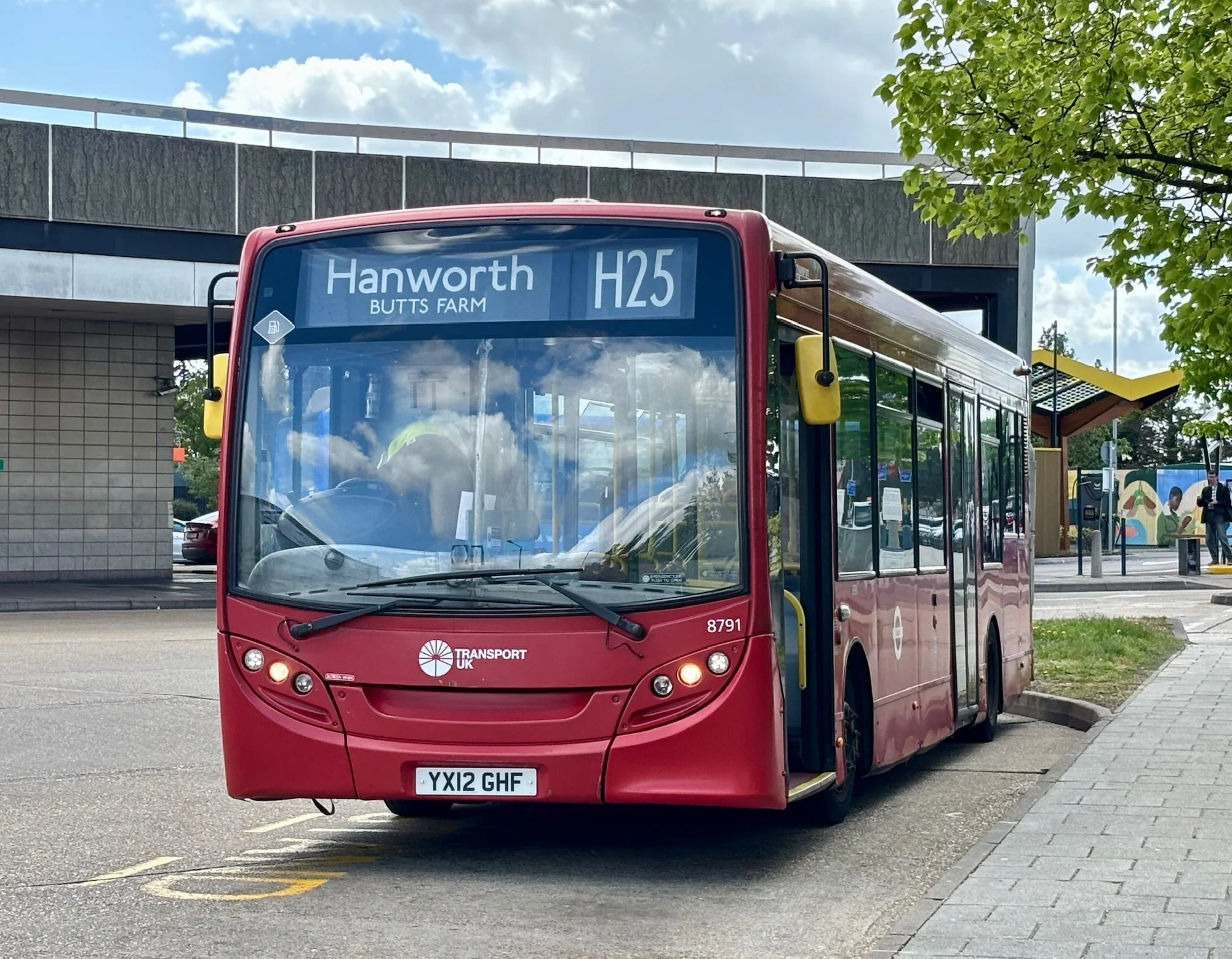
Transport UK Enviro200 no 8791 of Fulwell (TF) Garage on stand at Hatton Cross Station on the H25 before my ride on it.
This bus has “Hanworth BUTTS FARM” on the blind, whereas some vehicles on the route display simply “Butts Farm”.
Route H26: Feltham - Sparrow Farm - Hatton Cross
At Feltham High Street, I had only a couple of minutes before my next bus, Transport UK short single door Enviro200 MMC no 8157 on the H26 arrived, bound for Sparrow Farm. Just half a dozen on the short trip over the railway bridge and straight down Hounslow Road, before turning off along The Drive and the terminal loop along Sparrow Farm Drive. A brief hesitation is built into the schedule at the shops, but after picking up a few passengers, we simply continued on around the circuit without pause.
The return is via the rest of Sparrow Farm Drive and Carlton Avenue, with some sharp narrow turns necessitating the use of smaller buses. Back on Hounslow Road, we made our way back into Feltham Town Centre, once again having to contend with the traffic queue in the High Street, although a bit quicker this time. Soon, we turned right into Rochester Avenue and the narrow estate roads in this part of town. Then it was on to the main Bedfont Road and a green section through the Bedfont Lakes Country Park area, calling on the way at Feltham Young Offenders Institution, which produced no custom on this occasion, although a couple of adults with children alighted at the Country Park.
At the roundabout with the Great South West Road, we took the right hand exit along Staines Road to Bedfont Green, where we rejoined the H25 and continued in parallel with it along Hatton Road back to Hatton Cross. The entire trip took only 45 mins from when I had boarded in Feltham.
As referred to earlier, the H26 came in 1993 when the H25 was altered, running between Sparrow Farm and Hatton Cross. Initially, buses ran via Terminal 4, with a diversion to serve the Cargo Area later added, although the present direct routeing along Hatton Road was introduced in 1999.
Capital Coaches were the first operator with Mercedes midis, initially carrying a yellow and white livery with reference to LB of Hounslow, who provided funding in the early days. Tellings Golden Miller took over the contract in 2000 with Plaxton Pointer Darts, since when (like the H25), the route passed through the various ownerships of Travel London, Abellio and Transport UK. Enviro200s took over in 2010, although with MMC versions replacing them in recent years.
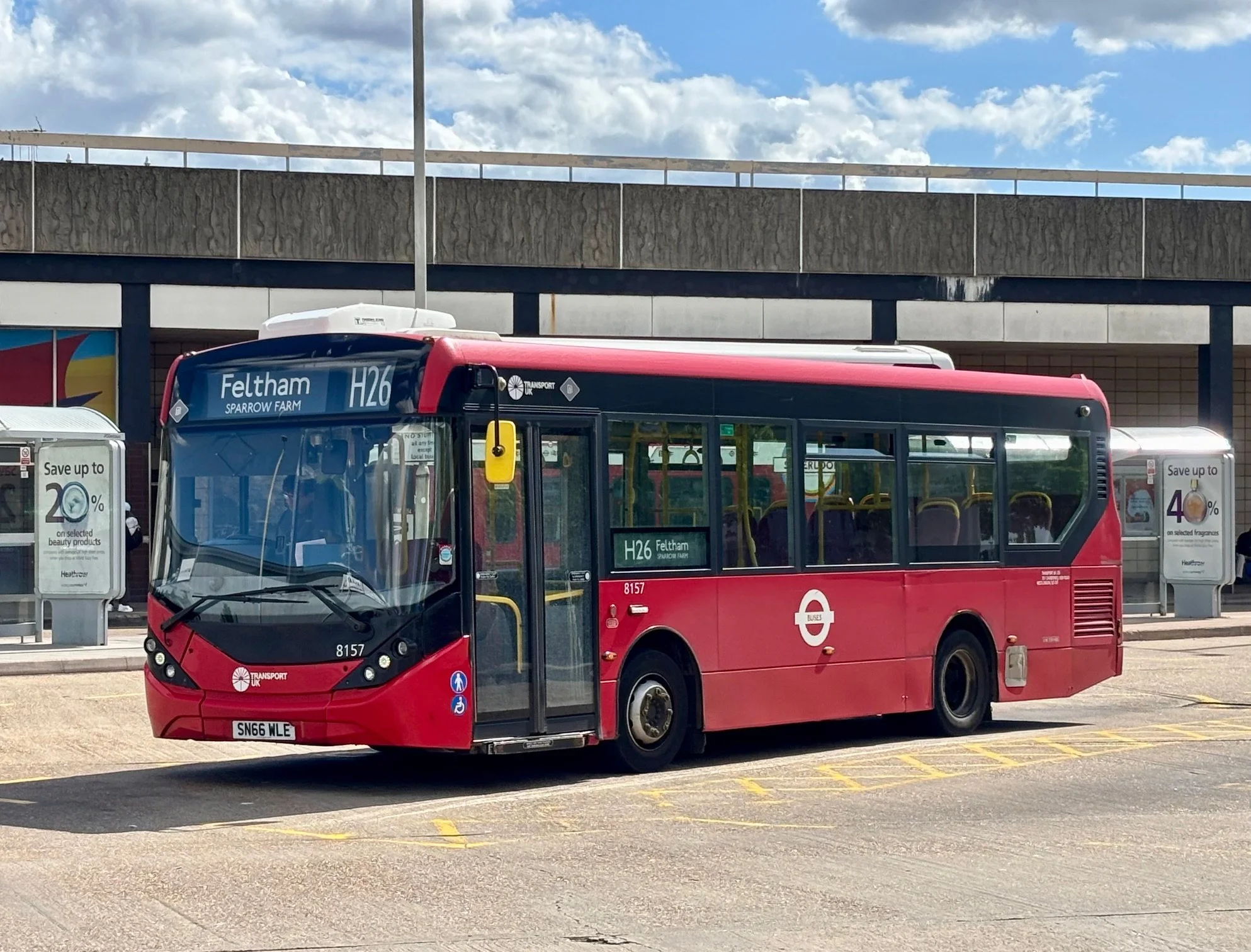
Single door Enviro200 MMC no 8157 sits at Hatton Cross Station on the H26 after my ride aboard from Feltham Sparrow Farm. This is also an inmate at Transport UK Fulwell (TF) Garage.
This batch of short single doored vehicles is necessary for the narrow roads and tight turns encountered at the Sparrow Farm end of the route.
Piccadilly Line: Hatton Cross - Hounslow Central
From Hatton Cross, I transferred to the Underground to travel a couple of stops on the Piccadilly Line to Hounslow Central.
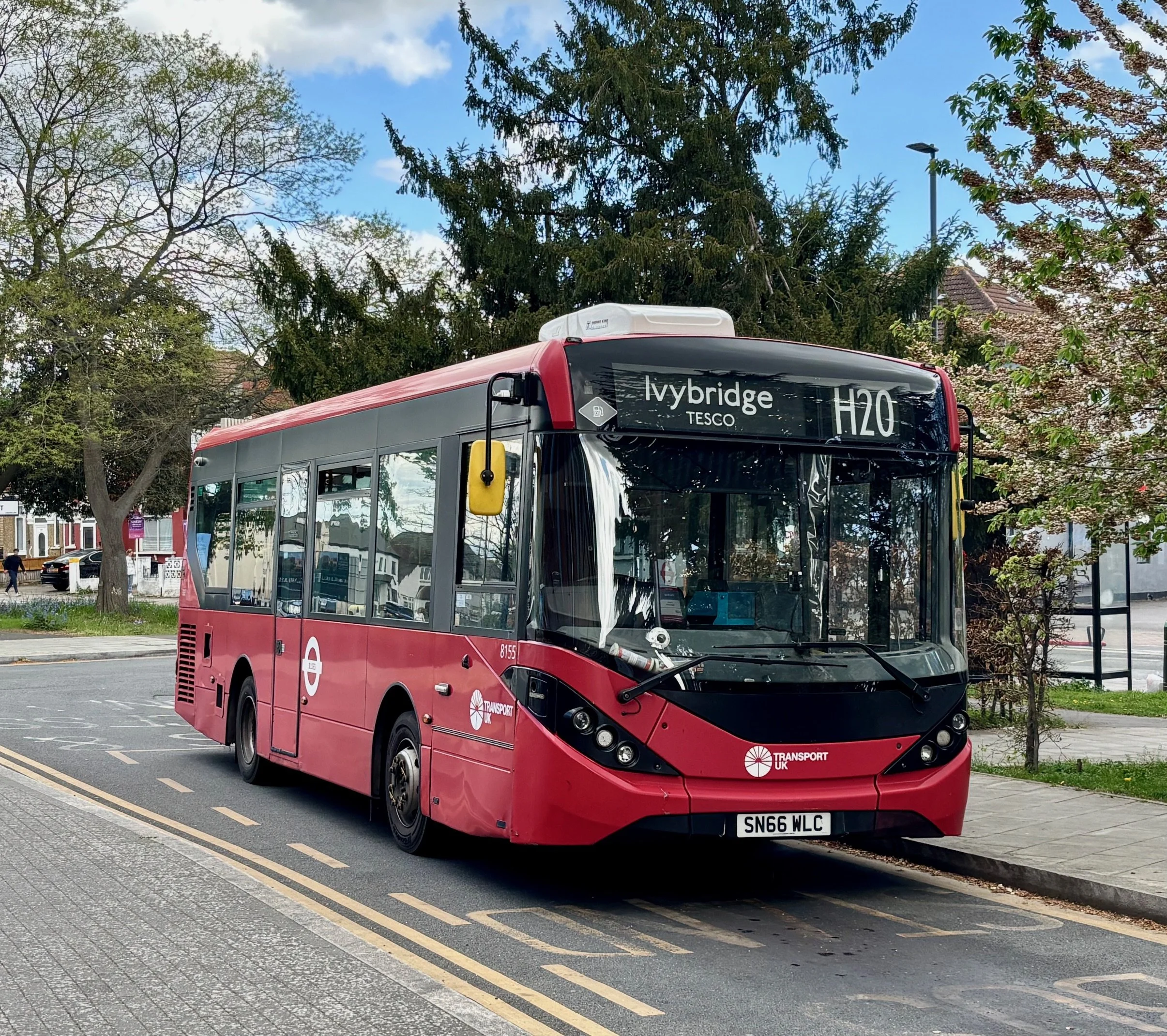
An offside view of short Transport UK Enviro200 MMC no 8155 (also from TF Garage) among the trees at Hounslow Civic Centre on the H20.
This is the bus I then rode to Ivybridge Tesco then back part of the way.
Route H20: Hounslow Civic Centre - Ivybridge Tesco - Hounslow Station
At Hounslow Central, I walked just one bus stop north to the Civic Centre for my last route of the day, the H20. This is yet another Transport UK operation out of TF Garage, using the same single door Enviro200 MMCs as the H26 I just ridden. This time, no 8155 was on stand and it was about a 10 min wait for departure time.
A fairly quiet run, with only me at first, although we picked up a few home-going shoppers as we traversed Hounslow Town Centre. We then dived off from the main road along Heath Road and Central Avenue, followed by Hall Road and Worton Road. On this stretch, we passed the grand edifice of Worton Hall, originally an 18th Century rich merchants’ house but repurposed in the early 20th Century by the film producer George Bertold Samuelson as Isleworth Film Studios. Today, it is used as a fine art printmaking studio.
Soon, we were into Isleworth proper, turning onto the main Twickenham Road and passing Isleworth Library and Redlees Park. At Mogden Lane, we turned off and completed the loop around the Ivybridge Estate, before terminating at the adjacent Tesco superstore. Just 30 mins end to end on this short route.
The H20 was yet another to commence with financial backing from the LB of Hounslow, this time in 1989. It ran between Hounslow Civic Centre and Ivybridge Estate, although a double run to serve Tesco was later added, which in turn became the southern terminus in 1999. Original operator was Westlink using unusual Omni CV minibuses which looked like milk floats! They were white and green with prominent Hounslow Borough branding. These buses were later replaced with standard MCW MetroRiders. A new contract commenced in 1999 with Tellings Golden Miller using Plaxton Pointer Darts, the route again passing through the familiar Travel London, Abellio and Transport UK ownerships subsequently. Enviro200s replaced the Darts in 2016, with MMC versions later taking over.
After the layover at Ivybridge Tesco, I returned part way on the same bus, alighting on the outskirts of Hounslow Town Centre some 20 mins later.
My bus rides over for the day, I took a short walk to nearby Hounslow National Rail Station, where I had a short wait for the SWR Train just 3 stops back to my start point at Staines, taking about 15 mins.
Watton
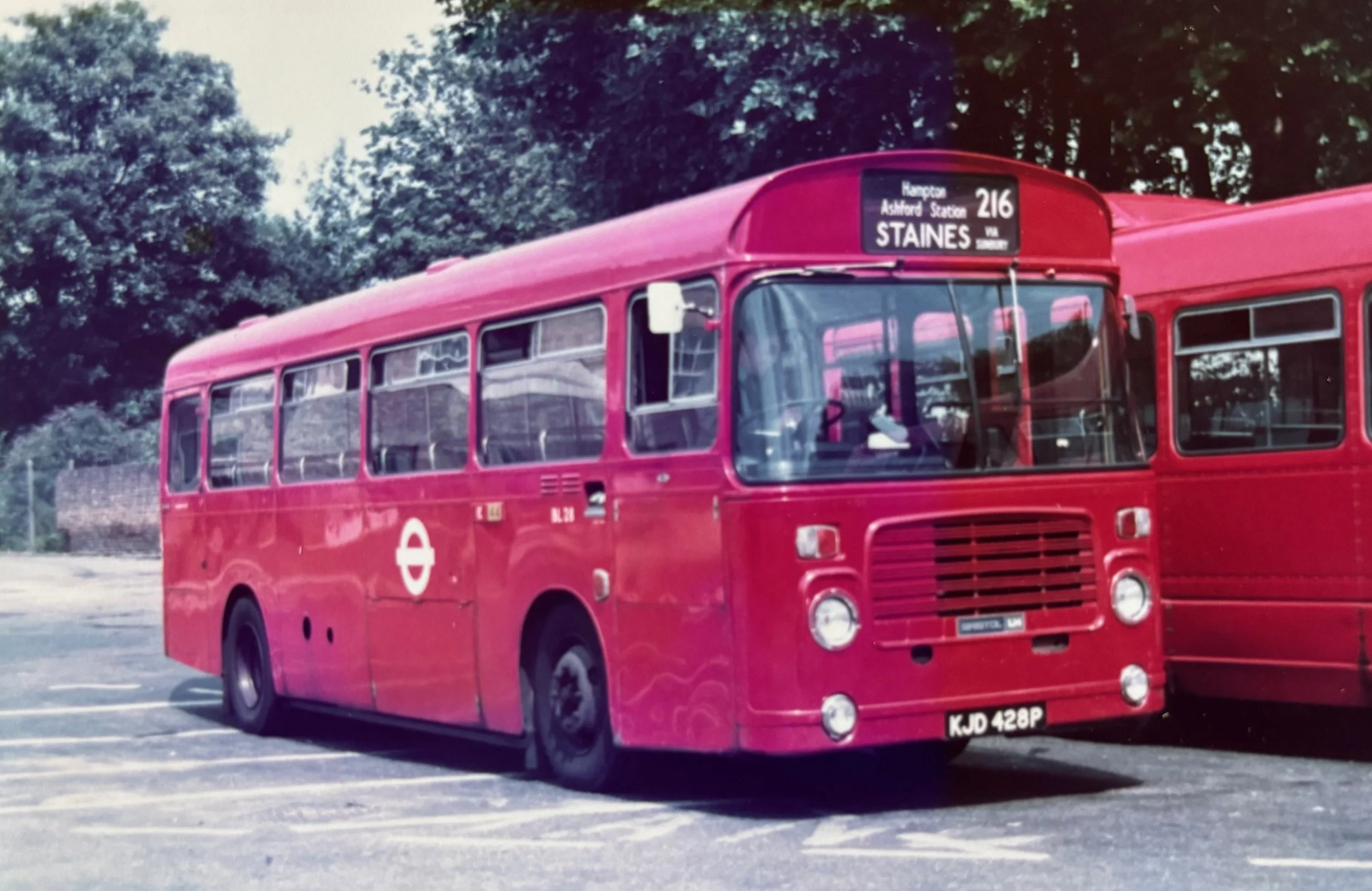
And Finally… a study of Bristol LH BL28 of Kingston (K) Garage on the 216 at the old Staines West Station terminus then in use back in 1982. The smart red and white livery was replaced by drab allover red on many examples of the class.
Shortly after this photo was taken, the 216 was converted to Leyland National LS operation as part of the massive route changes which took place in September 1982.
