
Beginning in the West End, in this adventure I travel by bus through the City & East End out to Bow and then on to Barking area, before ending up in Leytonstone.
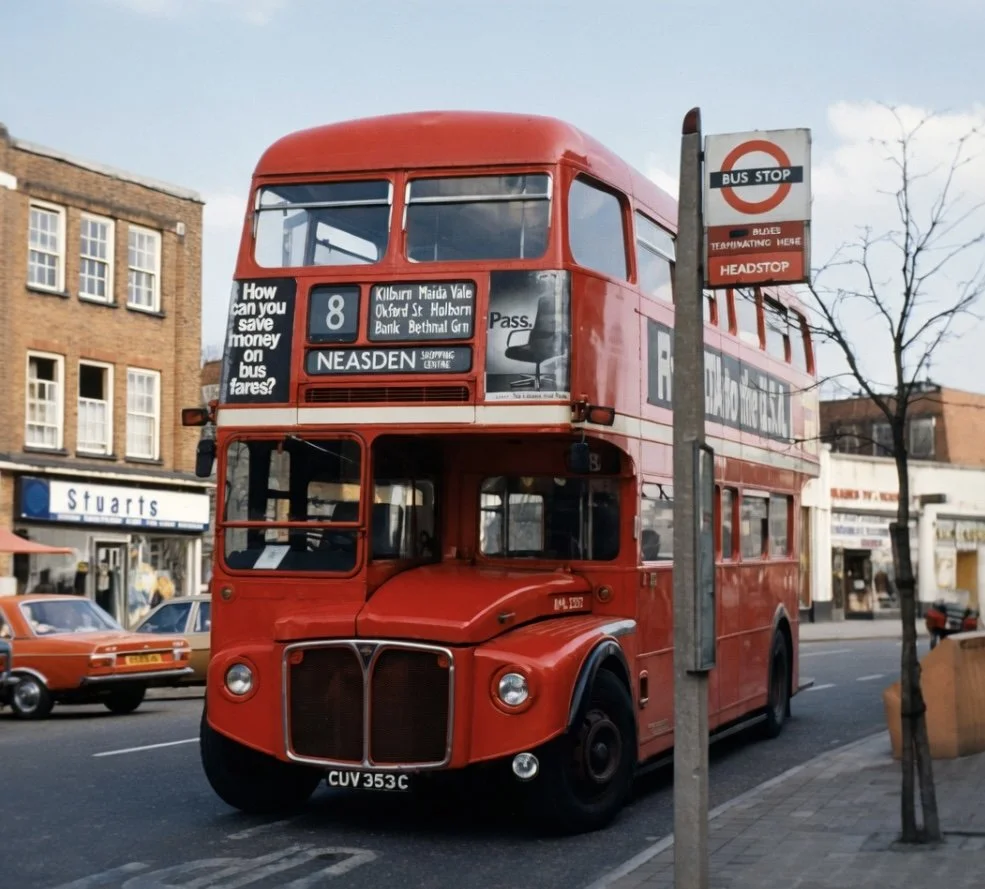
We begin with one from my archives. Back in 1981, the 8 was a lengthy cross town route from Old Ford to Willesden Garage using Routemasters. It had a M-F Peaks extension to Wembley Trading Estate and a Sats Shopping Hours projection to Neasden Shopping Centre, where RML2353 of Willesden (AC) Garage is seen on stand.
This particular extension was withdrawn in April 1981, shortly after this shot was taken.
Route 8: Tottenham Court Road - Bow Church
The Central Line brought me to Tottenham Court Road bright and early on a Saturday morning where I fortified myself with a coffee before seeking out my first bus on the 8 to Bow. Stagecoach London have retained the contract this year on the basis of new electrics in due course but, for now, the mainly New Routemaster allocation from Bow (BW) Garage continues. However, one or two Enviro400 hybrids support the run-out, with both “classic” and MMC versions appearing.
I was lucky that LVF showed the next departure to be 12316, one of the former, and I only had 5 mins or so to wait before it rolled up to the New Oxford Street stop, where two of us boarded. As to be expected at this time of day at the weekend, it was a quiet run onwards to Holborn and then through the City. Past Chancery Lane and the site of the long gone Gamages Department Store, closed in 1972 and where my mother used to take me and my brother to visit Father Christmas when we were children. Across Holborn Circus and past City Thameslink Station to the Old Bailey and to the new road layout at St Paul’s, where we now took the direct route into Cheapside, the name originating from the Old English word “ceap” or “chepe” meaning a market.
Reaching Bank Junction, we made our way straight across to Bishopsgate, turning left towards Liverpool Street Station. Past this point, we became busier with shoppers and other locals through Shoreditch and into the East End, soon reaching Bethnal Green. It was then a saunter along Roman Road through Globe Town to the market, before looping around to former terminus of the route at Old Ford, named after a historic Roman river crossing of the River Lea. After depositing most of our passengers, we had a brief speedy run along the Blackwall Tunnel Approach Road to Bow Roundabout. Whilst the destination of our bus was Bow Church, we actually continued one further stop to end the journey just before Bow Garage. A straight-forward 45 min run.
The 8 was a traditional cross-London service from Old Ford to Willesden Garage, with allocations for many years at both ends, as Bow (BW) and Willesden (AC) each had a share. The route was RTW operated from 1951-65, although RT/RTL types also appeared, after which RMs took over. There was a Sunday extension to Alperton back in the 1950s, whilst the main M-S service used to continue to Neasden. The latter was cut back to Willesden Garage in 1970, save for a M-F Peaks extension to Wembley Trading Estate and Sats Shopping Hours to Neasden Shopping Centre. The Wembley journeys came off in 1982 and the Neasden ones in 1981. Meanwhile, the main allocation had transferred to the longer RMLs from 1975 onwards.
At the other end, garage journeys had been projected from Old Ford to Bow Church for some years, but in 1984 the whole service was extended through to Bow. The Sunday service was converted to Titan in 1988 and was transferred to West Ham (WH) on this day, with buses working in service to/from the garage. A major change in 1992 was the splitting of the route, with the western section becoming new route 98, whilst the eastern part retained the 8 number but was rerouted to Victoria in lieu of a withdrawn section of the 25. The WH Garage allocation came off at this time, the route becoming purely a BW Garage responsibility. Soon after, the evening service was also converted to OPO using Ts plus S type Scanias, later replaced with VN type Olympians. In 2001, the route reverted to crew operation at all times using the daytime RMLs.
Full-time OPO finally came in 2004 using Tridents, after which the route began a slow retreat, being first cut back to Oxford Circus in 2009 (with the C2 taking on the Victoria section) and then to Tottenham Court Road in 2013. A new contract in 2014 saw a conversion to LT class NRMs, which continue to this day.
Finally, a mention of the variants. The 8A was a long-standing route at the eastern end, running via the 8 from Old Ford to Liverpool St, then deviating to London Bridge. It followed the RTW, RM then RML allocation of the parent over the years, but suffered various reductions, going from Daily to M-F only except evenings in 1969 and then M-F Peaks only in 1984. OPO conversion to Titan occurred in 1986, although the following year it was reduced to a very short (and fairly useless) Shoreditch - London Bridge rump. Unsurprisingly, this remnant was withdrawn in 1989.
Then there was the 8B which had two incarnations. The first was from Old Ford to Alperton, which began in 1957 when the main 8 gained a M-F extension to Wembley, necessitating a change to the Sunday service number (which followed a different route north of Willesden). RTW operated, it was withdrawn in 1964, with the Willesden - Alperton section left unserved and the route could revert to its plain 8 number daily. The second use was for a M-F route between Cricklewood Garage and Tottenham Court Road (extended to Bloomsbury in peaks), mainly replacing former route 60 in 1968. This was RM operated, but only lasted until 1970, when it was mostly replaced by new flat fare route 616.
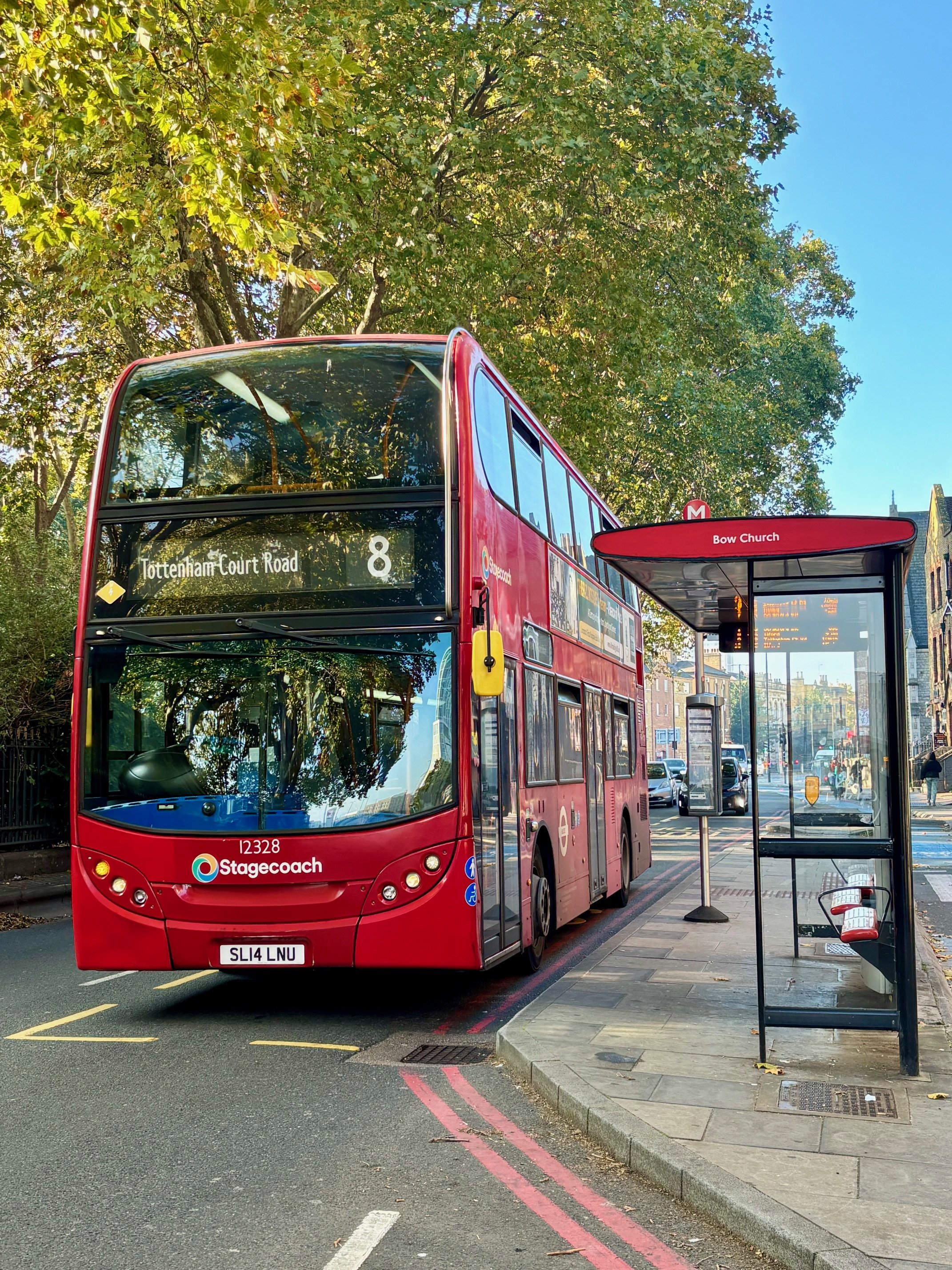
Back to the present day, where we have Stagecoach London’s “classic” Enviro400H no 12328 starting its journey to Tottenham Court Road at Bow Church. I had just arrived here on sister vehicle 12316, which had scuttled into the depths of Bow Garage before I could capture it on film!
The normal allocation at this time was LT class New Routemasters, but one or two Enviro400 hybrids appear on most days. The route is due for new Wright StreetDeck Electroliners with the latest contract renewal.
Part Route 25: Bow Church - Stratford
Walking back a short distance to Bow Church on its island site in the middle of the road, I noted that the church itself has a brick built tower atop its mainly stone building, this following bomb damage in WW2, after which the tower was reconstructed, presumably using whatever materials were then available.
It was then a short hop of less than 10 mins to Stratford Bus Station aboard fellow BW Garage bus Enviro400 MMC hybrid 11357 on the 25. From Stratford, I took the Central Line three stops east to Wanstead.
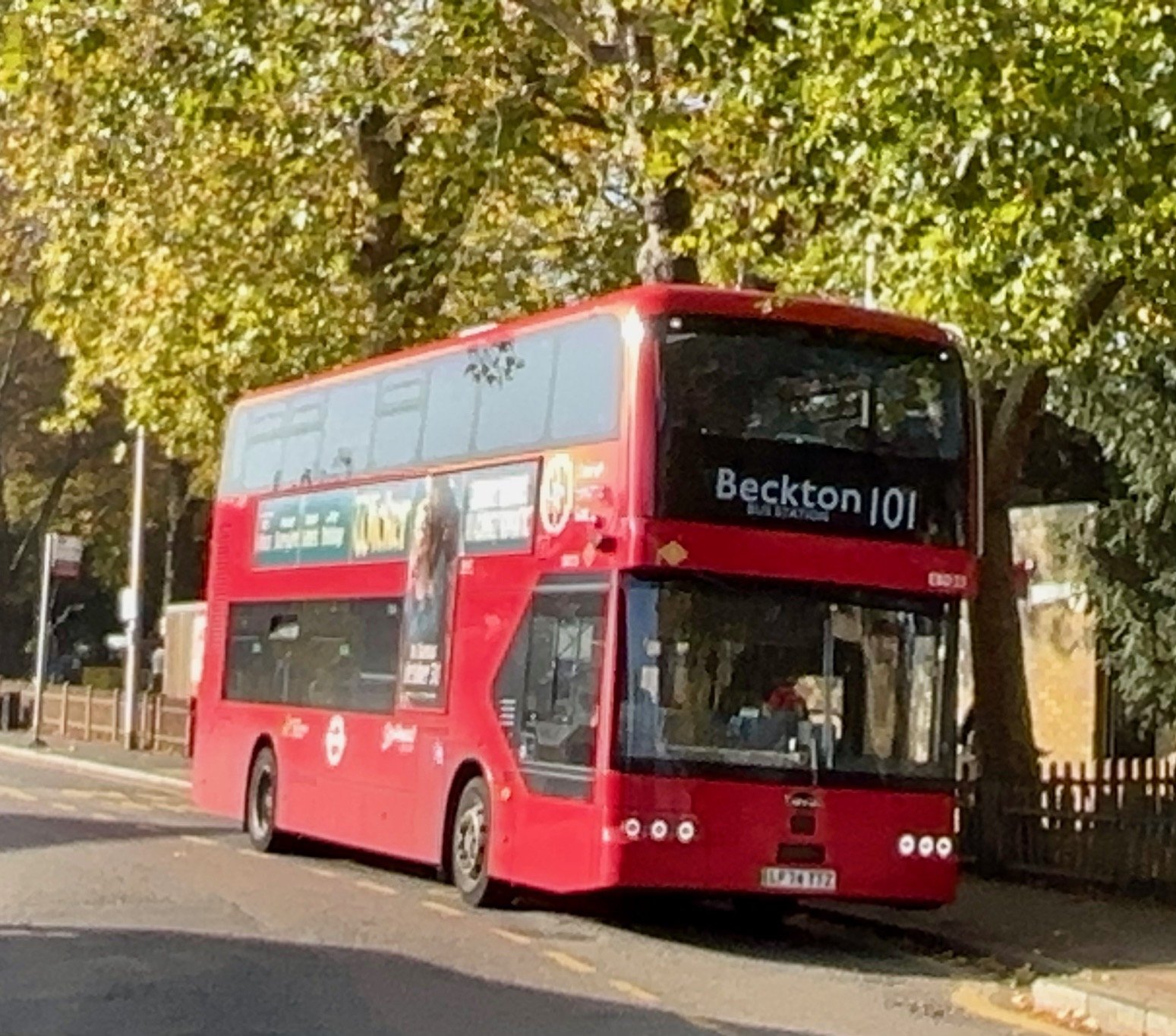
The 101 was converted to BYD B11 electric double deckers following the last contract change in 2024. Go Ahead London EBD35 of RIver Road (RR) Garage is at Wanstead ahead of my journey aboard to Beckton.
The route held the distinction for many years of being the most frequent in London, back when the docks were still open and the peak frequency was scheduled at 1-2 mins over the busiest section.
Route 101: Wanstead - Beckton
At Wanstead, it was a short walk from the station to Woodbine Place, start point of my next route, the 101. This had been converted to electric using BYD B11 types following the last contract change in 2024, but I had yet to sample these on the service. First to arrive was EBD35 of Go Ahead London’s River Road (RR) Garage and I joined it upon its departure after its break.
At first, a fairly quiet run in terms of passengers, although almost immediately we joined a queue for temporary traffic lights on the junction of Cambridge Park with Blake Hall Road. Once through, it was a fairly gentle amble through the pleasant fringes of Epping Forest to Aldersbrook and into Forest Drive.
At Forest Gate, the nature of the route suddenly changes, the greenery being replaced with busy suburbia. Crossing the main Romford Road, we continued through East Ham, where we became almost full and standing with short-riders. Passing East Ham Town Hall and Central Park, we gained more shoppers en route to Beckton, soon crossing the Newham Way. Arrival at Beckton Bus Station was after a fairly easy run of just 40 mins from Wanstead.
Traditionally, the 101 ran from Wanstead to North Woolwich, with a more frequent service south of Manor Park to serve the then thriving docks. There was a Summer Sundays extension from Wanstead to Lambourne End until 1954, which was reprised on the occasion of a London Bus Museum Running Day in 2023, enabling me to ride an RT on the 101 to Lambourne End for the first and only time!
In the late 1940s, the route was famously the home of the G class Utility Guys, although these were supplemented by STLs. Replacement by RTs was completed in 1954, although they had appeared at weekends for some time previously. In that year, the PVR was a massive 64 RTs, demonstrating the importance of the route and its high frequency at this time. The allocation gradually declined over the next 25 years, being converted to RMLs off the 15 at weekends in 1971, with the M-F service receiving RMs a year later. From 1978-79, the route was operated by crew DMs, although RM/RMLs returned after 18 months.
OPO conversion to Titan came in 1982, with just 15 buses now required - a mighty comedown from the route’s heyday. In the early 90s, S type Scanias were added to the type mix. Then, in 1994, the route was chosen to become one of the pilot routes converted to low floor single deck operation, using SLW types. These lasted until 2005, when the route was double-decked again with Tridents. In the same year, the route was withdrawn between Cyprus & North Woolwich, leaving this section to the 474, and diverted to Gallions Reach Shopping Park. The next contract renewal in 2012 saw new Enviro400 buses replace the Tridents.
After being with Stagecoach and its predecessors for years, the 101 passed to Go Ahead London in 2017, using mostly WVLs, although other types such as Es did appear. In 2022, the route was cut back again at the southern end to Beckton Bus Station, the 262 continuing to provide the link to Gallions Reach. Soon after the next contract renewal in 2024, electrics began to replace diesels, in the form of the current EBD class.
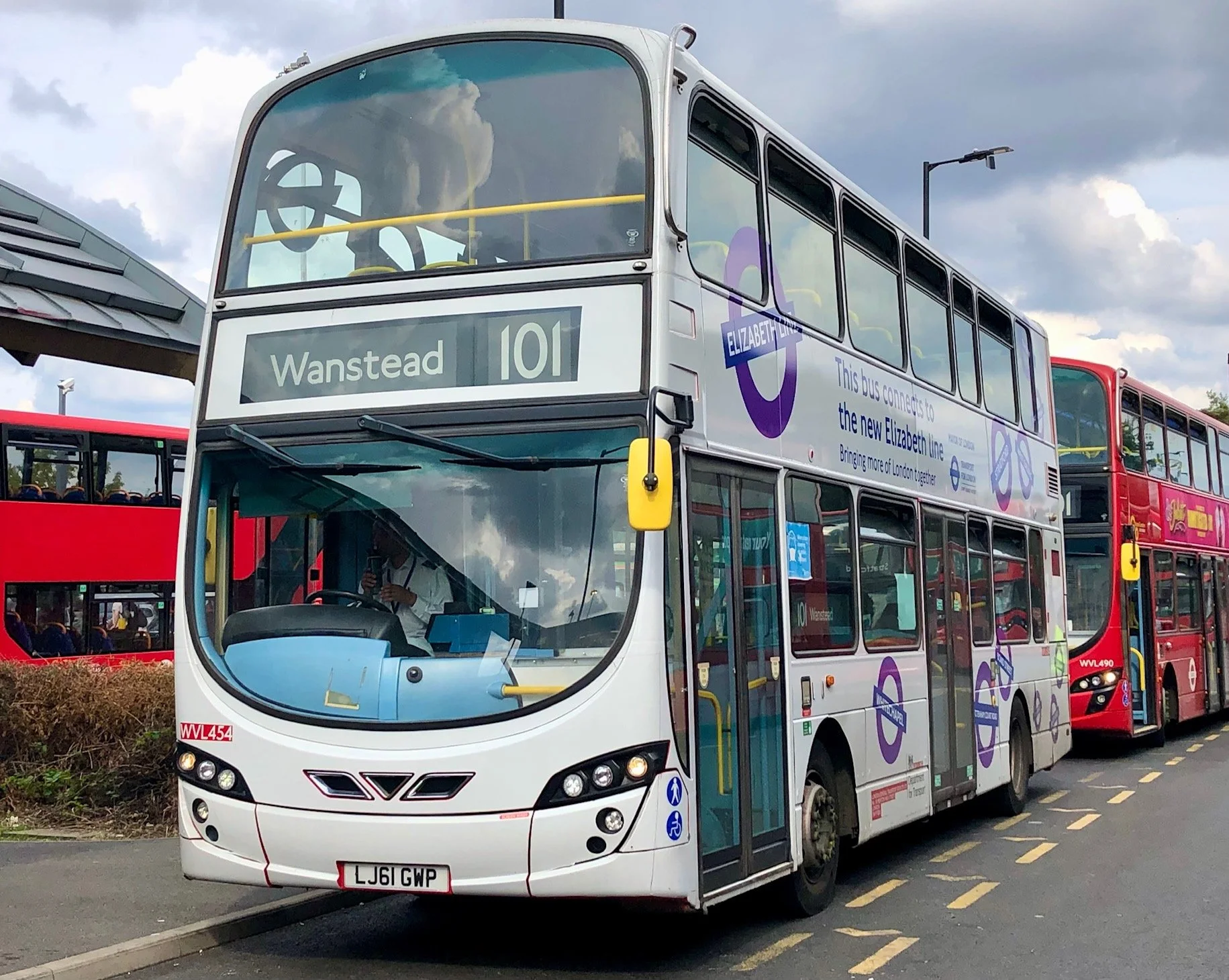
Prior to electrification, Volvo B9TLs were the principal allocation on the 101. Back in September 2022, WVL454 of RR Garage is seen at the other end of the route in Beckton Bus Station.
The bus is one of a handful that gained special signwriting to advertise the then new Elizabeth Line and the connections that could be made to it.
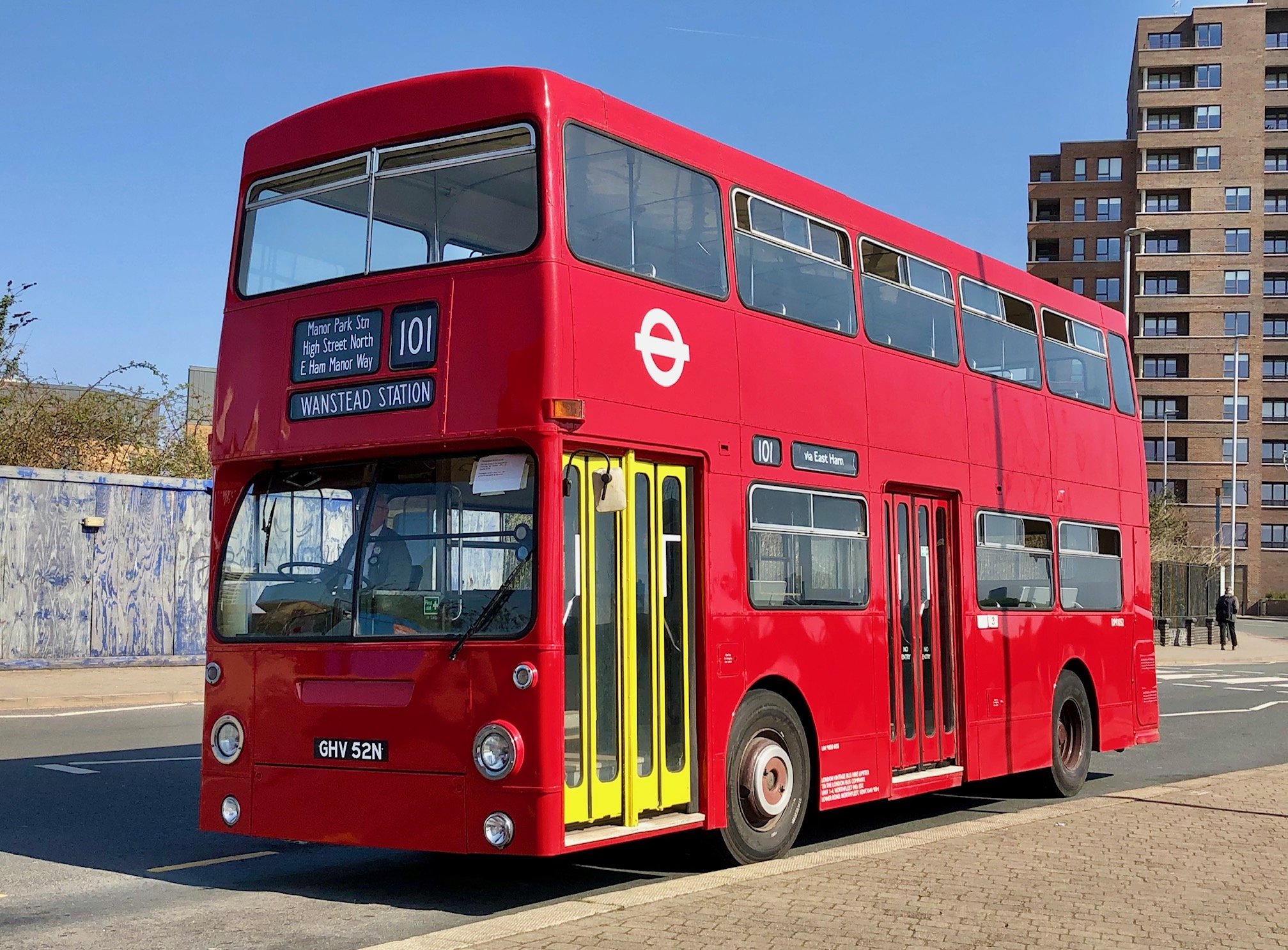
An earlier generation of doored bus on the 101 is illustrated by preserved Daimler Fleetline DM1052, seen at North Woolwich during a London Bus Museum organised Running Day in March 2023.
These crew-operated variants only ran for a short period on the route, for around 18 months in 1978-79. The 101 was cut back from North Woolwich to Gallions Retail Park in 2005 and still further to Beckton in 2022.
Route 173: Beckton - Goodmayes King George Hospital
At Beckton Bus Station, I had barely crossed the road after alighting from my 101, before my next bus, Stagecoach Wright StreetDeck Electroliner no 82155 of Barking (BK) Garage rolled forward to the first pick-up stop on the 173. This route was one of those previously converted to electric using Enviro400EV City types, but which Stagecoach have been replacing in East London with new Electroliners after only a few years of service in a bid to reduce costs with upgraded vehicles.
After loading, we left the Bus Station and made our way back to the Newham Way Roundabout, where we turned right to join the fast dual carriageway section, which we followed all the way through Beckton, the southern fringes of Barking and then Rippleside through to Dagenham. Over this section, we gained a decent speed, picking up and setting down in small numbers at certain stops. Leaving the retail parks and industrial sites behind upon reaching Heathway, we turned off and made more sedate progress through the inter-war housing to the Church Elm and Dagenham Heathway Station. It was a long straight run up to Becontree Heath, where were caught in the usual queue at the traffic lights.
From here, it was across into Whalebone Lane South up to London Road, where we swung left through Chadwell Heath. After “looping the loop” by the station, we continued along Chadwell Heath Lane, gradually dropping off passengers along the suburban section until reaching the green at Little Heath. By now, only me and the driver were left for the short run to the final stop at King George Hospital Goodmayes. A 55 min run in all from the start.
Originally, the 173 referred to the Peckham & Nunhead Circular Route, which operated between 1949 & 1970 and enjoyed first RT then RM operation. It disappeared when it was converted to single deck OPO and renumbered P3.
The number was re-used in 1973 for a lost section of the 175, operating between Poplar Blackwall Tunnel (M-F Peaks) / Canning Town (M-S) and Dagenham (M-S eves) / Becontree Heath (M-S daytimes), with M-F peak journeys to/from Dagenham Fords Main Works. It was OPO DMS from the start, although the route was simplified in 1978 to become Canning Town - Becontree Heath M-S at all times. Converted to LS single deck in 1979, it was extended from Canning Town to Stratford via West Ham. In 1983, it was diverted en route to serve East Beckton ASDA, with a further rerouteing the following year via Plaistow instead of West Ham, meaning that the low bridge previously passed under was avoided and the route could revert to double deck, but this time using Titans.
In 1987, tendering reached the 173 and it passed from London Buses to Grey Green (trading as Eastenderbus) using Daimler Fleetlines in an orange, white and brown livery, although these were later replaced with Metrobuses in more appropriate grey and green colours! in 1993, the route was extended from Becontree Heath to Little Heath and, just a few months later, further on to Goodmayes King George Hospital. Meanwhile, still in the same year, it retracted at the other end from Stratford to East Beckton ASDA when new route 473 replaced the Stratford section.
Arriva were the next operator when the contract came up for renewal again in 2000, this time using ADL and then PDL Dart single deckers. A rerouteing from East Beckton to Beckton DLR Station came in 2008, followed by conversion to ENL class Enviro200s in 2010. Double deckers returned again 2015 using a mix of T class Enviro400s and VLA type Volvo Alexander 400s. These continued until Stagecoach acquired the contract in 2020, initially using Enviro400s until new Enviro400EV City types replaced them the following year.
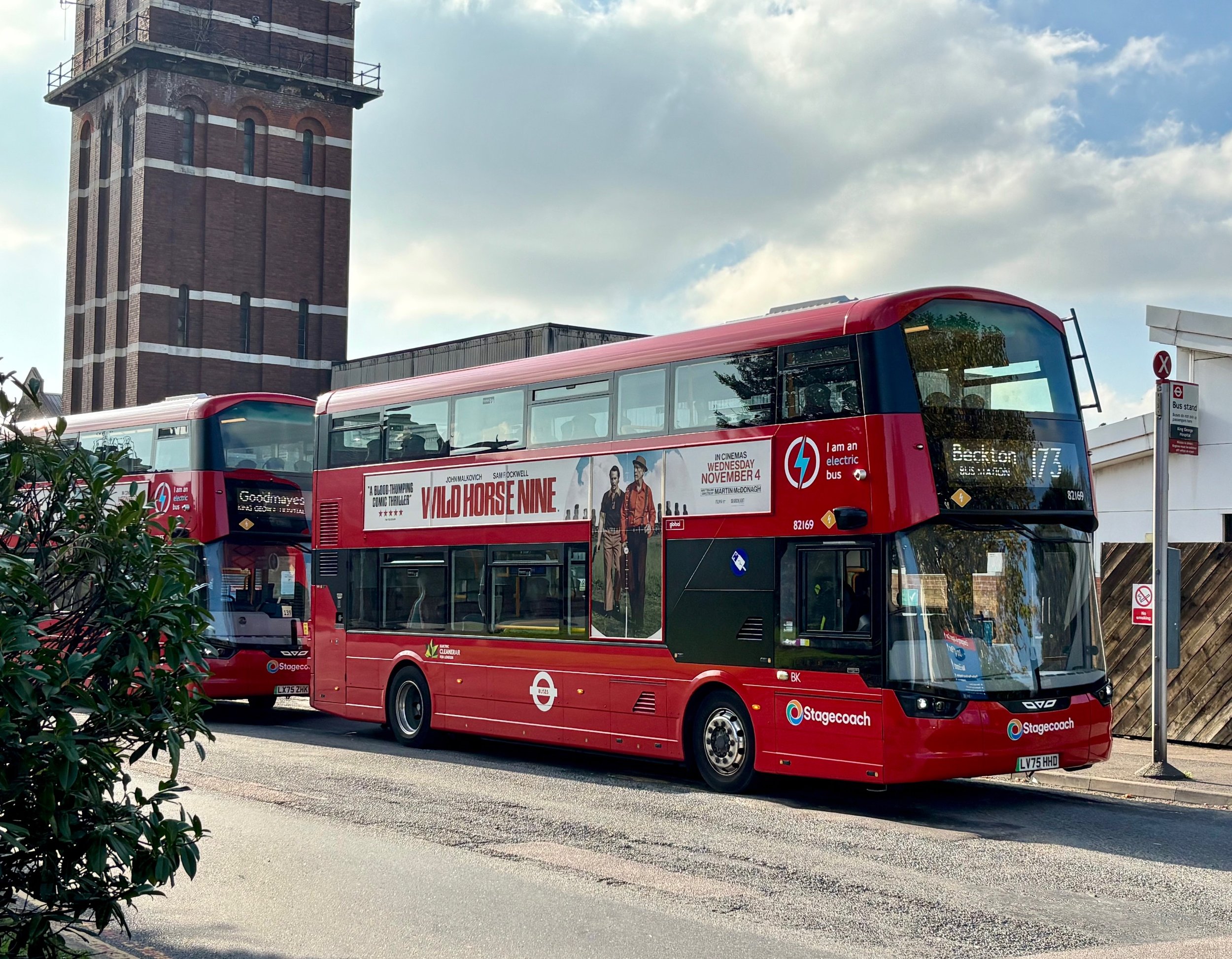
Stagecoach London Wright StreetDeck Electroliner no 82169 at Goodmayes King George Hospital before I travelled on it back to Dagenham. I had arrived here on the bus behind, 82155. Both of Barking (BK) Garage.
This is the second generation of electrics on the route, the previous Enviro400EV City types having not found favour with the company in East London.
Part Route 173: Goodmayes King George Hospital - Dagenham
I was able to move up a working at King George Hospital, as sister Electroliner 82169 was ahead on the stand when we arrived and left 5 mins later. I retraced my steps on the 173 as far as Dagenham Chequers, where I alighted. Traffic had built up a bit by now and we had a somewhat protracted 35 min run on this trip, with slow-moving sections through Becontree Heath and at Heathway Station.
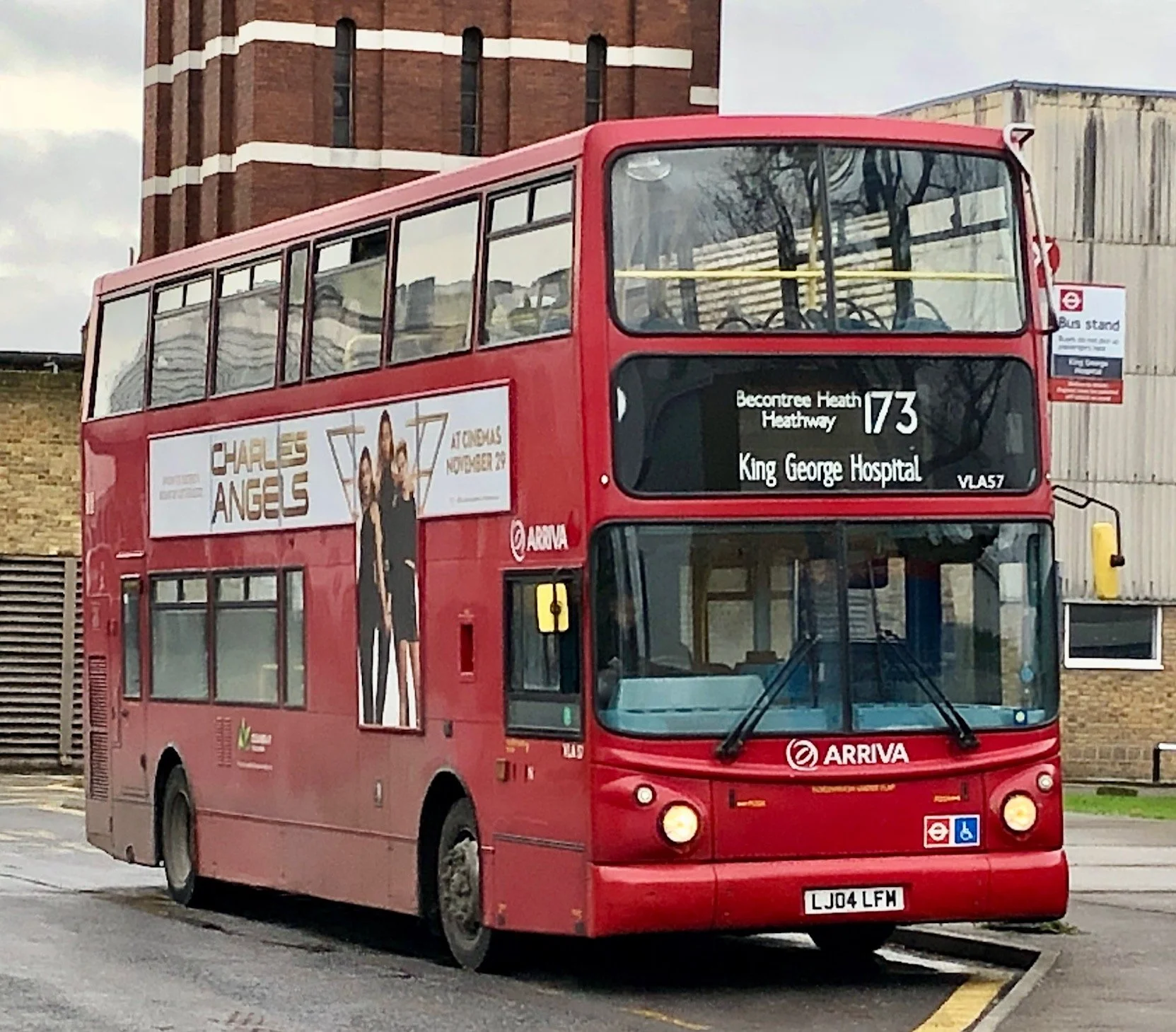
On virtually the same spot as the previous photo is Arriva London Volvo Alexander ALX400 VLA57 of Barking (DX) Garage in November 2019.
This type shared the route with T class Enviro400 diesels until the contract passed from Arriva to Stagecoach in 2020.
Route 145: Dagenham ASDA - Leytonstone
From The Chequers, I walked to the nearby ASDA store and, after stocking up on supplies, made my way to the adjacent terminus of the 145, my final route of the day. This is another service operated by Stagecoach out of Barking (BK) and is currently the home of (mainly) Enviro400 MMCs. I had noted that BK is down to its last couple of “classic” Enviro400s, but these tend to appear on the 62, 179 or 238 as a first choice. MMC version no 12422 was waiting on stand in the sunshine and I had just a few minutes before it was ready to leave with me and half a dozen other passengers in tow.
After negotiating the back of the retail park, we emerged at The Chequers and turned right towards New Road, before looping around through Dagenham Village, which these days doesn’t retain much of a village atmosphere apart from the ancient Parish Church, now set amongst much more modern developments. Crossing Heathway, we entered the long straight Hedgemans Road through suburban housing and past Goresbrook Park. At Becontree, we joined up with the 62 and turned right past the station along Gale Street with the expanse of Parsloes Park to our right. Continuing into Porters Avenue, we hung a sharp left at Wood Lane into Longbridge Road towards Barking. At Lodge Avenue, we caught sight of the rear of the 145 in front, which was running around 7 mins late on the 12 min frequency, but as we were a little early ourselves, we were asked to remain at the stop for 5 mins.
After this, we continued on to the home garage at Fair Cross, turning into South Park Drive, but with no driver change to delay us we went straight on and past South Park itself to join the main road into Ilford at Green Lane. By now, we had almost caught up the bus in front once again and our driver held back a little. Nevertheless, by the main stop at Hainault Street we had joined it and proceeded virtually in tandem through Ilford Town Centre. At Ilford Station, we overtook the other bus and then ran ahead of it for the rest of the journey. An easy run up The Drive, picking up and setting down in ones and twos, before we joined a traffic queue in Eastern Avenue up to the Redbridge Roundabout. From here, we picked up speed again on the short section to Wanstead Station.
Once again, we were caught by the temporary lights at Cambridge Park / Blake Hall Road, where the queue was a bit longer than it had been earlier on the 101. Past this, it was an easier run on the dog leg through the forest and along Bush Road to the Green Man Roundabout, where we joined the habitual slow-moving traffic into Leytonstone High Road. I have always been bewildered by the road layout here, with its anti-clockwise one-way system, always congested - surely a normal clockwise one-way system would flow better? Finally, we broke through and made it around the back roads into Leytonstone Bus Station, although it had been a marathon journey of 1h30m, timetable padding adding around 10 mins to this.
The 145 was historically a long route from Chingford Royal Forest Hotel to Dagenham via Ilford, with journeys at different times of day to New Road, Fords Main Works and Dagenham Dock. It operated all three RT variants at different times - standard RT, RTL and RTW, although the latter only for a short period in 1950-51 before these wide vehicles were approved for use in Central London. In 1963, the introduction of the 179 meant the 145 lost its Chingford - Ilford section apart from M-F school journeys, which continued for many years, although these were cut back to Woodford Wells in 1970. OPO came in 1974 with DMS types, although the school trips and the southern extensions continued to operate. An early convert to Titans in 1980, the school journeys were again extended to Chingford two years later. In 1985, the route was diverted from the direct route via Heathway to Dagenham Village and Ballards Lane, providing a service to this area for the first time.
Tendering came to the route in 1986, with Ensignbus taking over from London Buses. The M-F school journeys to Chingford were renumbered 145A at this time at transferred to Eastern National. Meanwhile, the main 145 was extended from Ilford to Redbridge Station. Ensign used DMSs in a blue and silver livery, although occasionally an RT appeared, long after they had been withdrawn from normal London service in 1979. I recall riding one on the route on one occasion, together with another trip on the 62, also operated by Ensignbus at this time. In 1991, the route reverted to East London at its old BK Garage home and was extended from New Road to ASDA in Dagenham, reverting to Titan operation, although the Fords journeys continued for now. In 1993, the 145 went over to DW midibuses and was extended later in the year from Redbridge to Leytonstone via the withdrawn section of the 366. By now with Stagecoach, 1995 saw larger single deckers take over in the form of LA class Lances, although low floor conversion came in 2001 with SLD type Darts, at which time the remaining Fords Works journeys were withdrawn.
Double deckers made a return in 2003 using Tridents, although these were mostly replaced at the 2011 contract change with Enviro400s, which in turn were ousted in the mid 2010s with the MMC version.
To end, a look at the 145A variant. I already mentioned the school journeys, which ran between Chingford & Goodmayes under this number with Eastern National for a few months in 1986, after which they were renumbered 345. However, there was a previous version of the 145A, which operated between Dagenham & Leytonstone on Sundays only between 1963-66. This combined the southern part of the 145 with the northern section of the 148 which didn’t run on that day at the time. It was RT operated from Seven Kings (AP) and Upton Park (U) Garages.
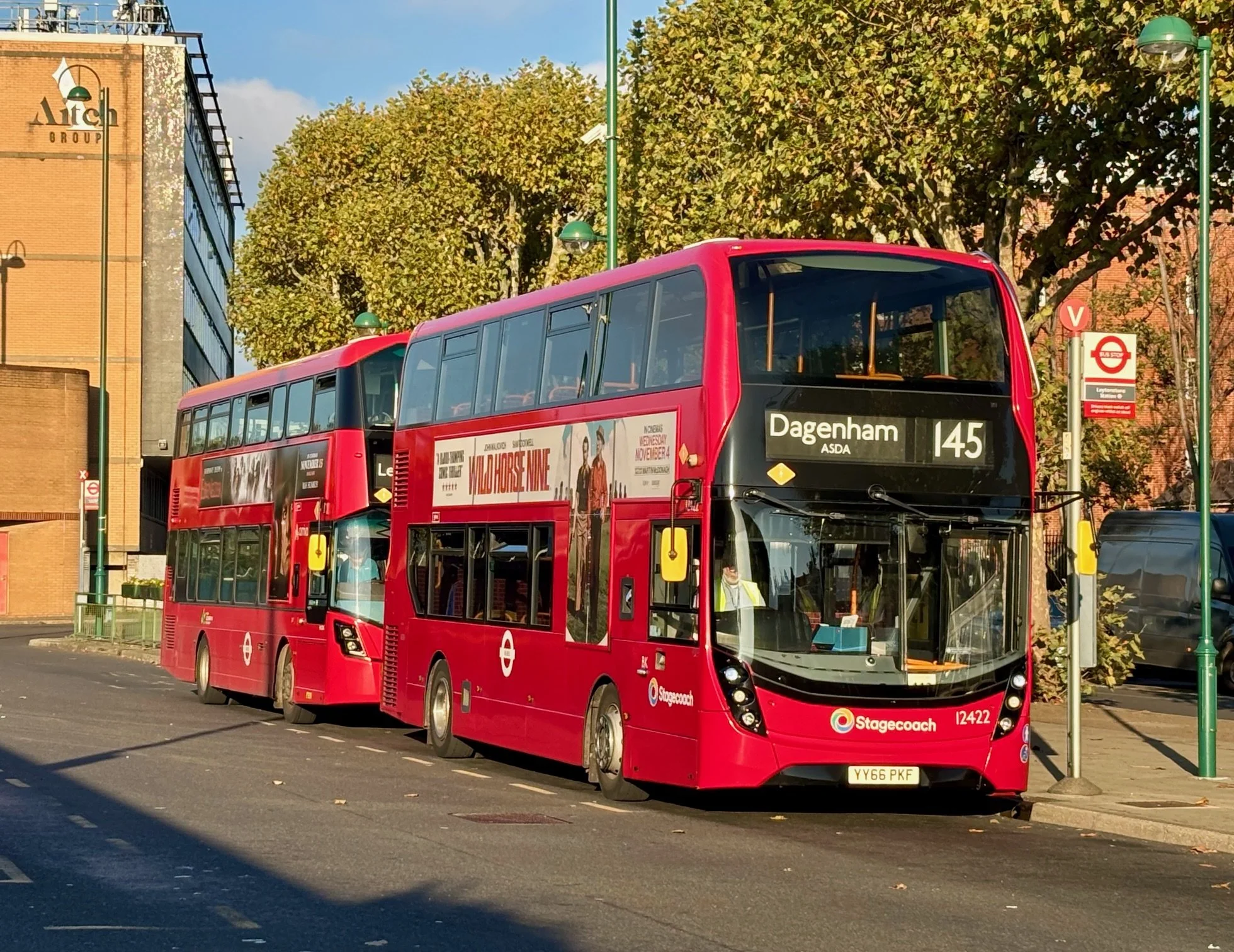
Stagecoach London’s Enviro400H MMC no 12422 of Barking (BK) Garage is seen in autumn sunshine at Leytonstone Station, after my lengthy ride aboard from Dagenham. This is the normal allocation on the 145 at time of writing.
Sneaking in behind is an Arriva HV class hybrid on the 66.
From Leytonstone Bus Station, I made my way into the adjacent Central Line Station for the journey home.
Watton
“And Finally…”
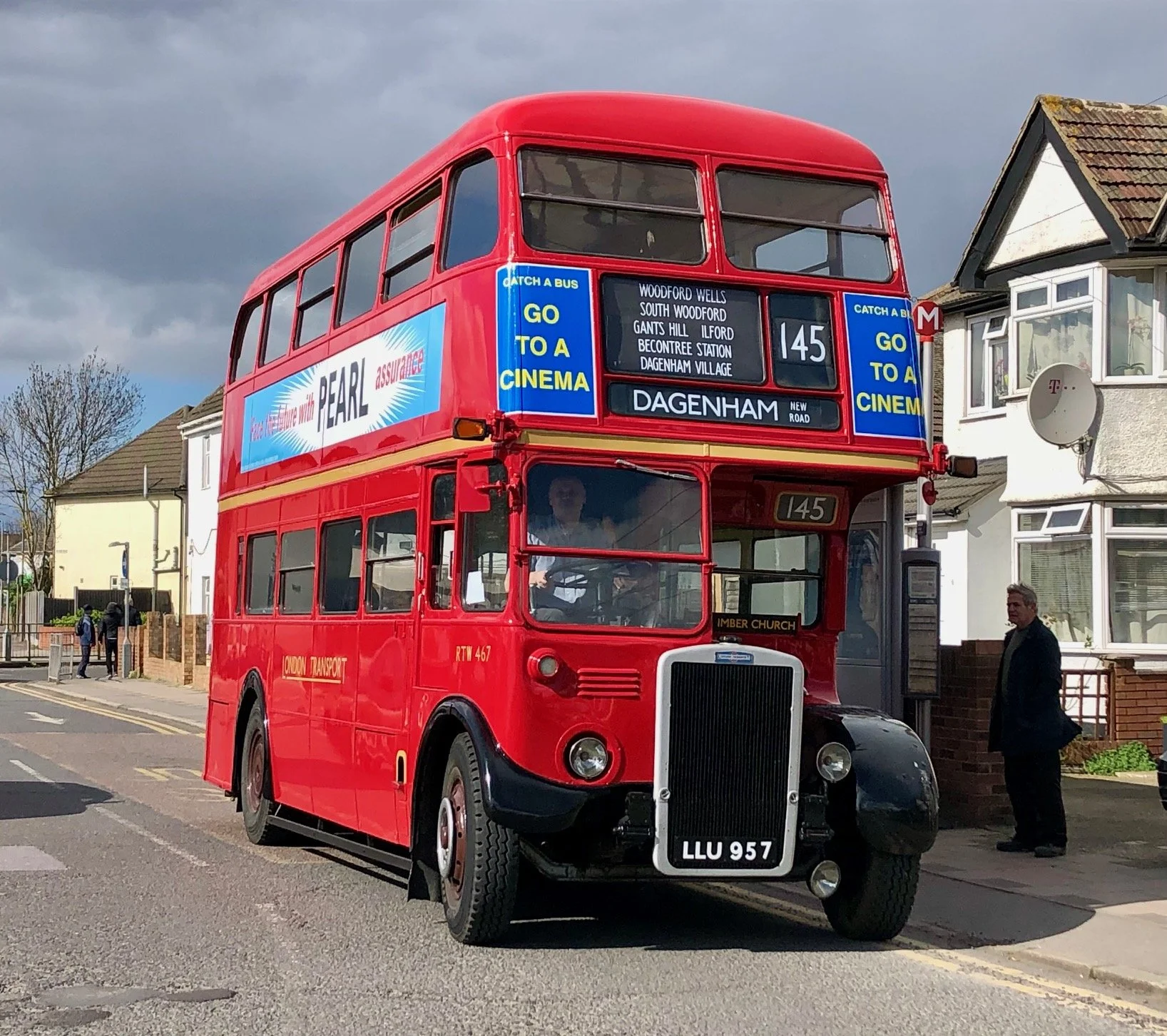
A previous era on the 145 is recalled by a “Dub” in the form of nicely preserved RTW467, seen at Dagenham New Road on the occasion of a London Bus Museum Running Day which covered the 62 & 145 routes, back in March 2024.
The 145 was mainly associated with the RT and RTL variants of the class for many years, but did see RTWs for a short period in 1950-51, when they were banished to wider roads in the suburbs until permission was given for these 8 foot wide vehicles to operate on their intended Central London routes.
