
40 Years of Riding Roundabout
2026 marks the 40th Anniversary of the “Roundabout” network in the Orpington area. On this celebration journey, I travel on the modern version of some of the original routes, taking a somewhat roundabout route to get there!
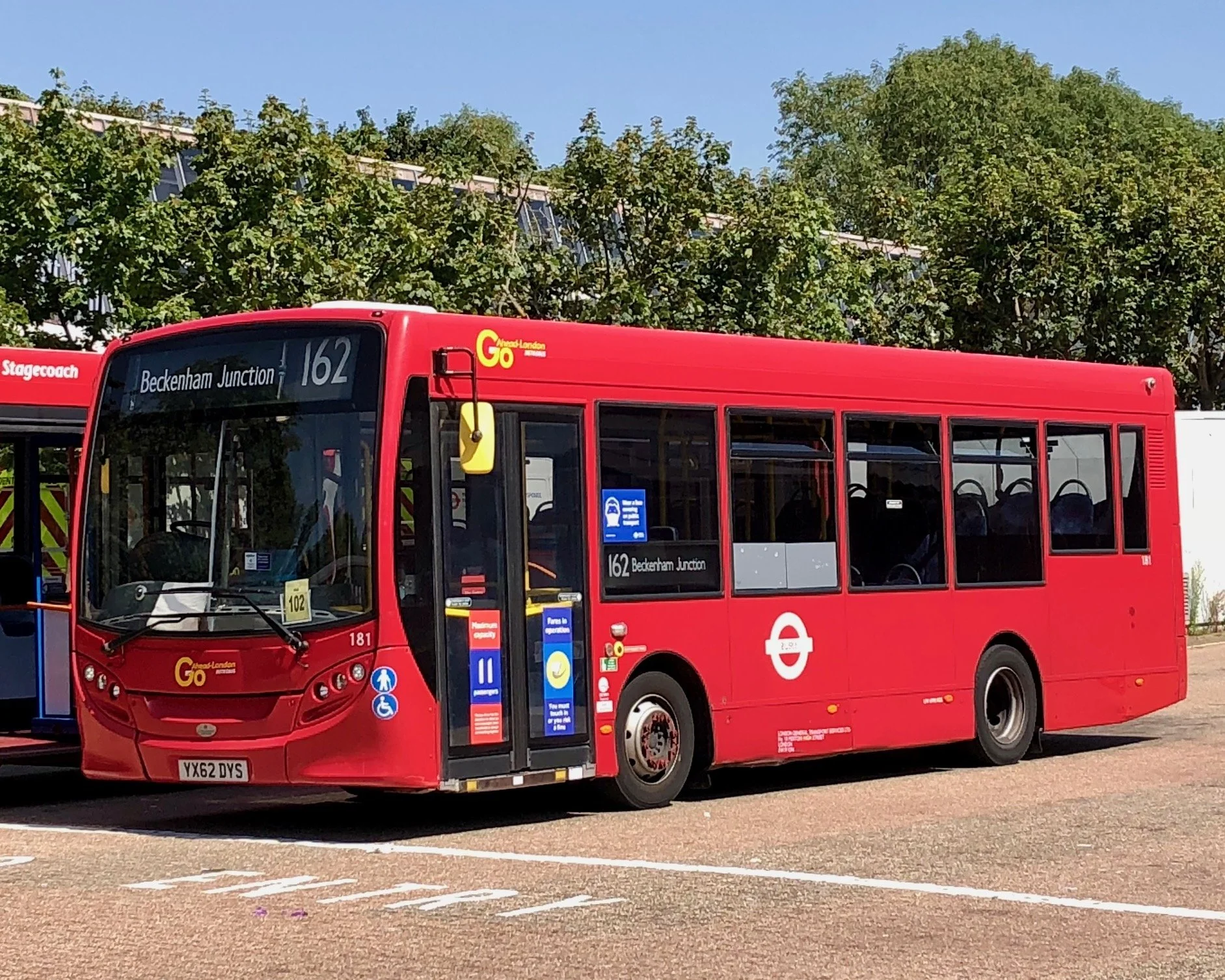
My rides began at Eltham Station. On a previous visit here in Summer 2000, I came across Go Ahead London’s Enviro200 no 181 of Orpington (MB), the operational garage of the 162 at the time.
The maximum 11 passengers notice on the door reflects the restrictions that were in place during the Covid period.
Route 162: Eltham - Beckenham Junction
By Southeastern train to Eltham in South East London, where I began my bus rides for the day. My first route was the 162, which has recently been transferred by Go Ahead London from its previous home at Orpington (MB) to the new Sydenham (SM) Garage. It is also due to be electrified with new Enviro 100 EVs, so a last chance for me to sample the existing diesels. As I arrived, Enviro200 no 158 roared up to the first pick up stop and I jumped aboard with a few others.
Unfortunately, all was not well, as soon after traversing Eltham High Street, we turned into Avery Hill Road, which was blocked by roadworks. A diversion was in operation, but either the driver had not been briefed or had forgotten and, after phoning the depot for instructions, we executed a three point turn and returned to Bexley Road. The long diversion route was signposted and we had to follow the 132 to Blackfen, then the 51 via Wellington Avenue, The Oval and Willersley Avenue, then the 286 along Halfway Street to emerge further down Avery Hill Road. Whilst this ensured that only one stop was missed, it added a good 10 mins or more to the journey time. Surely a better diversion would have been direct to New Eltham along Footscray Road, which would have missed a few more stops, but at least these are covered by the 132 and B13. As a result, gaps and short turns were evident in the service, even fairly early on a Saturday morning with minimal traffic.
Once back on route, we progressed at a fair lick as there were few passengers to pick up and free flowing traffic. From New Eltham, we were soon across the Fiveways junction and on to the suburban stretch through the Edgebury area to Chislehurst. At Chislehurst Common, we traversed the leafy stretch past Chislehurst Caves, which are now a tourist attraction but were made by human hands and have been inhabited for centuries. In WW2, they were used as a vast underground shelter, equipped with electricity and water, complete with church, cinema and canteen.
On this section, we caught up with another 162, which was actually the following departure that had not made the same mistake as us and we ran virtually in tandem through Bickley into Bromley Town Centre. However, the other bus then drew ahead, which was to shortly to produce a problem. In Westmoreland Road, the driver received an instruction to curtail at Park Langley, which he informed to the three passengers by then on board. However, the second bus, just a couple of minutes ahead, was not held to transfer us and we were unceremoniously dumped in the middle of nowhere, although the driver apologised profusely.
LVF showed the next bus 25-30 mins behind, on this supposedly 15 min interval service. When it eventually arrived, it too was curtailed at Park Langley and deposited a crowd of angry passengers. One lady was upset as her young daughter was in tears at missing her dance class in Beckenham due to the delay. Others had appointments that they would be late for and train connections at Beckenham Junction that would be missed. Such is the human cost of curtailing buses that the Controllers in front of their screens don’t see.
The next bus was 8 mins behind and the assembled crowd thankfully boarded fleet no 180 after ascertaining from the driver that she was definitely going to Beckenham Junction. A couple of stops further on, at The Chinese Garage, there is a freehold section into Beckenham, with passengers boarding again berating the driver for the long wait which had disrupted their travel plans. We finally arrived at Beckenham Junction a massive 2 hours after I had left Eltham, some 50 mins later than I should have done. A poor show from GAL, which could have handled the situation much better in my view.
This version of the 162 is the third use of the number in London, the previous versions being a route between Staines & Stanwell which operated between 1948-56 using ST and then RT types until taken over by a rerouted 203, then the more well known East London version between Stratford & Little Heath (later amended to Wanstead & Barking / Mayesbrook Park), which ran between 1960-93. This began as crew operated with RT/RM but upon OPO conversion in 1971 used SMS, DMS and T classes in turn.
Today’s 162 dates from 1994, initially operated by Kentish Bus with Darts and running between Beckenham Junction and Petts Wood, replacing parts of the 126, 161 and 161A. In 1997, it transferred to Selkent with Titans and Olympians, but in 2001 was replaced over the Chislehurst - Petts Wood section by the 273, receiving instead an extension to Eltham. Low floor Darts first appeared at this time. Arriva had a 5 year term, also with Darts, between 2006-11, before present operator GAL took over with Enviro200s.
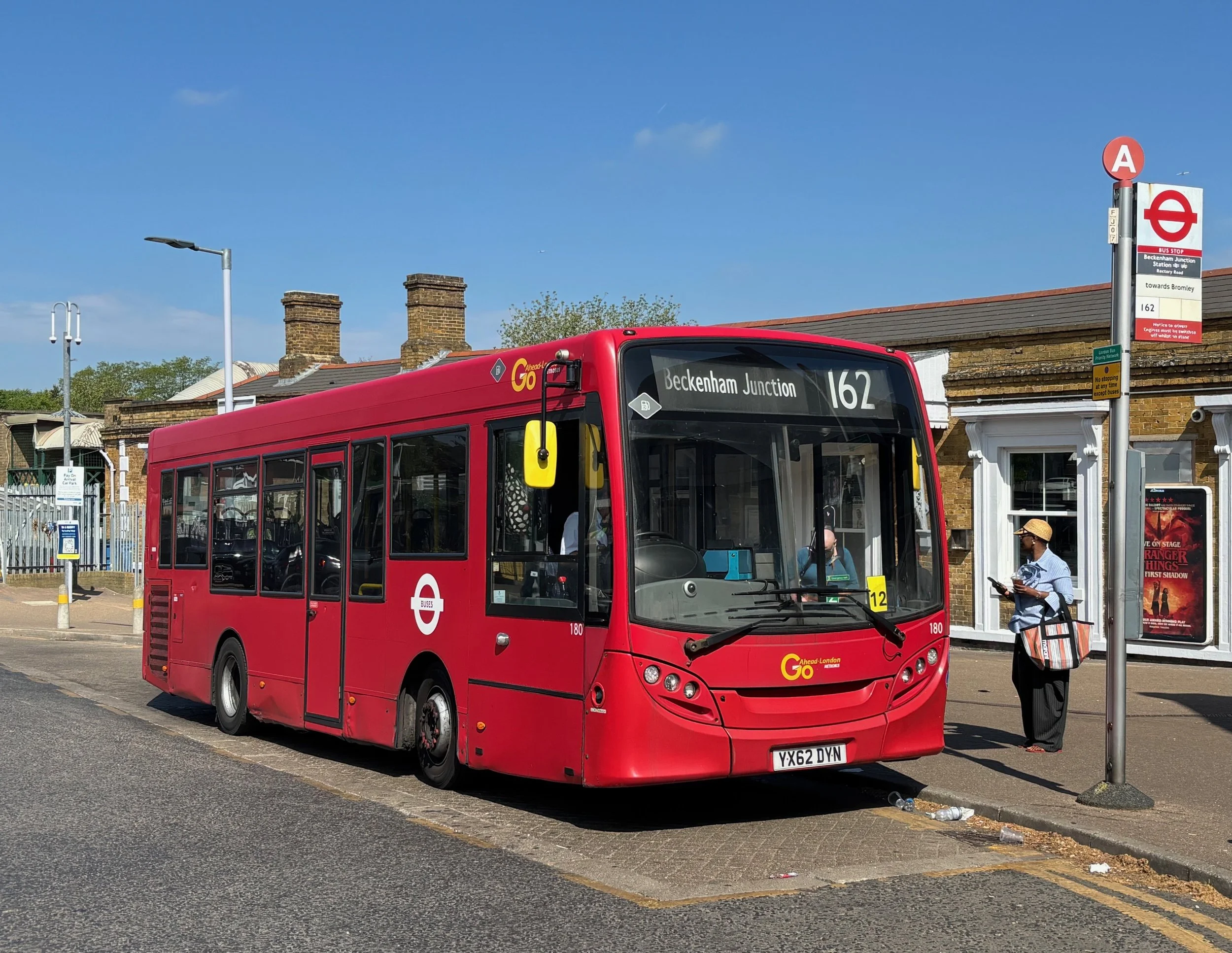
Back to the present day and here is GAL Enviro200 no 180 at the other end of the 162 on stand at Beckenham Junction Station after my short ride on it following the previous bus being turned short.
The route is now operated out of the new Sydenham (SM) base and is due to be converted to electrics in the near future.
Part Route 227: Beckenham Junction - Bromley North
Fortunately, after walking around the corner from Beckenham Junction, my next bus, a 227 back to Bromley the direct way, appeared just as I arrived. WS122, another GAL bus from Sydenham Garage, was already full and standing and several of us squeezed aboard.
Only 15 mins to Bromley North on this trip, for which even our long single decker was inadequate for the load, although double deckers cannot operate due to the low bridge on this section at Shortlands Station, with no obvious alternative route. A frequency increase is definitely needed.
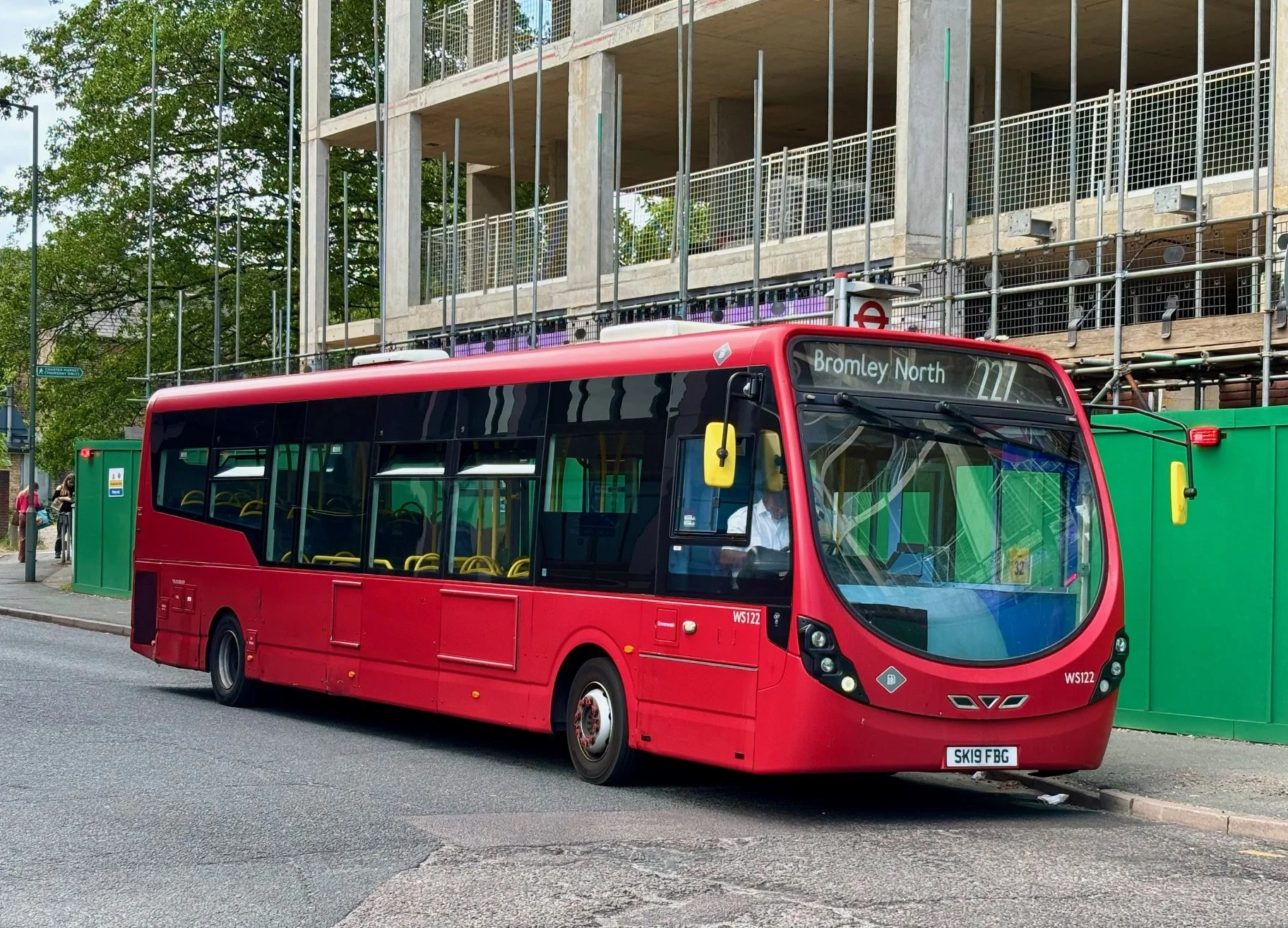
GAL Wright StreetLite WS122 of Sydenham (SM) Garage at Bromley North Station after my short journey aboard from Beckenham.
The 227 is a very busy route that could do with double deckers but is restricted to single deck due to the low bridge at Shortlands. Even these very long buses struggle with the loads at peak times.
Route 269: Bromley North - Bexleyheath
At Bromley North, it was time for my sole double deck ride of the day, on the 269 to Bexleyheath. This was taken over by GAL in early 2025 and I had ridden it in the other direction back then aboard a WVL diesel. However, since then, the intended electrics have entered service at BX Garage and I had only a few minutes wait before Wright StreetDeck Electroliner DEL118 drew up to the first stop. My first ride aboard the class from this garage.
For a change, the interior info screens were working correctly and displayed the correct next stop and destination details. A smooth ride on this modern bus with the usual new vehicle features. After leaving Bromley Town Centre, we made our way back through Bickley to Chislehurst, although there was a slow moving traffic queue up to Chislehurst Common, many apparently taking advantage of the good sunny weather to visit this attraction.
Once over the lights at Chislehurst War Memorial, we sped up and had a clear run through to Queen Mary’s Hospital. Temporary lights and single lane working between here and Sidcup High Street didn’t delay us on this trip too much and soon we were descending the hill to Sidcup Station. A reasonable run on the suburban stretch from here towards Bexley, for much of which we were following an Arriva T on the 229. Then the final section up to Bexleyheath Town Centre, depositing all of our load at the Library, leaving just me and the driver to travel the last couple of stops to the terminus at Friswell Place. Despite the earlier delays, we managed to complete the trip in 55 mins, which wasn’t too bad.
I covered the history of the present 269 in my previous article “Repurposed Deckers in Bexleyheath & Bromley”dated 20 Feb 2025, which should be referred to for that story, so this time a reminder of the two previous uses of the number in London:
Firstly, for a route between Enfield & Tottenham Court Road, which replaced Trolleybus 629 in 1961. RM operated, it lasted until 1968, when it was superseded by an extended 123 and Flat Fare Route W4. The number resurfaced in 1973 for a service replacing the northern end of the 69 between Chingford & Leyton Downsell Road, also RM, which was short-lived and was replaced by the 69 again in 1976.
The present 269 had a 269A variant, which I missed last time, running between Bexleyheath & Woolwich, with a M-F Peaks extension to Charlton. This differed from the 269 by running via Crabtree Manor Way, Yarnton Way and Eynsham Drive in Thamesmead, rather than direct via Abbey Road and Abbey Wood. Introduced in 1984 with Titans, later replaced with L class Olympians, it lasted only until 1988 when much of it was replaced by the 401.
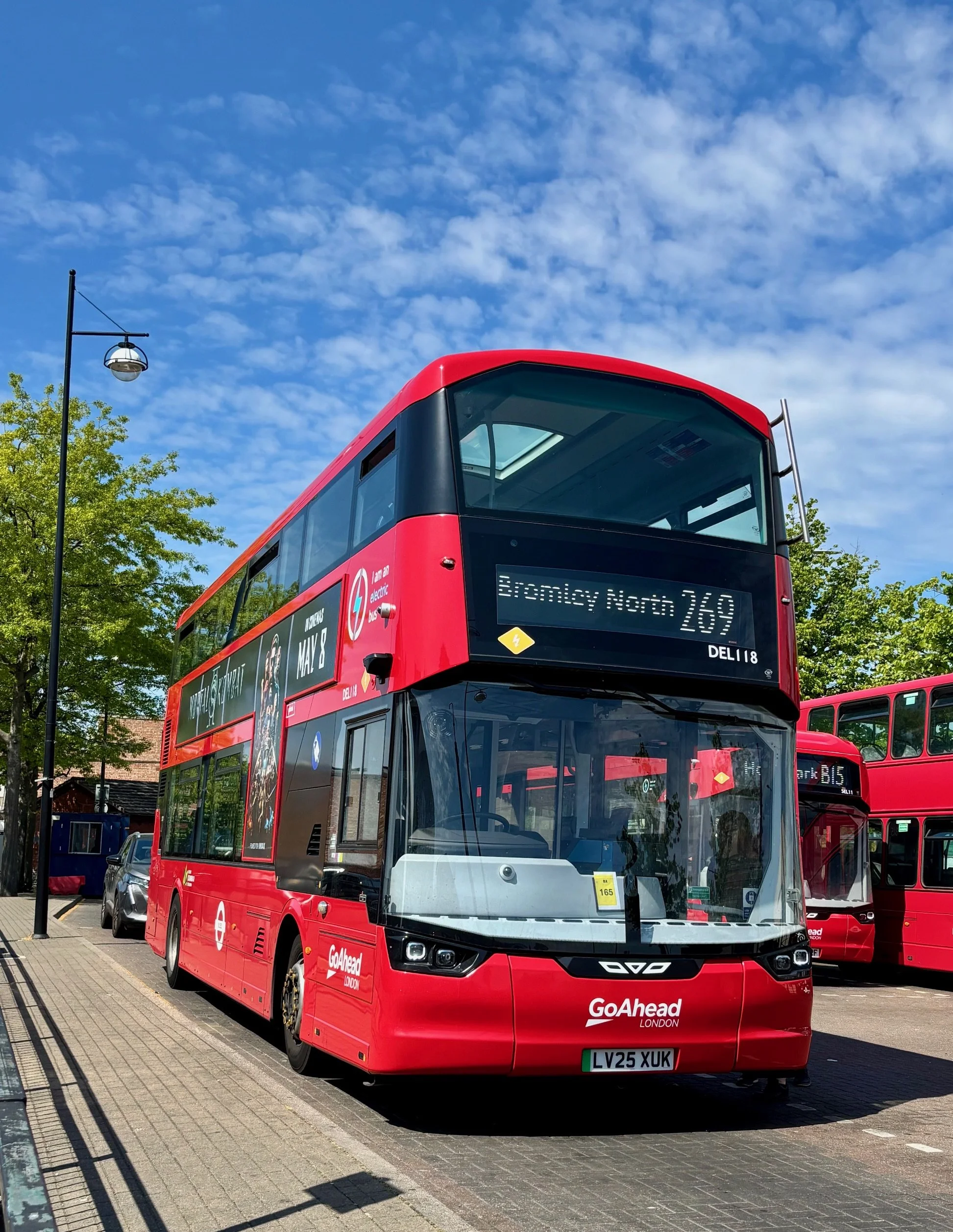
GAL’s new Wright StreetDeck Electroliner DEL118 of Bexleyheath (BX) Garage is at Friswell Place on the 269 after my ride aboard from Bromley North.
Note the sunroof on the top deck and the nearside tree defender bar. The 99, 269 & 401 were taken on by GAL in 2025, initially using E, EH, WVL & WVN types until the DELs were delivered.
Route B14: Bexleyheath - Orpington
Lunch time and a brief break before my next ride on Route B14. Since I last rode it some years ago, it has been rerouted in Bexleyheath to depart from the Library rather the Clock Tower and diverted at the other end to absorb the former R6 between St Mary Cray and Orpington. Also, the previous Enviro200 MMCs have largely been replaced by new Enviro100 EVs, which I was keen to ride as my first experience of this new class.
LVF showed one diesel still on the route, but I awaited the next electric, fleet no 46051 of Stagecoach’s Bromley (TB) Garage. Boarding the bus, which was “singing its song” as a safety feature on these quiet vehicles, my first impression was of a small and fairly cramped interior, although with the expected high back seating, USB ports and modern info screens. The seats had TfL moquette rather than Stagecoach’s own which was a slight surprise. There are 3 steps at the back up to the high seating area, with an extended low floor section at the front - the middle medium height seats usual on most single deckers missing on this model. The nearside screen which faces forwards so that the wheelchair user can see it blocks the forward view from anyone sitting rear of it on that side and also prevents a clear sightline of the next stop screen in the top front bulkhead, a design flaw in my opinion.
Nevertheless, a smooth ride as we left Bexleyheath with just half a dozen on board and we were soon bowling through Crook Log up to the Danson Underpass. The route to Orpington is a fairly meandering one and after continuing through the Blendon area, we entered the loop to serve Albany Park, which is very narrow and necessitated waiting for vehicles coming the other way past parked cars. Roadworks meant we circled the roundabout at Albany Park Shops and returned along the reverse of our outward route, rather than continuing around the loop via Albany Park Station.
Back on Bexley Lane, we navigated the back streets through to Sidcup, emerging in the High Street and continuing to St Mary’s Hospital. After circling the grounds, we resumed progress on the brief fast section along the Sidcup By-Pass. Into Sevenoaks Way at Crittall’s Corner, before turning into Midfield Way and entering another loop through St Paul’s Cray to St Mary Cray Station. It was only on this section that we became busy, but those on board bound for Orpington then had to contend with the new section taken over from the R6 in the Sandway Drive and Burrfield Drive area.
Finally, we were onto the narrow St Mary Cray High Street, with its village atmosphere, followed by a swift run along Lower Road to the junction with Court Road. Crossing the lights without delay, we were into Orpington High Street, where most of our clientele left. Just a handful of us continued up the hill to Orpington Station, where I alighted after the 1h15m run. On time, but a very convoluted route it has to be said! I suspect that the fairly measly 30 min frequency is prone to delays at peak times, a downside of long services like this with several functions to fulfill.
This B14 is the second use of the number, the first being a short-lived minibus route which ran for just a few months in 1988 between Bexleyheath and Erith, before being replaced by a revised B13.
The number returned in 1999 for a new route between Bexleyheath, Albany Park and Queen Mary’s Hospital, operated by Crystals with Mercedes Vario midibuses. It was extended to Orpington in 2001, with Optare Solos taking over. The contract was novated to Tellings Golden Miller in 2003 with the same buses, but Metrobus was the new operator from 2005 using Solos and Darts. This period saw minor rerouteings in the Albany Park and Crittalls Corner area, with Enviro200s replacing Darts in the 2010s.
After a couple of years in which the route moved within GAL from Metrobus to London Central from BX Garage using SEN class Enviro200 MMCs, the contract was gained by Stagecoach in 2018 with their Enviro200 MMCs. The rerouteing in St Mary Cray to replace the R6 came in March 2025.
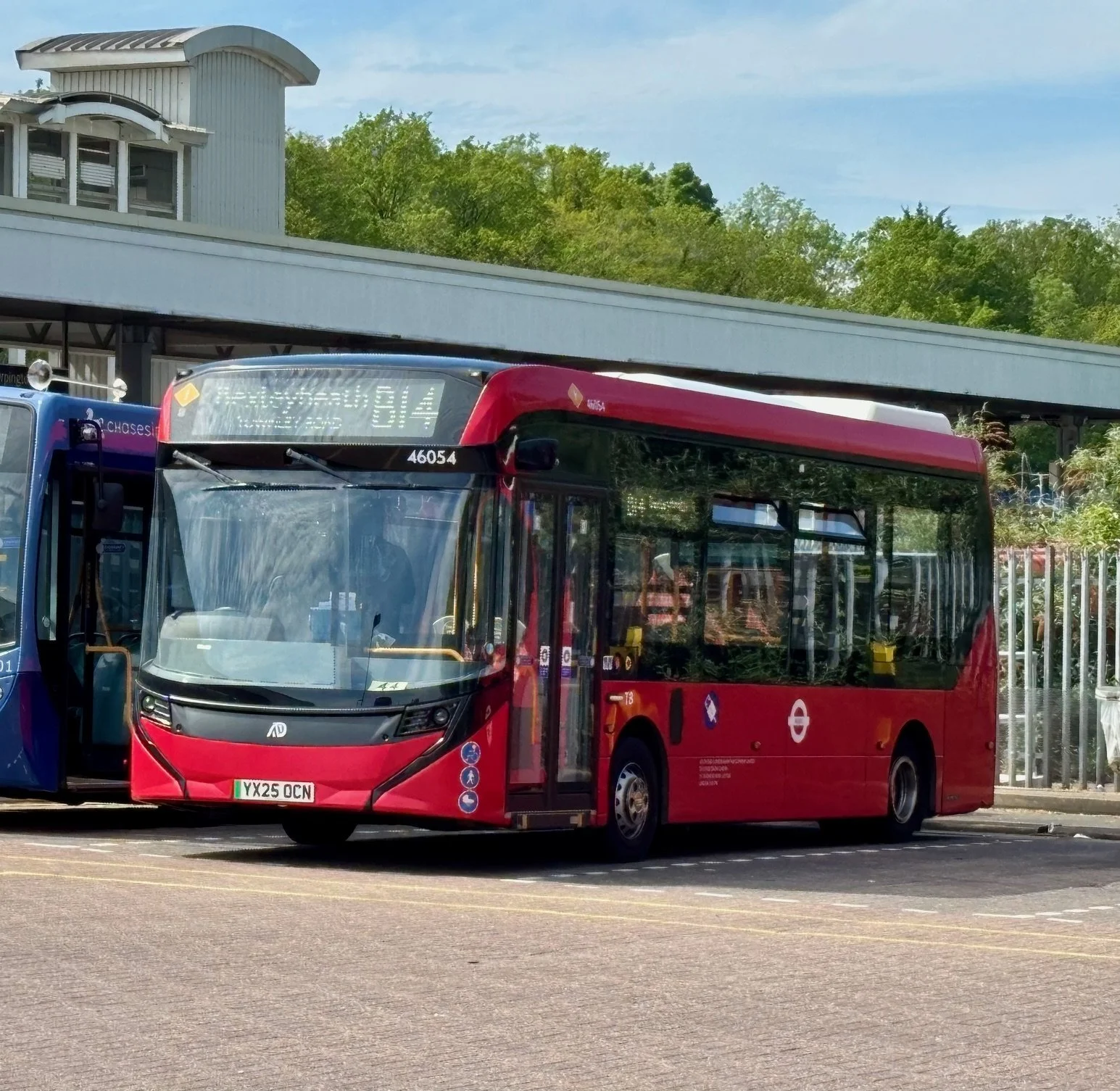
A nearside view of Stagecoach Enviro100 EV no 46054 of Bromley (TB) Garage seen parked up between duties on the B14 at Orpington Bus Station. I travelled on sister vehicle 46051 which left out of service when I arrived here.
These electric vehicles recently replaced diesel Enviro200 MMCs on the route although one or two of the latter still appear each day.
Part Route R1: Orpington - Pauls Cray Hill
For the grand finale of my trip, I intended to ride a couple of “R” routes in the Orpington area to celebrate the 40th Anniversary this year of the introduction of the original “Roundabout” minibus network in 1986, which was a completely revolutionary concept at the time in terms of bus operation in London and spawned similar networks around the capital. The idea was to penetrate areas previously remote from existing routes or where narrow roads prevented traditional “big” bus services from operating. Many of the innovative routes introduced in the late 80s/early 90s in this way still form part of the TfL network today, although now with larger vehicles than the pioneer minis.
I began at the beginning with the R1, the first of the routes included in the initial launch of Roundabout. Back in 1986, I had ridden on the then new Iveco RH minibuses on the route, so it was fitting that this time I also had a new bus, as the route is in process of conversion to Enviro100 EV single deckers. I had GAL’s SEO29 of Orpington (MB) Garage, which I duly boarded at Orpington Station on its next trip to St Paul’s Cray / Pauls Cray Hill, depending on which description of the destination you prefer! The interior was very similar to the Stagecoach example on which I had just arrived on the B14, although this one had blue GAL moquette, rather than the TfL type.
A gentle run down to the High Street, before turning onto Cray Avenue and the straight run past the Nugent Retail Park to the railway bridge, where we hung a left up to St Mary Cray Station. The R1 then describes a long loop around the estate roads via Leesons Hill, St Paul’s Wood Hill and Mickleham Road to Chipperfield Road, almost a complete circle. Then into Midfield Way, before turning into Grovelands Road and the terminal loop. We arrived at the terminus by Grovelands Shops after a 30 min run, which had been quite busy.
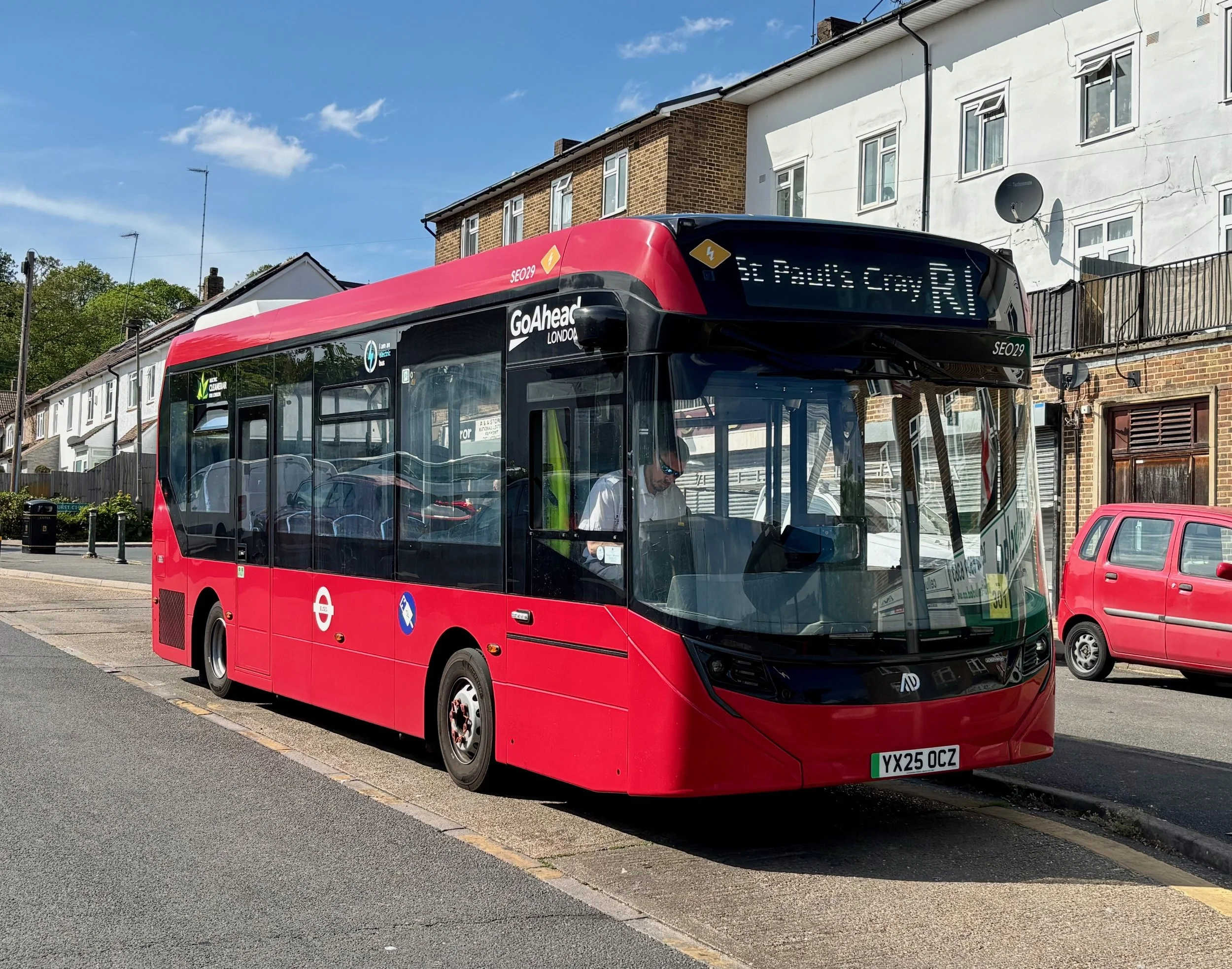
The offside view of the new Enviro100 EV is demonstrated by one of GAL’s examples (SEO29) of Orpington (MB) Garage on the R1 at the Pauls Cray Hill terminus during my rides on it.
47 of these buses are on order so far and have been entering service at Camberwell, Orpington and Sydenham Garages. Those at MB are for the 233, R1, R3, R4 & R8.
Route R1: Pauls Cray Hill - Green St Green
After the layover, I reboarded SEO29 for the return trip, this time travelling through to the other end of the route at Green St Green. The first section back to Orpington was basically the reverse of the outward trip described earlier, with all its convolutions. After traversing the High Street and the double run to the Station, we continued direct along Tower Road, crossing Sevenoaks Road into Repton Road, serving the suburban housing area towards Chelsfield. Sweeping around to Chelsfield Station and adjacent shops, most of our passengers departed on the section down to Farnborough Hill. At the stop prior to the last one in the High St, we paused for a driver change, which seemed quite absurd - this may be the nearest stop to MB Garage, but surely better to change over on the stand a few hundred yards away? I alighted at the final stop after a 45 min run.
Incidentally, the repetition in the name “Green St Green” is because the name originates from a place known as “La Grenestrete” in the 13th Century, which meant a green or grassy hamlet, with the second “Green” later added to refer to the village green!
The R1 began in June 1986 as one of the new minibus routes operated by the Orpington Buses Ltd subsidiary of London Buses, trading as “Roundabout”. It was initially operated by Iveco “RH” and Optare “OV” minis in a smart maroon and grey livery. The original route was from Bromley Common to Sidcup QM Hospital, with a branch to St Paul’s Cray Grovelands. On M-S daytimes it ran in two sections: Bromley Common - St Paul’s Cray and Green St Green - QM Hospital.
In 1987, certain journeys on M-S daytimes and Sun PM were diverted via Orpington Hospital and were numbered R11 to distinguish them, although initially at least, the R1 & R11 operated under a joint schedule. The folllowing year saw journeys on both routes diverted via Foots Cray Tesco during shop opening hours. Meanwhile, the original minis had become too small for the number of passengers now using the routes and they were replaced by longer MRLs in 1988 and then by DT Darts in 1990, although the introduction of the latter coincided with a return to plain red livery.
In 1995, First Centrewest took on the route and the “Roundabout” name was replaced by “Orpington Buses” on the DP Darts now used. Also at this time, the R1 became Bromley Common - St Paul’s Cray only, the R11 taking the Green St Green - QM Hospital leg, with joint operation on the two routes ceasing. Further adjustments came in 2001 to the R1, which was rerouted in the St Paul’s Cray area and later in the year was withdrawn betwen Bromley Common and Green St Green, together with a diversion via Chelsfield between the latter and Orpington. Low floor DMS Dart Marshalls replaced the previous high floor Darts.
In 2007, the R1 & R11 moved from First to Metrobus using existing Dart types, although these were later replaced with Enviro200s. By now part of Go Ahead, the R1 was rerouted via Tower Road between Orpington Station and Sevenoaks Road in 2017, whilst in the same year the double run to Foots Cray Tesco on the R11 ceased. A new contract in 2024 saw the R1 specified with Enviro100 EVs which began to enter service in 2025, whilst the R11 is due Volvo BZL EVs during 2026.
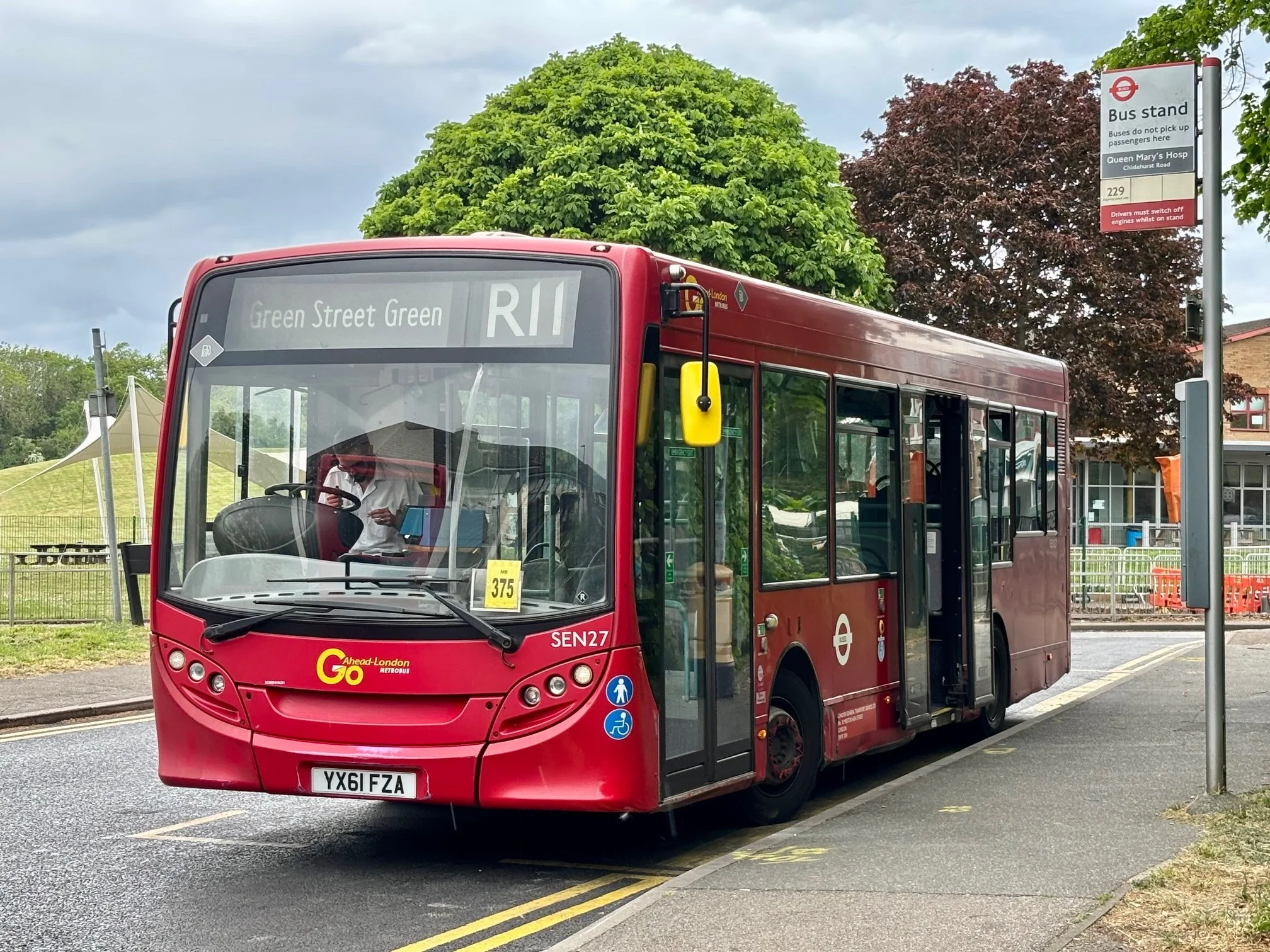
New Volvo BZL EV buses are on order for the R11 but, in the meantime, existing Enviro200s continue, such as SEN27 of MB Garage, seen at Queen Mary’s Hospital Sidcup after my trip from Green Street Green.
This is one of the examples which began life with First and retains the purple and grey interior of that operator.
Route R11: Green St Green - Sidcup Queen Mary’s Hospital
Crossing the High St outside “The Queen’s Head” pub, it was time for my final full route of the day, the R11 to QM Hospital. This is a derivative of the original R1 as noted in the above section of this article. New electric buses are expected on this service too but, unlike the R1, they had yet to enter service at the time of my visit. Meantime, a motley collection of SE and SEN class Enviro200s formed the allocation.
Next off the blocks was SEN27, its origins with First London being evident when I boarded with its light blue, purple and grey interior scheme. A somewhat tired bus, but still giving good service. After one stop, at Glentrammon Road, another driver change by the garage which although fairly swift could have taken place on the stand to save time. Proceeding direct along Sevenoaks Road, we dived off to serve the double run to Orpington Hospital, picking up one passenger there. Then back to the main road and on to Orpington War Memorial. Mercifully, no double run to the station on this route and we continued direct into the High Street.
From this point we ran over the same route as the R1 via Sevenoaks Way to St Mary Cray Station, before taking a slightly more direct route through St Paul’s Cray to Midfield Way and back to Sevenoaks Way. Straight across the roundabout at Crittall’s Corner and up to Foots Cray, near to the site of Sidcup (SP) Garage, closed in 1988, before ascending Sidcup Hill to the High Street, where all the other passengers alighted. I continued with the driver to the terminus at Queen Mary’s Hospital, although he had to reverse onto the 229 stand as another R11 and a 229 were on the R11 stand! Just over 40 mins trip time.
Part Route 321: Sidcup - Eltham
From QM Hospital, I walked back to the High Street, where I was just in time to board Go Ahead London EBD8 of New Cross (NX) Garage on the 321 for the short 15 min journey back to Eltham where I alighted. Then a quick sprint down to the station to reunite with Southeastern Trains for the journey home.
Watton
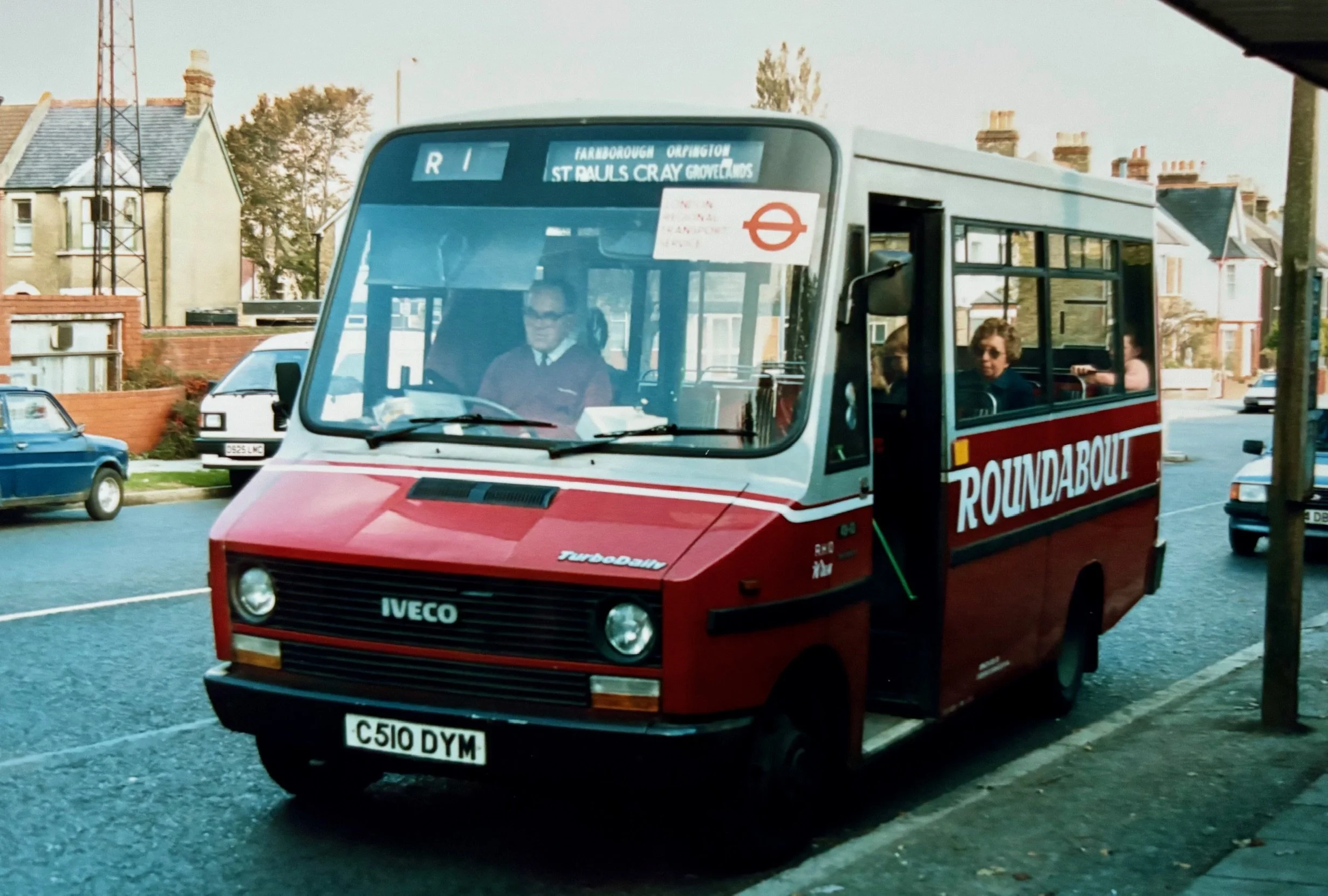
And Finally… How it all began. The Roundabout minibus network was the first of a number in London, starting in 1986. Here is one of the Iveco RH minibuses which began the service, seen at Bromley Common on the R1 in the following year.
In a nice touch, the original minis were all named after birds, RH10 here being “Wren”. The distinctive and attractive maroon and grey livery was later replaced by plain red.
