
Transiting through Croydon in transition
This time, I travel to the Croydon area to ride some buses soon to say goodbye to London but which are finding continuing use in their old age, together with sampling new arrivals in service.
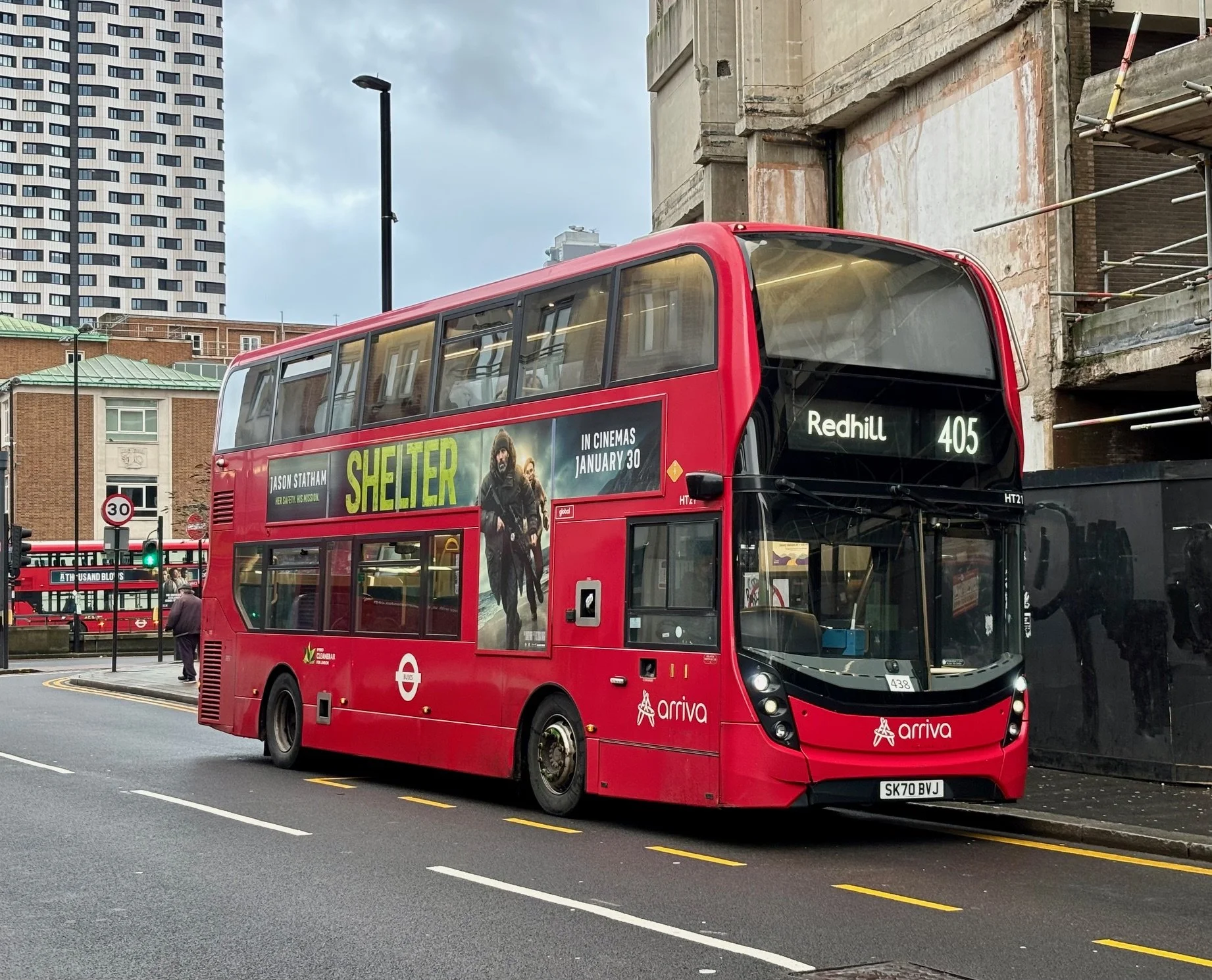
The 405 received a batch of Enviro400 MMC hybrids in 2020, like HT21 of Arriva London’s Croydon (TC) Garage, seen in Croydon Town Centre at the beginning of my day in the area. I had previously travelled on the type soon after introduction.
These buses are rare with Arriva, as only Croydon and Norwood Garages operate the type, mainly on routes 405 and 202 respectively. However, they are now starting to move on - see below!
Route 405: Croydon - Redhill - Purley
The Southern train provided a fast link from London Victoria to East Croydon, where it was a short stroll to Park Street in the Town Centre and the start point of my first bus route of the day, the 405. This was one of a number at Croydon (TC) Garage retendered last year and retained by Arriva London on the basis of new electrics, although as is usual, existing vehicles continue in the meanwhile. The 405 is one of only two routes (the other being the 202 at Norwood Garage) to operate the HT class Enviro400H MMC type with Arriva, but it seems these are starting to move on to Edmonton (EC) Garage for the 158, where its contract renewal requires existing hybrids. To fill the gap, spare DB300 Wright diesels released from the 466 by conversion of that route to ED class electrics have started appearing on the 405 instead, pending the arrival of more new buses.
I had ridden HTs on the 405 soon after their introduction, so I ignored HT21 which was the first departure to Redhill after I arrived. A few minutes later, DW544 arrived, out of service from the garage, to take up the next working 15 mins after the previous one. I duly boarded with a number of fellow passengers and we proceeded through uncannily empty streets towards South Croydon, taking a right at the famous “Swan & Sugar Loaf” junction, where the former pub of that name still stands with its decorative upstairs fascia, but sadly now a Tesco Express. From here, we proceeded via the rerouteing introduced several years ago away from the main Brighton Road, along the more suburban streets of Warham Road and Pampisford Road down to Purley, rejoining the main drag at Purley Cross.
Then the straight run down through Reedham to Coulsdon, serving the town centre shops and both Coulsdon Town then Coulsdon South stations. From here, we continued out of the London area over the border into Surrey, through Hooley, over the M25 interchange and then the fast dual carriageway section down into Merstham village, this whole section being mainly countrified through woodland. The final section onwards into Redhill is more surburban and we picked up a few short riders. Due to planned engineering works on the parallel railway, we passed numerous Rail Replacement buses of various types with several operators. We reached Redhill Bus Station after a very quick 45 min journey from Croydon. It is interesting to reflect that this is the second southernmost point served by TfL buses, with only Dorking on the 465 beating it into first place.
Letting the HT in front go, I rejoined my DW on its next northbound trip, which departed from Stop 2 instead of the designated Stop 2. Redhill Bus Station is one where buses often call at the “wrong” stop due to the correct one being occupied with another vehicle, so it is essential to keep a wary eye open to avoid missing your bus! A busier journey on the return run but an enjoyable one nevertheless through the scenic section, although we did encounter slow moving traffic through Hooley. I got off back at Purley Cross 30 mins from the start.
The 405 is etched in many memories as a longstanding London Transport Country Bus and later LCBS route running from West Croydon to Crawley for many decades, associated with green buses of the RT and (later) RCL classes, until replaced with OPO vehicles such as the AN and LR types. After the southern section was transferred to other services, the “London” end between West Croydon and Redhill became a TfL route in 2001. The only significant route changes since have been the rerouteing via Pampisford Road instead of Brighton Road between South Croydon & Purley in 2003 and the withdrawal between West Croydon & Croydon Town Centre in 2019.
Connex were the first operator in the TfL era, using single deckers in the form of Dart SLF types, although Metrobus took over in 2003, also with Darts. Double deck conversion came in 2006, principally employing Scania Omnideckers, although other types including E and WVL classes also appeared later on. Arriva gained the contract from Metrobus (by now part of Go Ahead) in 2020, with the then new HT type hybrids.
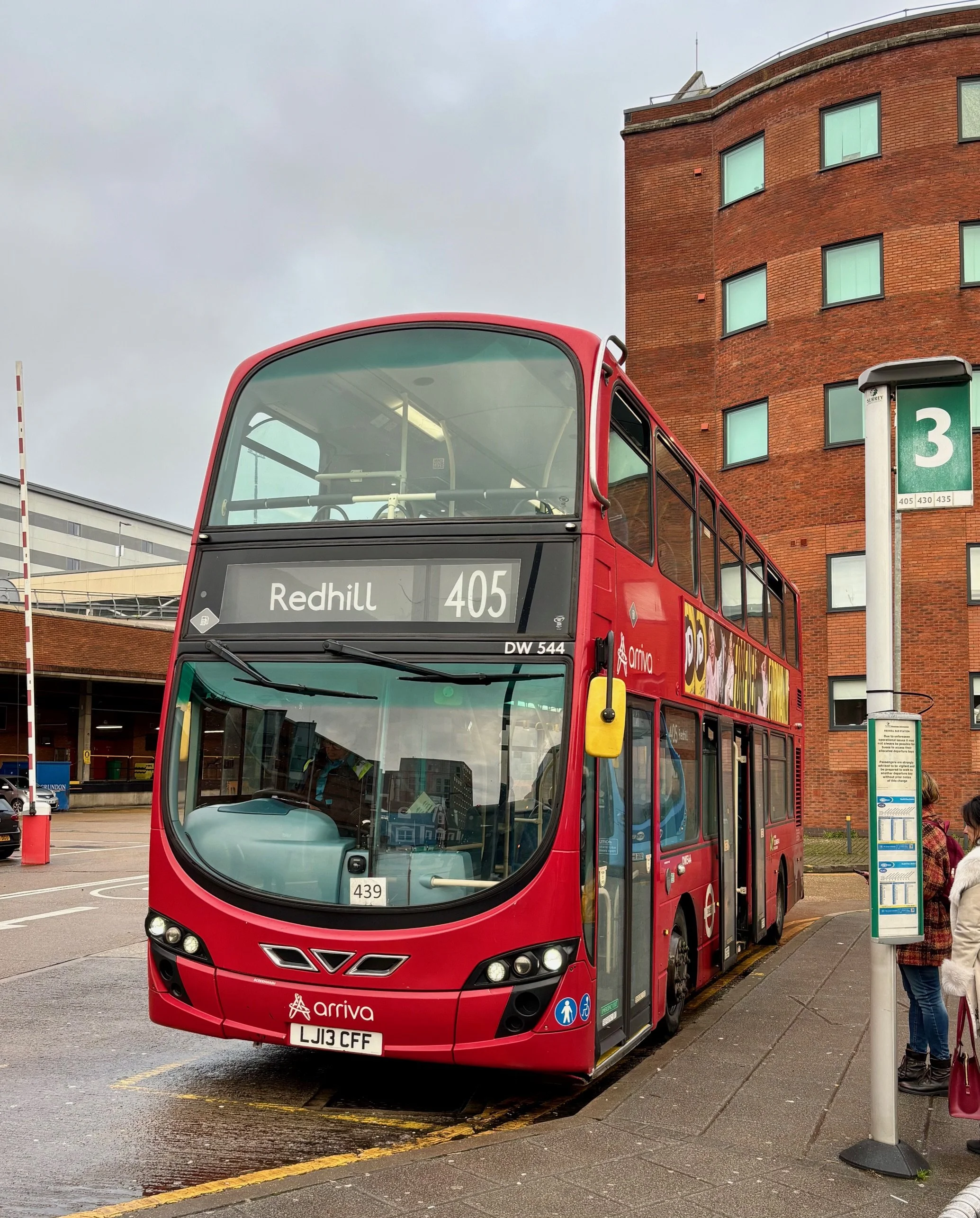
At the time of my visit, the 405 was beginning to see a few older DB300 Wright diesels, as DW544 (TC) illustrates at Redhill Bus Station after I rode it here from Croydon.
Meanwhile, the HTs are beginning to move to Edmonton (EC) for the 158 to comply with its contract terms for existing hybrids. The 405 was retained by Arriva in August 2025 on the basis of new ED electrics, so the use of DWs is likely to be a short-term arrangement.
Route 289: Purley - Elmers End
At Purley, it was a short walk from Purley Cross to the Station, in order to catch my next bus on the 289. At the time, this route was home to mostly elderly Enviro400s operated by Arriva London from Thornton Heath (TH) Garage. New ES class electrics were intended as part of its contract renewal spec in 2024, but these had still to enter service at their intended home, being temporarily redeployed north of the river at Tottenham (AR) Garage instead. For me, it was maybe a final chance to ride the old stagers before they disappear.
T128 was the next off the stand and I clambered aboard, but my ride was to be short-lived. After picking up at Purley High Street and the Library, the bus went into “limp mode” climbing the hill out of town and we staggered to a halt at the Battle of Britain War Memorial. The driver contacted the garage for assistance and informed passengers that he had been told to turn the engine off for 5 mins and restart. However, as there was a possibility that the bus might fail again or be replaced at the garage, I opted to alight and await the next bus. After T128 resumed its path, I only had a 5 min wait for the next bus, T192.
Purley Way is a very busy road at the best of times and this was made worse as there were multiple sets of roadworks to contend with as we made our way north through Fiveways to Waddon Marsh. Beyond this, just past where the dual carriageway goes into a single lane, the northbound lane was being dug up, with temporary lights controlling alternate one-way working using the southbound lane. This was causing delays of at least 15 mins at this time (mid morning) and would get worse during the midday and afternoon period. Eventually, we broke through, crossing the Lombard Roundabout and up to Thornton Heath Pond.
We then turned south, back towards West Croydon, with luckily no driver change at TH Garage to impede us even more. Interestingly, T128, which I had abandoned earlier was continuing through to Elmers End and remained about 5 mins ahead of us, despite by now being around 25 mins late itself. Traffic was slow but moving through West Croydon, but then we accelerated a little as we continued through Addiscombe and on through the leafy suburbs to Elmers End. We terminated at the Interchange next to Tescos exactly 1h30m after I had left Purley, on a route that should have taken about 1h5m. This was not to be my last encounter with the 289 that day though - see later!
The 289 began in 1968 as a short local between Thornton Heath Garage & Addiscombe, avoiding West Croydon, replacing a withdrawn section of the 50. It was RT operated at first but converted to OPO with SMS in 1970. It then began to grow, first being rerouted via West Croydon in 1973 and then extended to Elmers End Green in 1974. A further extension to Beckenham Junction came in 1978, together with a conversion to LS Leyland National operation. In 1981, it was projected at the other end to Croydon Airport / Purley to replace part of withdrawn route 115, but it 1985 it retracted back from Beckenham Junction to Elmers End once again.
Tendering saw the route pass to London & Country in 1987, who operated types including Dennis Falcons and Leyland Lynxes, although there were a couple of scheduled double deck workings at school times. By the time L&C morphed into Londonlinks in the mid 90s, Dennis Darts were the prevalent type. Into the Arriva era and low floor conversion at the turn of the century saw PDL Darts take over, which were later mixed with the similar DDL class. In 2012, long Enviro200s in the form of the ENX took charge, with the odd T class decker appearing. Although full conversion to the latter type occurred in 2024, one or two ENXs per day were still turning out at the time of writing.
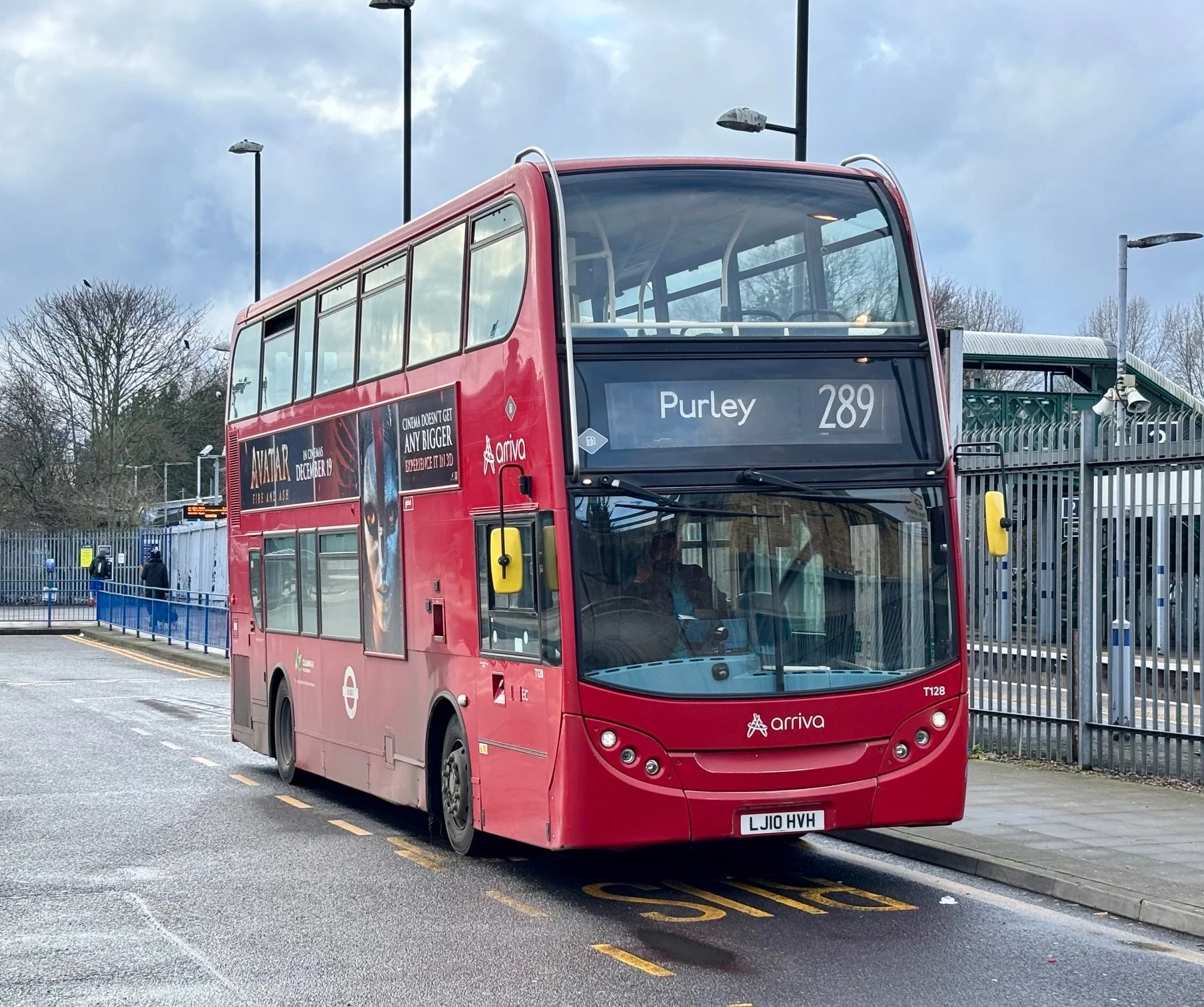
The 289 was upgraded from single to double deck in 2024 as part of its contract retention with Arriva. Once again, new electrics are planned to take over, but elderly Enviro400s continue in the interim. T128 of Thornton Heath (TH) Garage is at Elmers End Station.
I began my journey on this bus from Purley but swapped vehicles after just a few stops after this one developed mechanical issues. However, the driver managed to coax it through to the end of the route after all!
Tramlink: Elmers End - East Croydon
At Elmers End, I transferred from the 289 at Tesco to the adjacent station, to return to Croydon the quick way using Tramlink. Bombardier CR4000 tram 2545 was waiting in the bay platform and departed a minute or so after I boarded. Just a 12 min run to East Croydon from here, less than half the time on the bus.
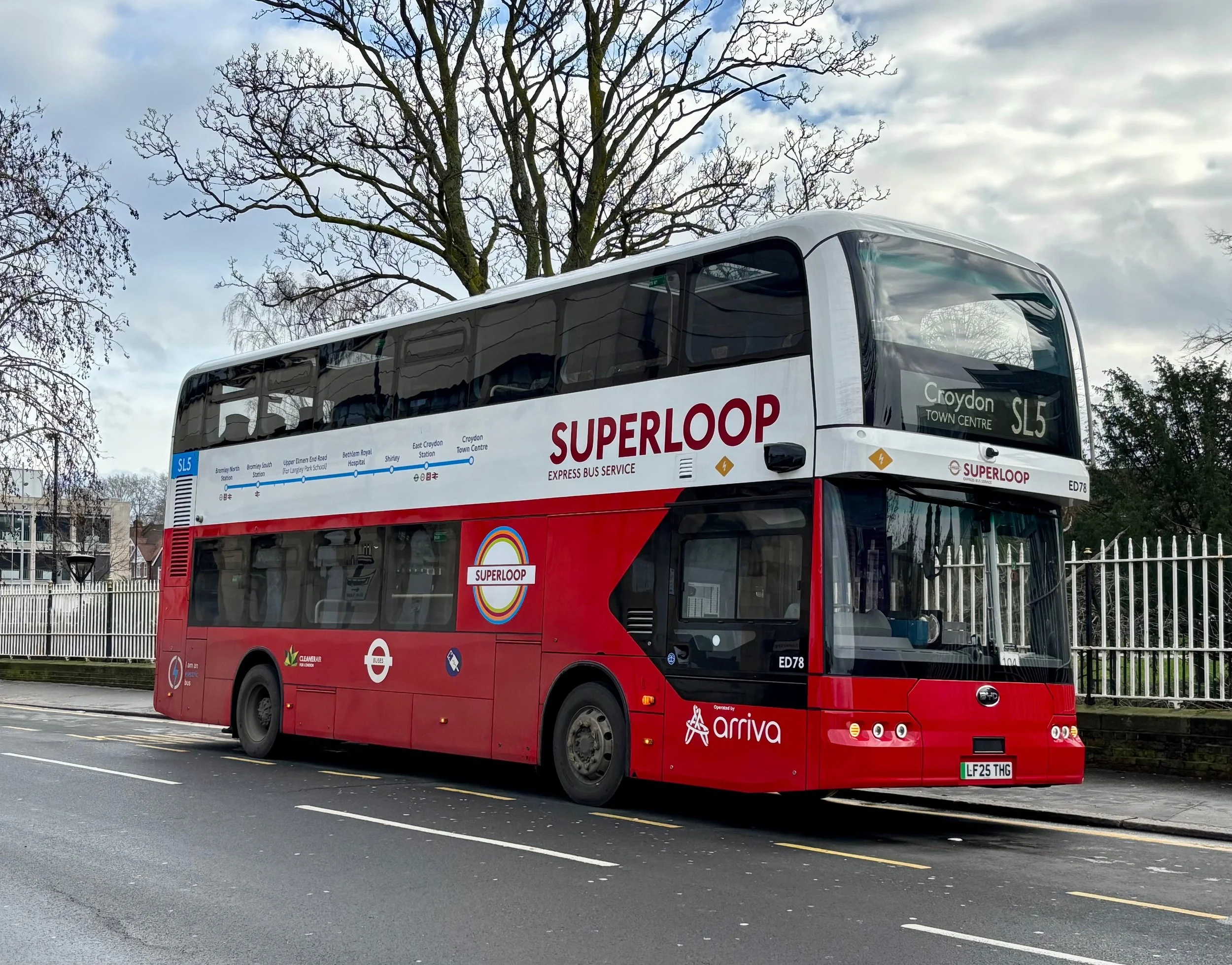
The SL5 is unusual in that it was the only “Superloop” route to start off with single deckers. However, Arriva retained the contract in 2025 with new electric double deckers which have now entered service. ED78 (TC) was seen on stand in Park Street Croydon before my ride aboard to Bromley.
These BYD B11 electrics are also entering service on other TC Garage routes in plain red, starting with the 466, but the batch for the SL5 bear this special “Superloop” livery with suitable signwriting.
Route SL5: Croydon Town Centre - Bromley North
From East Croydon Tram Stop, I walked back into the Town Centre for a change of gear, both in terms of age and speed, with my next route “Superloop” SL5. The reason for this choice was that, since I first rode it, this service has been upgraded from its former ENX class Enviro200s to brand new BYD B11 electric double deckers. Arriva London ED78 of Croydon (TC) Garage, with its “Superloop” livery and branding, was the first to draw up at the Croydon Library pick up stop, where a fair crowd boarded with me. An even bigger number piled on at East Croydon Station, making us virtually full, a far cry from the handful using the route last time I travelled on it not long after it started. It seems that people have become aware of the benefits of the faster journey now offered between Croydon & Bromley.
Passengers on and off in small numbers at Shirley Library, Monks Orchard Road, The Bethlem Royal Hospital and Upper Elmers End Road. Our only delay was caused by a slow-moving traffic queue on approach to The Chinese Garage, which at least enabled me to appreciate the unusual architecture of this former petrol station, now a Tesco Express, built in 1928 in Japanese pagoda style and now a Grade II listed building. Continuing on through the suburbs, we called at Westmoreland Road, before arriving into Bromley itself and dropping off at Bromley South Station, Elmfield Road The Mall and Bromley North Station. A very good time of just 45 mins end to end.
The SL5 started in February 2024 as part of the initial “Superloop” network, connecting with the SL7 to Heathrow at Croydon and with the SL3 to Thamesmead at Bromley. It has been operated by Arriva London since the start, being unique amongst the SL routes in requiring single deckers at first due to low trees on part of the route, which have now been dealt with by the council, so allowing double deck conversion.
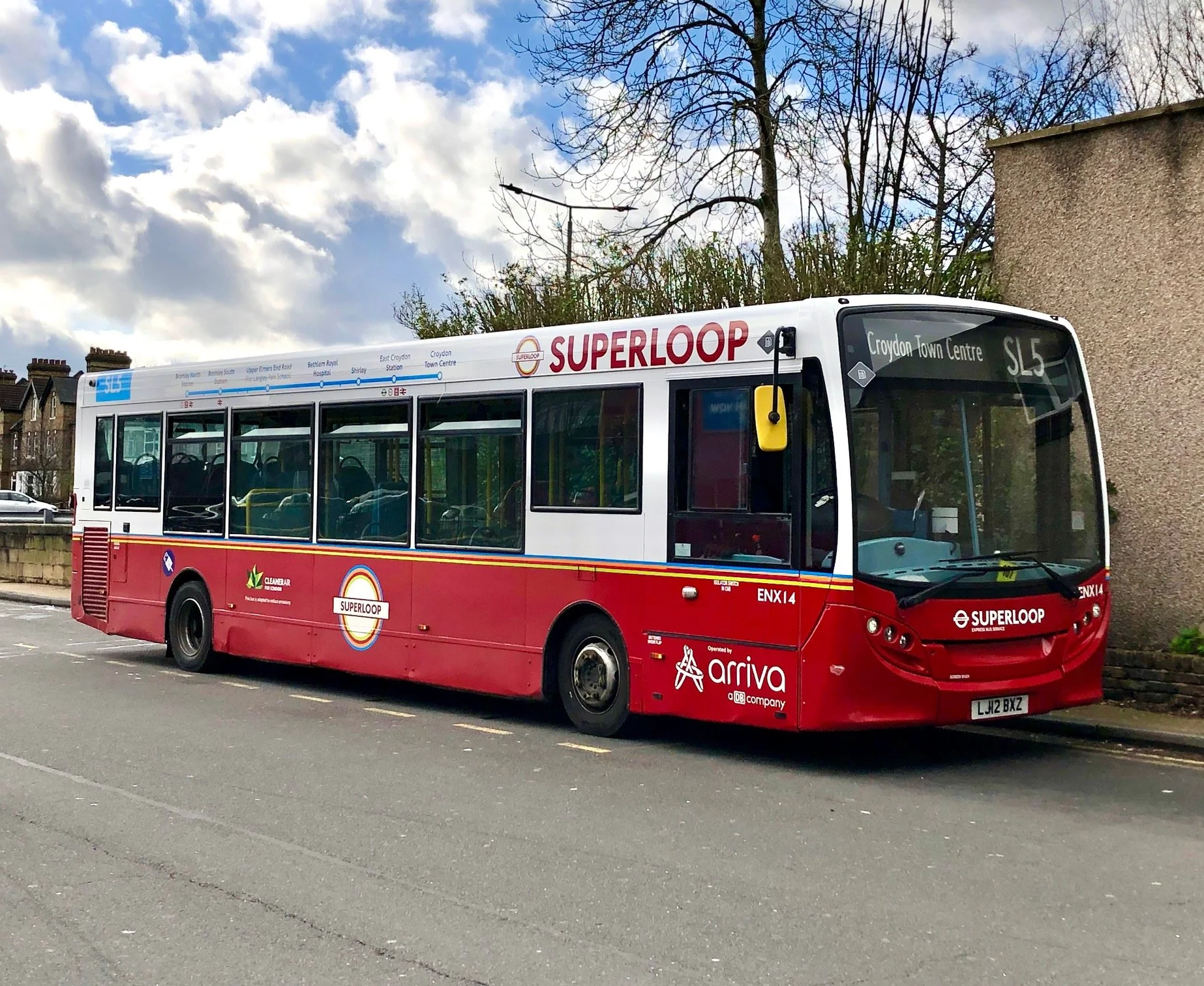
When the SL5 began in February 2024, it used existing long Enviro200 diesels which were repainted in “Superloop” livery. ENX14 (TC) is seen at Bromley North soon after the route began.
These vehicles were required until low hanging trees on part of the route were dealt with by the council, but are now withdrawn.
Route 119: Bromley North - Croydon Airport / Collonnades
I then returned to Croydon via the “traditional” 119 route from Bromley North. This is operated by GAL using mainly Ee class electrics, although a few WHV hybrids support. However, recently, one or two Enviro400s from Croydon (C) Garage seem to turn out most days and I was fortunate that E215 was on the second departure from Bromley North Station after I arrived, enabling a rare ride on an older bus on this service.
Another decent run, very quiet in terms of other traffic and in terms of passenger usage, adding to my theory that many longer distance passengers on this corridor have transferred to the faster SL5. Nevertheless, we picked up a number of returning shoppers at the stops in Bromley Town Centre, before making our way via Hayes Lane into Hayes itself, serving the library and the station. A straight run along Addington Road through the outskirts of Coney Hall, then turning right to ascend Corkscrew Hill, which sometimes proved too much an obstacle for previous generations of buses if they were not in the best of health, but our old Enviro had no such problems and coped admirably.
A few passengers on and off at the shops in West Wickham High St, before continuing back to Shirley, joining up with the SL5 again but of course serving all stops on this occasion. Early running caused a couple of minutes pause at Sandilands Tram Stop, but we were soon at East Croydon, then negotiating the town centre and onwards to South Croydon. A right turn once again at the “Swan & Sugar Loaf” as earlier in the day on the 405, but this time continuing west along Denning Avenue to the Fiveways junction at Waddon. Hanging a left, it was just a short hop to the terminus at Croydon Airport, The Colonnades. An impressive 65 min run.
The 119 number began running over the Bromley - Croydon corridor in 1939, using ST and then STL types. In 1950, it was one of the routes converted temporarily to RTW when the type was restricted to suburban routes with wide roads, pending suitable tests being carried out on these 8 foot wide buses on narrower roads in Central London. The following year, standard RTs replaced the “Dubs” which were removed to their intended Inner London routes. In 1961, the 119 gained a M-F peaks extension to Thornton Heath Garage via Waddon, which was projected still further to Thornton Heath High St the following year, although it retracted back to the garage again in 1964.
In 1970, the plain 119 became M-F only, as the weekend service was unusually replaced by two different variants:
119A on Saturday, which ran from Bromley to Croydon then to Thornton Heath via London Road direct rather than via Waddon, hence requiring the suffix.
119B on Sunday, which also ran from Bromley to Thornton Heath, but diverting via Shirley Way instead of Wickham Road, replacing withdrawn route 194B.
RM conversion came to the weekend variations first in 1975, with the M-F version following suit the following year, although the odd RT continued to appear right up to their end of service at Bromley (TB) Garage in 1978. That year saw the introduction of “Busplan”, which aimed to simplify routeings and eliminate variations. However, although the 119A variant on Sats was withdrawn and replaced by the plain 119 again, the Sunday 119B surprisingly survived and continued on until 1985, even being converted to crew Titan operation in late 1984 at the same time as the main service. From 1978, all buses operated direct via London Road and terminated at Thornton Heath High St.
OPO came to the 119 in 1985 using the existing Titans, which simply lost their conductors. In 1992, the Thornton Heath section was withdrawn, the terminus being retracted back to West Croydon. In 1996, the route was involved in a swap of terminals with the 194, with the 119 going to Croydon Airport and the 194 to West Croydon, the reverse of previously! This is the foundation of the route as operated today.
Since then, an operator change saw Metrobus (later part of Go Ahead London) take over from Stagecoach in 1998 using Olympian and then Scania double deckers. These were replaced in the mid 2010s with WHV hybrids, with a gradual conversion to Ee electrics following in 2022, although with a few other visitors as described earlier.
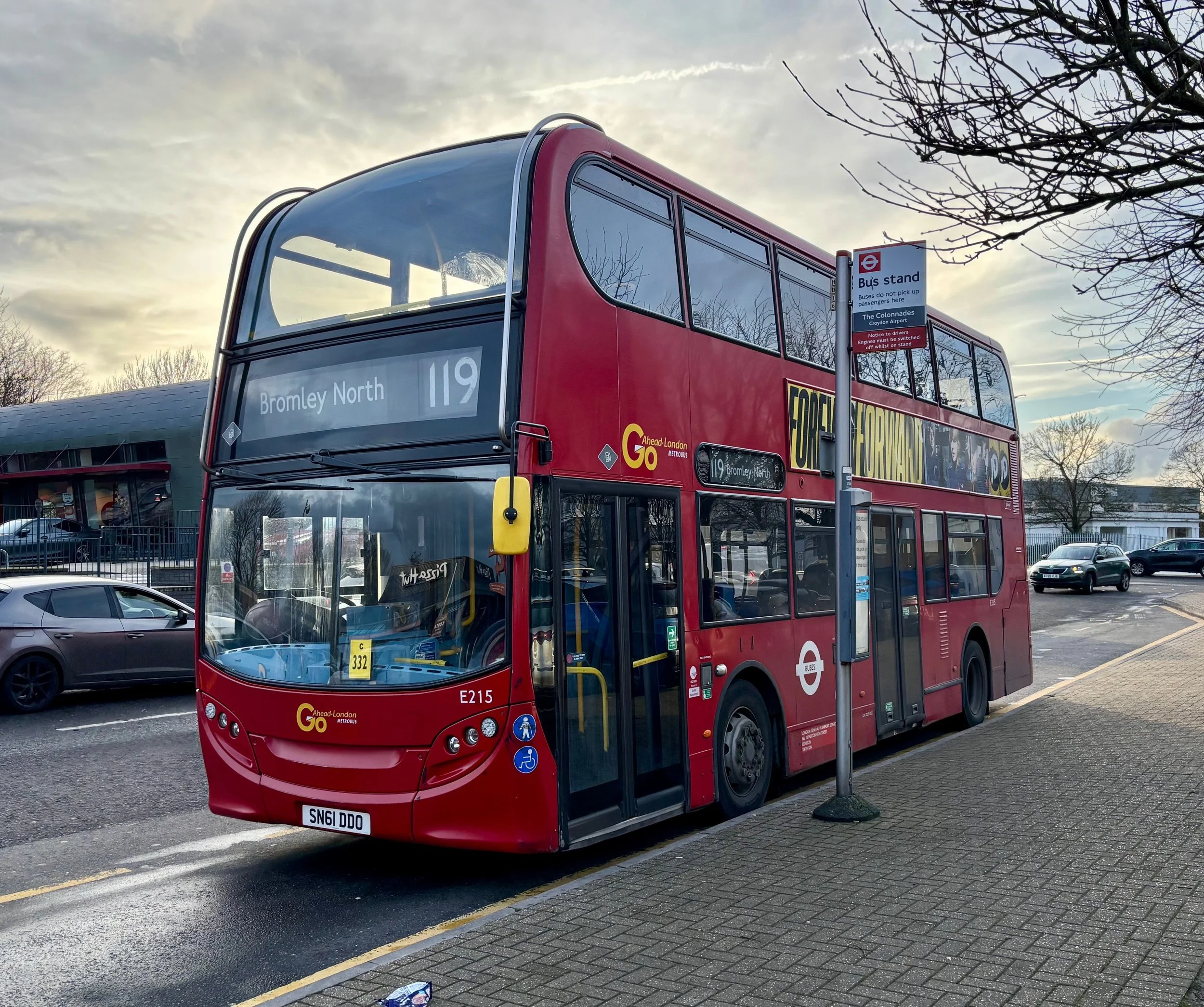
Go Ahead London operate the 119 with Ee type electrics but one or two hybrids or diesels often appear each day. E215 was one of two Enviro400s out to play when I visited and is seen at Croydon Colonnades after my run on it from Bromley North.
Like many buses at Croydon (C) Garage, this one does not bear the garage code.
Part Route 289: Croydon Airport/Colonnades - Purley
From The Colonnades, it should have been a simple short trip back to Purley Station on the 289, but the traffic congestion further up Purley Way was still playing havoc with the schedules, so I had a 20 min wait. This did enable me to appreciate the art deco facade of Croydon Airport opposite, which was the first international airport in the U.K, opening in 1920. During WW2, it became an RAF fighter base, but although resuming its role after the war as a civil airport, lack of space meant it could not be expanded, so it closed in 1959 as Heathrow was being developed instead. Much of Croydon Airport has been built on since, the Roundshaw Estate occupying much of the site, but a visitor centre remains in the former terminal building / control tower, now preserved.
Returning to the 289, whilst passing through Fiveways earlier on the 119, I noted a northbound 289 in service but on diversion away from the normal route, which I later discovered from the TfL website was via Stafford Road, Duppas Hill Road, Old Town and Roman Way to the Lombard Roundabout, thereby avoiding the worst of the congestion. Interestingly, the notice said that the diversion was subject to change, which could mean that alternative diversions may also have been used, whilst it was clear from LVF that some buses were sticking to the normal route in order to provide at least some service over the affected section. A very unusual eaxmple, in my experience, of a variable diversion in operation on a TfL service!
Eventually, T132 arrived and I boarded for a quick journey of no more than 10 mins to Purley Station, where I joined the Southern train for the journey home, after a day out of mixed fortunes.
Watton
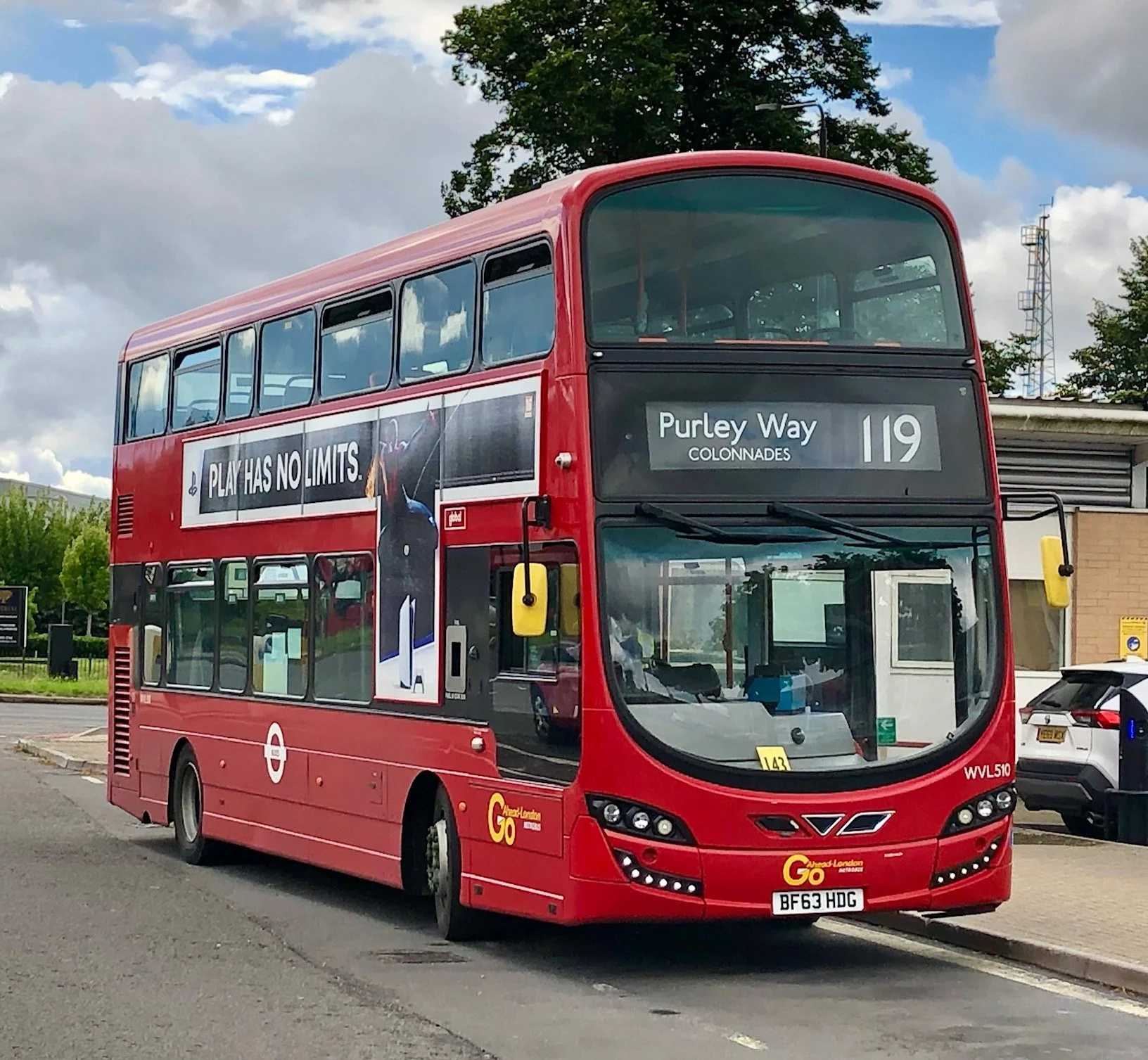
A rare vehicle at Croydon (C) Garage is WVL510, one of only two Volvo B5TL Wright deckers with GAL that started life with First London. Back in July 2021, it was captured on the 119 at Croydon Colonnades.
This bus was still around, as I saw it on the 127 at Purley Station at the end of my rides on my latest trip.
