
Edging into New Year in Edgware
My first TfL bus adventure of 2026 saw me catch up with a recent operator change and ride a grand circle from Edgware around North West London.
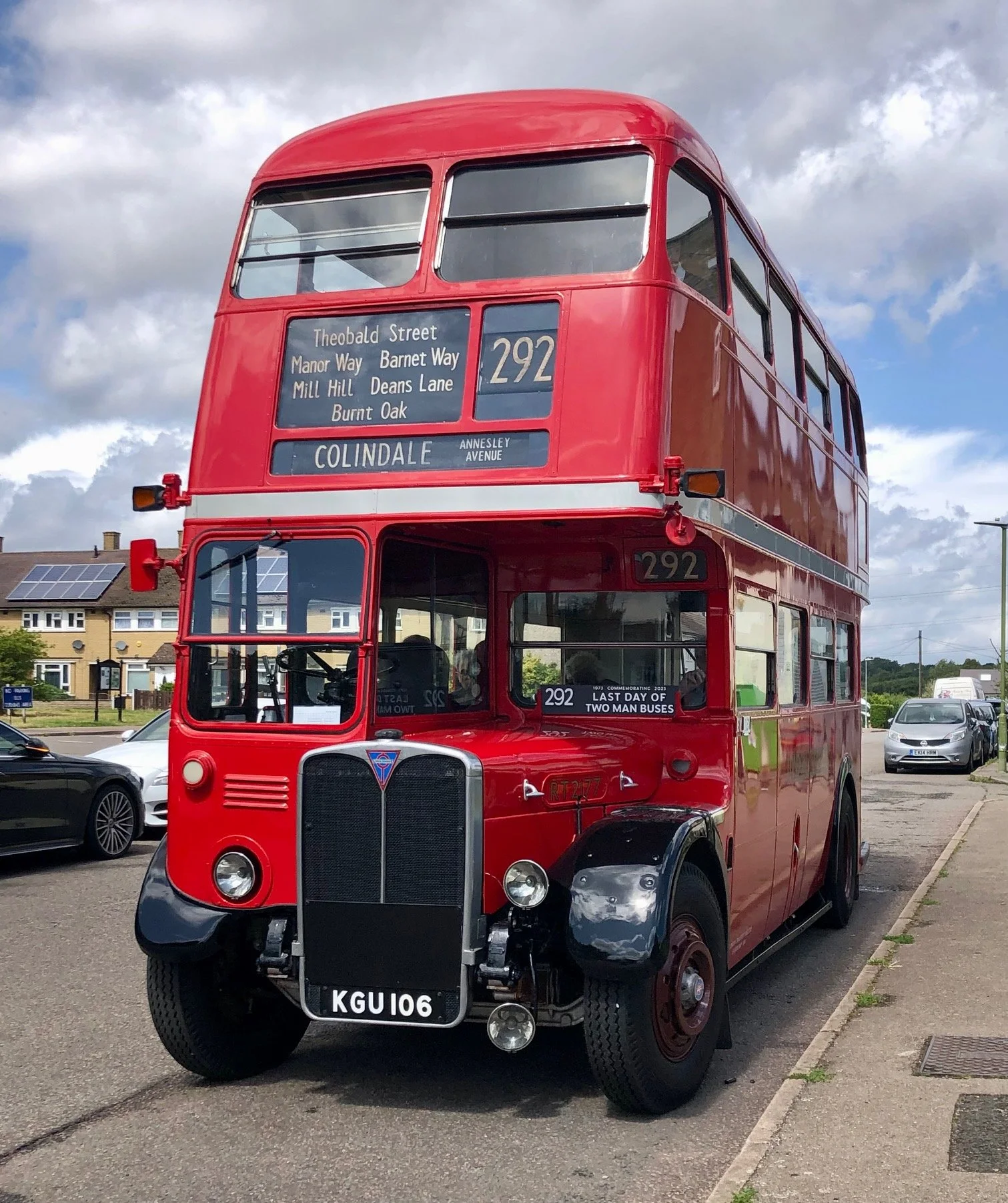
My first route of 2026 was the 292, which changed operator in December 2025 from Metroline to UNO. However, we start the new year with a classic shot of preserved AEC Regent III RT2177 at the Borehamwood Rossington Avenue terminus, on the occasion of a Running Day in July 2023.
The Running Day marked 50 years since the conversion of the 292 from crew RT to one person operation with DMS in 1973, as recalled by the board behind the bonnet.
Route 292: Edgware - Colindale - Borehamwood - Edgware
My first TfL bus rides of 2026 began at a sub-zero Edgware Bus Station on the first working day after the Christmas/New Year break. As many were still on holiday, both the roads and the buses were relatively quiet, a rare thing these days.
Top of the “to do” list was the 292, which passed from Metroline to UNO Buses on re-tender in December 2025. UNO have sourced various electric buses for the new contract, including a couple of TfL spec BYD B11E02 demonstrator models plus several BYD/ADL Enviro400EVs loaned from Stagecoach London. However, a few diesels make up the numbers, at least for now, mostly taken from the batch of Enviro400s obtained from First Bus London (formerly RATP London United).
On the day I travelled, a couple of the latter were out, so I duly boarded fleet no 1493 (ex London United ADE40426) at Edgware for the short southbound run to Colindale Superstores, a 10 min trip with the low winter sun in my eyes most of the way and precluding seeing much on the journey. After the 15 min layover, I rejoined the same bus for the full trip through to Borehamwood. The driver appeared to be route learning, as a colleague was with him giving directions and pointing out the significant features to be aware of when driving on this service. We picked up a reasonable load in Burnt Oak, presumably due to a gap in the parallel 32 and 142 routes over this section.
Turning into Station Road, we did the circuit of Edgware Bus Station again, before continuing along Hale Lane and Selvage Lane through typical suburban housing to Apex Corner. From here, the usual fast run along the A1 Barnet Way, where we encountered some remnants of winter snow at Scratchwood Open Space, where a few dog walkers were braving the elements. Swinging left at Stirling Corner, we entered Borehamwood, part of Hertfordshire and with HCC type Bus Stops replacing the TfL ones we had served up to this point. We picked up a fair number of short riders in the estate roads travelling to Borehamwood Tescos and other nearby shops. After serving Tescos, which occupies part of the site of the once much larger Elstree Studios, we made our way up the High Street to Elstree & Borehamwood Station, before continuing on the final leg via the estate roads of Theobald Street, Gateshead Road, Leeming Road and Aycliffe Road to the terminus at Rossington Avenue. 50 mins to here from Colindale.
After another break of just under 15 mins, I returned on the same vehicle to Edgware, thereby completing my rounder on the route. A bit busier in this direction, as more shoppers were emerging by this time and we took 45 mins for the trip, which included a slightly protracted driver change at Borehamwood Tesco.
It may not be obvious, but the 292 started in 1962 as part of the Trolleybus Replacement programme. It ran initially between Borehamwood and Colindale and on to Willesden Garage, replacing parts of bus 52 and trolleybus 666 on M-S, using RTs. The service included an “EXPRESS” element in M-F peaks between Borehamwood & Colindale, with buses displaying blue blinds and running non stop between Stirling Corner and Burnt Oak Station, but these workings only lasted until 1965.
Returning to 1962, within months, the Saturday service was replaced by a 292A variant which went to Edgware rather than Colindale and the following year received a long extension via the 142 to Watford Junction. In 1966, the 292A became Sats & Suns, replacing the 52 which had continued to operate to Borehamwood on Suns up until then.
OPO came to the 292 in 1973 with DMS conversion daily, with the 292A weekend variation then withdrawn, as the main 292 then became Borehamwood - Edgware, except M-F peaks when it continued to run to Colindale with some journeys to Grahame Park. 1980 saw Ms replace DMSs.
Tendering in 1987 resulted in London Country North East take the route with LR type Olympians, but due to strike action by drivers, the contract was transferred to Borehamwood Transport Services (BTS) in early 1988, using Scanias & Atlanteans. In 1993, the route assumed its present form when it was rerouted direct from Mill Hill to Edgware via Hale Lane, instead of the long way round via Burnt Oak, although it continued on from Edgware to Burnt Oak and Colindale along the Edgware Road. A new route, 305, took over the previous routeing of the 292.
Since 1993, the 292 has flip-flopped between the operators, spending periods with Metroline (using Ms again), Sovereign (with Olympians), London Sovereign (low floor mainly with SLE/VLP types) and Metroline (yet again! with VW/VWH types), until the latest change to UNO.
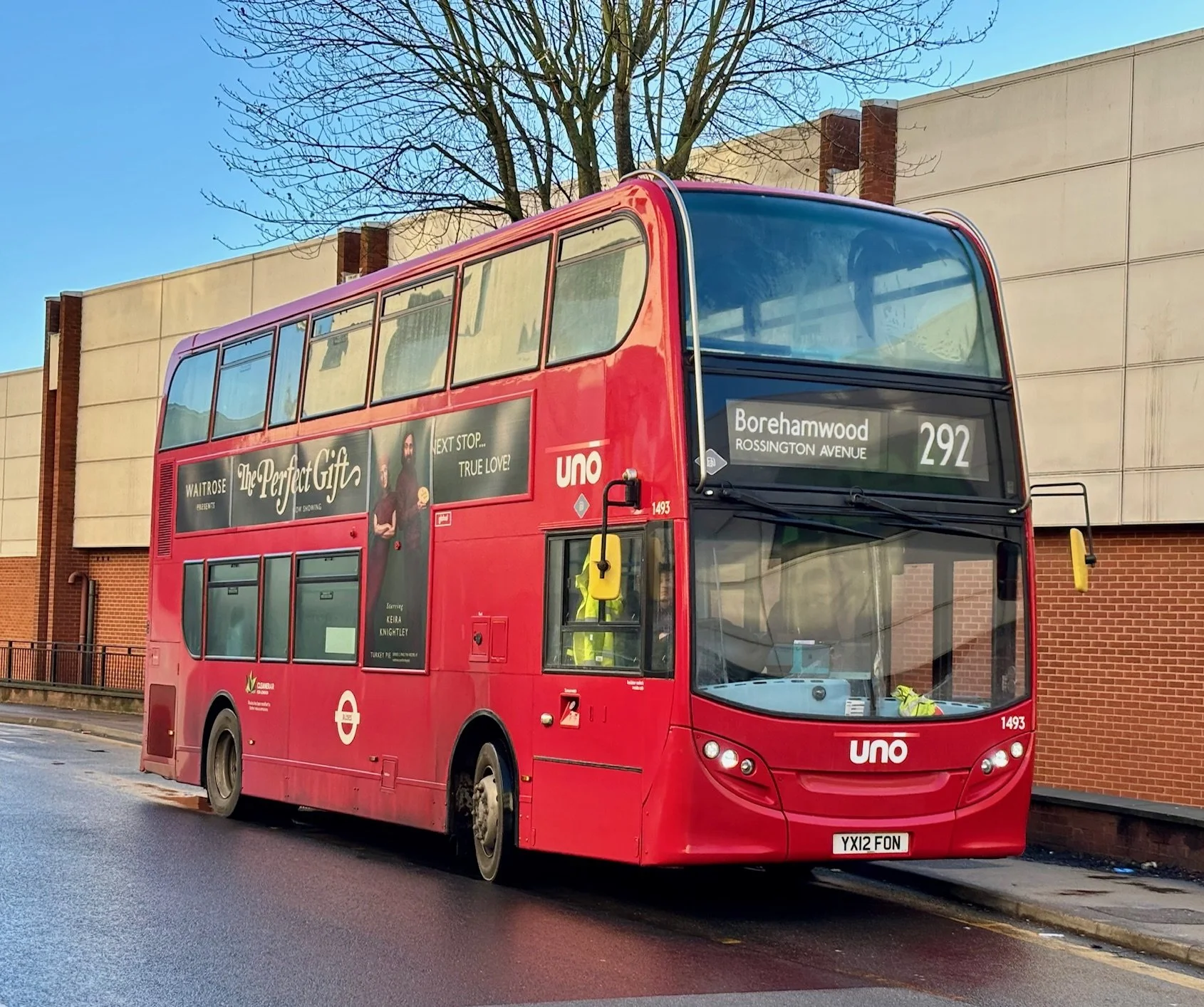
UNO took over the 292 from Metroline on 6th December. A mix of acquired and hired electric double deckers has been employed, together with a few existing diesels. One of the latter, Enviro400 fleet no 1493 is at Colindale Superstores during my rounder.
This is one of several former First Bus London / RATP London United examples now with UNO, which was formerly ADE40426 when at Hounslow (AV) Garage in its previous life.
Route 240: Edgware - Golders Green
Next on the list was the 240, an old favourite of mine as a fairly short but quite scenic local linking Edgware and Golders Green via Mill Hill and Hendon. Since my last ride on it, the former TE class Enviro400s had been replaced abruptly in 2025 by spare Wright StreetDeck Electroliners, a surprise given that the contract renewal is in April 2026 and although specified for electrics, it is rare for routes to receive these new vehicles on time, let alone several months early!
So it was that I boarded Metroline’s WDE2772 of Edgware (EW) Garage in Edgware Bus Station as the sole passenger, although a few more joined at the next stop. Then it was back along Hale Lane, although this time continuing straight on to Mill Hill Broadway, where there was an exchange of clientele. From here, after crossing the A1 at Mill Hill Circus, the nicest part of the route followed as we climbed up to the pond, cottages and general greenery of Mill Hill Village, before descending the hill down to Mill Hill East Station. From here, we continued across the Great North Way into Hendon, pausing at the site of the famous “Bell” pub, which is no longer there. Then across the North Circ and into Golders Green, terminating at the station after a smooth hassle-free run of 45 mins.
For a simple local route, the 240 has a fascinating history. It is easy to forget today that the old low bridge at Mill Hill Broadway once precluded through double deck running, so the route was split for many years, double deck with RTs on the Golders Green - Mill Hill section and TD single deckers on the overlapping Mill Hill East - Edgware section during the 1950s, although the single deck part was later subsumed into the 240A, which covered a slightly different route between Mill Hill East & Mill Hill (via today’s 221). The TDs on the 240A were the last to operate in London, not being replaced by RFs until 1962. Meanwhile, on the main 240, RTLs joined in the allocation with RTs in the mid 60s, with RMs later taking over on Sundays.
A through service between Golders Green & Edgware on the 240 finally came in 1966, with the building of a new railway bridge at Mill Hill Broadway in conjunction with the extension of the M1 motorway. Inevitably, the 240 was an early candidate for OPO, with SMS single deckers taking over in 1971. Double deckers returned in 1980 with M conversion, where they stayed for a remarkably long period, being one of the last routes to lose the type in 2003 when VPL low floor deckers replaced them. TE class Enviro400s became the norm from the late 2010s, which operated until the recent electrification of the route.
A final word about the 240A variant, which was replaced in 1966 by an extended 221 on M-S, but not on Suns, when it continued to run with RTs, by now over the full route between Golders Green and Edgware. In 1971, when OPO came to the 240, its SMSs also appeared on the 240A on Suns. However, in 1979, the 240A finally bit the dust when a Sunday service was introduced on the 221, removing the necessity for this unusual route.
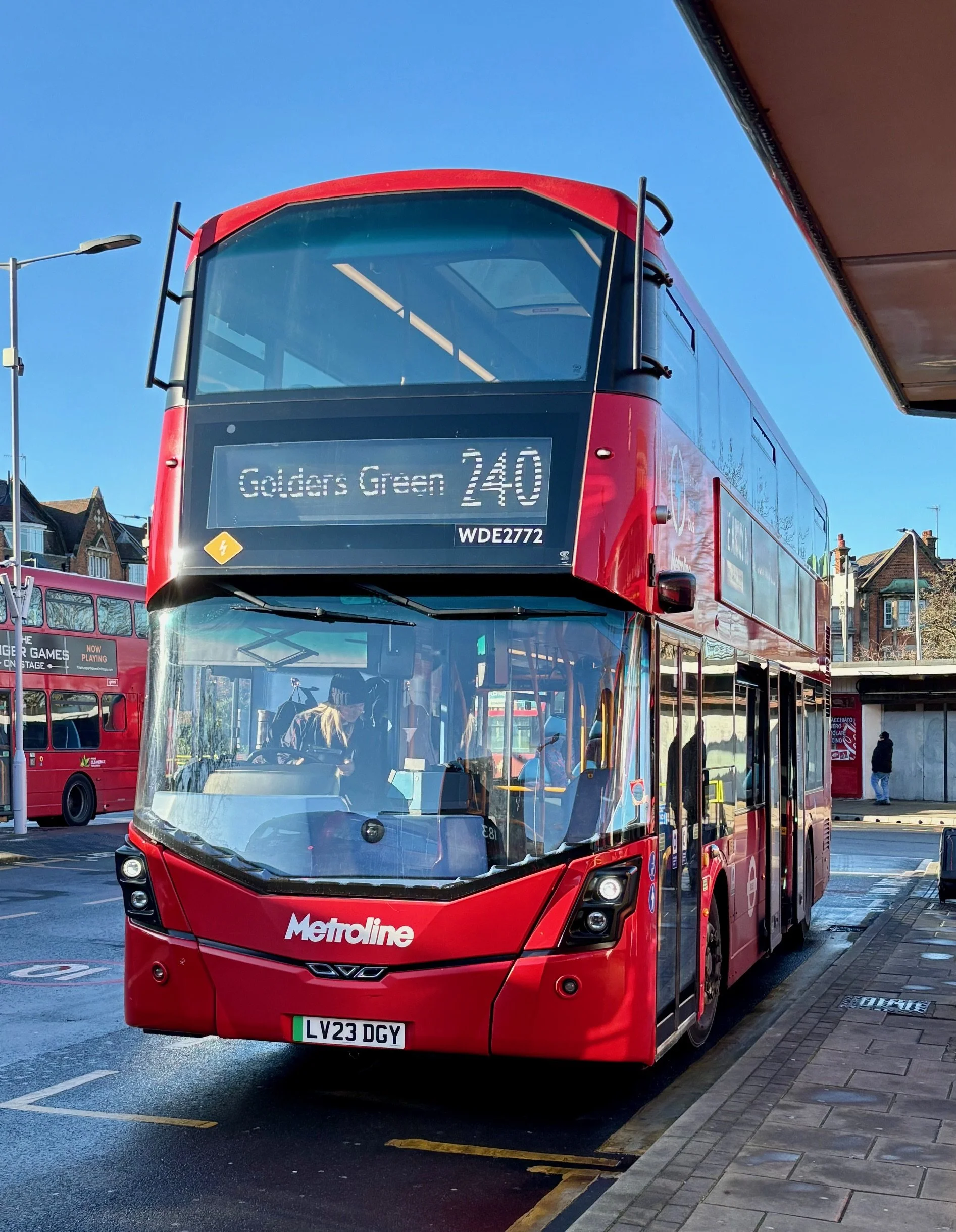
The 240 has been retained by Metroline on retender from April 2026 on the basis of new electrics. However, its former diesels were replaced earlier in 2025 by spare Wright StreetDeck Electroliners, like WDE2772, seen on arrival at Golders Green Station after my ride on it from Edgware.
It remains to be seen whether these vehicles stay on the 240 or whether new ones currently on order replace them at Edgware (EW) Garage in due course.
Route 245: Golders Green - Alperton
After a lunch and comfort stop, I continued on my travels from Golders Green on the 245 to Alperton. This is operated by Metroline from Perivale (PV) Garage, with some workings from Athlon Road (AO) outstation, although vehicles are regularly swapped between the two. The current allocation at time of writing comprises a mixture of VWH hybrids, WHD hydrogen vehicles plus a few older VW diesels. I awaited one of the latter, the next to arrive being VW1368.
Soon, we were off, exiting the Bus Station with a throaty roar that typifies these Volvos. An easy run down to Childs Hill, before turning right along Cricklewood Lane, passing under the railway bridge just before reaching the Broadway. Another right along the Edgware Road past Cricklewood Garage, before turning left into the estate roads between Gladstone Park and the North Circ. After passing along Crest Road and Tanfield Avenue past typical inter-war housing, we reached Neasden Shopping Centre, although the bus doesn’t serve it directly north-west bound, the nearest stop being somewhat inconveniently situated near the North Circ underpass. A short traffic queue to contend with at the foot of Blackbird Hill, but once through it was a straight run up to the former Brent Town Hall, now an international school.
The 245 is one of the few routes here that does not serve Wembley Town Centre, instead continuing on along Forty Avenue, crossing Preston Road and on to North Wembley, once the site of a Metroline garage. After calling at the station, we made our way along East Lane to Watford Road, where we turned south past Barham Park and the edge of Horsenden Hill open space, one of the highest points in the area, the summit at 85m being the site of an ancient hillfort. Soon we were into Alperton, passing the site of the former bus garage which has now been replaced by a new development, leaving no trace of its former use. Arrival at Sainsbury’s was after a run of almost exactly 1 hour.
The 245 is another which is a surprising child of the Trolleybus Replacement Programme in 1962. When it began, it ran between North Finchley & Stanmore via Golders Green, Cricklewood and Colindale, largely replacing the 645 trolleybus, using RMs. In 1968, it was retracted back to West Hendon / Colindale at the western end, when the 251 was amended to cover the Edgware/Stanmore section. OPO came in 1970 with conversion to SM single deck, at which time the route was completely reconfigured, being cut back from North Finchley to Golders Green at one end and diverted at Cricklewood via Neasden and North Wembley to Sudbury Town at the other end.
The following years saw various switches between single and double deck operation, with double deckers returning in 1973 on conversion to DMS, which in turn were replaced by Ms in 1980. Another single deck interlude occurred from 1987-90 using spare LS Leyland Nationals, although the Ms then returned again, but not for long, as DT class Darts took over in 1991. The following year saw the extension from Sudbury to Alperton Sainsbury’s, the route then assuming its current form. By now with Metroline, the route was converted to low floor Darts in 1998, firstly with DL and later with DLD types. First London took the contract in 2008 with DM class Enviro200s. When First pulled out of London in 2013, the service transferred back to Metroline and was double-decked again with VWs, which remain part of the current allocation, supported by other types.
Mention should also be made of the 245A variant, which has been used twice:
Firstly, for a route between Golders Green & Stanmore on Sats & Suns from 1964-68, which differed from the plain 245 by covering part of the 226 via Pennine Drive between Golders Green & Cricklewood on those days, rather than the normal route via Childs Hill. RM operated from Cricklewood Garage.
Secondly, between Golders Green & Sudbury Town on Suns only from 1970-78. This again varied from the parent route number by covering the Pennine Drive leg of the 226 on that day instead of the usual M-S routeing. Again operated from Cricklewood using in turn SM, SMS and DMS types.
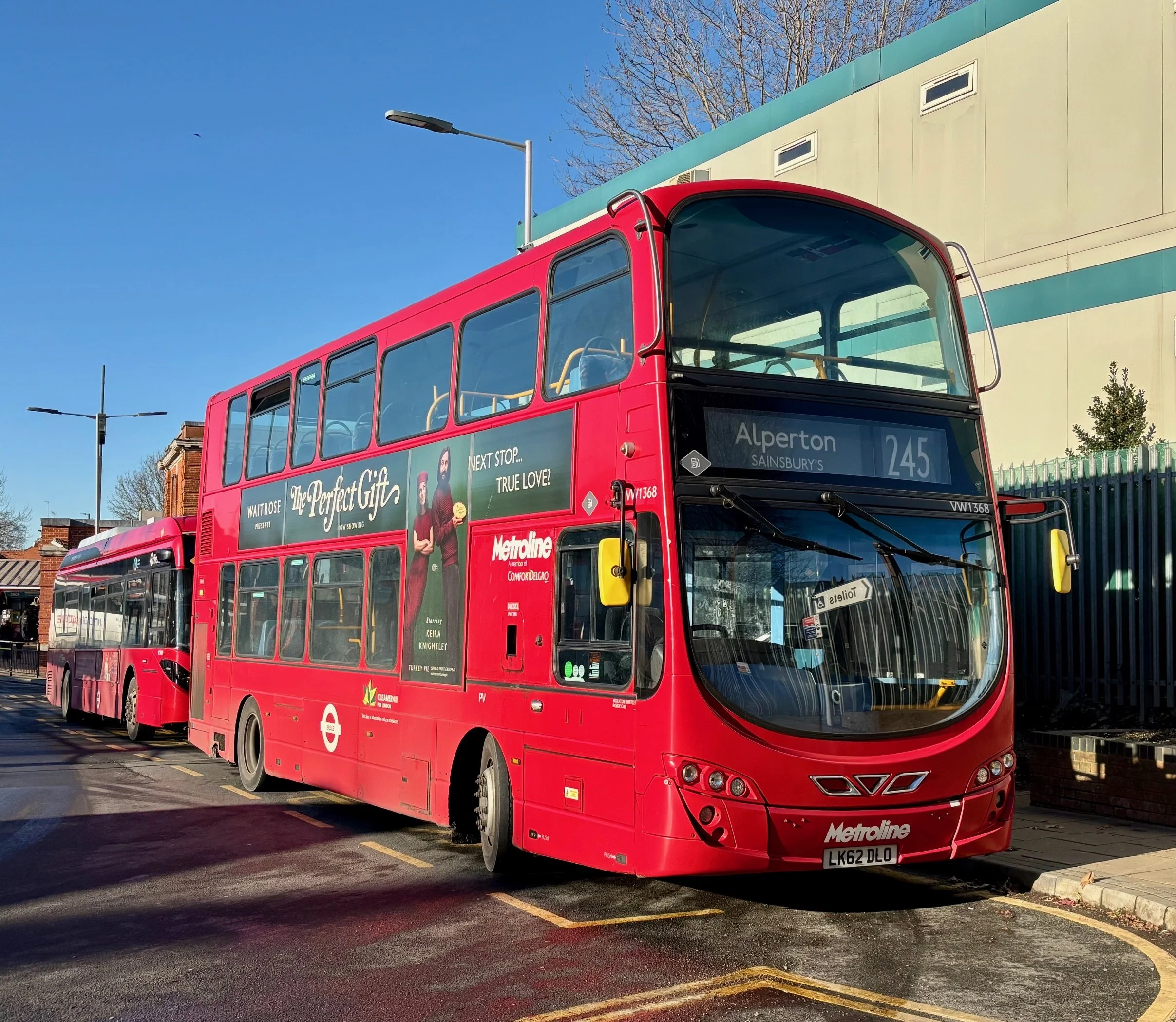
The 245 retains a few diesels as part of its allocation, together with VWH hybrids and WHD hydrogen buses. Volvo B9TL VW1368 in the winter sunshine at Golders Green Station before my ride aboard to Alperton.
The 245 allocation is nominally based at Perivale (PV) Garage, although some workings are from Athlon Road (AO) which is an outstation of PV.
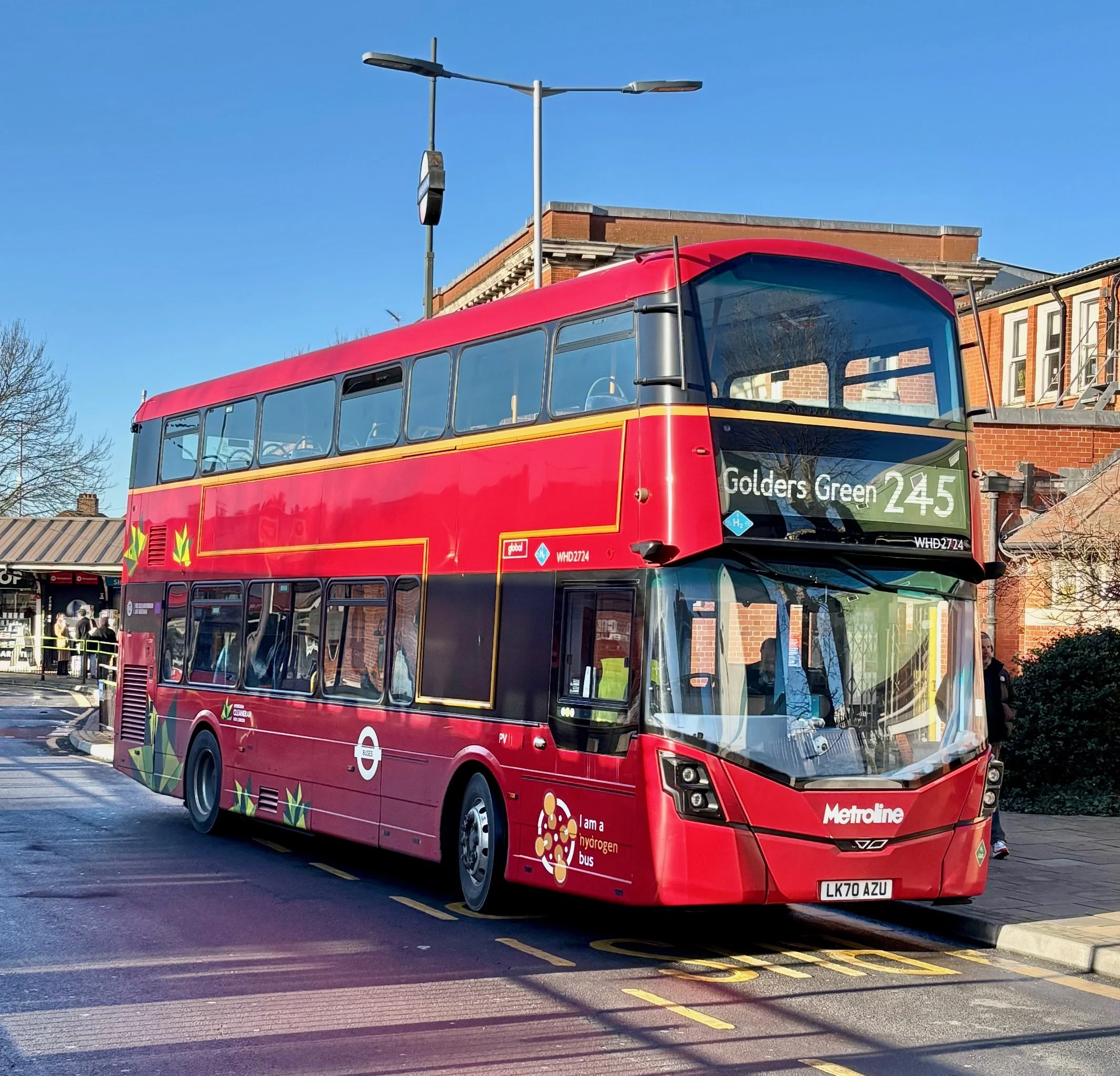
Metroline operates the only hydrogen buses on TfL work, with a batch of Wright StreetDeck FCEV types at Perivale (PV) Garage. WHD2724 illustrates the type on the 245 at Golders Green.
Route 7 into Central London is the principal home of this type, but a partial allocation appears on the 245. Note the “I am a hydrogen bus” logo on the offside, positioned low down to avoid being hidden behind the side advert, which is blank here in any case!
Route 79: Alperton - Stonebridge Park - Edgware
From Alperton Sainsbury’s, I walked the short distance past the former garage and the station along Ealing Road to the first available stop for my final route, the 79. This would take me back to Edgware in due course, completing my large loop around North West London, but first I took the next bus to the terminus at Stonebridge Park Station, a short 10 min ride through the Heather Park area. This was First Bus London’s Volvo B5LH VH45304, a type which shares the route with ADH Enviro400H and VHR Volvo B5LH SRM classes at Edgware (BT) Garage.
After a 15 min layover, I reboarded the same bus for a trip along the whole length of the route to Edgware. Despite it being mid-afternoon, traffic and passenger usage was relatively light, as it was still the school holiday period, so we made reasonable progress. A quick trip back to Alperton and up Ealing Road to Wembley, with the only real congestion encountered being along the High Road, not an unusual occurrence! Filled with shoppers, we continued along Park Lane and Wembley Hill Road through typical “Metroland” suburbia to Preston Road Station. A gentle perambulation along Preston Hill and The Mall followed, until we arrived at Kingsbury Circle. Then along Honeypot Lane, with the obligatory double-run to serve Queensbury Station, which originated in the 1930s with the opening of the Metropolitan Line branch to Stanmore and was the result of a newspaper competition, “Queensbury” being a made-up name to complement nearby “Kingsbury”!
We then continued north along Honeypot Lane, before turning right into Whitchurch Lane and serving the next station on what is now the Jubilee Line, Canons Park. This is named after the large grounds of the Canons Park Estate, largely built on in the 1930s with the coming of the Underground, but with some woodland, grassland and lakes remaining. Soon after this, we arrived back into Egware, finishing at the station after another run of around 1 hour.
The 79 is a long standing route number in North West London but has gone through several changes over the decades. When I first knew it in the early 70s, it had already been converted from crew RT to OPO MB in 1969. In those days, there were two variants, which split at Kingsbury to different northern destinations:
79 - Burnt Oak to Alperton, with a M-F Peaks extension to Northolt, Target.
79A - Edgware to Alperton.
Both were converted back to double deck with DMS in 1974 and then to M in 1980, when the Northolt peaks extension on the 79 came off. However, a new extension was added to Willesden Junction in 1983 on M-S, with a separate extension to Ealing Broadway added in 1984 on Suns. However, later the same year the 79 was wihdrawn completely, replaced by changes to the 226 and 297.
This left the 79A to continue as an orphaned route between Edgware & Alperton, but when the route passed to London Buslines in 1979 under tendering, the opportunity was taken to renumber it as plain 79, which is the origin of today’s version of the route. After a period with DMS then Olympian operation, London Buslines was purchased by First Centrewest, who continued on the route until 1996. In that year, MTL London took over with MM class single deckers, although in 1998 they in turn were bought out by Metroline. EDR Darts then replaced the MMs. First returned to the route in 2001, restoring a top deck with TN class Tridents, later replaced with VNW Volvo B7TLs, until VW Volvo B9TLs took over in 2011 when the route passed back to Metroline again.
The route was reassigned to RATP London Sovereign in 2018, with a plethora of types appearing until RATP sold out to First Bus London in early 2025. The final route change came in 2023 with the diversion at Alperton to Stonebridge Park, which was introduced to improve bus connections to Heather Park following new housing developments in the area.
Back at my start point of Edgware, my rides were concluded for the day and it was time to make my way home after a successful trip.
Watton
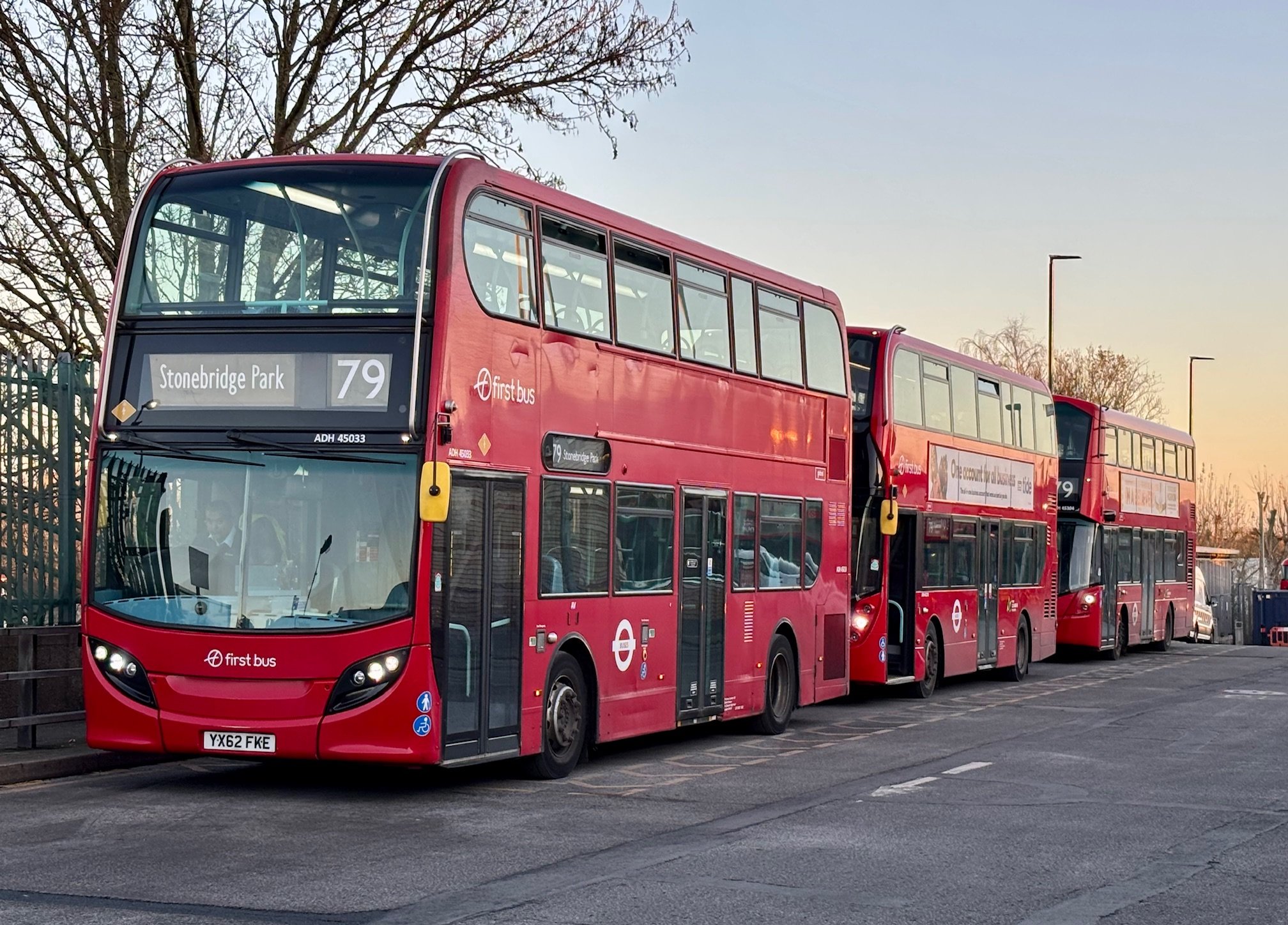
A trio of First Bus London buses lined up at Edgware Bus Station on the 79 illustrate the main types to appear on the route. “Classic” Enviro400H ADH45033 leads an unidentified MMC version of the type, with Volvo B5LH Wright VH45304 (the one I travelled on) at the rear.
All these buses are allocated to Edgware (BT) Garage, the only type missing being the VHR variant of the Volvo B5LH, which also appears on the 79 from time to time.
