
Camberwell & Battersea Duos
On this trip, I take advantage of quieter traffic over the Easter weekend to ride routes linking the City and the West End with South East and South West London, featuring electric and hybrid operation.
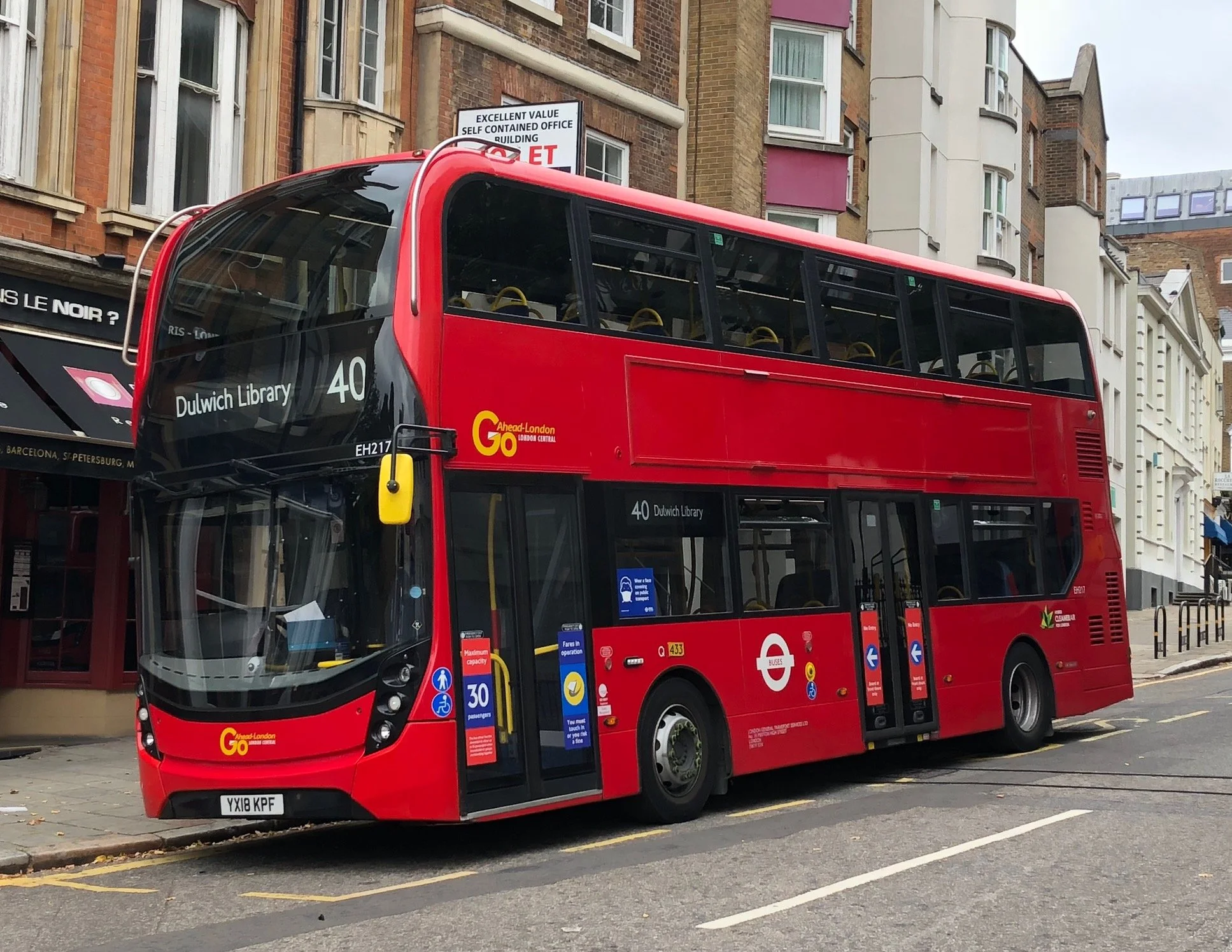
We begin with a retro shot of GAL Enviro400H MMC EH217 of Camberwell (Q) Garage on the 40 at Clerkenwell Green stand back in Aug 2020. At the time, the route was a mix of EH and MHV hybrids.
This was during Covid when the maximum number of passengers permitted on double deckers was 30, hence the signage on the doors.
Route 40: Clerkenwell Green - Dulwich
The Thameslink service brought me to Farringdon Station early on a quiet morning over the Easter Weekend, where it was a short walk around the corner into Farringdon Road to pick up my first route of the day, the 40, operated by Go Ahead London out of Camberwell (Q) Garage. My previous trip on the route had been soon after the service had been rerouted from Aldgate to Clerkenwell Green back in 2019, at which time it was a hybrid operation featuring EH and MHV types. However, in April 2023, the contract was renewed with new Ee class Enviro400EV City types, which I had yet to sample on the service.
I had less than 5 mins to wait before Ee199 came off the stand and around the corner to the first stop, where I boarded as the sole passenger. The usual bright modern interior greeted me, with wood-effect flooring, high-backed seating and USB ports. The updated info screens were displaying next stop indications, but oddly showed “40 to Clerkenwell Green” throughout the trip, rather than “40 to Dulwich Library” - faults with the more modern displays seem not to be uncommon for some reason.
We rumbled down Farringdon Road across Ludgate Circus to Blackfriars Station and over the bridge without any other takers. Only when we reached Southwark Station did we start to pick up a few. Interestingly, along Blackfriars Road, some of the stops had new style shelters in place with signage saying that these were experimental designs, although from my observations there wasn’t much that was revolutionary about any of them, just minor tinkering with the previous format! At Elephant & Castle, we at last began to pick up a reasonable number and continued at pace along a remarkably traffic-free Walworth Road.
Very soon, we reached Camberwell Green, close to the operational garage, although there was no driver change on this trip and we continued straight on. Dropping a few off at King’s College Hospital, we turned left beside Denmark Hill Station, with its unusual sculptures in the adjoining woodland. Then down Dog Kennel Hill to East Dulwich, where there was once a unique section of double track in each direction during the days of Trams. Arriving at Goose Green, we picked up a few short-riding passengers for the final section along Lordship Lane to the terminus at Dulwich Library, which was closed for rebuilding and covered in scaffolding. An impressive ride of just 40 mins on Route 40!
The 40 was once a complex group of routes with “A” and “B” variants at different times and operating between different points on different days of the week. Prior to 1970, the plain 40 ran between Wanstead/Wanstead Flats and Herne Hill/Norwood Junction, but in that year it was diverted at the eastern end to East Ham on Sat afternoons and cut back to Poplar at other times. It also became weekends only, with the 40A increased on M-F and becoming the main service to replace it on those days. The 40A had begun in 1965, covering the same roads as the parent between Poplar and Camberwell Green/Herne Hill, but with a M-F peaks extension to North Woolwich, which necessitated the suffix. In 1965/6, there was a short-lived Sats only 40B variation (as per the 40A but deviating via Loughborough Junction). When the 40B came off, the 40A became M-S until 1970, when it reverted to M-F with the 40 becoming the main service on Sats & Suns!
All this was simplified with the “Busplan” changes of 1978, when the 40A was withdrawn and the 40 became Poplar - Herne Hill at all times, although still with a M-F peaks extension to North Woolwich until 1982. The East End terminus moved around in subsequent years but settled on Aldgate in 1999, whilst the southern destination changed to Dulwich Library in 1994. The final rerouteing, from Aldgate to Clerkenwell Green, came in 2019.
In terms of vehicle types, the 40 was converted from RT/RTL to RM/RML in 1965/6, although the odd RT continued to appear afterwards for a few years. A part crew DM allocation was added at weekends from 1975-8. Several garages had part allocations over the years but Poplar (PR) & Camberwell (Q) became the main two from 1970 onwards. Crew Titans from PR alone took over in 1984, presaging OPO conversion with the same vehicles the following year when PR closed and the allocation was transferred to Q. NV class Olympians succeeded to the route in 1997, with low floor conversion using PVL/WVL types coming in 2002. However, the odd Titan still turned out with the route famously hosting the very last T in normal London service during 2003. By now with GAL, the route transferred to Travel London (later Abellio) from Walworth (WL) in 2009 for a 7 year term using Enviro400s, but returned to its old firm and old garage at Q in 2016, this time with EH/MHV hybrids, which continued until electrification in 2023.
The 40A & 40B suffixed variations were essentially always RM operations throughout their lives, although with the occasional RT interloper.
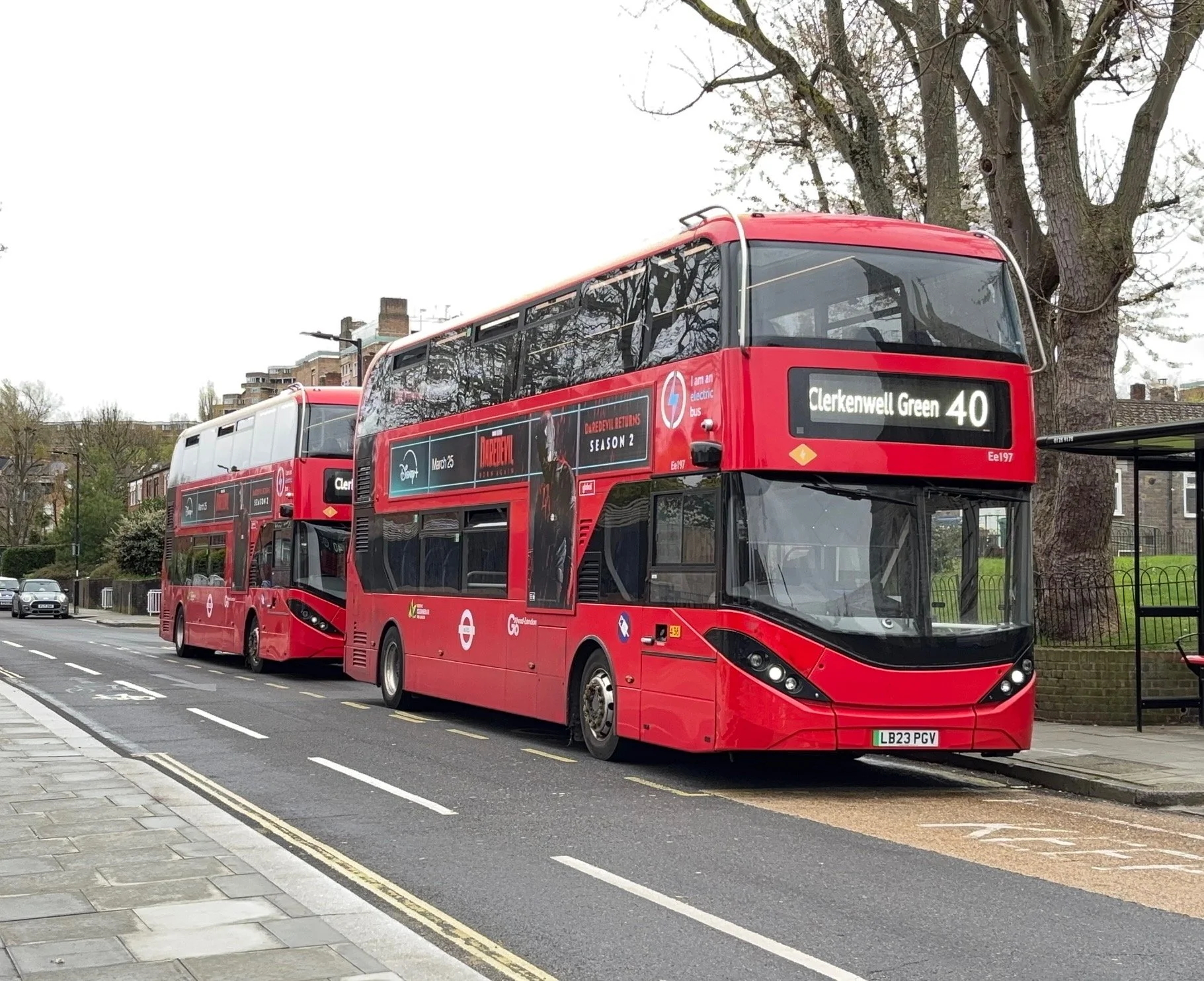
The current allocation on the 40 comprises Enviro400 City EVs. Ee197 is ahead of Ee199 (both Q), the latter of which I travelled on, at the Dulwich Library terminus.
Despite the destination display, the route doesn’t quite make Clerkenwell Green in service, the last stop being near Farringdon Station.
Route 12: Dulwich - Oxford Circus
At Dulwich Library, I walked around the corner to Etherow Street, before arriving at the first pick up stop for my next route, the 12, which shares a terminus with the 40 at this point, both routes being operated by GAL from Camberwell (Q). A 197 to Peckham arrived and scooped up the queue, meaning that when New Routemaster LT444 pulled in behind on the 12, I had the bus to myself for the first few stops. We sped off in pursuit of the 197 in front and followed it between the rows of housing to Peckham Rye, where we had a brief glimpse of open space and greenery on this mainly urban inner city route. Continuing along narrow Rye Lane past the station, we picked up a good number in the shopping area, before turning left into Peckham High St. Soon after this, on passing by the Harris Academy, I noted a yellow 3-wheeler Reliant Regal Supervan in the yard with signage for “Trotters Independent Traders” as used by Del Boy & Rodney in the BBC sitcom “Only Fools & Horses” which was supposedly set in Peckham, but whether this was one of those actually used in the series, I have no idea!
A good number joined us along Peckham Road, before arriving at Camberwell Green again, which we had reached via a very different intermediate route from Dulwich than the 40 I had been on earlier. Turning right, we joined up with the 40 again along the length of Walworth Road, until parting company once more at the Elephant & Castle roundabout. Incidentally, the name for the area is derived from a local 18th Century coaching inn, the original having been replaced at least 3 times since by pubs of the same name. An elephant with a castle on its back is also the crest of the Cutler’s Company of the City of London, because of the use of ivory in the handles of cutlery, but it is uncertain whether there is any connection with the place or the inn.
We branched off at the roundabout towards the Imperial War Museum, an imposing building set in tree-lined grounds, which was set up in 1917 to record the effort and sacrifice of the UK and its Empire in WW1. After initially being housed at Crystal Palace and then at South Kensington, the museum moved to the current site in 1936 into the former Bethlem Royal Hospital which had relocated. Eventually, the museum became devoted to all conflicts in which British or Commonwealth forces have been involved since 1914. Other branches of the museum opened subsequently are Duxford Airfield (near Cambridge), HMS Belfast and Churchill War Rooms (in London) and IWM North (in Manchester).
From here, we powered on past Lambeth North Tube Station, before crossing under the railway bridge on the approach to Waterloo Station and reaching County Hall Roundabout. We then crossed the River Thames over Westminster Bridge, with the familiar sight of the Houses of Parliament and the recently restored Big Ben to our left. A “Buses Only” right-turn at the traffic lights meant we didn’t have to circumnavigate Parliament Square, watched over the huge statue of Winston Churchill and thronged with tourists. Soon, we were making our way along Whitehall, past the Cenotaph, Downing Street and various Government Buildings, before arriving at Horse Guards Parade, where many visitors were taking the expected selfies. Up to Trafalgar Square, where most of our passengers alighted, before the final stretch across Piccadilly Circus and the famous Eros statue, then into Regent Street with its high class shops, the covered arcades at the southern end being specially built to keep the rain off the well-to-do shoppers who frequented the area in the 19th Century. Arriving at Oxford Circus, we crossed Oxford Street to complete the journey at Margaret St, after a run of 55 min, not bad.
As I walked around the block and into Oxford Street itself, I reflected how the number of buses running east-west and vice versa has declined in recent years. There were once so many frequent routes operating between Oxford Circus and Marble Arch that there seemed to be a permanent “bus wall” over this section, but as many services have been shortened or diverted away from the area, just 5 routes are left on this section, with few buses to be seen. Even that reduced level of service is due to disappear, if mayoral plans to pedestrianise Oxford Street between Oxford Circus and Selfridges come to fruition as planned later in 2026, with the 7 and 94 cut back and the 98, 139 & 390 rerouted via Wigmore St.
At one time, the 12 was perhaps the most complicated route in London. Operating “in extremis” from South Croydon to Harlesden Willesden Junction (with a M-F Peaks extension to Park Royal) for many years, it ran in a complex series of overlapping sections for much of the time, which varied by day of the week and time of day. An odd feature was that the Shepherds Bush - Harlesden section was covered by an extension of the 49 on Sundays only from 1958-78. 4 or even 5 garages at a time had a hand in its allocation, some on certain days of the week only. Back in the mid 50s, the PVR was over 100, but this declined inexorably until reaching the shrunken rump which operates today between Dulwich & Oxford Circus and requires just 15 buses.
At the southern end, new OPO Route 12A came in 1972 between Peckham and South Croydon, replacing the 12 south of Norwood Junction. SMS operated to begin with, these were replaced with LS class Leyland Nationals in 1977. The route gained spurs to Selsdon (M-S), Riddlesdown (M-F peaks) and in 1984 was extended to Purley Old Lodge Lane to replace the 234/A. The 12A was cut back from Peckham to Forest Hill in 1981, being covered satisfactorily by the 12, but when the parent route was withdrawn between Norwood Junction & Penge in 1986, the suffixed variant returned to Peckham once again! The 12 itself was cut back from Penge to Dulwich in 1988, assuming the southern terminus which exists to this day.
From 1986-90, another variant, numbered 12B and also using LS, replaced the 12A on Sunday, operating from Peckham but differing at the southern end by running to Chipstead Valley in lieu of the 59 on that day. However, both the 12A & 12B were withdrawn in 1990 when the Peckham - Croydon section was renumbered 312 and the Old Lodge Lane section was replaced by new route 412, these latter two routes surviving today in modified form.
Meanwhile, at the western end of the 12, the route was cut back from Harlesden/Park Royal to East Acton in 1986, with a new localised OPO service numbered 255 running between Shepherds Bush and Harlesden. Further retractions at this end came in 1991 (to Shepherds Bush), in 1994 (to Notting Hill Gate) and finally in 2004 (to Oxford Circus). Since then, the 12 has plied its course between Dulwich & Oxford Circus only.
In terms of principal types, the 12 was unusual for a major Central London trunk route in retaining RTs fairly late, its massive allocation being converted to RM only in stages between 1968 and 1973. RMLs soon entered the mix as did doored buses on Sundays, with crew DM and MD featuring in the mid-late 70s. OPO came on Sundays only from 1988, with T and L types putting in a turn, although these were replaced in the noughties with low floor double deckers, principally PVL & AVL classes. Crew operation with RMLs finally ended in 2004, when the whole daily service was converted to MAL class Mercedes Benz Citaro bendibuses, seen as a controversial move at the time. Double deckers returned in 2011 when WVLs took over, the current LTs replacing them in 2015.
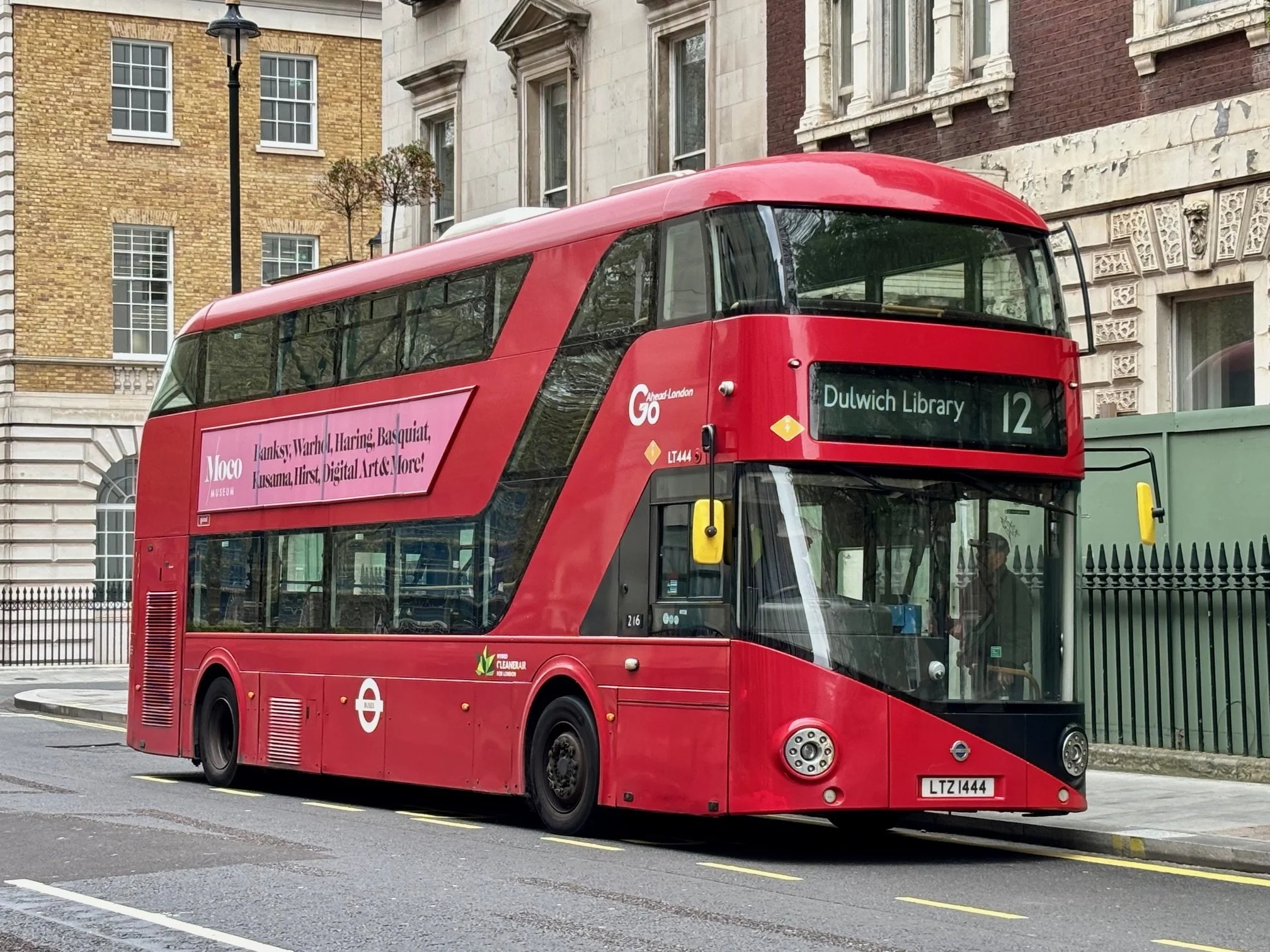
New Routemaster LT444, also of Camberwell (Q) Garage, at the Oxford Circus stand of the 12 at Cavendish Square after I had journeyed on it from Dulwich.
The current PVR of the 12 is just 15, a come down from the massive 100+ vehicles on the much longer version of the route which existed in the 1950s!
Tube: Oxford Circus - Vauxhall
At Oxford Circus Station, I descended to the Victoria Line, which I took a few stops south to Vauxhall, where I alighted less than 10 mins later.
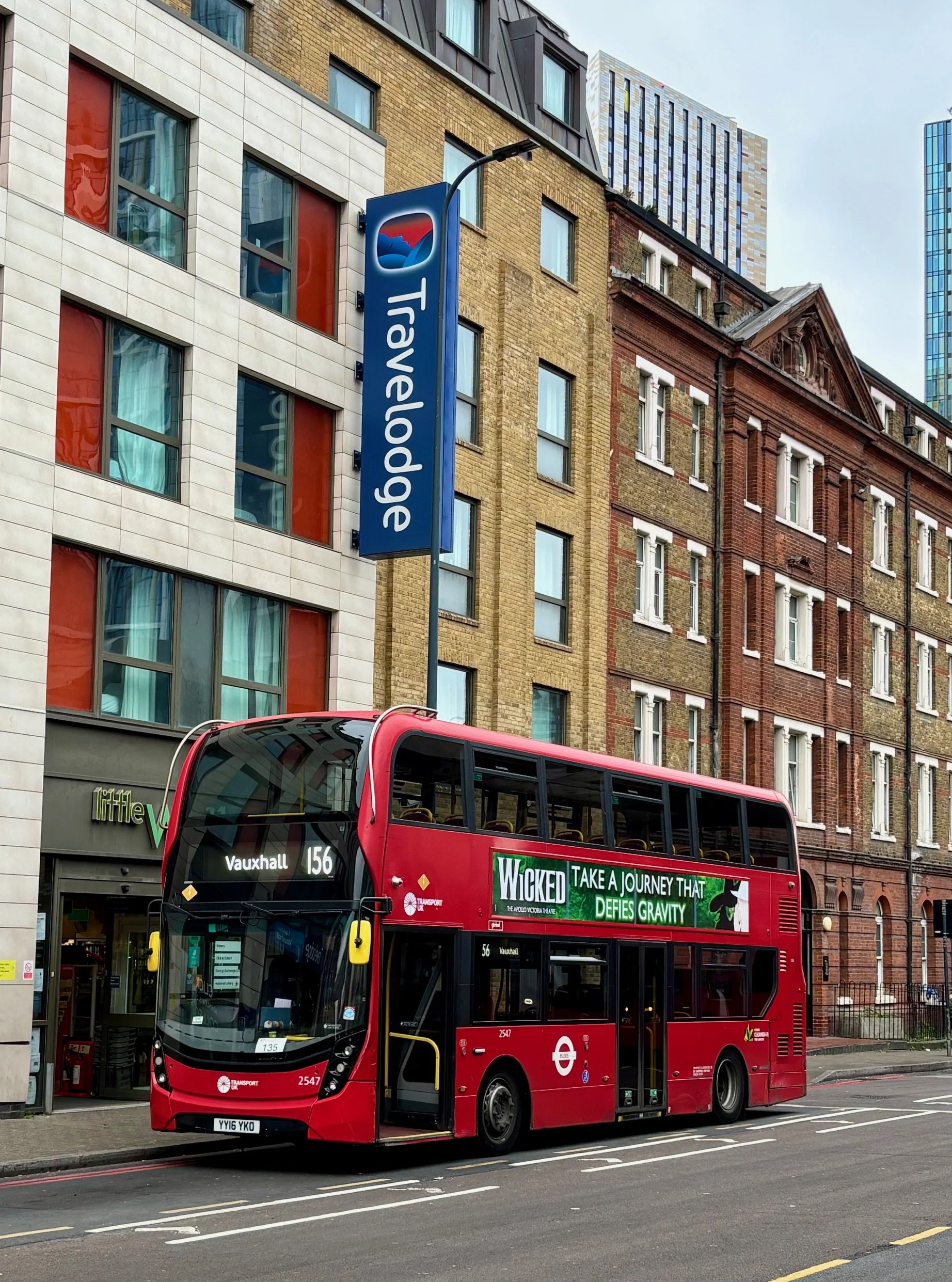
Transport UK Enviro400H MMC no 2547 parked up outside the Travelodge at Vauxhall Bus Station on the 156, although I travelled on a different bus.
The route is currently a mix of MMC and “classic” Enviro400s from Battersea (QB) Garage.
Route 156: Vauxhall - Wimbledon
At Vauxhall, I came up from the Underground into the Bus Station, where my next route, the 156, commenced. This is operated by Transport UK from Battersea (QB) Garage using a mix of older and newer Enviro400 hybrids, but has been retained on retender from September 2026 on the basis of new electric double deckers. Therefore, probably my last time sampling the current offering, where I opted for one of the “classic” Enviro400H examples, fleet no 2472.
We set off with a fair load, although these were mostly short-riders to the new Battersea Power Station retail development. Passing the monolith that is the new United States Embassy, followed by New Covent Garden Market at Nine Elms, we soon arrived at Battersea Power Station Station (!), which serves the adjacent massive Grade II* listed art deco building from the 1930s now decommissioned and repurposed as a mix of retail, bar, restaurant and leisure venues. Next stop was Battersea Dogs & Cats Home, strangely but appropriately to the accompaniment of a couple of barking dogs who were with their owners on board!
From here, we passed Battersea Park and Queenstown Road Stations in quick succession, before turning right into the main Wandsworth Road and passing Battersea Arts Centre before arriving into the shopping area of Clapham Junction. A bit of a trundle up St John’s Hill and across Trinity Road, where we avoided the traffic queue down into Wandsworth by use of the Bus Lane. Passengers on and off at the Southside Shopping Centre, before the final suburban section along Buckhold Road, Merton Road and Durnsford Road, then a right via Gap Road and Alexandra Road beside the South Western Railway depot into Wimbledon. We terminated just past the station after a run of a couple of minutes under the hour.
This version of the 156 is the fourth use of the number in London, the previous iterations being:
Morden & Sutton Circular (1934-61), associated in its final years with the RT class.
Parliament Hill Fields - Clapham Junction / Wandsworth (1963-65), M-F only with RT / RTL.
Becontree - Barking / Creekmouth (1971-82), initially RT then OPO from 1973 with DMS and later T.
The current 156 came in 1983, running between Morden and Clapham Junction, replacing withdrawn sections of the 77A and M1. A M-F peaks extension to Vauxhall direct via Wandsworth Road Station was added in 1985. Then, in 1987, the route was withdrawn on M-S between Morden and Raynes Park when the 163 took over this section. The service was then greatly simplified in 1991, when it became Wimbledon to Clapham Junction at all times. The extension back to Vauxhall via Queenstown Road came in 2002.
Originally operated by London Buses with DMS types, a few Ms saw service in 1991 before the route was converted to “Streetline” DR type Darts the same year, although MRL Metroriders later took over. The contract passed to Limebourne in 1997 with Darts, this company being taken over by Connex in 2001. Double decking with Trident Alexander ALX400s came in 2002, these vehicles passing through the subsequent ownership of Travel London and Abellio. Enviro400s came with contract renewal in 2009, diesels being replaced by hybrids in 2021 made spare from the loss of the 49 to RATP. Abellio was purchased by Transport UK in 2023.
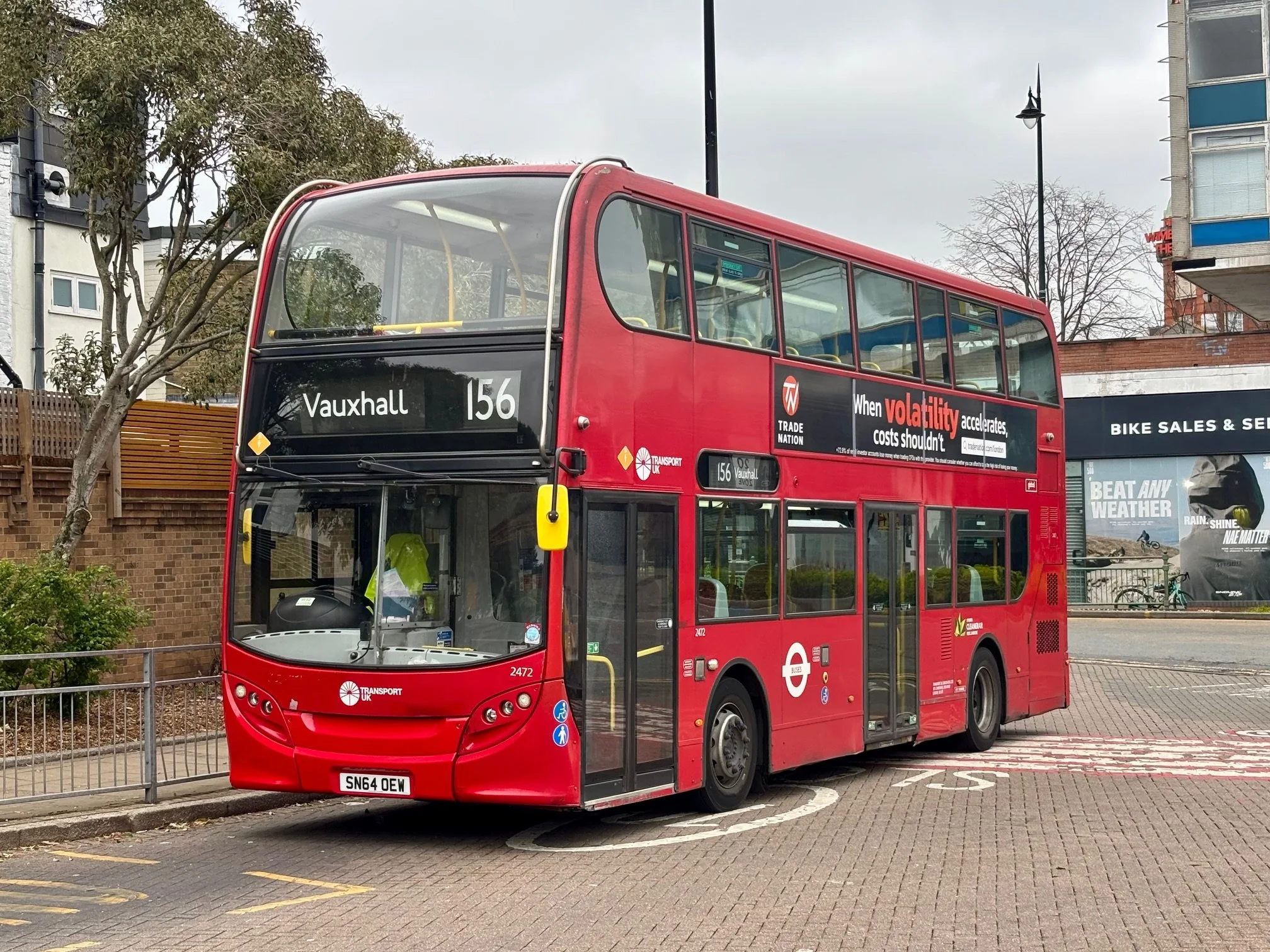
At the other end of the 156, we see “classic” Enviro400H no 2472 (QB) at Wimbledon Bus Station between trips, after I had travelled on it from Vauxhall.
The contract for the route has been retained by Transport UK from September 2026, with new electrics intended to replace the hybrids.
Train: Wimbledon - Clapham Junction
Entering Wimbledon Station, I joined a new “Arterio” EMU train on the South Western Railway service to Clapham Junction, with one intermediate stop at Earlsfield.
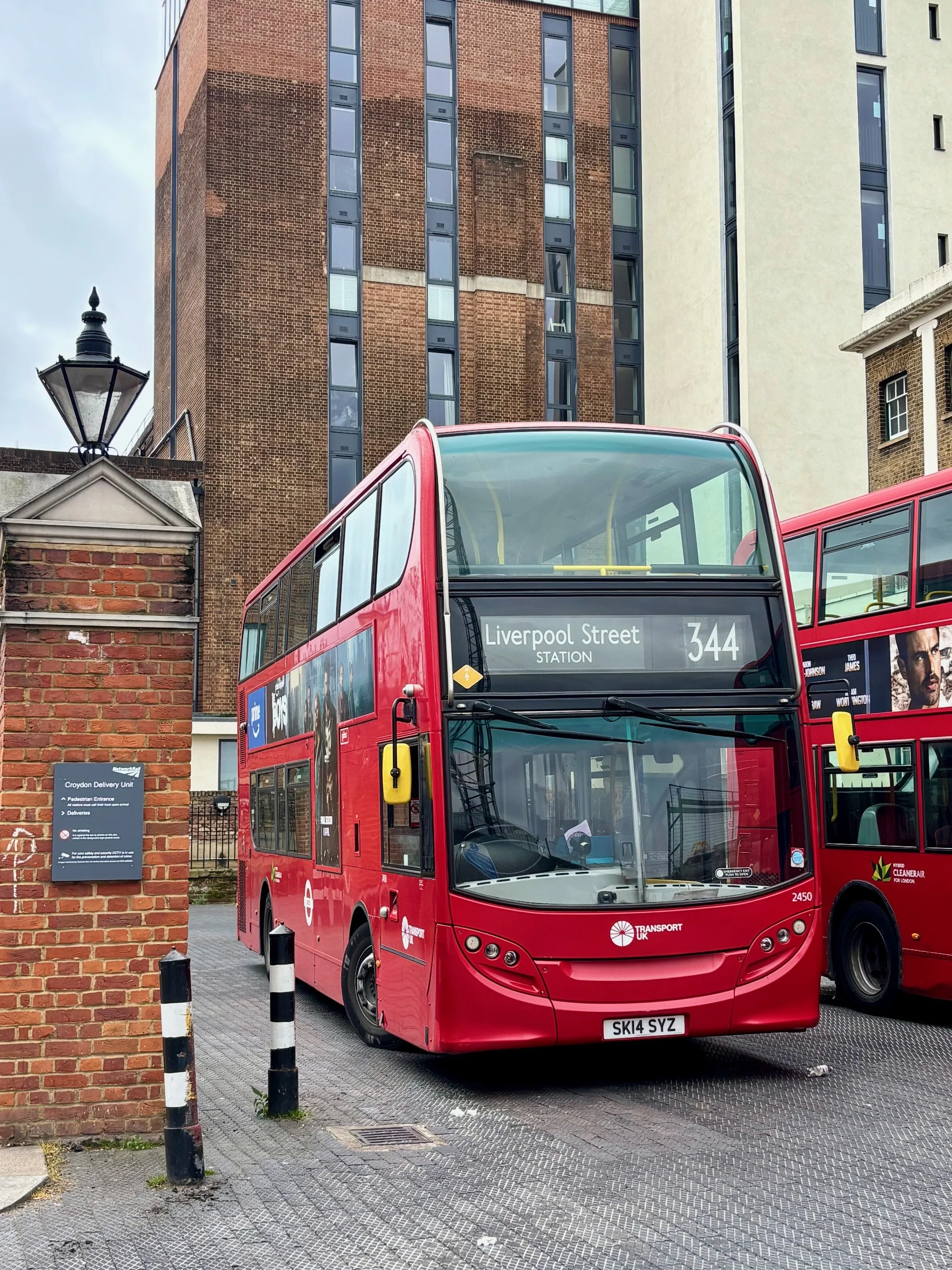
Another of the older Enviro400H deckers, no 2450 of Battersea (QB) Garage, shares the cramped stand at Plough Road Clapham Junction with a classmate on the 344.
The 344 is also due to receive new electrics in due course following its contract renewal with Transport UK from August 2026.
Route 344: Clapham Junction - Liverpool Street
Outside Clapham Junction Station, I observed a couple of buses further up St John’s Hill on the Plough Road stand for my final route of the day, the 344. First to depart was Enviro400H no 2429, another Transport UK vehicle based at Battersea (QB), which I was the only one to board at the first stop. Like the 156, this route has been retained on retender by the same operator, this time from August 2026, with new electrics intended to replace the existing hybrids in due course.
A large crowd awaited us as we turned the corner into Falcon Road and we picked up more at subsequent stops before turning into Battersea Park Road. Busy traffic and 20mph limits caused a slow run past The Latchmere through to Battersea Park Station, where we rejoined the 156 for the section past Battersea Power Station to Vauxhall, this time in the opposite direction to my earlier journey on the latter route. Continuing beyond the Bus Station, we made our way past the south side of Vauxhall Bridge and beside Vauxhall Cross, the prominent and well-known high-security HQ of the Secret Intelligence Service (SIS/MI6), which has appeared frequently in James Bond films. Further along Albert Embankment we came closer to the south bank of the Thames, which we followed to Lambeth Bridge, swinging right at the roundabout next to Lambeth Palace, official London residence of the Archbishop of Canterbury.
Continuing along Lambeth Road, we passed the Imperial War Museum for the second time on my travels that day, before looping around St George’s Circus down to Elephant & Castle. After a short stretch along Newington Causeway, we turned off into Southwark Bridge Road along the freehold section of route. However, the service was diverted northbound some years ago over London Bridge rather than Southwark Bridge, oddly whilst still using the latter southbound, so we turned into Southwark Street and past a bustling Borough Market followed by Southwark Cathedral and on to London Bridge, where we picked up a few short-riders to Liverpool St.
It didn’t take long to cross the Thames, with the familiar views of Tower Bridge, Tower of London and HMS Belfast to our right, before passing Monument Station then on to Gracechurch St and Bishopsgate. Just before London Wall, we passed the little church of St Ethelburga, one of the few surviving Medieval churches in the City of London, which was severely damaged by an IRA bomb in 1993 but subsequently restored and re-opened as a Centre for Reconciliation and Peace. From here, it was only a couple more stops to our final destination, Liverpool Street Station, where we terminated in the adjacent Bus Station after a total journey time of 65 mins.
The 344 emerged from the splitting of the 44 in 1991, running between Clapham Junction and London Bridge. It was rerouted from Southwark Bridge Road over Southwark Bridge to Liverpool Street in 1999. Since then, there have been just minor adjustments to terminal arrangements, plus the northbound rerouteing over London Bridge as mentioned earlier.
The first operator was London General with M (with the odd DMS for a while), although the Sunday operation saw midibus operation for some years involving SR, MRL, MA, DRL and DW types at different times. This was another service that passed to the ill-fated Limebourne in 1999 using mostly Caetano Darts, followed by their successor Connex. After double decking again in 2002 with Trident Alexander ALX400s, the route passed again on change of ownership to Travel London in 2004 followed by Abellio in 2009. By this time, Enviro400s had taken over, with MMC versions later joining the “classic” ones on the service. Transport UK became the operator in 2023 in line with other routes previously with Abellio.
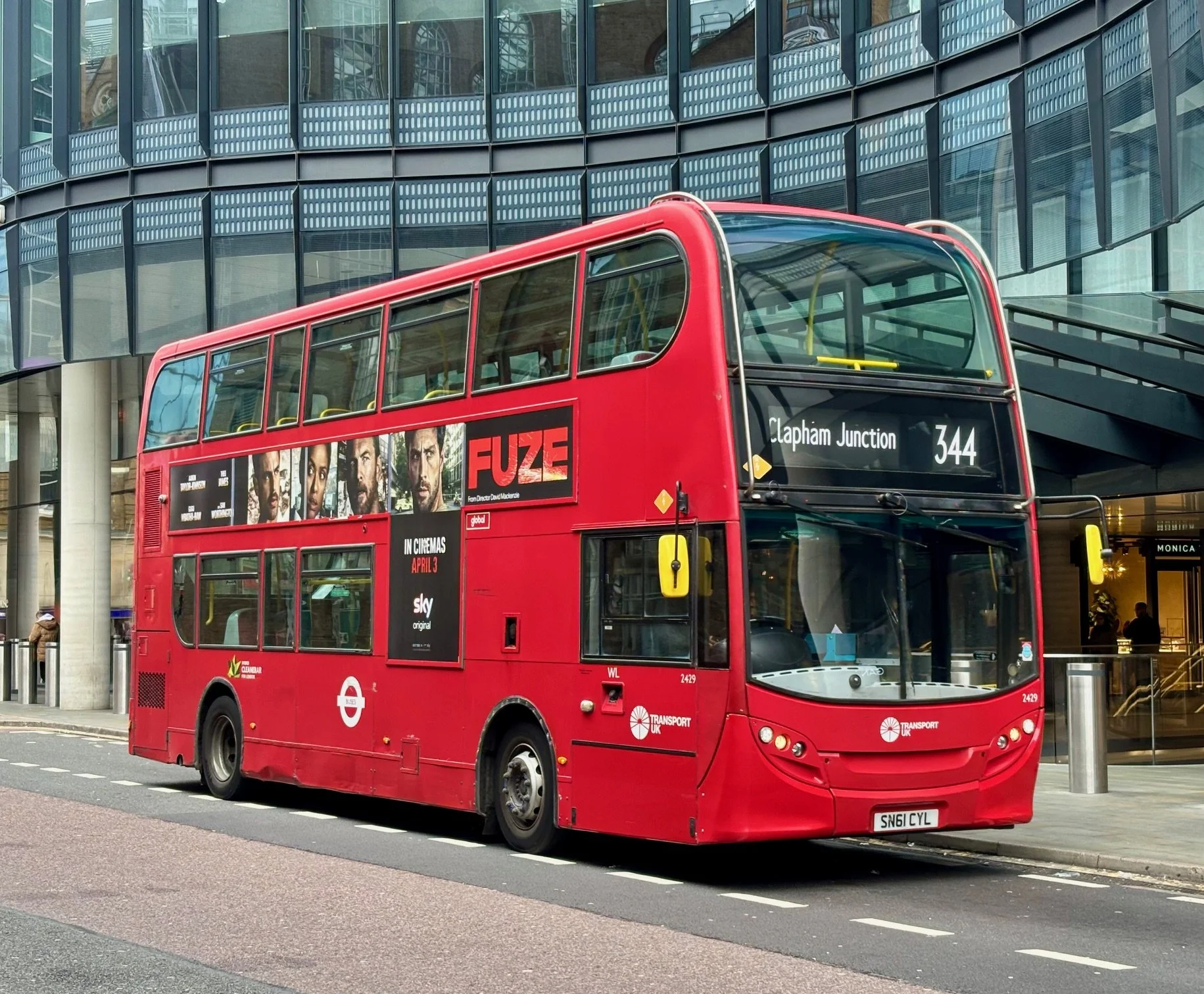
Journey’s end for me at Liverpool Street Station on the 344, where Enviro400H no 2429 (QB) has just arrived, with the blind already set for the return run to Clapham Junction.
These older vehicles are likely to be withdrawn when new electrics take over in the coming months.
After alighting from my final bus at Liverpool Street Station, I crossed the road to Hope Square. This is dedicated to the children of the Kindertransport, who found refuge in Britain having fled the Nazis in Europe just prior to WW2. I stopped briefly to read the commemorative plaque on the wall and to view the bronze statue depicting children with their luggage having just stepped off a train at the station with a short stretch of railway track behind them, completed in 2006. Around the statue are a series of blocks inscribed with the names of the cities from which the children had fled.
I then entered the main station building, descending to the concourse and entering the Underground for the journey home.
Watton
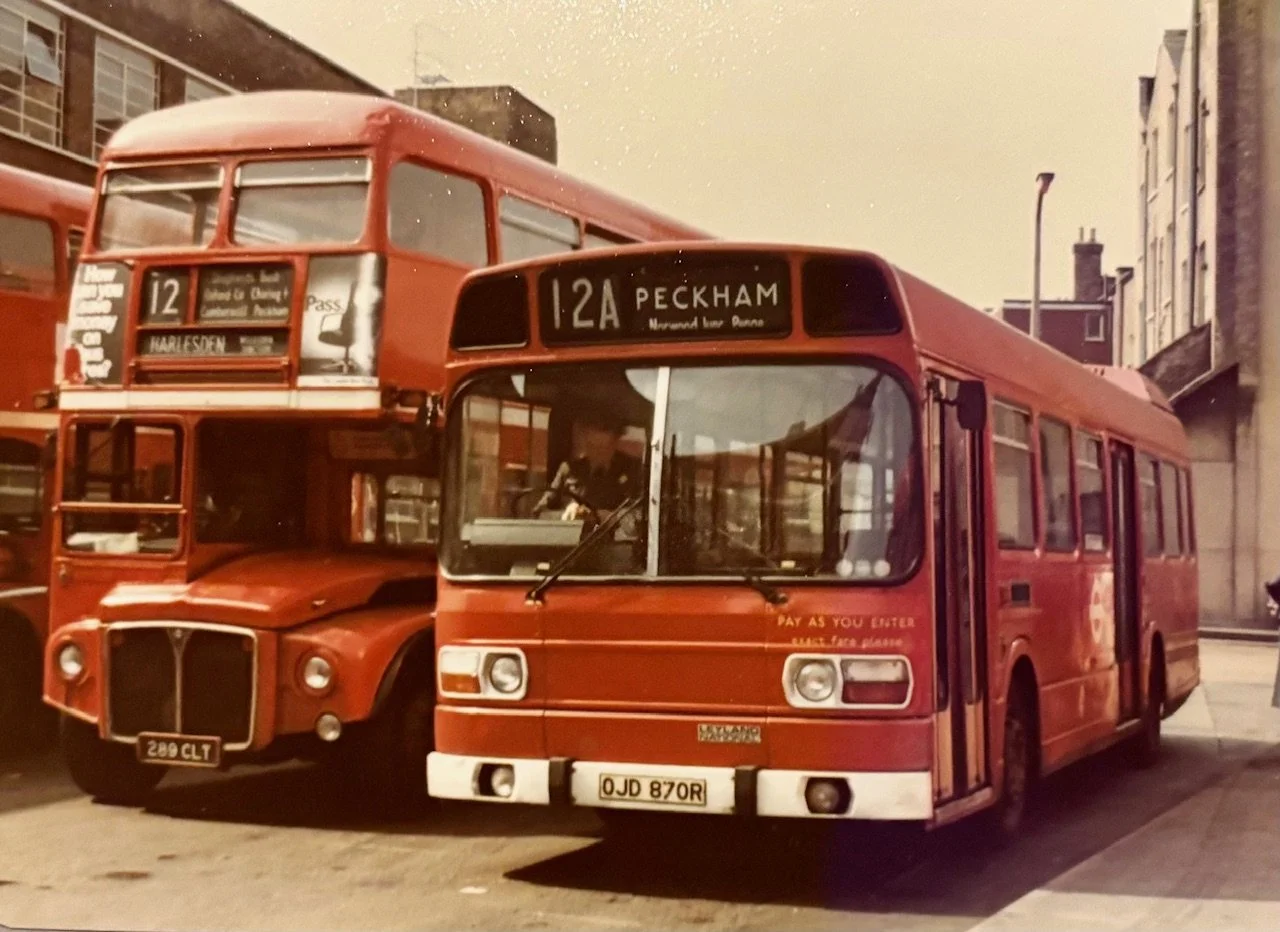
“And Finally”… A shot from 1981 showing RM1289 on the 12 and LS70 on the 12A in the forecourt of the old Peckham (PM) Garage before heading off in different directions north west and south. This was just prior to the 12A being cut back from this point to Forest Hill, although it was re-extended to Peckham again in 1986!
RM1289 was then allocated to Shepherds Bush (S) and after withdrawal from London in 1987 continued in further service with Stagecoach in Scotland. In 2003 it was bought by Aintree Coachlines as a wedding bus, with whom it continues. LS70 was then working from Elmers End (ED) Garage until transferred to Croydon (TC) in 1986 when ED closed. Withdrawn from London in 1990, it went on to see service with Black Prince of Morley and then Chase Coaches of Cannock, surviving right up until 2006/7 when it was dismantled for spares and scrapped.
