
Another String to my Bow
This time, I travel from North to Central London, then through the East End to the Bow area, before returning via The Isle of Dogs and Hackney to the outskirts of the City once again.
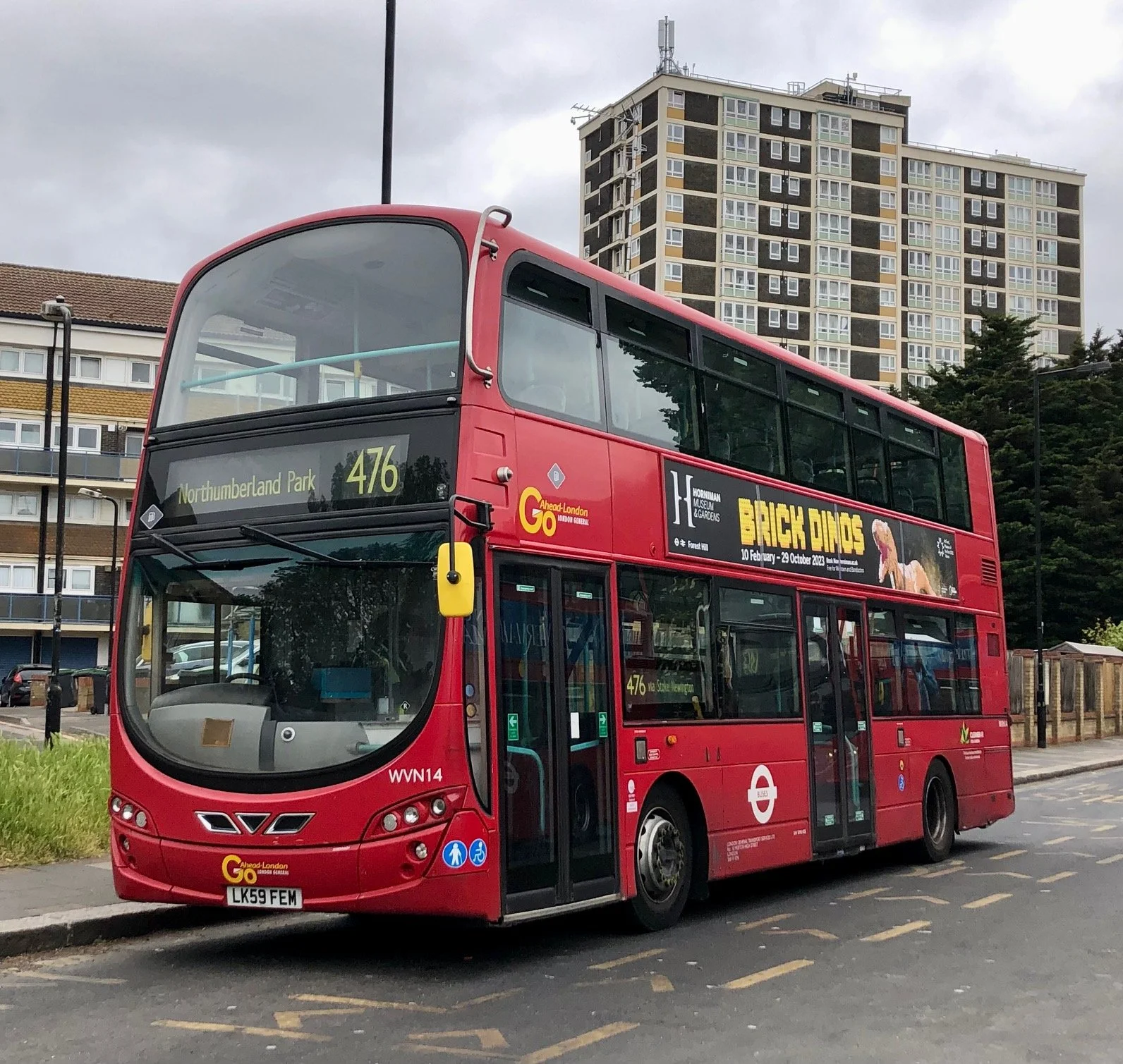
The 476 received a contract renewal with Go Ahead London from January 2024 with existing hybrids replacing its incumbent diesels. Before that happened, we see Volvo B9TL WVN14 at Northumberland Park Station back in June 2023.
This batch of vehicles was inherited from First and have largely been replaced at Northumberland Park (NP) Garage, although one or two per day still appear on the 476 at the time of writing.
Part Route 192: Tottenham Hale - Northumberland Park
By Greater Anglia train to Tottenham Hale, where I began my bus rides from the adjacent Bus Station with a short 5 min trip aboard Arriva ENN69 on the 192 a few stops to Northumberland Park at the end of the morning peak.
Route 476: Northumberland Park - King’s Cross
Crossing the railway by the footbridge, I came to the start point of my first full route of the day, the 476 to King’s Cross. Since I last travelled this route, it has been largely converted from diesel to hybrid, since Go Ahead London retained the contract last year on this basis. In the main, the allocation is a mix of EHV and MHV hybrids, and next off the blocks was MHV64, one of those transferred in to Northumberland Park (NP) Garage from Bexleyheath for the recent take up of the 144, but which also turn out on the 476 together with earlier examples already in place.
We left with a small number on board, although we soon became busier as we progressed along the route to the Tottenham High Road. Luckily, traffic was flowing well and we soon passed Tottenham Garage and ran via Seven Sisters and Stamford Hill to Stoke Newington. There must have been a gap in the 73s, which parallel the 476 from this point, as we took on a good number at most stops from here on. After circumnavigating Newington Green, we continued through Mildmay Park and on to Islington Green, passing on the way WVN15 coming in the opposite direction and one of a couple of Volvo B9TLs which still support the allocation. A bit of a queue to turn right at the Angel junction, but then it was a straight run downhill to King’s Cross, terminating in York Way beside the restored edifice designed by Lewis Cubitt and opened in 1852 for the Great Northern Railway. A reasonable 65 min run.
The 476 is quite a recent route, starting in 2003 between Northumberland Park & Euston, replacing the northern end of the 76. It was operated by First out of NP Garage with Olympians, although soon converted to low floor with VTL and VN types over the next few years. By the time GAL took over operations at NP, EN type Enviro400s were the norm, later replaced by WVN Volvo B9TLs also inherited from First. The only significant route change came in 2019 with the cut back from Euston to King’s Cross.
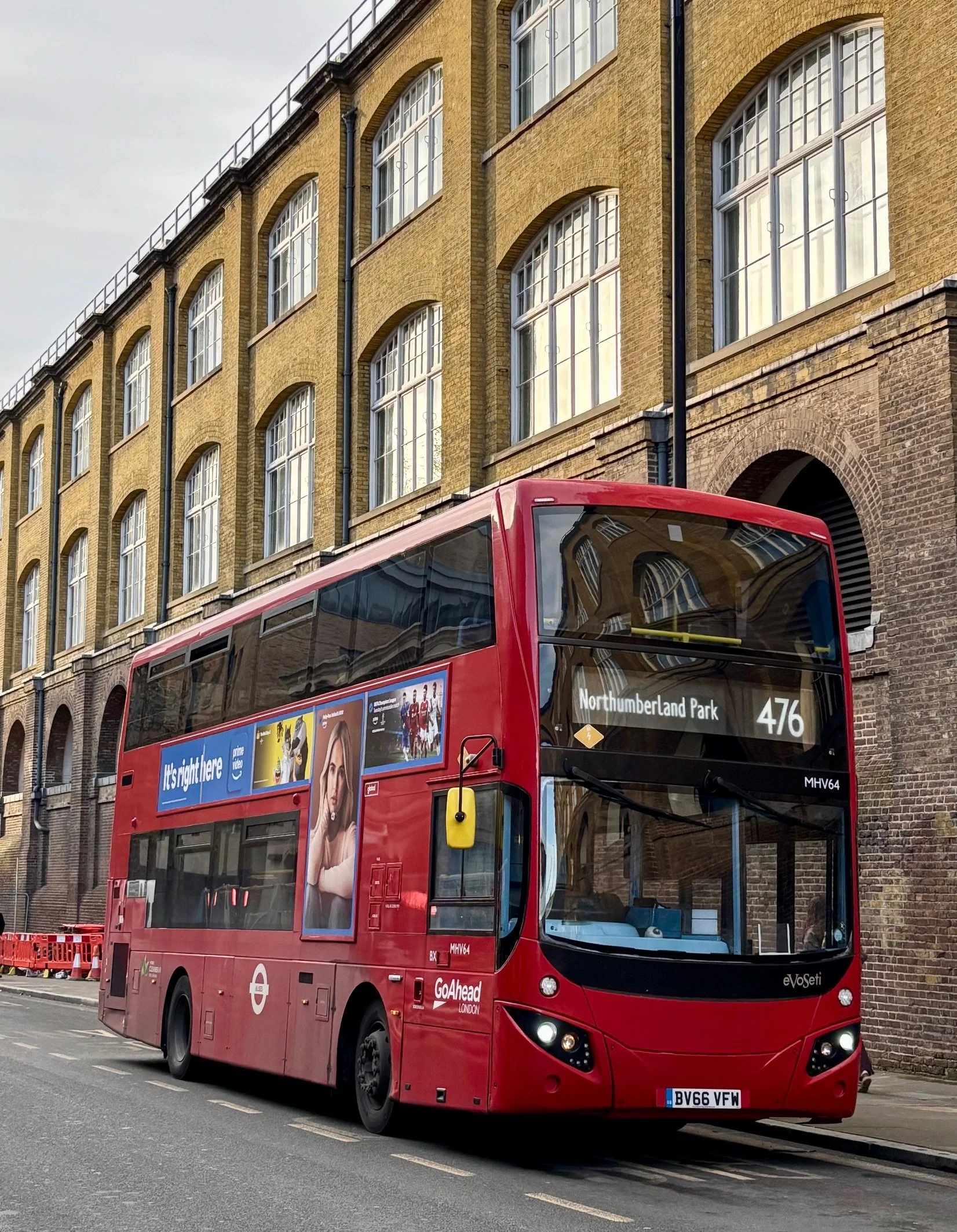
GAL Volvo B5LH MCV EvoSeti MHV64 at King’s Cross Station after my ride on the 476. The allocation is a mix of EHV and MHV hybrids in the main, although the odd Ee electric and WVN diesel is often in support.
This bus is a former Bexleyheath example, as evidenced by its “BX” garage code, transferred to NP with a few others for the recent take up of the 144, but also appearing on the 476 along with lower numbered examples that were already in place.
Part Route 205: King’s Cross - Marble Arch
Route changes in summer 2025 saw the 30 withdrawn between Euston and Marble Arch, with the 205 diverted from Paddington to Marble Arch to replace this section. As I had yet to ride the new part of the route, I joined Stagecoach Enviro400H 12315 of Bow (BW) Garage outside St Pancras Station to do just that. A straight run along the Euston and Marylebone Roads to Baker Street, then down Baker Street to Portman Square and on to the terminus at Marble Arch Station, a run of just over 20 mins.
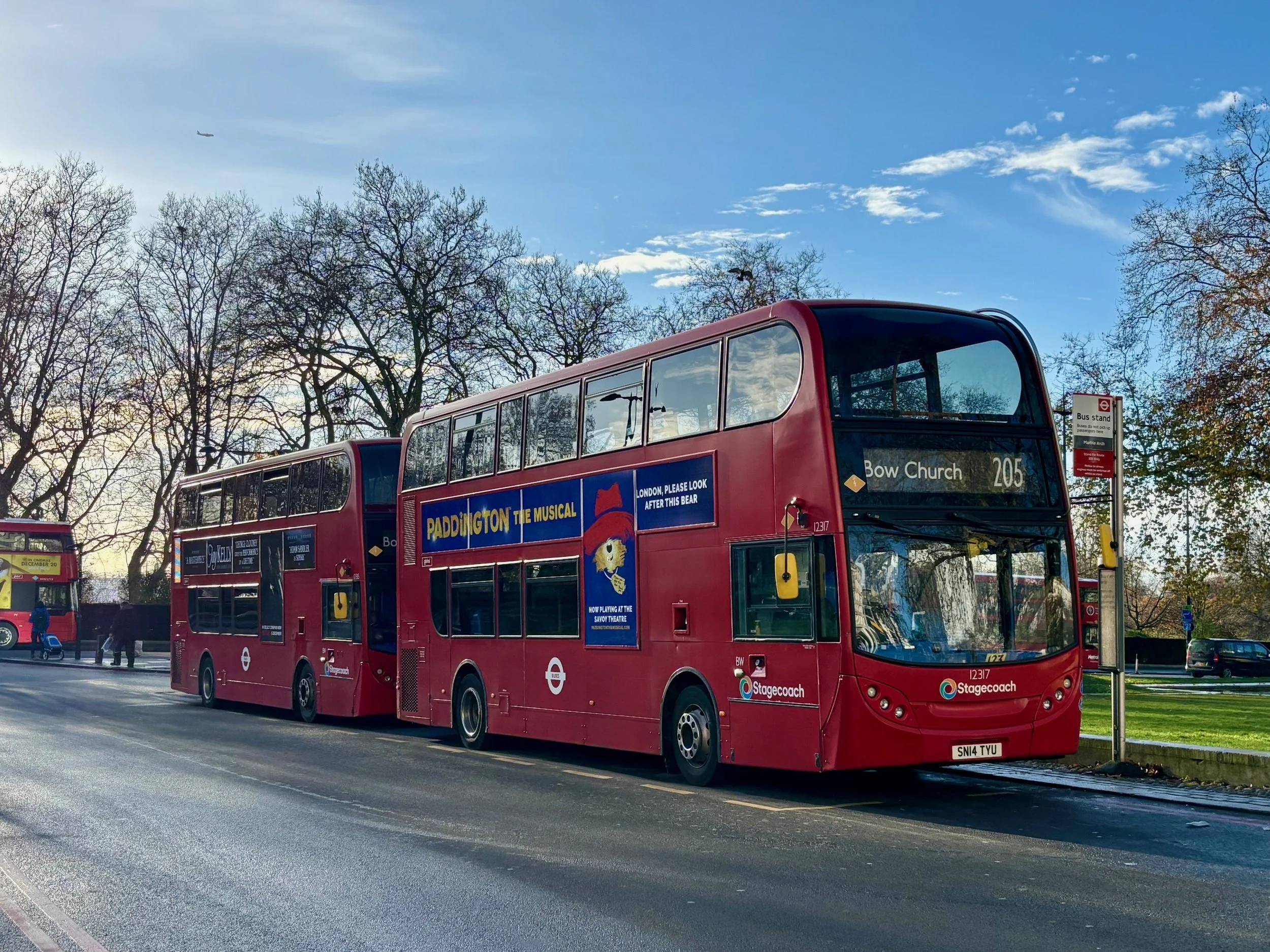
Stagecoach Enviro400H fleet no 12317 stands ahead of 12315, the latter being the one I rode, at a sunny but wintry Marble Arch terminus. The 205 was rerouted here instead of Paddington in June 2025, replacing the 30 over this section which was cut back to Euston at the same time.
Both buses are from Bow (BW) Garage but these hybrids are due to be replaced by new electrics on contract renewal in August 2026.
Route 205: Marble Arch - Bow Church
After a 15 min break, I rejoined 12315 on its next trip back to base at Bow. Not many with me on the first part of the trip, which operates via Gloucester Place up to Marylebone Old Town Hall, before continuing back past Baker Street and Madame Tussauds Waxworks Museum to Regents Park, Great Portland St Station and Warren Street, where roadworks were in evidence but didn’t delay us. The rerouteing has severed the direct bus link between the various main line stations served and Paddington, but although the Elizabeth Line now provides a convenient and quicker step-free route between Paddington and Liverpool Street, the same cannot be said for the other stations, although the 27 covers much of the western section.
After calling at Euston, St Pancras and King’s Cross Stations, we made our way back up to the Angel Islington, with a long queue up to the lights there due to one lane being closed on the approach, costing a few minutes. Once past this, we made better time along the City Road, passing “The Eagle” pub, made famous by the old song “Pop Goes the Weasel”. At Old Street, we swung left to reach Shoreditch, before turning south towards Liverpool Street, where many alighted. A quieter run down to Aldgate then into the East End through Whitechapel, passing another well known hostelry, “The Blind Beggar”, where Ronnie Kray infamously murdered George Cornell in 1966, which led to Kray’s imprisonment. Onwards through Stepney to Mile End, finally reaching Bow Road and terminating just short of Bow Church, close to the operational garage in Fairfield Road. 1h20m in total, around 5 mins late.
Route number 205 has been reused several times over the years:
Version 1 - Probably the most well known incarnation, operating for many years between Hammond St and Chingford, but reduced to a Sunday only route in 1963 between Flamstead End and Chingford at the time of various route changes in the Waltham Cross area. Further changes in 1968 saw Upshire replace Chingford as the eastern destination. RT operated until the end, it was withdrawn in 1976, replaced by daily operations on the 217 and 279. There was also a 205A variant, running between Hammond St and Epping Forest Wake Arms on Sundays only from 1961 to 1976, with projections to Loughton Garage from 1971 onwards when that replaced Enfield as the operational base. Another RT route throughout its life.
Version 2 - A short route between Mill Hill Broadway and Colindale via the then new Grahame Park Estate, from 1980-81, using 1 SMS initially then 1 M. Replaced subsequently by other more frequent routes.
Version 3 - Began as a new route between Willesden Garage and St Raphael’s Estate in 1984 with M, but rerouted the following year to run between Park Royal ASDA and St Raphael’s / Wembley, with DT / DW Darts replacing Ms in the early 90s. Withdrawn in 1995 when it was replaced by the PR2.
Version 4 - The current route, beginning in 2002 between Paddington and Whitechapel, specifically to link many of the main line stations. Metroline were the first operator with TP types plus the odd SEL, out of Perivale (PV) Garage. It was extended to Mile End in 2007 and further to Bow in 2009 when Stagecoach took over the route. Scania Omnicities were the first type in this era, later replaced by Enviro400 hybrids. The route has been retained on retender from late 2026 with new electrics intended eventually.
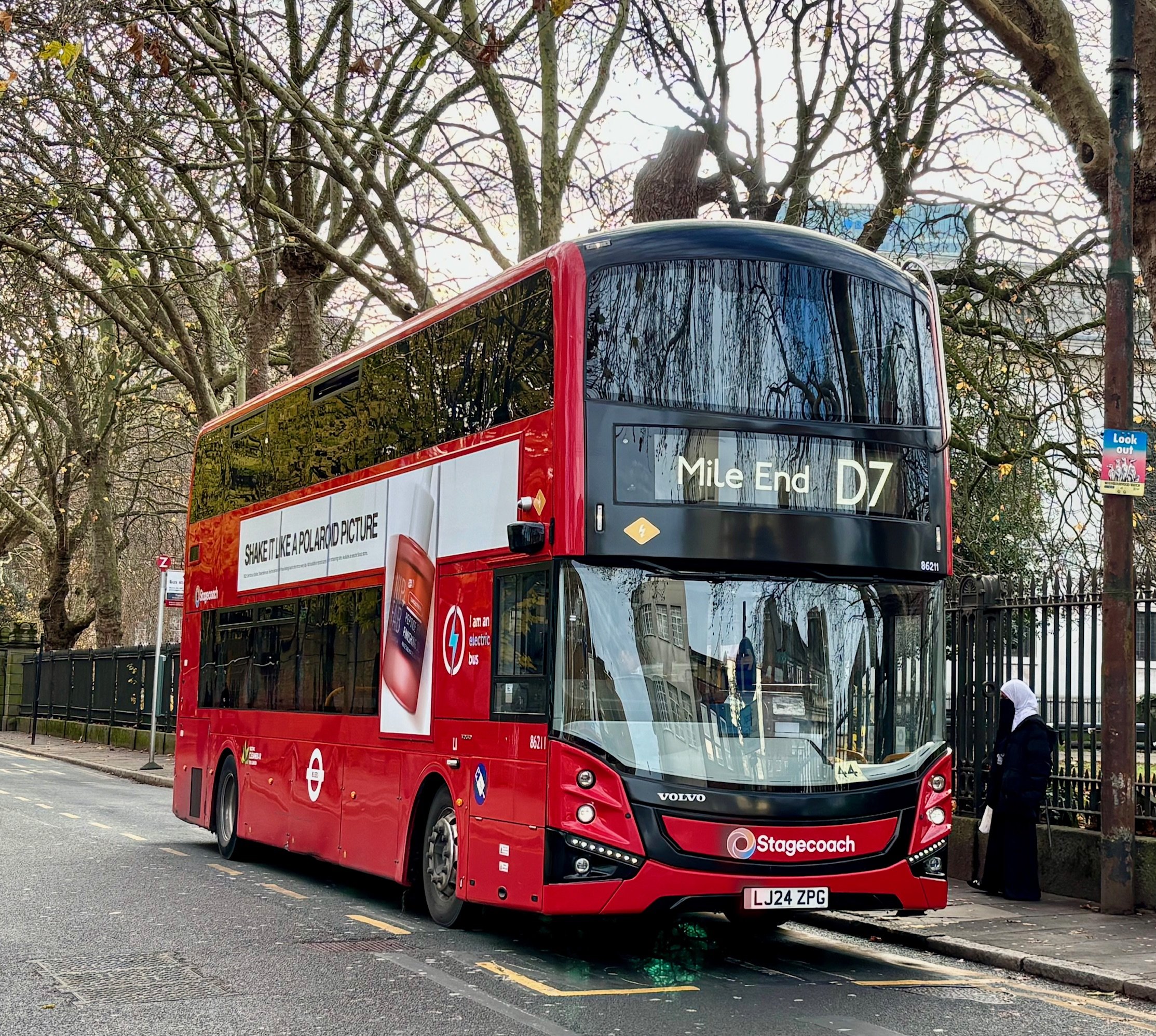
Stagecoach London Volvo BZL MCV EV 86211 of Ash Grove (HK) Garage at Poplar on the D7 before my trip aboard to Mile End.
The route is currently operated by a mix of this type and Wright StreetDeck Electroliners.
Part Route 108: Bow Church - Poplar
At Bow Church, I hopped on GAL SEe20 of New Cross (NX) Garage on the 108 for the short trip through the back streets to Poplar, which took just over 10 mins.
Route D7: Poplar - Mile End
My last trip on the D7 was a couple of years ago, when Stagecoach had just taken over the contract from Go Ahead. At that time, a temporary diesel allocation of spare Enviro400s had been amassed at Ash Grove (HK) Garage, pending the arrival of the intended new electrics. Since then, the new buses have arrived and been placed in service, so I took the opportunity to sample the latest offering whilst in the area.
The route is now a mix of Wright StreetDeck Electroliners and Volvo BZL MCV EVs, with one of the latter, fleet no 86211, being on stand and the next to depart from Poplar All Saints Church. Both types feature all the expected modern interior features, including TfL style moquette with headrests on the seats. The previous working had departed late on the 12 min frequency and had taken most of the waiting customers along the route, so we only had a small number aboard as we progressed at a gentle pace. Soon we were on Prestons Road and entering the Isle of Dogs, of which there are several theories as to how it got its name, the most popular being that royal hunting dogs were kept there during the time of King Henry VIII.
Ambling around the perimeter of the island, never far from the River Thames, we eventually caught up with the bus in front and overtook. Reaching Canary Wharf, we were around 5 mins early, earning an admonishment from the Controller and a 5 min pause to await correct time. Not really the driver’s fault though, as we had hardly been rushing along and the previous bus being 7 mins or so late was clearing passengers after the extended gap. From Canary Wharf, we had an equally easy run via Limehouse up to Mile End, where we terminated close to the station after a 35 min trip on this short local (net of the 5 min enforced wait).
The D7 started in 1989 between Mile End & Poplar, replacing part of the 277, which was withdrawn between Limehouse & Poplar. Initially, this was just on M-S, with the 277 continuing over the full route on Suns, but the D7 became daily from 1993. For a short time in 1991-92, alternate journeys were diverted to Crossharbour ASDA instead of Poplar during M-S shopping hours.
East London were the initial operator with Titans, although the Sunday service used DRL Darts when introduced. First assumed the contract in 1999 using DML single deckers with a couple of double deck workings at peak times, although inadequacies in capacity saw a top deck restored at all times in 2003 using TN type Tridents. Go Ahead became the third operator on contract change in 2011 using WVLs, which lasted until the current era with Stagecoach from 2023.
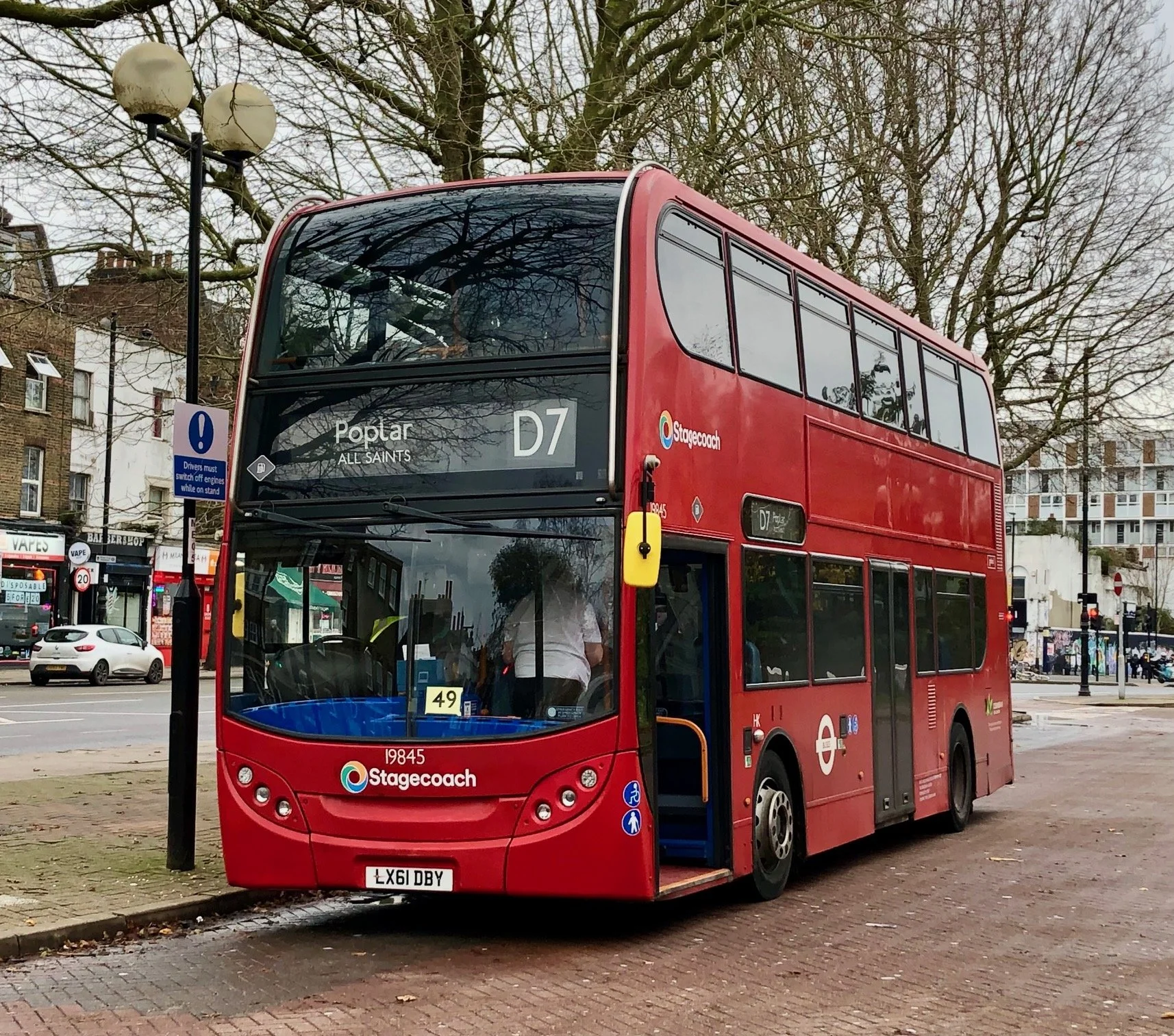
The D7 contract was taken over from GAL by Stagecoach in December 2023. Pending the delivery of the current electrics, existing diesels made spare from other garages had to suffice, like Enviro400 19845, seen at Mile End Station soon after the contract began.
Subsequently, these buses were also used on the D6, but have since departed HK Garage.
Part Route 425: Mile End - Homerton Hospital
At Mile End Station, I had only a couple of minutes wait for Stagecoach Enviro400H MMC 11374, another Bow Garage inmate, on the 425 for a positioning ride via Victoria Park and Hackney to Homerton Hospital. A 25 min run, with congestion on the final stretch due to road closures in the area causing diversions on various bus routes.
Route 242: Homerton Hospital - Aldgate
My last full route of the day was the 242, another operated by Stagecoach from Ash Grove (HK) Garage and also now operated with a mix of Wright Electroliner and Volvo BZL electric double deckers. Having sampled the latter on the D7, I chose an Electroliner for comparison purposes on this trip, 82141. Whilst both types have similar features, the Wright product does have a roomier feel inside, although there is not much to choose in terms of the acceleration and smoothness of ride.
In a repeat performance to my ride on the D7, the bus in front left late from Homerton Hospital and we soon caught it up and overtook as we looped around the Millfields Estate area of Clapton Park. A straight run up Powerscroft Road, but then we hit a traffic queue in Median Road, which took an age to get out onto the main Lower Clapton Road, one lady even getting off at one stop, walking to the next and reboarding! Long term road closures in Hackney Town Centre have caused some major diversions to buses and a great deal of congestion, in the case of the 242, necessitating a diversion via Hackney Downs Station and Dalston Lane together with the 38, rather than using Graham Road, line of route being resumed just before Dalston Junction.
A left turn onto Kingsland High Street enabled us to resume a bit of speed and we continued south via Haggerston and Hoxton to Shoreditch. Turning into Commercial Street, traffic was slow but moving and soon we reached Aldgate East Station, hanging a right to our ultimate destination at Aldgate Station. The 65 min run was more or less what the padded schedule allowed, so in line with expectations.
The 242 is unusual in that the number was given to a new route whilst still being in use for the traditional service between Potters Bar and Waltham Cross, although as the latter was a commercial / HCC route entirely in Hertfordshire and not part of the TfL network, it was considered to be a vacant number in the London sequence and hence could be re-used by TfL.
The TfL version of the 242 replaced most of the former 22A and 22B routes in 1998, running between Homerton Hospital and Tottenham Court Road, operated by Arriva. Olympians served at first, but the route became one of the first in London to use low floor double deckers after just a few months, with the introduction of DLAs. By the 2010s, DW and T types replaced the DLAs, whilst the route itself was cut back to St Paul’s at the Central London end in 2017, then diverted to Aldgate two years later to cover a withdrawn section of the 67. Conversion to HV class hybrids came around this time. Stagecoach won the contract from Arriva in February 2024, using Enviro400 hybrids at first, both “classic” and MMC versions, until the arrival of the new electrics during 2025.
Alighting at the last stop of the 242 at Aldgate, I simply had to cross the road to the Underground Station for the journey home.
Watton
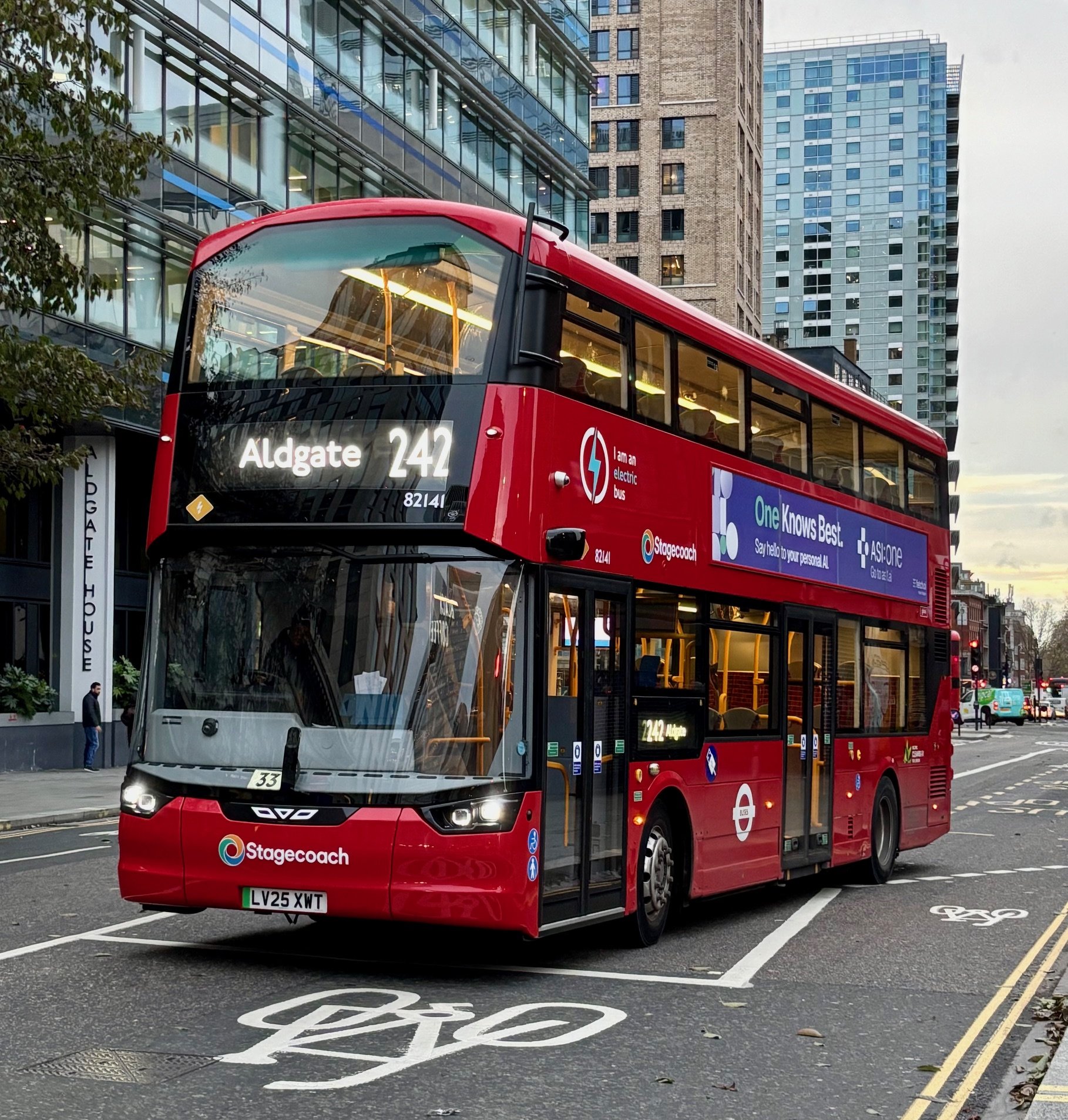
Lights ablaze, new Stagecoach Wright StreetDeck Electroliner 82141 of HK Garage pulls away from the last stop at Aldgate Station on the 242 after my journey from Homerton.
Stagecoach assumed the route from Arriva in February 2024 and initially used hybrids until electrics were available. Like the D7, a mix of Electroliners and Volvo BZL types now operates.
